
Consulting Services Market Analysis by Mordor Intelligence
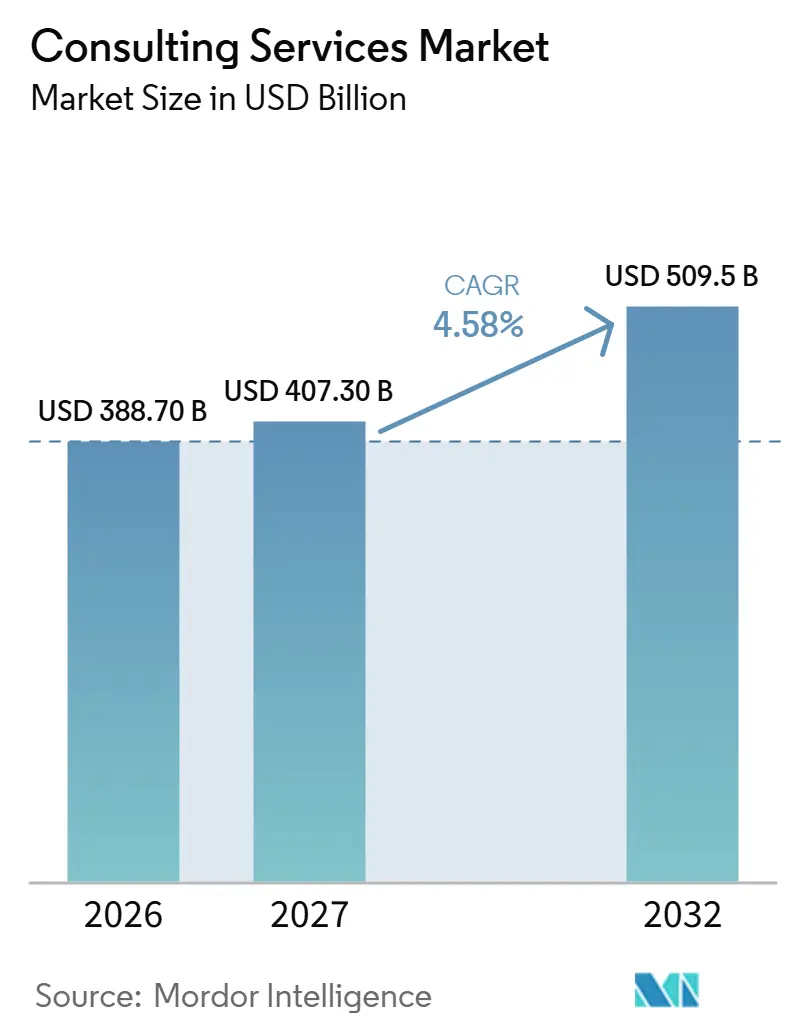
The consulting services market size is estimated at USD 388.7 billion in 2026 and is projected to be USD 407.3 billion in 2027, reaching USD 509.5 billion by 2032, growing at a CAGR of 4.58% from 2027 to 2032.
Digital transformation and cloud adoption expand the potential for advice connecting technology design with operating responsibilities, including banking compliance in the United States. The Iran conflict, triggered by U.S. and Israeli strikes in Iran on February 28, 2026, prompted Gulf buyers to consider shifting consulting work toward cybersecurity and digital defenses. Client scrutiny of consulting fees and competition for specialist skills can constrain providers’ ability to convert these needs into profitable work. AI-enabled productivity also exposes some services to pricing pressure, increasing the importance of specialist judgment in assurance engagements.
Key Report Takeaways
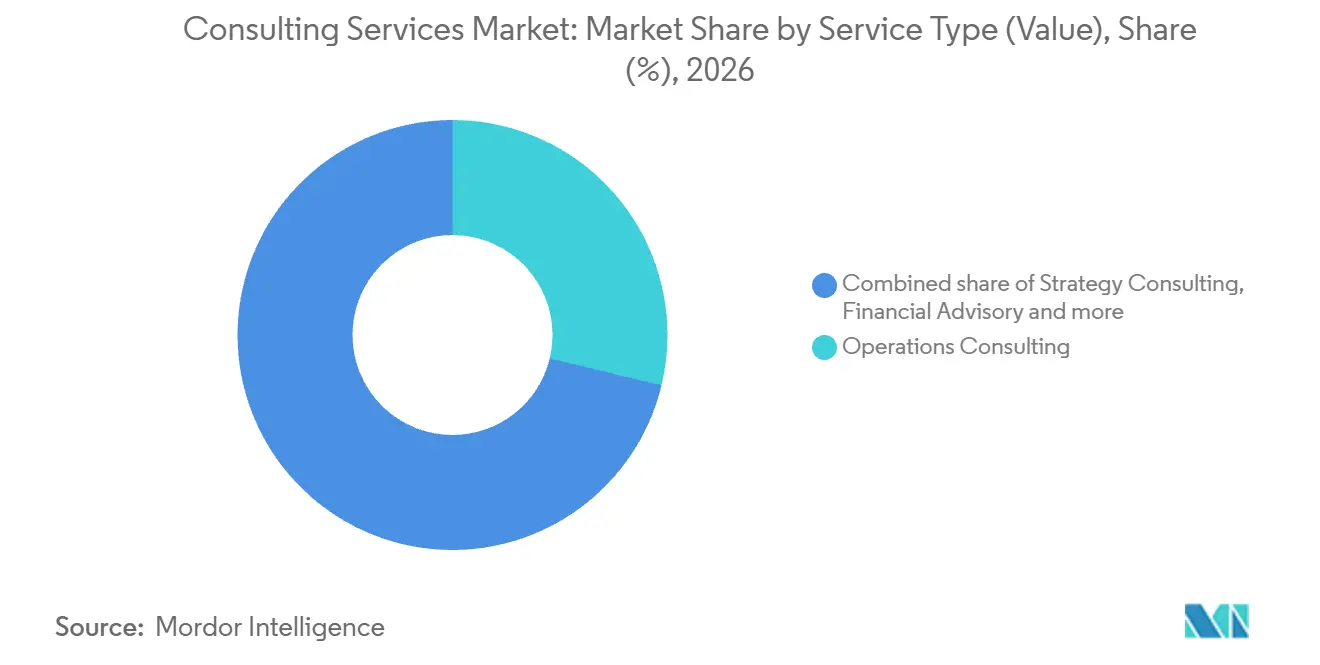
- By service type, operations consulting held a 28.76% consulting services market share in 2026, while technology advisory is the fastest-growing segment with a 6.12% CAGR forecast from 2027 to 2032.
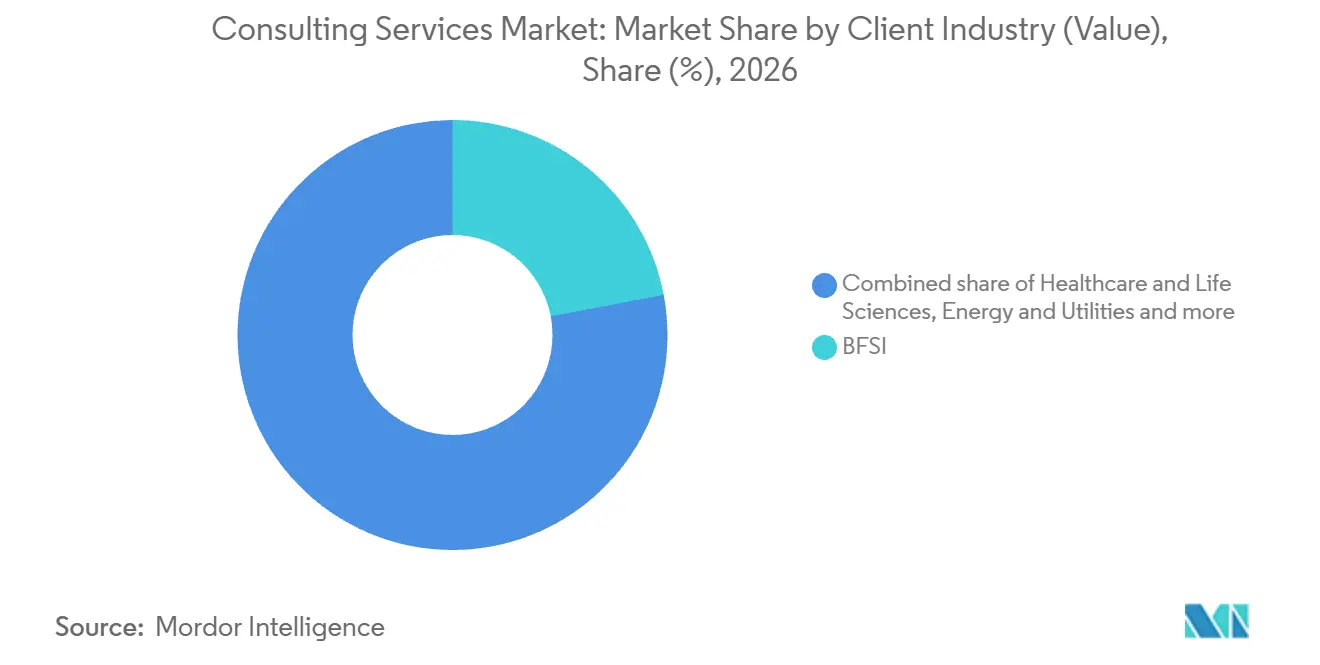
- Within client industries, BFSI accounted for a 22.01% share of the consulting services market size in 2026, while healthcare and life sciences is the fastest-growing segment with a 6.4% CAGR forecast from 2027 to 2032.
- In delivery models, remote / virtual consulting is the fastest-growing segment with a 5.75% CAGR forecast from 2027 to 2032, although on-site consulting led with 63.16% of consulting spending in 2026.
- Among organization sizes, small and medium-sized enterprises are the fastest-growing segment with a 6.5% CAGR forecast from 2027 to 2032, whereas large enterprises held 70.01% of consulting spending in 2026.
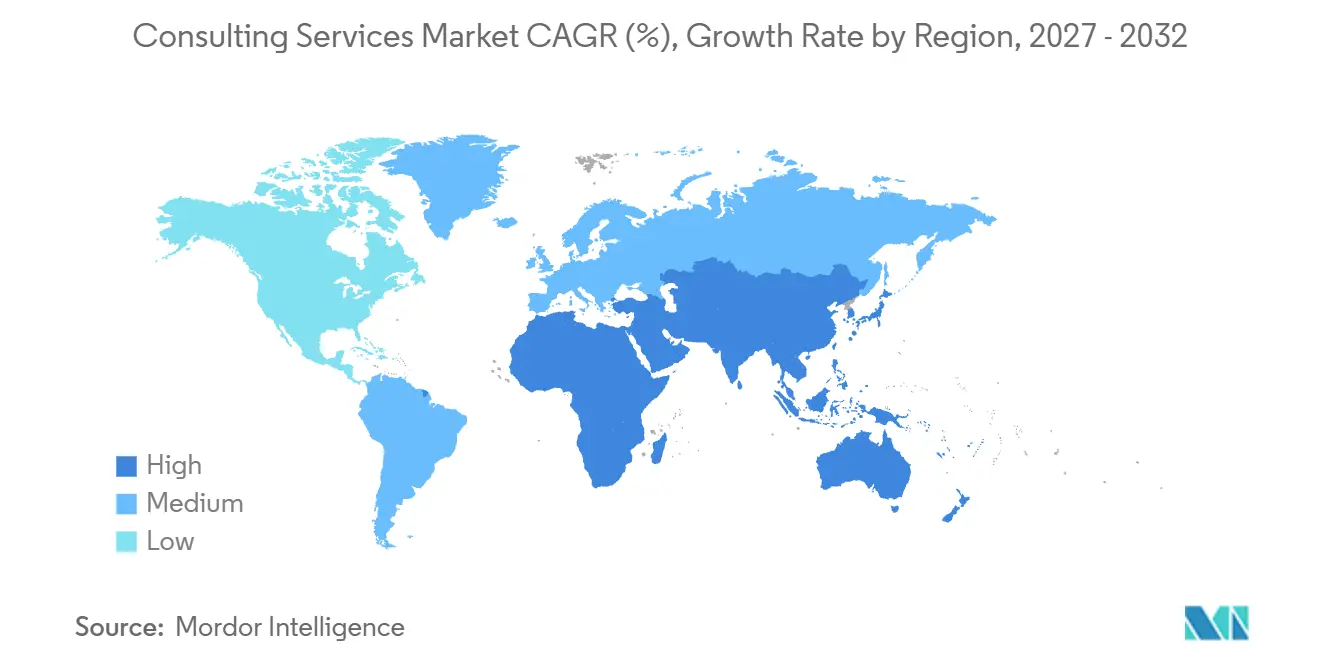
- Across geographies, North America led with 40.22% of consulting spending in 2026, and Asia-Pacific (APAC) is the fastest-growing region with a 6.2% CAGR forecast from 2027 to 2032.
Note: Market numbers in this report are based on Mordor Intelligence's proprietary estimation framework, which combines nine months of actuals with Q4 projections for base year 2026.
Market Trends and Insights
Drivers Impact Analysis of Consulting Services Market*
| Driver | (~) % Impact on CAGR Forecast | Geographic Relevance | Impact Timeline |
|---|---|---|---|
| Mainstream - Accelerating digital-transformation mandates | +1.8% | United States, India and Germany | Medium term (2-4 years) |
| Mainstream - Heightened post-pandemic operational-efficiency focus | +1.4% | Europe, including Germany | Short term (≤ 2 years) |
| Mainstream - Growing regulatory complexity in ESG and risk | +1.1% | The European Union | Short term (≤ 2 years) |
| Mainstream - Rapid cloud and cybersecurity adoption | +1.5% | The European Union | Medium term (2-4 years) |
| Under-the-radar - Demand for advisory on Gen-AI governance | +0.6% | The United Kingdom | Short term (≤ 2 years) |
| Under-the-radar - Board-level pressure for Scope-3 value-chain decarbonization | +0.4% | North America, Europe and Asia-Pacific | Long term (≥ 4 years) |
| Source: Mordor Intelligence | |||
Mainstream - Accelerating digital-transformation mandates
TEKsystems surveyed 782 technology and business decision-makers across 12 countries, including the United States, India and Germany, online in October and November 2025. The share of organizations planning to commit more than USD 10 million to digital transformation rose from 22% in 2025 to 27% in 2026.[1] For advisers, this expansion in large planned programs creates an opportunity to connect technology choices with the organizational changes needed to use them. An engagement can establish which business processes should change first and how subsequent technology work depends on those decisions. The rise of 5 percentage points in organizations planning commitments above USD 10 million widens the potential pool for scoping work before technology purchasing starts.
Mainstream - Heightened post-pandemic operational-efficiency focus
In Deloitte’s March to April 2026 survey of CFOs in 12 European countries, cost reduction ranked among the top 3 priorities in every surveyed country.[2] In Germany, efficiency programs, supply-chain resilience initiatives and production-related projects sustained operations-consulting demand in 2025, when the segment grew 0.7%. Together, these findings distinguish a broad management priority from a specific advisory workload that survived restrained spending. Consultants can connect cost objectives to changes in production processes and supply-chain design, giving an efficiency engagement a defined operational purpose. That support did not fully offset German clients’ restraint in marketing, sales and organizational projects, making efficiency demand a cushion for advisers rather than a broad spending recovery.
Mainstream - Growing regulatory complexity in ESG and risk
Regulatory advice gains value when a company must translate disclosure and risk duties into responsibilities across subsidiaries and suppliers. In February 2026, the IFRS Foundation reported that sustainability disclosure requirements related to the International Sustainability Standards Board (ISSB) had come into effect in 19 jurisdictions.[3] From January 17, 2025, the Digital Operational Resilience Act (DORA) required in-scope EU financial entities to maintain registers of contractual arrangements with ICT third-party service providers. These registers cover entity, sub-consolidated and consolidated levels. The combined advisory task extends beyond interpreting a rule to connecting its coverage with the contracts, organizational boundaries and disclosures that give it operational meaning. Register maintenance can support continuing advisory work after initial rule interpretation, as entity-level changes need to be reflected in the consolidated view.
Mainstream - Rapid cloud and cybersecurity adoption
Widespread cloud use creates an advisory opening around computing responsibilities and the security controls surrounding them. In surveyed EU industry sectors, 52.74% of enterprises with at least 10 employees or self-employed persons used paid cloud services in 2025. Cloud security software applications were used by 34.54% of the same surveyed enterprise population. An advisory engagement can divide security responsibilities between the client and cloud provider, translating the selected environment and applications into an operating control design. This creates a fee opportunity for architectural expertise alongside platform supply, including for specialists that do not own cloud infrastructure.
Restraints Impact Analysis of Consulting Services Market*
| Restraint | (~) % Impact on CAGR Forecast | Geographic Relevance | Impact Timeline |
|---|---|---|---|
| Mainstream - Client cost-cutting and in-house capability build | -1.1% | United States and United Kingdom | Short term (≤ 2 years) |
| Mainstream - Talent scarcity and wage inflation | -0.7% | Europe and North America | Medium term (2-4 years) |
| Under-the-radar - Rising carbon-footprint scrutiny of travel-heavy projects | -0.2% | The United States | Short term (≤ 2 years) |
| Under-the-radar - Vendor-lock-in concerns around proprietary consulting assets | -0.2% | The United States | Medium term (2-4 years) |
| Source: Mordor Intelligence | |||
Mainstream - Client cost-cutting and in-house capability build
In April 2025, the U.S. Defense Department ordered termination of several IT-services contracts, including Defense Health Agency consulting work it said its civilian workforce could perform. In Grant Thornton’s Q2 2026 CFO survey, 44% of respondents identified external professional consulting support and fees as a top area for potential cuts. By June 2025, the UK Ministry of Housing, Communities and Local Government (MHCLG) reported that its consultancy use had fallen 50% since 2023-24. Separately, its June 2025 plan proposed in-house support for digital methods in policy design and delivery to replace contractors. The proposal aimed to retain learning and experience within permanent staff. Retaining expertise in digital methods for policy work internally could reduce repeat contractor assignments beyond the initial cost-cutting period.
Mainstream - Talent scarcity and wage inflation
Specialist capacity and payroll costs impose different constraints on the economics of consulting delivery. Accenture’s FY2026 report identified competition for scarce new-technology skills across its global business. It warned that failure to match employee skills with client demand could materially harm utilization and operating results. In January 2026, Germany’s Bundesverband Deutscher Unternehmensberatungen (BDU) reported that 55% of surveyed German consulting firms planned 2026 salary increases, averaging 3.1% across consulting levels. Adding general capacity would not by itself resolve a specialist mismatch, while higher compensation would increase the cost of the hours delivered. For specialist-dependent assignments, a skills mismatch can turn planned demand into work a provider cannot staff at the required time.
*Our forecasts treat driver/restraint impacts as directional, not additive. The impact forecasts reflect baseline growth, mix effects, and variable interactions.
Consulting Services Market Segment Analysis
By Service Type (Value):
Operations Scale and Technology DeploymentOperations consulting accounted for a 28.76% share of the consulting services market size in 2026. National Records of Scotland awarded Deloitte LLP a contract concluded on July 17, 2025, for service redesign, process reengineering and operating-model work. Its scope included process mapping and target operating models for major programs. That combination connects the diagnosis of individual workflows with the responsibilities and organizational structure needed to carry out a broader program. Linking process maps to a target operating model can expand an operations contract into decisions about who will run the redesigned service.
Technology advisory is the fastest-growing segment, with a 6.12% CAGR forecast from 2027 to 2032. The Management Consultancies Association’s 2026 report identified digital and technology consulting as the UK sector’s most in-demand offerings. The association linked that demand to rapid AI scaling and the embedding of new technologies across core business functions. Embedding AI within a function makes the relationship between technical design and everyday use commercially significant, because the recommendation must work within the client’s business. This makes the breadth of AI rollout across core functions a more useful indicator of potential advisory scope than the decision to adopt AI alone.



By Client Industry (Value):
Financial Oversight and Reimbursement ExpertiseBFSI represented a 22.01% consulting services market share in 2026. The Office of the Comptroller of the Currency (OCC) ordered Community Federal Savings Bank on April 24, 2026, to submit consultant contracts and work plans for an end-to-end Bank Secrecy Act and anti-money-laundering program review. Submission is required within action-plan time periods for which the OCC’s Assistant Deputy Comptroller provides no supervisory objection. The review must identify program deficiencies and assess whether the program fits the bank’s size, complexity and risk profile. That requirement creates a defined opportunity for external specialists, because internal program improvements alone would not satisfy the ordered third-party assessment.
Healthcare and life sciences is the fastest-growing segment, with a 6.4% CAGR forecast from 2027 to 2032. In October 2025, NYC Health + Hospitals authorized the execution of contracts with 4 firms for Medicare and Medicaid reimbursement consulting. Its board cited complex, changing rules and the need for timely, accurate reporting to avoid penalties and secure proper reimbursement. Advice on rate analysis, appeals and fiscal submissions connects specialist knowledge with the information used to determine the healthcare system’s reimbursement. The board’s reference to penalties alongside reimbursement shows the authorized work serving compliance protection as well as revenue recovery.

By Delivery Model (Value):
Site Access and Remote Technical WorkOn-site consulting held 63.16% of consulting spending in 2026, making it the largest segment. On April 30, 2025, MAG Airport Limited awarded a strategic-change consulting framework allowing supplier resources to work at its 4 airports or other MAG group-managed locations, remotely or both. Its work packages could use suppliers’ specialist resources to deliver outcomes specified by MAG. Placing specialists in the client’s operating setting can connect their recommendations with the people responsible for a particular change, making location a functional delivery choice. A framework permitting both settings makes site access an assignment-level capability, allowing suppliers to match deployment to each work package.
Remote / virtual consulting is the fastest-growing segment, with a 5.75% CAGR forecast from 2027 to 2032. On March 13, 2025, Sauk County, Wisconsin, authorized entry into a contract with Esri for up to 20 hours of remote ArcGIS Enterprise upgrade consulting. The quoted upgrade covered version 10.9.1 to 11.3 or newer and was limited to Esri commercial off-the-shelf software. That technical boundary makes the task suitable for a limited specialist engagement, because the proposal defines both the software and the supported upgrade. The quoted USD 7,720 ceiling turns remote upgrade advice into a separately bounded commitment for the county.
By Organization Size (Value):
Enterprise Relationships and Smaller Buyer ChannelsLarge enterprises accounted for 70.01% of consulting spending in 2026, making them the largest segment. In fiscal 2026, Accenture served more than 9,000 clients across its consulting, managed services, platforms and software business, including approximately 3 in 4 companies in the Fortune Global 100 and 500. This reach places advisory capability alongside managed services and software within relationships with many of the world’s largest companies. The potential fee advantage lies in converting existing access into a specialist consulting mandate while keeping that mandate distinct from the wider service portfolio.
Small and medium-sized enterprises are the fastest-growing segment, with a 6.5% CAGR forecast from 2027 to 2032. In the UK’s 2025 survey of private-sector employers with 1 to 249 employees, 44% of medium-sized and 41% of small businesses seeking external advice consulted consultants or general business advisers. Among micro businesses seeking that advice, the share was 28%. The lower micro-business use suggests that consultant-led advice has a different channel position even among firms already looking outside for help. A size-tiered offering could prioritize direct specialist engagements for small and medium-sized advice seekers while testing different entry channels for micro businesses.
Geography Analysis
North America Consulting Services Market
North America accounted for 40.22% of the consulting services market size in 2026. U.S. employer firms in management, scientific and technical consulting recorded USD 226.5 billion in nominal, seasonally unadjusted first-half 2026 revenue, up 4.2% from first-half 2025. However, in February 2025, USAID terminated a Deloitte contract that provided for accountability oversight of direct budget support and technical assistance to Ukraine. The agency rescinded a stop-work order for a separate KPMG contract in March 2025. The broad U.S. consulting-category revenue base supports supplier scale even when individual federal mandates are interrupted.
Asia-Pacific (APAC) Consulting Services Market
Asia-Pacific (APAC) is the fastest-growing region, with a 6.2% CAGR forecast from 2027 to 2032. Accenture reported growth in its Asia Pacific consulting revenue in fiscal 2026 compared with fiscal 2025, measured in local currency. In December 2025, the Asian Development Bank approved a 3-year technical-assistance project to help Cambodia’s government develop an integrated e-procurement system, building on multiyear analytical and advisory work. Linking that system with the national financial-management network can generate phased advisory tasks around interfaces and operating responsibilities, extending potential consulting work from initial analysis toward implementation decisions.
In South America, EY’s 2025 Brazil survey of 207 leaders and CEOs found that 34% prioritized operational improvement, productivity and cost reduction over the following 3 years, favoring an efficiency-led advisory proposition. In Europe, German public authorities and regulated industries were among the main drivers of consulting demand in 2025, supporting specialist work tied to institutional responsibilities. In March 2026, 48% of surveyed Gulf companies were considering shifting consulting work toward cybersecurity and digital defenses amid the Iran conflict, The National reported. In Southern Africa, the Southern African Development Community awarded individual consultant Charles Chaitezvi a 6-month assignment starting February 1, 2026, for Simplified Trade Regime sensitization, capacity building and implementation support. A 6-month term held by one named expert shows the buyer sourcing implementation support for a trade regime without engaging a consulting firm.
Regional Editions
Regulatory Framework and Outlook
The comparison examines selected jurisdictions from the perspective of consulting providers seeking public-sector contracts. U.S. federal service procurement requires performance-based methods to the maximum extent practicable, subject to specified exceptions. The UK Procurement Act 2023 changed covered public procurement rules on February 24, 2025, with a stated aim of streamlining the process for suppliers. The commercial comparison turns on how clearly suppliers can define outcomes, demonstrate relevant expertise and fit the buyer’s procurement framework.
Regulatory Table of Consulting Services Market
| Decision factor | United States | Brazil | United Kingdom |
|---|---|---|---|
| Primary authority | Federal contracting agencies; FAR Council issues the framework | Public contracting authorities | Cabinet Office Procurement Compliance & Oversight within its remit |
| Key instruments or direction | FAR Part 37; performance-based methods required to the maximum extent practicable, subject to exceptions | Law 14.133/2021, Article 74(III); predominantly intellectual technical services by providers with notable expertise | Procurement Act 2023 for covered purchases; rules changed February 24, 2025 |
| Commercial effect | Favors service proposals with defined performance outcomes | Direct contracting requires infeasible competition and essential, suitable specialist work; advertising and publicity are excluded | Stated streamlining aim; compliance oversight operates within the covered remit |
| Current policy attractiveness | Medium | Medium | Medium |
| Future direction of policy attractiveness | No change | No change | No change |
| Source: Mordor Intelligence | |||
U.S. performance-based preferences favor clearly specified outcomes, and the June 23, 2026, Part 37 proposal describes no substantive policy change, supporting continuity for advisory suppliers. Brazil’s conditional route favors providers able to substantiate essential specialist expertise, supporting a neutral assessment of access under the operative law. The UK Act’s supplier-facing streamlining aim is balanced by the need to work within the covered procurement and oversight regime. Its operating Procurement Compliance & Oversight function supports continued Act implementation, with separate oversight routes for devolved arrangements.
Value Chain Stages
Consulting value capture can be compared across strategic framing, process design, technology integration and workforce adoption. Accenture delivers strategy, process, operating-model, change-management, talent, data, technology and AI capabilities through consulting, managed services, platforms and software. A provider spanning several stages can address related client decisions, making the handoff between recommendations and execution commercially important. The fee opportunity changes with the work performed, from defining an intervention to supporting its implementation and organizational adoption.
Value Chain Analysis Table of Consulting Services Market
| Primary activity | Key participants | Value capture | Bottleneck | Resilience response |
|---|---|---|---|---|
| Strategic framing and diagnosis | Strategy advisers such as Accenture plc and Deloitte US | Strategy and diagnostic consulting fees | Risk of framing the wrong client decision | Agree the decision scope and compare strategic alternatives |
| Process and operating-model design | Operations advisers such as Accenture plc and EY | Process-design and operating-model consulting fees | Dependencies between processes and responsibilities | Map process ownership before finalizing the redesign |
| Technology integration | Technology-integration consultants such as Accenture plc | Technology-integration consulting fees | Uncertainty in estimated completion effort | Review completion estimates as implementation advances |
| Workforce adoption and change | Workforce and change consultants such as Accenture plc and EY | Change-management consulting fees | Risk of misalignment between redesigned work and workforce capabilities | Align role changes with the redesigned process |
| Source: Mordor Intelligence | ||||
Accenture’s technology-integration consulting contracts generally span 6 months to 2 years, with revenue recognized over time using costs incurred relative to estimated total costs to measure progress. This creates an economic exposure to the work remaining, making reliable design handoffs and updated completion estimates important to delivery resilience. The shift from recommendation to integration ties the provider’s fee-bearing role to delivery progress, making execution accountability part of the value captured.
Competitive Landscape
Market Concentration
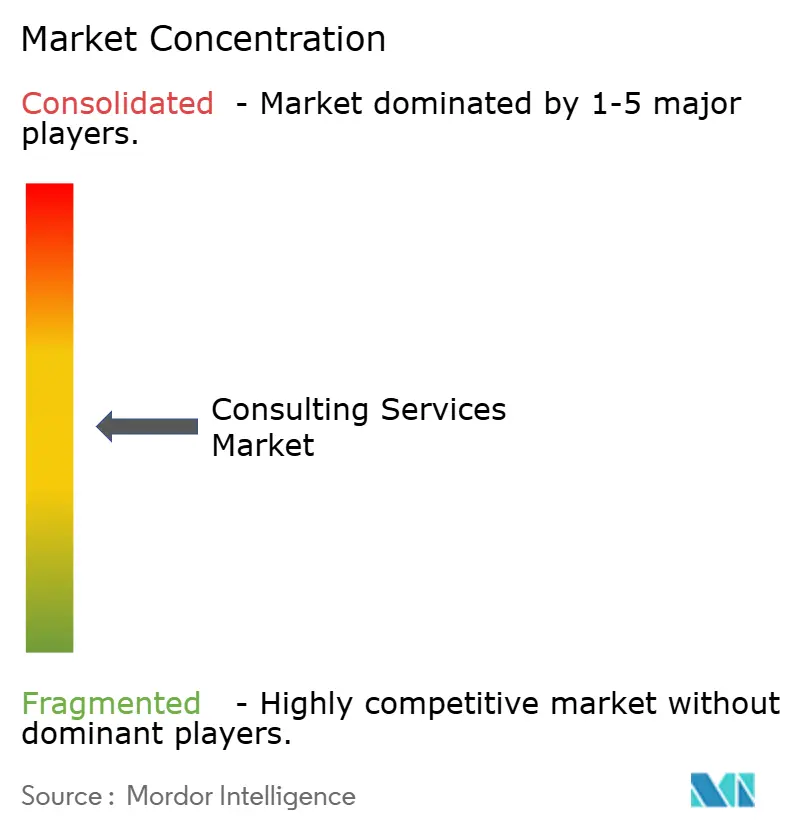
Competition is moderately concentrated around multidisciplinary groups, including the network of Deloitte Touche Tohmatsu Limited and the integrated service group Accenture plc. Other major organizations include PricewaterhouseCoopers LLP, the EY network coordinated by Ernst & Young Global Limited, and Capgemini SE. The global EY organization’s Consulting service line generated USD 17.43 billion in the fiscal year ending June 2026, up 4.4% in local currency from fiscal 2025. That scale gives large provider organizations a substantial base for combining specialties within an engagement and supporting clients through several related decisions.
In August 2025, Accenture acquired The Highlands Consulting Group, a management consultancy headquartered in Sacramento, California. The business brought consulting relationships with California state agencies and expertise in healthcare, transportation, social services and environmental solutions. That combination can link the broader provider’s capabilities with a consultancy’s understanding of how state agencies frame and deliver their programs, giving technical recommendations a more specific institutional setting. Accenture’s Health and Public Services chair said Highlands’ strong relationships and credentials with California state agencies would help the company better serve its clients and open new opportunities.
By June 2025, PwC said it had cut prices for some services as AI helped it complete work faster. Clients had asked for a share of the efficiency gains, according to PwC’s chief AI officer. In the United Kingdom, PricewaterhouseCoopers LLP offers independent AI assurance opinions on compliance with regulation or external standards. Visible time savings can strengthen a client’s argument for price concessions, linking execution productivity directly to the fee negotiation. Because the cuts applied to some services only, AI-driven speed reshaped fee negotiations in selected lines, while the UK assurance service gives PwC a separate independent-opinion offer.
Consulting Services Industry Leaders
-
Deloitte Touche Tohmatsu Limited
-
Accenture plc
-
PricewaterhouseCoopers LLP
-
Ernst & Young Global Limited
-
Capgemini SE
- *Disclaimer: Major Players sorted in no particular order
Consulting Services Market Companies Covered in this Report
- Deloitte Touche Tohmatsu Limited
- Accenture plc
- PricewaterhouseCoopers LLP
- Ernst & Young Global Limited
- KPMG International Limited
- Capgemini SE
- McKinsey & Company, Inc.
- Boston Consulting Group, Inc.
- Bain & Company, Inc.
- Roland Berger Holding GmbH & Co. KGaA
- Kearney, Inc.
- Simon-Kucher & Partners Strategy & Marketing Consultants GmbH
- OC&C Strategy Consultants LLP
- Gartner, Inc.
- Tata Consultancy Services Limited
- IBM Consulting (International Business Machines Corporation)
- Booz Allen Hamilton Holding Corporation
- CGI Inc.
- Infosys Consulting (Infosys Limited)
- Marsh Management Consulting (Marsh)
Key Opportunities for Market Participants
The opportunities compare AI governance and assurance work for UK institutions and Singapore financial institutions. On October 14, 2026, the University of Essex awarded Naomi Korn Associates an AI governance consultancy contract, with services scheduled from November 2, 2026, to March 31, 2027. On October 7, 2026, the Monetary Authority of Singapore issued AI risk-management guidelines for financial institutions, with phased expectations from October 7, 2027, and by October 7, 2028. The opportunity is to define proportionate assurance work around the buyer’s risk profile and the scale and nature of its AI use.
Market Opportunities Table of Consulting Services Market
| Opportunity | Why now | Buyer / lead segment | Recommended play | Main barrier | Likely beneficiaries |
|---|---|---|---|---|---|
| AI governance and assurance-framework design | October 2026 governance commissioning alongside lifecycle-assurance guidance | UK public-sector AI program owners | Design a risk-proportionate governance and assurance framework | Demonstrating the value of external specialist input | UK AI governance advisers such as PricewaterhouseCoopers LLP |
| Independent AI lifecycle reviews | Current commissioning and a standard calling for independent review | UK public organizations with AI-enabled activity | Offer a defined review separate from operational management | Demonstrable reviewer independence and specialist competence | UK AI assurance firms such as PricewaterhouseCoopers LLP |
| Third-party AI assurance readiness | 2026 guidelines phase in from October 7, 2027, and by October 7, 2028 | Singapore financial institutions using third-party AI | Review provider assurance, suitability and potential compensating controls | Potential gaps in provider assurance | Financial-sector AI risk advisers |
| Source: Mordor Intelligence | |||||
The UK digital standard says assurance should be proportionate to risk, value and impact and typically use at least 3 levels, including independent review. That structure can support a consultant’s role in specifying assurance boundaries and contributing an objective opinion within the buyer’s governance framework. Singapore financial institutions should obtain sufficient assurance from third-party AI providers, assess whether the AI suits its intended use, and apply compensating controls where practical constraints or assurance gaps arise. The central opening is a defensible judgment about assurance sufficiency, giving the buyer a basis for deciding whether continued AI use fits its risk appetite.
Recent Industry Developments in Consulting Services Market
- Sep 2026: IBM UK announced the acquisition of UK cybersecurity consultancy Logiq Consulting to expand IBM Consulting’s cybersecurity and sovereign technology capabilities.
- Sep 2026: Korn Ferry completed its acquisition of UK-headquartered AMS from OMERS Private Equity, combining talent and organizational consulting capabilities.
- Mar 2026: Accenture completed its acquisition of UK-based AI company Faculty, whose services include AI strategy and AI systems design, build and implementation.
Consulting Services Market Report Scope and Research Methodology
Market Definition and Coverage
The consulting services market measures annual client spending on consulting and advisory work in the global market. It covers professional fees for operations, strategy, financial, technology, human-capital, risk and compliance, and other services delivered on-site, remotely or in hybrid arrangements to clients across industries and organization sizes.
Scope exclusions: Standalone software licenses, cloud platforms and technology products, outsourced business-process or managed-IT operations, recruitment placement and temporary staffing fees, and client payroll for in-house strategy or advisory teams are excluded.
Segments Covered in This Report
- By Service Type (Value)
- Operations Consulting
- Strategy Consulting
- Financial Advisory
- Technology Advisory
- Human-Capital Consulting
- Risk and Compliance Consulting
- Other Service Types
- By Client Industry (Value)
- BFSI
- Healthcare and Life Sciences
- Energy and Utilities
- Manufacturing and Automotive
- ICT and Media
- Public Sector
- Consumer and Retail
- Other Industries
- By Delivery Model (Value)
- On-site Consulting
- Remote / Virtual Consulting
- Hybrid Consulting
- By Organization Size (Value)
- Large Enterprises
- Small and Medium-sized Enterprises
- By Geography
- North America
- United States
- Canada
- South America
- Brazil
- Europe
- United Kingdom
- Germany
- France
- Italy
- Asia-Pacific (APAC)
- Middle East and Africa
- Middle East
- Saudi Arabia
- United Arab Emirates
- Africa
- South Africa
- Middle East
- North America
Data Sources, Market Sizing, and Validation
Desk Research
Public sources such as Eurostat's European business statistics, the UK Government's Professional and Business Services Sector Plan, and the Management Consultancies Association's annual industry report provide business activity, service-sector, consulting, regional export and service-demand context. IFRS Foundation updates on sustainability-disclosure implementation indicate where regulatory requirements can generate specialist advisory work.
Company filings, annual reports and investor materials can corroborate consulting revenue, service mix, geographic exposure and staffing costs, while reputable press and public contract records can cross-check demand and award timing. These named sources are illustrative rather than exhaustive, and further sources inform collection, validation and clarification.
Primary Interviews and Surveys
Analysts would interview consulting-firm executives, service-line and regional leaders, and client-side procurement, finance and transformation managers across the global market to test how advisory fees, project mix and delivery arrangements are recorded. Interviews and structured surveys would check secondary estimates at the variable level, clarify gaps in regional or service-line evidence, and reconcile conflicting answers against public records and provider disclosures before incorporation.
Distribution of primary research fieldwork respondents
| Company type | Respondent position | Region |
|---|---|---|
| Top tier: 30% | CXOs: 20% | APAC: 38% |
| Mid tier: 50% | Functional/Unit leaders: 35% | EMEA: 32% |
| Smaller Players: 20% | Managers: 45% | Americas: 30% |
Market-Sizing & Forecasting
Where countries publish business-services receipts and cross-border trade together, analysts would use the series to test regional revenue estimates. Analysts would estimate global annual consulting fees in USD using a top-down model that reconciles national business-service revenues and cross-border service data with provider disclosures, then test selected regional and service-line totals through supplier roll-ups and sampled project-fee times engagement volume. Revenue reported for consulting practices, client-sector demand indicators, business investment and digital-transformation activity, consultant employment and wage trends, and project pricing would inform the historical series and forecast. Verified provider revenue by service type, client industry, delivery model, organization size and geography would support segment shares. Where a sufficiently long series exists, multivariate regression would relate fee growth to these demand and supply indicators, with scenario analysis used when data are sparse or structural change weakens the historical relationship. Analysts would address missing observations with the nearest comparable official or company evidence, document the remaining range internally, and have primary respondents check the logic and direction of each major variable forecast before revising the estimate.
Data Validation & Update Cycle
Analysts would triangulate provider revenues, official business-service and trade series, client demand indicators and primary responses, then reconcile estimates to the annual-fee boundary and remove operational or product sales that do not represent consulting work. They would test segment shares and regional totals for arithmetic consistency, investigate material variance from independent signals, record the explanation and obtain a second analyst review before sign-off. When answers conflict, a key input is missing or a material change alters a prior explanation, analysts would re-contact respondents. The model would be refreshed annually, revisited after material market events and given a fresh pre-delivery review.
Mordor Intelligence's Consulting Service Market Estimate Compared With Other Published Estimates
Published estimates can differ in the transactions and products they count and the inputs used to model demand. The consulting services market measures annual client spending on consulting and advisory work in the global market.
Key Gap Drivers include the study's defined coverage and market-specific modeling choices. Revenue reported for consulting practices, client-sector demand indicators, business investment and digital-transformation activity, consultant employment and wage trends, and project pricing would inform the historical series and forecast.
Benchmark comparison
| Source | Market Size | Gaps in Research Methodology |
|---|---|---|
| Mordor Intelligence | USD 407.3 B (2027) | |
| Global Market Research Firm A | USD 378.9 B (2025) | At its 2025 base, this estimate is 7.0% below this report's 2027 value of USD 407.3 B, 2 years later. Its 2025 base precedes the report year, and the source forecasts 5.41% annual growth over 2026-2032. |
| Global Market Research Firm B | USD 348 B (2025) | At its 2025 base, this estimate is 14.6% below this report's 2027 value of USD 407.3 B, 2 years later. Its 2025 base precedes the report year, and the source forecasts 4.8% annual growth over 2026-2034. |
Mordor Intelligence's analysts would triangulate provider revenues, official business-service and trade series, client demand indicators and primary responses, then reconcile estimates to the annual-fee boundary and remove operational or product sales that do not represent consulting work.
Key Questions Answered in the Report
What is the consulting services market size and growth outlook?
The size is estimated at USD 388.7 billion in 2026, projected at USD 407.3 billion in 2027 and forecast to reach USD 509.5 billion by 2032. The forecast CAGR is 4.58% from 2027 to 2032.
What drives demand for consulting services?
Digital transformation, operational-efficiency work, regulatory duties and cloud adoption support demand. In surveyed EU industry sectors, 52.74% of enterprises with at least 10 employees or self-employed persons used paid cloud services in 2025.
Which consulting service type leads spending?
Operations consulting held 28.76% of consulting spending in 2026. Technology advisory is the fastest-growing service segment, with a 6.12% CAGR forecast from 2027 to 2032.
Which major organizations compete in consulting?
Major organizations include Deloitte Touche Tohmatsu Limited, Accenture plc, PricewaterhouseCoopers LLP, the EY network coordinated by Ernst & Young Global Limited, and Capgemini SE.
What spending challenge affects consulting providers’ outlook?
In Grant Thornton’s Q2 2026 CFO survey, 44% identified external professional consulting support and fees as a top area for potential cuts.
Which region leads global consulting demand and which is growing fastest?
North America held 40.22% of consulting spending in 2026. Asia-Pacific (APAC) is the fastest-growing region, with a 6.2% CAGR forecast from 2027 to 2032.