
Computer and Peripherals Standard Logic IC Market Size and Share
Market Overview
| Study Period | 2020 - 2031 |
|---|---|
| Market Size (2026) | USD 37.37 Billion |
| Market Size (2031) | USD 48.72 Billion |
| Growth Rate (2026 - 2031) | 5.44 % |
| Fastest Growing Market | Asia Pacific |
| Largest Market | Asia Pacific |
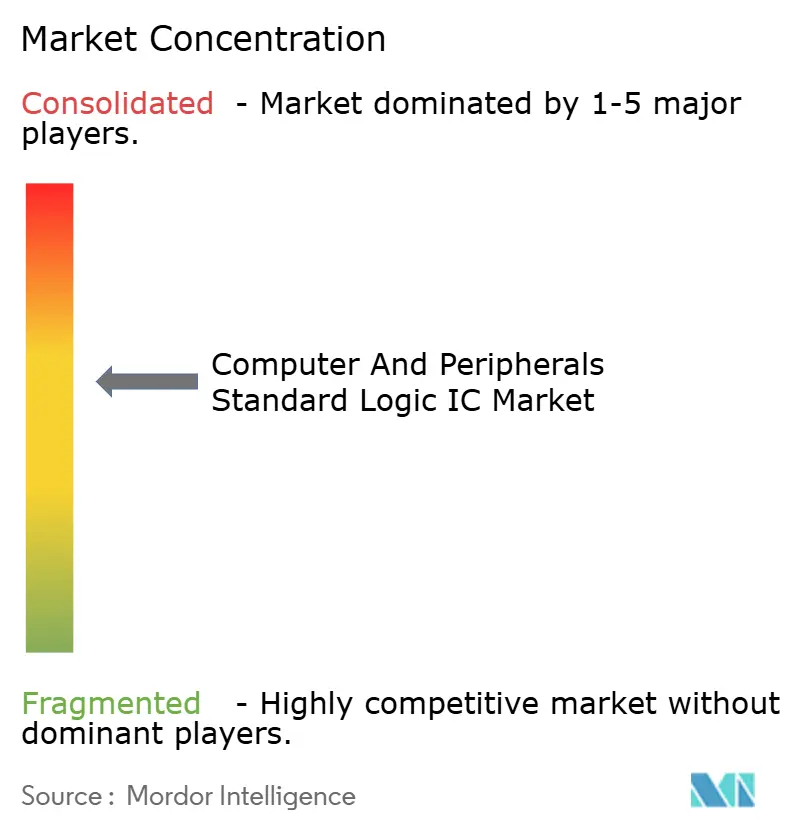
| Market Concentration | Medium |
Major Players *Disclaimer: Major Players sorted in no particular order Image © Mordor Intelligence. Reuse requires attribution under CC BY 4.0. | |
Computer and Peripherals Standard Logic IC Market Analysis by Mordor Intelligence
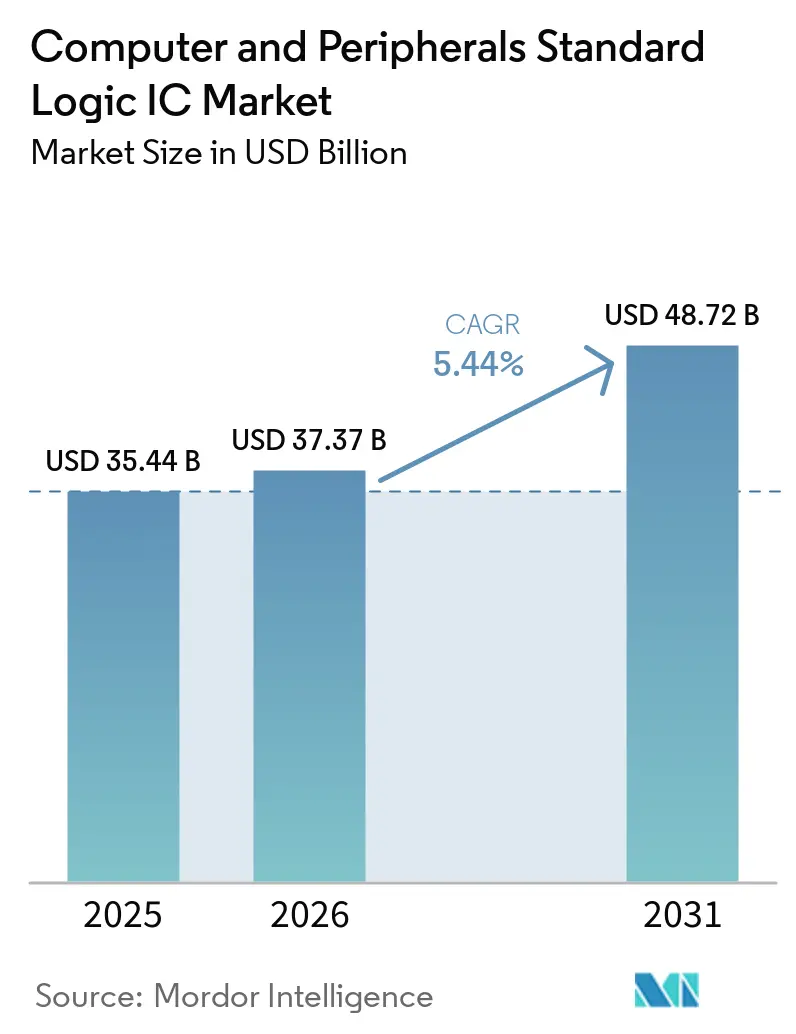
The Computer and Peripherals Standard Logic IC market size is expected to grow from USD 35.44 billion in 2025 to USD 37.37 billion in 2026 and is forecast to reach USD 48.72 billion by 2031 at 5.44% CAGR over 2026-2031. Intensifying digitalization and AI-assisted PCB design workflows keep discrete logic devices relevant even as SoCs integrate more on-chip functions. Manufacturers gain from ultra-thin peripheral demand, wafer-level chip-scale packaging advances, and USB-C/Thunderbolt refresh cycles that require high-speed signal conditioning. Asia-Pacific dominates production capacity, while North America and Europe steer design innovation and automotive-grade qualification programs. Competitive positioning increasingly relies on packaging expertise, parametric search tools, and rapid prototyping support rather than catalogue breadth alone.
Key Report Takeaways
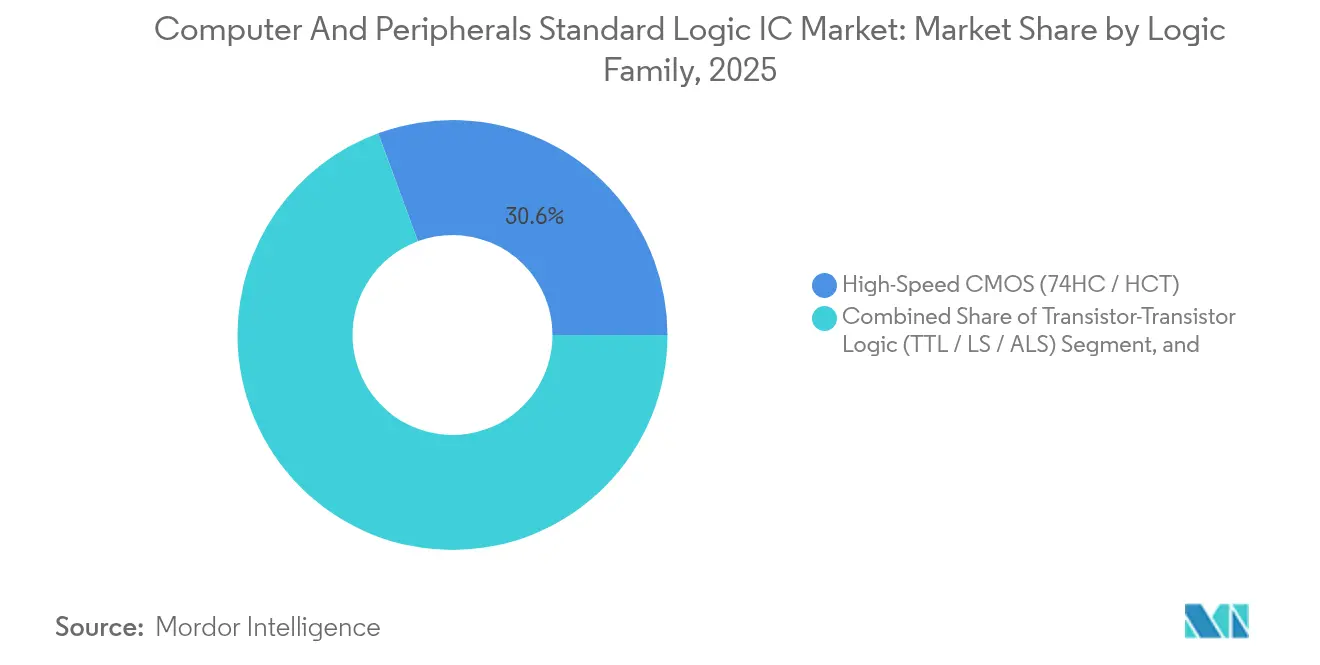
- By logic family, 74HC/HCT devices led with 30.62% revenue share in 2025; 74LVC/AUP devices are forecast to expand at a 6.51% CAGR through 2031.
- By function type, gates and inverters accounted for 25.98% of the Computer and Peripherals Standard Logic IC market share in 2025, while signal switches and level translators posted the fastest 6.74% CAGR to 2031.
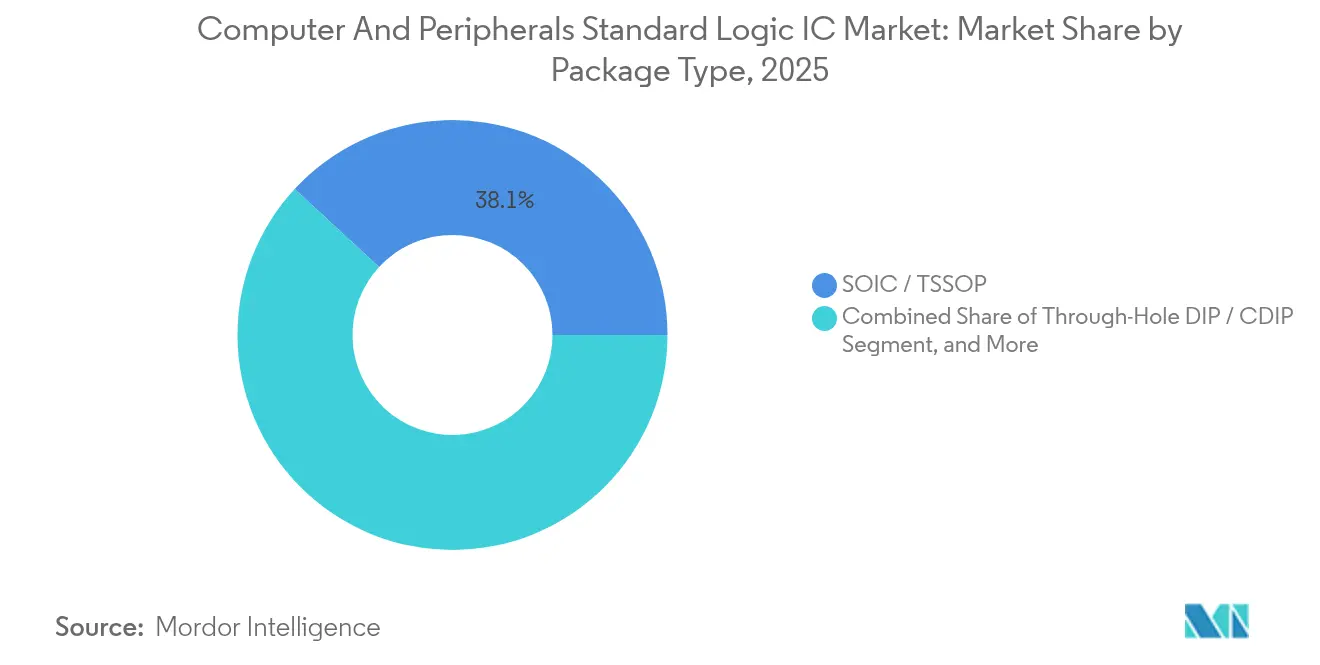
- By package type, SOIC/TSSOP captured 38.12% of the Computer and Peripherals Standard Logic IC market size in 2025; WLCSP solutions are growing at an 8.05% CAGR to 2031.
- By end-use device, personal computers and laptops held a 28.37% share in 2025, and gaming consoles and accessories are rising at a 7.66% CAGR through 2031.
- By geography, Asia-Pacific commanded a 50.72% share in 2025 and is advancing at an 8.45% CAGR to 2031.
Note: Market size and forecast figures in this report are generated using Mordor Intelligence’s proprietary estimation framework, updated with the latest available data and insights as of 2026.
Market Trends and Insights
Drivers Impact Analysis of Computer and Peripherals Standard Logic IC Market*
| Driver | (~) % Impact on CAGR Forecast | Geographic Relevance | Impact Timeline |
|---|---|---|---|
| Surging demand for low-voltage LVC logic in ultra-thin peripherals | +1.20% | Global, with APAC core leadership | Medium term (2-4 years) |
| Shift-left PCB design workflows boosting single-gate (1G) logic ASPs | +0.80% | North America & EU design centers, APAC manufacturing | Short term (≤ 2 years) |
| AI-assisted auto-routing increasing volume of configurable multi-gate ICs | +1.10% | Global, concentrated in advanced design hubs | Medium term (2-4 years) |
| Mainstream upgrade cycles for USB-C/Thunderbolt hubs | +0.90% | Global consumer markets | Short term (≤ 2 years) |
| Rising attach-rate of wireless keyboards and mice using low-power buffers | +0.70% | Global, with premium segment leadership in developed markets | Medium term (2-4 years) |
| Cost-down programs in ODM printers favouring 74HC/HCT drop-ins | +0.50% | APAC manufacturing, global distribution | Long term (≥ 4 years) |
| Source: Mordor Intelligence | |||
Surging demand for low-voltage LVC logic in ultra-thin peripherals
Ultra-thin peripherals favor 1.65 V-5.5 V 74LVC/AUP devices that deliver nanosecond switching while fitting strict thermal envelopes, propelling a 6.73% CAGR through 2030. USB4 and Thunderbolt 5 hubs exemplify this shift by requiring 40 Gbps-plus signaling in compact enclosures.[1] Distributed low-voltage logic architectures outperform monolithic alternatives on power and heat, sustaining demand across global design centers and APAC assembly bases.
AI-assisted auto-routing increasing configurable multi-gate IC volume
Machine-learning PCB tools evaluate thousands of topologies in minutes and frequently choose uncommon gate combinations, driving a 23% rise in demand for configurable multi-gate devices.[2] Vendors supplying broad parametric libraries and rapid samples win sockets as design cycles compress.
Mainstream USB-C/Thunderbolt hub upgrade cycles
Hub manufacturers logged 40% year-over-year growth in advanced connector adoption during 2024, spurring sales of logic ICs that handle multigigabit translation while preserving legacy compatibility. Bidirectional 80 Gbps Thunderbolt 5 implementations particularly benefit from advanced CoWoS packaging that minimizes impedance across logic stages.[3]
Rising attach rate of wireless keyboards and mice using low-power buffers
Wireless peripherals captured 67% penetration in premium computing during 2024, lifting the addressable logic IC pool to USD 890 million. Low-power buffers optimized for Bluetooth LE enable sub-millisecond latency and year-long battery life, fueling sustained demand.[4]
Restraints Impact Analysis of Computer and Peripherals Standard Logic IC Market*
| Restraint | (~) % Impact on CAGR Forecast | Geographic Relevance | Impact Timeline |
|---|---|---|---|
| Design-in inertia toward SoC integration of discrete logic | -0.90% | Global, with advanced design centers leading integration | Long term (≥ 4 years) |
| Lengthening automotive-grade qualification queues (AEC-Q100) | -0.60% | Global automotive supply chain | Medium term (2-4 years) |
| Volatility in 200mm foundry capacity for legacy logic nodes | -0.70% | APAC foundry concentration | Short term (≤ 2 years) |
| Counterfeit 74-series influx in secondary channels | -0.40% | Global distribution, concentrated in cost-sensitive markets | Medium term (2-4 years) |
| Source: Mordor Intelligence | |||
Design-in inertia toward SoC integration of discrete logic
Advanced SoCs now embed programmable logic blocks that replicate common 74-series functions, cutting discrete content in high-volume devices despite rising overall electronics complexity.[5] Yet functions needing galvanic isolation or high-voltage switching still rely on stand-alone ICs, tempering but not eliminating the substitution threat.
Lengthening automotive-grade qualification queues (AEC-Q100)
Qualification for new logic ICs stretched to 18-24 months in 2025, straining supplier ROI calculations as product life cycles shorten.[6] Limited test-house capacity and rigorous thermal cycling slow entry into lucrative ADAS and infotainment sockets.
*Our forecasts treat driver/restraint impacts as directional, not additive. The impact forecasts reflect baseline growth, mix effects, and variable interactions.
Computer and Peripherals Standard Logic IC Market Segment Analysis
By Logic Family:
CMOS efficiency anchors growth2025 results showed high-speed 74HC/HCT devices occupying 30.62% revenue. Low-voltage 74LVC/AUP families, benefiting from energy-sensitive edge nodes, are forecast to add 6.51% CAGR, driving the Computer and Peripherals Standard Logic IC market size in this category to outpace legacy TTL lines. Mixed-voltage designs combine multiple CMOS families to balance cost and timing, a pattern accelerated by AI-guided CAD that lowers design effort.
The migration toward heterogeneous voltage domains preserves discrete demand where SoC pins cannot satisfy isolation or noise immunity, supporting adjacent applications within the computer and peripherals special purpose logic IC segment. ECL/MECL retains niche roles in jitter-sensitive acquisition systems, whereas 4000-series CMOS fulfills wide-voltage industrial needs. Continued package shrinkage ensures the Computer and Peripherals Standard Logic IC market retains family diversity rather than converging on a single dominant architecture.

By Function Type:
Interface complexity lifts translatorsGates and inverters held a 25.98% share in 2025, reflecting their universality. Signal switches and level translators will lead segment expansion with a 6.74% CAGR to 2031 as multi-voltage SoCs interface with mixed-signal peripherals, raising the Computer and Peripherals Standard Logic IC market share for these devices. Multiplexers and decoders support multi-display docks, while buffers maintain integrity on high-speed differential pairs.
Design teams increasingly prefer translator ICs with adaptive threshold tracking, trimming board spins caused by supply-rail migrations. The shift signals demand growth rooted in interface management rather than raw gate count, sustaining value even as transistor integration climbs.
By Package Type:
WLCSP accelerates miniaturizationSOIC/TSSOP remained dominant at 38.12% revenue in 2025 for its cost-thermals balance. WLCSP units, however, post the highest 8.05% CAGR as OEMs compress z-height in wearables and thin laptops, expanding the Computer and Peripherals Standard Logic IC market size for fan-out variants. QFN and XSON formats gain in RF-sensitive designs needing low parasitics, whereas through-hole DIP persists in serviceable industrial boards.
Fan-out panel-level roadmaps promise further cost reductions, drawing logic vendors into packaging partnerships once reserved for memory or RF chips. The coexistence of legacy and advanced formats aligns with varied lifecycle and field-repair priorities across end markets.
By End-Use Device:
Gaming peripherals surgePersonal computers and laptops delivered 28.37% revenue in 2025, yet gaming consoles and accessories will grow fastest at 7.66% CAGR, expanding the Computer and Peripherals Standard Logic IC market size for low-latency switch matrices. External storage and docking stations capitalize on remote-work ergonomics, with translators facilitating multi-monitor USB-C docks. Networking peripherals ride Wi-Fi 7 rollouts, demanding high-speed logic drivers.
Industrial PCs and rugged peripherals justify higher ASPs through extended temperature ranges and conformal-coated packages, buffering cyclical consumer demand. Segment diversification, therefore, anchors revenue stability despite consumer volatility.
Geography Analysis
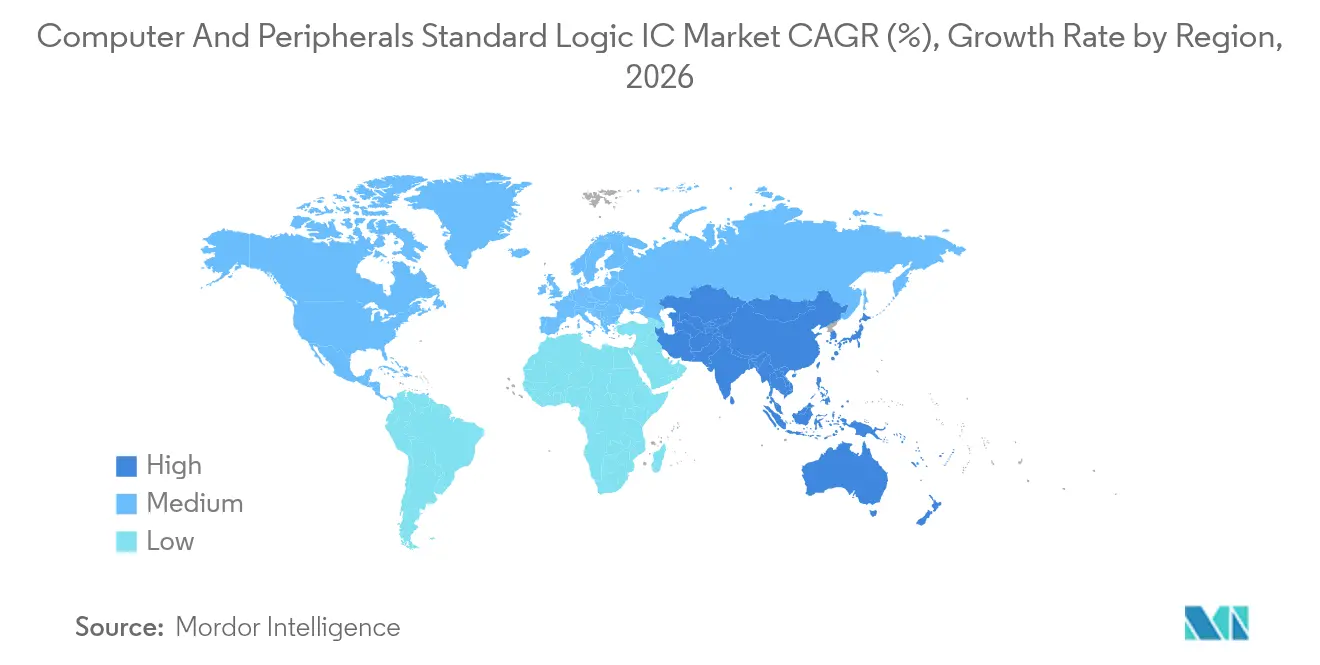
APAC Computer and Peripherals Standard Logic IC Market
Asia-Pacific led with 50.72% Computer and Peripherals Standard Logic IC market share in 2025 and is forecast to rise at an 8.45% CAGR, underpinned by integrated foundry-to-assembly ecosystems in China, Taiwan, and South Korea. Japan’s automotive-centric tier-1s sustain demand for extended-temperature families, while Taiwan extends leadership through panel-level packaging clusters.
North America Computer and Peripherals Standard Logic IC Market
North America delivered a growing CAGR outlook as design houses in the United States push AI-centric peripherals that require configurable multi-gate logic. Canada and Mexico leverage proximity to U.S. OEMs for board-level assembly, anchoring regional demand despite limited wafer capacity.
EMEA and LATAM Computer and Peripherals Standard Logic IC Market
Europe posted a growing CAGR trajectory driven by automotive electrification and industrial automation. Germany’s Tier-1 suppliers qualify AEC-Q100 devices, France supports aerospace variants, and Italy attracts panel-level packaging investment that diversifies supply beyond Asia. Emerging regions in Latin America, the Middle East, and Africa collectively formed a small part of the 2024 revenue, with infrastructure-driven networking peripherals stimulating future uptake.
Regulatory Landscape
Regulation affecting standard logic ICs used in computers and peripherals is increasingly shaped by cybersecurity obligations for hardware and by cross-border trade controls on semiconductors and related technologies. In the European Union, the Cyber Resilience Act (Regulation (EU) 2024/2847) introduces horizontal cybersecurity requirements for products with digital elements, which raises compliance expectations for component suppliers and OEMs that integrate logic ICs into connected peripherals and hubs.
In the United States, export-control rules and trade measures affecting semiconductor technology flows tightened further after new Foreign Direct Product (FDP) rule changes introduced in December 2024, followed by subsequent 2026 actions tied to semiconductor trade and licensing policy. Separately, the European Commission tabled a 2026 proposal to strengthen preparedness for semiconductor supply disruptions through coordinated alerts and a potential crisis-stage mechanism, adding more reporting and response expectations for electronics supply-chain participants.
Value Chain Analysis
The value chain for computer and peripheral standard logic ICs covers architecture and library development, including parametric models used in PCB design tools, front-end wafer fabrication, predominantly on mature nodes for many 74-series and interface parts, and backend assembly, test, and packaging (ATP) that drives form-factor, thermal behavior, and high-speed signal integrity. Upstream inputs include semiconductor manufacturing equipment, silicon wafers, and high-purity chemicals and gases, while midstream capacity is concentrated across Asia-Pacific manufacturing ecosystems alongside design and product-definition hubs in North America and parts of Europe.
For 2026, supply constraints have been more focused on packaging and testing throughput than on raw wafer availability, which matters for WLCSP and other compact packages used in ultra-thin peripherals. Industry monitoring also points to extended lead times for specialized high-speed buffers and voltage translators, with early-2026 ranges cited at roughly 20 to 26 weeks in some channels. That pattern is pushing OEMs and ODMs toward earlier bill-of-material profiling, dual-sourcing, and pin-compatible alternates. Distribution remains relevant for broad catalog coverage, but larger programs increasingly use direct contracting with suppliers, alongside regional authorized distributors, to manage allocation risk and lifecycle continuity.
Competitive Landscape
Texas Instruments, Nexperia, onsemi, and STMicroelectronics collectively anchor mid-price catalog breadth, using global fabs and decades-long distributor ties to secure design wins. Their computer and peripherals. Standard Logic IC market strategies emphasize reference designs and cross-sell of power-management companions that embed switching costs.
Challengers such as Diodes Incorporated and ROHM target niche windows like printer cost-downs or industrial wide-voltage needs, offering quick sample cycles and narrow-format WLCSP to entice ODMs. Packaging differentiation and reliability pedigrees often outweigh mere per-unit cost when sockets risk field failures.
Advanced packaging players, including Broadcom and foundries such as TSMC, increasingly compete upstream by offering 2.5D/3D interposer integration that embeds discrete logic alongside SoCs in chiplet form factors. Patent depth in interconnect and AI-centric libraries, therefore, shapes competitive boundaries more than transistor count, marking a shift toward system-level engagement.
Computer and Peripherals Standard Logic IC Industry Leaders
-
Diodes Incorporated
-
Texas Instruments Incorporated
-
NXP Semiconductors N.V.
-
STMicroelectronics N.V.
-
Taiwan Semiconductor Manufacturing Co., Ltd.
- *Disclaimer: Major Players sorted in no particular order
Computer and Peripherals Standard Logic IC Market Companies Covered in this Report
- Texas Instruments Incorporated
- Nexperia B.V.
- onsemi Corporation
- STMicroelectronics N.V.
- Toshiba Electronic Devices and Storage Corporation
- ROHM Co., Ltd.
- Diodes Incorporated
- Microchip Technology Inc.
- Infineon Technologies AG
- Renesas Electronics Corporation
- Maxim Integrated (Analog Devices, Inc.)
- Vishay Intertechnology, Inc.
- Lattice Semiconductor Corporation
- Skyworks Solutions, Inc.
- Taiwan Semiconductor Manufacturing Co., Ltd. (Foundry Perspective)
- Teledyne e2v Semiconductor
- Samsung Electronics Co., Ltd. (System LSI)
- NXP Semiconductors N.V.
- Broadcom Inc.
- Analog Devices, Inc.
Read Analysis of Computer and Peripherals Standard Logic IC Companies
Market Opportunities and Future Outlook
A key opportunity for standard logic IC suppliers in computers and peripherals is attaching more value to interface complexity and signal integrity, rather than competing on basic gate count. High-speed redrivers, switches, and level translators used around PCIe, CXL, USB-C, and Thunderbolt-class interconnects match the report trend of rising demand for signal switches and level translators, while packaging-driven differentiation such as WLCSP and other low-parasitic formats supports thin-and-light devices where board area and z-height are constrained.
On the supply side, major semiconductor manufacturing and packaging investments announced in July 2026 provide clearer pathways to reduce concentration risk and expand regional capability, which supports both long-lifecycle catalog parts and advanced interfaces that rely on shared backend resources. Examples include the Trump Administration and TSMC highlighting an additional USD 100 billion tied to expanding U.S. semiconductor manufacturing, Intel announcing a EUR 5 billion manufacturing expansion at Leixlip in Ireland, and Tower Semiconductor announcing a USD 3 billion dual-track expansion in Japan supported by Government of Japan grants. Together, these programs reinforce a shift toward localized hubs and advanced packaging capacity, creating whitespace for logic vendors that can secure qualified capacity, shorten replenishment cycles for OEMs, and provide validated reference designs for next-generation peripheral connectivity.
Recent Industry Developments in Computer and Peripherals Standard Logic IC Market
- July 2026: Diodes Incorporated announced a definitive agreement to acquire ElevATE Semiconductor for USD 250 million, expanding its analog and mixed-signal capabilities and positioning the company closer to automated test equipment and adjacent high-reliability applications. The agreement supports broader mixed-signal content around high-speed interfaces and validation workflows that influence logic and signal-conditioning design-ins across computing platforms. Closing is targeted for the second half of 2026, subject to customary conditions.
- May 2026: STMicroelectronics introduced new 700V PowerGaN transistors aimed at improving efficiency in high-frequency power conversion for demanding compute platforms. While not a standard logic device, the release signals ongoing platform-level redesign around AI-era power and thermals, which cascades into tighter board layouts and greater need for compact, low-parasitic signal-conditioning and interface logic around processors and peripheral controllers.
- May 2026: Diodes Incorporated launched the PI3EQX32904Q, a 32Gbps four-channel linear ReDriver targeting PCIe 5.0 and CXL signal integrity for automotive smart cockpit and AI-driven computing platforms. This expands addressable content around high-speed interconnects, where redrivers and related logic help maintain eye margins across connectors, cables, and compact PCB stacks used in modern peripherals and docking ecosystems.
Computer and Peripherals Standard Logic IC Market Report Scope and Research Methodology
Market Definition and Coverage
This market covers revenue generated from standard logic integrated circuits used inside computers and peripheral devices, where demand is tied to device build volumes, refresh cycles, and the mix of logic families and package types shipped globally.
Scope exclusions: We exclude analog ICs, memory, discrete components, and full custom logic that is not sold as standard logic catalog parts.
Segments Covered in This Report
- By Logic Family
- Transistor-Transistor Logic (TTL / LS / ALS)
- High-Speed CMOS (74HC / HCT)
- Low-Voltage CMOS (74LVC / AUP)
- Advanced High-Speed CMOS (74AC / ACT)
- Wide-Voltage 4000-Series CMOS
- ECL / MECL and Other Bipolar Logic
- By Function Type
- Gates and Inverters
- Flip-Flops and Latches
- Counters and Dividers
- Shift Registers
- Buffers / Drivers / Transceivers
- Multiplexers / Decoders and Encoders
- Comparators and Arithmetic Logic
- Signal Switches and Level Translators
- By Package Type
- Through-Hole DIP / CDIP
- SOIC / TSSOP
- SOT-23 / SOT-353 and Other Micro-Packages
- QFN / XSON / DFN
- WLCSP / Wafer-Level Chip-Scale
- BGA / LGA
- By End-Use Device
- Personal Computers and Laptops
- Printers, Scanners and MFPs
- External Storage and Docking Stations
- Gaming Consoles and Accessories
- Networking Peripherals (Routers, Hubs)
- POS Terminals and Kiosks
- Industrial PCs and Rugged Peripherals
- By Geography
- North America
- United States
- Canada
- Mexico
- South America
- Brazil
- Argentina
- Colombia
- Rest of South America
- Europe
- United Kingdom
- Germany
- France
- Italy
- Spain
- Rest of Europe
- Asia-Pacific
- China
- Japan
- South Korea
- India
- Rest of Asia-Pacific
- Middle East and Africa
- Middle East
- Saudi Arabia
- United Arab Emirates
- Rest of Middle East
- Africa
- South Africa
- Egypt
- Rest of Africa
- Middle East
- North America
Data Sources, Market Sizing, and Validation
Desk Research
We start with desk research to set the market boundary and to build the first demand map for computers and key peripherals, along with logic content assumptions per device class. Public sources are used to anchor volumes and trade direction, such as U.S. International Trade Commission trade statistics, UN Comtrade, OECD ICT indicators, and industry publications from groups such as JEDEC and the IEEE.
After that, we cross-check the demand map using company filings and investor presentations to understand product mix, end-market exposure, and any pricing commentary. We then use reputed business press to track capacity additions, shortages, and inventory corrections. Where needed, a paid subscription database is used only for company financials, patent reads, and shipment-level import and export checks, which helps us avoid relying on a single signal. The desk sources listed here are illustrative, and we use many other references for data collection, validation, and clarification during the work.
Primary Interviews and Surveys
Primary work is used to pressure-test model inputs that are hard to read from public data, especially standard logic content per device, channel margins, and realistic ASP movement across mature nodes and packaging formats. We speak with a mix of component suppliers, distribution-side contacts, OEM and ODM stakeholders, and engineers and procurement leaders across APAC, EMEA, and the Americas, so regional build plans and correction cycles can be reflected in the final view.
Distribution of primary research fieldwork respondents
| Company type | Respondent position | Region |
|---|---|---|
| Top tier: 28% | CXOs: 18% | APAC: 46% |
| Mid tier: 51% | Functional/Unit leaders: 26% | EMEA: 34% |
| Smaller Players: 21% | Managers: 56% | Americas: 20% |
Market-Sizing & Forecasting
The main sizing path is top-down, where device production and shipment data is used to reconstruct the reachable demand pool for standard logic in computers and peripherals, and then translated into revenue through content and pricing assumptions. To keep the totals realistic, we corroborate the outcome with selective bottom-up approximations, such as sampled ASP times implied unit demand for high-run families, channel checks on distributor throughput, and a sanity roll-up of supplier exposure to the computer and peripherals end market.
Key inputs in the model include PC and notebook shipment trends, peripheral attach rates (printers, monitors, docking, and connectivity add-ons), the mix shift between CMOS and TTL family demand, average package mix (including small-outline and wafer-level packages), and ASP movement tied to node maturity and inventory levels. For forecasting, scenario analysis is applied around refresh-cycle strength, inventory digestion length, and unit recovery pace. The final trajectory is then adjusted based on expert consensus gathered in interviews. When a direct data point is missing for a smaller device group, we fill gaps using proxy devices with similar logic content and validate the proxy with two independent interview checks.
Data Validation & Update Cycle
Outputs are checked against independent signals, including device shipment trajectories, trade flows for relevant HS codes, and revenue direction indicated in public filings, which helps us catch mismatches early. If a region or year shows an unusual jump, the assumptions are reopened and re-tested through follow-up calls, then reviewed again internally before sign-off.
Reports are refreshed annually, and interim updates are made when material events change pricing, supply, or demand behavior, such as major inventory corrections or sharp currency moves. Before delivery, a final pass is completed so the model reflects the most recent shipment and pricing commentary available at that time.
Mordor Intelligence's Computer and Peripherals Standard Logic Ic Market Sizing Compared With Other Published Estimates
Published market values for this space can look far apart because the scope line is not always drawn the same way, and because the timing of pricing and currency conversion can shift the reported USD value in any given year. Differences also show up when one estimate leans more on unit recovery expectations, while another leans more on ASP compression assumptions.
Key gaps usually come from what is counted as standard logic for computers and peripherals, and from how ASP progression is handled through inventory cycles on mature nodes, which can temporarily distort revenue even when units are stable. When FX timing is not aligned to the same averaging window, or when validation checks are limited to a single demand indicator, the spread can widen quickly, especially in years with fast pricing resets and uneven regional restocking.
Benchmark comparison
| Source | Market Size | Gaps in Research Methodology |
|---|---|---|
| Mordor Intelligence | USD 37.37 B (2026) | |
| Industry Research Publisher A | USD 37.90 B (2025) | Uses a different base year and appears to carry forward a slower growth curve with a longer horizon, which can hide near-term ASP swings caused by inventory correction years. |
| Industry Research Publisher B | USD 198.29 B (2025) | Likely applies a much wider scope that blends adjacent logic categories and end markets beyond computers and peripherals, which inflates totals when broader logic IC revenue is included. |
The table shows that the large spread is mostly explained by scope boundaries and by timing choices in pricing and FX conversion, rather than by a true disagreement on unit demand direction. By refreshing assumptions around ASP movement and re-checking them against shipment and channel signals, Mordor Intelligence keeps the estimate tied to the computer and peripherals demand pool without pulling in broader logic IC revenues.
Key Questions Answered in the Report
How large is the Computer and Peripherals Standard Logic IC market in 2026?
The market totals USD 37.37 billion in 2026.
What is the forecast growth rate for these logic ICs?
Revenue is projected to rise at a 5.44% CAGR from 2026 to 2031.
Which region leads demand for standard logic in computer peripherals?
Asia-Pacific accounts for 50.72% of 2025 revenue and shows the fastest 8.45% CAGR.
Which logic family is expanding most quickly?
Low-voltage 74LVC/AUP devices are advancing at a 6.51% CAGR through 2031.
Why are signal switches and level translators in high demand?
Heterogeneous voltage domains in USB-C hubs and wireless peripherals require seamless translation, driving a 6.74% CAGR for this function type.
What packaging technology is gaining share fastest?
WLCSP solutions post an 8.05% CAGR due to space savings in ultra-thin peripherals.