
Common Warts Market Size and Share
Market Overview
| Study Period | 2020 - 2031 |
|---|---|
| Market Size (2026) | USD 2.73 Billion |
| Market Size (2031) | USD 3.47 Billion |
| Growth Rate (2026 - 2031) | 4.87 % |
| Fastest Growing Market | Asia-Pacific |
| Largest Market | North America |
| Market Concentration | Low |
Major Players
*Disclaimer: Major Players sorted in no particular order Image © Mordor Intelligence. Reuse requires attribution under CC BY 4.0. |
|
Common Warts Market Analysis by Mordor Intelligence
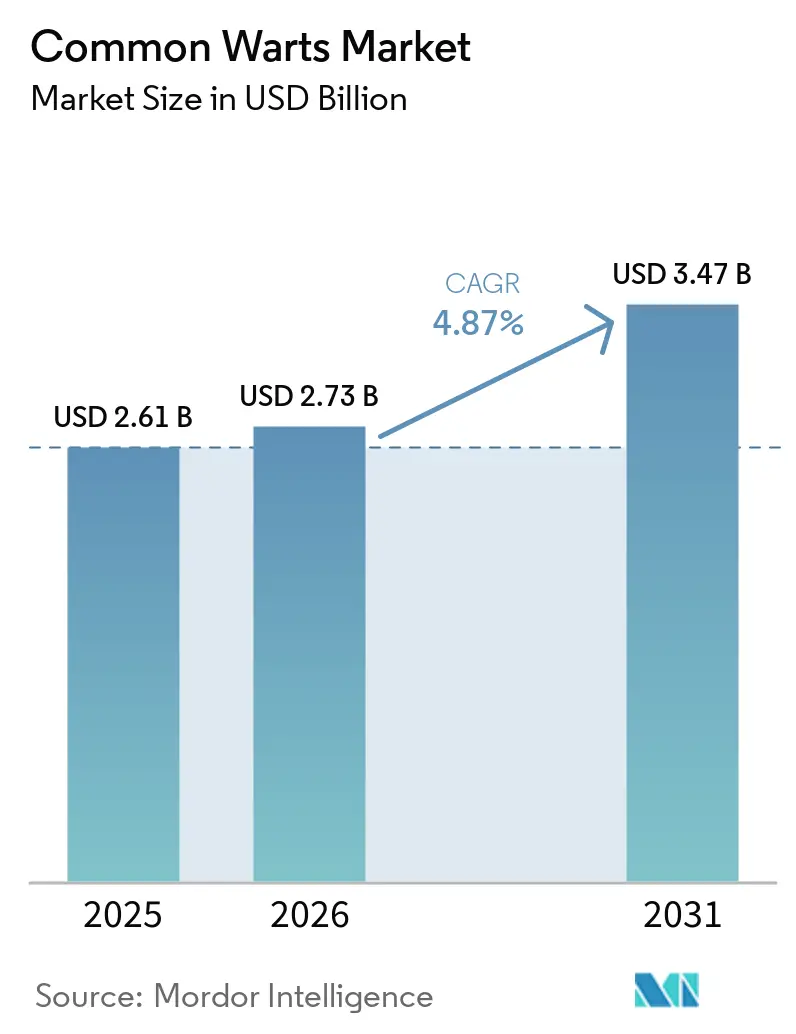
The Common Warts Market size is expected to grow from USD 2.61 billion in 2025 to USD 2.73 billion in 2026 and is forecast to reach USD 3.47 billion by 2031 at 4.87% CAGR over 2026-2031.
Persistent lesions sustain demand because visible or functionally inconvenient warts lead patients to seek care after self-treatment has not worked. The absence of a disease-specific approved prescription treatment leaves clinicians dependent on topical products and lesion-directed procedures. Consumer products support large treatment volumes, while clinic procedures generate greater revenue per treatment episode. Late-stage immunotherapy programs could change how recalcitrant disease is managed if they gain approval. This creates room for companies that can support both accessible self-care and specialist-led treatment pathways.
Key Report Takeaways
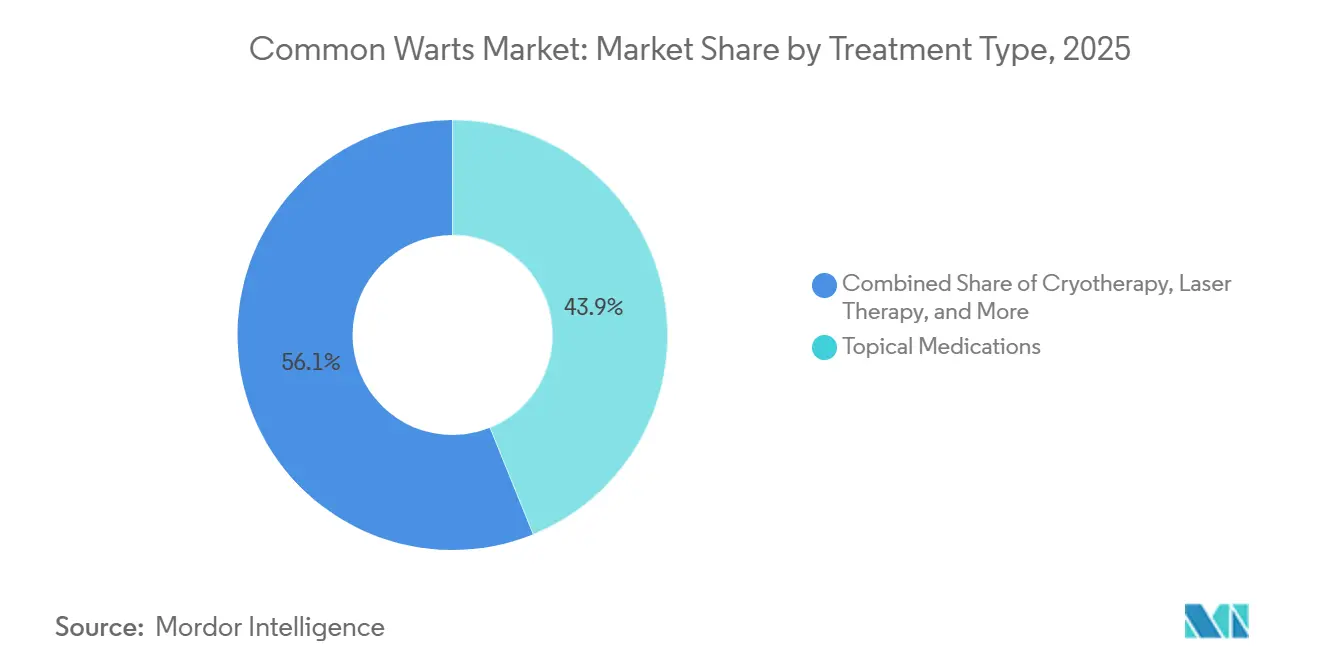
- By treatment type, topical medications held 43.87% of the Common warts market share in 2025, while laser therapy is forecast to grow at a 6.13% CAGR through 2031.
- By patient group, children and adolescents held 46.31% of the segment value in 2025, while adults are forecast to grow at a 5.88% CAGR through 2031.
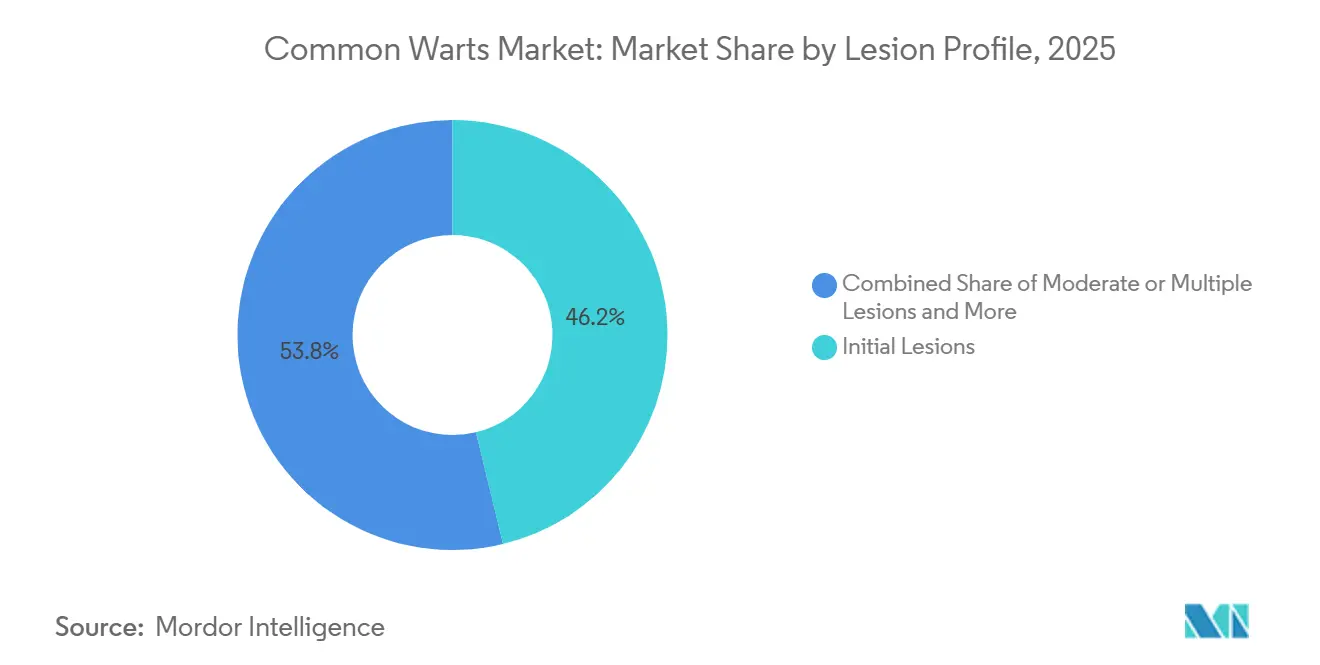
- By lesion profile, initial lesions held 46.22% of segment value in 2025, while severe or recalcitrant lesions are forecast to grow at a 5.92% CAGR through 2031.
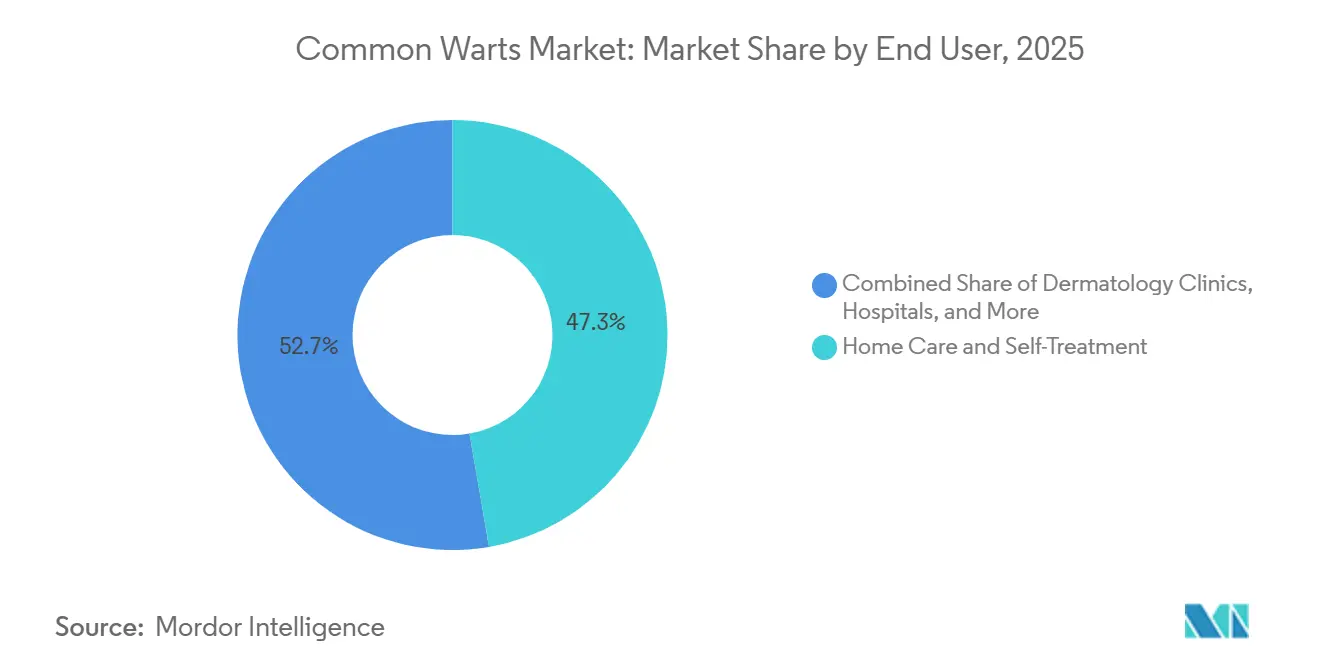
- By end user, home care and self-treatment held 47.29% of the segment value in 2025, while dermatology clinics are forecast to grow at a 5.68% CAGR through 2031.
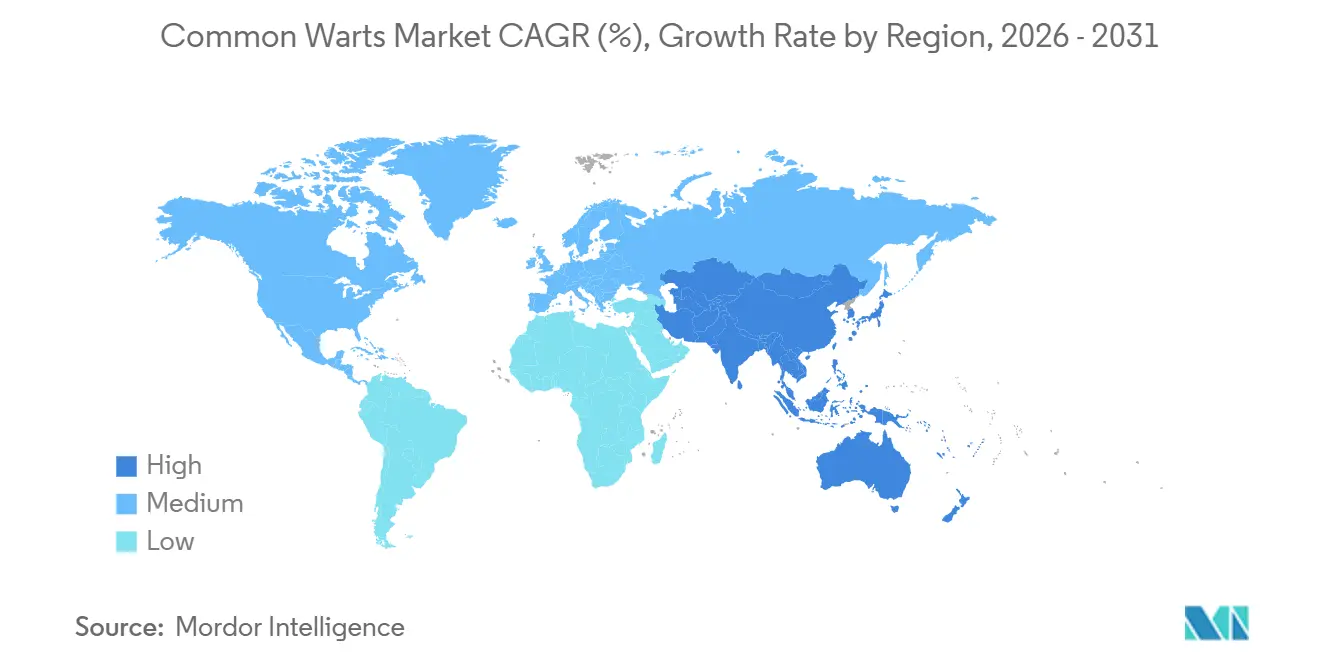
- By geography, North America held 44.17% of the segment value in 2025, while Asia-Pacific is forecast to grow at a 6.32% CAGR through 2031.
Note: Market size and forecast figures in this report are generated using Mordor Intelligence’s proprietary estimation framework, updated with the latest available data and insights as of January 2026.
Market Trends and Insights
Drivers Impact Analysis of Common Warts Market*
| Driver | (~) % Impact on CAGR Forecast | Geographic Relevance | Impact Timeline |
|---|---|---|---|
| Rising Treatment-Seeking from Persistent Lesions | +1.2% | Global, led by North America and Europe | Medium term (2-4 years) |
| OTC Access and Self-Care Adoption | +1.0% | Global, strongest in North America and Asia-Pacific | Short term (≤ 2 years) |
| Expansion of Dermatology and Teledermatology Access | +0.8% | North America and APAC core, spill-over to MEA | Medium term (2-4 years) |
| Demand for Minimally Invasive, Patient-Friendly Therapies | +0.7% | Global, concentrated in Europe and North America | Medium term (2-4 years) |
| Pipeline Validation of Disease-Modifying Immunotherapies | +0.6% | North America and Japan, expanding to Asia | Long term (≥ 4 years) |
| HPV-Targeted Topicals for Recalcitrant Disease | +0.5% | North America, Europe, Japan | Long term (≥ 4 years) |
| Source: Mordor Intelligence | |||
Rising Treatment-Seeking from Persistent Lesions
Cutaneous warts affect an estimated 7% to 12% of the global population at a given time, supporting a recurring base of potential treatment demand. Lesions that remain for 12 to 18 months often become harder for patients to ignore, especially on the hands or around nails. Their visibility and effect on routine work can lead patients to move from watchful waiting to active treatment. Repeating disease also matters because recurrence occurred in 35% of treated cases within 1 year in clinical guidance. The common wart market therefore benefits when persistent disease prompts patients to use several treatment options over time. Adults whose work involves manual tasks, food preparation, contact sports, or public-facing activity may be more willing to pursue procedures when a lesion interferes with daily activity.
OTC Access and Self-Care Adoption
Salicylic acid is available through the U.S. OTC framework for wart removal, which makes pharmacy and retail channels a usual starting point for uncomplicated cases. Products are sold as liquids, gels, medicated pads, patches, and freezing kits, giving consumers several ways to begin treatment. The American Academy of Dermatology identifies salicylic acid as a home-treatment option and describes daily use over a period that can extend to 12 weeks.[1] This access maintains high consumer volume in the Common warts market, particularly for initial lesions. It also supports clinical demand because patients whose lesions do not clear can subsequently seek a dermatology consultation. OTC freezing devices widen self-treatment options, although their performance and patient experience differ from clinic-based liquid nitrogen procedures.
Expansion of Dermatology and Teledermatology Access
Teledermatology can reduce the time and travel required for a patient to obtain a specialist assessment of a suspected wart. Image-based consultation can help a dermatologist confirm the presentation, explain treatment choices, and direct a patient to in-person care when a procedure is needed. Teladoc Health expanded access to dermatology through Walmart Better Care Services in May 2026, including diagnosis and treatment planning for skin conditions. The Common warts market gains from this pathway when failed self-treatment is identified and referred to clinic care. Greater access also favors procedures that are delivered under supervision, including cryotherapy, laser treatment, and emerging intralesional approaches. Patient preference for treatments that limit pain, tissue injury, and repeated visits encourages clinics to evaluate options beyond standard lesion destruction.
Demand for Minimally Invasive, Patient-Friendly Therapies
Nielsen BioSciences reported positive Phase 3 results for CANDIN in May 2026, with complete clearance of the injected wart in 45.4% of treated participants compared with 23.4% for saline placebo. The same announcement reported distal wart clearance of 27.6% with CANDIN and 16.0% with placebo. These data matter because immune-directed treatment may address the disease beyond the individual lesion that was injected. CANDIN had an anticipated FDA submission in the second half of 2026, while YCANTH continued in global Phase 3 development for common warts.[2] The Common warts market could gain a labeled prescription option if these programs progress through regulatory review. HPV-targeted topical and immune-based approaches may also reduce reliance on repeated destructive procedures for patients with difficult disease.
Restraints Impact Analysis of Common Warts Market*
| Restraint | (~) % Impact on CAGR Forecast | Geographic Relevance | Impact Timeline |
|---|---|---|---|
| Spontaneous Resolution and Watchful Waiting | -1.2% | Global, strongest in pediatric-heavy markets | Short term (≤ 2 years) |
| Treatment Failure and Recurrence | -0.9% | Global | Medium term (2-4 years) |
| Pain, Scarring, and Repeat-Visit Burden | -0.7% | North America and Europe | Short to Medium term (≤ 4 years) |
| Limited Disease-Specific Approval and Reimbursement | -0.8% | North America, with a partial overhang in Europe | Medium term (2-4 years) |
| Source: Mordor Intelligence | |||
Spontaneous Resolution and Watchful Waiting
Two-thirds of common warts in immunocompetent patients resolve within 2 years without treatment, which limits demand for formal care. Dermatology guidance accepts watchful waiting for low-risk and asymptomatic lesions, particularly when the treatment discomfort outweighs the benefit of faster removal. This pattern is important in children and adolescents, who form the largest patient group but often begin with observation or over-the-counter care. Existing therapies can also leave patients uncertain about paying for repeat procedures because recurrence remains common. A 2025 meta-analysis found that oral zinc sulfate used with traditional treatments reduced 6-month recurrence, showing why adjunctive immune-related approaches continue to attract attention.[3] Until durable clearance becomes more predictable, treatment spending may remain concentrated among people whose lesions persist, recur, spread, or disrupt daily life.
Pain, Scarring, and Repeat-Visit Burden
Cryotherapy and other lesion-destruction methods can require several visits and may cause pain or tissue injury. These practical issues can deter patients from moving beyond self-care, even after an OTC product has failed. Periungual and subungual lesions are especially difficult because their location can make destructive treatment less convenient and more uncomfortable. No disease-specific FDA-approved prescription therapy was available for common warts in the source material, which has kept care dependent on off-label protocols and established procedures. Payment decisions may further restrict procedure use when a payer treats benign wart removal as cosmetic rather than medically necessary. The common wart market remains exposed to these barriers until more durable and labeled therapies provide clearer clinical and reimbursement pathways.
*Our forecasts treat driver/restraint impacts as directional, not additive. The impact forecasts reflect baseline growth, mix effects, and variable interactions.
Common Warts Market Segment Analysis
By Treatment Type:
Topical Products Lead Use While Laser Therapy Gains GroundTopical medications accounted for 43.87% of the treatment-type value in 2025, making them the largest part of the Common warts market size within this segmentation. Salicylic acid-based products support this position because they are readily available without a prescription and can be used at home. Their keratolytic action, retail distribution, and range of liquids, gels, pads, and patches make them accessible for initial or uncomplicated lesions. Immunotherapy-based topicals, including imiquimod, represent a prescription-focused portion of the category. Coverage rules can require a patient to try generic imiquimod 5% cream before a branded product is authorized, as shown in a policy effective in July 2025.[4]
Laser therapy is projected to grow at a 6.13% CAGR through 2031, the highest rate among treatment modalities. Clinics can use aesthetic laser systems for wart removal without purchasing a separate platform, which supports their operating economics. A 2026 review across 15 studies found comparable efficacy for pulsed-dye and Nd: YAG lasers in refractory warts, with lower hemorrhagic risk for pulsed-dye laser treatment. Cryotherapy remains a familiar physician-administered option, although pain and inconsistent freeze depth support demand for alternatives. Electrosurgery and photodynamic therapy serve narrower groups, with a 2024 study reporting a 70.6% excellent response rate and a 37% relapse rate within 52 weeks for recalcitrant hand warts.

By Patient Group:
Children Create Volume While Adults Support Faster GrowthChildren and adolescents held 46.31% of patient-group value in 2025, reflecting the spread of HPV types 1, 2, and 4 through skin contact in school and recreational settings. This group supports broad treatment volume in the Common warts market, yet its value per treatment episode is limited by watchful waiting and first-line OTC use. Caregivers may avoid clinic cryotherapy when they expect discomfort or believe the lesion could resolve naturally. A study of tirbanibulin 1% ointment for pediatric hand warts began recruiting in May 2025 and addresses the need for better-tolerated topical care. The CANDIN agreement expansion across Asian territories places the pediatric burden within a future commercial pathway for immunotherapy.
Adults are expected to grow at a 5.88% CAGR through 2031, the fastest pace among patient groups. Working-age adults may seek treatment sooner in the Common warts market when lesions affect dexterity, food preparation, manual work, sport, or public interaction. Periungual warts can be difficult to conceal and may not respond well to OTC monotherapy, increasing the use of clinic-based combinations. An ongoing randomized trial compares imiquimod 5% cream plus cryotherapy with either treatment alone and is expected to be completed in 2026. Elderly patients remain clinically important because immunosenescence can reduce spontaneous clearance, and topical selection must consider skin resilience and concurrent medication use.
By Lesion Profile:
Initial Disease Drives Access While Recalcitrant Disease Draws InvestmentInitial lesions accounted for 46.22% of the lesion-profile value in 2025 and served as the main entry point for self-care and primary-care treatment. Salicylic acid is a common first option for a single uncomplicated wart, with daily use often continuing for up to 12 weeks. High accessibility makes this group central to consumer product volume in the Common warts market. Moderate or multiple lesions in the Common warts market are more likely to move beyond topical monotherapy into cryotherapy or combination treatments. Phase IIa results for purified Candida antigen reported better clearance of distal untreated warts in multiple-lesion presentations.
Severe or recalcitrant lesions are projected to expand at a 5.92% CAGR through 2031, the strongest growth rate in the lesion-profile segmentation. This group is a key future opportunity for the Common warts industry because failed destructive therapies can lead to specialist referral and immune-based protocols. CANDIN Phase 3 findings reported that more than 60% of responders achieved durable clearance within 4 injections. A 2024 systematic review of 24 randomized controlled trials also found superior complete clearance with intralesional Candida antigen versus placebo. Periungual and subungual disease complicates physical ablation and strengthens the rationale for immune activation over repeated destruction of individual lesions.
By End User:
Home Care Has the Broadest Reach While Dermatology Clinics Add ValueHome care and self-treatment held 47.29% of the end-user value in 2025, the largest portion of the Common warts market size for end users. Pharmacy chains, grocery retailers, and e-commerce channels make established wart products easy to obtain. Compound W offers gels, liquids, medicated pads, and freeze kits that serve different lesion types and consumer preferences. Primary-care practices and pharmacies occupy a middle position by managing straightforward cases and directing patients when a lesion does not improve. Unsuccessful self-treatment can later lead to referrals to specialists in the Common warts market.
Dermatology clinics are forecast to grow at a 5.68% CAGR through 2031, supported by self-care failures, teledermatology triage, and physician-administered protocols. The Teladoc Health and Walmart service, introduced in May 2026, provides a route from virtual evaluation to an in-person treatment plan when clinical procedures are appropriate. Clinics in the Common warts market are positioned to offer cryotherapy, laser procedures, intralesional therapy, and complex combination care. Hospitals and ambulatory surgical centers address difficult periungual, subungual, and surgically complex cases. This division gives consumer channels an access role and clinics an escalation role in the Common Warts market.
Geography Analysis
North America Common Warts Market
North America held 44.17% of the 2025 value, giving it the largest regional position in the Common warts market. The region combines broad OTC access with a developed network of dermatology clinics and commercially insured patients. Medicare's classification of benign wart removal as cosmetic can limit reimbursement for some patients and constrain procedure revenue in older populations. Canada adds publicly funded primary-care cryotherapy, while Mexico’s expanding private dermatology setting supports greater access for a younger population. Community teledermatology projects in the Bronx and Los Angeles received grants in 2026, extending specialist support to underserved groups.[5]
Europe Common Warts Market
Europe has established topical and cryotherapy use, while prescribers still rely on protocol guidance because a common-wart-specific label is absent. The United Kingdom provides cryotherapy through primary-care dermatology services, while Germany covers initial treatment through primary-care consultations. Haleon’s Bazuka range demonstrates the role of established consumer brands in pharmacy and grocery channels. Spain and Italy have lower clinical-visit use for minor skin conditions, while private dermatology networks in major cities are gradually formalizing care.
APAC Common Warts Market
Asia-Pacific is projected to grow at a 6.32% CAGR through 2031, the fastest regional rate in the Common warts market. China’s streamlined OTC registration pathways support wider consumer access, especially in cities with limited specialist capacity. In Japan, Torii Pharmaceutical launched YCANTH for molluscum contagiosum in February 2026 and initiated a domestic Phase III study of TO-208 for common warts in June 2026. The Maruho and Nielsen BioSciences license expansion covers China, South Korea, Taiwan, Hong Kong, Macau, and ASEAN countries, with milestone and royalty payments of up to USD 36 million.
Competitive Landscape
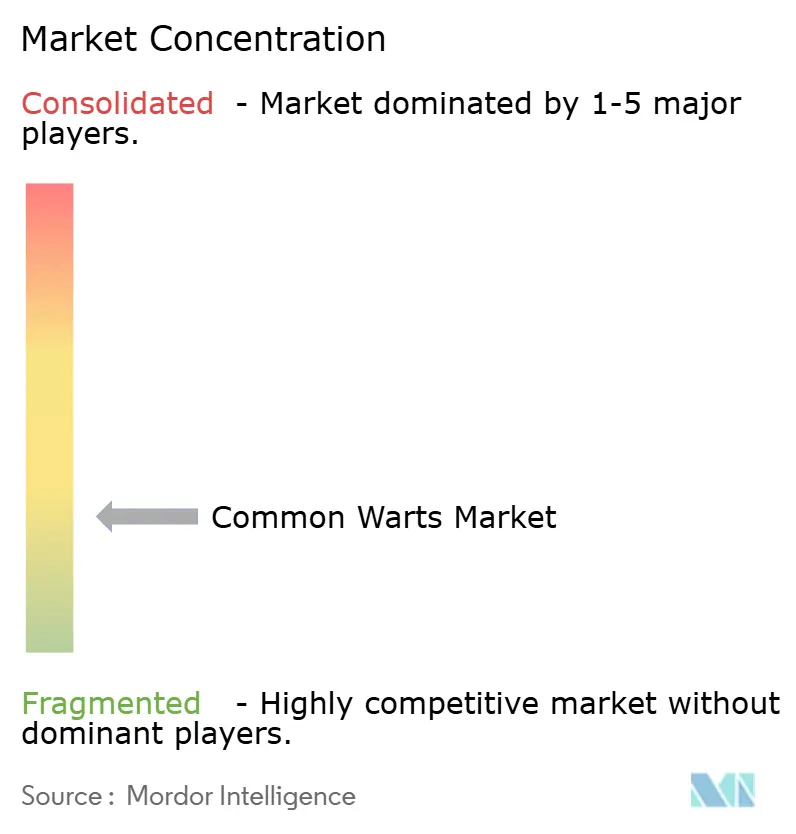
The common wart market is fragmented in the OTC tier because no single company holds a controlling share in the supplied material. Companies compete through delivery formats, retail placement, online visibility, and brand recognition rather than major differences in active ingredients. Haleon, Prestige Consumer Healthcare, Perrigo, Scholl’s Wellness Company, and Sanofi offer freeze sprays, hydrocolloid patches, gels, liquids, and precision applicators across retail and e-commerce channels. Teva Pharmaceutical and Viatris provide generic imiquimod, while Bausch Health markets Zyclara for external genital warts and has off-label relevance for recalcitrant common wart cases.
Brymill Cryogenic Systems and CryoSurgery Inc. participate in the in-office segment through liquid nitrogen delivery systems designed for greater application precision. Their position reflects the continuing role of cryotherapy as a familiar procedure, even as clinics assess alternatives that may improve comfort or response durability. Nielsen BioSciences reported positive Phase 3 CANDIN data in May 2026 and stated that it planned an FDA submission in the second half of 2026. Verrica and Torii advanced the global COVE-2 program for YCANTH, with the first patient dosed in December 2025. A first labeled therapy could concentrate the prescription portion of the Common warts market around the successful developer.
Verrica and Torii structured their collaboration to support global development, with Torii covering the first USD 40 million of out-of-pocket trial costs under the COVE-2 arrangement. Torii also began a Japan-specific Phase III study of TO-208 in June 2026, strengthening its regional position. Nielsen BioSciences expanded its CANDIN license arrangement with Maruho across additional Asian territories in October 2025. These transactions show how commercial partners are preparing for a potential labeled-treatment category. Established consumer companies will retain an important role in the Common warts market because many initial presentations will continue to start with self-care.
Common Warts Industry Leaders
-
Bausch Health Companies Inc.
-
Haleon plc
-
Perrigo Company plc
-
Prestige Consumer Healthcare Inc.
-
Scholl’s Wellness Company
- *Disclaimer: Major Players sorted in no particular order
Common Warts Market Companies Covered in this Report
- Aclaris Therapeutics, Inc.
- Almirall S.A.
- Bayer
- Bausch Health
- Brymill Cryogenic Systems
- Cipla
- CryoSurgery Inc.
- GlaxoSmithKline
- Haleon plc
- Maruho Co., Ltd.
- Nielsen BioSciences, Inc.
- Novan, Inc.
- Perrigo Company
- Prestige Consumer Healthcare
- Sanofi
- Scholl's Wellness Company
- Teva Pharmaceutical Industries
- Torii Pharmaceutical
- Verrica Pharmaceuticals Inc.
- Viatris
Recent Industry Developments in Common Warts Market
- May 2026: Nielsen BioSciences announced positive Phase 3 topline results for CANDIN (Purified Candida albicans Antigen) in common warts, demonstrating 45.4% complete clearance of the injected wart versus 23.4% for placebo (p<0.001) and 27.6% distal wart clearance versus 16.0% for placebo (p=0.023).
- May 2026: Teladoc Health launched dermatology services, including common wart diagnosis and treatment planning, through Walmart's Better Care Services platform, enabling U.S. consumers to access board-certified dermatologists virtually within 24 hours on both insured and cash-pay terms.
- March 2026: Verrica Pharmaceuticals and Torii Pharmaceutical initiated COVE-4 (NCT07457918), a Phase 3 open-label long-term follow-up study for YCANTH (VP-102/TO-208) in common warts. The study enrolls participants from COVE-2 and COVE-3 and runs through May 2028, providing safety and durability data intended to support regulatory submissions in multiple jurisdictions.
Global Common Warts Market Report Scope
The common warts market comprises products, therapies, procedures, and healthcare services used to treat, manage, and prevent common warts. Common warts are benign skin growths primarily caused by infection with certain types of human papillomavirus (HPV). The market includes pharmaceutical, device-based, and procedural solutions designed to eliminate warts, reduce recurrence, and improve patient outcomes across various healthcare settings.
The common warts market is segmented by treatment type, patient group, lesion profile, end user, and geography. By treatment type, it is further divided into topical medications, cryotherapy, laser therapy, and others. By patient group, it is segmented into children and adolescents, adults, and elderly patients. By lesion profile, the market is segmented into initial lesions, moderate or multiple lesions, severe or recalcitrant lesions, and periungual and subungual lesions. By end user, the market is segmented into home care and self-treatment, dermatology clinics, hospitals, ambulatory surgical centers, and primary-care practices and pharmacies. The geography segment is further divided into North America, Europe, Asia-Pacific, the Middle East and Africa, and South America. The report also covers the estimated market sizes and trends for 17 countries across major regions globally. The report offers the market size and forecasts in value (USD) for the above segments.
| Topical Medications | Salicylic Acid-Based Therapy |
| Immunotherapy-Based Topicals | |
| Retinoid-Based Therapy | |
| Silver Nitrate, Glutaraldehyde, and Formaldehyde | |
| Cryotherapy | Liquid Nitrogen Therapy |
| Carbon Dioxide Therapy | |
| Laser Therapy | Pulsed-Dye Laser Therapy |
| Carbon Dioxide Laser Therapy | |
| Others (Electrosurgery, Photodynamic Therapy etc.) |
| Children and Adolescents |
| Adults |
| Elderly Patients |
| Initial Lesions |
| Moderate or Multiple Lesions |
| Severe or Recalcitrant Lesions |
| Periungual and Subungual Lesions |
| Home Care and Self-Treatment |
| Dermatology Clinics |
| Hospitals |
| Ambulatory Surgical Centers |
| Primary-Care Practices and Pharmacies |
| North America | United States |
| Canada | |
| Mexico | |
| Europe | Germany |
| United Kingdom | |
| France | |
| Italy | |
| Spain | |
| Rest of Europe | |
| Asia-Pacific | China |
| Japan | |
| India | |
| Australia | |
| South Korea | |
| Rest of Asia-Pacific | |
| Middle East and Africa | GCC |
| South Africa | |
| Rest of Middle East and Africa | |
| South America | Brazil |
| Argentina | |
| Rest of South America |
| By Treatment Method | Topical Medications | Salicylic Acid-Based Therapy |
| Immunotherapy-Based Topicals | ||
| Retinoid-Based Therapy | ||
| Silver Nitrate, Glutaraldehyde, and Formaldehyde | ||
| Cryotherapy | Liquid Nitrogen Therapy | |
| Carbon Dioxide Therapy | ||
| Laser Therapy | Pulsed-Dye Laser Therapy | |
| Carbon Dioxide Laser Therapy | ||
| Others (Electrosurgery, Photodynamic Therapy etc.) | ||
| By Patient Demographics | Children and Adolescents | |
| Adults | ||
| Elderly Patients | ||
| By Lesion Profile | Initial Lesions | |
| Moderate or Multiple Lesions | ||
| Severe or Recalcitrant Lesions | ||
| Periungual and Subungual Lesions | ||
| By End User | Home Care and Self-Treatment | |
| Dermatology Clinics | ||
| Hospitals | ||
| Ambulatory Surgical Centers | ||
| Primary-Care Practices and Pharmacies | ||
| By Geography | North America | United States |
| Canada | ||
| Mexico | ||
| Europe | Germany | |
| United Kingdom | ||
| France | ||
| Italy | ||
| Spain | ||
| Rest of Europe | ||
| Asia-Pacific | China | |
| Japan | ||
| India | ||
| Australia | ||
| South Korea | ||
| Rest of Asia-Pacific | ||
| Middle East and Africa | GCC | |
| South Africa | ||
| Rest of Middle East and Africa | ||
| South America | Brazil | |
| Argentina | ||
| Rest of South America | ||
Key Questions Answered in the Report
What is the forecast value of the Common warts market in 2031?
The Common warts market is forecast to reach USD 3.47 billion by 2031, growing at a 4.87% CAGR from 2026. The outlook reflects persistent lesions, consumer self-treatment, and specialist care pathways across the Common warts market. This pattern supports steady demand across care settings.
Which treatment type has the largest role in common wart care?
Topical medications held 43.87% of treatment-type value in 2025, supported by widely available salicylic acid products.
Which patient group is expected to grow the fastest?
Adults are forecast to grow at a 5.88% CAGR through 2031, supported by greater treatment seeking for persistent or inconvenient lesions.
Why do patients move from home treatment to dermatology clinics?
They may seek specialist care after OTC products fail, when lesions recur, or when a lesion needs cryotherapy, laser treatment, or another supervised approach
Which region is projected to grow fastest for common wart treatment?
Asia-Pacific is projected to grow at a 6.32% CAGR through 2031, supported by OTC access and clinical development activity.
Which prescription programs are advancing for common warts?
CANDIN reported positive Phase 3 results in May 2026, while YCANTH continued through Phase 3 development.