
Commercial Wallpaper Market Size and Share
Market Overview
| Study Period | 2020 - 2031 |
|---|---|
| Market Size (2026) | USD 7 Billion |
| Market Size (2031) | USD 8.61 Billion |
| Growth Rate (2026 - 2031) | 4.23 % |
| Fastest Growing Market | Asia-Pacific |
| Largest Market | North America |
| Market Concentration | Low |
Major Players *Disclaimer: Major Players sorted in no particular order Image © Mordor Intelligence. Reuse requires attribution under CC BY 4.0. | |
Commercial Wallpaper Market Analysis by Mordor Intelligence
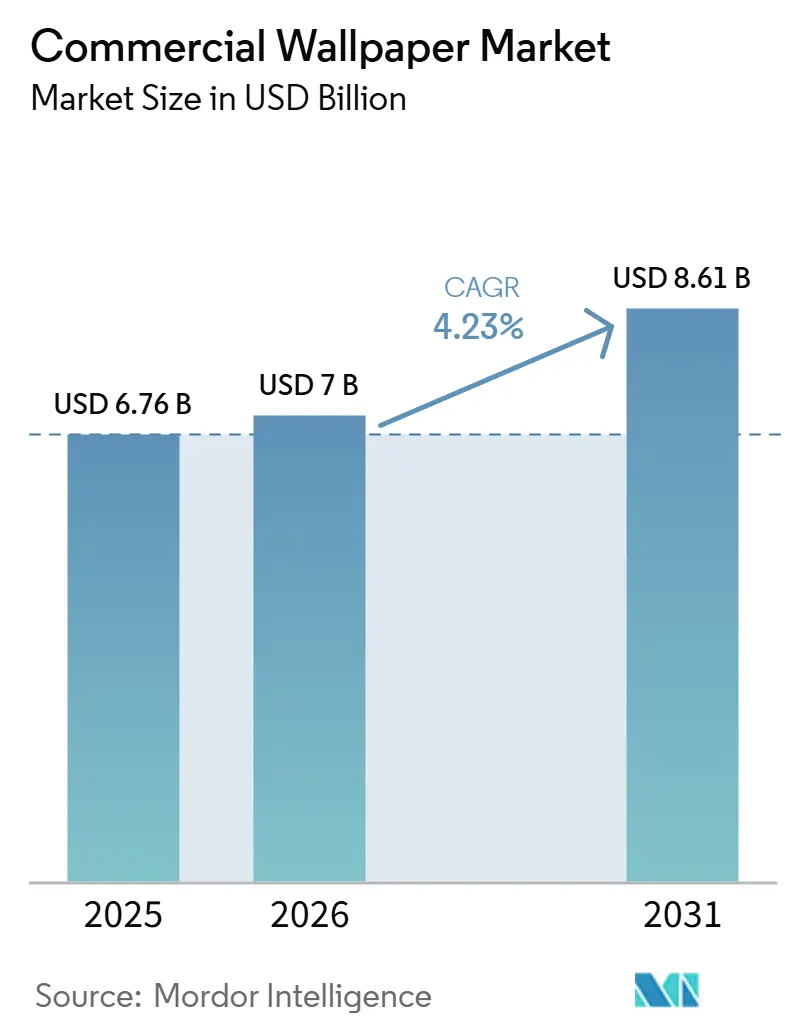
The commercial wallpaper market size was valued at USD 6.76 billion in 2025, is estimated to grow to USD 7.0 billion in 2026, and is forecast to reach USD 8.61 billion by 2031, growing at a CAGR of 4.2% over 2026-2031. The commercial wallpaper market is benefiting from hospitality operators, healthcare providers, and corporate landlords treating wallcoverings as a specified interior material rather than a discretionary finish. Short-run digital production is making custom wallcoverings more practical for mid-sized projects, especially when design requirements change late in the project cycle. Healthcare and corporate buyers are also placing greater weight on documented performance in fire, scrub, air quality, and chemical resistance. These requirements give suppliers with tested products and clear documentation a stronger position in the specification and procurement process. Competition remains fragmented, so product breadth, turnaround time, and relationships with architects matter alongside manufacturing scale.
Key Report Takeaways
- By material type, solid vinyl accounted for 46.8% of the commercial wallpaper market size in 2025, while non-woven vinyl is projected to grow at a 4.9% CAGR through 2031.
- By application, new construction accounted for 53.5% of the commercial wallpaper market share in 2025, while renovation and remodeling are forecast to expand at a 4.6% CAGR through 2031.
- By end user, hospitality held 29.4% of demand in 2025, while healthcare is projected to grow at a 4.7% CAGR through 2031.
- By distribution channel, direct sales held 61.2% of demand in 2025, while indirect channels are forecast to grow at a 4.4% CAGR through 2031.
- By geography, North America accounted for 36.3% of 2025, while Asia-Pacific is the fastest-growing region, with a projected 4.7% CAGR through 2031.
Note: Market size and forecast figures in this report are generated using Mordor Intelligence’s proprietary estimation framework, updated with the latest available data and insights as of January 2026.
Global Commercial Wallpaper Market Trends and Insights
Drivers Impact Analysis*
| Driver | (~) % Impact on CAGR Forecast | Geographic Relevance | Impact Timeline |
|---|---|---|---|
| Hospitality Renovation and Brand-Experience Investment | +1.0% | Global, concentrated in North America, the Middle East and Africa, and the Asia-Pacific | Medium term (2-4 years) |
| Digitally Printed and Customized Commercial Interiors | +0.8% | Global, with early gains in North America and Europe | Medium term (2-4 years) |
| Durable, Scrubbable, and Fire-Rated Wallcoverings | +0.6% | Global, with strong compliance influence in North America and Europe | Long term (≥ 4 years) |
| Healthcare, Retail, and Flexible Workplace Refurbishment | +0.7% | Global, concentrated in North America, Europe, and the Asia-Pacific | Long term (≥ 4 years) |
| Acoustic and Biobased Wallcovering Adoption | +0.4% | North America and Europe | Long term (≥ 4 years) |
| Print-On-Demand Production Cycles | +0.3% | Global, with early gains in North America and the United Kingdom | Short term (≤ 2 years) |
| Source: Mordor Intelligence | |||
Hospitality Renovation and Brand-Experience Investment
The commercial wallpaper market is supported by hospitality refurbishment, where operators refresh interiors more often to maintain brand standards. Luxury operators have moved toward 5-7-year refresh cycles, compared with 10-year cycles used a decade earlier. The GCC hotel pipeline included 161,574 rooms across 650 active projects in Q2 2025, with Saudi Arabia accounting for more than 340 hotels and over 92,000 rooms. United States hotel renovation and brand conversion activity totaled 2,118 projects at the end of Q4 2025. Property improvement plans commonly specify wallcovering type, fire rating, and scrub resistance. This makes approved products less exposed to bids based only on initial purchase price.
Digitally Printed and Customized Commercial Interiors
Digital printing supports the commercial wallpaper market by reducing minimum order quantities and shortening project lead times. Wallquest installed 4 HP Latex FS70 W printers in April 2026 and reported a 30% improvement in overall production performance [1]Paul Restarick, “The Future of Wallcoverings: Expert Interview on Epson Resin Printing,” TEXINTEL, texintel.com. Newmor added a Canon Colorado M5W printer and Neolt finishing equipment to support bespoke commercial work. These investments allow architects to specify small custom runs for reception areas and feature walls. Shorter runs also reduce inventory needs for suppliers and project teams. Muraspec’s Mural Book used GREENGUARD Gold-certified, VOC-free UV inks, demonstrating that customized products can also meet indoor air quality requirements.
Durable, Scrubbable, and Fire-Rated Wallcoverings
Performance requirements are expanding the role of documented commercial wallcoverings in the commercial wallpaper market. ASTM F793 Type II products rated for 10,000 scrub cycles are widely specified in hospitality corridors and clinical spaces. Koroseal introduced the Fortis Collection in February 2026 with 8 Type II designs, Class A fire ratings, woven backing, California indoor air quality compliance, and Health Product Declarations. A 2026 journal study found that ISO 22196 and ISO 21702 together provide a broader framework for evaluating antibacterial and antiviral wallcovering performance. Suppliers with accessible test data can respond more effectively to procurement requests than suppliers relying on unsupported product claims. Fire compliance under ASTM E-84 in North America and EN 13501-1 in Europe also limits substitution by lower-specified materials.
Healthcare, Retail, and Flexible Workplace Refurbishment
Healthcare is the fastest-growing end-user segment in the commercial wallpaper market, with a projected 4.7% CAGR through 2031. Clinical buyers seek wallcoverings that can withstand repeated cleaning and meet documented surface-performance requirements. Antimicrobial wallcovering products for hospitals and clinics focus on hygiene and cleaning durability. Flexible workplaces use peel-and-stick and paste-the-wall non-woven formats for reversible branded interior changes. Retailers use digitally printed wallcoverings to maintain a common brand identity while adapting designs by location. These end uses broaden demand beyond the hospitality projects that have historically anchored the category.
Restraints Impact Analysis*
| Restraint | (~) % Impact on CAGR Forecast | Geographic Relevance | Impact Timeline |
|---|---|---|---|
| Substitution from Paint, Decorative Panels, and Architectural Films | -0.7% | Global, strongest in South America, and price-sensitive Asia-Pacific segments | Long term (≥ 4 years) |
| PVC, Non-Woven Substrate, and Adhesive Cost Volatility | -0.4% | Global | Short term (≤ 2 years) |
| Installation, Substrate Preparation, and Skilled-Labor Constraints | -0.3% | North America and Europe | Medium term (2-4 years) |
| Certification and End-Of-Life Complexity for Multilayer Wallcoverings | -0.2% | North America and Europe, with emerging compliance pressure in the Asia-Pacific | Long term (≥ 4 years) |
| Source: Mordor Intelligence | |||
Substitution from Paint, Decorative Panels, and Architectural Films
Paint, decorative panels, and architectural films remain important substitutes for the commercial wallpaper market. Paint keeps an estimated 75% of global interior-surface spending and generally has lower installed material and labor costs. Painted finishes are especially competitive where project budgets favor speed and low upfront costs. Architectural films are also used in retail refurbishments that require quick installation and easy removal. Wallcovering suppliers are responding with peel-and-stick formats, textured printing, and biobased substrates. The price gap remains a constraint in South America and price-sensitive Asian commercial projects.
PVC, Non-Woven Substrate, And Adhesive Cost Volatility
PVC resin costs expose the Commercial wallpaper market to movements in petrochemical feedstocks, supply conditions, and logistics costs. Non-woven substrates also depend on energy inputs and polypropylene fiber pricing. Higher input prices can lead architects to select paint or films when project budgets cannot cover the revised cost of wallcovering. Shortages of skilled installers add pressure because wallcovering requires careful substrate preparation and trained labor. Sustainability documentation can add a further cost for smaller suppliers that must maintain certifications across several product lines. Wolf-Gordon notes that the NSF/ANSI 342 sustainability standard is being updated to incorporate human health and wellness considerations [2]“Sustainability,” Wolf-Gordon, wolfgordon.com.
*Our forecasts treat driver/restraint impacts as directional, not additive. The impact forecasts reflect baseline growth, mix effects, and variable interactions.
Segment Analysis
By Material Type: Non-Woven Vinyl Gains Specification Momentum
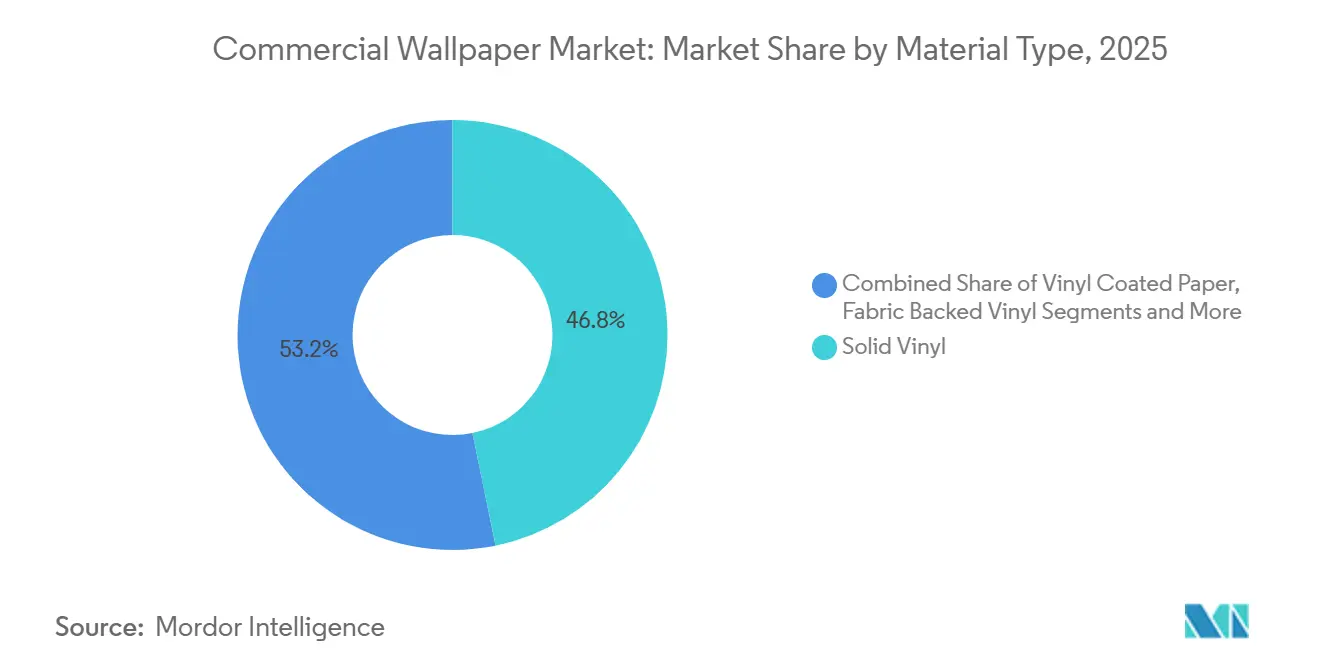
Solid vinyl held 46.8% of 2025 demand, making it the largest material category in the commercial wallpaper market. It remains established in high-traffic hospitality corridors, clinical settings, and corporate interiors that require Type II scrub performance and Class A fire characteristics. Vinyl-coated paper remains relevant for renovation projects that need a balance between cost and functional performance. Fabric-backed vinyl is well-suited to premium hospitality lobbies and corporate settings where durability and acoustic properties are valued. Non-woven vinyl is forecast to expand at a 4.9% CAGR through 2031. Its paste-the-wall application reduces installation time and preparation requirements, which is useful where installer availability is limited.
PVC-free, biobased, and natural-fiber formats remain smaller in volume but receive greater attention in project specifications that pursue material-health objectives. The commercial wallpaper industry is therefore serving both conventional performance needs and projects with sustainability requirements. Ahlstrom introduced WallStar Digital Advance and WallStar Digital Essential in 2025 for digital-printing applications, including a PVC-free Type II option and a product using FSC-certified pulp and recycled components. These offerings show how material suppliers are addressing both performance and environmental documentation. The market for non-woven vinyl benefits from labor-saving installation, while solid vinyl keeps demand in locations with intensive wear. This balance allows suppliers to serve a wider range of building specifications. In practice, design teams compare the appearance of finishes, cleaning requirements, fire performance, installation methods, and documentation before selecting a substrate. Products that reduce site labor can be particularly useful for occupied buildings, where project managers seek to limit noise, dust, and downtime. Suppliers also need to provide samples and technical support to help designers distinguish among material options.


By Application: Renovation Gains Ground Alongside New Construction
New construction accounted for 53.5% of 2025 application demand and was the largest application in the commercial wallpaper market. Hotel openings in Asia-Pacific, GCC developments, and North American healthcare projects create a pre-opening purchasing window for wallcoverings. The 2026 hotel pipeline included 15,900 projects and 2.4 million rooms, although wallcovering specifications are often concentrated among major contractors and approved suppliers. New-build demand, therefore, remains closely linked to commercial construction starts. It is also more sensitive to delays in project financing and completion schedules. Large projects can still create meaningful order volumes for established suppliers. These orders often require early engagement because samples, mock-ups, and performance information are considered before the final interior package is approved. Supplier panels may narrow options for new projects, but they can also create a predictable route for products that have already met the required technical criteria. This emphasis on prior approval favors firms with established specification relationships.
Renovation and remodeling are forecast to grow at a 4.6% CAGR through 2031, faster than new construction. Brand refreshes, asset repositioning, and office reconfiguration distribute this work across many smaller projects. The commercial wallpaper market size for renovation is supported by mature North American and European property bases that require recurring upgrades. Refurbishment activity can continue even when new construction peaks decline. Hybrid workplace design adds another source of demand as tenants adapt layouts, meeting rooms, and shared spaces. Suppliers with distributor coverage and the ability to handle smaller orders are well-positioned to complete these projects. Renovation buyers commonly need replacement materials, localized designs, or limited quantities that do not justify a large direct order. This work can generate recurring sales across a broad property base rather than a single construction cycle. It also makes stock availability and responsive customer service more important for channel partners.
By End User: Healthcare Creates a Higher Performance Requirement
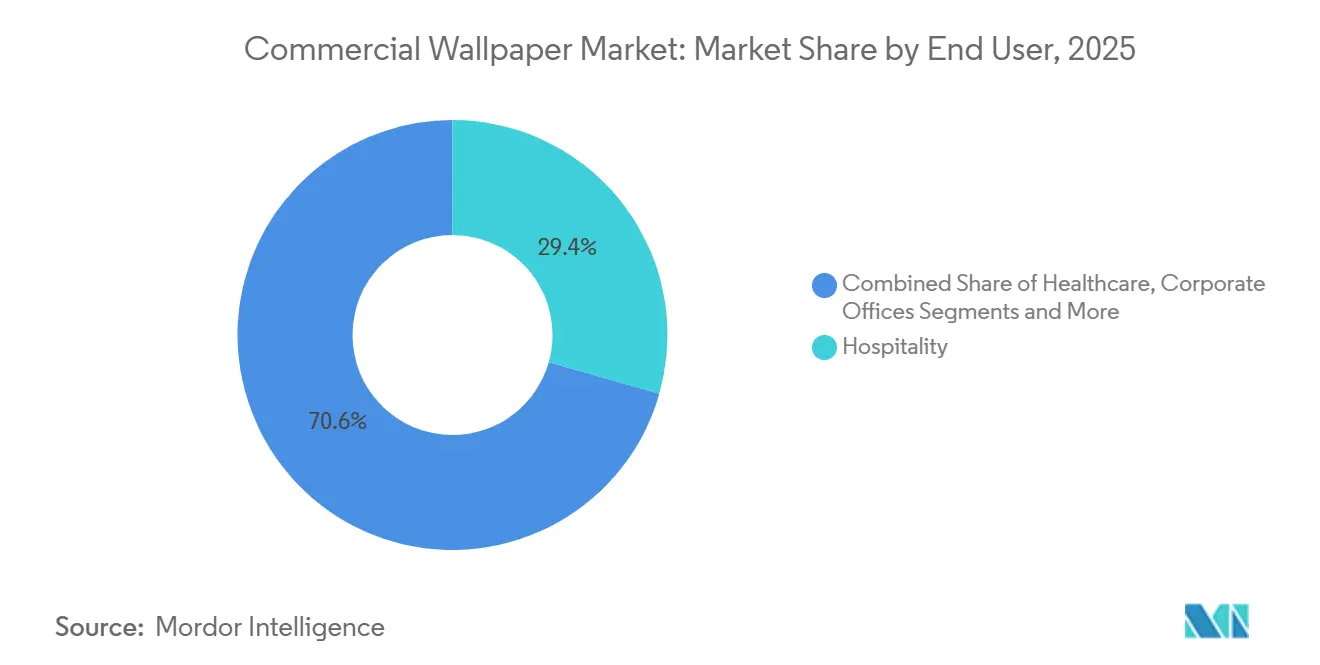
Hospitality held 29.4% of 2025 demand and remained the leading end-user segment in the commercial wallpaper market. Luxury and upper-upscale properties used wallcoverings in guestrooms, corridors, lobbies, and other public areas to support the operator’s brand and ensure visual consistency. Procurement requirements typically include durability, scrub resistance, and fire safety. The hotel development pipeline also creates an ongoing source of specified interior work in the GCC and Asia-Pacific. Hospitality remains important because renovation cycles create repeat demand after the initial installation. Its project sizes can provide suppliers with substantial volume. Hospitality designers often use wallcoverings to create a consistent visual identity across rooms, corridors, lounges, and reception spaces. Material selection must also account for cleaning routines, guest traffic, and the timing of phased renovation work. These practical requirements make durability and installation planning as important as pattern selection.
Healthcare is forecast to advance at a 4.7% CAGR through 2031, making it the fastest-growing end-user segment. The commercial wallpaper market size in healthcare is driven by cleaning resistance, antimicrobial performance, impact resistance, and compliance documentation. ISO 22196 and ISO 21702 provide reference methods for assessing antibacterial and antiviral performance in wallcovering coatings. Corporate offices and co-working sites also use reversible formats for short-tenure fit-outs. Retail, education, transport, and marine spaces add stable demand where moisture resistance and fire compliance are important. These uses reduce reliance on a single end-user category. Healthcare projects place the greatest weight on documented surface performance, while office projects often prioritize reversibility and brand updates. Retail sites require visual consistency across multiple locations but may need local customization. Transport and marine interiors impose demanding conditions for moisture, cleaning, and fire safety.
By Distribution Channel: Indirect Channels Extend Mid-Market Access
Direct manufacturer sales accounted for 61.2% of 2025 distribution demand, reflecting the commercial wallpaper market’s project-led purchasing model. Large hospitality and healthcare specifications are commonly handled through manufacturer representatives, architects, and procurement teams. Direct contact gives suppliers control over product education, samples, and technical documentation. It also supports closer engagement during the design phase. However, direct sales are less efficient for smaller renovation projects with limited order values. This creates room for distributors, dealers, retailers, and contractors. These channel partners can hold samples and inventory closer to project sites, which helps smaller contractors respond to compressed schedules. They can also guide customers toward products that meet the practical needs of a particular renovation. Their role grows as purchasing decisions move beyond large, centralized procurement teams.
Indirect channels are forecast to grow at a 4.4% CAGR through 2031 as renovation activity shifts toward more mid-sized projects. Stocking distributors can offer immediate availability and lower minimum order quantities. Digital ordering also gives contractors and smaller design practices greater access to product information. The commercial wallpaper industry needs both direct specification support and channel partners capable of serving fragmented renovation demand. Suppliers relying solely on direct sales may miss orders in which contractor and distributor relationships guide product selection. Indirect channels are especially relevant where renovations are distributed across many locations, and each order is modest. Digital tools can give smaller design practices access to technical information that they once had to obtain through a direct sales visit. Manufacturers must still maintain product data and sample quality because those resources influence downstream recommendations.
Geography Analysis
North America accounted for 36.3% of 2025 demand and remained the largest regional component of the commercial wallpaper market. The United States luxury hotel pipeline had 102 projects in Q1 2026, up 16% year over year. Healthcare refurbishment also supports demand for documented interior materials. California VOC limits and CDPH v1.2 requirements underscore the importance of available compliance documentation in commercial projects in the western United States. Canada adds demand through healthcare and education upgrades, while Mexico contributes through resort and retail construction. North American projects often require suppliers to provide documentation on emissions, fire, and durability at the specification stage. Established test records can reduce uncertainty for architects and facility owners. This requirement reinforces the value of suppliers that can provide consistent product information across several project types.
Europe is forecast to expand significantly through 2031. Renovation, material compliance, and premium architectural specification remain important sources of demand across the region. REACH restrictions and sustainability requirements influence material selection in major building categories. Germany’s energy-efficiency upgrades support broader interior renovation activity. France retains demand for heritage-oriented and pattern-led wallcoverings, while Spain and Italy benefit from hospitality investment. Nordic buyers show particular interest in PVC-free and biobased products. The commercial wallpaper market benefits in Europe when suppliers can combine design credentials with clear regulatory documentation. Buyers in the region assess both visual suitability and material eligibility for renovation and sustainability-led projects. This favors portfolios that include PVC-free and biobased options alongside traditional commercial products. Suppliers must also provide architects with documentation for review during project approval.
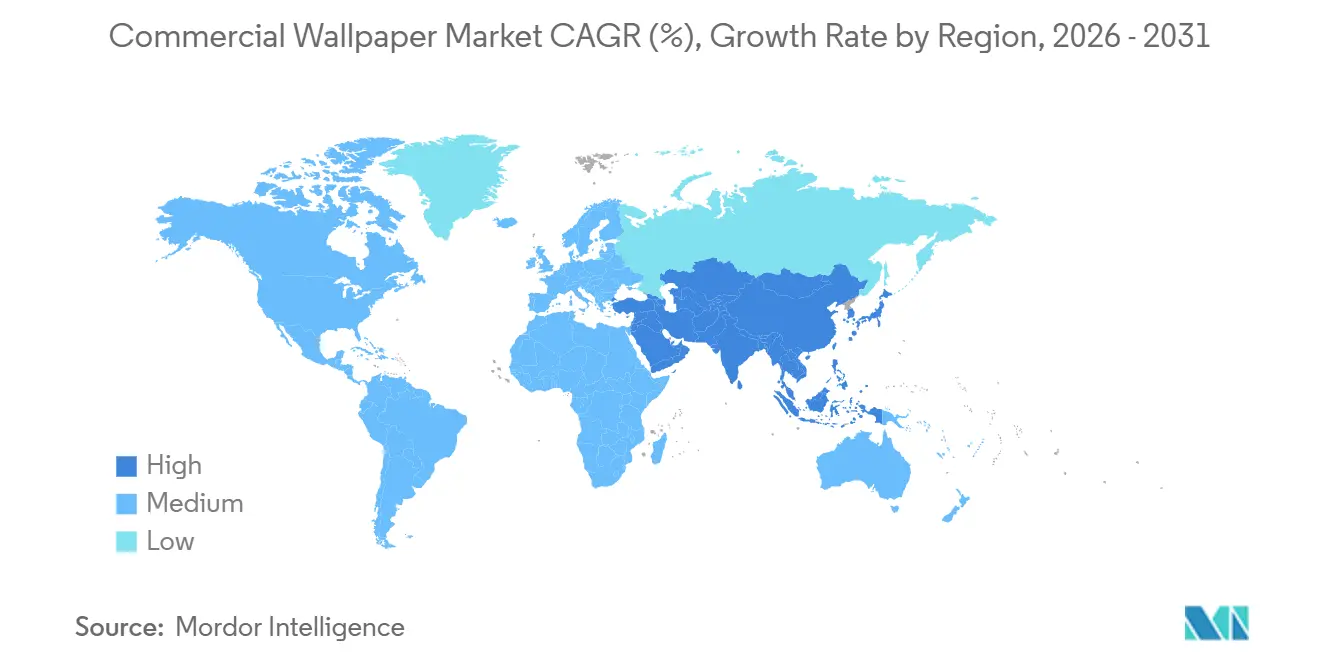
Asia-Pacific is the fastest-growing region, with a projected 4.7% CAGR through 2031. China remains the largest regional production and consumption base, though demand is moving toward renovation and premium upgrades. India’s commercial infrastructure programs support demand across hospitality, retail, and institutional buildings. Southeast Asia is gaining attention through hotel and mixed-use construction in Vietnam, Indonesia, and the Philippines. The Middle East and Africa have a strong internal growth profile, supported by the GCC’s active hotel pipeline. South America grows through hotel refurbishment and commercial construction, although currency volatility can delay purchases of imported products. In the GCC, large hospitality programs create demand for products that meet premium design and commercial performance needs. Asian suppliers and buyers are also increasingly focused on renovation, which can support higher-value applications beyond initial new-build installation. The commercial wallpaper market, therefore, has distinct regional demand patterns despite shared requirements for durability and design flexibility.

Competitive Landscape
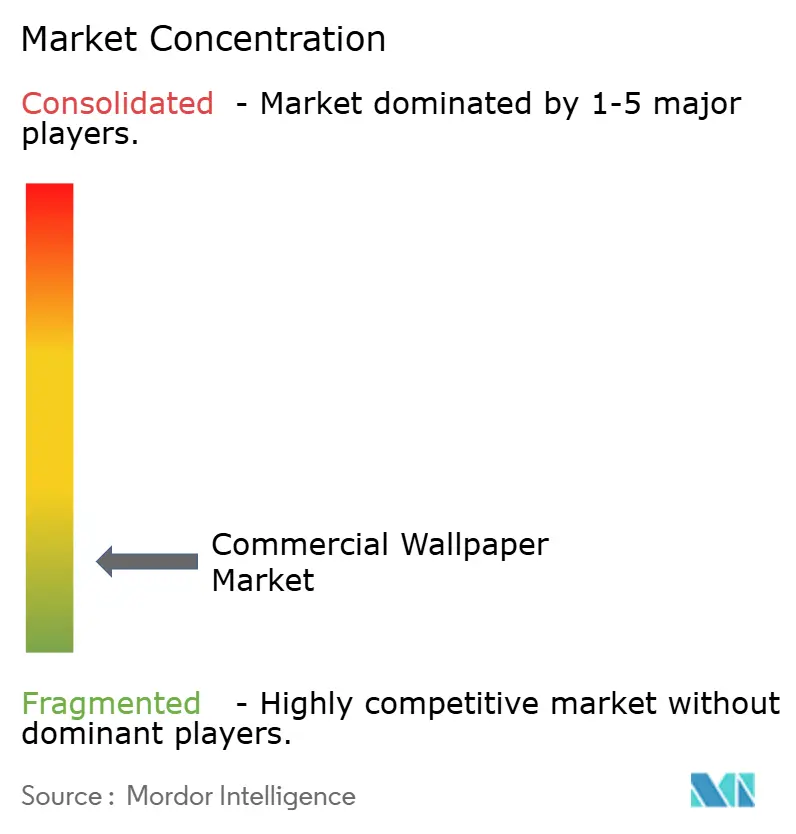
The commercial wallpaper market is highly fragmented, with the top 5 suppliers estimated to hold a combined share of 20-30%. Regional converters, digital printers, and custom fabricators compete with larger companies on design choice, project speed, and installer relationships. This structure makes specification access and reliable technical support important competitive tools. Koroseal Interior Products, Muraspec Group, Sangetsu Corporation, and Omexco NV are among the established participants. Their product strategies show the value of expanding collections while retaining commercial performance credentials. Muraspec launched more than 200 wallcovering products in 2025 [3]“Leading the Way in Wallcoverings: Over 200 New Products Launched by Muraspec in 2025,” Muraspec, muraspec.com.
Koroseal presented the Fifth & Form Type II collection and 4 specialty wallcoverings at HD Expo 2026 [4]“Designer Report: Inside HD Expo 2026,” Koroseal Interior Products, koroseal.com. The company also highlighted a partnership with American Architectural Products Group for architectural panel systems. The Fortis Collection, developed with Arte International, brought together Type II wallcoverings, Class A fire ratings, indoor air quality compliance, and Health Product Declarations. These moves show how product launches increasingly combine visual range with performance documentation. Muraspec’s Mural Book illustrates a second strategy, combining digital customization with GREENGUARD Gold-certified inks. Companies that can supply compliant custom work in short runs can address projects that commodity suppliers and design studios may not serve efficiently. The panel partnership also added an acoustic component for contract projects that require coordinated interior systems. This approach can help project teams source complementary surfaces from related product lines, rather than assembling every interior element separately. It is particularly relevant where hospitality and corporate projects seek visual consistency across wall finishes and functional interior components.
Digital investment also affects lead times and inventory needs across the commercial wallpaper market. Wallquest’s 4-printer installation was associated with a reported 30% improvement in production performance. Antimicrobial technologies and systematic testing may also become stronger differentiators in healthcare and other high-cleaning environments. REACH requirements in Europe and evolving NSF/ANSI 342 expectations in North America create further demand for traceable documentation. Smaller manufacturers may face difficulty maintaining broad testing and certification coverage. The competitive field remains open because local suppliers can still win projects through design responsiveness and distribution reach. The commercial wallpaper market also rewards firms that can coordinate product development with technical documentation, rather than treating compliance as a later administrative task. Regional converters can remain relevant by offering faster local service, customized designs, and close support for installers. Larger suppliers retain advantages when their range gives architects a single source for several types of commercial interiors. This leaves competition active across both premium and mid-market specification projects. The same investment supports more reliable delivery for short renovation windows, where a missed installation date can disrupt other trades. Suppliers are therefore balancing capital spending on production with investments in testing, product data, and sample availability. This balance can protect relationships with architects and contractors when projects require both custom visuals and documented compliance.
Commercial Wallpaper Industry Leaders
A.S. Création Tapeten AG
York Wallcoverings Inc.
Sangetsu Corporation
Muraspec Group
Brewster Home Fashions LLC
- *Disclaimer: Major Players sorted in no particular order

Recent Industry Developments
- May 2026: Koroseal Interior Products launched the Fifth & Form Collection (7 Type II wallcovering designs, including Wexley Plaid, Ostra Noir, and Solure) and 4 Specialty Wallcoverings, two hand-painted designs and two foils at HD Expo 2026. All products carry Class A fire ratings per ASTM E-84, targeting premium hospitality, corporate, and retail interiors.
- April 2026: Wallquest Wallcovering installed 4 HP Latex FS70 W wide-format printing systems at its Wayne, Pennsylvania facility, reporting a 30% overall production performance improvement. The investment expands short-run, sustainable wallcovering capability and reduces minimum order quantities, positioning Wallquest to serve rapid-cycle commercial renovation projects that were previously uneconomical for manufacturer-direct supply.


Global Commercial Wallpaper Market Report Scope
The commercial wallpaper market encompasses wallcovering products for non-residential interiors, such as hospitality, healthcare, corporate offices, retail, education, transport, and institutional buildings. It assesses demand by material type, application, end user, distribution channel, and geography. The scope includes solid vinyl, non-woven vinyl, vinyl-coated paper, fabric-backed vinyl, PVC-free, biobased, and digitally printed formats. It covers both new construction and renovation activity, along with direct manufacturer sales and indirect distributor, dealer, retailer, and contractor channels.
Residential wallpaper, purely decorative consumer products, and unrelated wall finishes such as paint, architectural films, and decorative panels are excluded, except where they are assessed as substitute products.
| Solid Vinyl |
| Vinyl Coated Paper |
| Fabric Backed Vinyl |
| Non-Woven Vinyl |
| Other Material Types (PVC-free, bio-based, etc.) |
| New Construction |
| Renovation and Remodeling |
| Hospitality |
| Healthcare |
| Corporate Offices and Co-Working Spaces |
| Retail and Shopping Centers |
| Education and Institutional Buildings |
| Transportation and Marine Interiors |
| Other End Users (Public Buildings and Government Facilities, Leisure and Other Commercial Facilities) |
| Direct Sales from Manufacturers |
| Indirect Sales (Distributors, Retailers, Dealers, Contractors) |
| North America | Canada |
| United States | |
| Mexico | |
| South America | Brazil |
| Peru | |
| Chile | |
| Argentina | |
| Rest of South America | |
| Europe | United Kingdom |
| Germany | |
| France | |
| Spain | |
| Italy | |
| BENELUX (Belgium, Netherlands, Luxembourg) | |
| NORDICS (Denmark, Finland, Iceland, Norway, Sweden) | |
| Rest of Europe | |
| Asia-Pacific | India |
| China | |
| Japan | |
| Australia | |
| South Korea | |
| South-East Asia | |
| Rest of Asia-Pacific | |
| Middle East & Africa | United Arab Emirates |
| Saudi Arabia | |
| South Africa | |
| Nigeria | |
| Rest of Middle East & Africa |
| By Material Type/Construction Type | Solid Vinyl | |
| Vinyl Coated Paper | ||
| Fabric Backed Vinyl | ||
| Non-Woven Vinyl | ||
| Other Material Types (PVC-free, bio-based, etc.) | ||
| By Application | New Construction | |
| Renovation and Remodeling | ||
| By End User | Hospitality | |
| Healthcare | ||
| Corporate Offices and Co-Working Spaces | ||
| Retail and Shopping Centers | ||
| Education and Institutional Buildings | ||
| Transportation and Marine Interiors | ||
| Other End Users (Public Buildings and Government Facilities, Leisure and Other Commercial Facilities) | ||
| By Distribution Channel | Direct Sales from Manufacturers | |
| Indirect Sales (Distributors, Retailers, Dealers, Contractors) | ||
| By Geography | North America | Canada |
| United States | ||
| Mexico | ||
| South America | Brazil | |
| Peru | ||
| Chile | ||
| Argentina | ||
| Rest of South America | ||
| Europe | United Kingdom | |
| Germany | ||
| France | ||
| Spain | ||
| Italy | ||
| BENELUX (Belgium, Netherlands, Luxembourg) | ||
| NORDICS (Denmark, Finland, Iceland, Norway, Sweden) | ||
| Rest of Europe | ||
| Asia-Pacific | India | |
| China | ||
| Japan | ||
| Australia | ||
| South Korea | ||
| South-East Asia | ||
| Rest of Asia-Pacific | ||
| Middle East & Africa | United Arab Emirates | |
| Saudi Arabia | ||
| South Africa | ||
| Nigeria | ||
| Rest of Middle East & Africa | ||


Key Questions Answered in the Report
What is the projected growth rate for commercial wallpaper through 2031?
The category is forecast to grow at a 4.2% CAGR from 2026 to 2031, reaching USD 8.61 billion in 2031.
Which material type leads commercial wallcovering demand?
Solid vinyl led demand with a 46.8% share in 2025, supported by use in high-traffic and clinical spaces.
Why is non-woven vinyl growing faster than other material types?
Its paste-the-wall installation can reduce installation time and preparation work, supporting a projected 4.9% CAGR through 2031.
Which end user is growing fastest for commercial wallcoverings?
Healthcare is the fastest-growing end user at a projected 4.7% CAGR through 2031, driven by cleaning, durability, and performance requirements.
Which region has the strongest growth outlook for commercial wallcoverings?
Asia-Pacific is projected to grow at a 4.7% CAGR through 2031, supported by commercial construction and renovation activity.
How are suppliers competing in the commercial wallcoverings market?
Suppliers compete through tested performance, digital customization, product range, fast turnaround, and specification relationships.
Page last updated on:


 Your data is secure and never sold or shared.


