
Market Overview
| Study Period | 2020 - 2031 |
|---|---|
| Forecast Data Period | 2026 - 2031 |
| Base Year Market Size (2025) | USD 51.90 Billion |
| Market Size (2026) | USD 54.55 Billion |
| Market Size (2031) | USD 70.69 Billion |
| Growth Rate (2026 - 2031) | 5.32 % |
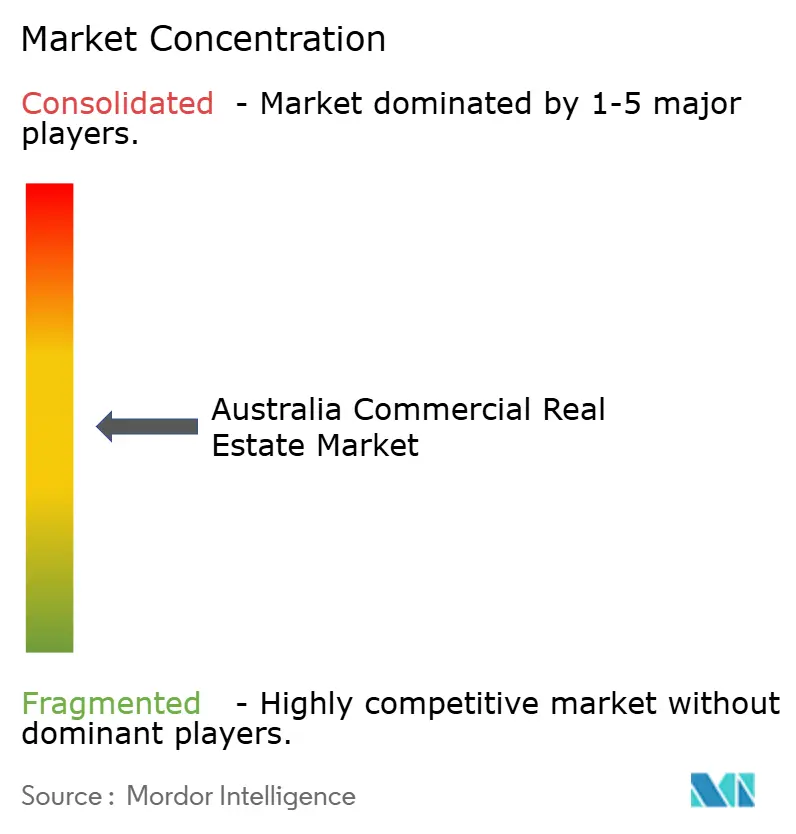
| Market Concentration | Medium |
Major Players *Disclaimer: Major Players sorted in no particular order Image © Mordor Intelligence. Reuse requires attribution under CC BY 4.0. | |
Australia Commercial Real Estate Market Analysis by Mordor Intelligence
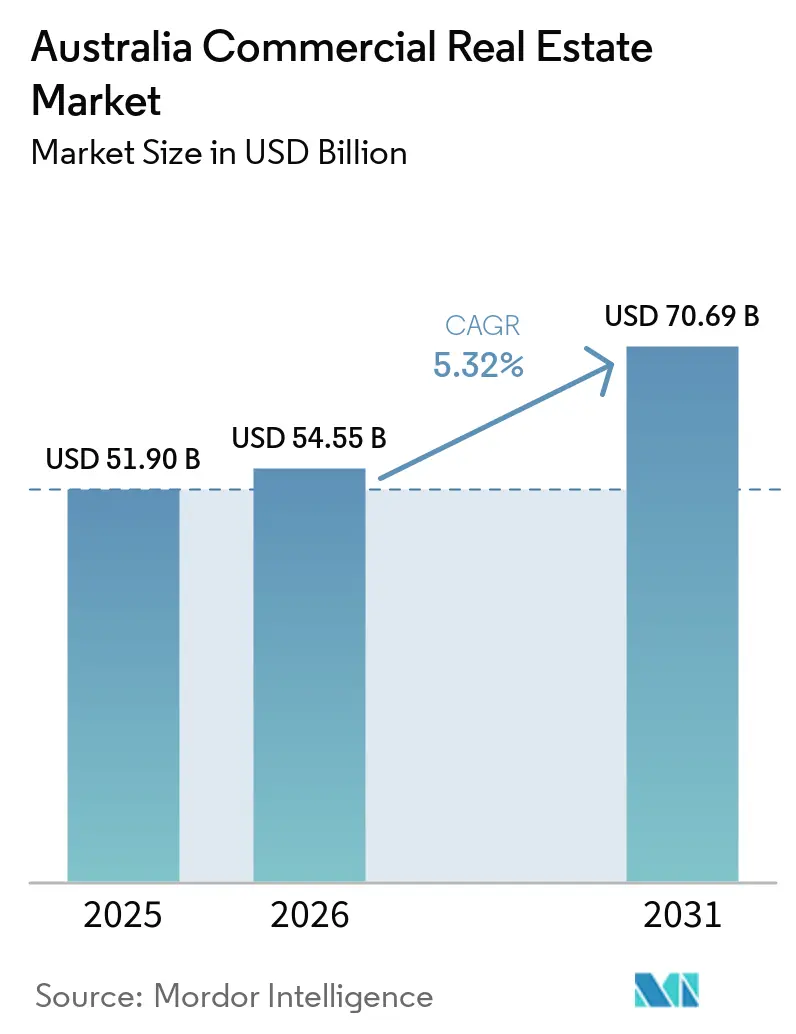
The Australia commercial real estate market size is estimated at USD 54.55 billion in 2026 and is projected to reach USD 70.69 billion by 2031, reflecting a 5.32% CAGR over the forecast period. Investor demand is shifting toward inflation-hedged assets such as logistics warehouses, data-center campuses, and ESG-certified towers as monetary conditions stay restrictive yet predictable. Cap-rate compression in secondary cities is widening the yield gap versus legacy CBD offices, while sovereign-grade credit fundamentals continue to attract cross-border allocations from Canada, Singapore, and the Middle East. Infrastructure megaprojects around Western Sydney Airport and the 2032 Brisbane Olympics are lifting commercial land prices, and data-localization laws are catalyzing regional edge-facility roll-outs.[1]
Key Report Takeaways
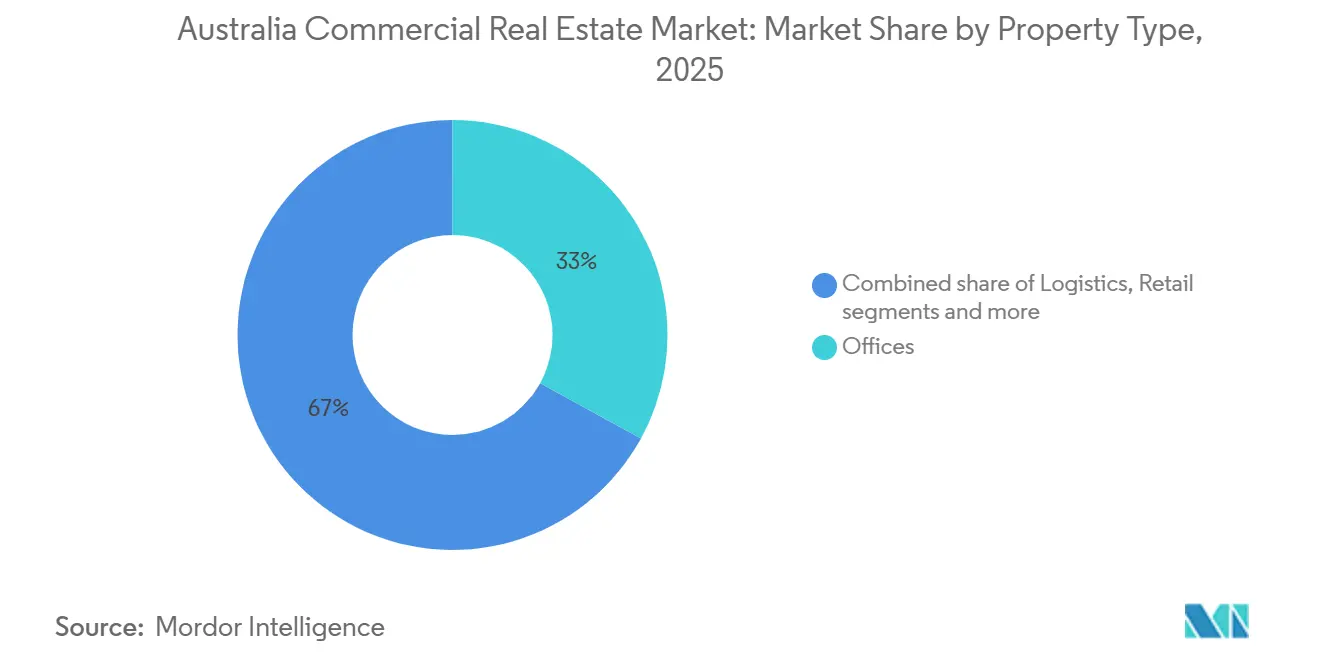
- By property type, offices held 33% of the Australia commercial real estate market share in 2025, while logistics assets are forecast to expand at a 5.91% CAGR to 2031.
- By business model, sales transactions captured 71% of the Australia commercial real estate market size in 2025, but rental income streams are expected to grow at a 6.01% CAGR through 2031.
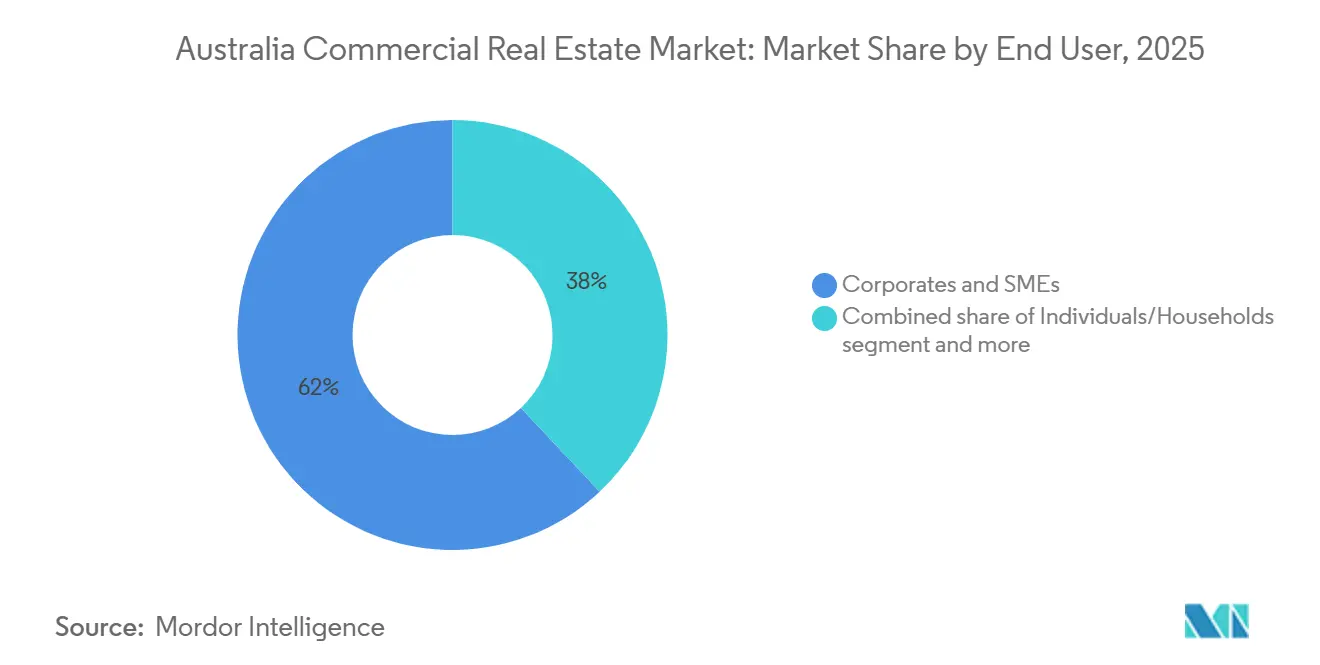
- By end-user, corporates and SMEs accounted for 62% of the Australia commercial real estate market in 2025; individual and household demand is advancing at a 6.01% CAGR on the back of build-to-rent and fractional-ownership formats.
- By geography, New South Wales led with 39% revenue share in 2025, whereas Queensland is set to log the quickest pace, expanding at a 5.96% CAGR to 2031.
Note: Market size and forecast figures in this report are generated using Mordor Intelligence’s proprietary estimation framework, updated with the latest available data and insights as of January 2026.
Market Trends and Insights
Drivers Impact Analysis of Australia Commercial Real Estate Market*
| Drivers | (~) % Impact on CAGR Forecast | Geographic Relevance | Impact Timeline |
|---|---|---|---|
| Accelerated Demand for Prime Industrial & Logistics Space Driven by E-Commerce | 1.2% | National, concentrated in Sydney, Melbourne, and Brisbane logistics corridors | Short term (≤ 2 years) |
| Government-backed Infrastructure Pipeline Lifting Commercial Land Values | 1.0% | Queensland, Western Australia, New South Wales (Western Sydney) | Long term (≥ 4 years) |
| Data-Localisation Mandates Fueling Edge Data-Centre Development | 0.9% | National, with edge deployments in regional centers | Medium term (2-4 years) |
| Surge in Institutional Capital Allocation to Core Office Assets | 0.8% | New South Wales, Victoria | Medium term (2-4 years) |
| Re-rating of ESG-Compliant Green Buildings Unlocking Premium Rents | 0.7% | National, early gains in Sydney CBD, Melbourne Docklands | Medium term (2-4 years) |
| Rebound in International Tourism Revitalising CBD Hotel RevPAR | 0.5% | New South Wales, Queensland, Victoria | Short term (≤ 2 years) |
| Source: Mordor Intelligence | |||
Accelerated Demand for Prime Industrial & Logistics Space Driven by E-Commerce
Cold-chain capacity expanded by 1.8 million m² in 2025 to keep pace with online grocery penetration that climbed to 14% of sales for major retailers. Last-mile hubs within 30 km of CBDs are transacting 50–75 basis points tighter than regional sheds, confirming investor preference for urban proximity. ESR and Logos committed USD 1.3 billion to automated fulfillment centers in Sydney and Melbourne featuring robotics and EV charging, aligning with net-zero pledges. Limited serviced land and sustained consumer expectations for same-day delivery support above-trend rental growth. Altogether, logistics remains the fastest-growing slice of the Australia commercial real estate market.[2]
Government-backed Infrastructure Pipeline Lifting Commercial Land Values
USD 4.7 billion in Olympic projects is transforming Brisbane’s Gabba and South Bank precincts, spurring rezonings that allow mixed-use towers up to 60 stories. In Western Sydney, land close to the new airport rose 47% between 2023 and 2025 as developers bank parcels for logistics estates. The USD 2.4 billion WestInvest fund extends similar incentives to Parramatta and Penrith, compressing approval timelines. Collectively, these projects re-route development capital from saturated CBD corridors toward growth suburbs. They also push the Australia commercial real estate market into new nodes where first-mover advantages exist.[3]
Data-Localization Mandates Fueling Edge Data-Center Development
The 2024 Privacy Amendment requires certain datasets to stay onshore, stimulating edge deployments in Canberra, Adelaide, and Hobart, where land is 40–60% cheaper than in Sydney. AirTrunk announced a USD 1.6 billion, 120 MW expansion in January 2025, complete with dedicated substations co-funded by Ausgrid. Power-supply bottlenecks are driving onsite solar-plus-battery designs that win planning consent faster. NextDC reported 34% of contracts now bundle renewable energy, revealing client pressure for carbon-neutral hosting. As a result, data-infrastructure assets are a rising share of the Australia commercial real estate market.
Surge in Institutional Capital Allocation to Core Office Assets
Australian superannuation funds managed USD 2.5 trillion in assets at end-2025, and property still accounts for under 10% of portfolios, indicating headroom for further allocations. Cross-border investors from Singapore and Canada injected USD 4.1 billion into Australian towers in 2025, attracted by a AAA sovereign rating and tax-efficient trust structures. Trophy assets with NABERS 5-star energy ratings continue to command premium pricing as buyers prioritize efficiency credentials. This structural bid underpins stable demand even while hybrid work tempers net absorption. The resulting competition for prime space provides a floor to valuations across the Australia commercial real estate market.
Restraints Impact Analysis of Australia Commercial Real Estate Market*
| Restraints | (~) % Impact on CAGR Forecast | Geographic Relevance | Impact Timeline |
|---|---|---|---|
| Persistent Work-from-Home Adoption Softening CBD Office Net Absorption | -1.1% | New South Wales, Victoria (CBD cores) | Medium term (2-4 years) |
| Elevated Construction Costs & Labour Shortages Delaying Project Delivery | -0.9% | National, acute in Sydney, Melbourne, Brisbane | Short term (≤ 2 years) |
| Monetary Tightening and Rising Cap Rates Compressing Transactions | -0.7% | National | Medium term (2-4 years) |
| Heightened Climate-Risk Exposure Raising Insurance Premiums for Coastal Assets | -0.5% | Queensland, New South Wales coastal precincts | Long term (≥ 4 years) |
| Source: Mordor Intelligence | |||
Persistent Work-from-Home Adoption Softening CBD Office Net Absorption
Thirty-eight percent of Australian employees worked from home at least once weekly in August 2025, only slightly below 2023 levels. Large banks reduced footprints by 14-18% over three years, pushing sublease availability in Melbourne Docklands to a three-year high. Incentives now equal 25–30% of face rent in secondary towers. Landlords are adding wellness centers and end-of-trip facilities to retain tenants, but payback stretches in a tepid demand setting. This drag could temper the overall CAGR of the Australia commercial real estate market.[4]
Elevated Construction Costs & Labor Shortages Delaying Project Delivery
Materials inflation hit 11.3% year-over-year in September 2025, while the industry lacked 90,000 skilled workers. Insolvencies at subcontractors forced re-tendering mid-build, stretching timelines by up to nine months. Mirvac trimmed development-margin guidance by 150 bps as overruns eroded returns. Modular construction is shaving 20–25% off program lengths, but adoption is uneven. Delays restrict supply, moderating the pace of growth in the Australia commercial real estate market.
*Our forecasts treat driver/restraint impacts as directional, not additive. The impact forecasts reflect baseline growth, mix effects, and variable interactions.
Australia Commercial Real Estate Market Segment Analysis
By Property Type:
Logistics Assets Accelerate While Offices Hold ScaleLogistics facilities represented 18% of the Australia commercial real estate market in 2025, yet they are forecast to post a 5.91% CAGR through 2031, the highest among property types. Offices retained the largest 33% share thanks to Sydney and Melbourne CBD inventories, but persistent hybrid work keeps vacancy elevated. Investors gravitate toward modern sheds with automation-ready clear heights and cold-chain fitouts. Goodman Group alone controls a USD 5.3 billion pre-leased pipeline across Western Sydney and Melbourne’s west, showcasing long-tenor covenants with Amazon and Coles. Rental spreads between prime and secondary warehouses widened to 22% in 2025, rewarding landlords who retrofit legacy stock.
Rising e-commerce and near-shoring augment demand for regional distribution hubs connected to renewable-energy corridors, as seen in Geelong and Newcastle industrial estates. Retail centers have turned into mixed-use micro-fulfillment hubs, demonstrated by Vicinity’s 8,000 m² Chadstone conversion. Hospitality cap rates compressed to 5.25–5.75% on stronger tourism flows, overtaking offices at 6.0–6.5%. Meanwhile, medical-office buildings adjacent to private hospitals drew steady tenant pre-commitments, enhancing diversification within the Australia commercial real estate market.
By Business Model:
Rental Income Streams Edge Toward SupremacySales transactions owned 71% of the Australia commercial real estate market share in 2025, reflecting a legacy trading culture and favorable capital-gains tax treatment. However, rental-based structures are scaling at a 6.01% CAGR toward 2031 as institutions target inflation-linked cash flows. Dexus guided a 3.2% year-on-year lift in 2025 distributions, citing CPI-indexed leases across 64% of its portfolio. Unlisted funds are lengthening WALEs to lock in predictable income, while build-to-rent ventures attract pension capital due to steady occupancy.
Australia commercial real estate market size for rental-heavy assets could climb meaningfully if superannuation schemes continue to prefer bond-like yields over speculative flips. State land-tax concessions for build-to-rent sweeten net returns, as evidenced by Greystar’s Sydney projects. Conversely, developers are scaling back strata-office sales after lenders imposed tighter loan-to-value ratios on non-core assets. That pivot channels fresh equity toward yield-oriented formats, gradually rebalancing the Australia commercial real estate market.
By End-User:
Corporate Demand Dominates but Household Participation RisesCorporates and SMEs occupied 62% of space in 2025, underscoring their anchor-tenant role within the Australia commercial real estate market. Blue-chip occupiers consolidated into premium towers, illustrated by GPT Group’s finding that tenant count fell 12% even as average lease size rose 9%. Individuals and households, while smaller today, are on course to expand 6.01% annually through tokenized ownership and self-storage uptake. Retail investor participation grew as platforms like BrickX fractionalize warehouses, offering tickets below USD 3,000 per slice.
Flexible workspace providers added 32,000 m² in 2025, meeting SME appetite for plug-and-play offices. Government departments in Canberra and state capitals supply a defensive revenue stream in the “Others” category, with average lease terms above 10 years. Overall, the end-user mix is diversifying, cushioning the Australia commercial real estate market from single-sector shocks.
Geography Analysis
New South Wales retained the largest share of the Australia commercial real estate market in 2025 at 39%, underpinned by Sydney’s deep finance, legal, and tech ecosystems. CBD office towers near Barangaroo and Martin Place remain coveted by global investors, though secondary stock in Parramatta and Penrith has drawn fresh attention after the USD 2.4 billion WestInvest fund accelerated planning pathways. Western Sydney Airport’s 2026 opening is already redirecting capital to logistics estates within the 10,000-hectare Aerotropolis precinct, pushing land values up 47% since 2023 and broadening the state’s commercial footprint. Alongside offices and logistics, mixed-use conversions of suburban malls into healthcare hubs—exemplified by the USD 204 million Westfield Parramatta redevelopment—signal a shift toward essential-service tenancy mixes.
Queensland is the fastest-growing state, forecast at a 5.96% CAGR to 2031, propelled by Olympic-related construction and sustained interstate migration. The Brisbane Arena, Cross River Rail, and South Bank makeovers are elevating surrounding land values, compelling developers such as Mirvac to launch USD 560 million mixed-use schemes with pre-committed government tenants. On the Gold Coast and Sunshine Coast, housing shortages translate into strong demand for build-to-rent and self-storage assets. Regional logistics demand is rising as food exporters tap Port of Brisbane, validating Frasers Property’s USD 145 million warehouse commitment.
Victoria remains a pillar of the Australia commercial real estate market thanks to Melbourne’s diversified industrial base and university network. Renewable-energy zones in Gippsland and the Western District encourage data-center and hydrogen-production campuses that require adjacent commercial support services. Meanwhile, Canberra sustains investor appetite for defensive income, with federal departments agreeing to 12-year average leases across new builds. Perth industrial sites near Fremantle Port continue to benefit from lithium-driven export growth, while Adelaide’s northern suburbs are thriving on defense-industry spillovers. In Tasmania and the Northern Territory, tourism and hydrogen exports respectively are fueling localized booms that draw patient institutional capital.
Regulatory Landscape
Australia commercial real estate development and operations are governed by national building standards and state planning and building enforcement, with the Australian Building Codes Board (ABCB) setting the National Construction Code baseline. A key 2026 inflection point is the release of NCC 2025 on 1 May 2026, which tightens commercial energy-efficiency settings and introduces requirements that affect new-build design and services specifications, including on-site renewable generation for nominated commercial building classes. This raises compliance focus for owners targeting NABERS and Green Star outcomes.
Capital formation and transaction pathways are also shaped by the Australian Government foreign investment framework administered through Treasury and the Foreign Investment Review Board process. In May 2026, Treasury outlined a foreign investment reform package that includes a stated target to decide low-risk applications within 30 days from 1 January 2027, which intersects with cross-border allocations into Australian core-plus assets and development platforms. At the state level, building regulators such as the Victorian Building Authority (VBA), along with updates to building regulations including Victoria's draft Building Amendment regulations released in 2025, reinforce inspection, documentation, and compliance expectations. Those requirements can affect project delivery timetables and cost-to-complete for commercial and mixed-use schemes.
Value Chain Analysis
The Australia commercial real estate value chain spans land sourcing and planning approvals, financing and capital formation (banks, superannuation, REITs and unlisted funds), development management, design and engineering, and construction delivery through Tier 1 contractors and specialist subcontractors. It also covers materials and building-services supply, leasing and brokerage, and ongoing property and facilities management supported by valuation and advisory services. Institutional managers such as Dexus, Charter Hall, and Goodman often combine funds management with development and asset management, while occupiers (corporates/SMEs, government, and logistics tenants) influence specifications through pre-commitments, WALE targets, and sustainability requirements.
Upstream execution risk in 2025-2026 has been concentrated in construction capacity constraints, including skilled labor shortages and elevated input-price volatility, which lengthen programs and raise feasibility hurdles across offices, logistics, and data-center projects. Policy settings can shape procurement and supplier participation on relevant pipelines, including the Australian Jobs (Australian Industry Participation) Rules 2026, which commenced in March 2026 and align government-funded procurement with Australian Industry Participation requirements above established thresholds. With a large public infrastructure pipeline, developers and contractors have also emphasized procurement flexibility, modular or prefabricated methods, and earlier supply-chain engagement for energy-intensive materials and building-services packages. This is particularly visible in logistics automation, cold-chain fitouts, and power-dense data-center shells.
Competitive Landscape
Dexus, Charter Hall, and Goodman leverage vertically integrated models that capture development, funds management, and asset management fees, creating scale advantages. Stockland and Mirvac cross-subsidize commercial ventures with residential cash flows, softening cyclical earnings swings. Scentre and Vicinity dominate super-regional retail yet are repurposing anchor boxes into healthcare, hotel, and logistics pods to offset e-commerce leakage. Offshore capital—led by Blackstone, Brookfield, and GIC—has poured USD 20 billion into core-plus assets since 2020, pushing domestic players to move up the risk curve.
Strategic differentiation increasingly centers on ESG performance, data-center exposure, and cold-chain logistics. Charter Hall disclosed that 72% of its USD 43 billion portfolio carries Green Star or NABERS certificates, enabling it to win mandates from pension funds seeking decarbonized allocations. Goodman’s pipeline surpasses 420,000 m² of pre-leased industrial space, locking in decade-long covenants that de-risk development. Dexus retrofitted 1.8 million m² of offices with IoT sensors, cutting operating costs by 8-12% and boosting tenant satisfaction scores. ESR and Logos target automated warehouses and refrigerated facilities supported by green-loan structures, reflecting a credit landscape that rewards sustainable design.
Emerging challengers backed by superannuation funds—such as Aware Super and Cbus Property—are bypassing intermediaries to acquire assets directly, compressing manager fees and altering deal-flow dynamics. PropTech disruptors introduce tokenized ownership models, widening retail access while adding regulatory scrutiny. Meanwhile, build-to-suit data-center joint ventures between Goodman and AirTrunk, and logistics estates funded by Charter Hall-GIC alliances, underscore a pivot away from speculative builds toward tailored solutions. These strategic plays collectively raise the sophistication bar across the Australia commercial real estate market.
Australia Commercial Real Estate Industry Leaders
-
Dexus
-
Goodman Group
-
GPT Group
-
Charter Hall Group
-
Mirvac Group
- *Disclaimer: Major Players sorted in no particular order
Australia Commercial Real Estate Market Companies Covered in this Report
- Dexus
- Charter Hall Group
- GPT Group
- Mirvac Group
- Goodman Group
- Scentre Group
- Lendlease
- Stockland
- Cromwell Property Group
- Vicinity Centres
- Centuria Capital Group
- Abacus Property Group
- ALE Property Group
- Region Group (formerly SCA)
- Arena REIT
- HMC Capital
- ESR Australia
- Blackstone ? Milestone Portfolio
- Frasers Property Australia
- Knight Frank Australia
Market Opportunities and Future Outlook
A near-term opportunity set is forming around compliance-driven refurbishment and new-build differentiation as NCC 2025 is applied across jurisdictions following its 1 May 2026 release by the ABCB. Mandatory and tightened commercial energy-efficiency settings, including on-site renewable generation requirements for nominated building classes, create whitespace for solar-ready rooftops on logistics and big-box assets, electrified building-services upgrades, and deeper retrofits that support NABERS performance targets. Owners repositioning older CBD offices or secondary stock can pair these upgrades with wellness and end-of-trip capex to compete for consolidation-driven demand in premium towers, while logistics landlords can bundle energy upgrades with EV charging and automation-ready specifications already preferred by large tenants.
Capital and development opportunities are also linked to infrastructure-linked growth nodes and specialized real assets. Western Sydney Airport-related logistics land banking and Queensland Olympic precinct rezoning activity continue to redirect site selection toward new corridors, and onshore data requirements, including the 2024 Privacy Amendment referenced in the market context, keep edge and campus-style data-center programs active beyond Sydney. On the capital-raising side, actions by managers such as Dexus securing over USD 600 million of new institutional capital in April 2026 for a flagship wholesale fund, and industrial land partnership activity including the Dexus and Boral Ravenhall logistics precinct initiative, point to a practical path for scaling supply in constrained markets through joint ventures, staged delivery, and pre-leasing supported by sovereign-grade and superannuation-backed pools.
Recent Industry Developments in Australia Commercial Real Estate Market
- May 2026: Dexus established a joint venture with Boral Limited to transform around 630 hectares of land at Ravenhall, Victoria, into a major logistics precinct with potential for approximately 2.5 million square metres of lettable area. The scale and location strengthen Melbourne's west as an institutional-grade industrial corridor and expands the pipeline of modern, power-capable warehousing required for automation, cold-chain, and last-mile operations.
- April 2026: Dexus raised over USD 600 million in new institutional capital for the Dexus Wholesale Property Fund (DWPF), including a USD 500 million commitment from a major Australian superannuation fund. The raise supports acquisitions and capital recycling into higher-conviction segments such as prime logistics and ESG-led office repositioning, reinforcing the role of domestic superannuation as a cornerstone funding source.
- August 2025: Goodman Group expanded its data-centre development program with multi-site capacity upgrades, reinforcing its specialist infrastructure pipeline and accelerating data-centre campus rollouts. The move strengthened the capability to compete for power-dense, long-duration occupier leases in key markets.
Australia Commercial Real Estate Market Report Scope and Research Methodology
Market Definition and Coverage
This market covers income-producing commercial property activity in Australia, captured through the value linked to assets that are traded or leased for business use, including office, retail, industrial and logistics, hospitality, and mixed-use properties.
Scope exclusions: Stand-alone housing, agricultural estates, and pure raw land banking are excluded from the market totals.
Segments Covered in This Report
- By Business Model
- Sales
- Rental
- By Property Type
- Offices
- Retail
- Logistics
- Others (Industrial estate, Hospitality, etc.)
- By End-user
- Individuals / Households
- Corporates & SMEs
- Others
- By Region
- New South Wales
- Victoria
- Queensland
- Western Australia
- South Australia
- Australian Capital Territory
- Tasmania
- Northern Territory
Data Sources, Market Sizing, and Validation
Desk Research
Desk research was used to set the market context and to make sure our assumptions match what is observable in Australia. We relied on public and official sources such as Australian Bureau of Statistics time series (population, employment, and construction activity), Reserve Bank of Australia releases (rates and credit conditions), and state planning portals that show major pipeline approvals and completions.
To translate market signals into sizing inputs, we also reviewed sources such as property and building performance benchmarks published by government-backed programs (for example, NABERS), trade association updates, and reputable press coverage of leasing and investment conditions. Company annual reports and investor presentations were used to sense-check how leasing spreads, occupancy, and asset revaluations were moving. We referenced a paid company financials and news database selectively to align timelines and financial definitions. These examples are illustrative only, and many other sources were also consulted to collect data, validate figures, and clarify open questions.
Primary Interviews and Surveys
Primary work focused on validating what the desk research cannot fully confirm, mainly the practical split between rental-led income and sales-led turnover, and how this mix shifts by property type. We spoke with a mix of owners, asset managers, developers, brokers, lenders, and large occupiers across major Australian markets to confirm vacancy direction, cap rate pressure, rent incentives, and how pipeline delivery was being absorbed.
Distribution of primary research fieldwork respondents
| Company type | Respondent position |
|---|---|
| Top tier: 38% | CXOs: 17% |
| Mid tier: 41% | Functional/Unit leaders: 33% |
| Smaller Players: 21% | Managers: 50% |
Market-Sizing & Forecasting
Sizing starts from a top-down reconstruction that uses Australia-level commercial property signals, and then converts them into market value by applying realistic activity weights for leasing and transaction turnover. In practice, indicators like commercial building approvals and completions, employment growth by service industries, interest-rate and credit conditions, and observed vacancy and net absorption trends help explain which property types are expanding or cooling.
Once the demand pool is mapped, the totals are corroborated through selective bottom-up checks. We sampled rent per square meter assumptions against reported leasing ranges and used approximate stock additions to test whether implied revenue growth is plausible. Where disclosure is patchy, gaps are handled by using state-level proxies and conservative carry-forward rules, followed by adjustment after expert feedback.
For the forecast, scenario analysis is used so that interest-rate paths, cap rate stabilization timing, and pipeline delivery shocks can be reflected without overfitting. Forecast assumptions are reviewed with interview inputs so that rent growth, incentive intensity, and occupancy recovery stay aligned with how market participants are planning their next 12 to 24 months.
Data Validation & Update Cycle
Validation is done by cross-checking model outputs against independent signals, including construction pipeline direction, vacancy movement, and visible shifts in investor risk appetite. Outliers are flagged early, and then the assumptions behind them are rechecked, followed by a second analyst review before sign-off.
Reports are refreshed annually. Material events like sharp rate changes, large policy shifts, or major pipeline cancellations can trigger interim checks. Before delivery, a final pass is completed so the client receives an updated view aligned to the most recent public releases and the latest reconfirmations from the field.
Mordor Intelligence's Australia Commercial Real Estate Market Sizing Compared With Other Published Estimates
Published market sizes for Australia commercial real estate can look far apart even when they describe similar property types, mainly because the counted value is not always the same. Differences usually come from what is included in the market total, how rental activity versus asset sales are treated, and which year is used as the anchor for currency and pricing.
The main gap comes from whether the estimate is closer to transaction value only, or it also counts recurring rental contracts and leasing-led value, which changes the scale a lot in this market. Mordor Intelligence treats the market as income-producing assets where both sales activity and recurring rentals are captured, rather than tracking only investment turnover, and this shifts the current-year number upward versus narrower transaction-led approaches.
Benchmark comparison
| Source | Market Size | Gaps in Research Methodology |
|---|---|---|
| Mordor Intelligence | USD 54.55 B (2026) | |
| Industry Publisher A | USD 12.65 B (2025) | Uses a smaller value construct that is closer to investment and development activity reporting with different category mapping, and it anchors the model to a different base year, which can compress the measured total. |
| Research Portal B | USD 34.07 B (2024) | Anchors sizing to a different year and growth window, and the scope emphasis leans more toward selected asset classes and activity measures, which can undercount parts of leasing-led value depending on how rentals are handled. |
The spread in the table is mostly explained by what is being valued and when it is being valued, not by a disagreement on the direction of the market. By keeping the inclusion rules clear and then cross-checking them with observable occupancy, pipeline, and rate signals, the resulting market size stays traceable to practical variables and can be repeated in future updates.
Key Questions Answered in the Report
What is the projected value of the Australia commercial real estate market by 2031?
The sector is forecast to hit USD 70.69 billion by 2031, growing at a 5.32% CAGR.
Which property type is expanding fastest within Australian commercial real estate?
Logistics warehouses lead with a 5.91% CAGR to 2031, buoyed by e-commerce and supply-chain reconfiguration.
Why are rental-income models gaining popularity among investors?
Higher interest rates elevate the appeal of inflation-indexed, long-WALE leases that stabilize distributions for funds and REITs.
Which state is expected to grow most rapidly through 2031?
Queensland is expected to remain one of Australia’s fastest-growing states through 2031, supported by strong population growth and continued net interstate migration.
How does ESG compliance influence office rents?
Green Star 5-star offices commanded average premiums of 9.2% over non-certified buildings in 2025, rewarding landlords that invest in efficiency.