
Commercial Helicopters Market Size and Share
Market Overview
| Study Period | 2019 - 2031 |
|---|---|
| Market Size (2026) | USD 7.13 Billion |
| Market Size (2031) | USD 9.03 Billion |
| Growth Rate (2026 - 2031) | 4.85 % |
| Fastest Growing Market | Asia Pacific |
| Largest Market | North America |
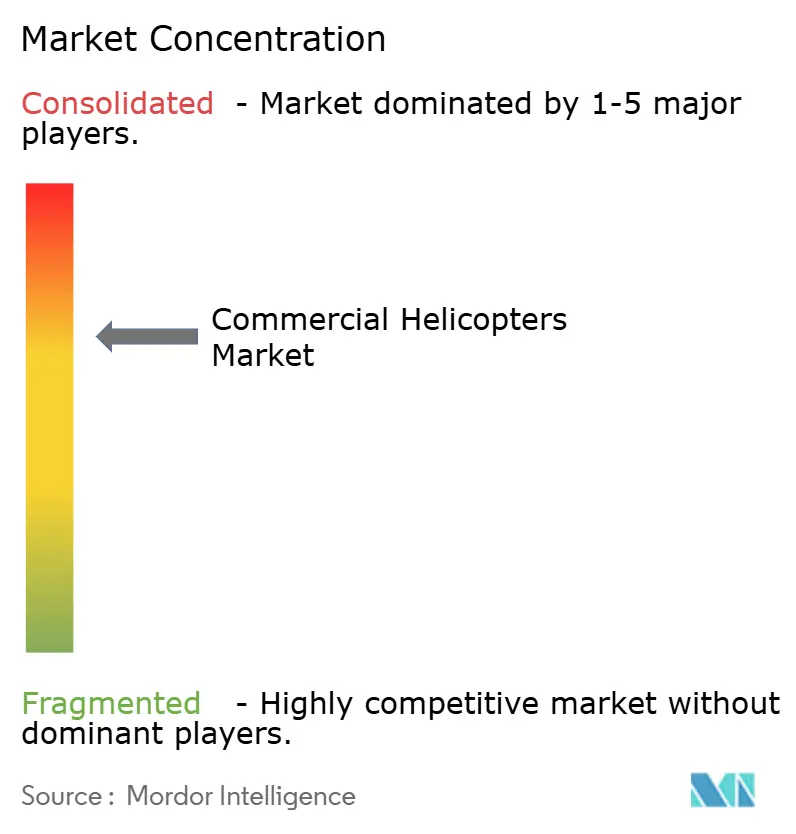
| Market Concentration | Medium |
Major Players *Disclaimer: Major Players sorted in no particular order Image © Mordor Intelligence. Reuse requires attribution under CC BY 4.0. | |
Commercial Helicopters Market Analysis by Mordor Intelligence
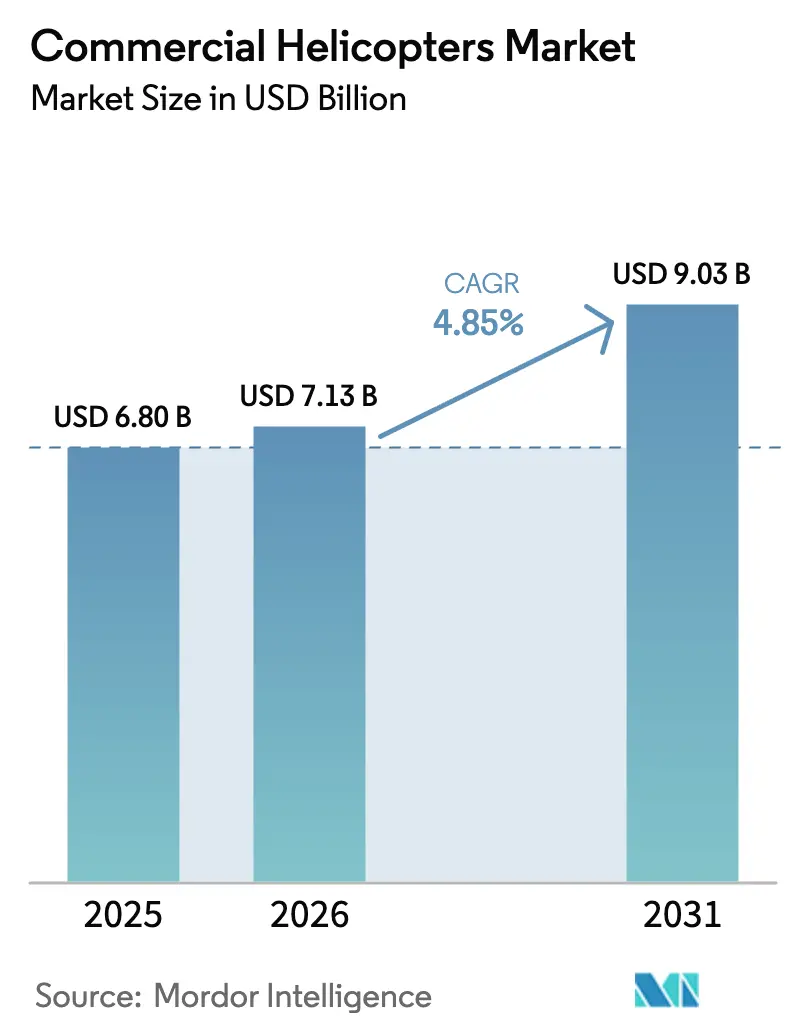
The commercial helicopters market size is expected to grow from USD 6.80 billion in 2025 to USD 7.13 billion in 2026 and is forecasted to reach USD 9.03 billion by 2031 at a 4.85% CAGR over 2026-2031. The growth stems from brisk offshore wind construction, a pivot to outsourced emergency medical fleets, and stricter noise rules that favor next-generation twin-engine designs. Contract momentum is visible in CHC Helicopter’s multi-year deal with Ørsted for North Sea and Baltic crew transfer, NHV Group’s new Vestas assignments, and Global Medical Response’s January 2025 purchase of 28 Airbus H140s with single-pilot IFR capability. Heavy twin adoption also reflects record wildfire seasons that drove US federal and state agencies to award USD 180 million in exclusive-use contracts for 2025 and to accept seven Sikorsky S-70i Firehawks into CAL FIRE service during the 2024-2025 period. OEMs are positioning for sustainable fuel and hybrid-electric retrofits; Bell flew its 505 for more than 700 hours on 100% SAF in 2024, while Airbus demonstrated neat-SAF operations on an H225 in September 2024.
Key Report Takeaways
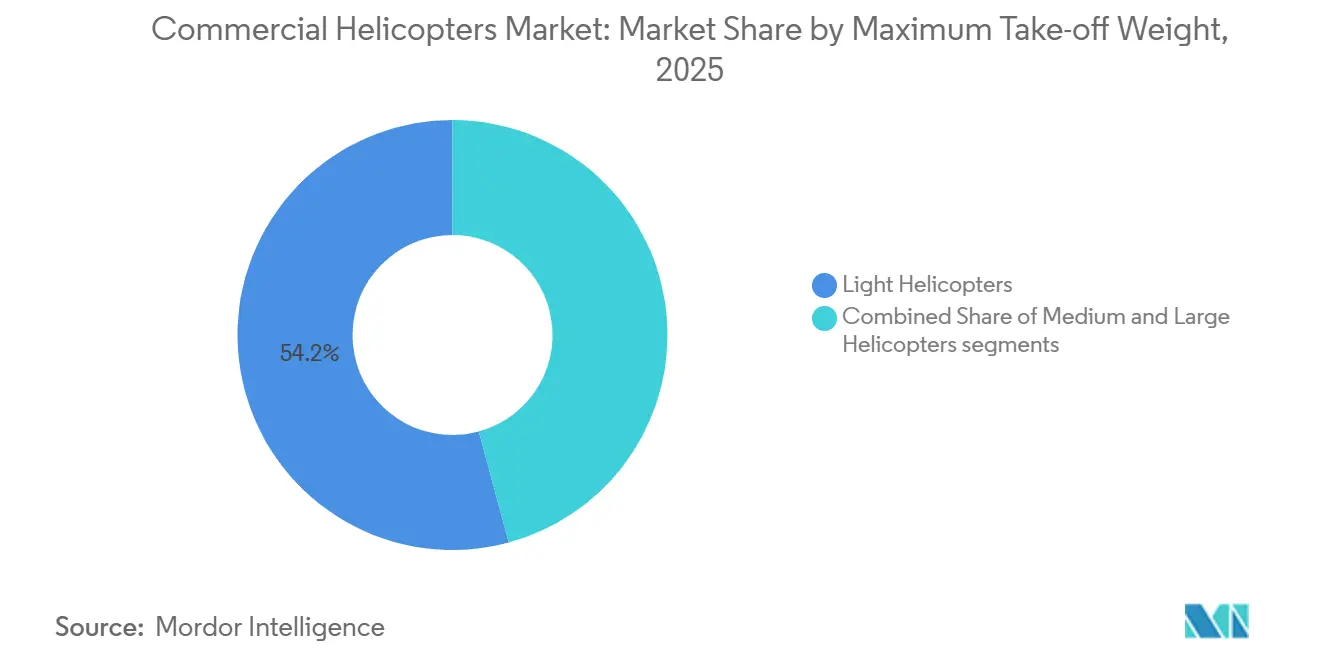
- By maximum take-off weight, light helicopters below 3.1 tons commanded 54.21% of the commercial helicopters market share in 2025; heavy platforms above 9 tons are projected to advance at a 6.92% CAGR through 2031.
- By number of engines, single-engine rotorcraft held 63.34% share of the commercial helicopters market in 2025, while twin-engine variants are expected to grow at 6.27% through 2031.
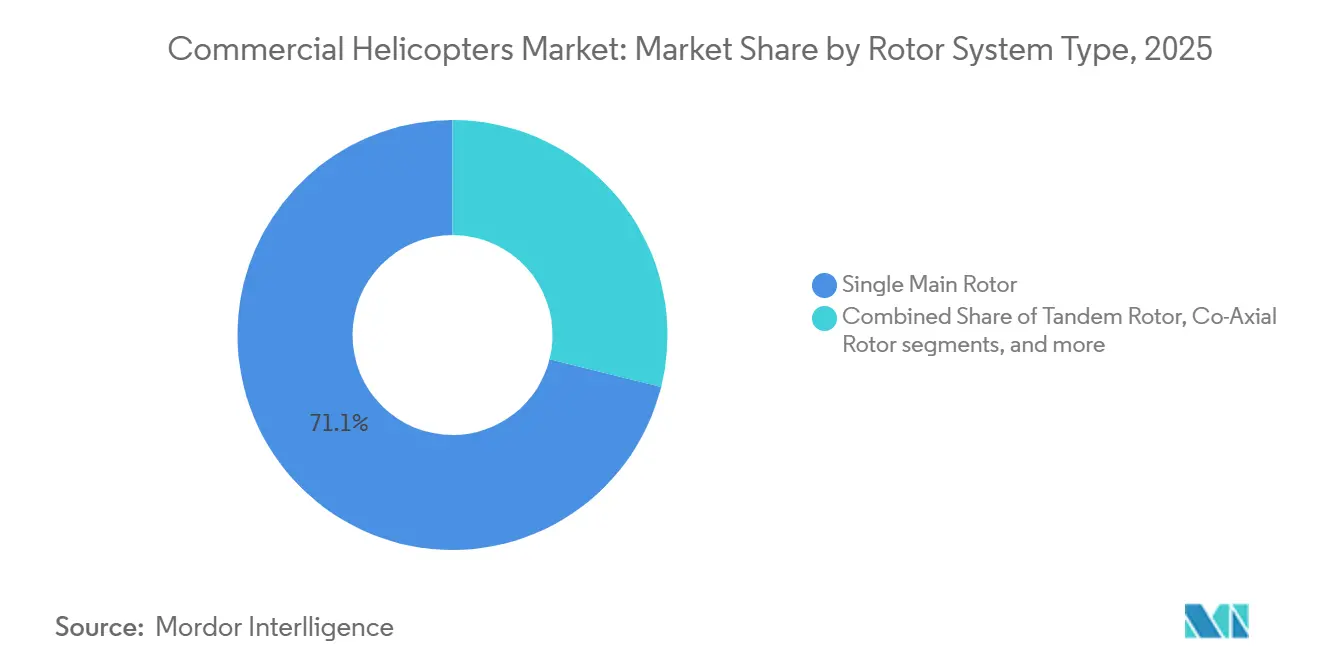
- By rotor system type, single main-rotor designs captured 71.12% of 2025 deliveries, and tilt-rotor configurations are on track for a 9.21% CAGR through 2031.
- By end-use, offshore oil and gas maintained a 35.11% share in 2025, while emergency medical services are forecast to expand at a 7.31% CAGR through 2031.
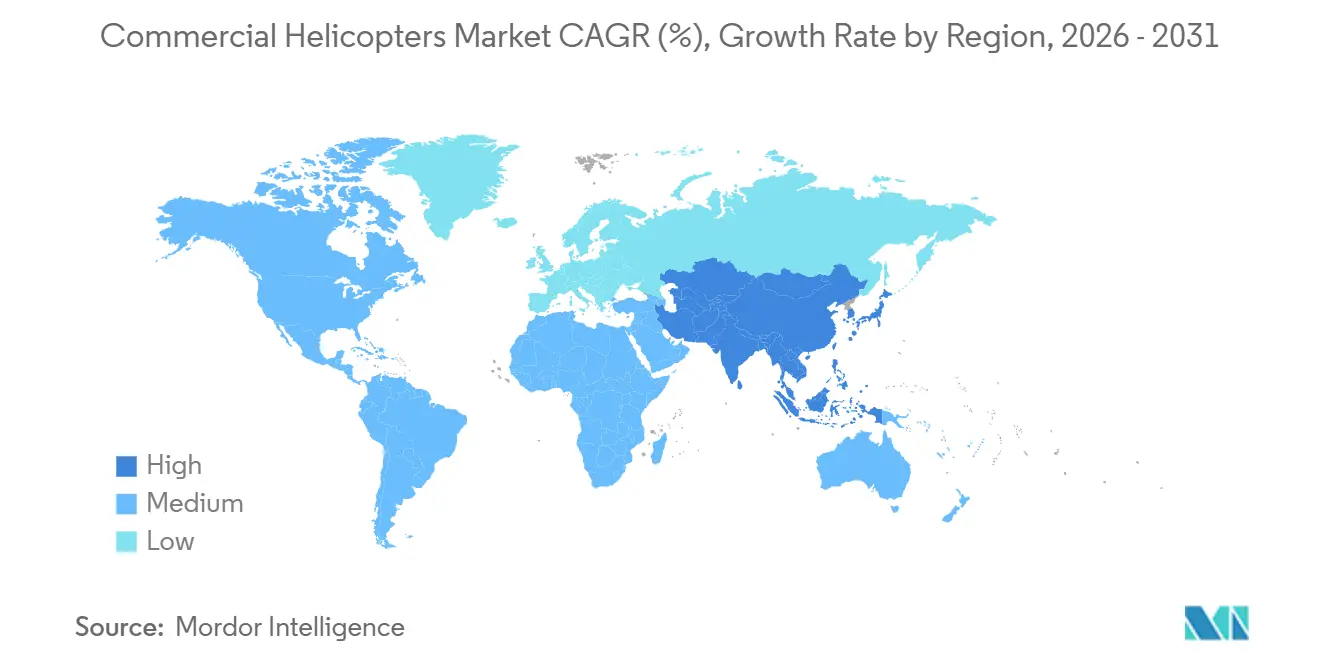
- By region, North America accounted for 39.78% of 2025 revenue, but Asia-Pacific is projected to record the fastest CAGR of 7.55% from 2026 to 2031.
Note: Market size and forecast figures in this report are generated using Mordor Intelligence’s proprietary estimation framework, updated with the latest available data and insights as of January 2026.
Market Trends and Insights
Drivers Impact Analysis of Commercial Helicopters Market*
| Driver | (~) % Impact on CAGR Forecast | Geographic Relevance | Impact Timeline |
|---|---|---|---|
| Rapid offshore wind-farm expansion widens mission scope | +0.8% | Europe (North Sea, Baltic), Asia-Pacific (Taiwan, Japan, South Korea), North America (US East Coast) | Medium term (2–4 years) |
| Outsourced HEMS shifts fleets toward purpose-built twins | +0.9% | North America, Europe (UK, Germany, France) | Short term (≤ 2 years) |
| Modernization wave tackles aging fleets | +0.7% | Global, with concentration in North America and Europe | Medium term (2–4 years) |
| VIP and charter flying gains traction in congested cities | +0.5% | Middle East (UAE, Saudi Arabia), Asia-Pacific (China, India), South America (Brazil) | Long term (≥ 4 years) |
| Climate-driven rise in wildfires supporting aerial firefighting contracts | +0.6% | North America (Western US, Canada), Europe (Mediterranean), Australia | Short term (≤ 2 years) |
| Commercialization of hybrid-electric, SAF-ready, and tilt-rotor technologies | +1.2% | Global, early adoption in North America and Europe | Long term (≥ 4 years) |
| Source: Mordor Intelligence | |||
Rapid Offshore Wind-Farm Expansion Widens Mission Scope
Eight US Atlantic wind projects approved in 2024–2025 will together require more than 7,000 flight hours of annual crew and technician lift once turbines reach full output, a shift that shields operators from oil-price swings.[1] European demand is already visible; Airtelis ordered eight Airbus H145 D3 aircraft in June 2024 for North Sea work, citing lower cabin vibration on 90-minute legs. Leonardo’s AW169 is likewise securing multiyear charters with Vestas via NHV Group, and Ørsted has extended HeliService’s Atlantic coverage through 2029. These contracts lock in five- to seven-year revenue streams and diversify mission portfolios.
Outsourced HEMS Shifts Fleets Toward Purpose-Built Twins
Hospital divestitures of helicopter assets are accelerating the renewal of helicopter fleets. Global Medical Response’s 28-unit Airbus H-140 purchase in January 2025, with options for 15 more, follows the same cost-of-capital logic that led Life Flight Houston to the H-160 platform in March 2025. IFR-certified twins reduce insurance premiums and simplify scheduling because they allow single-pilot operations under instrument conditions. Standardized avionics across an outsourced fleet also compresses training cycles, which is critical amid a pilot shortfall.
Modernization Wave Tackles Aging Fleets
Pre-2010 airframes are prone to fatigue and expensive ADS-B retrofits, making replacement a more economical option. Robinson delivered 312 units in 2024, with many R66 turbine aircraft replacing piston-powered R44s for utility and training missions. Lease-return data tell the same story: Milestone Aviation noted that 22% of its portfolio ended lease terms in 2024–2025 and rolled into newer twins rather than extending single-engine contracts. OEM production stability now relies as much on replacements as on new missions, supporting the commercial helicopters market through the decade.
VIP and Charter Flying Gains Traction in Congested Cities
Blade flew 47,000 paying passengers in 2024 on Manhattan airport routes, a 31% year-over-year increase, and has opened vertiport partnerships in Miami and Los Angeles for 2026 operations. Brazil’s ANAC recorded 2.1 million helicopter movements in São Paulo during 2024, highlighting latent demand in megacities where road commutes exceed 90 minutes. Light twins, such as the Airbus H145, combine cabin quietness with IFR capability, enabling operators to secure nighttime slots in noise-sensitive urban zones.
Restraints Impact Analysis of Commercial Helicopters Market*
| Restraint | (~) % Impact on CAGR Forecast | Geographic Relevance | Impact Timeline |
|---|---|---|---|
| Operating-cost inflation squeezes margins | -0.6% | Global, acute in Europe and North America | Short term (≤ 2 years) |
| Pilot supply constraints limit utilization | -0.5% | North America, Europe, Asia-Pacific | Medium term (2–4 years) |
| Tightening global noise and emissions certification hurdles | -0.4% | Europe (EASA), North America (FAA), Asia-Pacific (CAAC) | Long term (≥ 4 years) |
| eVTOL and long-range drone substitution risk in light segments | -0.3% | North America, Europe, Asia-Pacific urban corridors | Long term (≥ 4 years) |
| Source: Mordor Intelligence | |||
Operating-Cost Inflation Squeezes Margins
Jet-A averaged USD 3.20 per gallon in North America during 2024, 14% higher than 2023, and parts inflation lifted maintenance reserves by 16% over the same period. Hull-and-liability insurance for HEMS fleets increased 18% in 2024-2025 due to night-IFR claims, and smaller operators lack the scale to negotiate discounts. These pressures curb discretionary upgrades such as glass-cockpit retrofits or SAF adoption.
Pilot Supply Constraints Limit Utilization
The Bureau of Labor Statistics projects a 6% annual shortfall in US helicopter pilots through 2030, and HAI surveys suggest that 68% of operators now have vacancies.[2] Captains with 2,000 or more flight hours receive a USD 25,000 signing bonus; however, the training pipelines produce only 3,200 new pilots annually, while demand stands at 4,500. Some North American HEMS fleets are seeing utilization rates dip below 70%, as aircraft remain grounded, awaiting crew availability.
*Our forecasts treat driver/restraint impacts as directional, not additive. The impact forecasts reflect baseline growth, mix effects, and variable interactions.
Commercial Helicopters Market Segment Analysis
By Maximum Take-Off Weight:
Heavy Platforms Gain Share on Offshore and Firefighting DemandLight helicopters retained 54.21% of the commercial helicopters market share in 2025, primarily driven by deliveries of the Robinson R44 and R66 to flight schools and ranching operators.[3] Medium twins serve offshore oil, HEMS, and corporate missions, while heavy models above 9 tons are forecast to post a 6.92% CAGR to 2031 as offshore wind and firefighting contracts proliferate. The Airbus H225 Super Puma secured nine heavy-lift orders in 2024-2025 after a 2,500-hour TBO extension, and Sikorsky’s S-92 picked up a 12-unit Bristow Group order in March 2025.
Heavy helicopters hold approximately 18% of the commercial helicopters market size, a figure that is expected to rise as governments bundle multi-year aerial firefighting contracts. Erickson’s nine-aircraft backlog for the S-64 Skycrane stretches to 2027, indicating sustained demand.

By Number of Engines:
Twin Redundancy Commands a Premium in HEMS and OffshoreSingle-engine models accounted for 63.34% of deliveries in 2025, offering a price-point entry for training and utility roles. Yet twin-engine types are expanding at 6.27% as insurers mandate redundancy over water and at night. Airbus delivered 187 H135 and H145 units combined in 2024, many into HEMS service, while Leonardo shipped 52 AW139s and 28 AW169s across offshore wind and VIP fleets.
Twin-engine helicopters contributed 36% to the commercial helicopters market size in 2025 and are projected to surpass single-engine helicopters in revenue by 2030, as unit prices average 2.5 times higher.
By Rotor System Type:
Tilt-Rotor Commercialization Reshapes Speed ExpectationsSingle-main-rotor airframes still dominate, with a 71.12% share, due to their mechanical simplicity and parts commonality. The arrival of the AW609 tilt-rotor, however, introduces a 275-knot cruise that halves crew-transfer time on 150-nautical-mile offshore legs. Tilt-rotor deliveries are expected to expand at 9.21% through 2031, the highest rate among rotor categories.
Tilt-rotor entrants are projected to capture USD y million of the commercial helicopters market size in 2031, though pilot-training and maintenance-complexity hurdles temper early adoption.
By End-Use:
HEMS Overtakes Offshore as Fastest-Growing MissionOffshore oil and gas maintained a 35.11% share in 2025, but growth in flight hours is flat as energy majors shift their focus toward renewables. Emergency-medical missions recorded a 7.31% CAGR forecast, benefiting from Global Medical Response’s 28-aircraft H140 order and similar procurements at STAT MedEvac and Stanford Health Care. Corporate-VIP traffic is also rising due to urban congestion. Blade’s sixth AW109 came online in April 2025, and Falcon Aviation added three AW139s in March 2025 to Abu Dhabi shuttle routes.
HEMS represents 18% of the commercial helicopters market size in 2025 and is positioned to surpass offshore oil by 2028, assuming current order books remain intact.
Geography Analysis
North America Commercial Helicopters Market
North America retained 39.78% of 2025 revenue, anchored by the world’s densest HEMS grid and stable Gulf of Mexico operations. CAL FIRE’s S-70i intake and the US Forest Service’s contract expansion underscore public-sector demand. FAA leadership on tilt-rotor and eVTOL certification supports early adoption of next-generation fleets.
Europe Commercial Helicopters Market
Europe benefits from stringent noise standards that compel fleet renewal and from the rapid development of offshore wind. The region’s 76 GW offshore-wind target for 2030 under REPowerEU assures heavy-twin demand, while EASA’s Chapter 11 enforcement accelerates retirement of older Chapter 8 airframes.[4]
APAC Commercial Helicopters Market
The Asia-Pacific region is the fastest-growing, with a 7.55% CAGR, driven by China’s low-altitude economy, India’s urban mobility schemes, and Japan's disaster response upgrades. AVIC’s AC352 deliveries and Pawan Hans’ 10-unit Bell 407GXi order illustrate indigenous and imported growth channels.
Regulatory Landscape
Commercial helicopter operations are governed by airworthiness and operating rules from regulators such as the FAA (United States) and EASA (Europe). Recent certification emphasis has increasingly shifted toward crashworthiness, avionics integration, and procedures that shape IFR access. In Europe, EASA finalized CS-26 Issue 5 via Decision 2024/010/R in December 2024, bringing crash-resistant fuel system requirements into effect for rotorcraft, with implementation linked to certification timing from early 2025. This is pushing operators and OEMs to plan around compliant new builds and retrofit schedules.
In the United States, FAA actions have tightened both training and operational frameworks, including updated special training and experience requirements for Robinson R-22 and R-44 models (June 2025). The FAA also revised local procedures in high-density airspace that reduce reliance on visual separation between helicopters and fixed-wing traffic (March 2025), increasing procedural and equipage discipline for urban and hub-adjacent missions. In India, regulatory support also feeds into procurement and connectivity planning, as the Cabinet-approved Modified UDAN regional connectivity scheme (covering FY 2026-27 to FY 2035-36 with an outlay of INR 28,840 crore) includes provisions supporting helicopter connectivity and domestic platforms such as HAL Dhruv, which in turn affects fleet composition and tender requirements.
Value Chain Analysis
The commercial helicopter value chain spans raw materials and tier suppliers (structures, dynamic components, avionics, and engines), OEM design, certification, final assembly, and flight test, followed by delivery, financing or leasing, and operator entry-into-service. While the report scope excludes aftermarket revenues, spares and major component availability still influences new-aircraft purchasing decisions and delivery cadence, particularly for operators in offshore, HEMS, and public service roles where dispatch reliability and predictable maintenance intervals are central.
Supply constraints shape how value is created and captured across the chain. In 2023-2024, shortages of Sikorsky S-92 main gearbox components constrained fleet availability, leading to mitigation measures such as the FAA-approved one-time 1,200-hour life extension for specific S-92 main gearbox housings in September 2024. Operators also used practices such as parts cannibalization to sustain missions. OEMs and primes are simultaneously adjusting sourcing strategies to reduce geopolitical and continuity risks, and in March 2026 Airbus Helicopters confirmed the setup of a European supply chain for the H175M variant. This reflects a broader push toward supply-base localization that can spill over into civil production resilience, lead times, and industrial participation requirements in government-linked tenders.
Competitive Landscape
Airbus Helicopters, Bell Textron, Leonardo S.p.A., Rostec, and Lockheed Martin Corporation together accounted for about 60% of global deliveries in 2024-2025, while Robinson Helicopter controlled roughly one-quarter of the light piston-and-turbine segment. Airbus delivered 330 civil units in 2024, supported by 31 service centers, and has enrolled 120 operators in its HCare parts-by-the-hour plan.[5] Bell shipped 140 units and is doubling down on hybrid-electric R&D. Leonardo’s AW609 tilt-rotor offers the only certified propeller in the commercial space, providing product differentiation as FAA approval nears.
Competition now hinges on innovation in propulsion and aftermarket capture. SAF compatibility, parts-hour programs, and predictive-maintenance analytics generate margins above 40%, versus less than 15% on new-aircraft sales. eVTOL disruptors Joby and Archer pose a medium-term threat to short-haul light singles, yet infrastructure build-outs give incumbent OEMs a window to decarbonize and retain customers.
Commercial Helicopters Industry Leaders
-
Bell Textron Inc.
-
Lockheed Martin Corporation
-
Leonardo S.p.A.
-
Airbus SE
-
Russian Helicopters (Rostec)
- *Disclaimer: Major Players sorted in no particular order
Commercial Helicopters Market Companies Covered in this Report
- Airbus SE
- Lockheed Martin Corporation
- Leonardo S.p.A.
- Russian Helicopters (Rostec)
- Robinson Helicopter Company
- MD Helicopters, LLC
- Enstrom Helicopter Corp.
- Schweizer RSG, LLC
- Kaman Corporation
- Kawasaki Heavy Industries, Ltd.
- Aviation Industry Corporation of China, Ltd.
- Korea Aerospace Industries, Ltd.
- Erickson Incorporated
- Helicopteres Guimbal S.A.S
Market Opportunities and Future Outlook
Fleet renewal and mission diversification are creating whitespace where operators can justify higher-capability twins and heavy or super-medium platforms with stronger IFR utility and lower vibration and noise footprints. Offshore wind-farm expansion provides a measurable utilization anchor, including eight US Atlantic projects approved in 2024-2025 that together require more than 7,000 annual flight hours once fully operational. That supports multi-year contracting patterns already visible in North Sea and Baltic crew-transfer awards. At the same time, outsourced HEMS procurement is shifting fleet mixes toward purpose-built twins with standardized avionics, supported by Global Medical Response ordering 28 Airbus H140s in January 2025, and by public-sector wildfire and SAR contracting that included USD 180 million in exclusive-use US contracts for 2025. During 2024-2025, this also included CAL FIRE taking delivery of Sikorsky S-70i Firehawks into service.
Operational enablement and expanded industrial capability are widening addressable markets beyond traditional offshore oil and gas. India is advancing helicopter IFR access through procedure design, including DGCA approval of the country’s first PinS instrument approach procedure for helicopter operations (July 2026), which supports higher utilization in weather-limited corridors and can improve economics for EMS and regional connectivity routes under schemes such as Modified UDAN. On the supply side, the order environment shows active platform planning and competition. Airbus reported 544 gross orders and 392 deliveries for 2025 (January 2026), while Turkey’s SHGM granted civil type certification to the T625 GOKBEY (March 2026). The certification of a newly developed domestic rotorcraft adds another competed offering in civil procurement channels that are often price sensitive and influenced by government requirements.
Recent Industry Developments in Commercial Helicopters Market
- July 2026: Airbus finalized a contract to supply 10 H125 helicopters to U.S. Customs and Border Protection. The award reinforces demand for light single-engine platforms in government and public security missions, supporting production continuity and training, spares, and support needs tied to fleet standardization.
- June 2026: Airbus signed a contract with Avincis for up to 15 H145 helicopters for EMS and offshore transport. The agreement highlights continued fleet investment in IFR-capable twins and multi-mission configurations, and it strengthens Airbus positioning with large operators that value commonality and lifecycle support programs.
- February 2024: Sikorsky introduced the hybrid-electric HEX 2-Rotor Tiltwing demonstrator with a stated 575-mile range. The program underlined OEM focus on next-generation propulsion and aircraft architectures that target speed and efficiency improvements, informing longer-term pathways for commercial rotorcraft technology adoption.
Commercial Helicopters Market Report Scope and Research Methodology
Market Definition and Coverage
This market is defined as the annual value of new-build commercial helicopters delivered for civil missions such as passenger transport, offshore logistics, emergency medical services, aerial work, tourism, law enforcement, and search and rescue, valued at manufacturer transfer prices in USD.
Scope exclusions: Excludes pre-owned helicopter transactions, military rotorcraft, aftermarket MRO and support revenues, and eVTOL prototypes.
Segments Covered in This Report
- By Maximum Take-off Weight
- Light Helicopters
- Medium Helicopters
- Heavy Helicopters
- By Number of Engines
- Single-engine
- Twin-engine
- By Rotor System Type
- Single Main Rotor
- Tandem Rotor
- Co-Axial Rotor
- Tilt-Rotor
- By End-Use
- Offshore Oil and Gas
- Emergency Medical Services (HEMS)
- Corporate and VIP Charter
- Search and Rescue / Firefighting
- Aerial Work (Utility, Survey, Cargo)
- Tourism
- By Geography
- North America
- United States
- Canada
- Europe
- United Kingdom
- France
- Germany
- Russia
- Rest of Europe
- Asia-Pacific
- China
- India
- Japan
- South Korea
- Rest of Asia-Pacific
- South America
- Brazil
- Rest of South America
- Middle East and Africa
- Middle East
- United Arab Emirates
- Saudi Arabia
- Rest of Middle East
- Africa
- South Africa
- Rest of Africa
- Middle East
- North America
Data Sources, Market Sizing, and Validation
Desk Research
Desk research was used to set the factual base for the model and to keep assumptions tied to what is visible in public aircraft and aviation statistics. We relied on sources such as civil aviation regulators and registries, national statistics offices, customs and trade statistics portals for rotorcraft-related categories, and international bodies tracking aviation activity and safety. We also reviewed helicopter fleet and operations indicators published by industry associations, along with aerospace and rotorcraft journals that discuss utilization patterns and mission profiles.
To translate this context into a market model, we supplemented public documents with company annual reports, investor presentations, and press releases that discuss deliveries, backlog, and pricing movements. In places where public data is thin, paid subscriptions for company financials and intelligence, news and financials, and an aerospace and aviation database with aircraft-level details were used to check delivery timing and platform positioning. These desk sources are illustrative only, and many other references were reviewed for data collection, cross-checking, and clarification.
Primary Interviews and Surveys
Primary work was used to test what desk sources cannot show cleanly, mainly the split of demand by mission types, typical delivery mixes across weight classes, and how pricing moves with specifications and contract terms. We spoke with OEM-facing stakeholders, operators, lessors, and service providers across APAC, EMEA, and the Americas so that regional utilization differences and procurement cycles were captured. Inputs from these conversations were then used to confirm the main drivers and to tighten ranges for uncertain variables before final sign-off.
Distribution of primary research fieldwork respondents
| Company type | Respondent position | Region |
|---|---|---|
| Top tier: 28% | CXOs: 12% | APAC: 45% |
| Mid tier: 56% | Functional/Unit leaders: 31% | EMEA: 37% |
| Smaller Players: 16% | Managers: 57% | Americas: 18% |
Market-Sizing & Forecasting
Sizing is built using a top-down approach where civil rotorcraft delivery activity is reconstructed from aviation production signals, program-level deliveries, and regional demand cues, then mapped to commercial missions covered in the scope. The totals are corroborated through selective bottom-up checks, such as sampled delivery counts by weight class and typical average selling price bands, followed by adjustments when interview feedback shows a consistent bias.
Key inputs used in the model include new helicopter deliveries by year, mix shifts across light, medium, and heavy platforms, typical mission utilization patterns (offshore, EMS, aerial work, and passenger transport), average selling price movement by configuration, and replacement demand tied to fleet aging and regulatory compliance cycles. Where bottom-up validation has gaps, conservative ranges are applied and then narrowed using operator procurement timing and OEM backlog visibility gathered from primary discussions.
For forecasting, we used scenario analysis supported by a simple multivariate regression layer that links demand to indicators such as offshore activity cycles, public safety and healthcare fleet renewal, and broader business aviation sentiment. The outputs are then sanity-checked with expert expectations on lead times and capacity constraints. The final forecast is kept reproducible, since each major driver can be traced back to a visible indicator and then re-tested in refresh cycles.
Data Validation & Update Cycle
Validation is done by triangulating the model output against independent signals, including delivery trends, backlog commentary, and observed shifts in mission demand by region. When a variance shows up, the assumption behind it is revisited, and follow-up calls are triggered if the difference cannot be explained by timing, currency effects, or known program changes. Before sign-off, the full workbook is reviewed in steps so that input logic, arithmetic, and reasonableness checks are completed by a second analyst.
The report is refreshed annually, and interim updates are made when there is a material event such as a major certification change, a sharp shift in offshore activity, or a meaningful change in delivery schedules. Right before delivery, a final pass is completed to confirm that the latest public releases and primary feedback have been reflected in the estimates clients receive.
Mordor Intelligence's Commercial Helicopters Market Estimate Compared With Other Published Estimates
Published market values for commercial helicopters often do not match, and it is usually because each publisher defines the product boundary and pricing basis differently and then selects a different reference year. These differences can look small at first, but they add up quickly when the market is sized across several regions and mission types.
Some external estimates widen the scope by blending in used helicopter sales, aftermarket MRO, or broader helicopter categories that are not limited to new civil deliveries. Mordor Intelligence limits the number to new-build civil helicopter deliveries valued at manufacturer transfer prices, and excludes military platforms plus aftermarket support so the total stays tied to a clean delivery-based demand pool.
Benchmark comparison
| Source | Market Size | Gaps in Research Methodology |
|---|---|---|
| Mordor Intelligence | USD 7.13 B (2026) | |
| Global Consultancy A | USD 6.07 B (2024) | Uses an earlier base year and a broader category-style definition, which can pull in adjacent civil helicopter uses and pricing assumptions that are not strictly aligned to manufacturer transfer pricing for new deliveries. |
| Industry Publisher B | USD 7.48 B (2024) | Appears to run a wider segmentation lens that may include additional rotorcraft configurations and application buckets, and the longer forecast horizon can lift the current-year figure depending on assumed ASP progression and currency timing. |
The table indicates that year selection and the items counted as market revenue are the main reasons the figures spread. By keeping the model anchored to new delivery value, and then checking it against delivery mix and pricing signals that can be re-tested every year, we keep the estimate transparent and easier to replicate.
Key Questions Answered in the Report
How large is the commercial helicopters market in 2026 and what growth is expected?
The commercial helicopters market size reached USD 7.13 billion in 2026 and is projected to reach USD 9.03 billion by 2031, reflecting a 4.85% CAGR.
Which weight class is growing the fastest?
Heavy platforms above 9 tons are forecasted to post the strongest 6.92% CAGR through 2031 as offshore wind and wildfire contracts expand.
Why are twin-engine helicopters gaining share?
Insurance requirements for IFR and over-water missions, coupled with outsourced HEMS contracts, push operators toward twin redundancy despite higher acquisition cost.
What region offers the highest growth opportunity?
Asia-Pacific is set to grow at 7.55% due to China’s low-altitude economy policy, India’s urban connectivity plans, and Japan’s disaster-response renewals.
How will sustainable aviation fuel affect fleet economics?
Trials on Bell 505 and Airbus H225 indicate up to 75% lifecycle CO₂ cuts with drop-in 100% SAF, helping operators meet ReFuelEU mandates without hardware changes.
Are eVTOL aircraft a near-term threat to light helicopters?
Certification milestones at Joby and Archer suggest commercial launches by 2026-2027, potentially displacing light single-engine helicopters on short urban routes where vertiport infrastructure is available.