
Commercial Aircraft Floor Panels Market Size and Share
Market Overview
| Study Period | 2020 - 2031 |
|---|---|
| Market Size (2026) | USD 373.98 Million |
| Market Size (2031) | USD 504.27 Million |
| Growth Rate (2026 - 2031) | 6.18 % |
| Fastest Growing Market | Middle East and Africa |
| Largest Market | Asia Pacific |
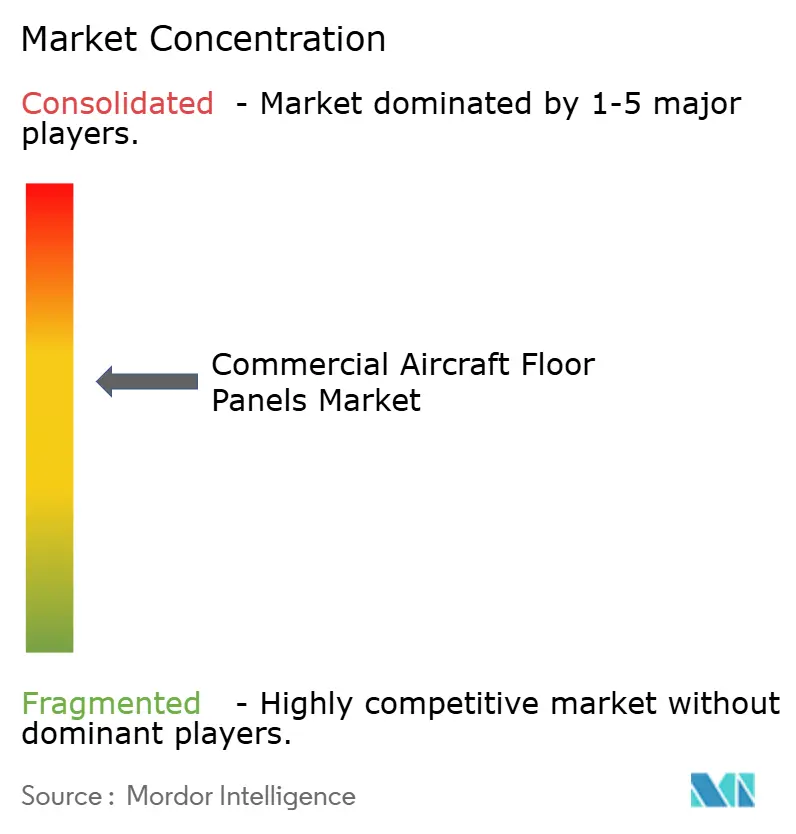
| Market Concentration | Medium |
Major Players *Disclaimer: Major Players sorted in no particular order Image © Mordor Intelligence. Reuse requires attribution under CC BY 4.0. | |
Commercial Aircraft Floor Panels Market Analysis by Mordor Intelligence
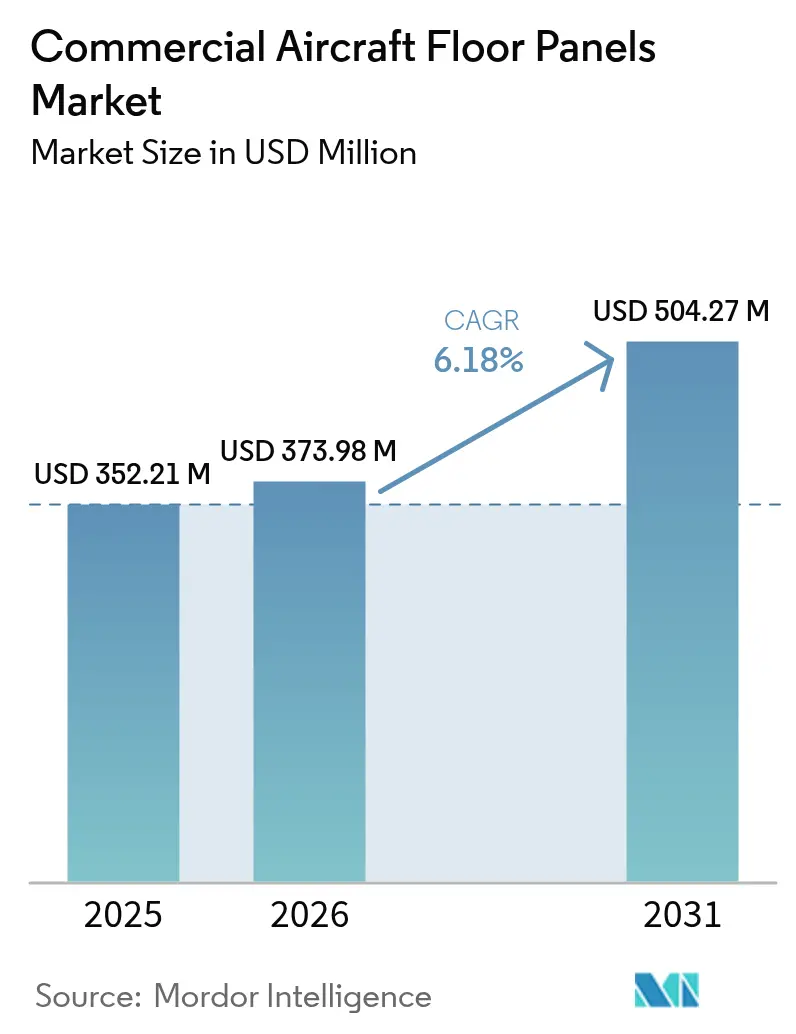
The commercial aircraft floor panels market size was valued at USD 352.21 million in 2025 and estimated to grow from USD 373.98 million in 2026 to reach USD 504.27 million by 2031, at a CAGR of 6.18% during the forecast period (2026-2031). Growing aircraft backlogs, stringent fire-safety rules, and the industry-wide shift toward lighter cabin interiors underpin this expansion. Airlines are accelerating their retrofit programs to reduce fuel burn, while next-generation wide-body platforms adopt composite-rich structures that rely on advanced floor panels to achieve weight parity. Supply-chain consolidations, such as Boeing’s purchase of Spirit AeroSystems and Airbus’s acquisition of Spirit’s European assets, realign sourcing power and help de-bottleneck panel deliveries. Meanwhile, recyclable thermoplastic honeycomb cores transition from prototype to line-fit status as operators pursue circular economy targets.
Key Report Takeaways
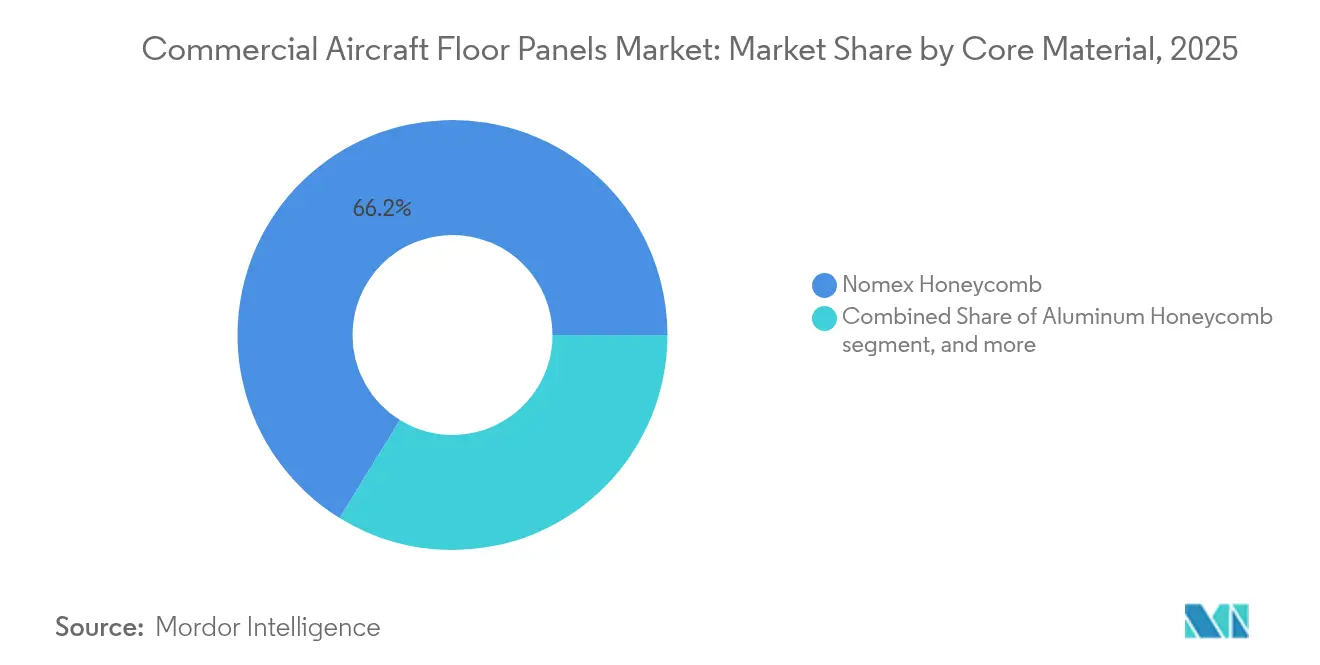
- By core material, Nomex honeycomb led the commercial aircraft floor panels market with a 66.20% share in 2025; carbon-fiber honeycomb is projected to expand at an 8.42% CAGR through 2031.
- By fitment, the OEM channel held 60.70% of the commercial aircraft floor panels market in 2025, while the aftermarket is forecasted to grow at an 7.76% CAGR to 2031.
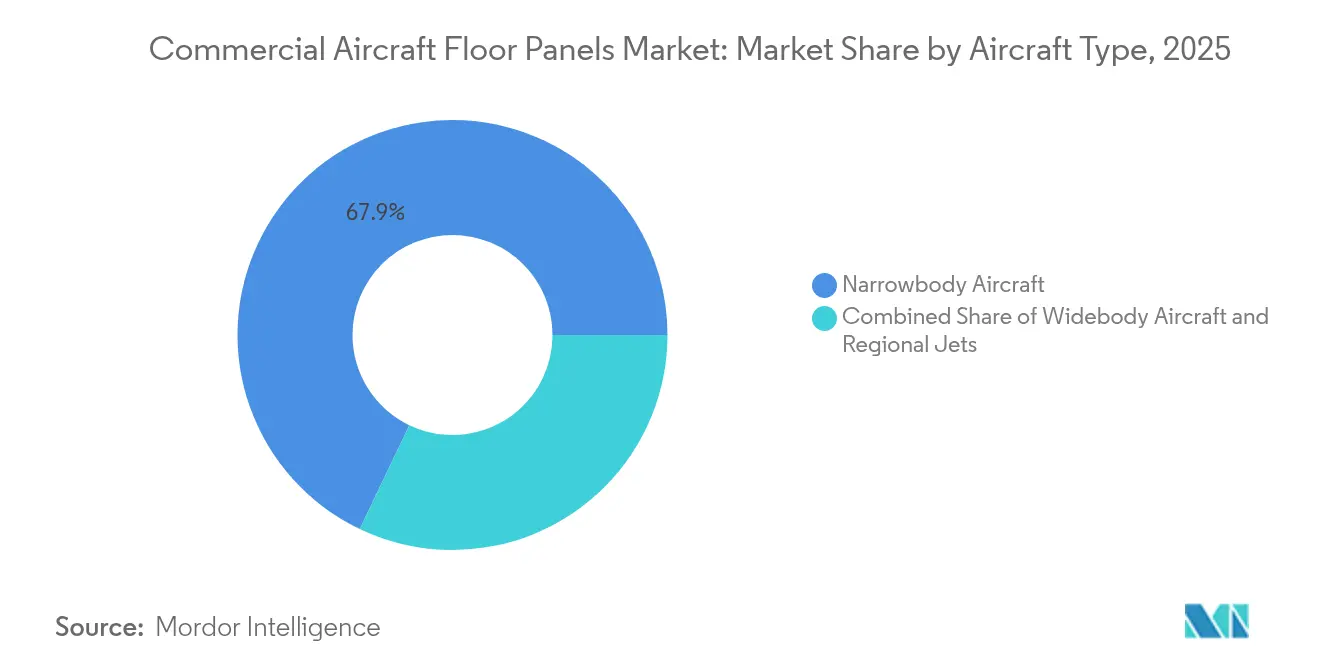
- By aircraft type, narrowbody programs accounted for 67.90% of the commercial aircraft floor panels market size in 2025; widebody programs are set to rise at a 6.43% CAGR during 2026-2031.
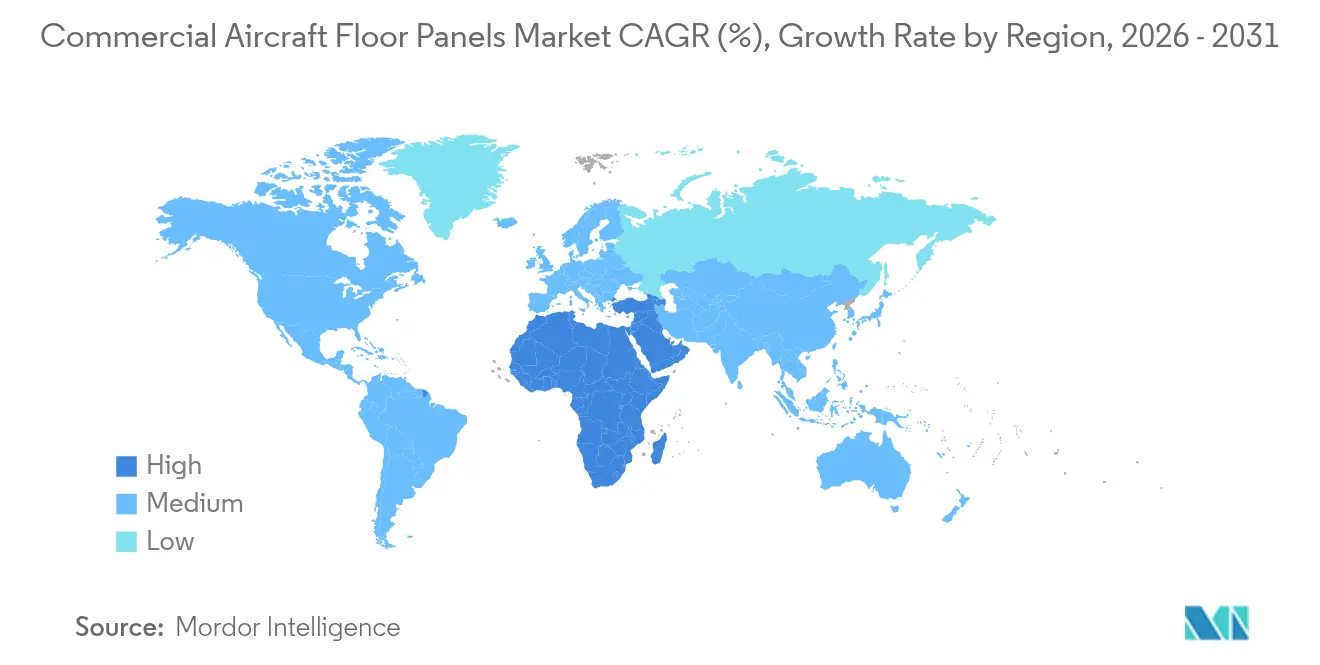
- By geography, the Asia-Pacific region dominated with a 30.85% revenue share in 2025; the Middle East and Africa region is poised for the fastest growth, with a 7.08% CAGR to 2031.
Note: Market size and forecast figures in this report are generated using Mordor Intelligence’s proprietary estimation framework, updated with the latest available data and insights as of 2026.
Market Trends and Insights
Drivers Impact Analysis of Commercial Aircraft Floor Panels Market*
| Driver | ( ~ ) % Impact on CAGR Forecast | Geographic Relevance | Impact Timeline |
|---|---|---|---|
| Surge in narrowbody aircraft production backlog | +1.8% | Global with focus on Asia-Pacific and North America | Medium term (2-4 years) |
| Airline retrofit cycles focused on lightweight cabin refurbishment | +1.2% | North America and EU, expanding into Asia-Pacific | Short term (≤ 2 years) |
| Ramp-up of composite-rich models requiring advanced floor panel solutions | +1.5% | Global, led by B787 and A350 lines | Long term (≥ 4 years) |
| Rising adoption of recyclable thermoplastic honeycomb cores for circularity goals | +0.9% | Europe leading, North America and Asia-Pacific following | Long term (≥ 4 years) |
| Expansion of integrated MRO and PMA supply chains shortening global TAT | +0.8% | Global, strong growth in Middle East and Asia-Pacific | Medium term (2-4 years) |
| Stricter flammability regulations accelerating phase-out of legacy panels | +0.4% | Global regulatory harmonization (FAA, EASA, ICAO) | Short term (≤ 2 years) |
| Source: Mordor Intelligence | |||
Surge in Narrowbody Aircraft Production Backlog
Narrowbody order books now span nearly 13 years of output, locking in sustained demand for commercial aircraft floor panels market installations. Each single-aisle jet needs 15-20 panels across the cabin and belly compartments, so every incremental production slot translates into tangible material volumes. The restart of B737 MAX production and the Airbus A320neo family’s targeted 75-per-month cadence intensify sourcing pressures, even as select component suppliers continue to struggle with electronics, forgings, and honeycomb cores. The US Government Accountability Office notes that nine of 15 tier-one vendors cite labor and material shortages as persistent constraints, which extend lead times and prompt airframers to dual-source qualified panel lines where possible.[1] Operators in Asia-Pacific and North America absorb the bulk of fresh deliveries, reinforcing the geographic skew toward those supply corridors.
Airline Retrofit Cycles Focused on Lightweight Cabin Refurbishment
Cabin refresh intervals range from eight to 12 years, and the current wave coincides with record fuel price volatility. Airlines, therefore, prioritize mass-reduction options, making lightweight floor systems a core feature of retrofit kits. Collins Aerospace displayed an integrated seating-plus-floor concept at the Aircraft Interiors Expo that reuses structural seat rails while replacing the original panels with next-generation phenolic-resin laminates. Safran’s interiors division booked 25.2% revenue growth in 2024, underpinned by similar retrofit demand as carriers such as Delta Air Lines chose smart-cabin modules over full fleet reconfigurations. Regulatory updates to FAR 25.853 test protocols also force older panels out of service sooner, lifting near-term replacement volumes in North America and several EU jurisdictions.
Ramp-Up of Composite-Rich Models Requiring Advanced Floor Panel Solutions
Widebody programs, such as the B787 and A350, comprise roughly 50% of the composite content by mass. Their floor structures must deliver comparable stiffness while absorbing point loads from premium-class monuments. Carbon-fiber honeycomb cores paired with phenolic skins exceed the weight savings of legacy Nomex by 8-10 kg per aircraft, yet sustaining those benefits requires high-precision bonding and tight supply coordination. Hexcel reported USD 1,194.20 million in commercial aerospace sales for 2024, representing a 12% year-over-year increase.[2] Continuous-autoclave curing and automated tape laying now enter mainstream floor panel production, boosting throughput and reducing rework rates to meet airframe schedules.
Rising Adoption of Recyclable Thermoplastic Honeycomb Cores for Circularity Goals
Europe’s Green Deal and comparable North American ESG frameworks motivate airlines and lessors to pursue panels with end-of-life recovery pathways. EconCore, Toray, and Bostik co-developed a flame-safe thermoplastic honeycomb solution that passes vertical burn tests without phenolic resins, paving the way for heat-welded disassembly. The ECO-COMPASS research consortium targets 50% weight trim and 20% CO₂ cuts via recycled carbon-fiber inserts across interior panels. At the same time, Collins Aerospace operates twin thermoplastic composite (TPC) lines in California and the Netherlands, producing 2,500 part numbers. Close to 700 commercial aircraft retire each year, and that tally is set to climb as early 2000s-built aircraft come due, creating a stream of recyclable panel scrap ready for circular processing.
Restraints Impact Analysis of Commercial Aircraft Floor Panels Market*
| Restraint | ( ~ ) % Impact on CAGR Forecast | Geographic Relevance | Impact Timeline |
|---|---|---|---|
| Volatile Nomex and carbon-fiber pricing compressing supplier margins | -1.1% | Global, particularly North America and Europe | Short term (≤ 2 years) |
| Persistent supply-chain constraints for aerospace-grade honeycomb cores | -0.9% | Global, acute in Asia-Pacific manufacturing hubs | Medium term (2-4 years) |
| Lengthy certification and qualification cycles for new core materials and bonding processes | -0.7% | Global regulatory harmonization led by FAA, EASA, ICAO | Long term (≥ 4 years) |
| Adhesive-bond delamination and moisture-ingress incidents triggering fleet-wide inspection directives | -0.5% | Global, with heightened scrutiny in North America and Europe | Medium term (2-4 years) |
| Source: Mordor Intelligence | |||
Volatile Nomex and Carbon-Fiber Pricing Compressing Supplier Margins
Nomex paper and aerospace-grade carbon fiber rely on petroleum-based feedstocks and specialized precursor capacity, exposing prices to crude oil swings and energy price fluctuations. Hexcel has trimmed its 2025 revenue outlook to USD 1.88–1.95 billion, citing rising raw-material costs and extended receivable cycles as airframers accelerate deliveries. DuPont likewise signals continued cost pass-through for its Nomex portfolio after capacity outages at select meta-aramid plants. Tier-two panel assemblers operate on thinner margins and often lack long-term supply contracts, forcing them to hedge or absorb volatility, which dilutes the capital available for R&D.
Persistent Supply-Chain Constraints for Aerospace-Grade Honeycomb Cores
Aerospace-grade honeycomb production requires proprietary expansion equipment and multiple clean-room bond lines, limiting the pool of qualified global suppliers. The US Government Accountability Office lists core material shortages among the top three impediments to Boeing and Airbus rate increases. Certification of novel core geometries can stretch 18–24 months under FAA and EASA test regimes, dissuading new entrants. Recent FAA directives on adhesive-bond delamination further tighten inspection cycles, adding process complexity and driving rework expenses in panel deliveries, especially in high-growth Asia-Pacific final-assembly centers.
*Our forecasts treat driver/restraint impacts as directional, not additive. The impact forecasts reflect baseline growth, mix effects, and variable interactions.
Commercial Aircraft Floor Panels Market Segment Analysis
By Core Material:
Nomex Dominance Faces Carbon-Fiber ChallengeNomex honeycomb held a 66.20% slice of the commercial aircraft floor panels market in 2025, reflecting decades of compliance with FAR 25.853 flammability rules and broad line-fit approvals. Nomex’s low smoke toxicity and favorable handling encourage continued use, anchoring baseline demand even as weight-saving pressures intensify. Hexcel and DuPont supply most aramid paper worldwide, granting them scale economies that small rivals struggle to match. However, the segment’s growth plateaus as operators pivot toward higher specific-modulus alternatives for premium cabins and long-range jets.
Carbon-fiber honeycomb combines thinner cell walls with superior compressive strength, unlocking cabin weight reductions of up to 10 kg per aircraft. Research published in the Journal of Sandwich Structures and Materials demonstrates that thicker-walled carbon cores avert shear-type instability under service loads, sustaining fatigue life across 90,000 flight cycles. The commercial aircraft floor panels market size for carbon-fiber cores is forecast to widen at an 8.42% CAGR. However, qualification costs and resin-film-adhesive compatibility still limit penetration on legacy narrowbody fleets. Aluminum cores remain relevant for cargo floors where impact tolerance outweighs the potential for fuel savings, while emerging thermoplastic and bio-derived variants are testing recycling pathways crucial to European circular economy mandates.
The innovation frontier centers on thermoplastic honeycomb options, such as EconCore’s ThermHex, which integrates recycled polypropylene feedstock and passes vertical burn tests without the use of phenolics. Panel makers pair these cores with PEI or PPS skins to produce fully weldable assemblies that airlines can shred and re-melt after decommissioning. Full-scale static and dynamic load trials on 9-g tie-down seats confirm equivalent structural margins, clearing an early hurdle toward line-fit status. As regulatory bodies fine-tune cradle-to-grave emissions accounting, the commercial aircraft floor panels market may progressively reward suppliers that offer transparent recycling certificates alongside performance guarantees.

By Fitment:
OEM Leadership with Aftermarket AccelerationOriginal equipment installations captured 60.70% of the commercial aircraft floor panels market revenue in 2025, reflecting the sheer volume of factory-fresh deliveries at Airbus and Boeing lines. Every assembled fuselage ships with a complete, certified panel kit, locking suppliers into multi-year pricing and volume frameworks. Tier-one conglomerates manage direct lineside deliveries and often assume kitting responsibility, bundling seat tracks, insulation blankets, and fastening hardware into just-in-sequence shipments. Despite holding this anchor position, OEM demand is sensitive to temporary rate dips when airframers troubleshoot production quality issues.
Conversely, the aftermarket reflects a compound pull from cabin retrofits, heavy checks, and in-service damage events, leading to an 7.76% CAGR through 2031. Maintenance shops inside the Lufthansa Technik, HAECO, and ST Engineering networks blend OEM and PMA panel sources depending on customer cost targets. FAA data show PMA floor panel approvals rising 11% yearly as design-data packages from retired airframes become publicly available. Triumph Group recorded a spike in spares shipments tied to B737 and B787 cabin refresh programs, validating how larger fleets propel baseline aftermarket volumes. Crucially, the commercial aircraft floor panel industry now sees airlines negotiating total-cost-of-ownership packages that combine the purchase price with the end-of-lease residual value, amplifying the appeal of recyclable thermoplastic concepts.
By Aircraft Type:
Narrowbody Dominance with Widebody RecoveryNarrowbody jets such as the B737 and A320 families accounted for 67.90% of the commercial aircraft floor panels market demand in 2025, supported by dense order books from low-cost carriers and network airlines. Each single-aisle airframe’s shorter cabin length moderates the absolute panel count, yet production volumes exceed those of widebody aircraft by roughly four-to-one, preserving the segment’s revenue heft. Route expansion plans in India, Vietnam, and Saudi Arabia underpin forward demand, while fleet-standardization strategies maintain consistent panel part numbers across sub-fleets, simplifying inventory management.
Widebody types are rebounding with international traffic normalization and slot scarcity at hub airports, and they are projected to grow at a 6.43% CAGR between 2026 and 2031. Emirates’ USD 1.2 billion cabin-upgrade package, covering the A350 and B777X platforms, pivots on premium-class branding, prompting bespoke floor panel layouts that integrate larger monument footprints and under-aisle wire conduits. Carbon-fiber honeycomb finds its earliest large-scale adoption in these long-range cabins, where every kilogram shaved translates into sizable mission fuel savings. Regional jets and turboprops remain a niche. However, they provide a steady baseline demand for aluminum-core variants used in lower-life-cycle platforms, especially in North American Essential Air Service routes and European PSO contracts.
Geography Analysis
APAC Commercial Aircraft Floor Panels Market
The Asia-Pacific region retained a 30.85% share of the commercial aircraft floor panels market in 2025, underpinned by aggressive fleet growth in China, India, Indonesia, and Japan. Airbus projects that the region’s aircraft services spending will surge from USD 52 billion in 2025 to USD 129 billion by 2043, with maintenance spending alone climbing to USD 109 billion. Significant narrowbody backlogs, a vibrant low-cost carrier (LCC) sector, and offset agreements that favor local composites production extend procurement cycles for panel suppliers in Tianjin, Hyderabad, and Nagoya. Government-backed R&D documents emphasize the increased adoption of digital design and highlight cost gaps compared to Western peers, signaling a further localization of floor panel finishing and inspection activities.
MEA Commercial Aircraft Floor Panels Market
The Middle East and Africa are expected to deliver the fastest forecast expansion at a 7.08% CAGR through 2031. Boeing forecasts 2,370 new-build aircraft, valued at USD 470 billion, entering the region by 2031, with 69% of these expected to stem from passenger traffic growth and the maturation of hub-and-spoke networks. Emirates, Qatar Airways, and Saudia collectively hold more than 880 widebody airframes on order or option, translating into high-value panel kits tailored for premium-class cabins. Concurrent investments in MRO free zones at Jeddah and Addis Ababa reduce turnaround times and facilitate localized panel repairs, thereby reinforcing the region’s complete value chain.
North America and Europe Commercial Aircraft Floor Panels Market
North America ranks third in revenue but commands significant technical influence; many panel design approvals are held by US or Canadian authorities. Consolidation through Boeing’s USD 8.3 billion acquisition of Spirit AeroSystems brings strategic stockholding of honeycomb core capacity onshore, smoothing OEM deliveries while rearranging competitive bidding for independent shops. Europe maintains a strong sustainability focus, championing the adoption of recyclable thermoplastics through ECO-COMPASS grants and mandating more transparent life-cycle analysis labels, which push suppliers to co-develop closed-loop recovery hubs adjacent to Hamburg and Toulouse assembly lines. Collectively, these mature regions stabilize the commercial aircraft floor panels market by balancing cyclical production swings with predictable retrofit cycles.
Regulatory Landscape
Commercial aircraft floor panels sit under stringent cabin interior fire, smoke, and toxicity rules, primarily FAA 14 CFR 25.853 (and Part 25 Appendix F test methods) and EASA CS-25.853, which drive material selection for skins, cores, and adhesives used in passenger and belly-cargo floors. For suppliers, demonstrating compliance typically requires heat-release and smoke-density performance for larger surface-area panels, supported by regulator guidance such as FAA flammability-testing policy and EASA certification memoranda used during certification and change approvals.
In March 2026, EASA updated its Easy Access Rules for Part-26, incorporating Regulation (EU) 2024/2954 (applicable from 22 December 2024), reinforcing continued airworthiness expectations that influence how operators and design organizations manage interior structural changes and repairs during retrofit programs. Separately, airworthiness directives can introduce incremental compliance actions that touch interior floor/track interfaces, such as FAA AD 2026-10-05 (effective 6 July 2026) addressing cabin attendant seat track attachments on Airbus A330/A340 variants, increasing scrutiny on attachment integrity and documentation around modified floor zones.
Value Chain Analysis
The value chain begins with raw materials and semi-finished inputs (aramid paper such as Nomex, aluminum foil, carbon-fiber reinforcements, phenolic/epoxy/thermoplastic resins, films and structural adhesives), followed by honeycomb-core expansion and stabilization, then panel fabrication (skin layup, bonding, curing, machining, sealing) and kitting for installation. Tier suppliers range from core-material specialists to integrated floor-system manufacturers such as The Gill Corporation, Triumph Group, Collins Aerospace, Comtek Advanced Structures, and Elbe Flugzeugwerke (EFW), supplying either design-build floor systems for newer platforms or built-to-print panels for high-rate single-aisle programs. Quality and airworthiness credentials (for example, AS9100 and EASA Part 21 design/manufacturing privileges at the program level) influence who can bid.
Downstream, OEM lineside logistics and just-in-sequence delivery into Airbus and Boeing final-assembly sites determine working-capital needs and on-time performance, while the aftermarket moves through airlines, lessors, and MRO networks that blend OEM parts with approved alternative parts based on cost and lead-time targets. Recent program activity illustrates broader participation in structural floor content, such as Montana Aerospace delivering the first floor grid section for the Airbus A350F (April 2024), while EFW-linked Aircraft Composites Sachsen (acosa) highlighted ongoing production of single-aisle cargo floor panels for Airbus (June 2026). This reinforces the role of qualified European manufacturing nodes for both passenger and cargo-floor applications.
Competitive Landscape
The commercial aircraft floor panels market features a moderate level of concentration. The top five suppliers collectively command over 40% of the market share, reflecting high certification barriers and entrenched line-fit contracts. Boeing’s acquisition of Spirit AeroSystems and Airbus’s parallel purchase of Spirit’s Northern Ireland and Morocco units consolidate vertically integrated supply chains and amplify purchasing leverage. Hexcel Corporation, Collins Aerospace, Safran S.A., and Triumph Group Inc. are the leading companies, each utilizing proprietary material chemistries or automated cell-expansion techniques that maintain a competitive edge.
Technology differentiation pivots on advanced composites, adhesive innovations, and continuous-flow manufacturing. Collins Aerospace deploys automated thermoplastic tape placement in California, reducing cycle times by 30% compared to batch autoclave processes. MTorres’ Torreswing concept eliminates molds and fasteners by curing panels on dynamic kinematic frames, hinting at future cost compression. EconCore champions recyclable polypropylene honeycomb cores that meet aviation flame-smoke-toxicity thresholds without the use of phenolics, carving a sustainability niche that legacy aramid products cannot match at the end of their life cycle.
Strategic collaboration remains a preferred growth lever. Satair leverages Telair’s cargo-handling know-how to bundle floor and side-wall solutions within unified inventory pools. Safran integrates reclaimed LEAP engine blades into decorative panel veneers to showcase circular-economy credentials while shrinking Scope 3 emissions. Meanwhile, PMA specialists forge alignments with independent MRO shops to win share in price-sensitive narrow-body fleets, expanding data-supported reliability dossiers that reassure cautious lessors.
Commercial Aircraft Floor Panels Industry Leaders
-
The Gill Corporation
-
Collins Aerospace (RTX Corporation)
-
Triumph Group, Inc.
-
Safran S.A.
-
Hexcel Corporation
- *Disclaimer: Major Players sorted in no particular order
Commercial Aircraft Floor Panels Market Companies Covered in this Report
- The Gill Corporation
- Collins Aerospace (RTX Corporation)
- Safran S.A.
- Triumph Group Inc.
- Singapore Technologies Engineering Ltd.
- LATECOERE
- Aeropair Ltd.
- Elbe Flugzeugwerke GmbH
- VINCORION Advanced Systems GmbH
- Satair (Airbus SE)
- Lufthansa Technik AG
- Hexcel Corporation
- Jamco Corporation
- Diab Group
- Plascore Inc.
- Euro-Composites S.A.
- FACC AG
- SEKISUI Aerospace
- Showa Aircraft Industry Co. Ltd.
- Honeycomb Company of America, Inc.
Market Opportunities and Future Outlook
A key opportunity lies in next-generation materials that reduce weight while maintaining compliance with FAA 14 CFR 25.853 and EASA CS-25.853, especially in high-traffic floor zones where durability and repair turnaround time matter. Thermoplastic constructions, including recyclable thermoplastic honeycomb concepts already under development in Europe, create a route for suppliers to bundle performance with end-of-life handling, aligning with airline and lessor efforts to document life-cycle impacts during cabin refresh and lease-return events.
Retrofit and modification activity also supports certified drop-in replacements and program-specific kits across high-volume fleets, including passenger-to-freighter conversions where cargo-floor configurations and localized reinforcements drive recurring panel demand. An example of ongoing product and qualification work is JCB Aero and SHD developing a lightweight floorboard panel system using FRVC411 prepreg (announced May 2024), positioned for compatibility across a large share of Boeing cabin configurations and aligned to Boeing material standards. Solutions like this increase the addressable installed base when paired with certification evidence and airline and MRO adoption pathways.
Recent Industry Developments in Commercial Aircraft Floor Panels Market
- May 2026: The Gill Corporation stated it continues supplying Tier One fabricated floor panel kits for Boeing 777-Classic and 777-8/-9 aircraft and supporting Boeing 737 passenger-to-freighter conversions. The disclosure reinforces the role of long-cycle Boeing widebody and conversion activity in sustaining demand for certified floor-panel kits across both production and modification channels.
- April 2025: Airbus finalized an agreement to acquire industrial assets from Spirit AeroSystems tied to its commercial aircraft programs. The move reshaped aerostructures sourcing and integration, with implications for interior-adjacent supply chains that depend on stable, rate-ready upstream structures and procurement frameworks.
- October 2024: Comtek Advanced Structures (Latecoere) received a contract from De Havilland Aircraft of Canada to design and manufacture composite floors for the DHC-6 Twin Otter Classic 300-G, covering both cabin and cockpit flooring. The award highlights continued platform-specific demand for engineered composite floor systems, supporting specialized suppliers that can deliver design, qualification, and manufacturing under aviation interior safety requirements.
Commercial Aircraft Floor Panels Market Report Scope and Research Methodology
Market Definition and Coverage
This market covers floor panel assemblies used inside commercial aircraft cabins and belly cargo areas, including line-fit supply and replacement demand. Values are captured in USD and reflect the sell-side value of panels supplied to OEM and aftermarket channels.
Scope exclusions: We exclude military aircraft, business and general aviation platforms, rotorcraft, and other interior sandwich panels that are not used as aircraft floor panels.
Segments Covered in This Report
- By Core Material
- Nomex Honeycomb
- Aluminum Honeycomb
- Carbon-Fiber Honeycomb
- Others
- By Fitment
- OEM
- Aftermarket
- By Aircraft Type
- Narrowbody Aircraft
- Widebody Aircraft
- Regional Jets
- By Geography
- North America
- United States
- Canada
- Mexico
- Europe
- United Kingdom
- Germany
- France
- Italy
- Russia
- Rest of Europe
- Asia-Pacific
- China
- India
- Japan
- South Korea
- Rest of Asia-Pacific
- South America
- Brazil
- Argentina
- Rest of South America
- Middle East and Africa
- Middle East
- Saudi Arabia
- United Arab Emirates
- Rest of Middle East
- Africa
- South Africa
- Rest of Africa
- Middle East
- North America
Data Sources, Market Sizing, and Validation
Desk Research
Desk research was used to set the factual base for aircraft deliveries, fleet activity, and material compliance needs that influence floor panel demand. We referenced public sources such as FAA aircraft certification and safety guidance, EASA airworthiness publications, ICAO air transport statistics, and World Bank macro indicators to keep the demand context consistent by region.
On the industry side, we also reviewed aircraft OEM order and delivery updates, supplier brochures and technical datasheets, investor presentations, and reputable aviation press to understand typical panel constructions and replacement triggers. Where needed, we supported program and company mapping through paid subscriptions focused on company financials and industry intelligence, plus patent databases for material and bonding innovations. These examples are illustrative, and other public sources were also used for data collection, validation, and clarification during the work.
Primary Interviews and Surveys
Primary work focused on interviews and structured surveys with panel manufacturers, core material suppliers, aircraft interiors integrators, and airline and MRO procurement contacts. Since demand patterns vary by aircraft type and retrofit timing, we also checked assumptions with experts across APAC, EMEA, and the Americas to confirm fitment splits, pricing direction, and replacement cadence.
Distribution of primary research fieldwork respondents
| Company type | Respondent position | Region |
|---|---|---|
| Top tier: 38% | CXOs: 18% | APAC: 47% |
| Mid tier: 40% | Functional/Unit leaders: 29% | EMEA: 30% |
| Smaller Players: 22% | Managers: 53% | Americas: 23% |
Market-Sizing & Forecasting
Market sizing is built with a top-down approach where commercial aircraft production and fleet activity are translated into a yearly demand pool for floor panels, and then converted into value using validated price bands. To keep it practical, we cross-check results with selective bottom-up approximations using sampled supplier outputs, typical panel count per aircraft area, and channel checks on OEM versus replacement share.
Key inputs include commercial aircraft deliveries and backlog signals, active fleet size and utilization direction, retrofit and cabin refresh cycles, material mix shifts between aluminum honeycomb and Nomex honeycomb, and observed pricing changes tied to resin, honeycomb core, and certification-driven specifications. Where a local data series is missing, we fill gaps by using regional averages anchored to similar fleet profiles and then adjust through expert feedback.
For forecasting, we use scenario analysis so build-rate changes and airline spending cycles can be reflected without forcing a single straight-line trend. Assumptions are finalized after reconciling expert consensus on production ramps, aftermarket timing, and realistic ASP movement by material and fitment.
Data Validation & Update Cycle
Outputs are validated through multiple checks, starting with comparing implied panel demand against independent signals such as delivery counts, fleet utilization, and known cabin upgrade waves. Any large variance is reviewed, and if the driver cannot be explained by scope or pricing logic, we re-check source inputs and re-contact select respondents to confirm the assumption.
Before sign-off, the model and narratives go through an analyst review cycle so unit logic, currency handling, and regional splits stay consistent. Reports are refreshed annually, and interim updates are made when material events occur, such as major aircraft program rate changes or notable regulatory shifts. Right before delivery, we complete a final pass so clients receive the latest updated view.
Mordor Intelligence's Commercial Aircraft Floor Panels Market Estimate Compared With Other Published Estimates
Published market sizes for aircraft floor panels can vary widely, even when the topic label appears similar. This usually happens because studies pick different aircraft coverage, include or exclude aftermarket demand, and apply different ways of converting volumes into USD.
In this market, the largest gaps tend to come from whether military and general aviation floor panels are counted, how retrofit cycles are timed, and whether pricing is assumed to move with raw material costs or kept flat. Some estimates also use older delivery assumptions or apply currency conversion at a different point in the time series, which changes the stated base-year value.
Benchmark comparison
| Source | Market Size | Gaps in Research Methodology |
|---|---|---|
| Mordor Intelligence | USD 373.98 M (2026) | |
| Global Consultancy A | USD 649.35 M (2024) | The scope is broader because it combines commercial and military aviation and also spans additional aircraft categories, so the base-year value captures a larger demand pool than commercial-only panels. |
| Industry Publisher B | USD 476.81 M (2025) | The coverage is aerospace-wide and the OEM versus aftermarket boundary is not clearly stated, which can lift totals if business and general aviation demand and unseparated replacement activity are implicitly included. |
The table shows that the spread is mostly explained by scope, not by a radically different growth view, especially around military and non-commercial platforms and how replacement demand is handled. By counting only commercial aircraft panels and explicitly carrying OEM plus aftermarket fitment, the size stays tied to deliveries, fleet use, and retrofit timing, which is the discipline applied by Mordor Intelligence.
Key Questions Answered in the Report
What is the current size of the commercial aircraft floor panel market?
The market stands at USD 373.98 million in 2026 and is set to grow to USD 504.27 million by 2031 at a 6.18% CAGR.
Which core material dominates floor panel demand?
Nomex honeycomb cores lead with 66.20% market share, although carbon-fiber honeycomb is the fastest riser at an 8.42% CAGR.
Why is the Middle East a high-growth region for floor panels?
Boeing forecasts 2,370 aircraft deliveries to the region by 2031, many of them wide-bodies that require premium-grade panels, fueling a 7.08% CAGR.
How do PMA parts influence aftermarket growth?
FAA-approved PMA floor panels cost up to 40% less than OEM parts, helping push aftermarket revenue toward an 7.76% CAGR through 2031.
What sustainability measures are impacting panel design?
Airlines and regulators favor recyclable thermoplastic honeycomb cores and bio-derived skins, encouraging suppliers to develop panels with validated end-of-life recovery routes.
How concentrated is the supplier landscape?
The top five vendors control more than 40% of revenue, signaling moderate concentration.