
Commercial Aircraft Evacuation System Market Size and Share
Market Overview
| Study Period | 2020 - 2031 |
|---|---|
| Market Size (2026) | USD 1.73 Billion |
| Market Size (2031) | USD 2.37 Billion |
| Growth Rate (2026 - 2031) | 6.52 % |
| Fastest Growing Market | Asia Pacific |
| Largest Market | North America |
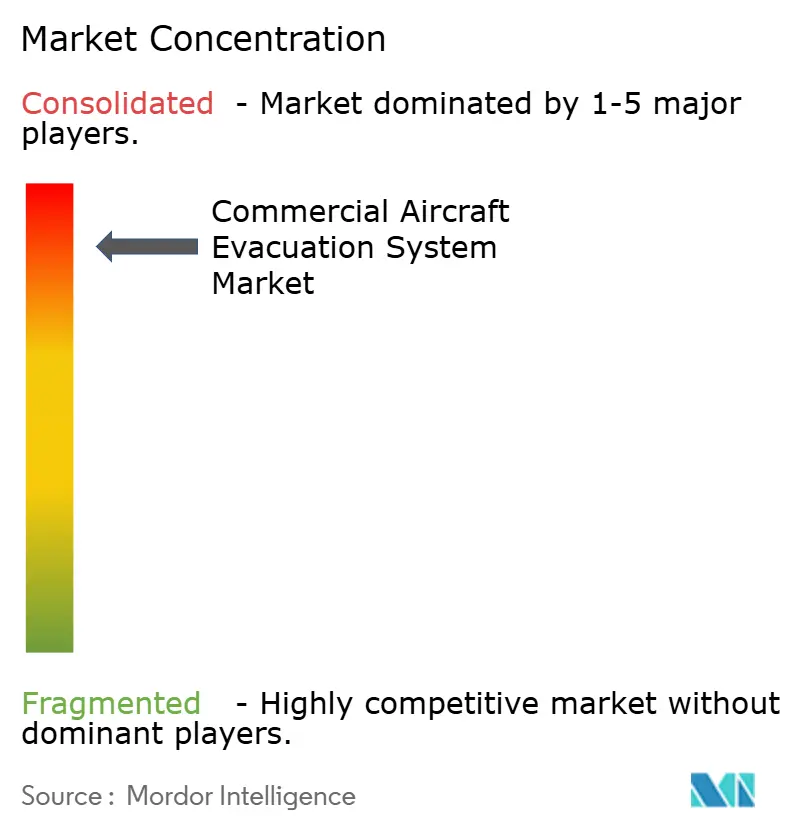
| Market Concentration | High |
Major Players *Disclaimer: Major Players sorted in no particular order Image © Mordor Intelligence. Reuse requires attribution under CC BY 4.0. | |
Commercial Aircraft Evacuation System Market Analysis by Mordor Intelligence
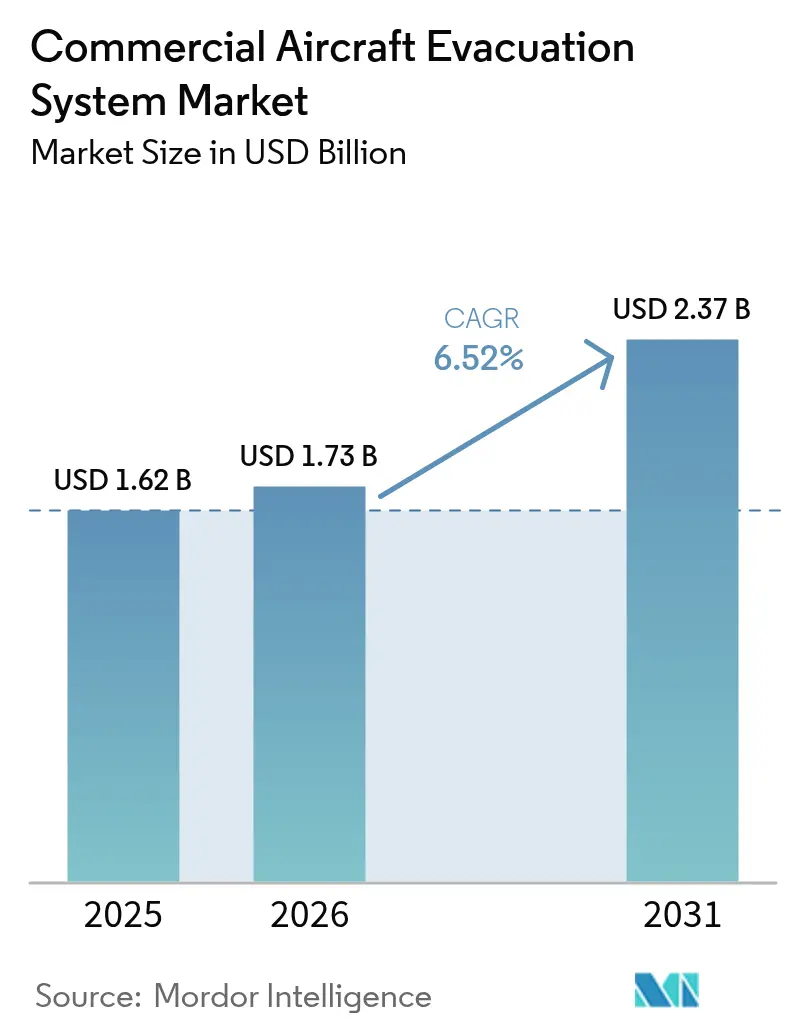
The commercial aircraft evacuation systems market size was valued at USD 1.62 billion in 2025 and estimated to grow from USD 1.73 billion in 2026 to reach USD 2.37 billion by 2031, at a CAGR of 6.52% during the forecast period (2026-2031). Growth is propelled by rapid fleet renewal, stringent post-2024 FAA/EASA testing protocols, and widespread adoption of battery-powered smart-sensor slides that cut unscheduled maintenance events. Escalating titanium and specialty-steel costs compress supplier margins, yet spur material-efficiency innovations that reinforce competitive barriers. Asia-Pacific leads demand creation through low-cost-carrier (LCC) expansion and a projected 19,500 new-aircraft intake by 2043, equal to 46% of global deliveries. Concurrently, North America commands the most significant regional foothold owing to mature MRO infrastructure, long-standing OEM supply contracts, and accelerated slide retrofits that align mixed-reality crew-training mandates.
Key Report Takeaways
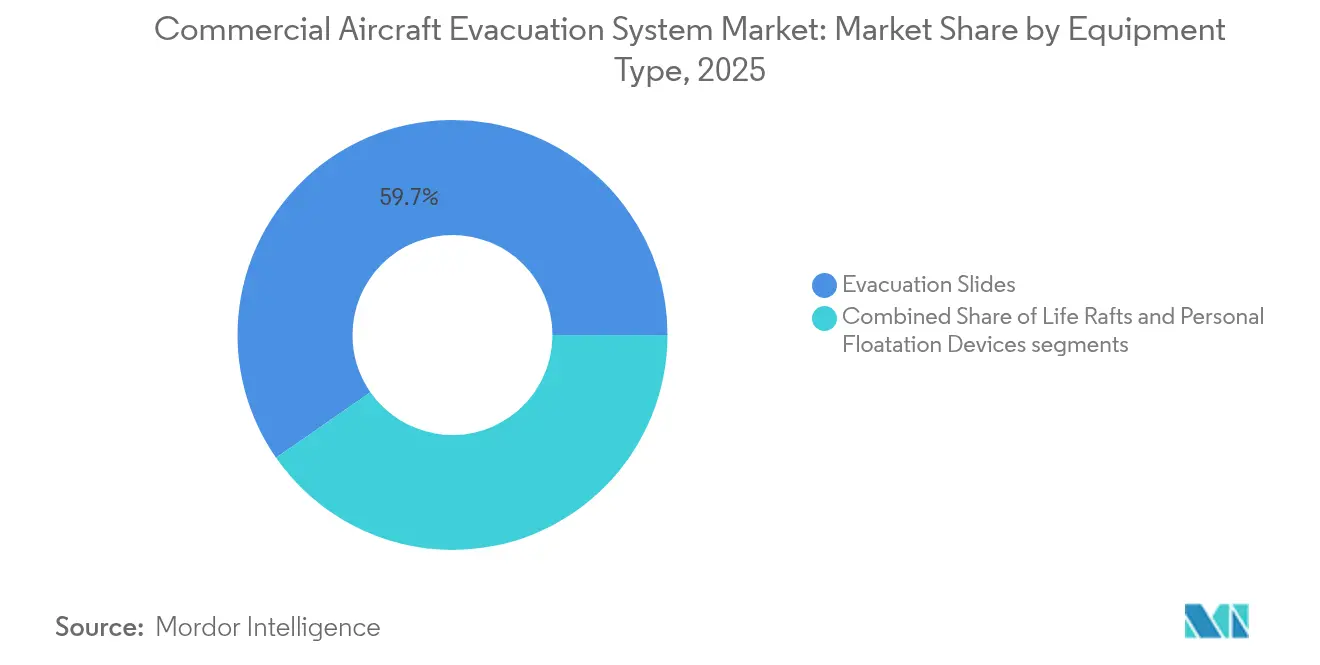
- By equipment type, evacuation slides captured 59.68% of the commercial aircraft evacuation systems market share in 2025 and are projected to expand at a 6.89% CAGR to 2031.
- By aircraft type, regional jets accounted for the fastest 7.12% CAGR within the commercial aircraft evacuation systems market size over 2026-2031, while narrowbodies held 48.25% value share in 2025.
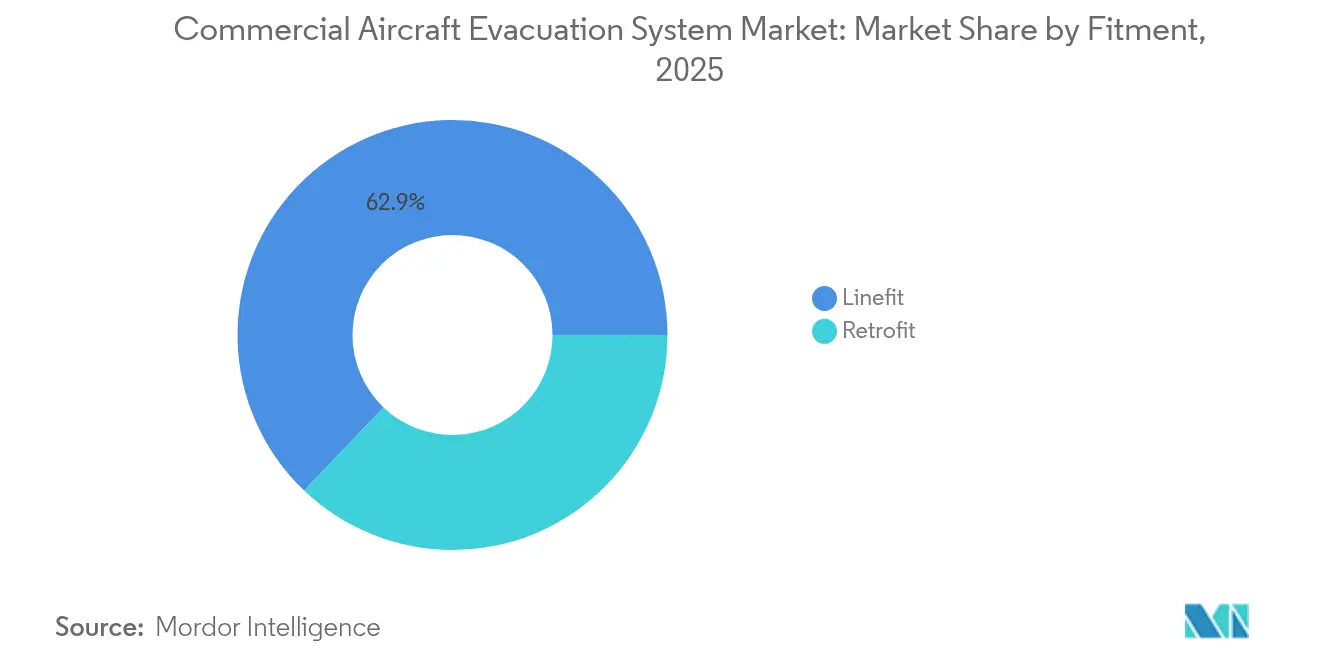
- By fitment, linefit installations dominated with 62.88% of 2025 revenue, whereas retrofit applications are forecasted to register a higher 7.05% CAGR through 2031.
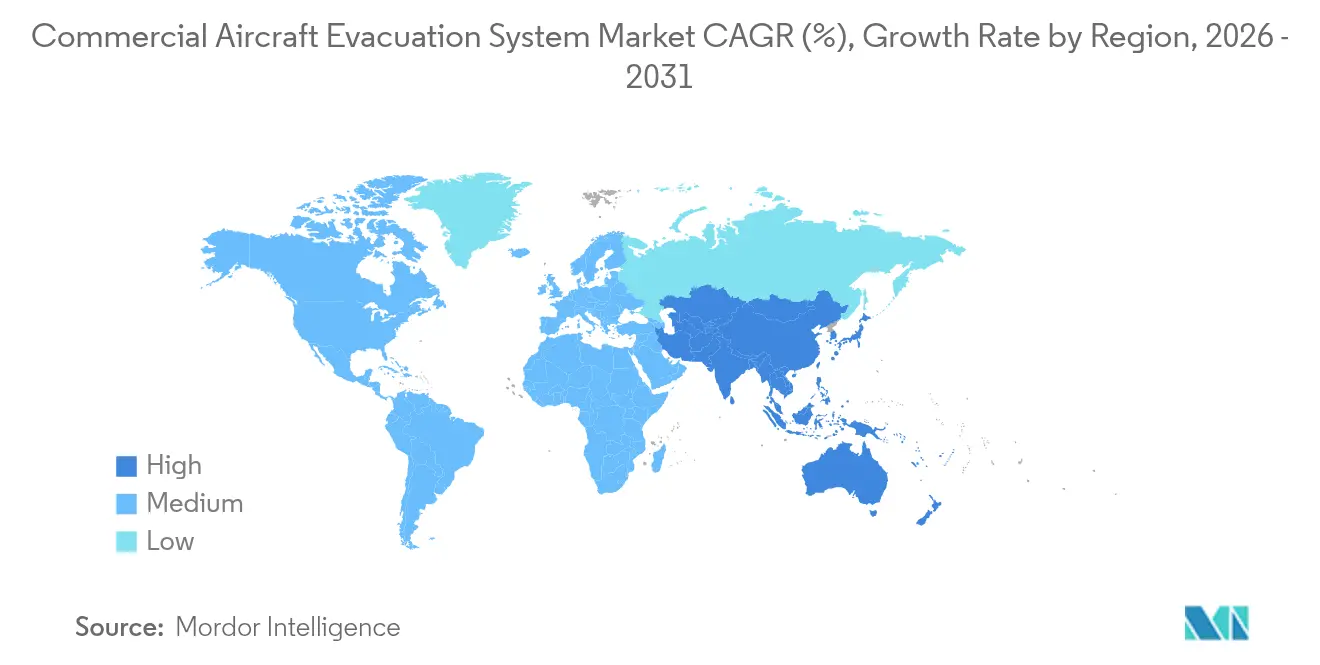
- By geography, Asia-Pacific is set to log the quickest 7.23% CAGR, whereas North America retained a 29.55% revenue share in 2025.
Note: Market size and forecast figures in this report are generated using Mordor Intelligence’s proprietary estimation framework, updated with the latest available data and insights as of 2026.
Market Trends and Insights
Drivers Impact Analysis of Commercial Aircraft Evacuation System Market*
| Driver | (~) % Impact on CAGR Forecast | Geographic Relevance | Impact Timeline |
|---|---|---|---|
| Fleet renewal cycles across narrowbody and widebody aircraft programs | +1.8% | Global, focus on North America and Asia-Pacific | Long term (≥ 4 years) |
| Stricter FAA and EASA evacuation testing standards post-2024 | +1.2% | Global, mainly North America and Europe | Medium term (2-4 years) |
| Growing MRO demand for evacuation slide overhauls in aging aircraft | +0.9% | North America and Europe, spreading to Asia-Pacific | Medium term (2-4 years) |
| Expansion of low-cost carriers (LCCs) fueling new evacuation system installations | +1.1% | Asia-Pacific core, spill-over to South America and MEA | Long term (≥ 4 years) |
| Integration of battery powered smart sensor evacuation slides reducing maintenance requirements | +0.7% | Global, early adoption in North America and Europe | Long term (≥ 4 years) |
| Adoption of mixed-reality crew training mandates to enhance evacuation readiness | +0.4% | Global, led by North America and Europe | Short term (≤ 2 years) |
| Source: Mordor Intelligence | |||
Fleet renewal cycles accelerate equipment-replacement demand
Airlines worldwide are retiring legacy airframes in favor of fuel-efficient A320neo and B737 MAX variants, each delivered with state-of-the-art evacuation slides engineered for high-density cabins. Safran recorded a 35% year-over-year jump in A320 slide shipments during 1H 2024, underscoring OEM pull-through. Replacement also stimulates aftermarket retrofits because operators strive for fleetwide equipment uniformity to ease crew training. Higher-seat-count layouts increase required exit-rate performance, pushing suppliers to integrate lightweight fabrics and rapid-inflation valves. Regulatory compliance timing further nudges carriers to retrofit ahead of certification deadlines rather than absorb disruptive mid-life upgrades.
Post-2024 regulatory standards reshape testing protocols
Section 365 of the 2024 FAA Reauthorization Act orders real-world evacuation studies covering smoke, low-visibility, and baggage interference variables.[1] EASA mirrored the shift, compelling slide makers to validate performance at extreme temperature and structural-damage thresholds. The JAL A350 incident revealed behavior-driven delays and spurred demands for crew-coordination data during certification. Compliance costs elongate product-development cycles yet confer scale advantages on incumbents fluent in multi-jurisdictional approval. Suppliers capable of digital-twin simulation and mixed-reality testing gain early-mover credibility, jointly elevating overall market standards.
MRO demand intensifies for aging-fleet overhauls
Oliver Wyman projects global aviation MRO spend rising to USD 124 billion by 2034, with evacuation slides occupying a mandatory overhaul niche. Material fatigue and fabric porosity drive recurrent replacements every 10 to 12 years, creating annuity-like revenue streams. Survitec leverages over 400 service locations to capture slide refurbishment contracts, citing rising work scopes across 2025 booking pipelines. Bottlenecks emerge because FAA-approved facilities are scarce and technician certification demands are stringent. Longer lead times elevate operator costs, prompting airlines to schedule proactive overhauls during heavy checks.
Low-cost-carrier expansion drives installation volume
Asia-Pacific LCCs such as IndiGo and Scoot sustain high fleet-growth trajectories, prioritizing rapid turnarounds and seat-dense cabins. Evacuation systems must balance minimal maintenance demands with enhanced exit speed to meet certification. Embraer’s forecast of 10,500 sub-150-seat aircraft through 2044 amplifies the regional jet opportunity for evacuation slide providers. Used-aircraft acquisitions by LCCs unlock retrofit contracts as operators harmonize safety equipment and satisfy insurer requirements. Digital monitoring also resonates with cost-sensitive carriers eager to limit unscheduled slide removals.
Restraints Impact Analysis of Commercial Aircraft Evacuation System Market*
| Restraint | (~) % Impact on CAGR Forecast | Geographic Relevance | Impact Timeline |
|---|---|---|---|
| Long-term OEM evacuation system supply contracts limiting new entrants | -0.8% | Global, notably North America and Europe | Long term (≥ 4 years) |
| Persistent cabin baggage evacuation delays increasing liability and safety risks | -0.6% | Global, higher in North America and Europe | Medium term (2-4 years) |
| Rising raw material costs squeezing manufacturer margins | -1.1% | Global, peaking in North America and Europe | Short term (≤ 2 years) |
| Limited FAA-approved independent MRO capacity constraining aftermarket growth | -0.7% | North America, extending worldwide | Medium term (2-4 years) |
| Source: Mordor Intelligence | |||
Long-term OEM contracts create market-entry barriers
Collins Aerospace’s 50-year distribution pact with Satair typifies enduring supply agreements that govern airframe life cycles.[2] Airbus and Boeing lean on legacy partners to minimize certification risk, confining opportunities for newcomers who face USD 10 million-plus platform-qualification costs. Safran’s 2024 divestiture of its North American actuation unit to Woodward demonstrates portfolio reshaping as incumbents consolidate rather than yield share. Airlines prefer vendors with global spares networks and proven safety pedigrees, cementing entry hurdles. Consequently, only niche play remains for start-ups specializing in lightweight textiles or modular raft canisters.
Persistent cabin-baggage delays elevate liability risk
Passenger non-compliance in retaining carry-ons during emergencies slowed recent evacuations, prompting insurers to question risk-pricing models. Regulators study design tweaks such as overhead-bin locking mechanisms and illuminated slide-path signage to mitigate retrieval attempts. Operators confront training challenges and public-awareness campaigns, but behavioral unpredictability persists, occasionally offsetting system-design gains. Liability exposure can escalate post-event settlements, nudging carriers to adopt stricter boarding-bag policies that indirectly impact time-to-slide deployment metrics, tempering market optimism.
*Our forecasts treat driver/restraint impacts as directional, not additive. The impact forecasts reflect baseline growth, mix effects, and variable interactions.
Commercial Aircraft Evacuation System Market Segment Analysis
By Equipment Type:
Slides Dominate Through Innovation IntegrationEvacuation slides generated the largest 59.68% market share of commercial aircraft evacuation systems in 2025 and propelled a 6.89% CAGR. Slides couple lightweight polyurethane fabrics with dual-lane architecture to improve exit-rate efficiency; embedded IoT nodes transmit pressure, temperature, and deployment-readiness status to airline dashboards. Real-time health monitoring underpins condition-based maintenance, slashing unscheduled removals by more than 25% on early adopter fleets.
Life rafts are the second-largest contributing line, buoyed by EASA’s tightened ditching-survivability criteria for extended diversion routes. Survitec’s 152-person Seahaven raft showcases advances in compact valise form factors and quadruple-redundant CO2 inflation valves. Although the smallest in revenue, personal flotation devices register steady renewals given heightened passenger-capacity metrics and regulatory calls for adult-infant size standardization. Growth headwinds arise from weight-reduction pressures, pushing suppliers to adopt ultra-high-molecular-weight polyethylene (UHNWP) fabrics. Yet slides maintain clear dominance through 2031, due to mandatory fitment on every exit door and competitive tech roadmaps.

By Aircraft Type:
Regional Jets Accelerate Growth TrajectoryRegional jets platforms are forecasted to advance at a 7.12% CAGR through 2031, surpassing narrowbody and widebody peers. Embraer E-Jet E2 variants and De Havilland Dash-8 replacements underpin the surge, requiring compact slide geometries compatible with lower sill heights. Slide suppliers engineer inflation trajectories that avoid ground impact while achieving 1.5-second deployment.
Narrowbodies continue to anchor total demand, with 48.25% 2025 market share, primarily via A320neo and B737 MAX production pipelines. LCC seating densities magnify exit-rate design margins, compelling two-lane slide retrofits on forward doors. Widebodies represent a mature, slower-growing niche, though higher passenger counts and over-water segments sustain steady raft and PFD demand. Suppliers differentiate through low-drag slide-pack bay doors that curtail maintenance-induced fuel burn penalties, essential for long-haul economics.
By Fitment:
Retrofit Gains Momentum Through ModernizationLinefit deliveries held 62.88% share of 2025 revenue, yet retrofit demand is climbing at a 7.05% CAGR as airlines synchronize mixed fleets under unified safety-equipment standards. Retrofit projects leverage modular pack-in-pack slide designs to avoid door-cutting and reduce out-of-service days. Lufthansa Aviation Training’s VR simulation upgrade created parallel retrofits for sensor-enabled slides to feed data into training analytics.
Smart-technology-ready kits integrate plug-and-play battery modules and BLE beacons, allowing incremental upgrade paths without wholesale slide replacement. FAA-approved Supplemental Type Certificates (STCs) streamline retrofit adoption on late-model NG fleets, though backlog persists due to limited MRO dock slots. Operators justify investment through up to 30% savings in unscheduled maintenance and enhanced insurance ratings tied to sensor-based compliance logs.
Geography Analysis
North America Commercial Aircraft Evacuation System Market
North America comprised 29.55% of the 2025 value, driven by entrenched aerospace OEM clusters in Seattle, Wichita, and Montréal that expedite certification cycles and sustain proximity supply chains. The region also houses the densest network of Part 145 slide-repair stations, cutting turnaround times and fortifying aftermarket stability. FAA leadership in rule-making shapes global benchmarks, giving US suppliers early technical foresight.
APAC Commercial Aircraft Evacuation System Market
Asia-Pacific is forecasted to be the fastest climber with a 7.23% CAGR, propelled by Airbus’s 19,500 aircraft delivery outlook and China’s 5.7% annual RPK growth. Indian carriers logged double-digit traffic rebounds, ordering next-generation narrowbodies outfitted with predictive-maintenance slides. Regional governments court local assembly lines, pressing suppliers to establish joint ventures in Tianjin and Hyderabad that comply with offset policies yet retain IP control.
EMEA and South America Commercial Aircraft Evacuation System Market
Europe remains technologically influential through EASA’s rigorous human-factor testing and composite-material programs originating in Toulouse and Hamburg. Brexit-related customs frictions temporarily hampered cross-Channel slide sub-component flows, though dual-site warehousing alleviated delays. Middle East and Africa, while smaller, witness steady uptake among Gulf mega-carriers expanding widebody fleets; however, political instability tempers sub-Saharan activity. South America benefits from LCC penetration in Brazil and Argentina, but macro-economic volatility caps fleet-renewal cadence.
Regulatory Landscape
Certification and continued airworthiness for commercial aircraft evacuation systems are anchored to transport-category requirements such as FAA 14 CFR 25.803 and Appendix J, including the 90-second evacuation demonstration with half the exits unavailable. For inflatable escape slides, ramps, and slide-rafts, minimum performance requirements flow through FAA TSO-C69 (including TSO-C69c) and the equivalent ETSO-C69c framework used in EASA product approval pathways, influencing material durability, environmental conditioning, and inflation performance validation across jurisdictions.
Ongoing maintenance and integrity oversight also relies on regulator guidance and airworthiness actions, including FAA maintenance guidance such as AC 43-208 for slides and associated mechanisms, and EASA safety and airworthiness communications relevant to emergency evacuation equipment. In practice, this combines certification testing, approved design data (for example via TC/STC paths), and recurring maintenance requirements, making regulatory compliance a key driver of qualification cost and a barrier for new entrants versus incumbent suppliers already certified across FAA and EASA regimes.
Value Chain Analysis
The value chain begins with upstream specialty inputs such as aramid fibers and polyurethane-coated fabrics for slide structures, along with inflation architecture including pyrotechnic gas generators, valves, and hoses. These inputs support system design and certification work by tier suppliers, notably Safran Aerosystems and Collins Aerospace, which integrate inflatable assemblies, packboards, sensors (where fitted), and door/slide interface hardware to meet FAA/EASA performance benchmarks such as the 90-second evacuation requirement. Because qualification to standards like TSO-C69c/ETSO-C69c is design- and process-intensive, material substitutions (for example composite packboards or lighter pressure-vessel designs) have to be managed alongside regulatory re-validation timelines.
Midstream production and assembly take place in established aerospace manufacturing bases in Western Europe and the United States, then move through OEM linefit channels and spares provisioning tied to long-duration aircraft program contracts. Downstream, operator demand is served through approved MRO and repair-station networks (FAA/EASA approved facilities, including specialized providers such as CARMAS Aviation Equipment) that handle periodic overhauls, inspections, and component replacements. Bottlenecks tend to emerge where supplier bases are concentrated, such as inflation components, and where approved maintenance capacity is limited, affecting turnaround times for slide overhaul cycles and spares availability for airlines.
Competitive Landscape
The commercial aircraft evacuation systems market is highly concentrated, with a handful of multinationals controlling core technology and certification portfolios. Safran and Collins Aerospace headline the tier-one cohort, blending slide, raft, and actuation product lines to cross-sell within broader interiors packages. Safran’s acquisition of Collins’s flight-control businesses deepens systems integration and unlocks cabin-safety joint solutions.
Mid-tier specialists like Survitec Group Limited carve out raft-centric niches leveraged by oil-rig helicopter and military segments, yet increasingly partner with tier-one firms for commercial jet penetration. Intellectual-property filings, such as Airbus’s US9248918B2 on acceleration-sensor fault detection, signal intensifying convergence between avionics health-monitoring and evacuation systems. Digital aftermarket platforms offering serialized component tracking appeal to airlines prioritizing on-time performance metrics.
Supply-chain volatility remains the foremost competitive threat as titanium and high-performance textile bottlenecks necessitate dual-source strategies. Players with vertically integrated fabric weaving and gas-inflation canister production gain resilience and pricing leverage. Overall, competition tilts toward those able to package smart sensors, predictive analytics, and global MRO services into unified lifetime-value propositions.
Commercial Aircraft Evacuation System Industry Leaders
-
Survitec Group Limited
-
Trelleborg AB
-
Collins Aerospace (RTX Corporation)
-
Safran SA
-
EAM Worldwide
- *Disclaimer: Major Players sorted in no particular order
Commercial Aircraft Evacuation System Market Companies Covered in this Report
- Safran SA
- Collins Aerospace (RTX Corporation)
- Survitec Group Limited
- Trelleborg AB
- SWITLIK SURVIVAL PRODUCTS
- EAM Worldwide
- FCAH Aerospace
- DART Aerospace Company
- Lufthansa Technik AG
- Hong Kong Aircraft Engineering Company Limited
- HRD Aero Systems, Inc.
Read Analysis of Commercial Aircraft Evacuation System Companies
Market Opportunities and Future Outlook
Regulator-driven replacement and inspection cycles create recurring aftermarket whitespace, particularly when airworthiness actions compel targeted component changes. A concrete example is EASA Airworthiness Directive 2026-0037, which mandates replacement of specific evacuation slide inflation hose assemblies on Airbus A318/A319/A320/A321 aircraft, with a 36-month compliance window from March 11, 2026. This supports demand for compliant hoses, kits, and labor capacity across approved MRO networks serving the A320-family installed base.
Technology differentiation is also tightening around reliability and maintainability improvements that help airlines reduce unscheduled removals while remaining within FAA/EASA frameworks. Maintenance guidance such as FAA AC 43-208 explicitly addresses slides and associated mechanisms, reinforcing the need for inspection-ready designs and traceable parts. At the same time, ongoing engineering activity evidenced by a 2025 patent filing on an improved daisy chain release mechanism for evacuation slide-rafts focuses on failure-mode reduction in girt and release systems, creating room for suppliers and MRO providers to package upgrade kits, validated modifications, and service bulletins aligned with operator reliability targets.
Recent Industry Developments in Commercial Aircraft Evacuation System Market
- April 2026: Scandinavian Airlines and the Norwegian Armed Forces extended their aeromedical evacuation system partnership through 2027, using a solution developed by Marshall Aerospace with NODIN Aviation. While oriented to aeromedical evacuation rather than standard commercial slides, the move reinforces demand for certified, modular evacuation-related equipment and service support across mixed civil-military operating environments.
- September 2025: Safran Aerosystems reorganized production and maintenance activities at its Cognac and Ars sites in France to increase capacity for commercial aircraft evacuation slide and life raft maintenance, supported by a EUR 16 million investment. The added MRO throughput targets faster turnaround for operators and strengthens Safran position in lifecycle support as overhaul demand rises across aging fleets.
- June 2024: A 2025 patent publication surfaced detailing an improved daisy chain release mechanism for evacuation slide-rafts intended to reduce stiffness-related failures during automatic detachment from aircraft girt sleeves. The design emphasis on mechanical-release reliability signals continued R&D focus on reducing deployment and separation failure modes, complementing broader industry moves toward maintainability and in-service readiness.
Commercial Aircraft Evacuation System Market Report Scope and Research Methodology
Market Definition and Coverage
This market covers the value of evacuation equipment installed on commercial aircraft to support passenger and crew evacuation during an emergency, including escape over land and ditching scenarios where flotation is needed.
Scope exclusions: We exclude military platforms, helicopters, general aviation aircraft, and non-evacuation safety equipment that does not directly support evacuation.
Segments Covered in This Report
- By Equipment Type
- Evacuation Slides
- Life Rafts
- Personal Floatation Devices
- By Aircraft Type
- Narrowbody
- Widebody
- Regional Jets
- By Fitment
- Linefit
- Retrofit
- By Geography
- North America
- United States
- Canada
- Mexico
- Europe
- United Kingdom
- France
- Germany
- Italy
- Rest of Europe
- Asia-Pacific
- China
- India
- Japan
- South Korea
- Australia
- Rest of Asia-Pacific
- South America
- Brazil
- Rest of South America
- Middle East and Africa
- Middle East
- United Arab Emirates
- Saudi Arabia
- Rest of Middle East
- Africa
- South Africa
- Rest of Africa
- Middle East
- North America
Data Sources, Market Sizing, and Validation
Desk Research
Desk work starts by mapping the demand context because evacuation equipment demand follows commercial aircraft deliveries, active fleet size, and safety certification rules. We refer to public aviation safety regulations and guidance from authorities such as the FAA and EASA, and then we use global civil aviation releases such as ICAO publications to understand traffic and fleet direction.
To convert that context into usable sizing inputs, we also review aircraft delivery and backlog indicators from OEM public releases, trade association material such as IATA updates, and relevant customs or trade statistics where product mapping is feasible. Alongside this, company filings, investor presentations, press releases, and reputable aviation media help us time program ramps, retrofit cycles, and major contract announcements. When needed, we also use paid subscriptions for company financials and intelligence, patent databases, and aerospace and aviation databases with aircraft-level details. These desk sources are not exhaustive, and many other public and paid references were used for data collection, validation, and clarification.
Primary Interviews and Surveys
Primary work is used to confirm what desk sources cannot fully prove on their own, especially replacement cycles, typical shipset content by aircraft class, and realistic pricing movement for slides, rafts, and personal flotation devices. We speak with a mix of suppliers, aftermarket participants, and aviation stakeholders across the main regions so assumptions around line-fit versus retrofit, MRO adoption, and certification-driven upgrades can be checked and then refined.
Distribution of primary research fieldwork respondents
| Company type | Respondent position | Region |
|---|---|---|
| Top tier: 31% | CXOs: 14% | APAC: 37% |
| Mid tier: 55% | Functional/Unit leaders: 41% | EMEA: 37% |
| Smaller Players: 14% | Managers: 45% | Americas: 26% |
Market-Sizing & Forecasting
Our sizing starts with a top-down build that reconstructs the commercial aircraft evacuation demand pool using aircraft deliveries and active fleet counts, which are then converted into equipment demand using shipset fitment by aircraft class plus typical replacement and overhaul timing. Because evacuation equipment does not get purchased in the same pattern each year, program ramp schedules and maintenance events are used to shape demand into realistic annual consumption.
To keep the model tied to what is observable, we track inputs that have a direct impact on value, such as the narrow-body versus wide-body delivery mix, the line-fit versus retrofit split, over-water operation share that increases life raft and flotation content, average shipset value by equipment category, and inflation or material-driven pricing changes. Results are then corroborated with selective bottom-up approximations, including sampled ASP x volume checks for key systems, channel checks with aftermarket participants, and supplier revenue cues where public disclosure supports it. When coverage gaps appear, conservative infill is applied using adjacent aircraft classes and validated replacement rates, and then the totals are re-checked with interview feedback.
For forecasting, scenario analysis is used and is linked to aircraft production outlooks, airline capacity trends, and certification-driven upgrade cycles. The final path is aligned to the ranges most frequently shared by industry experts. This keeps the forecast explainable and repeatable even when aircraft program timing shifts.
Data Validation & Update Cycle
We validate the model in several passes, starting with logic checks such as year-to-year delivery consistency, reasonable shipset values, and region totals that align with known fleet distribution. After that, outputs are compared against independent signals like aircraft backlog direction, MRO activity indicators, and public program news, and any large variances are reviewed before sign-off.
If a material event occurs, like a production rate change, a major certification update, or a program delay that affects deliveries, we re-contact relevant sources to confirm the impact and update assumptions. The report is refreshed annually, and before delivery an analyst performs a final review pass so clients receive an updated view based on the latest available information.
Mordor Intelligence's Commercial Aircraft Evacuation System Market Estimate Compared With Other Published Estimates
It is normal to see different market sizes for evacuation systems because each publisher chooses a different product scope, aircraft coverage, and base year timing. Currency conversion timing, pricing build-up logic, and how retrofit demand is treated also change the final number.
Some published figures expand the definition into broader emergency equipment and then apply high average values across the fleet, which can inflate totals if shipset content is not separated by aircraft class and mission type. Other estimates stay narrow on a single component type or a short set of programs, which can push the number down when replacement demand and over-water equipment content are undercounted. Some estimates also blend civil and defense platforms into one total, and Mordor Intelligence counts only evacuation slides, life rafts, and personal flotation devices used on commercial narrow-body, wide-body, and regional jets.
Benchmark comparison
| Source | Market Size | Gaps in Research Methodology |
|---|---|---|
| Mordor Intelligence | USD 1.73 B (2026) | |
| Industry Publisher A | USD 6.94 B (2024) | Likely uses a broader equipment basket beyond evacuation slides, rafts, and personal flotation items, and it also applies higher average values across the fleet, which can lift totals materially. |
| Aviation Research House B | USD 0.48 B (2024) | Appears closer to a component-level view across multiple aircraft categories, which can understate commercial shipset content and replacement demand if retrofit timing and over-water equipment needs are not fully captured. |
The spread in the table mainly comes from what is included and how demand is timed across deliveries and replacement cycles, not from simple arithmetic differences. By tying key assumptions to aircraft mix, fitment content, and maintenance-driven replacement, the market value remains traceable to inputs that can be re-tested when new aircraft rates or certification changes emerge.
Key Questions Answered in the Report
How large is the commercial aircraft evacuation systems market in 2026?
The commercial aircraft evacuation systems market size stands at USD 1.73 billion in 2026 and is projected to reach USD 2.37 billion by 2031, advancing at a 6.52% CAGR.
Which region drives the fastest demand growth for evacuation systems?
Asia-Pacific is expected to record a 7.23% CAGR from 2026-2031, buoyed by LCC expansion and 19,500 forecast aircraft deliveries.
What equipment segment leads revenue share today?
Evacuation slides dominate with 59.68% share in 2025 and benefit from 6.89% forecast CAGR.
Why are retrofit installations accelerating?
Aging fleet overhauls, mixed-reality training mandates, and the desire to standardize equipment across diverse aircraft are pushing retrofit demand at a 7.05% CAGR.
How do smart-sensor slides improve airline economics?
Continuous health monitoring reduces unscheduled removals and allows predictive maintenance, cutting slide-related operational disruptions by more than 25% on early adopter fleets.
What is the main barrier for new evacuation-system entrants?
Long-term OEM supply contracts and high certification costs—often exceeding USD 10 million per aircraft platform—present formidable hurdles for newcomers.