
Colombia Beauty And Personal Care Products Market Size and Share
Market Overview
| Study Period | 2021 - 2031 |
|---|---|
| Forecast Data Period | 2026 - 2031 |
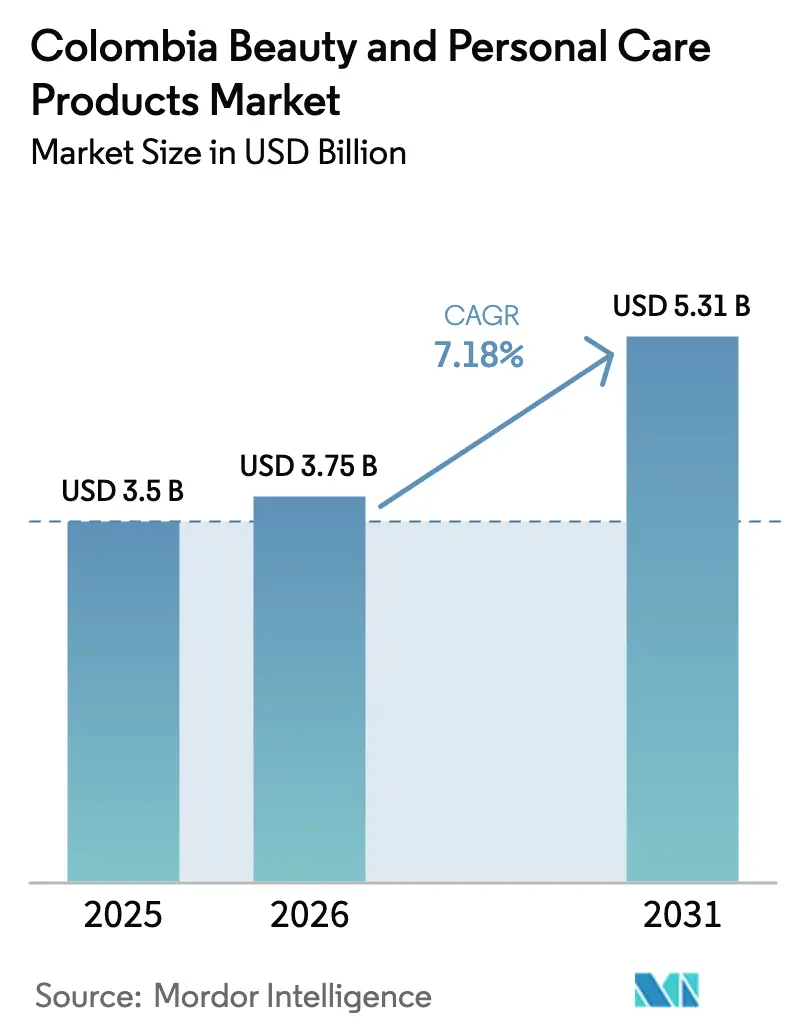
| Base Year Market Size (2025) | USD 3.5 Billion |
| Market Size (2026) | USD 3.75 Billion |
| Market Size (2031) | USD 5.31 Billion |
| Growth Rate (2026 - 2031) | 7.18 % |
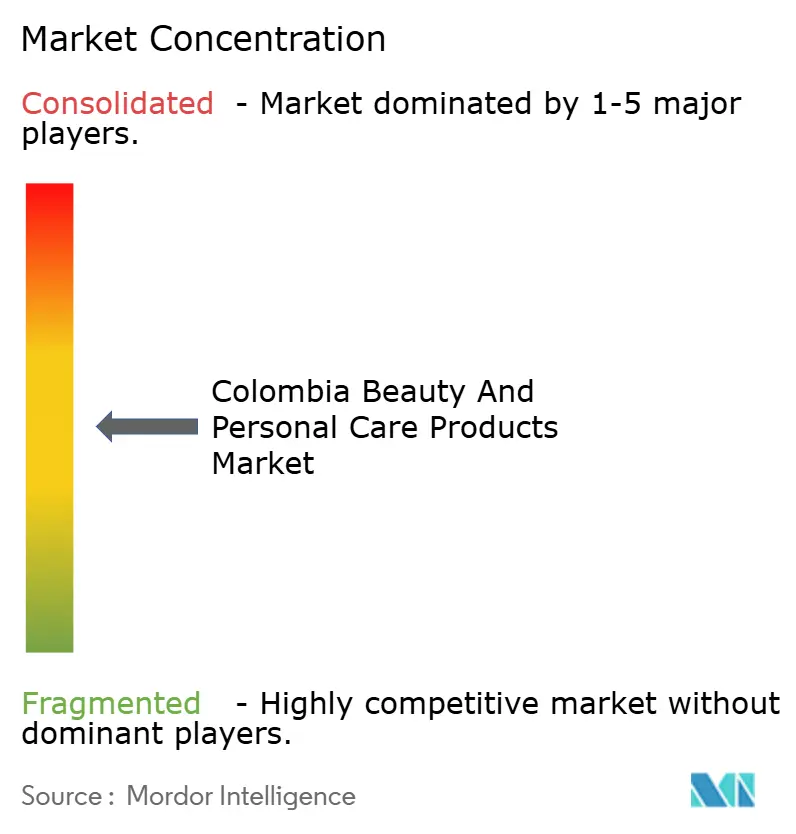
| Market Concentration | Medium |
Major Players *Disclaimer: Major Players sorted in no particular order Image © Mordor Intelligence. Reuse requires attribution under CC BY 4.0. | |
Colombia Beauty And Personal Care Products Market Analysis by Mordor Intelligence
The Colombia beauty and personal care market size is expected to grow from USD 3.5 billion in 2025 to USD 3.75 billion in 2026 and is forecast to reach USD 5.31 billion by 2031 at 7.18% CAGR over 2026-2031. The market’s upward trajectory is propelled by rising disposable incomes, a youthful demographic profile, and Colombia’s status as a biodiversity hotspot that supplies natural actives for premium formulations. Mass-market personal care items keep the consumer base engaged on a daily-use cycle, yet premiumization, digital engagement, and ingredient transparency are opening new value pools that differentiate the Colombia beauty and personal care market from other Latin American countries[1]. Intensifying influencer activity, growing e-commerce penetration, and government support for functional claims have further accelerated brand innovation and consumer adoption. Concurrently, export promotion of indigenous botanicals such as copoazú and açaí positions the country as a regional hub for clean beauty sourcing.
Key Report Takeaways
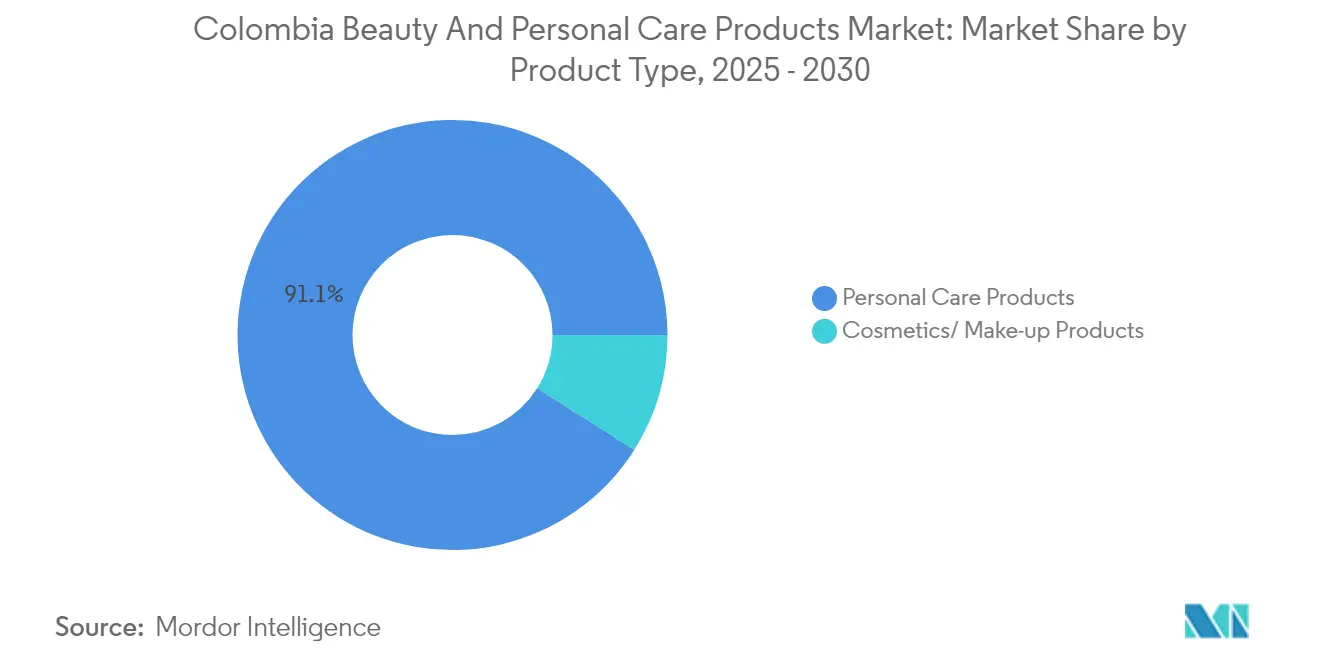
- By product type, personal care products held 91.05% of the Colombia beauty and personal care market share in 2025, while cosmetics are forecast to grow at an 8.32% CAGR through 2031.
- By category, mass products commanded 76.62% of the Colombia beauty and personal care market size in 2025; premium products are projected to expand at a 8.86% CAGR to 2031.
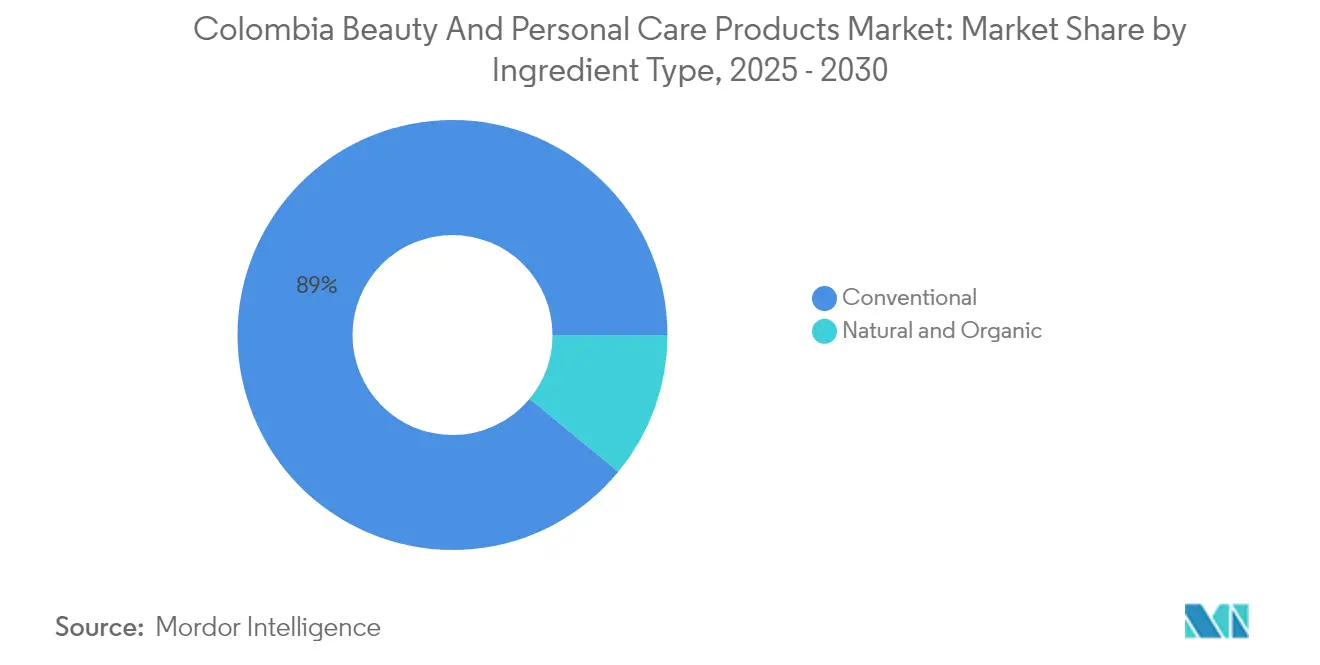
- By ingredient, conventional formulations accounted for 89.02% share of the Colombia beauty and personal care market size in 2025, whereas natural and organic items will rise at an 8.54% CAGR through 2031.
- By distribution channel, supermarkets and hypermarkets led with 28.42% revenue share in 2025; online retail records the fastest CAGR at 9.95% through 2031.
Note: Market size and forecast figures in this report are generated using Mordor Intelligence’s proprietary estimation framework, updated with the latest available data and insights as of 2026.
Market Trends and Insights
Drivers Impact Analysis of Colombia Beauty And Personal Care Products Market*
| Driver | (~) % Impact on CAGR Forecast | Geographic Relevance | Impact Timeline |
|---|---|---|---|
| Rising focus on personal health and hygiene | +1.8% | Urban centers (Bogotá, Medellín, Cali) | Medium term (2-4 years) |
| Multifunctional and hybrid products | +1.2% | National, strongest in metropolitan areas | Short term (≤ 2 years) |
| Aggressive brand marketing and influencer activation | +1.5% | National, digital-first in urban clusters | Short term (≤ 2 years) |
| Premiumization of hair- and skin-care through “skinification” | +2.1% | Urban Colombia, expanding to secondary cities | Medium term (2-4 years) |
| Digital transformation and try-on technology | +1.0% | Urban, e-commerce focused | Short term (≤ 2 years) |
| Export push for Colombian natural ingredients | +0.7% | Amazon and Andean regions | Long term (≥ 4 years) |
| Source: Mordor Intelligence | |||
Rising Focus on Personal Health and Hygiene
Post-pandemic routines have moved beyond basic cleansing to preventive and therapeutic benefits, encouraging consumers to trade up to formulations enriched with vitamins and antimicrobial actives. Higher disposable incomes in Bogotá, Medellín, and Cali correlate with stronger adoption of dermatologically tested products that promise tangible health outcomes. INVIMA’s clear guidance on functional claims enables brands to position these offerings without regulatory ambiguity. Consumers increasingly perceive premium personal care items as extensions of healthcare, thereby sustaining volume growth even in turbulent economic conditions.
Multifunctional and Hybrid Products Gaining Traction
Time-constrained urban professionals value single products that deliver multiple benefits, accelerating demand for BB creams with SPF, shampoos with conditioning agents, and moisturizers with anti-aging properties. The consolidation of steps simultaneously addresses household space limitations and tight budgets. Local manufacturer Laboratorios Smart tailors hybrids to Colombia’s humid climate, reinforcing consumer trust in homegrown innovation[2]. Younger shoppers embrace hybrids as they explore minimalist routines without compromising efficacy.
Aggressive Brand Marketing and Influencer Activation
Beauty brands are reallocating budgets toward digital channels where Colombian consumers exhibit some of Latin America’s highest social-media engagement rates. Influencer campaigns that showcase real-time product usage drive higher conversion for color cosmetics and skincare. Live shopping events, YouTube tutorials, and TikTok challenges create interactive experiences that strengthen brand loyalty. Smaller domestic brands leverage cultural authenticity to stand out against multinational rivals, confirming that digital storytelling effectively levels the playing field in the Colombia beauty and personal care market.
Premiumization of Hair- and Skin-Care Through “Skinification”
Consumers now approach hair health with the same rigor applied to facial skincare, seeking scalp serums and pH-balanced shampoos containing niacinamide, hyaluronic acid, and peptides. The trend elevates average selling prices as buyers view premium products as investments in long-term wellness rather than momentary styling aids. Brands incorporate indigenous botanicals such as quinoa and chia seeds to combine efficacy with national pride, a strategy that has resonated strongly among urban professionals looking for elevated experiences.
Restraints Impact Analysis of Colombia Beauty And Personal Care Products Market*
| Restraint | (~) % Impact on CAGR Forecast | Geographic Relevance | Impact Timeline |
|---|---|---|---|
| Counterfeit and grey-channel product proliferation | -1.4% | Border regions, informal markets | Medium term (2-4 years) |
| Persistent inflation eroding discretionary spend | -1.8% | National, stronger hit to lower-income segments | Short term (≤ 2 years) |
| Tightened de-minimis rules curbing cross-border e-commerce | -0.9% | National, online imports | Short term (≤ 2 years) |
| Certification hurdles for natural/organic formulations | -0.6% | National | Medium term (2-4 years) |
| Source: Mordor Intelligence | |||
Counterfeit and Grey-Channel Product Proliferation
Colombia's beauty market faces persistent challenges from counterfeit products and unauthorized distribution channels that undermine brand integrity and consumer safety while creating unfair price competition for legitimate retailers. INVIMA regularly issues alerts for falsified cosmetic products, including recent warnings about contaminated children's shampoos and unauthorized vaginal care products that pose health risks to consumers. These counterfeit products typically enter through porous border controls and informal distribution networks that exploit price-sensitive consumer segments seeking branded products at reduced costs. The proliferation particularly affects premium and luxury brands whose higher margins make counterfeiting economically attractive, while grey-market imports bypass official distribution channels and authorized pricing structures.
Persistent Inflation Eroding Discretionary Spend
Colombia's inflationary environment pressures household budgets and forces consumers to prioritize essential purchases over discretionary beauty and personal care items, particularly affecting premium and specialty product categories. Despite economic headwinds, Colombian consumers demonstrated resilience by increasing personal care spending in recent periods, suggesting the category's defensive characteristics and essential nature. However, sustained inflation creates trading-down pressure where consumers shift from premium to mass-market alternatives or reduce purchase frequency to manage household expenses. This dynamic particularly impacts color cosmetics and specialty treatments that consumers can defer during economic uncertainty, while basic personal care items like soap, shampoo, and toothpaste maintain more stable demand patterns[3].
*Our forecasts treat driver/restraint impacts as directional, not additive. The impact forecasts reflect baseline growth, mix effects, and variable interactions.
Colombia Beauty And Personal Care Products Market Segment Analysis
By Product Type:
Personal Care Dominance Meets Cosmetics AccelerationPersonal care items accounted for 91.05% of the Colombia beauty and personal care market share in 2025, underscoring their indispensability in daily routines. Hair-care lines formulated for humidity control, UV-shielding skincare, and oral-care staples keep volume robust even during economic slowdowns. The Colombia beauty and personal care market size within personal care continues to benefit from high replenishment rates and culturally ingrained grooming habits that prioritize hair aesthetics.
Cosmetics, though smaller, will exhibit an 8.32% CAGR through 2031, making them the fastest-growing subsector. Social media tutorials demystify application techniques, prompting younger consumers to experiment with bold, long-wearing formulations tailored for tropical conditions. Local players such as Masglo innovate around Colombian skin tones, while global giants adapt portfolios to local color preferences. Distribution via supermarkets and dedicated beauty chains ensures broad access, while online channels broaden shade ranges beyond physical shelf constraints.

By Category:
Mass Market Stability Versus Premium AspirationsMass products held 76.62% of the Colombia beauty and personal care market size in 2025, supported by value-oriented consumers and country-wide supermarket penetration. Supermarket chains like Grupo Éxito offer bulk promotions and private-label alternatives that reinforce affordability. Despite price pressures, mass manufacturers maintain relevance through functional upgrades such as anti-pollution or antibacterial claims that raise perceived value without exceeding budget limits.
Premium items will rise at a 8.86% CAGR, reflecting aspirational spending among urban Millennials and Gen Z. Brands such as Loto del Sur justify higher price points through indigenous botanicals and sustainable sourcing. Influencer content highlighting visible outcome-based results boosts willingness to pay, while omnichannel strategies—flagship boutiques, shop-in-shop concepts, and online exclusives—create curated experiences that reinforce prestige.
By Ingredient:
Conventional Formulations Lead Natural InnovationConventional chemistries dominated with 89.02% share in 2025, favored for proven efficacy, cost efficiency, and regulatory clarity. Multinationals leverage global R&D to ensure temperature-stable products suited to Colombia’s tropical climate. The Colombia beauty and personal care market size for conventional products benefits from streamlined manufacturing and distribution that keep shelf prices accessible.
Natural and organic lines will post an 8.54% CAGR to 2031. Biodiverse sourcing of copoazú, açaí, quinoa, and chia enriches product stories while aligning with global clean-beauty values. Younger consumers, informed by social media, scrutinize ingredient lists, rewarding transparent labeling. Nevertheless, certification costs and raw-material price volatility require premium pricing, confining natural offerings to affluent urban shoppers unless scale efficiencies emerge.
By Distribution Channel:
Traditional Retail Strength Meets Digital DisruptionSupermarkets and hypermarkets delivered 28.42% of 2025 revenue, benefitting from national footprints and integrated grocery-plus-beauty shopper missions. Promotional aisle endcaps and loyalty programs drive impulse buys, while private labels fortify retailer bargaining power. Physical sampling still appeals to consumers who prefer tactile evaluation prior to purchase.
Online retail will climb at a 9.95% CAGR as high smartphone penetration meets improving payment security. Platforms such as Rappi and specialized e-tailers extend assortments to smaller cities, bridging geographic gaps. Virtual try-ons lower return rates and enhance confidence, and subscription models generate predictable revenue streams. Brands deploying direct-to-consumer portals capture first-party data that inform targeted campaigns, raising overall share of the Colombia beauty and personal care market.
Geography Analysis
In Colombia, metropolitan regions like Bogotá, Medellín, Cali, and Barranquilla drive demand, fueled by higher salaries, trend-sensitive populations, and dense retail networks. Here, affluent shoppers are leading a pronounced shift towards premium products, associating prestige beauty with social capital. Meanwhile, as brand awareness grows and multinationals establish new outlets, secondary cities are feeling the ripple effects. Colombia's Amazonian and Andean ecosystems are rich sources of unique botanicals, fueling both domestic and export-driven natural formulations. Thanks to the UNIDO Safe+ initiative, rural cooperatives receive training in sustainable harvesting and quality control. This ensures local brands have dependable ingredient sources, especially those eyeing the international clean-beauty market. Urban consumers, particularly those eco-conscious, are drawn to narratives of ethical sourcing, valuing authenticity and traceability.
While border zones facilitate cross-border retail, they also become gateways for counterfeit products. To safeguard product integrity, a robust partnership between customs authorities and INVIMA is crucial. The logistics landscape is uneven: inland routes, challenged by rugged terrain, see heightened last-mile costs, whereas coastal regions enjoy the advantage of port connectivity. Brands are strategically placing their inventory to minimize stockouts and uphold service standards.
Competitive Landscape
In Colombia's beauty and personal care market, competition remains balanced, scoring a 5 out of 10 on the concentration scale. While multinationals like Unilever, L’Oréal, Colgate-Palmolive, Procter & Gamble, and Natura & Co enjoy scale advantages, agile local players leverage cultural insights and quicker innovation cycles. As consumer sophistication evolves, both sides are bolstering their omnichannel presence and prioritizing sustainability. Leading brands allocate 30-50% of their marketing budgets to digital media, underscoring the success of influencer partnerships. Brands are harnessing technology, from AI-driven recommendations to augmented-reality makeup testers, to deepen consumer engagement. Meanwhile, local disruptors are carving a niche with direct-to-consumer models, sidestepping shelf-space battles and swiftly refining product assortments using gathered data.
Consolidation is becoming a favored growth strategy: Lindcorp's acquisition of Prosalon not only integrates Colombian retail assets but also broadens its reach across Latin America. Simultaneously, Alquería's investment in Vitad hints at category diversification by unconventional players. INVIMA's regulatory oversight ensures a level playing field, standardizing safety and labeling norms, and curbing any undue advantages for both multinationals and local firms.
Colombia Beauty And Personal Care Products Industry Leaders
-
Colgate-Palmolive Company
-
Natura & Co.
-
Unilever Plc
-
The Procter & Gamble Company
-
L’Oréal S.A.
- *Disclaimer: Major Players sorted in no particular order
Colombia Beauty And Personal Care Products Market Companies Covered in this Report
- Unilever PLC
- Natura & Co
- Colgate-Palmolive Co.
- Procter & Gamble Co.
- LOreal S.A.
- Yanbal de Colombia S.A.S.
- Belcorp
- Grupo Familia
- Johnson & Johnson Services Inc.
- Estee Lauder Companies Inc.
- Avon Products Inc.
- Kimberly-Clark Colombia
- Beiersdorf AG
- Henkel AG & Co. KGaA
- Laboratorios Vogue
- Rappi Beauty Vertical
- Grupo oxito (Private-Label BPC)
- Quala S.A. (Savital, Ego)
- Helen Keller Cosmetics
- Osika (Belcorp brand)
- Masglo
- Babaria Colombia
- Yanet (Hair Care)
- TecnoquOmicas (TQ)
- Hada Labo Colombia
Read Analysis of Colombia Beauty And Personal Care Products Companies
Recent Industry Developments in Colombia Beauty And Personal Care Products Market
- August 2025: Colombian label Vélez has introduced a new collection in the domestic market, combining traditional handcrafted designs with a contemporary approach and an emphasis on nature. This collection is positioned to seamlessly integrate into daily life, offering a blend of style and authenticity.
- August 2023: the Colombian beauty brand Ésika, owned by Belcorp, partnered with Proximity BBDO Colombia to focus on its fragrance market in Colombia and Latin America.
Colombia Beauty And Personal Care Products Market Report Scope
Beauty and personal care products include a wide range of products, including skincare products, hair care products, bath and shower products, oral care products, color cosmetics, perfumes and fragrances, and deodorants, that both men and women use to maintain their hygiene and enhance their facial and body appearance. The Colombian beauty and personal care products market is segmented by product type, category, and distribution channel. By product type, it is segmented into personal care products, cosmetic/makeup products, and fragrances. The personal care products segment is further segmented into haircare products (shampoo, conditioner, and other haircare products), skincare products (facial care products, body care products, and lip care products), bath and shower (shower gels, soaps, and other bath and shower products), oral care (toothbrush and replacements, toothpaste, and other oral care products), men's grooming products, and deodorants. The cosmetics/makeup products segment of the market includes facial cosmetics, eye cosmetics, lip and nail makeup products, and hair styling and coloring products. By category, the market is segmented into mass products and premium products. By distribution channel, the market has been segmented into specialty stores, supermarkets/hypermarkets, convenience stores, pharmacies/drug stores, online retail stores, direct selling, and other distribution channels. The market sizing has been done in value terms (USD) for all the abovementioned segments.
Segmentation Overview
| Personal Care Products | Hair Care Products | Shampoo |
| Conditioner | ||
| Hair Styling and Coloring | ||
| Others | ||
| Skincare Products | Facial Care Products | |
| Body Care Products | ||
| Lip and Nail Care Products | ||
| Bath & Shower | Shower Gels | |
| Soaps | ||
| Others | ||
| Oral Care | Toothbrush | |
| ToothPaste | ||
| Mouthwashes and Rinses | ||
| Others | ||
| Men's Grooming Products | ||
| Sun Care Products | ||
| Deodorants & Fragrances | ||
| Cosmetics / Make-up Products | Facial Cosmetics | |
| Eye Cosmetics | ||
| Lip & Nail Make-up | ||
| Mass Products |
| Premium Products |
| Natural and Organic |
| Conventional |
| Health and Beauty Stores |
| Supermarkets / Hypermarkets |
| Online Retail |
| Direct Selling |
| Other Channels |
| By Product Type | Personal Care Products | Hair Care Products | Shampoo |
| Conditioner | |||
| Hair Styling and Coloring | |||
| Others | |||
| Skincare Products | Facial Care Products | ||
| Body Care Products | |||
| Lip and Nail Care Products | |||
| Bath & Shower | Shower Gels | ||
| Soaps | |||
| Others | |||
| Oral Care | Toothbrush | ||
| ToothPaste | |||
| Mouthwashes and Rinses | |||
| Others | |||
| Men's Grooming Products | |||
| Sun Care Products | |||
| Deodorants & Fragrances | |||
| Cosmetics / Make-up Products | Facial Cosmetics | ||
| Eye Cosmetics | |||
| Lip & Nail Make-up | |||
| By Category | Mass Products | ||
| Premium Products | |||
| By Ingredient | Natural and Organic | ||
| Conventional | |||
| By Distribution Channel | Health and Beauty Stores | ||
| Supermarkets / Hypermarkets | |||
| Online Retail | |||
| Direct Selling | |||
| Other Channels | |||
Key Questions Answered in the Report
How large is the Colombia beauty and personal care market in 2026?
It stands at USD 3.75 billion and is forecast to reach USD 5.31 billion by 2031.
What is the expected CAGR for Colombia’s beauty sector through 2031?
The market is projected to grow at a 7.18% CAGR during 2026-2031.
Which product category holds the largest share?
Personal care products lead with 91.05% of 2025 revenue.
Are natural ingredients gaining traction in Colombia?
Yes, natural and organic formulations will grow at an 8.54% CAGR, supported by Colombia’s biodiversity and consumer eco-awareness.