
Market Overview
| Study Period | 2020 - 2031 |
|---|---|
| Forecast Data Period | 2026 - 2031 |
| Base Year Market Size (2025) | USD 4.60 Billion |
| Market Size (2026) | USD 4.83 Billion |
| Market Size (2031) | USD 6.17 Billion |
| Growth Rate (2026 - 2031) | 5.03 % |
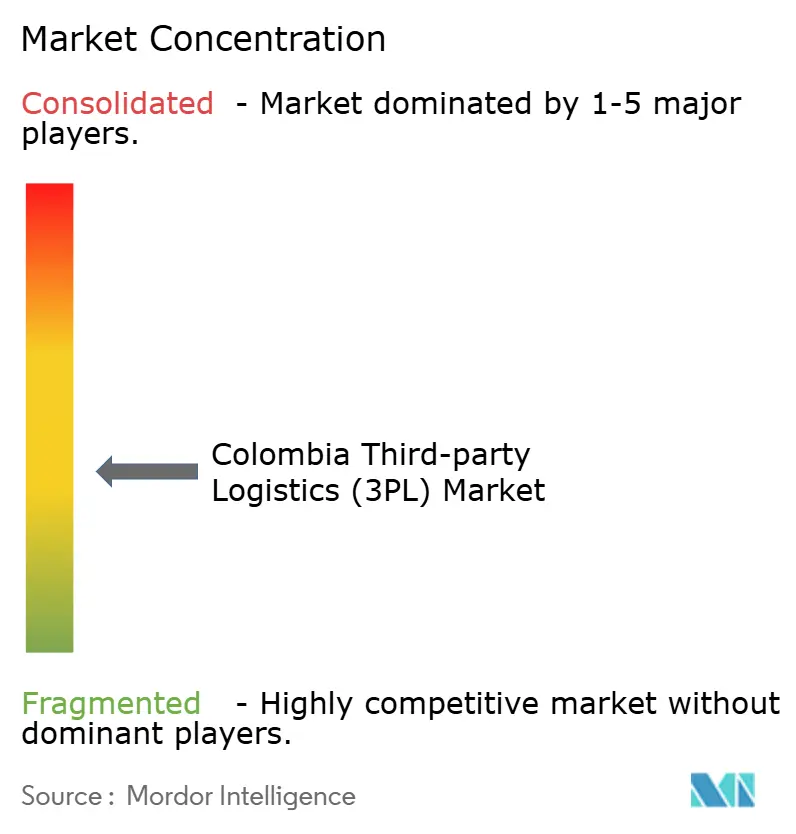
| Market Concentration | Medium |
Major Players *Disclaimer: Major Players sorted in no particular order Image © Mordor Intelligence. Reuse requires attribution under CC BY 4.0. | |
Colombia Third-party Logistics (3PL) Market Analysis by Mordor Intelligence
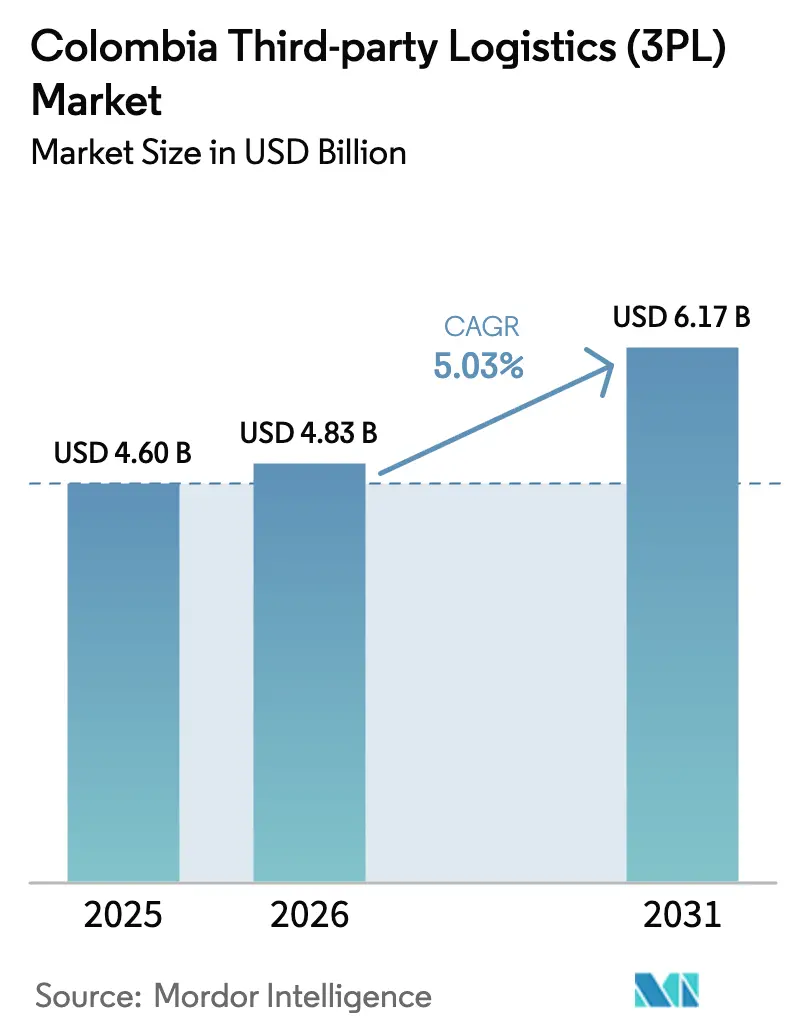
The Colombia Third-party Logistics Market size is estimated at USD 4.83 billion in 2026, and is expected to reach USD 6.17 billion by 2031, at a CAGR of 5.03% during the forecast period (2026-2031).
Demand is accelerating as nearshoring, port modernization, and end-to-end digitization reshape shipment patterns. E-commerce platforms are expanding beyond Bogota into secondary cities, stimulating parcel volumes and prompting 3PLs to roll out micro-fulfillment sites. Port upgrades at Buenaventura and the forthcoming Puerto Antioquia are re-routing exports toward coastal corridors, while Magdalena River and rail investments promise new inland options that ease reliance on mountain roads. Digital transportation and warehouse management systems are lowering entry barriers for small carriers, yet cargo-security expenses and currency volatility continue to squeeze margins. Competition now hinges less on fleet size and more on visibility platforms that integrate trucking, rail, river, and ocean legs into a single control tower.
Key Report Takeaways
- By service type, domestic transportation commanded 47.14% of revenues in 2025; Value-Added Warehousing & Distribution is set to expand at a 6.09% CAGR to 2031.
- By logistics model, asset-light providers controlled 45.23% of the Colombia third-party logistics (3PL) market size in 2025, yet Hybrid models are advancing at a 5.73% CAGR.
- By end-user industry, consumer goods and FMCG held 27.53% of the Colombia Third Party Logistics (3PL) market share in 2025. The Colombia Third Party Logistics (3PL) market for Retail and E-commerce is set to grow at a 7.12% CAGR between 2026-2031.
- By geography, the Andean region held 58.02% in 2025, while Colombia third-party logistics market size for the Pacific Corridor is projected to record the fastest 6.62% CAGR through 2031.
Note: Market size and forecast figures in this report are generated using Mordor Intelligence’s proprietary estimation framework, updated with the latest available data and insights as of January 2026.
Colombia Third-party Logistics (3PL) Market Trends and Insights
Drivers Impact Analysis*
| Driver | (~) % Impact on CAGR Forecast | Geographic Relevance | Impact Timeline |
|---|---|---|---|
| Explosive growth of domestic e-commerce | +1.3% | Andean Region (Bogotá, Medellín, Cali) | Short term (≤2 years) |
| Nearshoring of the US and LATAM supply chains into Colombia | +1.6% | National, with a concentration in Free Trade Zones | Medium term (2-4 years) |
| Expansion of special Free-Trade Zones (FTZs) & multimodal parks | +0.8% | Andean, Pacific Corridor, Caribbean Coast | Medium term (2-4 years) |
| Investments in cold-chain capacity for floriculture & pharma exports | +0.6% | Andean (flower farms), Pacific Corridor (ports) | Short term (≤2 years) |
| Digitization, TMS/WMS SaaS adoption among SMEs | +0.5% | National, early gains in urban centers | Medium term (2-4 years) |
| Magdalena River & rail corridor upgrades, unlocking inland freight | +0.7% | Magdalena River basin, La Dorada-Chiriguaná corridor | Long term (≥4 years) |
| Source: Mordor Intelligence | |||


Explosive Growth Of Domestic E-Commerce
Online sales reached COP 12 trillion (USD 2.97 billion) in 2025, rising 23.9% year-on-year, and pushed 3PLs to cut urban delivery windows from 48 hours to same-day. Parcel growth of 30-35% in Cali and Barranquilla is widening the customer base beyond Bogotá. The surge is strongest in grocery and pharmacy categories, which require temperature control and real-time inventory visibility. Providers are setting up micro-fulfillment hubs inside populous districts, matching inventory to neighborhood demand profiles. Regional specialists who master local traffic restrictions and zoning rules are gaining contracts from national retailers.
Nearshoring Of Regional Supply Chains
Tariff relief under free-trade agreements and dual-ocean access are attracting textile, auto-parts, and medical-device producers that target the US and intra-LATAM markets. Lead-times have fallen by up to 50% versus Asia-based sourcing, justifying labor-cost premiums. 3PLs are responding with bonded warehouses and cross-dock sites inside zones such as Tocancipá, where duties are deferred until goods exit to the local market. Increased southbound traffic from Brazilian plants and northbound exports to Central America are raising demand for cross-border compliance expertise[1].A.P. Moller-Maersk, “Maersk Inaugurates New Container Logistics Centre in Bogotá,” maersk.com
Digitization Via TMS/WMS SaaS Adoption
More than 70% of Colombian logistics firms launched digital projects in 2024 to manage routing, invoicing, and customs data on cloud platforms. SaaS models eliminate high up-front license fees, allowing small carriers to access optimization algorithms once reserved for multinationals. Digital freight marketplaces have begun matching independent truckers to spot loads in real time, lowering empty-mile ratios. Sector associations and government grants now fund training for data analytics skills, addressing a labor shortage that could erode 23% of sector cash flow by 2030 if left unresolved[2].Food Logistics Staff, “The Urgent Need for Digital Transformation in LatAm Food Logistics,” foodlogistics.com
Magdalena River & Rail Corridor Upgrades
USD 800 million of public-private investment is modernizing the La Dorada-Chiriguaná rail line and dredging the Magdalena River to cut bulk-freight costs by 26% by 2030. Higher axle loads and faster train speeds will divert cement, grain, and coal away from congested mountain roads. 3PLs capable of integrating barge, rail, and truck services can now offer shippers mode-mix options that align with cost or speed priorities, widening their service portfolios.
Restraints Impact Analysis*
| Restraint | (~) % Impact on CAGR Forecast | Geographic Relevance | Impact Timeline |
|---|---|---|---|
| Chronic road-infrastructure bottlenecks & mountain terrain | -0.8% | National, acute in the Andean highlands | Medium term (2-4 years) |
| Cargo-theft & security costs on key corridors | -0.5% | Ruta del Sol, Norte de Santander, La Guajira | Short term (≤2 years) |
| Customs bureaucracy & port dwell times | -0.4% | Buenaventura, Cartagena ports | Short term (≤2 years) |
| Exchange-rate volatility affecting contract pricing | -0.3% | National, particularly import-dependent sectors | Short term (≤2 years) |
| Source: Mordor Intelligence | |||
Customs Bureaucracy & Port Dwell Times
Despite Cartagena ranking among the world’s most efficient terminals, paperwork checks still prolong container release times. Time-sensitive cargo such as fresh mangoes and just-in-time auto parts suffers the most. Electronic declarations and risk-based inspections are rolling out, but cross-agency coordination issues persist. 3PLs with in-house brokerage arms are monetizing pre-clearance services, helping shippers cut detention fees and improve inventory turns.
Exchange-Rate Volatility Affecting Contract Pricing
Peso swings against the US dollar directly impact diesel costs, which account for up to 40% of haulage expenses. Fixed-price contracts denominated in pesos expose carriers to fuel spikes, while dollar contracts expose shippers to local inflation. Some 3PLs are adopting rolling fuel surcharges and currency-adjustment clauses, yet smaller firms lack hedging tools, prompting consolidation as they seek balance-sheet strength to withstand FX shocks[3].International Trade Administration, “Colombia - Infrastructure,” trade.gov
*Our forecasts treat driver/restraint impacts as directional, not additive. The impact forecasts reflect baseline growth, mix effects, and variable interactions.
Segment Analysis
By Service Type: Value-Added Warehousing and Distribution Gains Momentum
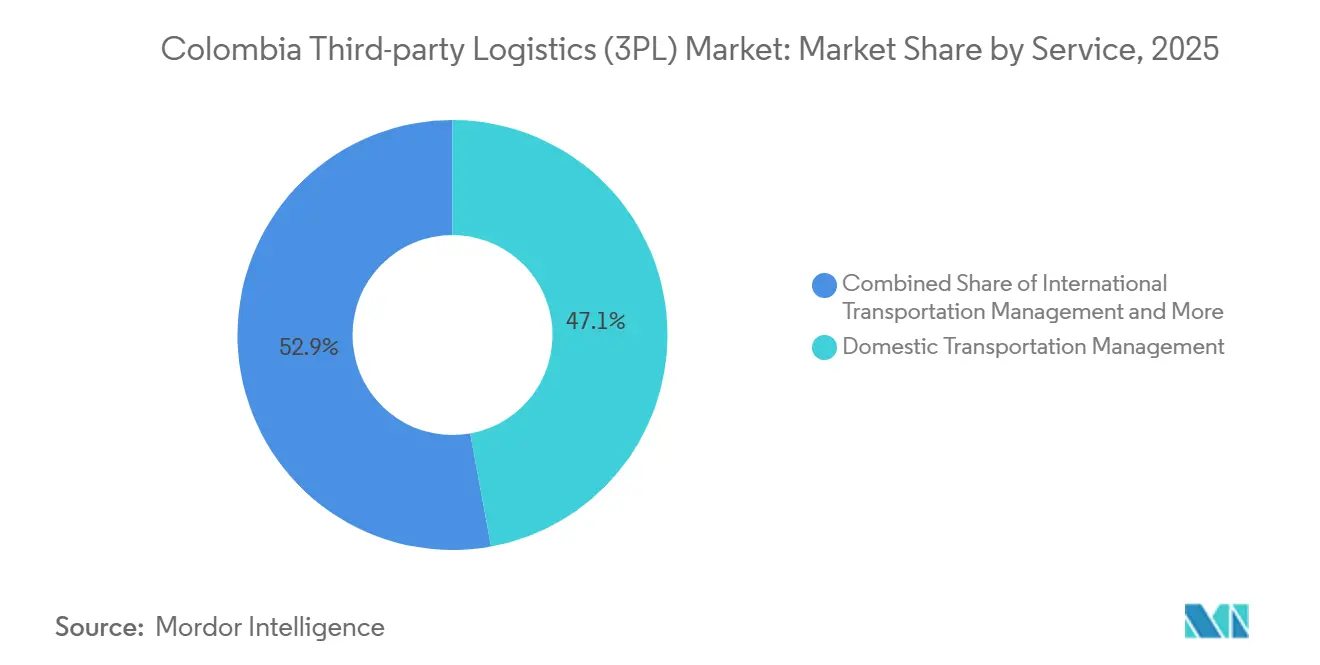
Domestic Transportation holds 47.14% of Colombia Third-party (3PL) Logistics market share in 2025, while Value-Added Warehousing & Distribution is expanding the fastest at a 6.09% CAGR through 2031. Warehousing is narrowing the performance gap with trucking as omnichannel retailers integrate store and online inventories, driving demand for kitting, labeling, and reverse-logistics services. Maersk’s new Tocancipá campus illustrates how integrated cold rooms and cross-docks create single-site logistics solutions that compress lead times and minimize double handling. Despite its scale advantage, Domestic Transportation faces tightening labor dynamics, with driver shortages expected to double by 2028, according to the International Road Transport Union.
Infrastructure bottlenecks and security-related costs are also encouraging modal diversification, supporting projected growth in multimodal contracts as river and rail corridors reopen. Asset-heavy haulers are investing in AI-powered dispatch tools to increase trip utilization, while warehouse operators deploy goods-to-person robots to meet same-day e-commerce cut-offs. Cross-dock hubs near Bogotá airport now trans-load perishables from trucks to wide-body freighters in under two hours, sustaining Colombia’s high-value florist exports. Meanwhile, ocean forwarding margins remain constrained by liner overcapacity, prompting forwarders to differentiate through bundled customs consulting and trade-finance services.


By End-User Industry: E-Commerce Upsets Legacy Hierarchies
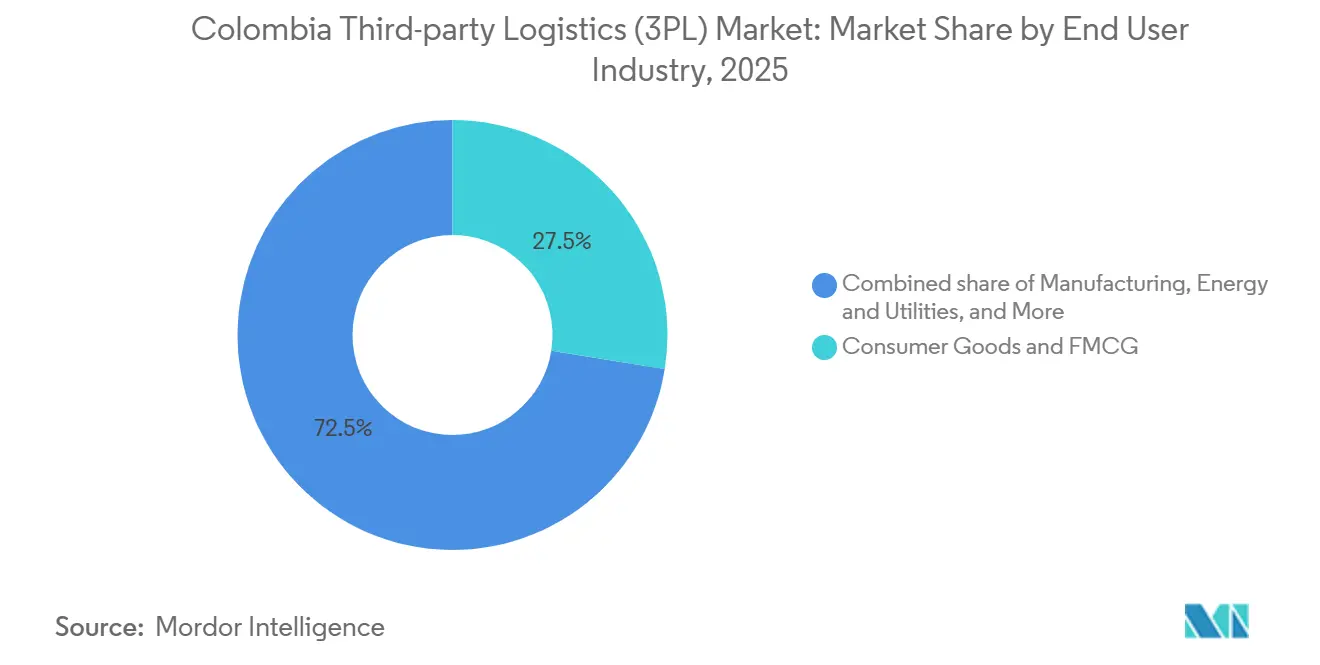
Consumer Goods & FMCG held the largest share of Colombia 3PL market in 2025 at 27.53%, while Colombia Third-party (3PL) Logistics market size for Retail & E-Commerce is projected to grow the fastest at a 7.12% CAGR as smartphone adoption and digital payments penetrate secondary cities. E-commerce expansion is reshaping logistics models as large brands seek unified stock pools that fulfill both store replenishment and direct-to-consumer orders. This shift is compelling 3PLs to implement inventory platforms with real-time, order-level visibility. Life-sciences shipments are also gaining market share as pharmaceutical fill-finish plants ramp up production near Cali, supported by validated cold rooms built to meet international Good Distribution Practice requirements.
Automotive parts and textiles moving into Colombia’s free-trade zones sustain consistent manufacturing volumes but require cross-dock operations and vendor-managed inventory programs to control multi-tier stock levels. Pharmaceutical exports depend heavily on compliant logistics chains featuring validated lanes and temperature-mapping audits. DHL’s acquisition of CRYOPDP strengthens Colombia’s integration into global clinical-trial logistics, enhancing credibility among drug manufacturers. Meanwhile, technology hardware and energy components, although representing smaller volumes, offer premium returns for logistics operators capable of maintaining strict handling and compliance standards.
By Logistics Model: Hybrid Configurations Scale Up
Asset-light firms captured the largest share of Colombia Third-party (3PL) market in 2025 at 45.23%, while hybrid logistics models are expanding the fastest at a 5.73% CAGR. Asset-light players scale quickly through subcontracted fleets, but the pandemic exposed their fragility when spot-market capacity disappeared, prompting shippers to favor providers guaranteeing peak-season equipment. Hybrid operators combining owned fulfillment centers and dedicated last-mile trucks with outsourced line-haul are gaining traction in new bids. Many now invest in automated small-parcel sorters within urban depots while continuing to rely on partner carriers for long-haul dry-van transport.
The share of fully asset-heavy fleets continues to contract, except in hazardous goods and validated cold-chain logistics, where direct control mitigates compliance risk. Small owner-operators increasingly depend on digital freight boards for utilization, yet performance rating systems reveal quality inconsistencies, steering multinational shippers toward hybrid 3PLs that maintain standardized service levels. Investors also view these hybrid firms favorably, considering their balanced asset portfolios more resilient to fuel-cost volatility and capacity market swings.
Geography Analysis
The Andean highlands, home to Bogota, Medellin, and Cali, captured 58.02% of 2025 revenue thanks to population density and manufacturing clusters. Congestion in mountain corridors, however, pushes logistics costs above coastal benchmarks. The Colombia third-party logistics market size allocated to the Pacific Corridor is forecast to grow fastest at a 6.62% CAGR through 2031 as Buenaventura’s berth deepening and the USD 4 billion Tren de Cercanías rail system shorten door-to-port transit times[4].Redacción El País, “Los Pasos que se Están Dando para Avanzar en el Tren de Cercanías de Cali,” elpais.com.co
Caribbean ports at Cartagena and Santa Marta benefit from efficiency scores that attract transshipment traffic, offering shippers schedule reliability and lower demurrage risks. The National Dredging Plan will further improve channel depths, easing access for neo-Panamax vessels. Inland departments along the Magdalena River stand to gain as barge services restart, enabling grain and cement exporters to bypass mountain passes. Orinoquía and Amazonia remain underserved, yet oil, gas, and timber projects create niche volumes that reward operators willing to invest in rugged equipment and community engagement.
Nearshoring is relocating assembly plants to coastal free-trade zones to avoid mountain trucking, creating a two-tier network: export-oriented corridors aligned with ports and consumption-driven routes feeding interior cities. 3PLs must design separate asset footprints for each, balancing the speed demands of consumer parcels with the cost efficiency required for bulk commodities.
Regulatory Landscape
Colombia is tightening formalization, traceability, and pricing discipline in cargo transport through digital reporting requirements and oversight. In March 2026, the Ministerio de Transporte updated the Registro Nacional de Despachos de Carga (RNDC) to strengthen operational transparency, security, and traceability in cargo movements, raising compliance expectations for 3PL-managed road operations that use subcontracted carriers.
The 2024-2025 rule set also affects contracting terms and cost pass-through on domestic routes. Decree 1017 of 2025 (September 2025) modified operational conditions for cargo transport, including fleet binding contract definitions and RUNT registration requirements, while updates linked to SICE-TAC introduced minimum logistics-hour parameters aligned to route transit times. Alongside supervisory frameworks under the Superintendencia de Transporte (via the Circular Unica de Infraestructura y Transporte and related updates), these measures push 3PLs toward tighter documentation, clearer carrier qualification, and more structured tariff and service-level arrangements with shippers and transport operators.
Value Chain Analysis
The Colombia 3PL value chain spans (i) demand owners, including omnichannel retail, FMCG, manufacturing in Free Trade Zones, and export sectors such as flowers and pharma, (ii) 3PL lead logistics providers that design networks and manage contracts, (iii) execution partners across trucking fleets and owner-operators, freight forwarders, customs brokers, warehouse operators (ambient and cold chain), and (iv) enabling layers such as TMS/WMS SaaS platforms, security services, and last-mile parcel specialists. Cloud tools and digital marketplaces are also reducing onboarding friction for SMEs, while compliance-linked reporting (RNDC/SICE-TAC) and cargo-security spending raise operational discipline requirements, favoring providers with control-tower visibility and in-house brokerage capabilities.
Infrastructure and public programs are reshaping flows and the nodes where value is captured. Government policy anchored in the National Logistics Policy (CONPES 3982) and the National Development Plan 2022-2026 emphasizes intermodality, while May 2025 marked the signing of a 10-year concession for the La Dorada-Chiriguana rail corridor to connect the center of the country with Caribbean ports. The DNP's National Logistics Survey indicates national logistics costs fell to 15.6% of sales in 2024 (from 17.9% in 2022). Ongoing tenders and corridor work, including rail feasibility and priority road programs, create new handoff points between road, rail, and ports where 3PLs can bundle warehousing, cross-dock, and multimodal coordination services.
Competitive Landscape
Top Companies in Colombia Third Party Logistics (3PL) Market
The sector shows moderate concentration. Global integrators such as DHL, DSV, and Maersk manage end-to-end visibility platforms, while national champions like Servientrega excel at last-mile parcels. Niche players specialize in cold chain for flowers and biopharma, or in dangerous-goods handling. Digital capabilities, rather than fleet size, now drive contract awards; shippers expect real-time ETA and exception alerts across modes.
DHL leads express shipping, underpinned by its Bogotá Gateway. DSV’s 2025 acquisition of Schenker roughly doubled network scale and will enhance cross-border capacity into Colombia once integration is completed. CEVA Logistics added three RORO vessels on Far East-South America lanes in 2025, offering finished-vehicle exporters new sailings that call at Colombian ports. Emergent Cold Latin America’s 157 million ft³ regional footprint positions it as the leader in temperature-controlled storage, appealing to both floriculture and pharmaceutical shippers.
Domestic consolidation is underway as family-owned trucking firms seek capital to install telematics and comply with security mandates. Venture investors back digital brokers that connect owner-operators to e-commerce traffic, challenging traditional forwarders. Yet premium contract wins increasingly go to 3PLs able to certify GDP logistics or provide multimodal river-rail solutions, barriers that loosely organized marketplaces cannot yet clear.
Colombia Third-party Logistics (3PL) Industry Leaders
DHL Supply Chain
Kuehne + Nagel
Blu Logistics
Coordinadora Mercantil
Servientrega
- *Disclaimer: Major Players sorted in no particular order

Market Opportunities and Future Outlook
Multimodal corridor buildout creates clear whitespace for 3PLs that can package road-rail-port operations under a single operational model. In February 2026, Puerto Antioquia began commercial operations as a multipurpose terminal in Uraba, adding a coastal gateway that changes inland routing choices and increases demand for drayage, consolidation, and bonded processes around new port-adjacent nodes. Parallel public actions in 2026, including ANI kickoff documents for feasibility studies for the Villavicencio-Puerto Gaitan rail corridor (USD 16 million) and the Ministry of Transports advancement of the Interoceanic Rail Corridor feasibility phase, expand opportunities for 3PLs to develop intermodal service designs, inland depot strategies, and control-tower offerings that integrate trucking with emerging rail interfaces.
Contract logistics and fulfillment remain a key monetization lane as e-commerce extends beyond Bogota and service expectations shift toward faster cutoffs and higher order complexity. With online sales reaching COP 12 trillion (USD 2.97 billion) in 2025 and 3PLs adding micro-fulfillment and value-added services (kitting, labeling, returns), demand concentrates on scalable warehousing, inventory visibility, and compliant cold rooms for grocery, pharmacy, and life-sciences cargo. On the regulatory-operational side, tighter traceability and minimum logistics-hour frameworks push shippers toward providers that can standardize subcontracted transport, execute digital reporting consistently, and structure fuel and FX pass-through mechanisms. This reinforces opportunities for hybrid 3PL models that combine owned facilities with managed carrier networks.
Recent Industry Developments
- June 2026: DHL Supply Chain deployed the DHL Fulfillment Network in Colombia with initial operational hubs in Bogota and Medellin. The rollout packages warehousing, inventory management, pick-and-pack, and distribution into a single offering for e-commerce shippers looking to scale quickly. This increases competitive pressure on local and regional 3PLs to match standardized fulfillment processes and city-level delivery performance.
- February 2026: Kuehne+Nagel, LATAM Cargo, and The Elite Flower executed a sustainable aviation fuel (SAF) initiative for the Valentine’s Day flower export season on the Bogota-Miami route. The collaboration reduced approximately 300 tonnes of CO2e, illustrating how forwarders can use carrier partnerships to deliver lower-carbon lanes for time-sensitive perishables. It also strengthens differentiated service propositions in Colombia’s high-value export logistics, where traceability and customer sustainability targets increasingly influence carrier and 3PL selection.
- April 2025: Rhenus Group rebranded Blu Logistics LATAM to Rhenus Logistics in Colombia following its earlier acquisition, aligning the local operation under a global brand and operating model. The integration brings air, ocean, and warehousing capabilities under a unified portfolio, improving cross-selling across forwarding and contract logistics. It also raises the bar for process standardization and network coverage among mid-sized competitors serving multinational accounts.


Research Methodology Framework and Report Scope
Market Definition and Coverage
For this study, the Colombia 3PL market is defined as revenues earned by contracted logistics providers that manage freight movement and related services for shippers, covering transport management, freight forwarding, customs brokerage, and value-added warehousing and distribution within Colombia.
Scope exclusions: Postal parcel networks and in-house logistics run directly by manufacturers or retailers are excluded.
Segmentation Overview
- By Service
- Domestic Transportation Management
- International Transportation Management
- Freight Forwarding & Customs Brokerage
- Value-Added Warehousing & Distribution
- Reverse & After-sales Logistics
- By Mode of Transport
- Road Freight
- Rail Freight
- Air Freight
- Sea Freight
- Multimodal / Intermodal
- By End-user Industry
- FMCG (incl. Beauty & Home Care)
- Retail & E-commerce (Hyper/Super/Convenience)
- Automotive & Spare Parts
- Technology (Consumer Electronics & Appliances)
- Fashion & Lifestyle (Apparel & Footwear)
- Cold-Chain (Fruits, Vegetables, Pharma, Meat, Seafood)
- Industrial & Chemicals
Data Sources, Market Sizing, and Validation
Desk Research
Desk research started with public data that describes the real logistics activity behind 3PL demand, and then it was translated into a revenue view. We typically refer to sources such as DANE for national accounts and sector indicators, DIAN for trade and customs context, and the Ministry of Transport plus ANI for infrastructure and freight corridor signals that shape how cargo moves.
To ground assumptions on mode mix and throughput, we also use port and airport statistics published by operators and regulators, plus broader references such as World Bank logistics and trade indicators. Company annual reports, investor presentations, and reputable press were reviewed to understand service portfolios and contract patterns. A paid subscription for company financials and a shipment-level import export database were used selectively to cross-check scale and activity. These sources were illustrative, and we also referred to other public documents and datasets for data collection, validation, and clarification.
Primary Interviews and Surveys
Primary work focused on interviews and short surveys with logistics providers, freight-forwarding and brokerage professionals, warehousing operators, and shipper-side logistics managers across key producing and consuming areas in Colombia. We used these discussions to confirm which services are commonly outsourced, how contract terms feed into pricing, and where secondary data tends to understate informal or spot activity.
Distribution of primary research fieldwork respondents
| Company type | Respondent position |
|---|---|
| Top tier: 25% | CXOs: 13% |
| Mid tier: 61% | Functional/Unit leaders: 35% |
| Smaller Players: 14% | Managers: 52% |
Market-Sizing & Forecasting
Sizing started from a top-down reconstruction of Colombia freight activity and outsourcing penetration. Trade flows, domestic cargo movement signals, and logistics intensity by end markets were used to build the addressable demand pool. That total is then mapped into the 3PL revenue scope by applying service attachment rates for transport management, forwarding and brokerage, warehousing and distribution, and reverse logistics (only when delivered by a contracted provider).
The totals were corroborated through selective bottom-up checks, such as rolling up a sample of provider revenues, sanity-checking warehouse utilization and typical storage fees, and using ASP x volume approximations for common transport lanes when market data was patchy. Inputs that mattered most included import export momentum, port and airport throughput, road freight dependency, warehouse occupancy trends near major metros, and the mix between contract logistics and spot trucking that shifts pricing power.
For forecasting, scenario analysis was used to reflect different paths for trade growth, infrastructure execution, and outsourcing adoption. Those scenarios were reviewed with interviewees so the final curve stayed practical. Where company disclosures were limited, gaps were handled by using peer benchmarks and adjusting for service mix differences that were confirmed during primary calls.
Data Validation & Update Cycle
Validation was done through multiple checks so the model stayed consistent with real-world logistics signals. We compared outputs against independent indicators such as trade direction, cargo handling trends at major gateways, and typical 3PL margin bands, then investigated large variances before final sign-off.
Anomalies were flagged when growth implied unrealistic jumps in warehouse space needs, lane volumes, or pricing. Those cases triggered follow-up outreach with industry participants. Reports are refreshed annually, and interim updates are done when material events occur, such as policy changes, major infrastructure disruptions, or sharp fuel and freight rate movements. Before delivery, the analyst performs a fresh pass on recent public updates so clients receive the latest view.
Mordor Intelligence's Colombia 3pl Market Sizing Compared With Other Published Estimates
Published market sizes for Colombia 3PL can look far apart because the service boundary is not always treated the same, and because pricing and outsourcing assumptions vary by source. Differences also show up when some estimates mix freight services with adjacent parcel networks, or when they convert currencies using different timing.
The benchmark table shows a spread that is mainly explained by what gets counted as 3PL revenue and how outsourcing is applied, and in Mordor Intelligence's model postal parcel networks and shipper-run in-house logistics are kept outside the total, even though they can be meaningful parts of the wider logistics economy.
Benchmark comparison
| Source | Market Size | Gaps in Research Methodology |
|---|---|---|
| Mordor Intelligence | USD 4.60 B (2025) | |
| Industry Association A | USD 5.10 B (2025) | Likely folds in broader outsourced logistics spending, including parcel and courier activity, and applies higher outsourcing shares to shipper logistics budgets without consistent service-boundary checks. |
| Regional Consultancy B | USD 4.10 B (2025) | Appears to emphasize contract warehousing and distribution and undercounts forwarding and transport management revenues, which can reduce the total when mode mix and cross-border handling are not fully captured. |
Reading the table together, the higher figure is better explained by scope expansion into adjacent services, while the lower figure aligns with a narrower view that misses parts of transport and cross-border management. By keeping inclusion rules tied to contracted 3PL services and then checking them against activity signals and interview feedback, the resulting number stays traceable to clear levers that can be revisited each update cycle.


Key Questions Answered in the Report
How large is the Colombia third-party logistics market in 2026?
The Colombia third-party logistics market size reached USD 4.83 billion in 2026 and is forecast to climb to USD 6.17 billion by 2031.
Which service type is growing fastest?
Value-Added Warehousing & Distribution is projected to expand at a 6.09% CAGR as omnichannel retail and nearshoring drive demand for sophisticated inventory services.
What region is expected to gain share by 2031?
The Pacific Corridor is set to post a 6.62% CAGR, outpacing the Andean highlands due to port deepening and new rail links that shorten export transit times.
How are 3PLs addressing road congestion?
Providers are integrating barge and rail legs, adopting AI route optimization and shifting inventory closer to consumption points to limit exposure to mountain bottlenecks.
Which industries are driving cold-chain investment?
Floriculture exports and the rapidly growing pharmaceutical manufacturing sector require validated temperature-controlled logistics, spurring expansion of cold-chain capacity across airports and seaports.
Page last updated on:


 Your data is secure and never sold or shared.


