Collaborative Whiteboard Software Market Size and Share
Market Overview
| Study Period | 2020 - 2031 |
|---|---|
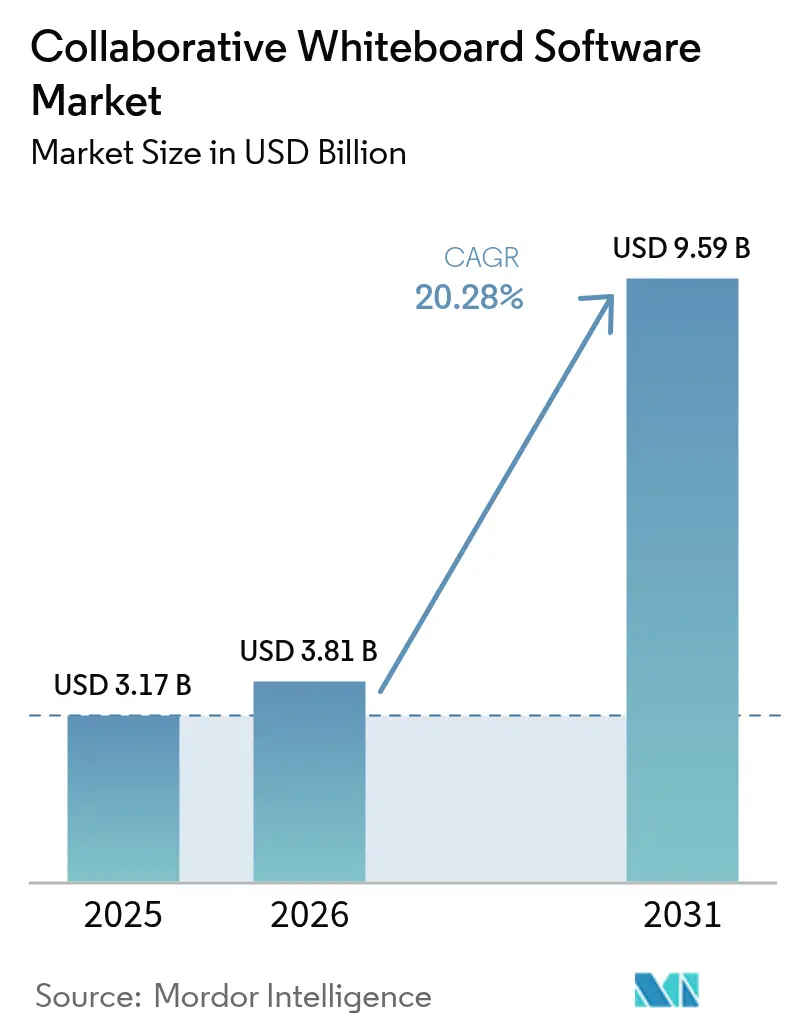
| Market Size (2026) | USD 3.81 Billion |
| Market Size (2031) | USD 9.59 Billion |
| Growth Rate (2026 - 2031) | 20.28% CAGR |
| Fastest Growing Market | Asia Pacific |
| Largest Market | North America |
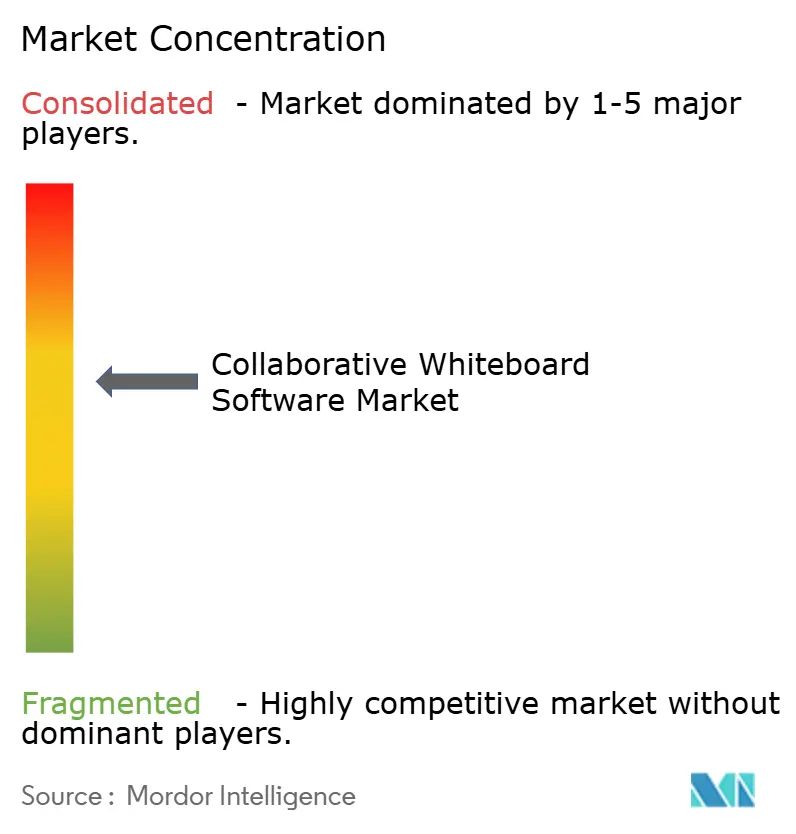
| Market Concentration | Medium |
Major Players *Disclaimer: Major Players sorted in no particular order Image © Mordor Intelligence. Reuse requires attribution under CC BY 4.0. | |
Collaborative Whiteboard Software Market Analysis by Mordor Intelligence
The collaborative whiteboard software market size was valued at USD 3.17 billion in 2025 and estimated to grow from USD 3.81 billion in 2026 to reach USD 9.59 billion by 2031, at a CAGR of 20.28% during the forecast period (2026-2031). Heightened reliance on hybrid work structures, the rise of cloud-native SaaS ecosystems, and rapid infusions of artificial intelligence have turned visual collaboration from a discretionary spend into a core productivity requirement. Enterprises favor platforms that blend synchronous brainstorming with asynchronous iteration, reinforcing long-term contracts and deep integrations with project management, customer relationship management, and unified communications environments. Vendors able to certify zero-trust architectures and offer FedRAMP or GDPR assurances capture premium demand as security and compliance move to the forefront of purchasing criteria. Simultaneously, “canvas sprawl” governance and knowledge-management integrations are emerging as decisive evaluation factors, especially for multinational organizations that juggle thousands of simultaneous boards. The collaborative whiteboard software market, therefore, rewards providers that deliver secure, AI-enabled, and workflow-embedded experiences across desktop and mobile contexts.
Key Report Takeaways
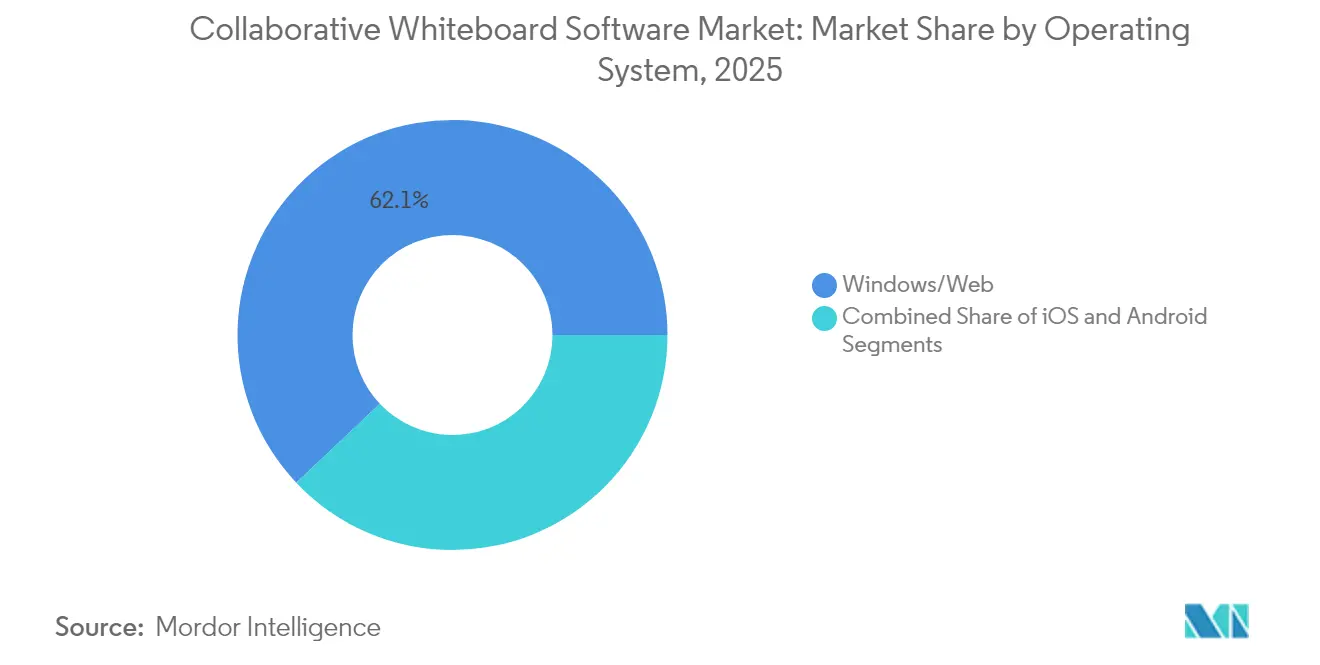
- By operating system, windows/web platforms commanded 62.05% share in 2025 in the collaborative whiteboard software market, whereas Android is projected to grow at a 21.55% CAGR through 2031.
- By deployment, cloud models accounted for 71.05% of the collaborative whiteboard software market size in 2025 and are forecast to accelerate at a 29.45% CAGR over the period.
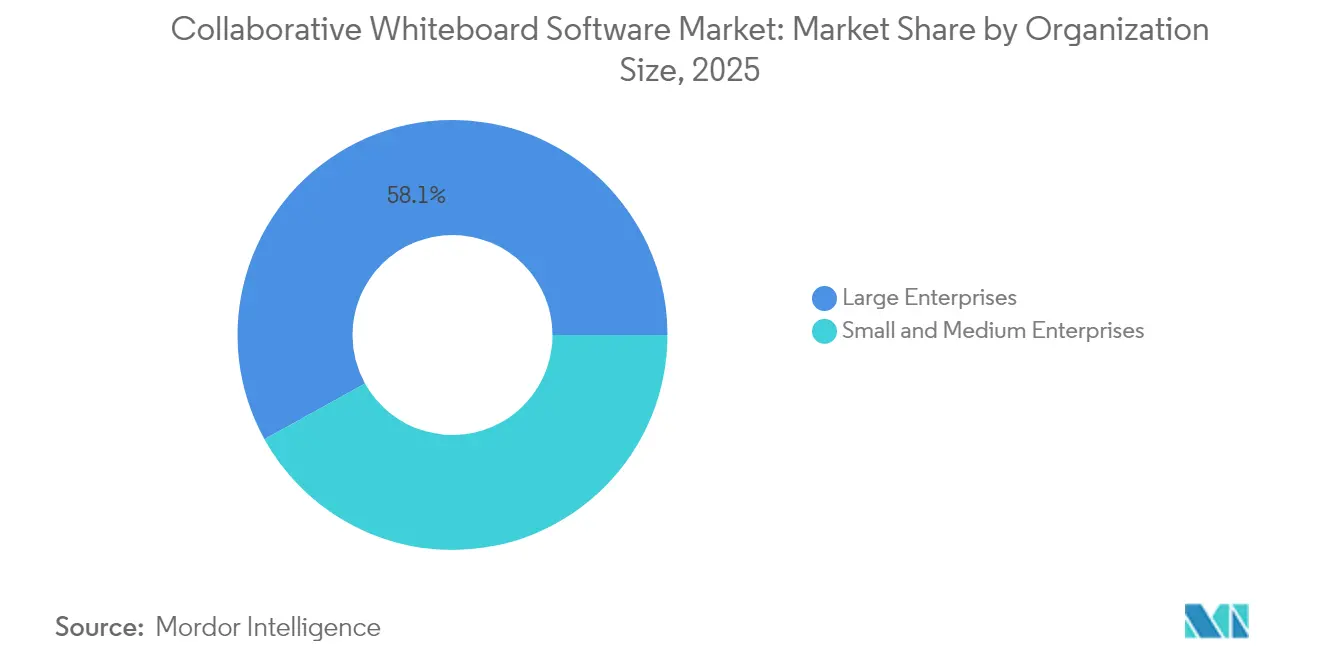
- By organization size, large enterprises held 58.05% revenue share of the collaborative whiteboard software market in 2025, while small and medium enterprises are advancing at a 21.32% CAGR to 2031.
- By end-user vertical, education captured a 30.10% share in 2025 in the collaborative whiteboard software market, yet healthcare is on track to climb at a 21.02% CAGR to 2031.
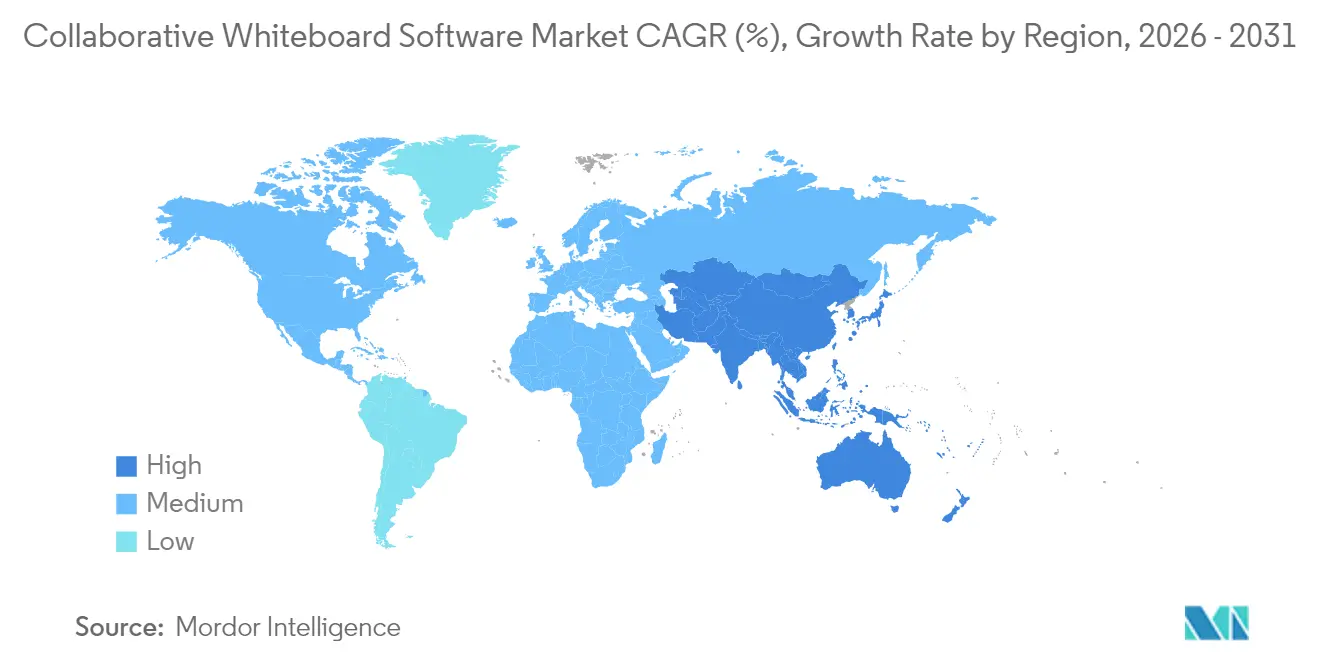
- By geography, North America led with 37.40% of collaborative whiteboard software market share in 2025, whereas Asia-Pacific is expanding at a 21.05% CAGR through 2031.
Note: Market size and forecast figures in this report are generated using Mordor Intelligence’s proprietary estimation framework, updated with the latest available data and insights as of 2026.
Global Collaborative Whiteboard Software Market Trends and Insights
Drivers Impact Analysis*
| Driver | (~) % Impact on CAGR Forecast | Geographic Relevance | Impact Timeline |
|---|---|---|---|
| Remote and hybrid work becoming permanent | +6.2% | Global, with highest impact in North America and Europe | Medium term (2-4 years) |
| Expansion of cloud-native SaaS ecosystems | +4.8% | Global, led by North America and Asia-Pacific | Long term (≥ 4 years) |
| Growing integration with UCaaS and project-management suites | +3.9% | North America and Europe primarily | Medium term (2-4 years) |
| AI-assisted facilitation and automated board summarization | +4.1% | Global, early adoption in North America | Short term (≤ 2 years) |
| Zero-trust whiteboarding demand in classified / defense sectors | +1.2% | North America and Europe, defense-focused | Medium term (2-4 years) |
| Vendor monetisation of template marketplaces and plug-in economies | +0.7% | Global, platform-dependent | Long term (≥ 4 years) |
| Source: Mordor Intelligence | |||


Remote and Hybrid Work Becoming Permanent
Enterprise surveys show that 80% of educators in 2025 believe technology simplifies their roles, up from 63% in 2023. Persistent hybrid arrangements therefore shift procurement from short-term fixes to strategic platforms that merge synchronous ideation with asynchronous follow-ups. Visual context maintained across time zones reduces project friction, prompting longer-term, organization-wide licensing. As a result, the collaborative whiteboard software market underpins core productivity stacks and supports zero-trust-aligned security postures demanded by government contractors and regulated industries.[1]Microsoft Corporation, “FY25 Q4 Productivity and Business Processes,” microsoft.com
Expansion of Cloud-Native SaaS Ecosystems
Microsoft’s cloud revenue climbed 27% year-over-year to USD 46.7 billion in Q4 FY25, underscoring the infrastructural capacity that powers embedded collaboration services.[2]Microsoft Corporation, “FY25 Q4 Productivity and Business Processes,” microsoft.com Vendors leverage open APIs and microservices to slot whiteboards directly into project, CRM, and ERP workflows, turning brainstorming sessions into actionable objects. Reduced implementation friction democratizes adoption among SMEs, while continuous delivery pipelines let providers roll out features such as AI templates and iterative analytics without client-side upgrades. Consequently, cloud alignment is both a competitive necessity and a primary accelerator of the collaborative whiteboard software market.
Growing Integration with UCaaS and Project-Management Suites
Unified communications suites now include native whiteboards, lowering switching costs and broadening exposure. Zoom offers AI-powered boards within existing subscriptions, highlighting how embedded functionality converts non-seekers into active users.[3]Zoom Video Communications, “Empower Visual Collaboration with Online Whiteboards,” zoom.com Standardization of features such as template libraries, infinite canvases, and task hand-offs pressures standalone vendors to specialize or vertically integrate. At the same time, convergence expands total addressable demand, lifting overall growth of the collaborative whiteboard software market.
AI-Assisted Facilitation and Automated Summarization
Miro’s in-product AI launched in 2023 shows how automation turns passive canvases into proactive copilots that generate diagrams, cluster ideas, and produce meeting summaries. Real-time automation boosts session throughput and addresses common fatigue associated with virtual workshops. Vendors investing in transparent data-handling policies and audit logs sidestep regulatory pushback, positioning AI as an accelerator rather than a compliance liability.
Restraints Impact Analysis*
| Restraint | (~) % Impact on CAGR Forecast | Geographic Relevance | Impact Timeline |
|---|---|---|---|
| Data-privacy and compliance concerns (GDPR, FedRAMP, HIPAA) | -2.8% | Europe and North America primarily | Short term (≤ 2 years) |
| Low digital infrastructure in parts of Africa and South Asia | -1.9% | Africa and South Asia regions | Long term (≥ 4 years) |
| "Good-enough" free whiteboards bundled with UC platforms | -2.1% | Global, with highest impact in North America and Europe | Medium term (2-4 years) |
| Canvas-sprawl creating governance and knowledge-management headaches | -1.4% | Global, enterprise-focused impact | Medium term (2-4 years) |
| Source: Mordor Intelligence | |||
Data-Privacy and Compliance Concerns
GDPR, FedRAMP, and HIPAA stipulations extend sales cycles by 12–18 months in sectors handling protected data. Requirements for in-region storage, encryption, and penetration-test attestation raise vendor operating costs. Providers achieving full certifications, such as Bluescape’s FedRAMP Moderate authorization, enjoy an immediate differentiator among defense and public-sector clients, but the broader collaborative whiteboard software market temporarily slows while vendors retrofit security postures.
Low Digital Infrastructure in Africa and South Asia
Average fixed-line bandwidth below 10 Mbps in portions of Sub-Saharan Africa constrains real-time multi-user synchronization. Offline modes, compressed data streams, and simplified mobile interfaces are essential adaptations. As fiber backbone expansions continue, latent demand will unlock, but near-term growth remains tempered outside major metropolitan hubs.
*Our forecasts treat driver/restraint impacts as directional, not additive. The impact forecasts reflect baseline growth, mix effects, and variable interactions.
Segment Analysis
By Operating System: Mobile Platforms Drive Future Growth
The collaborative whiteboard software market size attributed to Windows/Web operating environments stood at USD 1.97 billion in 2025, translating to 62.05% dominance. Android platforms, however, are expected to post a 21.55% CAGR through 2031, reflecting the workforce shift toward device-agnostic collaboration. Android gains are reinforced by deep Google Workspace hooks and cost-effective hardware that suits field teams and emerging-market users. iOS adoption also rises in executive settings where tablets prove convenient for on-the-go ideation.
Traditional desktop integrations with legacy enterprise software safeguard the leadership of windows/web, yet touchscreen advancements and AI-generated diagramming are shrinking productivity gaps. Mobile security frameworks such as enterprise mobility management now match desktop controls, further propelling smartphone and tablet usage. Consequently, providers that deliver parity across screen sizes will seize disproportionate growth within the collaborative whiteboard software market.


By Deployment Mode: Cloud Dominance Accelerates
Cloud deployments captured 71.05% of collaborative whiteboard software market share in 2025, equal to a USD 2.25 billion revenue pool. Fueled by 29.45% CAGR expectations, SaaS models appeal through automatic scaling, continuous feature rollout, and lower total cost of ownership. On-premises adoption persists in banking and defense, yet even these verticals gravitate toward hybrid architectures that partition sensitive data into private clouds while retaining public-cloud collaboration advantages.
Capital investments of USD 24.2 billion by hyperscale providers such as Microsoft in 2025 underscore the infrastructure race supporting cloud applications. Features like high-availability global points of presence and integrated observability tools enhance performance and governance. As a result, cloud-native orientation remains the bedrock for competitive resilience within the collaborative whiteboard software market.
By Organization Size: SME Adoption Accelerates
Large enterprises generated USD 1.84 billion of revenue in 2025, equal to 58.05% collaborative whiteboard software market share, owing to larger seat counts and deeper integrations. Yet SMEs represent the fastest expansion vector at a 21.32% CAGR through 2031, boosted by freemium entry points and credit-card-based self-service onboarding. Subscription elasticity lets smaller teams pilot advanced functionality without infrastructure expenditure.
SME enthusiasm is amplified by employee familiarity with collaboration apps from prior roles in bigger organizations. Conversely, large enterprises seek consolidation, bundling whiteboard capabilities into broader productivity suites to eliminate redundant tools. Vendors balancing ease of adoption with enterprise-grade governance will bridge both cohorts and capture outsized influence across the collaborative whiteboard software market.
By End-User Vertical: Healthcare Growth Outpaces Education Leadership
Education accounted for 30.10% of revenue in 2025 as classrooms embraced interactive digital content and remote learning. Healthcare, while smaller today, is projected to grow at 21.02% CAGR, fueled by telehealth, interdisciplinary case reviews, and medical-training simulations that benefit from visual collaboration.
Regulatory complexities traditionally slowed healthcare purchases, but vendors with HIPAA-ready or ISO 13485-aligned offerings now unlock budgets for collaboration in patient-centric and research workflows. Education demand remains stable, driven by curriculum innovation and government digital inclusion grants. Together these sectors anchor vertical diversification strategies inside the collaborative whiteboard software market.
Geography Analysis
North America generated the highest revenue at 37.40% collaborative whiteboard software market share in 2025, reflecting mature SaaS spending patterns and entrenched hybrid work cultures. Zero-trust mandates spur demand for platforms boasting FedRAMP or DoD Impact Level 4 credentials, particularly among aerospace and defense contractors. Saturation in traditional enterprise pockets propels vendors toward niche-vertical modules and advanced AI features to sustain renewal growth.
Asia-Pacific is on pace for a 21.05% CAGR through 2031, propelled by mobile-first workstyles, surging ed-tech investments, and government-backed digital programs across India, Indonesia, and Vietnam. Smartphone penetration and 5G rollouts lower access barriers, though providers must optimize for intermittent connectivity and multilanguage UI support. The collaborative whiteboard software market therefore rewards mobile-optimized architectures and region-specific pricing.
Europe’s steady adoption is moderated by GDPR data-sovereignty obligations that lengthen deployment cycles and limit AI functionality unless vendors can guarantee transparent data-handling. National cloud initiatives in France and Germany create opportunities for local hosting partnerships. Meanwhile, Middle East and Africa and South America represent long-term upside contingent on infrastructure upgrades and increased hybrid work prevalence.

Regulatory Landscape
Collaborative whiteboard software procurement is increasingly shaped by data protection and AI governance regimes that affect storage location, access control, and auditability. In Europe, GDPR-aligned requirements around data sovereignty and regulated processing underpin vendor demands for encryption, retention, and defensible exports, while Regulation (EU) 2024/1689 (EU AI Act) adds transparency and risk-management duties for AI-enabled features such as automated summarization and agentic assistance, with key provisions moving into effect on August 2, 2026. These requirements push vendors to document AI supply chains and maintain technical and organizational controls that can be evidenced in customer audits.
In the United States, the patchwork of state privacy laws has raised the operational bar for global SaaS deployments that serve mixed consumer and employee data use cases, with 20 states having comprehensive consumer privacy laws in effect as of July 2026. Public-sector collaboration also faces standards-driven procurement pressure, including federal considerations captured in the proposed Secure and Interoperable Government Collaboration Technology Act, which emphasizes voluntary consensus standards, end-to-end encryption, and record-keeping compatibility. Cross-border compliance programs such as the updated Global CBPR and PRP systems (2026) provide an additional pathway for structured privacy assurance across jurisdictions, complementing GDPR-driven controls for multinational buyers.
Value Chain Analysis
The value chain is predominantly software and ecosystem driven, beginning with product design and cloud-native development (UI/UX, real-time collaboration infrastructure, identity and access management, and AI feature engineering), then extending to cloud deployment and operations across hyperscale platforms and regional hosting arrangements where data residency is required. AI enablement sits across the chain via in-house model development, third-party model consumption, and middleware patterns that connect models to enterprise context, which elevates the importance of provenance, security logging, and governance workflows for board content.
Distribution and customer acquisition are handled through direct SaaS sales, marketplaces, and channel partners, with integrations acting as a primary adoption route. Platform providers increasingly differentiate through API/SDK ecosystems and native connectors into productivity and work-management suites, including integrations with Microsoft 365, Google Workspace, and Atlassian environments, supported by solution partners that manage deployment, change management, and vertical-specific templates. Recent product actions reflect this ecosystem shift, including JetBrains adding Whiteboards to YouTrack in April 2026 to embed canvases inside project workflows, and Miro introducing agentic AI innovations and expanding native connectors in May 2026, reinforcing the role of integrations and developer ecosystems in driving stickiness and expansion.
Competitive Landscape
Market fragmentation persists, yet consolidation is ramping. Wrike announced plans in December 2024 to absorb Klaxoon, integrating infinite canvas capability directly into its work-management suite. In September 2025, Atlassian agreed to acquire The Browser Company, signaling intent to weave browser-native whiteboarding and AI insights into its developer collaboration stack.
Technology differentiation centers on embedded artificial intelligence. Miro’s beta assistants auto-generate templates, cluster sticky-notes, and draft follow-up tasks, raising the baseline for productivity features. Microsoft Whiteboard leverages Azure OpenAI services to summarize session outcomes and convert diagrams into Microsoft Planner tasks, tightening ecosystem lock-in.
Security and compliance remain decisive. Bluescape secured FedRAMP Moderate and DoD IL4 status, enabling classified collaboration scenarios. Vendors also monetize template marketplaces and custom integrations, diversifying revenue beyond per-seat SaaS subscriptions. Overall, intensified R&D around AI, security, and workflow convergence defines competitive trajectories across the collaborative whiteboard software market.
Collaborative Whiteboard Software Industry Leaders
InVisionApp Inc.
Microsoft Corporation
Google LLC
Cisco Systems, Inc.
Miro, Inc.
- *Disclaimer: Major Players sorted in no particular order

Market Opportunities and Future Outlook
Enterprise governance and compliance readiness create whitespace for vendors that can translate whiteboard artifacts into auditable records without disrupting workflow. Microsofts April 2026 enablement to view Microsoft Whiteboard artifacts in Microsoft Purview eDiscovery, along with its roadmap to store Teams channel-tab whiteboards in SharePoint, points to active buyer demand for retention, legal hold, and discovery alignment. Vendors that offer comparable controls, such as granular access, exportability, and policy-based retention, and connect them to existing security stacks should compete more effectively in regulated verticals including healthcare, government, and defense.
AI-enabled visual collaboration is shifting from add-on features to a core product battleground, creating opportunities for differentiated agentic workflows that convert canvases into executable work. Microsofts March 2026 hiring of the team behind the AI-based collaboration platform Cove to strengthen infinite whiteboard and copilot capabilities indicates continued investment in AI-augmented canvases by major suite vendors, while Boardmixs June 2026 release of 100-plus AI agents shows faster feature expansion among specialists. The environment also supports ecosystem-led opportunities, where deeper bi-directional synchronization with knowledge and delivery systems, such as GitHub, Confluence, and Slack, helps reduce canvas sprawl and improves handoff from ideation to execution, benefiting vendors and partners that package integrations, templates, and governance as deployable solutions for large enterprises and SMEs.
Recent Industry Developments
- April 2026: Microsoft expanded compliance support by enabling Microsoft Whiteboard artifacts to be viewed in Microsoft Purview eDiscovery in readable HTML. This ties whiteboard content more directly into enterprise legal, retention, and investigation workflows, raising the bar for governance capabilities among competing platforms.
- March 2026: Microsoft communicated changes to Microsoft Whiteboard storage for Teams channel tabs, shifting boards to the channels SharePoint site with rollout beginning in late September 2026. The update aligns whiteboard content with Microsoft 365 information governance controls such as retention and discovery, reinforcing suite-based buying and reducing friction for regulated customers.
- December 2024: Google reached end of life for the Jamboard application across web, mobile, and Google Meet devices. The sunset accelerated migrations toward software-first and partner whiteboarding options within broader collaboration ecosystems, reshaping competitive positioning for vendors integrated into Google Workspace and other UC suites.


Research Methodology Framework and Report Scope
Market Definition and Coverage
For this study, the market covers paid collaborative whiteboard software used to create, share, and edit visual boards in real time across users, typically delivered through cloud or on-premise deployment.
Scope exclusions: We exclude physical interactive whiteboards, bundled endpoint hardware, and general video meeting licenses unless a priced collaborative whiteboard software module is explicitly accounted for.
Segmentation Overview
- By Operating System
- Windows and Web
- iOS
- Android
- By Deployment Mode
- Cloud
- On-premise
- By Organization Size
- Large Enterprises
- Small and Medium Enterprises
- By End-user Vertical
- BFSI
- Healthcare
- Education
- IT and Telecommunications
- Other End-user Verticals
- By Geography
- North America
- South America
- Europe
- Asia-Pacific
- Middle East and Africa
Data Sources, Market Sizing, and Validation
Desk Research
Desk research helped us set the boundary of what counts as collaborative whiteboard software and what should sit outside the model. We relied on public sources such as U.S. SEC filings, U.S. Bureau of Economic Analysis data for software and IT spending context, U.S. Bureau of Labor Statistics indicators for knowledge-worker trends, and OECD and World Bank datasets for macro and digital adoption checks.
We also reviewed non-paywalled references such as NIST security guidance that influences enterprise collaboration tool requirements, along with company websites, product documentation, public pricing pages, and reputable press coverage to track packaging changes and feature evolution. Patent databases were used selectively to identify themes such as AI-assisted diagramming and workflow integrations, and a paid subscription for company financials and intelligence was used only to normalize revenue splits when disclosures were limited. The desk sources listed here are illustrative only, and many other public references were used to collect data, validate assumptions, and clarify gaps.
Primary Interviews and Surveys
Primary work was used to test our scope choices and translate adoption behavior into practical assumptions. We spoke with product, sales, channel, and IT decision stakeholders across enterprises and SMBs in APAC, EMEA, and the Americas to confirm pricing motion, typical seat counts, renewal patterns, and how whiteboard tools are bought alongside broader collaboration stacks.
Distribution of primary research fieldwork respondents
| Company type | Respondent position | Region |
|---|---|---|
| Top tier: 33% | CXOs: 20% | APAC: 44% |
| Mid tier: 46% | Functional/Unit leaders: 22% | EMEA: 33% |
| Smaller Players: 21% | Managers: 58% | Americas: 23% |
Market-Sizing & Forecasting
Sizing was built using a top-down approach where IT and collaboration software spend is reconstructed into an addressable pool, which is then narrowed using adoption and usage checks specific to collaborative whiteboards. To avoid overcounting, the model separates dedicated whiteboard subscriptions from adjacent tools and then applies realistic penetration levels by region and organization type.
The totals were corroborated with selective bottom-up approximations using sampled price points and likely paid seats, along with supplier revenue disclosures where they were available and comparable. Key inputs that shaped the model included cloud versus on-premise mix, typical per-user pricing ranges and discounting, estimated paid seat density for hybrid teams, education and enterprise procurement cycles, and the pace of feature-led upgrades (such as AI assistance and workflow integrations) that can lift average selling price over time.
For forecasting, scenario analysis was used so the outlook could be stress-tested under different adoption speeds, budget pressure levels, and pricing progression paths. When bottom-up signals were incomplete for smaller vendors, gaps were handled by applying conservative adoption bands tied back to interview feedback and region-level demand indicators, and then rechecked against the overall spend envelope.
Data Validation & Update Cycle
Validation was done through multiple passes where model outputs were compared against independent signals, and then reviewed again for internal consistency. Outliers, sudden jumps in implied pricing, or region shares that drifted away from known deployment patterns were flagged, explained, and corrected before sign-off.
We also re-contact sources when a key assumption moves, such as a pricing change, packaging shift, or a noticeable demand swing tied to workplace policy updates. Reports are refreshed annually, and interim updates are made when material events affect adoption or pricing. Before delivery, a fresh review pass is completed so clients receive the latest updated view rather than an older snapshot.
Mordor Intelligence's Collaborative Whiteboard Software Market Size Compared Against Other Published Estimates
Published market sizes for collaborative whiteboard software can look far apart because each publisher chooses a different timing, boundary, and pricing logic. Even when the same words are used, the counted revenue pool can shift based on whether the view is subscription-only, whether services are added, and which year is treated as the starting point.
In our work, refresh cadence and currency timing matter because many contracts are annual and multi-region, so FX snapshots and price progression assumptions can swing the USD total. When average selling prices are recalibrated using current packaging and discount behavior, and then rechecked against renewal patterns and adoption signals, the 2026 value of USD 3.81 B stays anchored to the paid seat-based demand pool, which is a validation step applied by Mordor Intelligence.
Benchmark comparison
| Source | Market Size | Gaps in Research Methodology |
|---|---|---|
| Mordor Intelligence | USD 3.81 B (2026) | |
| Industry Dataset A | USD 3.30 B (2025) | Uses a different base year and may treat pricing as a single blended rate, which can understate enterprise seat expansion and newer plan-driven ASP uplift. |
| Trade Outlet B | USD 3.80 B (2025) | Often reflects headline figures with limited visibility on currency timing, packaging changes, and boundary rules around adjacent collaboration suites, which can shift what revenue is counted. |
The table shows that small shifts in year selection and pricing treatment can move the number even when growth direction is similar. By keeping scope tight to paid collaborative whiteboard software and repeatedly checking ASP and adoption assumptions against interview signals, the model stays easier to trace and reproduce.


Key Questions Answered in the Report
What is the current value of the collaborative whiteboard software market?
The collaborative whiteboard software market size is USD 3.81 billion in 2026.
How fast is the market expected to grow by 2031?
It is projected to expand at a 20.28% CAGR, reaching USD 9.59 billion.
Which region is growing the quickest?
Asia-Pacific is forecast to register a 21.05% CAGR through 2031, the highest worldwide.
Why are cloud deployments so dominant?
Cloud models offer automatic updates, elastic scaling, and seamless integration, giving them 71.05% market share in 2025.
Which vertical shows the strongest growth potential?
Healthcare is poised to grow at a 21.02% CAGR as telehealth and clinical collaboration expand.
Page last updated on: