
Cognitive Media Market Size and Share
Market Overview
| Study Period | 2020 - 2031 |
|---|---|
| Market Size (2026) | USD 18.74 Billion |
| Market Size (2031) | USD 45.48 Billion |
| Growth Rate (2026 - 2031) | 19.40 % |
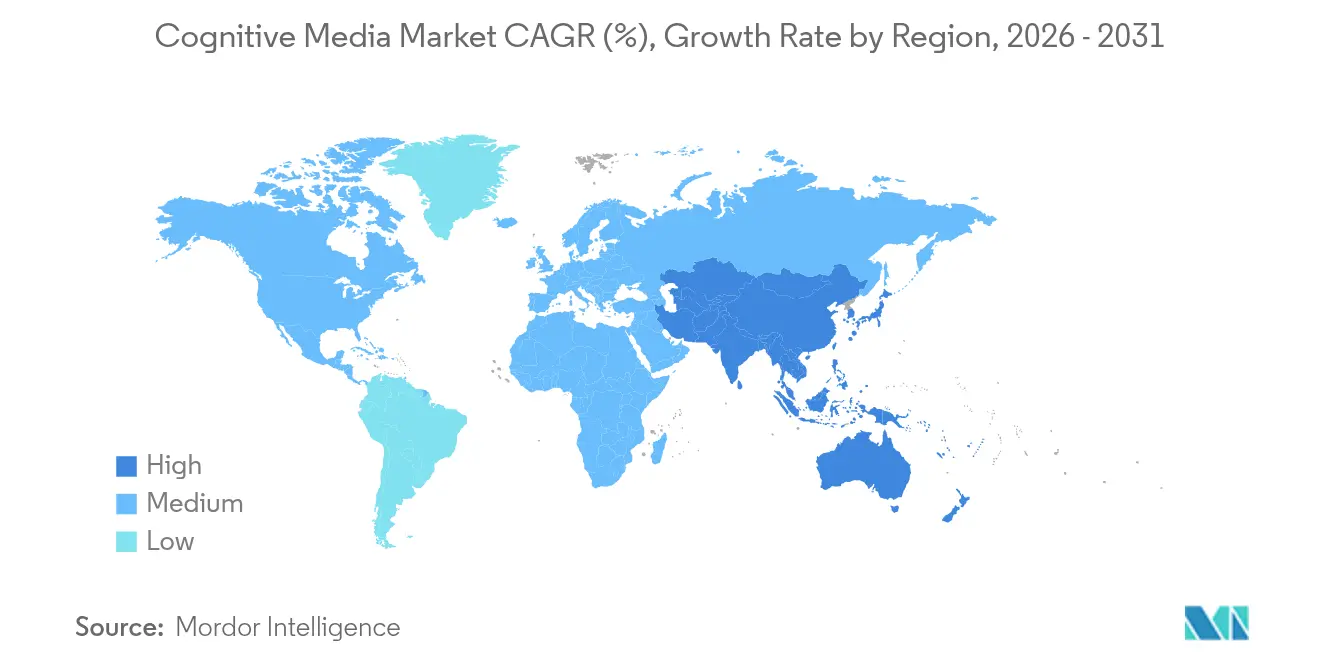
| Fastest Growing Market | Asia Pacific |
| Largest Market | North America |
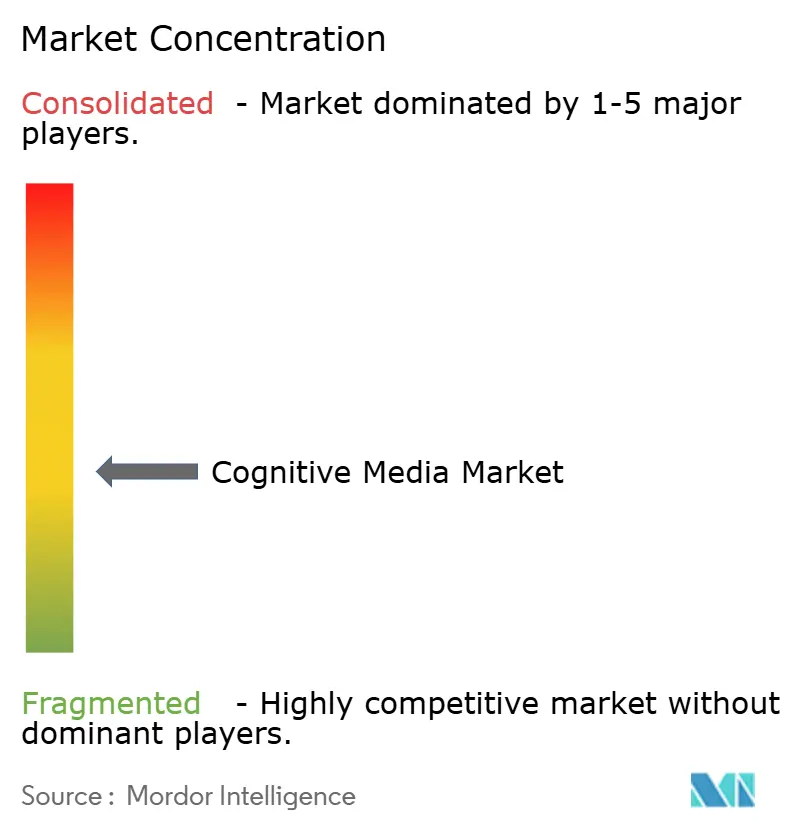
| Market Concentration | Medium |
Major Players *Disclaimer: Major Players sorted in no particular order Image © Mordor Intelligence. Reuse requires attribution under CC BY 4.0. | |
Cognitive Media Market Analysis by Mordor Intelligence
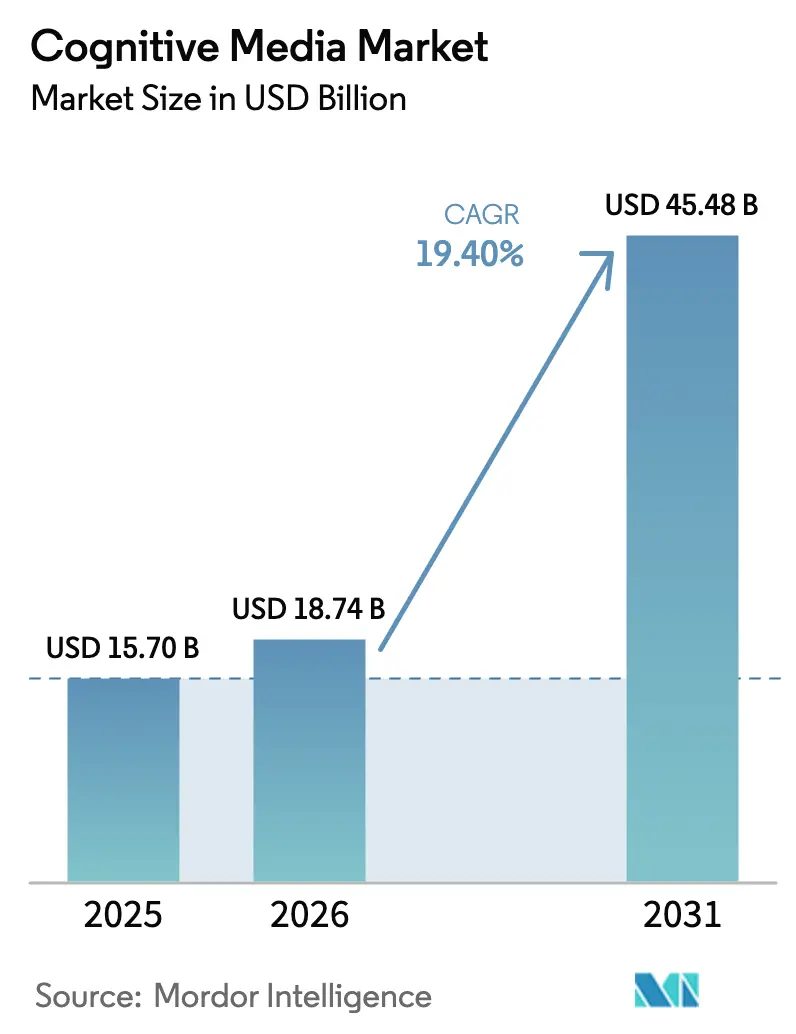
The Cognitive Media Market size is expected to grow from USD 15.70 billion in 2025 to USD 18.74 billion in 2026 and is forecast to reach USD 45.48 billion by 2031 at 19.4% CAGR over 2026-2031.
Expanding AI capabilities, lower cloud-GPU pricing, and the shift toward hyper-personalized digital experiences are moving the market from early experimentation to mainstream adoption. Media companies increasingly rely on large-language-model pipelines to automate editing, captioning, and localization tasks, cutting turnaround times for multi-language releases. AI-native ad formats that build entire campaigns from a single product image are widening revenue streams, while edge deployments are reducing latency for interactive and live use-cases. North America continues to anchor global spending thanks to heavy R&D outlays by platform leaders, yet rapid infrastructure rollouts in Japan and China are propelling Asia-Pacific toward the fastest regional growth trajectory.
Key Report Takeaways
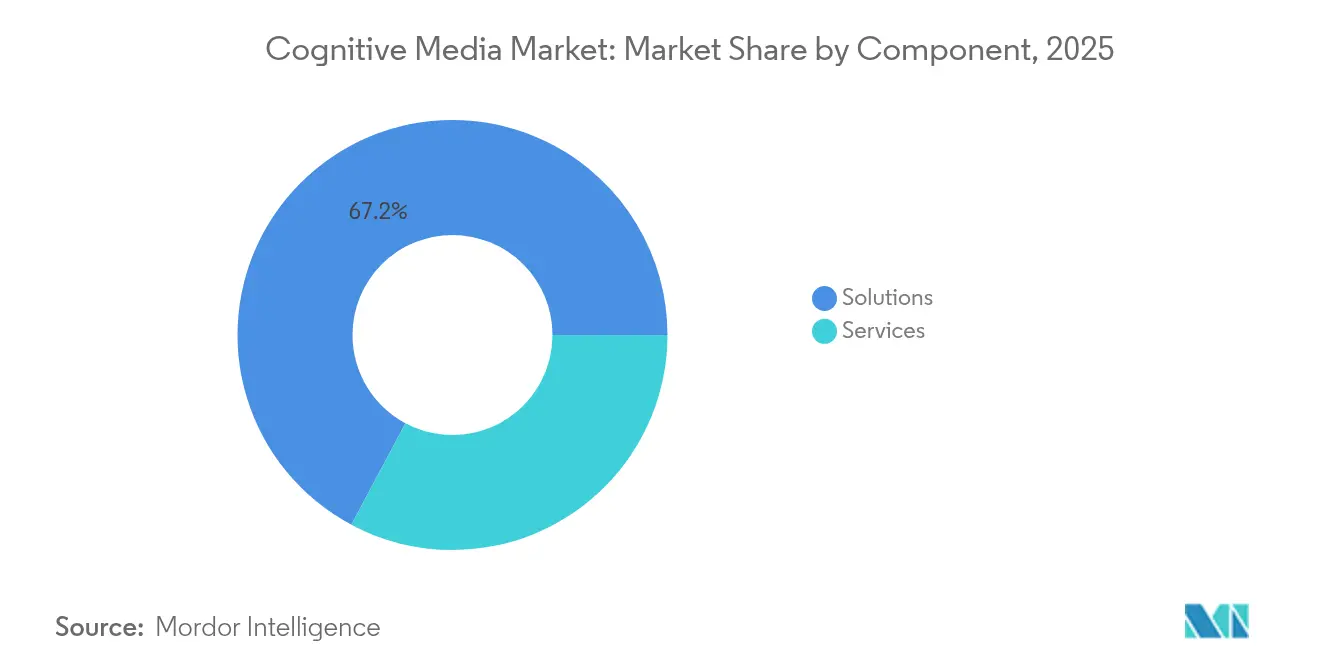
- By component, solutions held 67.20% of the cognitive media market share in 2025; services are projected to grow at a 23.30% CAGR to 2031.
- By deployment, the cloud model accounted for 81.30% of the cognitive media market size in 2025 and is forecast to expand at a 20.50% CAGR.
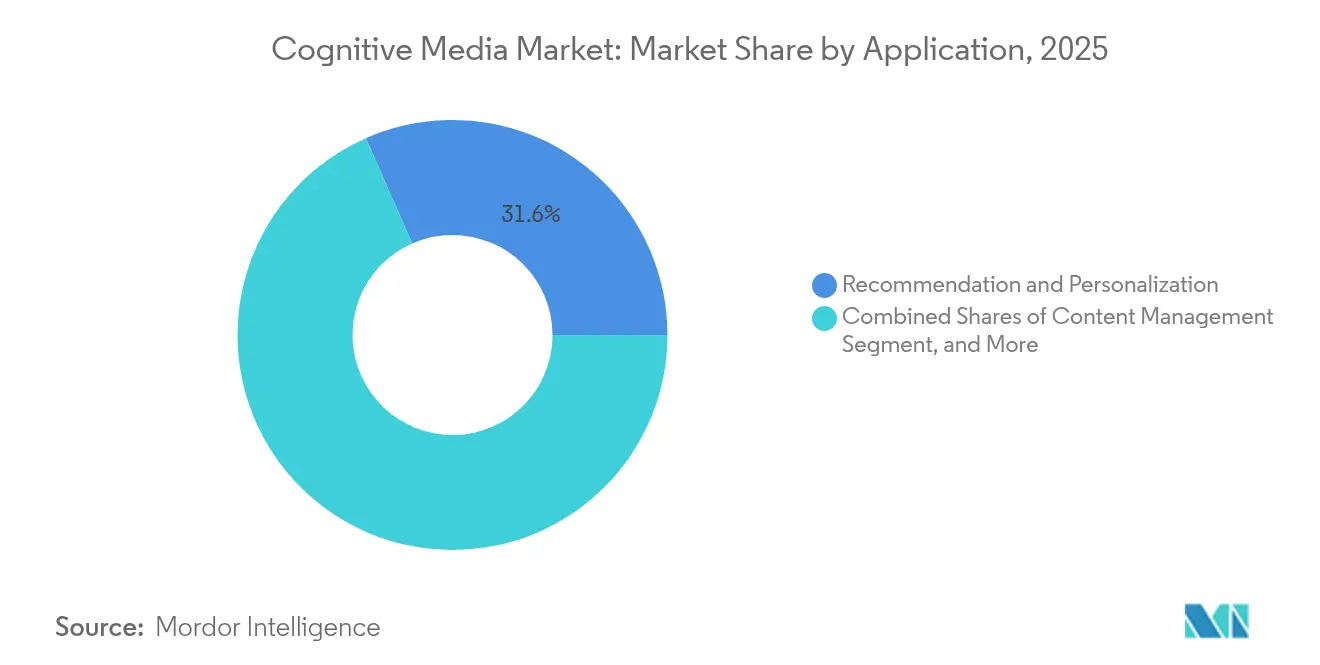
- By application, recommendation and personalization led with 31.60% revenue share in 2025 in the cognitive media market, while predictive analytics is advancing at a 26.80% CAGR through 2031.
- By geography, North America captured 42.40% of the cognitive media market in 2025 in the cognitive media market; Asia-Pacific is set to post a 23.10% CAGR to 2031.
Note: Market size and forecast figures in this report are generated using Mordor Intelligence’s proprietary estimation framework, updated with the latest available data and insights as of 2026.
Market Trends and Insights
Drivers Impact Analysis of Cognitive Media Market*
| Driver | (~) % Impact on CAGR Forecast | Geographic Relevance | Impact Timeline |
|---|---|---|---|
| Workflow automation across multi-platform content supply chains | +4.20% | Global; early uptake in North America and EU | Medium term (2-4 years) |
| Hyper-personalized content as an ARPU lever | +3.80% | Global; strongest in Asia-Pacific streaming markets | Short term (≤ 2 years) |
| Cloud GPU cost curves falling faster than Moore’s Law | +3.10% | Global; concentrated in hyperscale regions | Long term (≥ 4 years) |
| AI-native advertising formats boosting CPM yields | +2.90% | North America and EU first; moving to Asia-Pacific | Medium term (2-4 years) |
| Generative-AI-ready creator tools democratizing production | +2.70% | Global; rapid takes in emerging economies | Short term (≤ 2 years) |
| Zero-party data strategies enhancing recommendation accuracy | +2.30% | Global; led by privacy-conscious markets | Medium term (2-4 years) |
| Source: Mordor Intelligence | |||
Workflow Automation Across Multi-Platform Content Supply Chains
Media groups now automate up to 100% of ingest, edit, and caption tasks, pushing 4.2 percentage points of additional CAGR. Warner Bros. Discovery cut localization costs by 60% after integrating Google’s generative captioning suite. Broadcast schedulers such as Mediagenix simultaneously optimize linear and streaming grids, freeing staff to focus on premium content.[1] Prime Focus Technologies reported a 30% fall in manual metadata work when AI agents preview, tag, and archive assets.
Hyper-Personalized Content as an ARPU Lever
Hyper-personalization adds 3.8 percentage points to growth by lifting engagement and subscriber spend. A healthcare retailer deploying AI recommenders logged a 33.49% ARPU jump and a 32.79% rise in average order value. The Financial Times uses an AI paywall that calibrates article access without depressing conversions, underscoring the delicate balance between personalization and revenue. Netflix analyzes more than 200 billion daily user events to steer script development toward segments most likely to binge entire seasons. Publishers collecting zero-party preference signals recorded 60% higher content clicks among self-declared interest cohorts.
Cloud GPU Cost Curves Falling Faster Than Moore’s Law
Spending efficiency gains contribute 3.1 percentage points to the cognitive media market. Akamai’s switch to NVIDIA RTX 4000 GPUs accelerated transcoding 25× and lowered live-stream cost bases by 70%. SoftBank’s Tokyo AI platform now runs 4,000 Hopper GPUs, illustrating how cloud economics beat most on-premise alternatives for model training at scale.[2]These savings enable real-time automated moderation and dynamic ad insertion that were previously cost-prohibitive.
AI-Native Advertising Formats Boosting CPM Yields
New ad units account for a 2.9 percentage-point lift. Meta’s generative ad suite raised return-on-ad-spend by 22% for the 4 million advertisers already live on the tools. TikTok’s AI-powered virtual try-ons achieve engagement rates 40% higher than standard video placements. On the sell-side, Revenue Analytics’ Aida platform mines price-inventory vectors in real time to boost yield for streaming outlets.
Restraints Impact Analysis of Cognitive Media Market*
| Restraint | (~) % Impact on CAGR Forecast | Geographic Relevance | Impact Timeline |
|---|---|---|---|
| Scarcity of licensed, culture-specific training data | -2.80% | Global; acute in non-English markets | Long term (≥ 4 years) |
| Escalating GPU power-consumption penalties | -2.10% | Global; hyperscale data-center hubs | Medium term (2-4 years) |
| Evolving copyright litigation on synthetic content | -1.80% | North America and Europe | Medium term (2-4 years) |
| Data-sovereignty constraints on cross-border AI workflows | -1.50% | Europe and parts of APAC | Short term (≤ 2 years) |
| Source: Mordor Intelligence | |||
Scarcity of Licensed, Culture-Specific Training Data
Court rulings in 2024–2025 confirmed that unlicensed copyrighted inputs fall outside fair-use protections, trimming 2.8 percentage points off market expansion. Disney and NBCUniversal’s suit against Midjourney signaled aggressive enforcement by rights holders.[3] News Corp’s USD 250 million licensing pact with OpenAI shows how compliant datasets now command premium fees. Smaller language markets face higher entry costs because culturally nuanced corpora remain scarce.
Escalating GPU Power-Consumption Penalties
Power draw erodes 2.1 percentage points of growth as data centers struggle with 120–140 kW racks. EPRI estimates AI workloads could reach 40% of new U.S. electricity demand by 2030. HPCwire projects AI accelerators will absorb 2,318 TWh between 2025 and 2029. Operators must invest in immersion cooling and renewable sourcing to keep large-model deployments financially viable.
*Our forecasts treat driver/restraint impacts as directional, not additive. The impact forecasts reflect baseline growth, mix effects, and variable interactions.
Cognitive Media Market Segment Analysis
By Component:
Solutions Drive Enterprise AdoptionSolutions contributed 67.20% of the cognitive media market in 2025 as studios prioritized turnkey AI systems over consulting-led roll-outs. IBM’s Watsonx alone booked contracts worth USD 5 billion by scaling language-model toolkits into existing broadcast asset management suites. Veritone’s Digital Media Hub and Ateliere Connect AI help rights-holders automatically surface long-tail clips for syndication, reducing dormant asset ratios by 45%. As a result, the solutions slice is forecast to maintain clear leadership through 2031.
The services sub-segment is expanding at a 23.30% CAGR because integration across legacy control rooms, playout chains, and OTT apps requires scarce engineering talent. Consulting practices now market rapid-deployment “factory models” to plug skills gaps within weeks. Where custom pipelines still prevail, newsrooms and multi-regional sports networks, specialists tune prompt-engineering, guardrails, and workflow orchestration on retainer models, adding annuity revenue to vendors.

By Deployment:
Cloud Infrastructure DominatesThe cloud captured 81.30% of the cognitive media market share in 2025, the backbone for multi-petabyte training runs and large-scale inference tasks. Processing one 8K feature-length film already consumes tens of thousands of GPU hours; hyperscale clusters amortize this load across clients, keeping marginal compute affordable. SoftBank’s 4,000-unit Hopper cluster shows how country-level platforms can offer model-as-a-service while meeting data-residency rules.
On-premise remains essential for tier-one live news, where latency tolerance can be below 100 milliseconds. Hybrid builds therefore mix real-time encoding racks on-site with burst training in the cloud. Google Cloud and NVIDIA’s GB300 NVL72 system brings 30× faster memory bandwidth to these hybrids, making model fine-tuning feasible inside daily production windows.
By Application:
Personalization Leads, Analytics AcceleratesRecommendation and personalization held a 31.60% share of the cognitive media market size in 2025, the direct beneficiary of zero-party data capture and real-time event feedback loops. Netflix uses pattern discovery on 200 billion daily touchpoints to green-light pilots that statistically align with high-completion cohorts. Publishers applying similar playbooks reduced churn by double-digits within one quarter.
Predictive analytics is advancing at a 26.80% CAGR through 2031 as networks model audience swings before locking program slates. Advanced churn-propensity models achieve accuracy above 85%, allowing pre-emptive retention incentives that raise subscription lifetime value. Content moderation and network optimization continue to mature, but the next uplift will arrive from AI-generated translation passes that compress localization timelines from weeks to days, expanding addressable audiences overnight.
Geography Analysis
North America Cognitive Media Market
North America accounted for 42.40% of 2025 revenue as platform majors assembled end-to-end AI stacks that blend proprietary data, silicon, and distribution. The region’s policy regime remains comparatively permissive; yet, a wave of copyright suits, with 25 active as of June 2025, has injected caution into generative deployment news.bloomberglaw.com. Nevertheless, combined USD 320 billion in 2025 AI capex from Meta, Amazon, Alphabet, and Microsoft keeps the cognitive media market primed for near-term innovations.
APAC Cognitive Media Market
The Asia-Pacific region posts the fastest 23.10% CAGR through 2031, led by Japan’s Society 5.0 programs and SoftBank’s USD 960 million backbone expansion, which anchors local model training capacity. China’s conversational-AI revenue is projected to quintuple from USD 1.05 billion in 2023 to USD 5.19 billion by 2030, driven by policy incentives that leverage domestic datasets to fuel industry clouds. The first full-length AI-generated feature, “Pirate Queen: Zheng Yi Sao,” premiered in Malaysia in 2025, underscoring regional creative momentum.
Europe, LATAM and Africa Cognitive Media Market
Europe advances steadily, striking a balance between innovation and consumer protection under the 2025 AI Act, which mandates content watermarking by August 2025. Spain’s draft deepfake fines underscore rising enforcement appetite, but the bloc’s single digital market still offers scale advantages for vendors clearing compliance hurdles. Emerging Latin American and African markets, largely mobile-first, present white-space opportunities as telcos bundle AI-enabled streaming tiers with prepaid data packs, leapfrogging legacy pay-TV ecosystems.
Regulatory Landscape
Regulation affecting cognitive media is tightening around transparency, provenance, and platform accountability for synthetic and AI-personalized content. In the EU, the Digital Services Act has been effective since February 2024, requiring very large online platforms to assess and mitigate systemic risks that include harms to information integrity, which increases compliance demands for AI-driven recommendation, moderation, and ad systems used by media and social platforms.
AI-specific requirements are also taking more concrete shape through standards and implementing instruments. The EU AI Act entered into force in August 2024 and raises transparency duties while restricting manipulative practices. Europe has also moved toward technical labeling via the EU Draft Code of Practice on Transparency of AI-Generated Content (published December 2025), with implementation timelines discussed through August 2026. Separately, ITU-T Recommendation F.748.65 (December 2025) provides a standardized framework for AI-based cognitive inference systems in multimedia, supporting more consistent requirements for vendors delivering cognitive inference across media workflows.
Value Chain Analysis
The cognitive media value chain starts with data and rights inputs (first-party media libraries, licensed datasets, and identity/consent signals), then moves into model development and orchestration (multimodal foundation models, fine-tuning, guardrails, and workflow agents). It ends in production and distribution applications, including editing, captioning and localization, metadata enrichment, recommendation and personalization, ad creative and yield optimization, and moderation. Delivery remains predominantly cloud-based, with hyperscalers and silicon partners providing GPU capacity, storage, and MLOps, while media-tech vendors and system integrators connect AI layers into newsroom, MAM/DAM, and OTT stacks.
Supplier power concentrates around compute, proprietary platforms, and scarce talent. Bundled AI stacks from Amazon, Alphabet, and Microsoft reinforce consolidation by tying models, orchestration, and infrastructure into single procurement paths, while specialist vendors differentiate with domain workflow IP such as broadcast scheduling, metadata automation, and rights-aware search. Hardware-dependent deployments also face cost and lead-time sensitivity, including pressures linked to 2025 US tariffs on imaging sensors and specialized accelerators, which pushes buyers toward more compute-efficient architectures, hybrid deployment patterns, and flexible licensing in production environments.
Competitive Landscape
The cognitive media market remains moderately fragmented; yet share is consolidating as cloud titans bundle AI tooling with infrastructure. Meta hired four OpenAI veterans to spearhead an internal Superintelligence unit, dangling multimillion-dollar packages that intensified global talent scarcity. IBM secured enterprise mindshare by positioning Watsonx as a modular layer atop existing newsroom systems, landing multiyear deals across broadcast groups. Google and NVIDIA’s co-developed accelerators grant content studios turnkey performance leaps, prompting co-location partnerships with premiere post houses.
Start-ups still capture niche demand. Edge-focused vendors pipe context-aware recommendation engines directly into set-top boxes, eliminating round-trip latency. Others specialize in authenticity verification, embedding cryptographic watermarks at the frame level to deter deepfake misuse. Patent filings around energy-efficient inference soared during 2024, pointing to silicon-level differentiation as an emerging moat.
White-space persists in regional language datasets and real-time human-in-the-loop moderation. Vendors furnishing curated, licensed corpora or hybrid review teams can command premium service margins until regulatory clarity unlocks broader automated roll-out. As lawsuits drive up dataset costs, players with first-party IP libraries enjoy a defensible position.
Cognitive Media Industry Leaders
-
IBM Corporation
-
Google LLC
-
Amazon Web Services
-
Microsoft Corporation
-
Salesforce.com, inc.
- *Disclaimer: Major Players sorted in no particular order
Cognitive Media Market Companies Covered in this Report
- IBM Corporation
- Google LLC
- Amazon Web Services
- Microsoft Corporation
- Salesforce Inc.
- Adobe Inc.
- Nvidia Corporation
- Veritone Inc.
- Albert.ai
- Brandwatch
- Valossa Labs Ltd.
- Video Intelligence AG
Market Opportunities and Future Outlook
A primary opportunity area is authenticity-by-design and provenance tooling that makes synthetic and AI-modified media traceable across the content supply chain, from creation through distribution and ad delivery. The policy and standards backdrop is turning into more concrete implementation work, including the EU push toward AI-generated content transparency via the Draft Code of Practice on Transparency of AI-Generated Content (published December 2025) and the ITU-T F.748.65 multimedia cognitive inference framework (December 2025). Together, these efforts translate into vendor requirements for watermarking, detection, auditability, and compliant metadata pipelines.
A second opportunity centers on modular AI layers that retrofit into existing broadcast and publisher systems, reducing change-management friction and speeding deployments across ingest, enrichment, and monetization workflows. In-market evidence of this integration-led route includes IBM Watsonx positioning as a modular layer for enterprise adoption within media workflows, plus cloud provider enablement such as Amazon Bedrock AgentCore being used to power agentic media intelligence use cases in third-party platforms. In Europe, public-interest and integrity programs also provide a channel for vendors serving news and civic information environments, with initiatives such as the European Democracy Shield (launched November 2025) supporting tooling and partnerships aimed at resilience against synthetic misinformation in AI-mediated information spaces.
Recent Industry Developments in Cognitive Media Market
- July 2026: Wreltik announces full availability of its AI platform in India (VideoMAE backbone with LoRA fine-tuning) for visual engagement and emotional arousal predictions. The launch strengthens regional cognitive media tooling and analytics capabilities and expands geographic reach, accelerating adoption in high-fidelity content engagement.
- July 2026: TwelveLabs raised USD 100 million Series B to expand its video intelligence platform into a full-stack agentic system. The funding supports growth of end-to-end cognitive video analytics and advances agentic AI capabilities in media intelligence with investor backing.
- April 2026: Zefr evaluated NVIDIA Nemotron 3 Nano Omni model for its Cognition AI engine to improve content classification across YouTube, Meta, and TikTok. The assessment enhances content classification and moderation accuracy and signals broader adoption of cognition-enabled analytics in social-media workflows.
Cognitive Media Market Report Scope and Research Methodology
Market Definition and Coverage
For this study, the cognitive media market covers software and related services that use AI to understand, tag, manage, and personalize media content, and then improve delivery decisions across digital channels.
Scope exclusions: The sizing excludes general IT outsourcing that is not tied to cognitive media workflows, and it excludes pure content production spending that does not include AI driven analysis.
Segments Covered in This Report
- By Component
- Solutions
- Services
- By Deployment
- Cloud
- On-premises
- By Application
- Content Management
- Recommendation and Personalization
- Predictive Analysis
- Network Optimization
- Geography
- North America
- South America
- Europe
- Asia-Pacific
- Middle East and Africa
Data Sources, Market Sizing, and Validation
Desk Research
We start by mapping the value chain and demand drivers using open sources that describe how AI is being used across media workflows. Public references used as anchors include sources such as the US Bureau of Economic Analysis, the US Census Bureau, the International Telecommunication Union, the OECD, and World Bank data series, mainly for digital access and macro spend context.
We then collect market structure signals from company annual reports, SEC filings, investor decks, product documentation, and reputable press coverage of deployments and partnerships. Where cross checks are needed, we also use paid subscriptions for company financials and intelligence, news and financials, and patent databases to confirm technology focus and to understand revenue exposure patterns. The desk research sources listed are illustrative only, and many other references were consulted to collect data, validate assumptions, and clarify findings.
Primary Interviews and Surveys
We then validate the desk findings through expert interviews and structured surveys with solution providers, system integrators, media platform teams, and enterprise buyers running content operations. Because this is a global market, inputs are balanced across major regions so we can compare adoption timing, pricing behavior, and cloud migration patterns before finalizing the model.
Distribution of primary research fieldwork respondents
| Company type | Respondent position | Region |
|---|---|---|
| Top tier: 31% | CXOs: 15% | APAC: 42% |
| Mid tier: 52% | Functional/Unit leaders: 30% | EMEA: 36% |
| Smaller Players: 17% | Managers: 55% | Americas: 22% |
Market-Sizing & Forecasting
The market is modeled mainly using a top-down build where signals from media and enterprise digital activity are converted into a demand pool for cognitive functions, then translated into annual spending by applying adoption and spending intensity factors. In practice, we track how quickly content volumes and streaming usage expand, and then assess what share of workflows are shifting to AI assisted tagging, recommendation, content management, and network optimization.
To keep totals realistic, we also corroborate outputs with selective bottom-up checks, such as sampled supplier revenue exposure to cognitive media use cases and channel conversations on typical deal sizes. Key inputs used in the model include the cloud versus on-premises mix, the split of solution versus services, AI feature penetration in content pipelines, the pace of personalization adoption, and observed pricing movement for software subscriptions and services hours. For forecasting, scenario analysis is applied, so the base case growth reflects expert expectations on productization speed, regulatory sensitivity around data use, and media platform investment cycles, with gaps in company disclosures handled using conservative ranges that are narrowed via interviews.
Data Validation & Update Cycle
Model outputs are checked against independent demand signals, then reviewed for spikes that do not fit known industry events or procurement cycles. When variance is high by region or application, we re-check inputs, revisit conversion factors, and re-contact select respondents to confirm whether the change is real or a data artifact.
Before sign-off, the dataset and calculations go through multi-step analyst review so assumptions, currency conversions, and time series are consistent across tables. Reports are refreshed annually, and interim updates are made when material events occur, such as major regulatory shifts or step changes in cloud pricing. Right before delivery, a fresh pass is completed so clients receive the latest updated view.
Mordor Intelligence's Cognitive Media Market Size Compared With Other Published Estimates
Published market sizes for cognitive media often do not match because each publisher draws the market boundary differently, then applies its own pricing and adoption timing assumptions. Differences also come from how services are counted, how multi year contracts are recognized, and whether the estimate is updated when new pricing models and cloud consumption patterns appear.
A practical gap driver in this space is refresh cadence and currency timing, since subscription pricing and cloud usage can move within the year, and older exchange rates can widen the spread once regional splits are rolled up. Another driver is ASP logic, where some estimates apply one blended price per deployment, while others separate software subscriptions from services and adjust for migration from on-premises to cloud. By refreshing conversion rates and application level price bands during the latest validation cycle, Mordor Intelligence keeps the 2025 value aligned to current deal patterns instead of relying on older averaged pricing.
Benchmark comparison
| Source | Market Size | Gaps in Research Methodology |
|---|---|---|
| Mordor Intelligence | USD 15.70 B (2025) | |
| Global Consultancy A | USD 14.20 B (2025) | Uses a tighter scope that leans toward software only, and it applies conservative pricing with limited adjustment for cloud migration driven usage expansion during the year. |
| Industry Association B | USD 17.90 B (2025) | Broadens scope by blending adjacent AI content tools into cognitive media, and it relies on blended spending ratios that can overstate services and inflate average selling prices. |
The table shows that the spread is mostly explained by what gets counted as cognitive media, and by how pricing and currency are handled over the year. When scope is kept specific to cognitive media workflows and pricing is checked by application and deployment, the total becomes easier to trace back to repeatable steps and observable demand signals.
Key Questions Answered in the Report
What is the projected size of the cognitive media market by 2031?
The cognitive media market is expected to reach USD 45.48 billion by 2031, growing at a 19.4% CAGR from 2026.
Which component segment leads revenue today?
AI solutions led with 67.20% of 2025 revenue as media firms favored turnkey platforms over consulting-heavy builds.
Why is Asia-Pacific growing faster than other regions?
Large infrastructure investments by Japanese and Chinese conglomerates and supportive policy frameworks are driving a 23.1% CAGR in the region.
How are cloud GPUs influencing market economics?
A 25% annual drop in cloud-GPU pricing is lowering barriers for smaller studios and enabling real-time AI workflows once considered cost-prohibitive.
What is the main legal risk facing AI media companies?
A shortage of licensed, culture-specific datasets and a rising wave of copyright litigation threaten to raise development costs and delay model launches.
Which application area will grow the fastest through 2031?
Predictive analytics is set to expand at a 26.8% CAGR as studios use AI forecasting to guide content investment, ad inventory, and churn management strategies.