
Cognitive Data Management Market Size and Share
Market Overview
| Study Period | 2020 - 2031 |
|---|---|
| Market Size (2026) | USD 32.74 Billion |
| Market Size (2031) | USD 73.92 Billion |
| Growth Rate (2026 - 2031) | 17.72 % |
| Fastest Growing Market | Asia Pacific |
| Largest Market | North America |
| Market Concentration | Medium |
Major Players *Disclaimer: Major Players sorted in no particular order Image © Mordor Intelligence. Reuse requires attribution under CC BY 4.0. | |
Cognitive Data Management Market Analysis by Mordor Intelligence
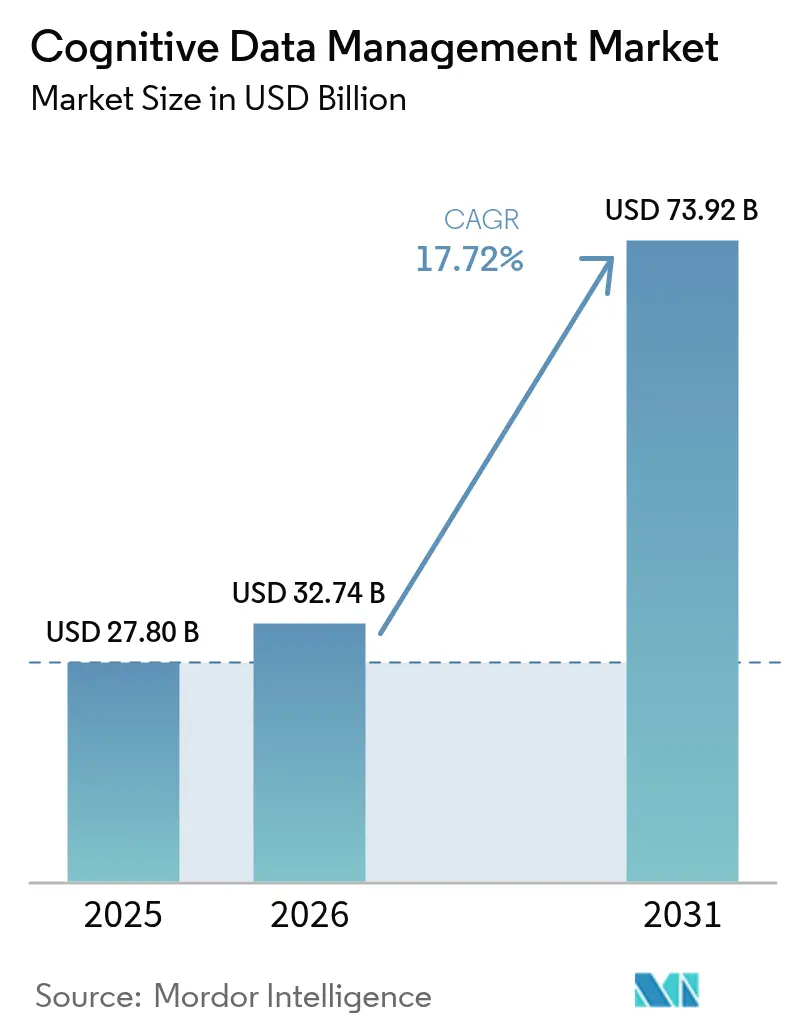
The Cognitive Data Management Market size was valued at USD 27.80 billion in 2025 and estimated to grow from USD 32.74 billion in 2026 to reach USD 73.92 billion by 2031, at a CAGR of 17.72% during the forecast period (2026-2031).
The rapid adoption of generative AI in enterprises, escalating regulatory scrutiny, and the surge in IoT-sourced data drive the expansion of the cognitive data management market. Foundational AI models now perform metadata enrichment in minutes rather than months, while privacy-preserving clean-room architectures support cross-enterprise analytics without exposing sensitive information. Cloud platforms equipped with GPU clusters enable real-time data orchestration, and industry-specific solutions shorten compliance cycles for healthcare, financial services, and manufacturing. Moderate vendor fragmentation encourages specialized entrants that focus on sector-tailored governance, automated lineage, and vector-ready cataloging capabilities.
Key Report Takeaways
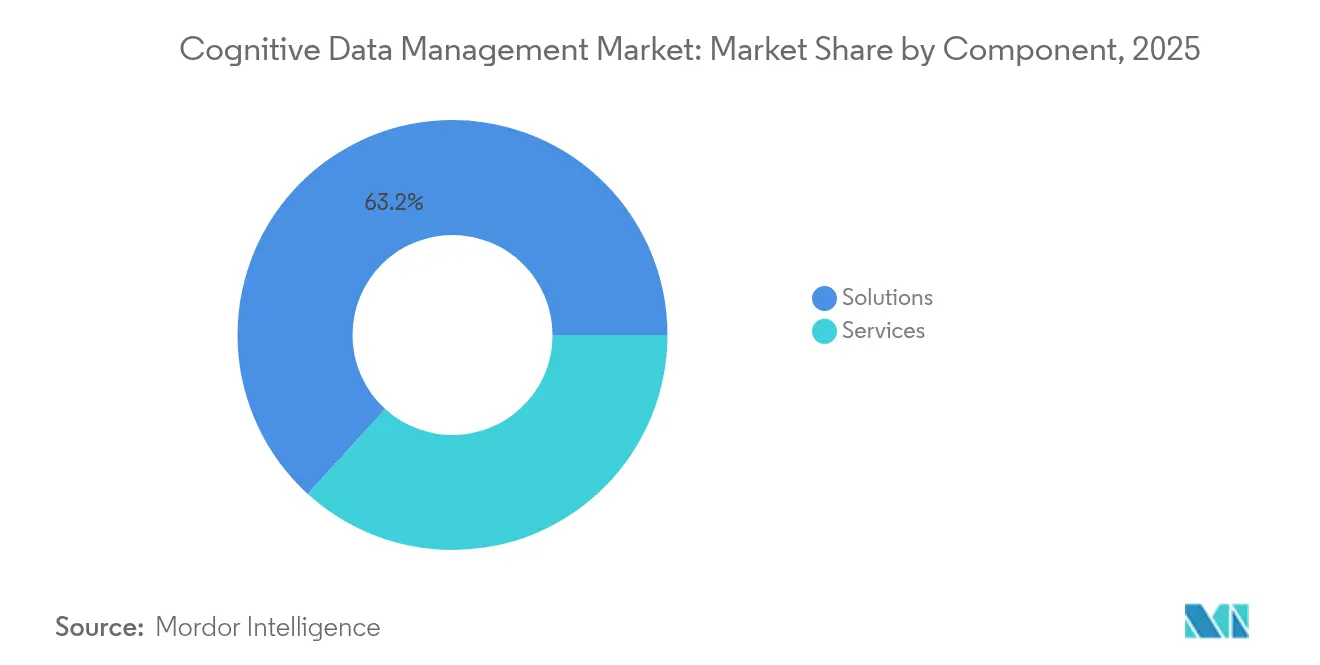
- By component, solutions led with 63.25% revenue share in 2025 in the cognitive data management market; services are projected to advance at a 24.1% CAGR to 2031.
- By deployment type, cloud captured 60.45% of the cognitive data management market share in 2025, while hybrid and multi-cloud deployments are forecast to expand at a 22.9% CAGR through 2031.
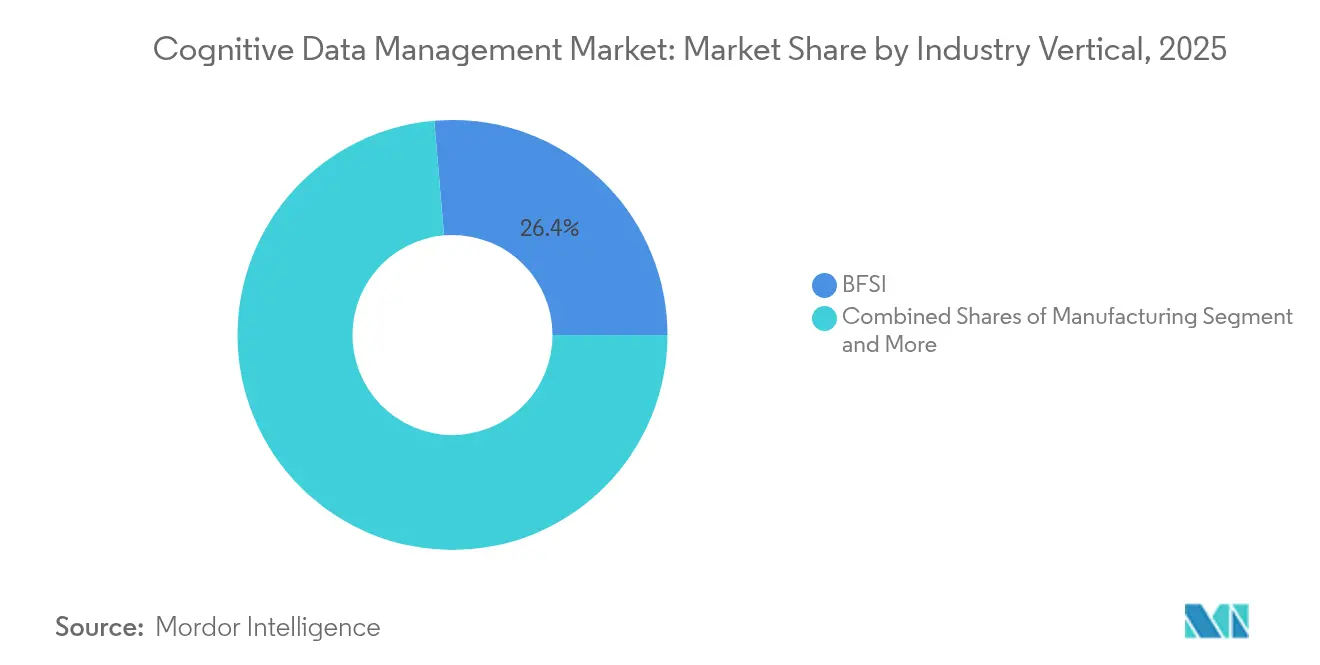
- By industry vertical, the BFSI sector held 26.35% of the cognitive data management market size in 2025; healthcare is the fastest-growing vertical with a 21.1% CAGR between 2026 and 2031.
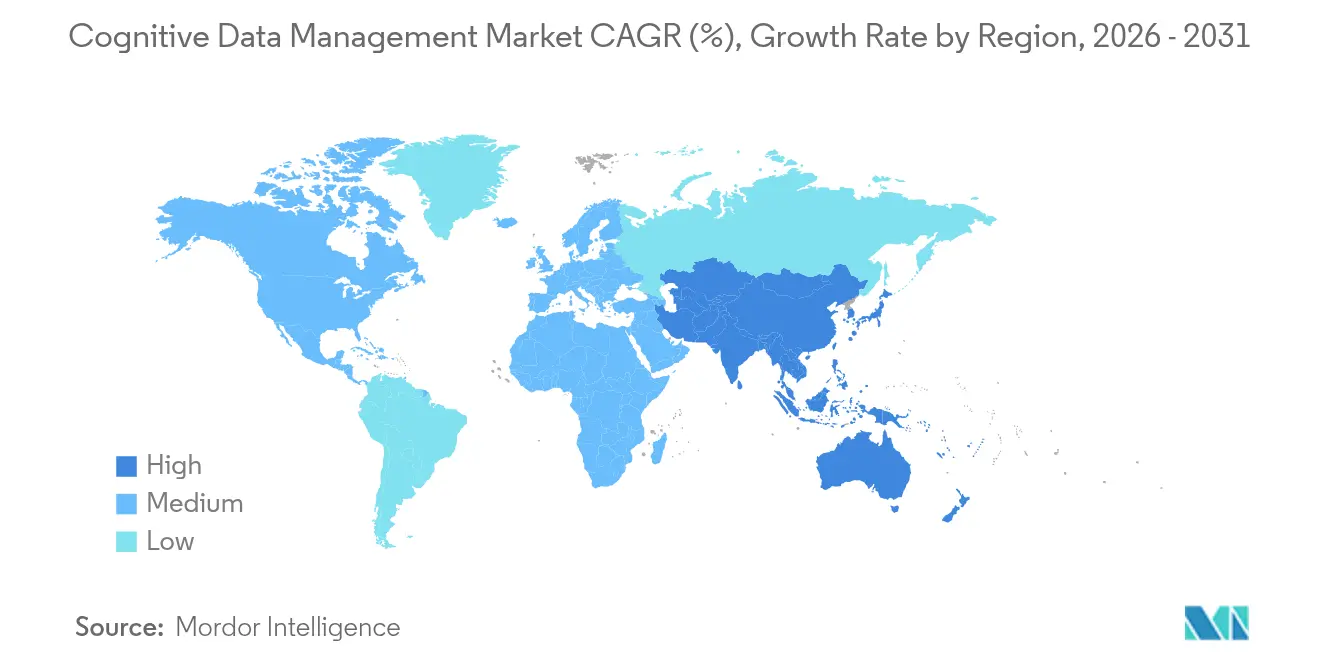
- By geography, North America commanded 41.20% revenue share in 2025 in the cognitive data management market; APAC is projected to record the quickest expansion at a 20.85% CAGR through 2031.
Note: Market size and forecast figures in this report are generated using Mordor Intelligence’s proprietary estimation framework, updated with the latest available data and insights as of 2026.
Market Trends and Insights
Drivers Impact Analysis of Cognitive Data Management Market*
| Driver | (~) % Impact on CAGR Forecast | Geographic Relevance | Impact Timeline |
|---|---|---|---|
| IoT-linked data deluge | +4.2% | Global, with APAC leading edge deployments | Medium term (2-4 years) |
| Hyper-scale analytics & Gen-AI adoption | +5.8% | North America and EU core, expanding to APAC | Short term (≤ 2 years) |
| Mandatory data-governance regulations | +3.1% | EU leading, North America following, APAC emerging | Long term (≥ 4 years) |
| Foundation-model-driven metadata enrichment | +2.9% | Global, concentrated in tech hubs | Medium term (2-4 years) |
| Rise of privacy-preserving data clean rooms | +1.8% | Global, with early adoption in BFSI and healthcare | Short term (≤ 2 years) |
| Cloud-native data-fabric services from hyperscalers | +2.3% | North America and EU leading, rapid APAC adoption | Short term (≤ 2 years) |
| Source: Mordor Intelligence | |||
IoT-Linked Data Deluge
Manufacturing plants, connected vehicles, and healthcare wearables now produce terabytes of telemetry every day. Cognitive data management platforms ingest, classify, and flag anomalies in real time, ensuring data is actionable at the edge while remaining governed centrally. Automotive fleets such as Tesla’s generate more than 1.6 petabytes of driving data each month, compelling the cognitive data management market to offer high-throughput pipelines that feed autonomous-driving models.[1] Local processing at the edge reduces latency, yet cloud orchestration preserves a unified governance layer for compliance and model training.
Hyper-Scale Analytics and Generative-AI Adoption
Large language model programs shorten the data-to-insight cycle by 40-60% when underpinned by intelligent cataloging and quality-assessment engines.[2] Cognitive platforms automate data discovery inside massive lakes, connect to vector stores for retrieval-augmented generation, and maintain complete lineage for model explainability. Automated pipeline optimization lowers computation spending, a key benefit as enterprises train ever-larger models.
Mandatory Data-Governance Regulations
The EU AI Act obliges detailed tracking of training data sources, logic, and outcomes, prompting enterprises to embed automated lineage and audit capabilities. Financial institutions must co-comply with GDPR and new AI rules, while healthcare organizations balance HIPAA with cross-border data-sharing needs. Cognitive data management systems embed policy engines that classify data, restrict residency, and generate real-time compliance dashboards.
Foundation-Model-Driven Metadata Enrichment
Platforms such as IBM watsonx cut metadata creation time by up to 80% through self-supervised models that learn enterprise taxonomies.[3] Automatic detection of personally identifiable and proprietary content strengthens governance, and domain-tuned models improve discovery in specialized fields like pharmaceuticals. Continuous user feedback loops refine enrichment accuracy, ensuring that catalog quality improves over time.
Restraints Impact Analysis of Cognitive Data Management Market*
| Restraint | (~) % Impact on CAGR Forecast | Geographic Relevance | Impact Timeline |
|---|---|---|---|
| Complex analytical workflows | -2.8% | Global, particularly affecting legacy enterprise environments | Medium term (2-4 years) |
| Persistent data-security gaps | -1.9% | Global, with heightened concerns in regulated industries | Short term (≤ 2 years) |
| Scarcity of data engineering talent | -2.1% | North America and EU core, emerging impact in APAC | Long term (≥ 4 years) |
| High carbon footprint of AI-grade infra | -1.4% | Global, concentrated in hyperscale deployments | Medium term (2-4 years) |
| Source: Mordor Intelligence | |||
Complex Analytical Workflows
Enterprises run multi-cloud estates that span AWS, Azure, and Google Cloud, with 76% operating mixed environments.[4]Cognitive data management platforms must orchestrate data movement, enforce consistent policies, and integrate mainframe feeds—all without performance loss. Custom connectors and real-time requirements add cost and lengthen implementation cycles, which dampens immediate growth.
Persistent Data-Security Gaps
Distributed architectures enlarge attack surfaces. AI models often require decrypted data during computation, exposing a potential breach window that traditional encryption approaches cannot close. Third-party models introduce supply-chain vulnerabilities, and the shortage of 200,000 cybersecurity professionals with AI expertise limits enterprises’ ability to harden deployments.
*Our forecasts treat driver/restraint impacts as directional, not additive. The impact forecasts reflect baseline growth, mix effects, and variable interactions.
Cognitive Data Management Market Segment Analysis
By Component:
Services Accelerate Through Implementation ComplexitySolutions accounted for 63.25% of 2025 revenue, reflecting the entrenched adoption of software suites that automate cataloging, lineage, and policy enforcement. Services expand at 24.1% CAGR to 2031 as organizations seek advisory, integration, and managed operations support for advanced AI governance. The cognitive data management market size for services is projected to move in tandem with large digital-transformation programs that lack in-house talent. Professional services dominate today, while managed services show the fastest pick-up in regulated verticals.
Implementation partners help clients embed foundation models, build anonymization frameworks, and connect legacy sources, reducing time-to-value. The talent gap in AI-ready engineering pushes enterprises toward outsourcing, making services pivotal for risk-controlled deployments. Vendors package ongoing model-curation services and compliance reporting into subscription models that promise predictable costs.

By Deployment Type:
Cloud Dominance Reflects AI Infrastructure RequirementsCloud deployments own 60.45% of 2025 spending and grow at 22.6% CAGR because cognitive workloads need elastic GPU farms and low-latency interconnects. The cognitive data management market size for cloud deployment benefits from capex avoidance and access to managed AI services. On-premises remain relevant in defense, healthcare, and banking, yet face slower upgrades and higher hardware outlays.
Hybrid configurations arrive as a pragmatic compromise. Sensitive assets stay inside private data centers, while burst computing and advanced foundation models run in public clouds. Leading providers invest in regional data centers to satisfy residency mandates. Edge extensions process IoT streams locally, then synchronize metadata and insights with central catalogs, ensuring unified governance.
By Industry Vertical:
Healthcare Transformation Drives Fastest GrowthThe BFSI sector held 26.35% of the cognitive data management market share in 2025, fueled by risk analytics and real-time fraud prevention. Healthcare records a 21.1% CAGR to 2031 as genomic sequencing, clinical imaging, and drug-discovery workflows demand automated stewardship. The cognitive data management industry applies de-identification, consent tracking, and lineage to comply with HIPAA while enabling AI research.
Manufacturing, telecom, and retail also adopt cognitive platforms for predictive maintenance, network optimization, and hyper-personalized commerce. Pharmaceutical firms leverage domain-tuned models to mine unstructured research papers, accelerating molecule discovery. Government agencies use automated classification to satisfy freedom-of-information laws and national security rules.
Geography Analysis
North America Cognitive Data Management Market
North America accounts for 41.20% of global revenue in 2025, upheld by mature cloud ecosystems, concentrated tech expertise, and aggressive enterprise AI rollouts in BFSI and healthcare. Ongoing investments, such as Snowflake’s USD 200 million AI hub in Silicon Valley, reinforce the region’s innovation leadership. Regulatory certainty and a large skilled workforce support stable growth, though talent shortages persist in specialty AI engineering roles.
APAC Cognitive Data Management Market
APAC exhibits the swiftest trajectory with a 20.85% CAGR through 2031. Japan’s Society 5.0 framework, Singapore’s Smart Nation program, and China’s sovereign-AI agenda accelerate spending on cognitive data management. Local manufacturing digitization and 5G expansion intensify data-volume challenges, and regional governance models spark demand for automated residency controls. India’s IT services sector expands managed offerings that deliver cognitive capabilities worldwide.
Europe Cognitive Data Management Market
Europe grows steadily as GDPR enforcement and the EU AI Act heighten compliance pressures. Enterprises prioritize privacy-preserving analytics using federated learning and differential privacy, which align well with cognitive platforms. Germany leads manufacturing adoption, the UK propels financial services use cases, and Nordic countries integrate sustainability metrics, tracking the carbon footprint of AI infrastructure alongside data governance.
MEA and South America Cognitive Data Management Market
Middle East and Africa and South America represent emerging opportunities. Governments launch digital-economy initiatives, and telcos modernize networks with AI-ready data fabrics. Infrastructure gaps and skills deficits temper near-term growth, yet localized regulations and cloud-region buildouts lay groundwork for future expansion.
Regulatory Landscape
Mandatory governance and AI transparency requirements are tightening data provenance, lineage, and documentation expectations for cognitive data management deployments. The European Union AI Act (Regulation (EU) 2024/1689) introduces obligations around technical documentation and training-data provenance for high-risk AI systems and general-purpose AI models, with full application on 2 August 2026. This is expected to reinforce demand for automated audit trails, policy controls, and evidence-ready catalogs.
Beyond the EU, governments are moving toward risk-based approaches for data classification, safeguarding, and smart-data interoperability, which affects how enterprises design data fabrics across cloud and hybrid environments. In June 2026, the US General Services Administration issued a Federal Register proposal for a GSAR clause (552.239-7001) to set safeguarding requirements for government data within large language model AI systems used in federal contracting. In July 2026, the Philippines issued Executive Order No. 119 to strengthen data security and establish a risk-based government data classification and residency framework. Complementary national initiatives, including Pakistan's National Data Governance Policy (June 2026) and the UK Smart Data Strategy, are also adding momentum toward standardized data-sharing and governance practices that broaden compliance coverage across the full data lifecycle.
Value Chain Analysis
The value chain covers data producers (IoT/OT telemetry, enterprise applications, customer and partner data), connectivity and storage infrastructure (edge clusters, data centers, and cloud GPU-backed platforms), and the core cognitive data management layers for ingestion, integration, cataloging, lineage, quality, and policy enforcement. Platform vendors and hyperscalers supply the foundational services, while systems integrators and consulting partners support discovery, migration, model enablement, and ongoing governance operations, which has become more critical as enterprises run mixed environments across AWS, Azure, and Google Cloud and need consistent controls.
Downstream, industry solutions and application teams consume governed data products for analytics and agentic AI use cases. Many add semantic layers such as ontologies and knowledge graphs to keep data machine-understandable and traceable. Bottlenecks persist around fragmented visibility across multi-domain estates, long lead times and volatility in infrastructure and components, and the limits of static forecasting and rule-based controls in fast-changing operating conditions. Association-led efforts like TM Forum Catalyst projects (for example, HINT for supply chain) and enterprise orchestration platforms referenced in TMT deployments (for example, SAP AI Foundation and o9 Digital Brain) indicate a shift toward real-time, cross-party data sharing with stronger governance and provenance requirements.
Competitive Landscape
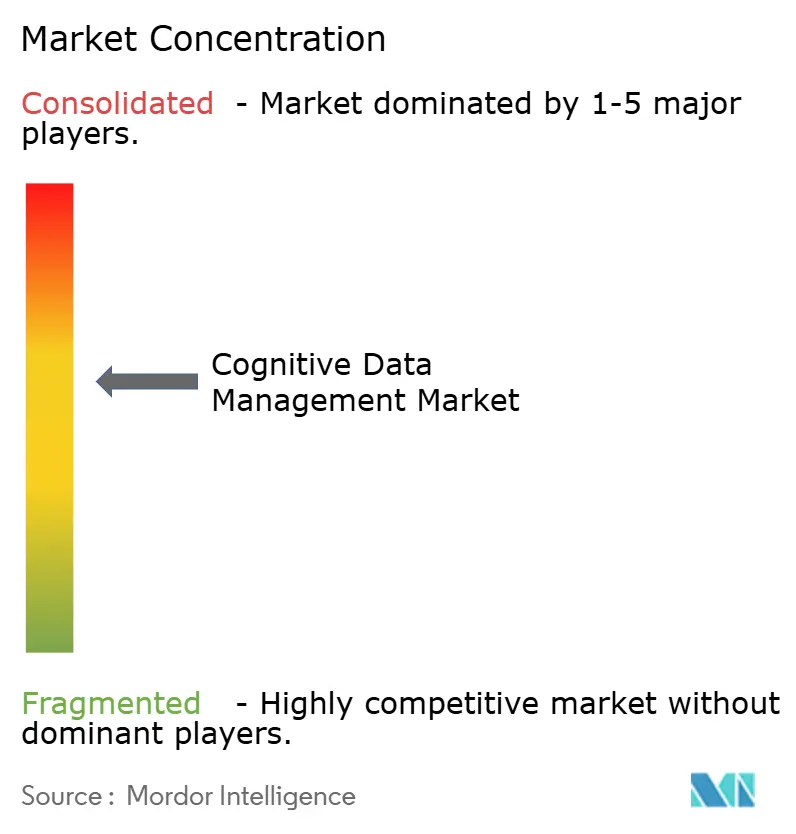
The cognitive data management market features moderate fragmentation; no vendor exceeds 15% share. Established providers, IBM, Microsoft, and Oracle, leverage installed bases and broad product suites to add cognitive features. Cloud-native players such as Snowflake and Databricks design architectures optimized for modern workloads, while AI-first startups focus on vector search, automated lineage, and privacy-by-design tooling.
Strategic consolidation intensifies. Salesforce announced a USD 27 billion Informatica takeover to fuse CRM data with AI-powered governance, while IBM bought DataStax for NoSQL and vector search capabilities. Partnerships also proliferate; Snowflake integrates Azure OpenAI Service, bringing state-of-the-art models into its secure environment. Patent filings rose 45% in 2024, centered on automated metadata generation and federated learning. Vendors differentiate on model accuracy, industry compliance packs, and ease of integration rather than price alone.
Managed services emerge as a growth lever. Clients lacking AI talent opt for turnkey operations that bundle software, infrastructure, and governance. Distributors and SI-partners build vertical-focused offerings, healthcare data fabrics, financial-risk hubs, and smart-factory control planes, built atop vendor platforms. Open-source projects gain mindshare for transparent governance frameworks but depend on integrators for enterprise-grade support.
Cognitive Data Management Industry Leaders
-
IBM Corporation
-
SAP SE
-
Salesforce.com, Inc.
-
SAS Institute Inc.
-
Informatica Inc.
- *Disclaimer: Major Players sorted in no particular order
Cognitive Data Management Market Companies Covered in this Report
- IBM
- Microsoft
- SAP
- Oracle
- Informatica
- Salesforce
- SAS Institute
- AWS
- Collibra
- Talend (Qlik)
- Snowflake
- Databricks
- Denodo
- Alteryx
- VAST Data
- Ataccama
- Immuta
- Reltio
- SnapLogic
Market Opportunities and Future Outlook
A key opportunity is the build-out of enterprise context and knowledge engineering layers that make cognitive data management outputs usable by AI agents at scale. As organizations move beyond basic cataloging toward semantic accuracy and provenance, demand rises for platforms that operationalize ontologies, knowledge graphs, entity-level access control, stable identifiers, and quality gates across both structured and unstructured data. This shift is reflected in 2026 enterprise AI readiness and knowledge-engineering guidance from firms such as KPMG, along with technical reference blueprints that prioritize context strategy as a prerequisite for AI-ready data.
Industrial and operational data remains a major whitespace for cognitive data management, especially where edge and cloud must operate together under strict governance. In March 2026, Cognite was positioned as a leader in an IDC MarketScape for industrial DataOps platforms, reflecting enterprise spend on governed industrial data foundations. In July 2026, IMA Group presented a cognitive manufacturing operating model that integrates its cloud-based AI platform with edge AI on production machines, highlighting the need for latency-sensitive, factory-floor decisioning. These deployments create room for offerings that combine OT ingestion, time-series and unstructured data governance, privacy-preserving collaboration, and audit-ready lineage to meet rising compliance demands while enabling real-time analytics and agent workflows.
Recent Industry Developments in Cognitive Data Management Market
- July 2026: IBM and Salesforce announced a collaboration through IBM Consulting to provide managed services and AI experience accelerators for Salesforce AI technologies, including Einstein and Slack. The collaboration strengthens delivery capacity for governed data and AI programs by pairing platform integrations with services execution, which is a key buying criterion as enterprises face talent shortages and compliance pressure.
- June 2026: Schneider Electric entered a definitive agreement to acquire Cognite Holding B.V. in an all-cash transaction. The deal strengthens Schneider Electric's industrial data governance and analytics capabilities across its digital industrial portfolio.
- June 2025: Salesforce agreed to acquire Informatica for USD 27 billion, aiming to combine Salesforce data assets with Informatica integration and governance capabilities. The transaction concentrates data integration, cataloging, and policy enforcement under a larger enterprise application umbrella, influencing platform selection for customers standardizing AI-ready data foundations.
Cognitive Data Management Market Report Scope and Research Methodology
Market Definition and Coverage
For this study, the market includes software and related services that use AI and automation to manage enterprise data, such as improving data quality, governance, and compliance across cloud and on-premises environments.
Scope exclusions: We exclude general IT outsourcing that is not tied to cognitive data management use cases and generic analytics tools that do not perform data management functions.
Segments Covered in This Report
- By Component
- Solutions
- Services
- By Deployment Type
- On-Premises
- Cloud
- By Industry Vertical
- BFSI
- Healthcare and Pharmaceuticals
- IT and Telecommunication
- Manufacturing
- Other Verticals
- By Geography
- North America
- South America
- Europe
- Asia Pacific
- Middle East and Africa
Data Sources, Market Sizing, and Validation
Desk Research
Desk research was used to lock the market boundary, build the first demand map, and set realistic input ranges before speaking with the industry. We used public and official sources such as US Census Bureau and Bureau of Economic Analysis data for macro IT spending signals, OECD and World Bank indicators for cross-country digitization context, NIST publications for data governance and security guidance, and SEC filings for vendor disclosures and revenue commentary. We also referred to materials such as annual reports, investor decks, product documentation, and reputable press coverage to understand go-to-market patterns and pricing narratives.
In addition, we used paid subscriptions only where they help with repeatable checks, mainly for company financials and intelligence, news and financials screening, and patent databases to track activity around automation, metadata, and data quality workflows. The sources listed here are illustrative, and many other public documents and datasets were also reviewed to collect data, validate assumptions, and clarify gaps.
Primary Interviews and Surveys
Primary work focused on validating what buyers actually purchase under cognitive data management and how budgets move between solutions and services in real deployments. We spoke with a mix of software providers, system integrators, data leaders, and end users across major regions so assumptions on adoption timing, cloud migration pace, and compliance driven refresh cycles could be stress tested and corrected where needed.
Distribution of primary research fieldwork respondents
| Company type | Respondent position | Region |
|---|---|---|
| Top tier: 37% | CXOs: 14% | APAC: 50% |
| Mid tier: 45% | Functional/Unit leaders: 40% | EMEA: 30% |
| Smaller Players: 18% | Managers: 46% | Americas: 20% |
Market-Sizing & Forecasting
The sizing model starts with a top-down build where enterprise data management spend is reconstructed into a cognitive data management share using adoption and feature-based inclusion rules, and then it is split across regions and deployment types. Once that first total is formed, it is corroborated with selective bottom-up checks using sampled vendor revenue disclosures, channel conversations on typical deal sizes, and simple volume by ASP logic for subscription deployments, which are then adjusted when mismatches show up.
Key inputs used in the model include the pace of cloud migration for data platforms, governance and compliance intensity (including privacy and sector rules), the share of unstructured data being brought under management, services-to-software mix during implementation waves, and typical contract duration and renewal timing. For forecasting, scenario analysis is used so growth can be mapped under a base case and then flexed using the interview-led outlook on AI feature adoption, buyer budget tightness, and implementation capacity. Where bottom-up data is thin for smaller geographies or niche verticals, gaps are handled through proxy ratios anchored to IT spend and validated using regional expert feedback before totals are finalized.
Data Validation & Update Cycle
Outputs are validated through a set of cross-checks so the final number stays consistent with observable signals and real buying behavior. We run variance checks across regions, test implied pricing against common contract structures, and review whether solution and services shares align with what implementers see in active programs. If an anomaly is found, the assumption is revisited, and in many cases respondents are re-contacted to confirm whether the change is structural or a short-term spike.
Before sign-off, the model and assumptions pass through multi-step analyst reviews, followed by a final consistency pass against independent indicators such as enterprise software spending direction and cloud platform expansion. Reports are refreshed annually, with interim updates when material events affect adoption, pricing, or compliance requirements, and a last-mile review is done right before delivery so clients receive an up-to-date view.
Mordor Intelligence's Cognitive Data Management Market Size Versus Other Published Estimates
Published market sizes for cognitive data management can look far apart, even when they seem to describe the same topic. The gaps usually come from how the market is bounded, what is counted as cognitive versus general data management, and how services and implementation revenue are treated.
By tracking deployment mix shifts, checking services attachment rates, and refreshing the inclusion rules each update cycle, Mordor Intelligence keeps the 2026 total focused on cognitive data management solutions and related services rather than broader data platform or analytics spend. A second driver is how pricing is escalated over time, since some estimates apply aggressive subscription ASP uplift across all regions while others hold pricing flat and only grow volumes. Currency conversion timing and the use of different base years can also widen the spread, especially when vendors report in multiple currencies and contracts renew at different times of the year.
Benchmark comparison
| Source | Market Size | Gaps in Research Methodology |
|---|---|---|
| Mordor Intelligence | USD 32.74 B (2026) | |
| Global Consultancy A | USD 30.10 B (2026) | Uses a narrower scope that counts mainly software licenses and subscriptions, and it often excludes implementation and managed services tied to cognitive data management rollouts. |
| Industry Association B | USD 35.80 B (2026) | Blends adjacent spend such as broader data platform modernization and some analytics enablement, which inflates totals when cognitive capabilities are not separated using a clear feature threshold. |
The spread in the table is largely explained by what gets included around services and adjacent platform spending, plus differences in how pricing is carried forward. With transparent inclusion rules and simple cross-checks against deployment and contract realities, the final estimate stays traceable to a repeatable demand pool rather than shifting buzzword definitions.
Key Questions Answered in the Report
What is driving the rapid growth of the cognitive data management market?
Enterprises face escalating regulatory demands and massive data growth from IoT and generative-AI projects, pushing them to adopt AI-enabled governance platforms that automate classification, lineage, and compliance.
Which component segment is expanding the fastest?
Services are rising at a 24.1% CAGR between 2026 and 2031 as organizations seek expert guidance and managed operations for complex AI data-governance deployments.
Why is healthcare the fastest-growing vertical?
Healthcare data volumes from genomics, imaging, and patient monitoring require de-identification and strict lineage tracking, capabilities that cognitive platforms deliver while supporting AI-driven research, resulting in a 21.1% CAGR.
How significant is cloud deployment in this market?
Cloud captures 60.45% revenue share thanks to elastic GPU resources and managed AI services, and it is forecast to grow at a 22.6% CAGR through 2031.
What regions present the strongest expansion prospects?
APAC leads with a 20.85% CAGR as Japan, Singapore, and China invest in sovereign-AI strategies and digital-industry programs that rely on advanced data-management capabilities.
How fragmented is vendor competition?
No supplier controls more than 15% share; the market holds a concentration score of 5, meaning established firms coexist with agile AI-first entrants that target niche compliance and automation needs.