
Coated Fabric Market Size and Share
Market Overview
| Study Period | 2020 - 2031 |
|---|---|
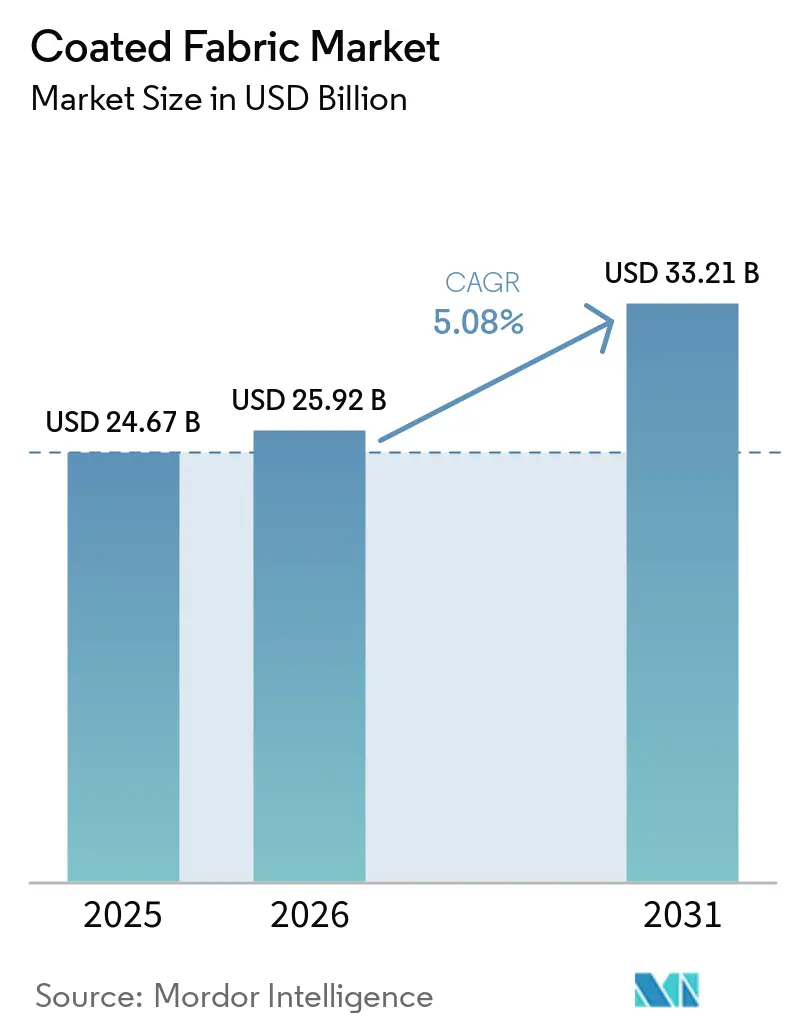
| Market Size (2026) | USD 25.92 Billion |
| Market Size (2031) | USD 33.21 Billion |
| Growth Rate (2026 - 2031) | 5.08 % |
| Fastest Growing Market | Asia-Pacific |
| Largest Market | Asia-Pacific |
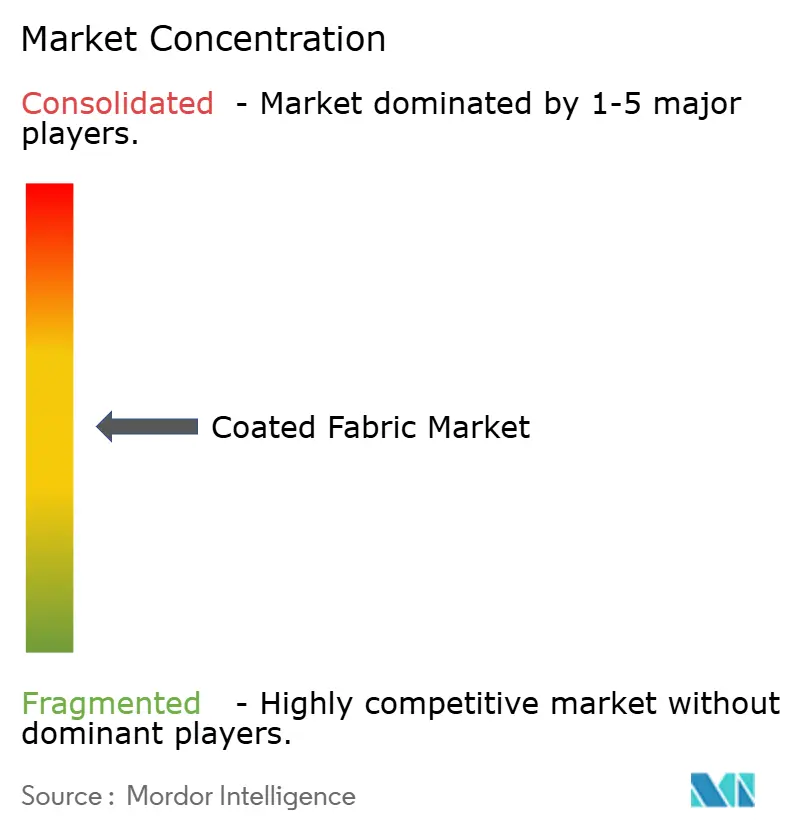
| Market Concentration | Medium |
Major Players *Disclaimer: Major Players sorted in no particular order Image © Mordor Intelligence. Reuse requires attribution under CC BY 4.0. | |
Coated Fabric Market Analysis by Mordor Intelligence
The Coated Fabric market size is expected to grow from USD 24.67 billion in 2025 to USD 25.92 billion in 2026 and is forecast to reach USD 33.21 billion by 2031 at 5.08% CAGR over 2026-2031. Growth is fueled by regulatory pressure for safer, lighter transportation materials, rising industrial-safety mandates, and the post-pandemic preference for hygienic, antimicrobial surfaces. Electric-vehicle platforms require lightweight, thermally efficient seat covers and air-bag fabrics, while hospitals and public spaces demand antiviral coatings that withstand repeated cleaning cycles. Supply shortages in specialty polymers and stricter per- and polyfluoroalkyl substances (PFAS) limits keep innovation in polyurethane (PU) and silicone systems brisk as producers seek compliant, high-performance alternatives. Meanwhile, Asia-Pacific’s manufacturing scale and smart-textile know-how reinforce its position as the leading production and consumption hub for premium coated substrates.
Key Report Takeaways
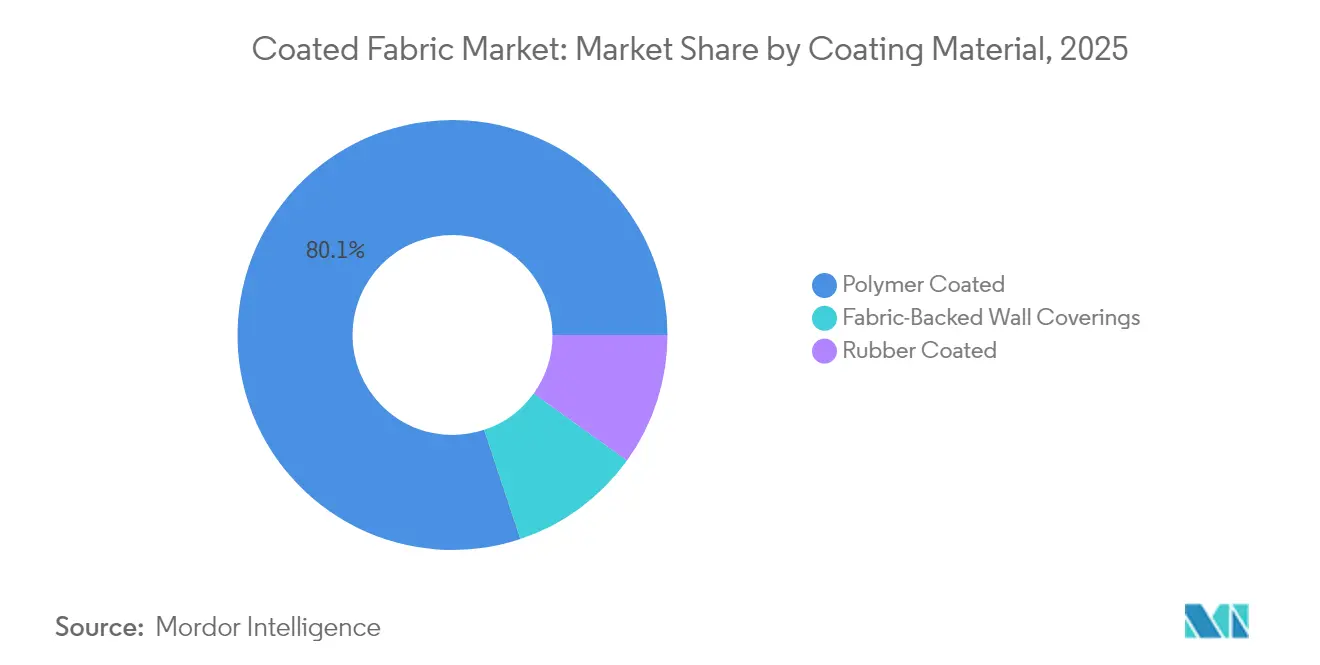
- By coating material, polymer-coated fabrics led with 80.12% of coated fabrics market share in 2025, and the polyurethane sub-segment is poised for a 6.75% CAGR to 2031.
- By fabric substrate, polyester accounted for 45.05% of the coated fabrics market share in 2025 and is set to grow fastest at a 7.05% CAGR through 2031.
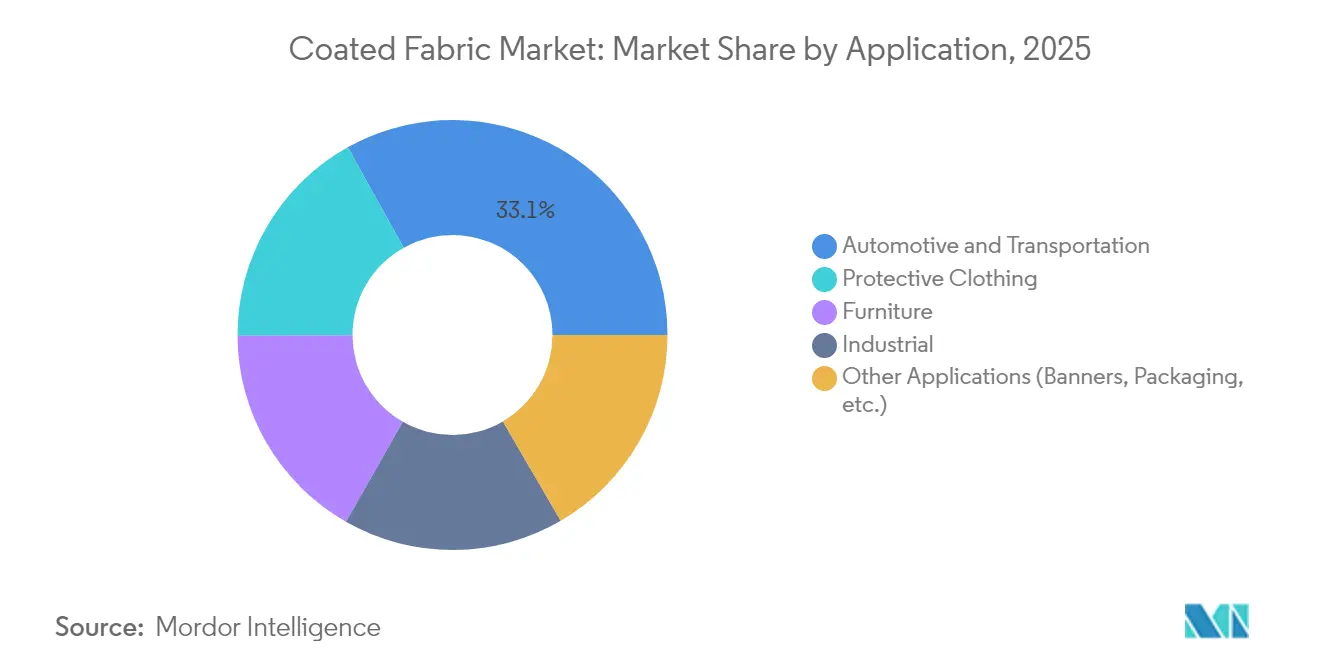
- By application, automotive and transportation commanded 33.10% of the coated fabrics market size in 2025, while protective clothing is projected to expand at a 7.55% CAGR between 2026-2031.
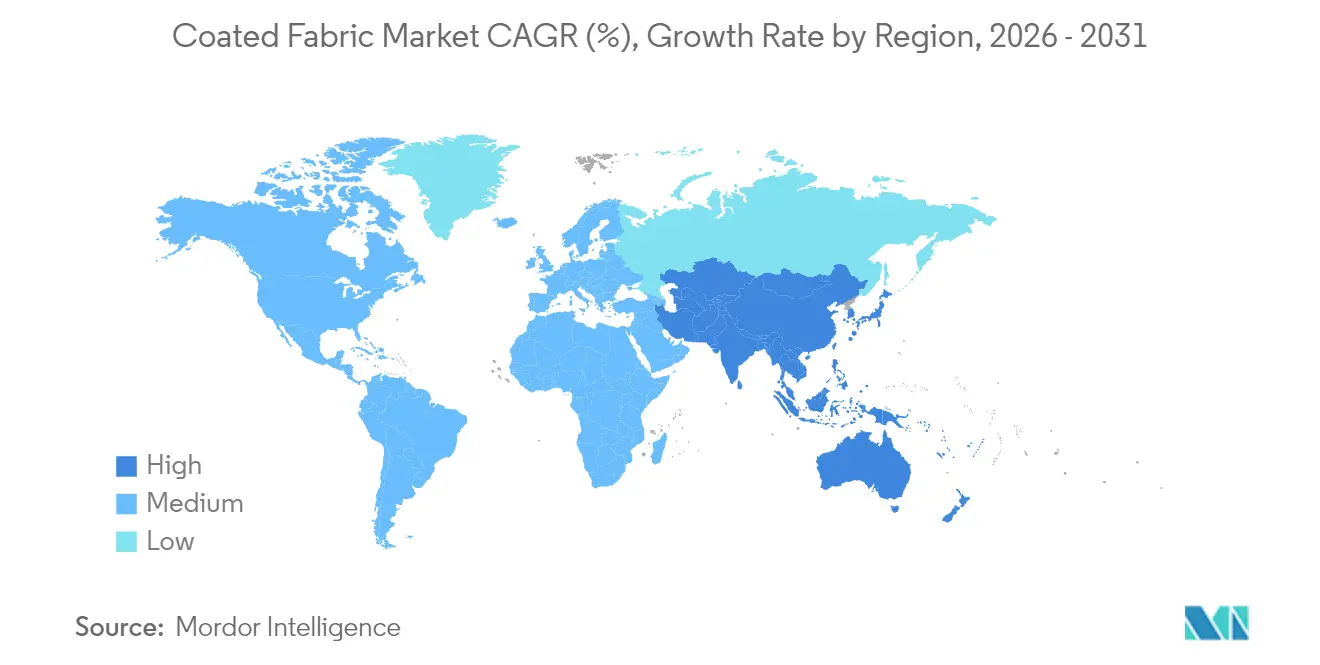
- By geography, Asia-Pacific held 46.70% revenue in 2025; it is also the fastest-growing region with a 6.20% CAGR to 2031.
Note: Market size and forecast figures in this report are generated using Mordor Intelligence’s proprietary estimation framework, updated with the latest available data and insights as of 2026.
Market Trends and Insights
Drivers Impact Analysis of Coated Fabric Market*
| Driver | (~) % Impact on CAGR Forecast | Geographic Relevance | Impact Timeline |
|---|---|---|---|
| Surge in automotive airbag and seat-cover volumes | +1.20% | Global, led by Asia-Pacific and North America | Medium term (2-4 years) |
| Expansion of industrial protective-clothing mandates | +0.80% | Europe and North America, spreading to Asia-Pacific | Short term (≤ 2 years) |
| Increasing demand for Antiviral and antimicrobial coatings for public-health resilience | +0.70% | Global, healthcare focus | Short term (≤ 2 years) |
| Sensor-integrated e-textiles for smart interiors and wearables | +0.50% | North America & Europe early, Asia-Pacific production | Long term (≥ 4 years) |
| Growing demand for coated fabrics from healthcare industry | +0.60% | Global, with developed markets leading adoption | Medium term (2-4 years) |
| Source: Mordor Intelligence | |||
Surge in Automotive Air-Bag and Seat-Cover Volumes
Automotive safety laws and electric-vehicle design targets are boosting demand for heat-stable, lightweight coated fabrics. Autoliv introduced an airbag fabric made from 100% recycled polyester in 2024, showing that stringent crash-safety requirements can coexist with circular-economy goals. Lear Corporation’s ComfortMax seat system, scheduled for 2025 launches, blends PU coatings with integrated heating to cut cabin-warm-up times and battery drain in electric cars. Covestro’s thermoplastic PU films enable flexible sunroof shades that house embedded electronics, illustrating the materials shift toward smart interiors[1]Covestro, “Flexible TPU Films for Smart Sunshades,” covestro.com . These breakthroughs push the coated fabrics market toward high-value, multifunctional constructions that tolerate abrasion, extreme temperatures, and complex forming.
Expansion of Industrial Protective-Clothing Mandates
Updated EU standards such as EN ISO 11612 require certified flame and heat protection, strengthening demand for advanced coatings over untreated fabrics. Sioen Industries extended its SYNQ multi-hazard workwear into the UK and Ireland in 2025 to address stricter employer liability rules. Silver-ion finishes can now achieve greater than 99% bacterial reduction after 50 laundering cycles, combining hygiene and safety in a single garment[2]MDPI, “Durability of Silver-Based Antimicrobial Finishes on Textiles,” mdpi.com . Manufacturers that secure multi-standard certifications convert regulation into durable revenue streams, particularly in chemicals, oil & gas, and utilities, where procurement cycles favor pre-approved vendors.
Increasing Demand for Antiviral and Antimicrobial Coatings for Public-Health Resilience
Hygiene concerns now extend coated textiles from hospitals to transit seating and hotel upholstery. Microban’s PFAS-free H₂O Shield range couples water repellency with broad-spectrum antimicrobial efficacy, answering consumer and regulatory calls for safer chemistries. Antimicrobial-coated fabrics also penetrate advanced wound-care dressings, where controlled release of silver ions delivers infection defence without compromising breathability. This public-health focus sustains premium pricing for coated fabrics that combine barrier performance, durability, and environmental compliance.
Sensor-Integrated E-Textiles for Smart Interiors and Wearables
Coated substrates are evolving into electronic assemblies. Saarland University engineered elastomer films with on-board haptic feedback that flex repeatedly without delamination—a leap for VR gloves and upholstery that responds to touch. Conductive yarns spun from carbon-nanotube bundles can be over-coated to stabilize the nano-network while retaining drape. Auto makers test seat-occupancy sensors built into coated fabric layers, while hospitals evaluate patient-monitoring bedding systems, signaling a new demand cycle that fuses textile, electronics, and polymer-coating supply chains.
Restraints Impact Analysis of Coated Fabric Market*
| Restraint | (~) % Impact on CAGR Forecast | Geographic Relevance | Impact Timeline |
|---|---|---|---|
| PVC raw-material volatility & disposal scrutiny | -0.90% | Global, Europe regulatory lead | Short term (≤ 2 years) |
| Specialty-polymer supply-chain disruptions | -0.60% | Global, Asia-Pacific sourcing | Medium term (2-4 years) |
| Increasing demand for Bio-based, un-coated technical textiles | -0.40% | Europe and North America leading adoption | Long term (≥ 4 years) |
| Source: Mordor Intelligence | |||
PVC Raw-Material Volatility & Disposal Scrutiny
The EU’s proposal to restrict over 10,000 PFAS chemicals would directly affect vinyl-based coatings, as many formulations rely on fluorinated processing aids. Hanwha’s bio-attributed PVC, incorporating plant oils and waste cooking oil, cuts cradle-to-gate CO₂ by 58% yet carries higher feedstock costs that squeeze margins[3]Hanwha, “Bio-Attributed PVC Cuts 58% Carbon Emissions,” hanwha.com . Disposal fees and take-back schemes under the EU’s Extended Producer Responsibility (EPR) framework raise life-cycle costs for legacy PVC items, prompting OEMs to switch to PU and silicone systems despite upfront price premiums.
Specialty-Polymer Supply-Chain Disruptions
Tariffs on titanium dioxide, resins, and solvents from key trading partners inflate costs for technical-textile coaters in North America. Lead times for new polymer plants average 24 months, keeping short-term supply tight despite domestic expansion announcements. Coaters hedge risk through multi-regional sourcing and backward integration, but capital intensity and regulatory approvals prolong relief, particularly for novel recyclable or bio-based chemistries.
*Our forecasts treat driver/restraint impacts as directional, not additive. The impact forecasts reflect baseline growth, mix effects, and variable interactions.
Coated Fabric Market Segment Analysis
By Coating Material:
Polymer Dominance Drives InnovationPolymer coatings commanded 80.12% of the coated fabrics market share in 2025 as their versatility spans automotive, industrial, and consumer applications. Within this group, polyurethane grades are on track for a 6.75% CAGR to 2031, a pace that underscores OEM preference for flexible, solvent-free alternatives to vinyl. PVC retains scale benefits in tarpaulins and advertising banners, yet EPR fees and landfill bans shrink its addressable volume in Europe. Silicone systems win in high-temperature gaskets, while acrylic dispersion coatings anchor breathable outdoor gear. BASF’s 2024 launch of Haptex 4.0—a recyclable synthetic leather that co-recycles with PET—points to future formulations that streamline mechanical-recycling flows.
Continued R&D in bio-attributed polymers hints at fresh competition for incumbent chemistries. Rubber-coated fabrics meet niche demands for extreme abrasion yet face substitution by PU films that offer similar durability at lighter weights. Specialty nano-coatings that add conductivity or self-healing properties command premium margins, expanding the coated fabrics market into electronics and aerospace niches. Suppliers that master multi-layer co-casting and in-line curing stand to secure the highest returns as end-users seek turnkey solutions.


By Fabric Substrate:
Polyester’s Dual LeadershipPolyester subtended 45.05% of the coated fabrics market share in 2025, and its 7.05% CAGR through 2031 illustrates unmatched versatility. The fibre’s strength-to-cost profile, dye receptivity, and compatibility with most polymer chemistries make it the default choice for airbags, luggage, and architectural membranes. Nylon remains indispensable for military tents and high-pressure hoses, but its higher price curtails share gains. Cotton enjoys a niche in breathable, fire-retardant workwear when paired with intumescent coatings, though synthetics are displacing blends in harsh environments.
Circularity pushes recycled polyester into mainstream procurement lists. Autoliv’s adoption of 100% post-consumer polyester yarns in airbags proves that safety-critical gear can incorporate reclaimed feedstock while meeting crash-test thresholds. Meanwhile, bio-based polyester pilot lines advance, but output stays limited relative to virgin PTA/MEG capacity. Rayon and wool underpin luxury fashion accessories coated for stain resistance, serving brands that prize tactile aesthetics over cost efficiency.
By Application:
Transportation Leads, Protection AcceleratesTransportation generated 33.10% of the coated fabrics market size in 2025, buoyed by requirements for seat upholstery, airbags, and convertible tops. The pivot to electric drivetrains multiplies demand for lightweight thermal barriers that protect battery enclosures. At the same time, protective clothing is expected to compound at 7.55% annually through 2031 as governments tighten industrial-safety codes. Sioen Industries’ push into multi-hazard gear illustrates how certification drives premium pricing.
Furniture upholstery remains resilient, boosted by consumer appetite for stain-repellent, PFAS-free coatings in residential and office décor. Technical-industrial uses—geomembranes, conveyor belts, and flexible storage tanks—absorb elastomer coated fabric that offers chemical resistance and dimensional stability. Smaller slices such as banner media ride advertising cycles yet benefit from digital-printing growth on PU-coated polyester.
Geography Analysis
APAC Coated Fabric Market
Asia-Pacific retained 46.70% of global revenue in 2025 and is projected to expand at a 6.20% CAGR to 2031. China anchors regional heft with its end-to-end textile base and surging EV output, while India’s expansion in technical-textile parks attracts fresh capital from multinationals like Saint-Gobain, which targets a three-fold local revenue lift by 2035. Japan and South Korea supply cutting-edge coating lines that enable haptic, sensor-rich fabrics, closing the loop between R&D and scaled manufacturing.
North America Coated Fabric Market
North America is a mature buyer emphasizing high-value niches. The United States dominates aerospace, defense, and medical bedding lines that demand strict traceability. Canada leads U.S. PVC-coated-fabric imports, benefiting from duty-free access and proximity, while Mexico widens capacity in automotive seating against a backdrop of near-shoring. Regional policy favors PFAS-free chemistries, spurring investment in water-borne PU dispersions.
Europe Coated Fabric Market
Europe faces the world’s tightest textile regulations but leverages them to spearhead sustainable-coating technologies. The Extended Producer Responsibility framework launching in January 2025 obliges separate textile-collection systems, raising compliance hurdles for non-recyclable laminates. Germany and Italy concentrate on machinery exports that enable solvent-free, multi-pass lines; France and the Netherlands pilot chemical-recycling loops for coated off-cuts. The bloc’s looming PFAS curbs amplify demand for silicone and fluorine-free water barriers, giving EU producers a home-court edge in next-generation finishes.

Value Chain Analysis
The coated fabrics value chain begins with petrochemical and specialty-chemical inputs (PVC, PU, acrylics, silicones, plasticizers, stabilizers, pigments, and solvents or waterborne carriers) and base textiles (polyester, nylon, cotton blends, and specialty reinforcements). Upstream resin and additive pricing acts as a key cost lever because formulations and major inputs make up a large share of conversion cost, commonly cited at about 55-70% for resin and plasticizers. At the same time, performance requirements increasingly push PFAS-free water repellency, low-VOC processing, and recyclability-compatible constructions.
Midstream production covers fabric preparation, compound or plastisol preparation, coating (knife, calendering, rotary screen, or extrusion), curing or fusing, and finishing (topcoats, lacquers, embossing, and lamination). Qualification and compliance testing can slow adoption for protective and medical end uses, where certification and lab turnaround can run roughly 4-12 weeks and shape lead times and inventory strategies. Downstream, coated fabric rolls and converted parts flow through converters and OEM supply chains serving automotive interiors and airbags, protective apparel brands, furniture, and industrial users. Regionalization and nearshoring targets reduce typical lead times from about 12-16 weeks toward 4-6 weeks for programs where brands and OEMs prioritize responsiveness.
Competitive Landscape
The coated fabrics market is moderately fragmented: the top five suppliers controlled roughly 39% of 2024 revenue, reflecting vertical integration from polymer synthesis to finished rolls. Continental AG aligns its ContiTech division with vehicle electrification, offering low-emission silicone fabrics for battery enclosures. Freudenberg bolstered its reach by buying key Heytex assets for EUR 100 million in September 2024, adding three plants and deepening its presence in architectural membranes. Saint-Gobain’s Sekurit glass unit collaborates with its Performance Plastics arm to supply sunroof shade laminates compatible with panoramic roofs.
Specialty chemical players such as Covestro and BASF intensify competition by marketing PU systems tailored to circular-economy grades. Hanwha’s bio-attributed PVC marks an early mover advantage in low-carbon vinyl, though cost parity with conventional PVC remains elusive. Start-ups integrate printed circuits directly onto fabrics, offering OEMs turnkey sensor layers; incumbents respond via venture-capital arms to spot disruptive chemistries early. Success hinges on securing raw-material flexibility, certification portfolios, and R&D pipelines that keep pace with evolving eco-label thresholds.
Coated Fabric Industry Leaders
Continental AG
Graniteville
OMNOVA North America Inc.
Saint-Gobain
Trelleborg AB
- *Disclaimer: Major Players sorted in no particular order
Coated Fabric Market Companies Covered in this Report
- Continental AG
- Freudenberg Performance Materials Service GmbH
- Graniteville
- Haartz Corporation
- Herculite
- Heytex Gruppe
- OMNOVA North America Inc.
- Saint-Gobain
- Seaman Corporation
- Sioen Industries NV
- SRF Limited
- Trelleborg AB

Market Opportunities and Future Outlook
A clear whitespace is forming around fluorine-free performance and durable barrier coatings that hold up under repeated cleaning cycles, which supports substitution away from legacy chemistries in transportation seating, healthcare bedding, and protective clothing. Technology introductions in 2026 reflect this shift: Americhem launched the nDryve PFAS-free in-melt surface-modifying platform for functional fibers in April 2026, and peer-reviewed work in Progress in Organic Coatings (2026) highlighted fluorine-free waterborne polyurethane systems with siloxane synergy for water repellency. Together, these developments broaden the supplier toolkit beyond surface-applied finishes and create room for coaters and compounders to validate repellency, abrasion, and laundering durability without PFAS.
Standards-driven upgrading also creates opportunities in architectural and public-space textiles, where fire performance and compliance documentation can determine material selection and tender eligibility. Elkem Silicones introduced BLUESIL TCS 7544 in April 2026 for EN 13501-1 Euroclass A1/A2 applications, reinforcing demand for coated fabrics that address flame and smoke requirements while maintaining processability for large-format membranes. In parallel, functionalization of coated substrates for electronics remains an emerging track, with 2026 academic work showing low-cost dip-coating approaches for wearable electronics that can be paired with protective topcoats; suppliers that can industrialize conductive layers without delamination and integrate them into upholstery, bedding, and workwear assemblies can differentiate offerings across smart interiors and medical monitoring textiles.
Recent Industry Developments in Coated Fabric Market
- May 2026: Trelleborg Engineered Coated Fabrics opened a new extrusion coating manufacturing facility in Forest City, North Carolina, expanding capability for high-performance engineered coated fabrics. The added localized capacity supports shorter supply chains for North American customers and strengthens responsiveness for medical, industrial, and transportation programs that require consistent quality and traceability.
- April 2025: Trelleborg Engineered Coated Fabrics entered a 26-month Knowledge Transfer Partnership with Nottingham Trent University (NTU) Medical Technologies Innovation Facility to develop smart medical textiles and sensing systems. The collaboration advances integration of sensing functions into coated substrates, aligning product development with higher-value healthcare applications.
- March 2024: Trelleborg Engineered Coated Fabrics partnered with the Institute for Infrastructure, Environment and Innovation (IMIEU) to support the Upscaling Lighter Than Air (U-LTA) program for airship materials. This work highlights demand for lightweight, durable, and barrier-performing coated fabrics in aerospace-adjacent uses, where qualification requirements and performance validation can translate into premium specifications.


Coated Fabric Market Report Scope and Research Methodology
Market Definition and Coverage
The coated fabric market, for this methodology, covers textile substrates that are coated with polymers, rubber, or similar layers to deliver properties like durability, water resistance, or protection, and it includes revenue earned from selling these coated fabrics across end-use industries.
Scope exclusions: We exclude ordinary uncoated textiles, standalone coating chemicals sold without fabric, and finished end products where the coated fabric is only a minor input.
Segments Covered in This Report
- By Coating Material
- Polymer Coated
- PVC Coated
- PU Coated
- PE Coated
- Other Polymer Coated Materials (Acrylic Coated, Silicone Coated, etc.)
- Rubber Coated
- Fabric-Backed Wall Coverings
- Polymer Coated
- By Fabric Substrate
- Polyester
- Nylon
- Cotton and Blends
- Other (Wool, Rayon, etc.)
- By Application
- Automotive and Transportation
- Protective Clothing
- Furniture
- Industrial
- Other Applications (Banners, Packaging, etc.)
- By Geography
- Asia-Pacific
- China
- India
- Japan
- South Korea
- Rest of Asia-Pacific
- North America
- United States
- Canada
- Mexico
- Europe
- Germany
- United Kingdom
- Italy
- France
- Rest of Europe
- South America
- Brazil
- Argentina
- Rest of South America
- Middle East and Africa
- Saudi Arabia
- South Africa
- Rest of Middle East and Africa
- Asia-Pacific
Data Sources, Market Sizing, and Validation
Desk Research
Desk work starts with building a fact base on coated-fabric production, trade, and use, then harmonizing terminology across sources so the scope stays consistent. Public sources such as the U.S. International Trade Commission trade statistics, UN Comtrade, World Bank macro indicators, and manufacturing output series from the U.S. Bureau of Labor Statistics were used to anchor the direction of volumes and the main demand pools.
We also reviewed technical and standards references, including ASTM-related guidance and safety frameworks, plus peer-reviewed journals that discuss coating chemistries and performance requirements. These references help narrow which applications are realistically addressable and how products are described in practice. Company annual reports, investor presentations, and industry association websites were used to map capacity expansions, application mix, and pricing narratives, which were then checked against paid subscriptions for company financials and shipment-level import and export reads. This list is illustrative only, and we also referenced other public sources for data collection, validation, and research clarification.
Primary Interviews and Surveys
Primary work focused on interviews and structured surveys with raw material suppliers, coated-fabric producers, converters, distributors, and procurement contacts from key end-use industries such as transportation, industrial, and protective uses. Because this is a global market, we collected inputs across major consuming and producing regions to confirm application shares, typical price movement, and practical substitution boundaries before finalizing assumptions.
Distribution of primary research fieldwork respondents
| Company type | Respondent position | Region |
|---|---|---|
| Top tier: 27% | CXOs: 13% | APAC: 41% |
| Mid tier: 58% | Functional/Unit leaders: 33% | EMEA: 34% |
| Smaller Players: 15% | Managers: 54% | Americas: 25% |
Market-Sizing & Forecasting
Sizing is built using a top-down approach, where manufacturing activity and trade flows are used to reconstruct the coated-fabric demand pool by region, then translated into revenue using normalized price bands. To keep totals realistic, we also run selective bottom-up checks using sampled volume by application and region, followed by ASP assumptions collected from channel conversations and public disclosures.
Key inputs that shape the model include coated-fabric consumption by end-use (transportation, industrial, and protective uses), shifts in coating-material mix, regional import dependence, and the direction of resin and elastomer prices as a cost pass-through signal, along with utilization changes tied to capacity additions. Where bottom-up views are missing for small or fragmented channels, gaps are handled by applying conservative penetration rates and then testing them against trade and manufacturing indicators.
Forecasts are produced using scenario analysis guided by agreed demand drivers from interviews, then tuned with time-series smoothing on the historical base so short-term shocks do not distort the curve. Assumptions are kept traceable so a client can follow how each region and application contributes to the final number.
Data Validation & Update Cycle
Validation happens in layers. We cross-check the market total against independent signals such as trade value trends, manufacturing output direction, and announced capacity changes, and we test for unusual step changes by region. If a variance cannot be explained by a clear driver such as pricing, substitution, or a one-time trade swing, we re-check calculations and reconnect with relevant respondents.
Before sign-off, the model and assumptions go through multiple analyst reviews to ensure definitions, units, and currency conversions are applied consistently. Reports are refreshed annually, and interim updates are made when material events occur, such as sharp raw material moves or meaningful capacity additions. Right before delivery, a final review pass is completed so the latest updated view is reflected in the outputs.
Mordor Intelligence's Coated Fabric Market Size Compared Against Other Published Estimates
Published market sizes for coated fabrics often differ because the underlying scope and measurement approach can be set up in different ways, even when titles look similar. Differences usually come from what gets counted as coated fabric revenue, the base year chosen, and how pricing and regional trade are treated.
Some estimates fold in adjacent items such as coated textile chemicals or certain finished goods, and others apply a more aggressive price escalation path when projecting forward. The spread also widens when trade is not netted correctly across regions, or when currency conversion is applied using a different reference period. In our view, the main gap comes from treating only saleable coated-fabric rolls and sheets as in-scope, while excluding finished assemblies, which is a definition choice used in our Mordor Intelligence approach.
Benchmark comparison
| Source | Market Size | Gaps in Research Methodology |
|---|---|---|
| Mordor Intelligence | USD 25.92 B (2026) | |
| Industry Publisher A | USD 27.92 B (2026) | Uses a higher 2026 value that can reflect broader inclusion of coated fabric related finished items in some applications and a faster assumed price progression into the forecast window. |
| Global Data Provider B | USD 30.81 B (2024) | Anchors the model on an earlier base year and may apply a wider product taxonomy that includes wall covering style composites, which can lift the starting value versus a coated-fabric-only revenue view. |
Taken together, the table shows that scope boundaries and the year chosen for the starting point explain most of the difference, more than any single demand driver. By keeping inputs tied to observable trade, manufacturing direction, and interview-checked pricing logic, we can present a balanced number that can be replicated and stress-tested.


Key Questions Answered in the Report
What is the current size of the coated fabrics market?
The coated fabrics market generated USD 25.92 billion in revenue in 2026 and is projected to reach USD 33.21 billion by 2031.
Which region leads coated fabrics consumption?
Asia-Pacific held 46.70% of global revenue in 2025 and is also the fastest-growing region, advancing at a 6.20% CAGR through 2031.
Which coating material segment is expanding most rapidly?
Polyurethane-coated fabrics are expected to grow at a 6.75% CAGR between 2026-2031 due to flexibility and PFAS-free formulation advantages.
Why are protective-clothing applications gaining momentum?
Stricter industrial-safety regulations and demand for antimicrobial performance push protective-clothing fabrics toward a 7.55% CAGR through 2031.
How are PFAS regulations influencing product innovation?
Impending PFAS bans are accelerating the shift toward silicone and PU chemistries, as suppliers redesign coatings to meet new sustainability and compliance standards.
Page last updated on:


 Your data is secure and never sold or shared.


