
Clove Oil Market Size and Share
Market Overview
| Study Period | 2021 - 2031 |
|---|---|
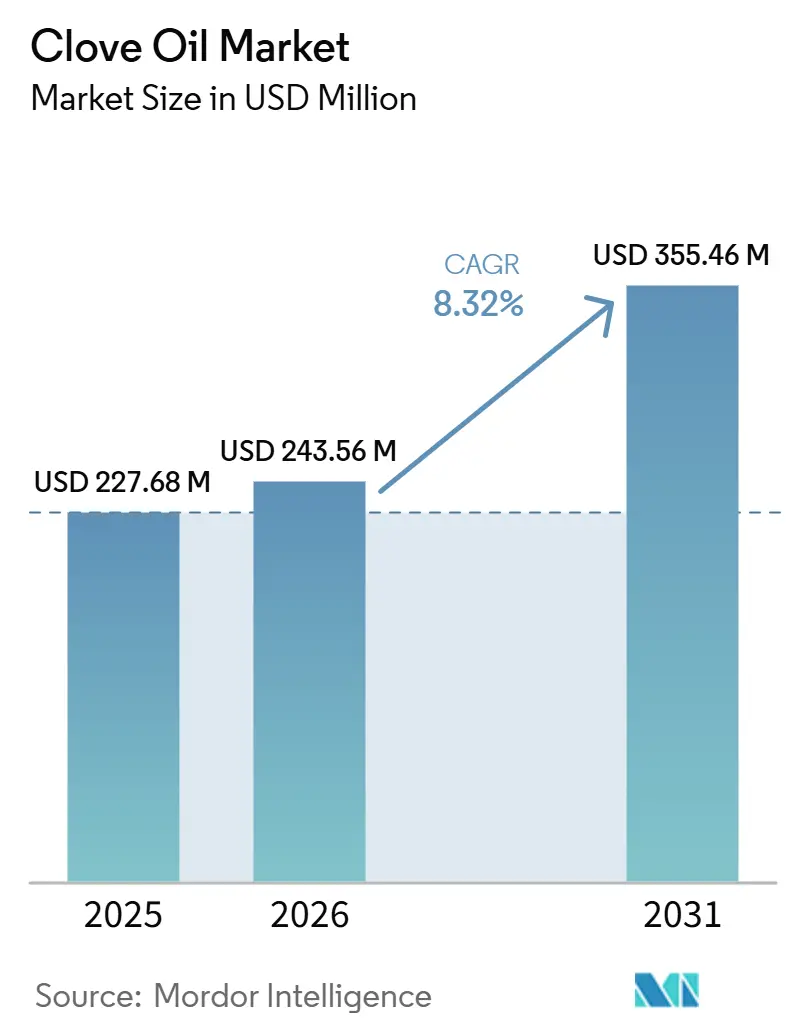
| Market Size (2026) | USD 243.56 Million |
| Market Size (2031) | USD 355.46 Million |
| Growth Rate (2026 - 2031) | 7.85 % |
| Fastest Growing Market | Asia-Pacific |
| Largest Market | Europe |
| Market Concentration | Medium |
Major Players *Disclaimer: Major Players sorted in no particular order Image © Mordor Intelligence. Reuse requires attribution under CC BY 4.0. | |
Clove Oil Market Analysis by Mordor Intelligence
The clove oil market size was USD 227.68 million in 2025 and is projected to reach USD 355.46 million by 2031, growing at a CAGR of 7.85% from 2026 to 2031. Demand is supported by clove oil’s antimicrobial, analgesic, and aromatic properties, which allow formulators to use one botanical ingredient across personal care, dental, and food products. Eugenol represents 70% to 90% of clove oil’s composition and has been studied for periodontal therapy, food preservation, and pharmaceutical applications. Regulatory scrutiny of synthetic ingredients is increasing interest in documented botanical alternatives. Suppliers with traceable extraction and certification programs are better placed to serve premium formulations. Supply remains exposed to weather conditions, the concentration of cultivation in Indonesia, and domestic demand from the kretek cigarette sector.
Key Report Takeaways
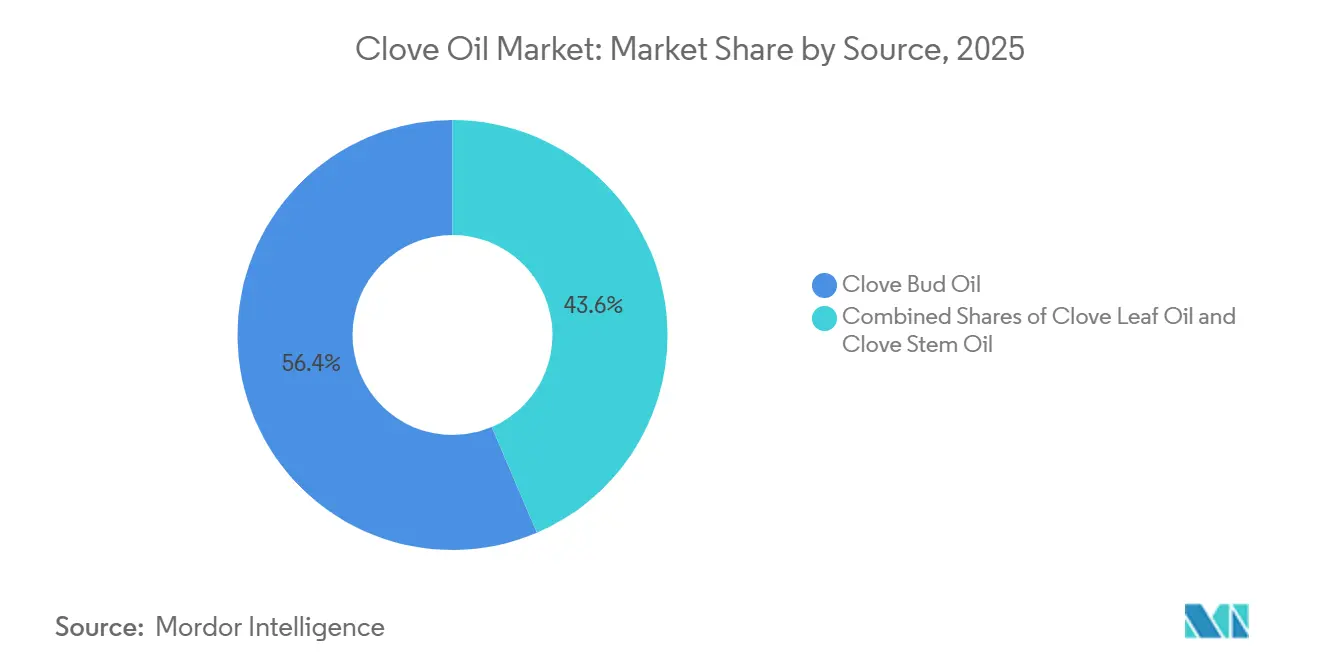
- By source, clove bud oil held 56.43% of the clove oil market share in 2025, while clove stem oil is forecast to grow at a 9.55% CAGR through 2031.
- By extraction method, steam distillation held 43.27% of clove oil market share in 2025, while cold press extraction is forecast to grow at a 9.46% CAGR through 2031.
- By nature, conventional clove oil held 63.28% of clove oil market share in 2025, while organic clove oil is forecast to grow at a 10.02% CAGR through 2031.
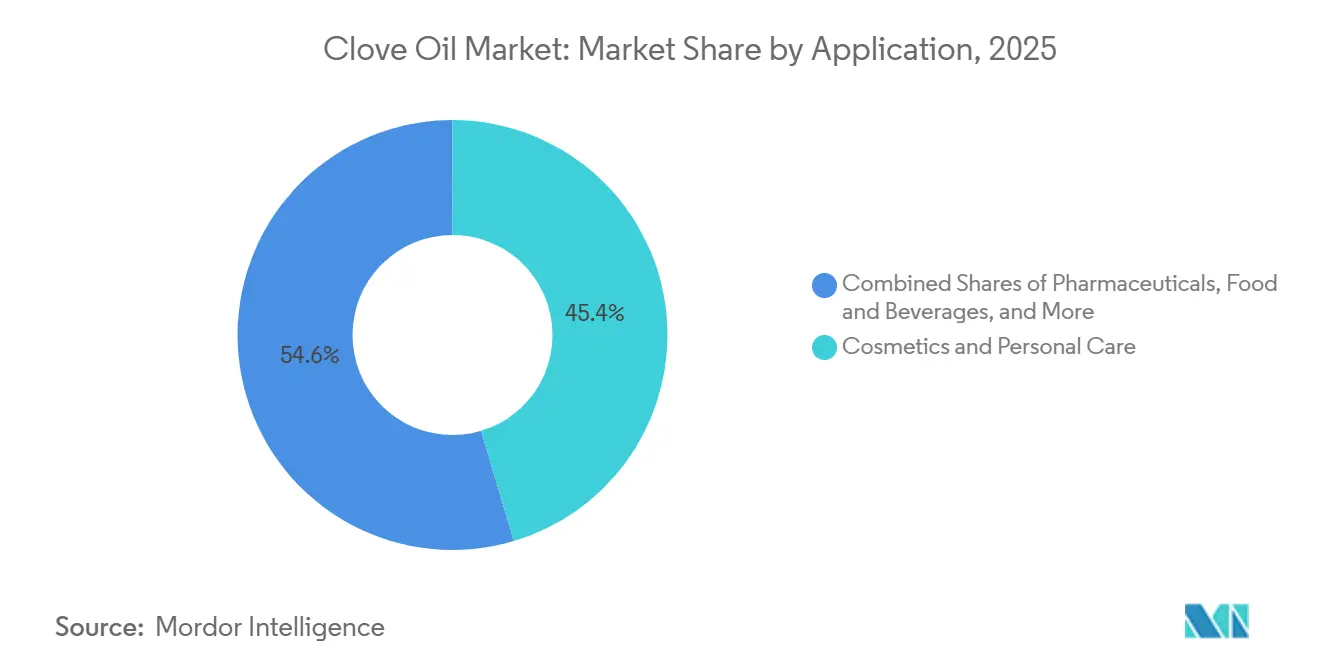
- By application, personal care and cosmetics held 45.38% of clove oil market share in 2025, while food and beverages are forecast to grow at a 10.78% CAGR through 2031.
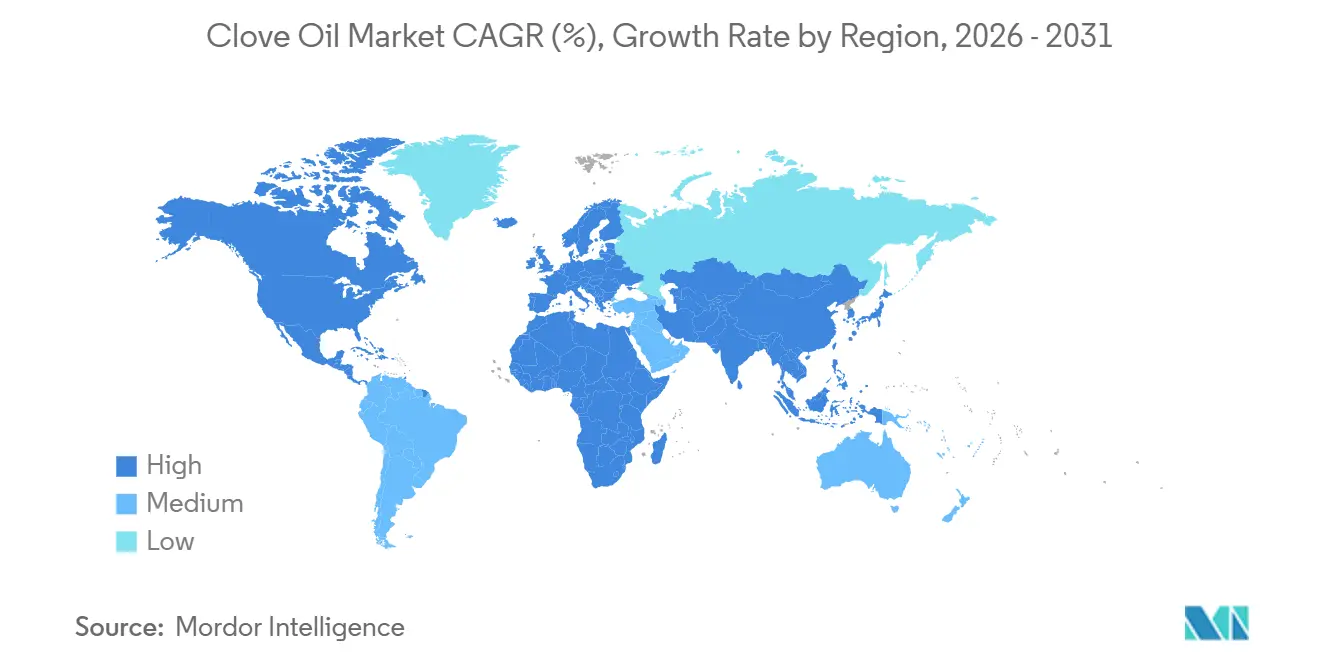
- By geography, Europe held 48.79% of the clove oil market share in 2025, while Asia-Pacific is forecast to grow at a 9.74% CAGR through 2031.
Note: Market size and forecast figures in this report are generated using Mordor Intelligence’s proprietary estimation framework, updated with the latest available data and insights as of January 2026.
Market Trends and Insights
Drivers Impact Analysis of Clove Oil Market*
| Driver | (~) % Impact on CAGR Forecasts | Geographic Relevance | Impact Timeline |
|---|---|---|---|
| Growing Demand for Natural Essential Oils in Personal Care Products | +2.1% | Global, concentrated in Europe and APAC | Medium term (2–4 years) |
| Increasing Adoption of Clove Oil in Oral Care and Dental Applications | +1.8% | Global, with North America and Europe leading | Medium term (2–4 years) |
| Rising Utilization in Food Flavoring and Natural Food Preservation | +1.5% | Global, APAC and North America primary | Short term (≤ 2 years) |
| Expanding Demand for Plant-Based Ingredients in Pharmaceuticals | +1.2% | Global, APAC (India, China) accelerating | Long term (≥ 4 years) |
| Growing Consumer Preference for Clean-Label and Botanical Products | +1.4% | North America and Europe, spill-over to APAC | Short term (≤ 2 years) |
| Rising Demand for Natural Antimicrobial and Antioxidant Ingredients | +1.0% | Global, spill-over to MEA | Medium term (2–4 years) |
| Source: Mordor Intelligence | |||
Growing Demand for Natural Essential Oils in Personal Care Products
Clove oil can act as a preservative, antimicrobial ingredient, and fragrance component in a single formulation. This combination can reduce the number of ingredient inputs needed in some personal care products. Regulation (EU) 2025/877 expanded restrictions for CMR substances under the EU Cosmetics Regulation in May 2025[1]. Givaudan announced a CHF 55.00 million investment in Campus 52 in Grasse during 2026, with the site focused on natural fragrance ingredients, agronomy, and extraction technologies. IFF expanded its LMR Naturals site in Grasse by 75.00% during 2025, showing continued investment in traceable natural ingredients. These investments support suppliers that can demonstrate extraction quality, provenance, and consistent supply for the clove oil market.
Increasing Adoption of Clove Oil in Oral Care and Dental Applications
Dental use is extending beyond traditional toothache remedies and toothpaste formulations. A 2026 study reported sustained antimicrobial activity from clove extract-loaded nano-hydroxyapatite composites against Streptococcus mutans. Research published in 2026 also reported that a clove-infused mucoadhesive orobuccal film showed analgesic potential for toothache and dental caries applications[2]. These findings support use in restorative materials, dental delivery systems, and post-procedure care. Such applications require higher eugenol purity and stronger quality documentation than commodity essential oil channels. This creates opportunities for clove oil market suppliers able to meet pharmaceutical-grade specifications.
Rising Utilization in Food Flavoring and Natural Food Preservation
Food and beverage demand is supported by flavoring use and by active packaging applications. In active packaging, clove oil is incorporated into films rather than added directly to food, which can reduce sensory limitations. A 2026 study found antimicrobial performance in PET and PP films coated with pullulan and 10.00% clove essential oil. The U.S. Food and Drug Administration lists clove oil as generally recognized as safe for intended food uses[3]. A 2025 systematic review also documented antimicrobial activity of clove essential oil in meat and meat products at tested concentrations of 0.01% to 0.10% w/v. These applications broaden the role of the clove oil market in food preservation while retaining the need for formulation-specific testing.
Growing Consumer Preference for Clean-Label and Botanical Products
Demand for transparent ingredient declarations is extending beyond specialist wellness products. Certifications such as COSMOS, USDA Organic, and NATRUE require suppliers to document sourcing and processing practices. Organic conversion is slow because clove trees require 4.00 to 7.00 years to reach their first yield, and certification adds a multiyear qualification period. This timing limits the ability of certified supply to respond quickly to demand. Robertet identifies natural raw materials as a central part of its botanical ingredient offer. Companies with established organic documentation can therefore have a practical advantage in the clove oil market when buyers require certified inputs.
Restraints Impact Analysis of Clove Oil Market*
| Restraint | (~) % Impact on CAGR Forecasts | Geographic Relevance | Impact Timeline |
|---|---|---|---|
| Volatility in Clove Crop Yields and Raw Material Prices | -0.8% | Global, centred on Indonesian supply base | Short term (≤ 2 years) |
| High Dependence on Seasonal Agricultural Production | -0.5% | Indonesia, Madagascar, Tanzania | Short to medium term (≤ 4 years) |
| Stringent Regulatory Requirements for Essential Oil Applications | -0.4% | Europe and North America | Long term (≥ 4 years) |
| Competition from Synthetic Flavoring and Fragrance Ingredients | -0.5% | Global | Medium term (2–4 years) |
| Source: Mordor Intelligence | |||
Volatility in Clove Crop Yields and Raw Material Prices
Supply risk is more persistent than ordinary seasonal price movement suggests. Indonesia produces more than two-thirds of global cloves, but more than 70.00% of its production is used domestically by the kretek cigarette sector. Indonesian yields in 2023 were 25.00% below their 2010 peak, and North Maluku growers reported 2025 harvests that were 30.00% to 40.00% below recent years. Rain also extended drying times from 3.50 days to more than 5.00 days, adding pressure after harvest. Indonesia has trailed Madagascar as the leading clove exporter since 2020, according to the supplied trade-data reference. The clove oil market therefore faces limited export availability even when total Indonesian production appears substantial.
Stringent Regulatory Requirements for Essential Oil Applications
EU compliance requirements are increasing the documentation burden across essential oil supply chains, including those serving the clove oil market. Regulation (EU) 2025/877 is expected to expand restrictions on CMR substances in 2025, requiring suppliers to maintain stronger evidence of compliance and product safety. From July 2026 onward, the EU fragrance allergen framework will expand declaration requirements from 26.00 substances to more than 80.00 substances, increasing the level of detail that exporters, distributors, and ingredient suppliers must provide to buyers. Clove oil also requires safety, allergen, and technical documentation when suppliers use it in food and cosmetic supply chains, as buyers increasingly request traceability records, specification sheets, safety data sheets, and compliance declarations. These requirements can create greater challenges for small distilleries and brokers that lack dedicated regulatory teams or the resources to manage detailed documentation processes.
*Our forecasts treat driver/restraint impacts as directional, not additive. The impact forecasts reflect baseline growth, mix effects, and variable interactions.
Clove Oil Market Segment Analysis
By Source:
Clove Bud Oil Anchors Revenue, Stem Oil Gains Commercial RelevanceClove bud oil held 56.43% of the clove oil market share in 2025, reflecting its higher and more consistent eugenol content than leaf and stem oil. Its chemical profile supports use in pharmaceutical and dental applications, fine fragrance, and certified personal care products. These are generally the higher-value uses for clove oil. Leaf oil serves industrial fragrance and commodity personal care applications where lower cost can outweigh its lower eugenol concentration. Bud oil remains the preferred option when buyers need a premium specification. It also benefits from established procurement practices in the clove oil market.
Clove stem oil is forecast to grow at a 9.55% CAGR between 2026 and 2031. It is extracted from the woody byproduct of clove harvesting, rather than from the harvested bud. Greater use of stem oil can raise farm-level returns without requiring more agricultural land. This is relevant for growers facing weaker bud yields and higher costs. Research published in 2025 confirmed that bud, leaf, and stem extracts differ in physicochemical properties depending on their source and extraction method. Separate procurement channels are therefore likely to remain appropriate for premium bud oil and volume-oriented stem oil.

By Extraction Method:
Steam Distillation Leads, Cold Press Extraction AcceleratesSteam distillation held 43.27% of clove oil market share in 2025 because it offers accessible economics for commercial-scale production. Its capital and operating requirements make it practical for many smallholder-linked distilleries in Indonesia and India. This method remains central to the supply base for conventional products. It is also compatible with established equipment and processing workflows. Buyers continue to use steam-distilled material in applications that do not require the most complete volatile profile. These conditions keep steam distillation important to the clove oil market.
Cold press extraction is forecast to grow at a 9.46% CAGR from 2026 to 2031. Premium personal care and pharmaceutical buyers seek extraction approaches that preserve heat-sensitive volatile fractions. Givaudan’s Campus 52 project includes advanced extraction technologies for natural fragrance ingredients. IFF also expanded its Grasse naturals site during 2025 to support traceable natural ingredient development. Carbon dioxide extraction occupies a high-value position because it captures eugenol and minor volatile constituents. Research has shown that extraction methods create materially different physicochemical profiles
By Nature:
Conventional Volume Persists, Organic Grows Fastest Across CategoriesConventional clove oil commanded 63.28% of the clove oil market share in 2025 and remains the volume base for food, industrial fragrance, and commodity personal care demand. Many of these uses do not require organic certification. Conventional supply also remains easier to source in the required volumes. It serves buyers whose product claims do not support an organic premium. This segment therefore continues to provide a large share of demand. Its scale supports the broad availability of the clove oil market across established applications.
Organic clove oil is forecast to grow at a 10.02% CAGR from 2026 to 2031, the highest rate across the stated segments. Clove trees need 4.00 to 7.00 years to reach first yield, and organic conversion further delays new certified supply. Demand from certified personal care brands and organic food processors can therefore grow faster than supply. Robertet has identified natural raw materials as part of its product portfolio. Robertet held 25.00% of the certified organic essential oil category, but no qualifying source link was available to retain that figure. The resulting supply constraint supports continued differentiation between certified and conventional clove oil.
By Application:
Personal Care Commands Largest Share, Food and Beverages Rise FastestPersonal care and cosmetics held 45.38% of the clove oil market share in 2025. Oral hygiene products, natural deodorants, and antimicrobial skincare support this leading position. The category benefits from clove oil’s aroma and functional properties. It also benefits from the move toward botanical ingredients with clearer sourcing records. The segment remains the largest application through 2031. It continues to anchor demand for the clove oil market.
Food and beverages is forecast to grow at a 10.78% CAGR from 2026 to 2031. Direct flavoring demand is supported by the FDA’s GRAS status for clove oil. Active packaging gives manufacturers another route to use the ingredient without adding it directly to food. Pharmaceutical demand is also becoming more specialized through research on nano-delivery dental systems and mucoadhesive formulations. Aromatherapy remains a steady source of demand for specialist essential oil brands. Other applications include natural agricultural biocides and animal feed, where antimicrobial and antifungal properties are being evaluated.
Geography Analysis
Europe Clove Oil Market
Europe held 48.79% of the clove oil market share in 2025 and remained the largest regional buyer. Its position comes from quality-sensitive import demand and re-export activity, rather than domestic clove production. The Netherlands and Germany function as major trading entry points for global clove imports. European buyers increasingly require documentation for fragrance allergens, CMR substances, and extraction practices. This directs procurement toward suppliers that can provide certified and ISO-aligned records. The region’s standards reinforce a quality-focused tier within the clove oil market.
APAC Clove Oil Market
Asia-Pacific is forecast to grow at a 9.74% CAGR between 2026 and 2031. The region combines a major production base with expanding consumption in food processing, pharmaceuticals, and personal care. Indonesia remains central to supply and has more than 3,000 essential oil distillation units. The Ministry of Industry reported Indonesian essential oil export revenue of USD 259.54 million in 2024. China and India contribute demand through traditional medicine, natural skincare, and industrial extraction. Japan, South Korea, Australia, and ASEAN markets add premium wellness demand and food-processing volumes.
The Americas and MEA Clove Oil Market
North America is supported by FDA food-use recognition, a natural oral care consumer base, and clean-label product reformulation. The United States is important for companies with FDA-compliant supply chains. Canada and Mexico add demand through herbal supplements and natural cosmetics. South America is an emerging consumption region led by Brazil’s herbal medicine and personal care sectors. Givaudan completed its acquisition of Vollmens Fragrances in Brazil during 2025. The Middle East and Africa support progressive imports through established use of spice aromatics and traditional medicine.
Competitive Landscape
The clove oil market is fragmented. Global flavor and fragrance groups operate alongside many Indonesian and Indian processors. The multinational group includes Givaudan, IFF, Symrise, dsm-firmenich, Takasago, and Robertet. Origin-proximate processors include Indesso, Van Aroma, PT Nusaroma, PT Mitra Ayu Adi Pratama, Synthite, Plant Lipids, Mane Kancor, AOS Products, Katyani Exports, Arora Aromatics, and NVR Agropolis. No single company was stated to have a dominant clove oil position. Competition is therefore based on access to sourcing, traceability, extraction capability, and customer relationships.
Givaudan announced a CHF 55.00 million investment in Campus 52 during February 2026. The project focuses on natural fragrance ingredients, agronomy, extraction technology, and perfumer access. IFF expanded its LMR Naturals site in Grasse during September 2025 after a EUR 10.00 million investment. The site increased by 75.00% and supports research on traceable natural ingredients. Symrise signed a put option agreement in July 2026 to acquire Floral Concept, a Grasse-based natural fragrance ingredients company. These moves show that premium natural ingredient capability is an important competitive priority.
Pharmaceutical-grade clove oil produced through carbon dioxide or cold press extraction is a potential area for suppliers that can deliver consistent specifications. Certified organic material for active packaging and premium food and beverage formulations is another area where documented provenance can matter. dsm-firmenich reported its 2025 results and continued its focus on consumer-oriented businesses during 2026. This wider refocus can increase attention on flavor, fragrance, and beauty ingredients. The competitive structure remains consistent with a fragmented clove oil market.
Clove Oil Industry Leaders
-
Givaudan SA
-
PT Nusaroma Essential Indonesia
-
International Flavors & Fragrances Inc.
-
Symrise AG
-
Indesso
- *Disclaimer: Major Players sorted in no particular order

Clove Oil Market Companies Covered in this Report
- Givaudan SA
- dsm-firmenich AG
- International Flavors & Fragrances Inc.
- Symrise AG
- Indesso
- PT Nusaroma Essential Indonesia
- Van Aroma
- Arora Aromatics
- Katyani Exports
- AOS Products Pvt. Ltd.
- Gem Aromatics Limited
- Kanta Enterprises Private Limited
- NVR Agropolis Pvt Ltd.
- PT Mitra Ayu Adi Pratama
- Berjé Inc.
- Biolandes SAS
- Ultra International B.V.
- Plant Lipids Private Limited
- Synthite Industries Pvt. Ltd.
- Mane Kancor Ingredients Private Limited
- Treatt plc
- Robertet SA
- Takasago International Corporation
- Sensient Technologies Corporation
Recent Industry Developments in Clove Oil Market
- March 2025: Dongguk University Developed Clove Essential Oil-Based Pickering Emulsions: Dongguk University researchers developed a novel clove essential oil-based Pickering emulsion using carbon quantum dots (CQDs) synthesized from clove oil extraction residue. The innovation enhances the emulsifying efficiency and antibacterial performance of clove essential oil while reducing reliance on synthetic surfactants.
- November 2024: Indesso launched its "Clove Oil: From Fallen Leaves to Everyday Wonder" campaign to showcase its sustainable production model, highlighting how fallen clove leaves are upcycled into high-value clove oil and derivatives.
Global Clove Oil Market Report Scope
Segmentation Overview
| Clove Bud Oil |
| Clove Leaf Coil |
| Clove Stem Oil |
| Steam Distillation |
| Cold Press Extraction |
| CO2 Extraction |
| Conventional |
| Organic |
| Food and Beverages |
| Personal Care and Cosmetics |
| Pharmaceuticals |
| Aromatherapy |
| Others |
| North America | United States |
| Canada | |
| Mexico | |
| Rest of North America | |
| Europe | Germany |
| United Kingdom | |
| France | |
| Italy | |
| Spain | |
| Rest of Europe | |
| Asia-Pacific | China |
| India | |
| Japan | |
| Australia | |
| Rest of Asia-Pacific | |
| South America | Brazil |
| Argentina | |
| Rest of South America | |
| Middle East and Africa | United Arab Emirates |
| Saudi Arabia | |
| Rest of Middle East and Africa |
| By Source | Clove Bud Oil | |
| Clove Leaf Coil | ||
| Clove Stem Oil | ||
| By Extraction Method | Steam Distillation | |
| Cold Press Extraction | ||
| CO2 Extraction | ||
| By Nature | Conventional | |
| Organic | ||
| By Application | Food and Beverages | |
| Personal Care and Cosmetics | ||
| Pharmaceuticals | ||
| Aromatherapy | ||
| Others | ||
| By Geography | North America | United States |
| Canada | ||
| Mexico | ||
| Rest of North America | ||
| Europe | Germany | |
| United Kingdom | ||
| France | ||
| Italy | ||
| Spain | ||
| Rest of Europe | ||
| Asia-Pacific | China | |
| India | ||
| Japan | ||
| Australia | ||
| Rest of Asia-Pacific | ||
| South America | Brazil | |
| Argentina | ||
| Rest of South America | ||
| Middle East and Africa | United Arab Emirates | |
| Saudi Arabia | ||
| Rest of Middle East and Africa | ||
Key Questions Answered in the Report
How large is the clove oil market?
It was USD 227.68 million in 2025 and is projected to reach USD 355.46 million by 2031 at an 7.85% CAGR.
Which application leads clove oil use?
Personal care and cosmetics led with 45.38% share in 2025. Food and beverages is projected to grow fastest at a 10.78% CAGR
Why is organic clove oil growing faster?
Certified supply takes time to develop because trees need 4.00 to 7.00 years to reach first yield and certification requires added time.
What is driving demand for clove oil?
Personal care, oral care, food preservation, and demand for traceable botanical ingredients support growth.