
Cloud Security In Manufacturing Industry Size and Share
Market Overview
| Study Period | 2020 - 2031 |
|---|---|
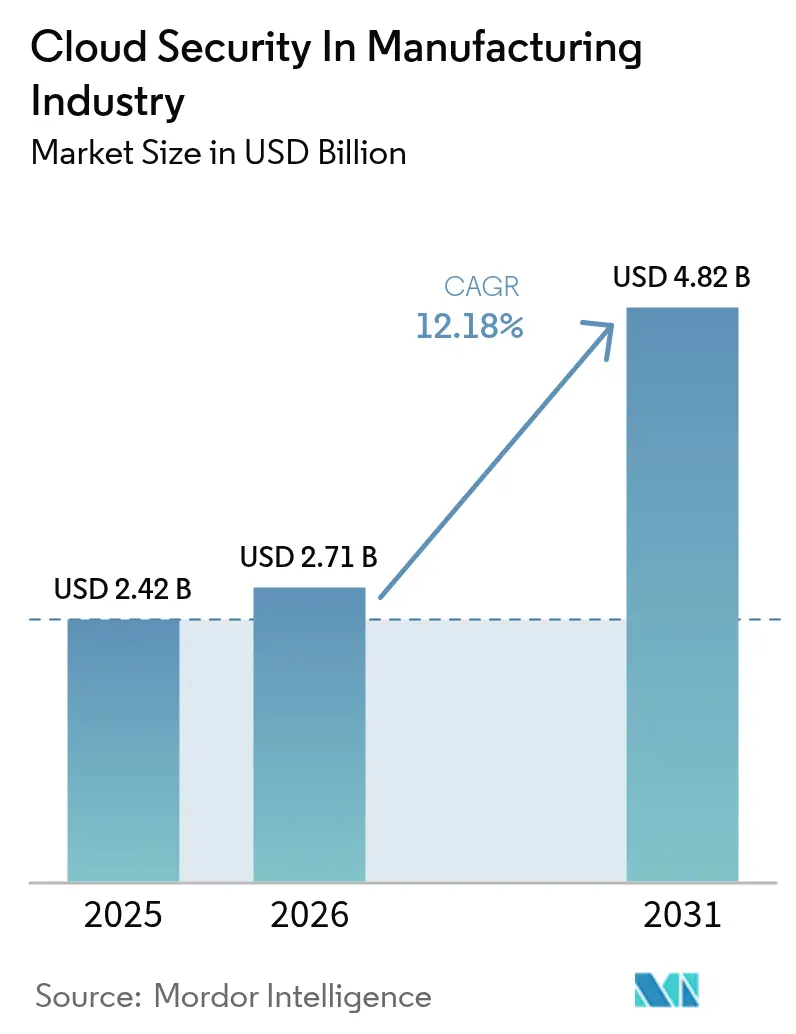
| Market Size (2026) | USD 2.71 Billion |
| Market Size (2031) | USD 4.82 Billion |
| Growth Rate (2026 - 2031) | 12.18 % |
| Fastest Growing Market | Asia Pacific |
| Largest Market | North America |
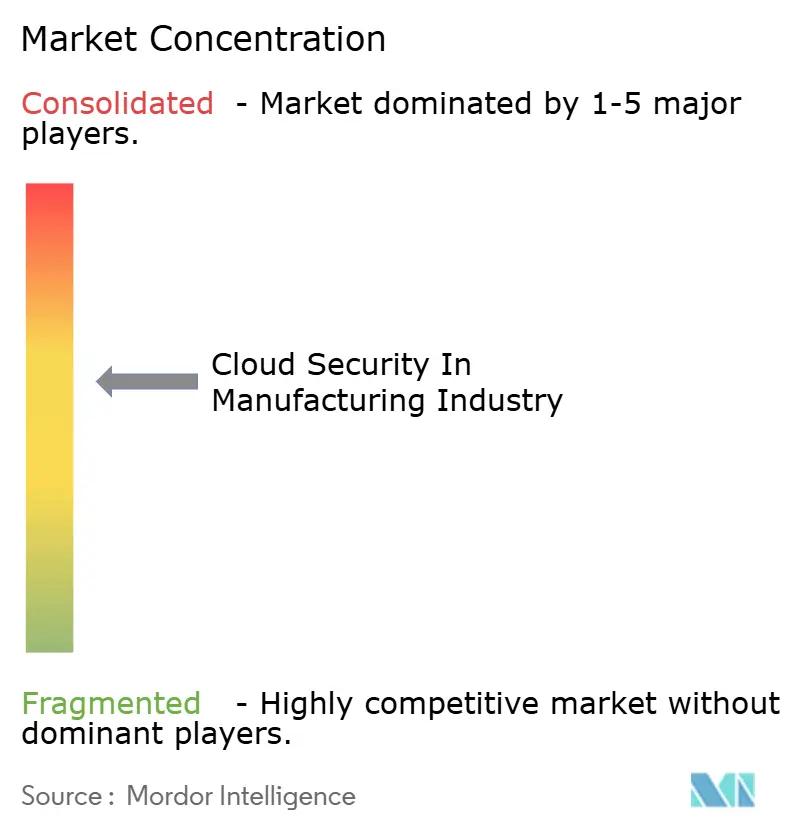
| Market Concentration | Medium |
Major Players *Disclaimer: Major Players sorted in no particular order Image © Mordor Intelligence. Reuse requires attribution under CC BY 4.0. | |
Cloud Security In Manufacturing Industry Analysis by Mordor Intelligence
The cloud security in manufacturing industry market size is expected to grow from USD 2.42 billion in 2025 to USD 2.71 billion in 2026 and is forecast to reach USD 4.82 billion by 2031 at 12.18% CAGR over 2026-2031. The steady migration of production systems to public and hybrid clouds, coupled with 25.7% of all global cyber incidents affecting manufacturers in 2024, drives spending on resilient, industry-specific defenses. Average breach costs rose to USD 5.56 million in 2024, and unplanned downtime averaged USD 22,000 per minute, making proactive investment in identity controls, zero-trust architectures, and AI-driven threat response a board-level imperative.[1] Vendor platform consolidation is accelerating as buyers favor integrated capabilities that cover both IT and OT assets, while sovereign-cloud mandates in Europe and Asia influence deployment choices. Competitive differentiation now hinges on AI-powered analytics, low-latency remediation, and support for quantum-ready encryption as manufacturers seek future-proof security roadmaps.
Key Report Takeaways
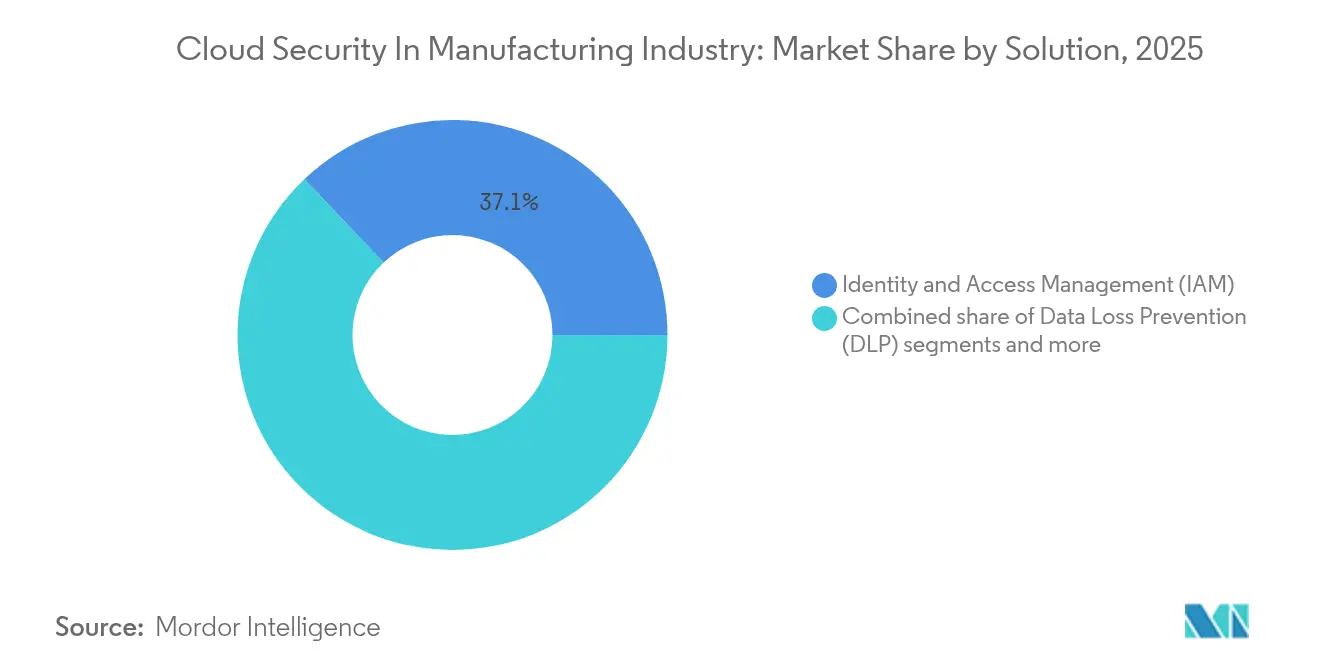
- By solution, Identity and Access Management led with 37.10% of cloud security in manufacturing industry share in 2025; Data Loss Prevention is projected to expand at a 12.37% CAGR through 2031.
- By security type, Application Security accounted for 37.75% revenue share in 2025, whereas Network Security posts the fastest 12.62% CAGR to 2031.
- By service model, Platform-as-a-Service Security captured 56.10% of the cloud security in manufacturing industry size in 2025; Software-as-a-Service Security is set to grow at 13.14% CAGR through 2031.
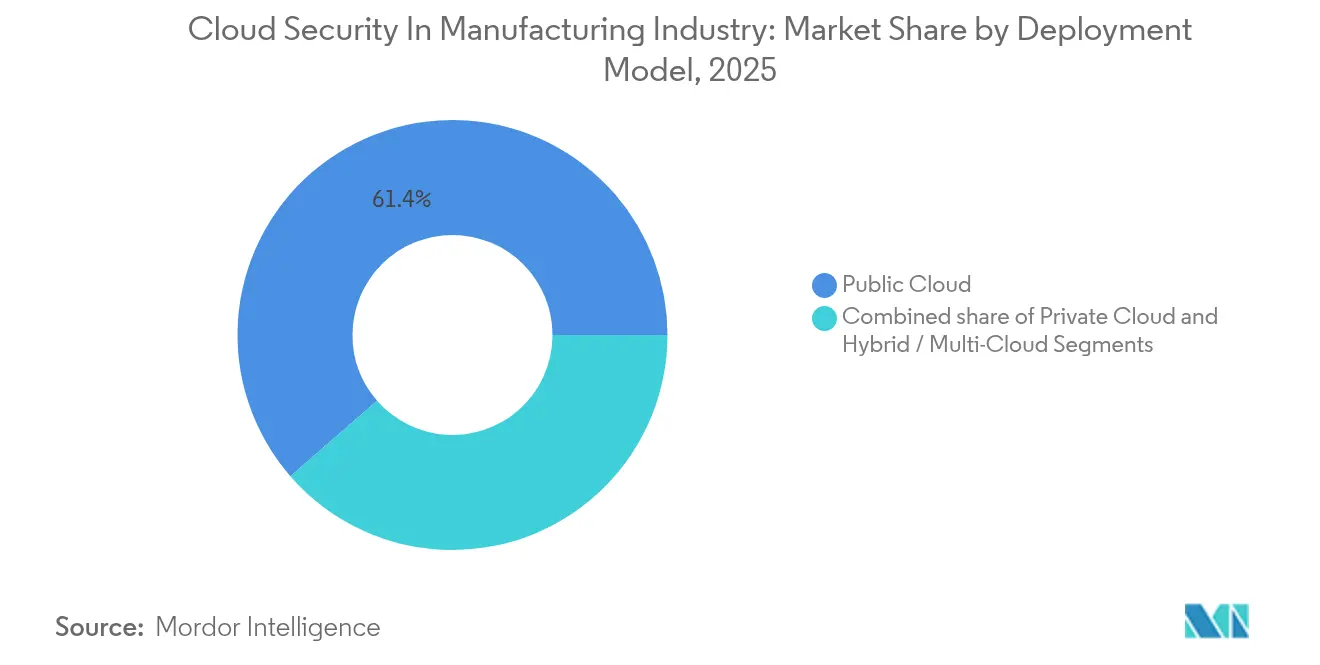
- By deployment model, Public Cloud held 61.40% adoption in 2025, while Hybrid/Multi-Cloud configurations rise at a 13.32% CAGR.
- By organization size, large enterprises accounted for 69.10% of spending in 2025, while SMEs are projected to show a stronger 13.74% CAGR to 2031.
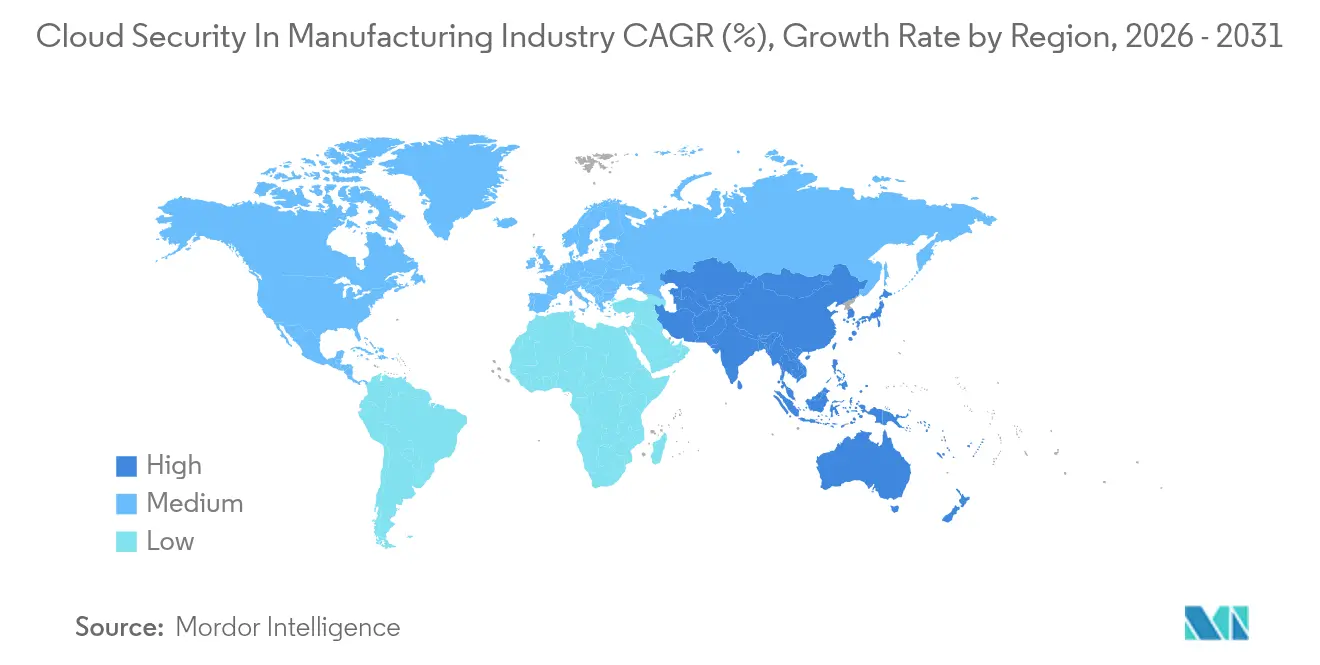
- By geography, North America retained 38.20% market leadership in 2025; Asia-Pacific is the fastest-growing region at 12.88% CAGR.
Note: Market size and forecast figures in this report are generated using Mordor Intelligence’s proprietary estimation framework, updated with the latest available data and insights as of 2026.
Market Trends and Insights
Drivers Impact Analysis of Cloud Security In Manufacturing Industry*
| Driver | (~) % Impact on CAGR Forecast | Geographic Relevance | Impact Timeline |
|---|---|---|---|
| Surging multi-cloud complexity elevating attack surface | +2.1% | Global, with highest impact in North America & Europe | Medium term (2-4 years) |
| Regulatory mandates accelerate security spend | +2.8% | Europe (NIS2), North America (CMMC), expanding to APAC | Short term (≤ 2 years) |
| AI-driven autonomous remediation cutting MTTR | +1.9% | Global, led by North America and Europe early adopters | Medium term (2-4 years) |
| Cloud-native application protection platform (CNAPP) consolidation wave | +1.7% | Global, concentrated in mature cloud markets | Medium term (2-4 years) |
| API economy exposure driving security budgets | +1.5% | Global, particularly in digitally advanced manufacturing hubs | Short term (≤ 2 years) |
| Quantum-safe encryption pilots in hyperscalers | +0.8% | North America & Europe, expanding to APAC | Long term (≥ 4 years) |
| Source: Mordor Intelligence | |||
Surging Multi-Cloud Complexity Elevating Attack Surface
Manufacturers now operate across AWS, Azure and Google Cloud, with 95% using at least two providers. Connecting these environments to legacy shop-floor systems multiplies threat entry points and complicates compliance alignment. Unified cloud security platforms that interpret both IT and OT telemetry command premium budgets. Demand is acute for agentless, runtime-aware controls that safeguard programmable logic controllers without disrupting production. Vendors that simplify policy orchestration across heterogeneous estates gain clear advantage.
Regulatory Mandates Accelerate Security Spend
Implementation of the EU NIS2 Directive and U.S. CMMC Level 2 obligations forces immediate upgrades to monitoring, incident reporting and supply-chain assurance.[2] Manufacturers invest in FedRAMP-authorized services and automated compliance tooling to avoid contract exclusion. Similar rules in India and Japan magnify complexity, spurring adoption of regionally hosted sovereign clouds to localize sensitive data. Short deployment windows turn compliance from a governance task into a primary budget catalyst.
AI-Driven Autonomous Remediation Cutting MTTR
Google Cloud’s Gemini agents and Siemens SIBERprotect illustrate how AI shrinks mean time to respond in both IT and OT zones. Autonomous playbooks that isolate malware-infected robots within milliseconds preserve production continuity and avert million-dollar downtime losses. Successful deployments couple machine-learning analytics with granular identity controls to execute safe-by-design actions, although governance teams still validate overrides to maintain operational assurance.
Cloud-Native Application Protection Platform (CNAPP) Consolidation Wave
Fortinet’s June 2024 acquisition of Lacework and Palo Alto Networks’ QRadar buy show momentum toward single-pane CNAPP suites. Manufacturers tired of tool sprawl favor vendors merging posture management, workload protection and entitlement governance under one license. Consolidation also unlocks deeper context sharing, allowing AI engines to prioritize alerts by production impact. Agentless scanning appeals to plants reluctant to install code on deterministic control hardware.
Restraints Impact Analysis of Cloud Security In Manufacturing Industry*
| Restraint | (~) % Impact on CAGR Forecast | Geographic Relevance | Impact Timeline |
|---|---|---|---|
| Identity debt from unmanaged machine identities | -1.8% | Global, particularly acute in automated manufacturing environments | Short term (≤ 2 years) |
| Shortage of cloud-literate security engineers | -2.2% | Global, most severe in North America and Europe | Medium term (2-4 years) |
| Cross-border data-sovereignty frictions slow roll-outs | -1.4% | Global, with highest impact in Europe and Asia-Pacific due to GDPR and sovereign cloud requirements | Medium term (2-4 years) |
| Hidden egress fees inflate TCO of secure cloud architectures | -1.1% | Global, particularly affecting multi-cloud and hybrid deployments | Short term (≤ 2 years) |
| Source: Mordor Intelligence | |||
Identity Debt from Unmanaged Machine Identities
IoT sensors, robots and edge gateways outnumber humans on the factory floor, yet 75% of firms lack lifecycle oversight for their credentials. Stale certificates and hard-coded keys provide covert persistence paths for attackers. Scaling zero-trust to millions of non-human identities demands automated discovery, rotation and revocation workflows that many plants still lack, constraining immediate uptake of advanced cloud services.
Shortage of Cloud-Literate Security Engineers
Hybrid security roles spanning Kubernetes, LDAP and PLC firmware remain scarce. Manufacturing lags behind technology and finance in employer brand appeal, resulting in a widening of vacancies for DevSecOps and OT security architects. Without staff to tune policies or investigate alerts, some firms postpone migrations or over-rely on managed service providers, trimming potential growth in the cloud security in manufacturing industry.
*Our forecasts treat driver/restraint impacts as directional, not additive. The impact forecasts reflect baseline growth, mix effects, and variable interactions.
Cloud Security In Manufacturing Industry Segment Analysis
By Solution:
IAM Leadership Amid DLP AccelerationIdentity and Access Management commanded 37.10% of the cloud security in manufacturing industry in 2025, reflecting the urgent need to gate every user and machine session. Manufacturers integrate privileged-access vaults with zero-trust segmentation to curb lateral movement. Modern IAM stacks embed certificate authorities for robots and additive printers, unifying policy across IT and OT. Data Loss Prevention, growing at a 12.37% CAGR, gains traction as export-controlled design files are exchanged between CAD systems and contract assemblers. Advanced DLP that classifies engineering blueprints and blocks exfiltration by anomaly peaks addresses rising IP theft.
Micro-segmentation features bolster IAM by binding dynamic policies to workloads in Kubernetes clusters that feed production lines. Conditional access using real-time risk scores throttles credentials during suspected compromise, lifting resilience against ransomware. Meanwhile, encryption and key-management modules gain relevance as quantum-ready algorithms enter pilots. Collectively, these trends keep the cloud security in manufacturing industry focused on identity-centric controls that can scale to millions of endpoints without impairing uptime.

By Security Type:
Application Focus Drives Network InnovationApplication Security held a 37.75% share of the cloud security in manufacturing industry in 2025 as industrial firms re-platform MES and PLM workloads into containers hosted in public clouds. Runtime protection, software-composition analysis and API gateways form core defense layers. Network Security is projected to grow 12.62% annually, driven by east-west inspection for OT traffic traversing SD-WAN links to cloud data lakes. Manufacturers apply deep-packet inspection tuned for Modbus and OPC UA protocols to thwart command spoofing.
Edge rollouts that leverage 5G private networks further elevate demand for micro-firewalls and zero-trust network access. Database, endpoint and email security maintain steady uptake, yet incremental spending converges on network detection-and-response engines that correlate traffic anomalies with application logs. This convergence underscores how the cloud security in manufacturing industry is increasingly treating the application and network layers as a single, unified fabric governed by a single policy engine.
By Service Model:
PaaS Dominance Challenges SaaS GrowthPlatform-as-a-Service Security accounted for 56.10% revenue in 2025, underscoring manufacturers’ desire to control compiler chains and runtime libraries while still benefiting from managed infrastructure. Vendors supply hardening blueprints, least-privilege defaults and drift detection that map neatly to DevSecOps pipelines. Software-as-a-Service Security, however, expands at 13.14% CAGR as ERP, PLM and quality-management vendors cut on-prem options. Secure access brokers that enforce granular OAuth scopes and contextual policies have become essential for protecting multi-tenant SaaS data sets.
Infrastructure-as-a-Service Security remains foundational, delivering host hardening, virtual network segmentation and policy-as-code frameworks. Yet, the cloud security in manufacturing industry increasingly gravitates toward abstraction layers where security controls are embedded by default, allowing plants to innovate without requiring deep in-house cloud talent.
By Deployment Model:
Public Cloud Leadership Faces Hybrid ChallengePublic Cloud represented 61.40% of the cloud security in manufacturing industry in 2025 as hyperscalers met ISO 27001 and sector-specific compliance benchmarks. Lower capex, global reach and managed AI services continue to attract production analytics and digital-twin workloads. Hybrid and Multi-Cloud adoption, advancing 13.32% annually, reflects sovereignty rules and latency-sensitive use cases placing edge nodes inside plants. Unified posture-management portals help teams visualize policy gaps across VMware-based private clouds and Kubernetes clusters hosted by hyperscalers.
Private Cloud persists for export-controlled defense programs or continuous-process plants that shun internet links. Flexible orchestration between tiers enables the burst-capacity rendering of computationally intensive simulations while sensitive parameters remain on-premises. Such patterns keep the cloud security in manufacturing industry diversified, ensuring suppliers must support consistent controls across all deployment options.
By Organization Size:
Enterprise Dominance Amid SME AccelerationLarge Enterprises contributed 69.10% of spending in 2025, leveraging scale to negotiate enterprise-wide platform licenses and fund red-team programs. However, SMEs drive the highest 13.74% CAGR as cloud-native offerings bundle best-practice configurations and managed detection out of the box. Consumption-based billing suits seasonal production cycles, enabling smaller plants to match security spend with throughput.
Vendor roadmaps increasingly include low-touch portals, automated onboarding and AI assistants that draft compliance reports, empowering SMEs to meet supply-chain mandates without hiring scarce cloud architects. As a result, the cloud security industry in manufacturing gains broader penetration across the supplier network, strengthening overall ecosystem resilience.
Geography Analysis
North America Cloud Security in Manufacturing Industry
North America held 38.20% of the cloud security in manufacturing industry in 2025 due to strict CMMC enforcement on defense contractors and multi-billion-dollar federal programs such as the USD 5.6 billion Mission Partner Environment. U.S. automotive and aerospace primes demand proof of zero-trust adoption from tier-one suppliers, spurring platform standardization. Canada’s CPCSC, effective winter 2025, introduces NIST-aligned certification for cross-border components, further reinforcing its regional leadership.
Europe Cloud Security in Manufacturing Industry
Europe accelerates on the back of the NIS2 Directive, compelling manufacturing firms to deploy incident monitoring, risk management, and supply-chain security by 2025. Germany, France, and the United Kingdom invest heavily in sovereign cloud zones managed by local telcos to comply with GDPR and upcoming AI Act data-governance clauses. Unified dashboards that map exposure across multinational plants are in demand as firms juggle varied national guidance.
APAC Cloud Security in Manufacturing Industry
Asia-Pacific records the fastest 12.88% CAGR, fuelled by national Industry 4.0 initiatives and rising awareness after headline OT attacks. China, India, and Japan combine smart-factory subsidies with stricter data-localization mandates, prompting hybrid architectures that keep telemetry onshore. Regional manufacturers show strong interest in AI-enabled threat hunting: 77% prioritise cybersecurity in digital roadmaps and 67% place cloud platform security among the top three investments. Sovereign clouds and shared-responsibility guidance tailored to multilingual workforces differentiate vendors seeking APAC market share.
Regulatory Landscape
Manufacturers securing cloud-hosted MES/PLM, production analytics, and connected IIoT stacks have to manage cyber obligations that span enterprise IT, OT, and third-party access. In Europe, the EU NIS2 Directive expands requirements around risk management and incident reporting timelines across critical and important entities, strengthening board-level accountability and documented supply-chain security practices as plants connect to public and hybrid clouds.
In North America, U.S. defense supply-chain requirements such as CMMC Level 2 push primes and suppliers toward demonstrable controls and evidence-based compliance. Public manufacturers also operate under the SEC cybersecurity disclosure rules (effective December 2023), which require disclosures covering governance and risk management processes. On standards, NIST activity around the Cybersecurity Framework 2.0 Manufacturing Profile (NIST IR 8183 Rev. 2, initial public draft in September 2025) and industrial guidance such as IEC PAS 62443-1-6:2025 (published December 2025) further formalize secure-by-design, shared-responsibility, and cloud-connected IIoT expectations, increasing demand for auditable identity, monitoring, and supplier assurance controls across multi-cloud estates.
Value Chain Analysis
Demand typically starts with manufacturers modernizing ERP, PLM, MES, quality, and OT data platforms on public and hybrid clouds, then spreads through tiered supply chains as large OEMs and tier-one firms extend security requirements to Tier 2 and Tier 3 suppliers. Core solution providers (IAM, CNAPP/CSPM, SIEM, DLP, encryption and key management) increasingly package controls as integrated platforms, while hyperscalers and cloud marketplaces remain key routes to market for cloud-native security services used by plants and engineering teams.
Integration and delivery are handled by managed security service providers (MSSPs), OT security specialists, and systems integrators that connect IT and OT telemetry, implement zero-trust access, and operationalize monitoring and incident response across distributed sites. Dependencies often center on device and machine identity issuance, vendor remote access governance, and protocol-aware visibility for industrial networks, and remote-access software used by equipment vendors remains a high-leverage entry point. This drives demand for brokered, time-limited, audited access and jump architectures. Bottlenecks persist around legacy controllers and deterministic production equipment that cannot host agents, which keeps agentless scanning, network segmentation, and compensating controls in focus to maintain uptime while meeting customer and regulator assurance demands.
Competitive Landscape
The cloud security in manufacturing industry remains moderately consolidated. Palo Alto Networks deepened platform breadth by acquiring Protect AI for USD 650-700 million in April 2025, bolstering AI code-supply-chain scanning. T-Mobile’s managed SASE launch with Prisma SASE 5G demonstrates how telco-security partnerships create vertical bundles that embed SIM-based authentication for IoT machines.
Fortinet’s integration of Lacework’s agentless CNAPP, completed in 2024, positions its Security Fabric to serve plants seeking unified policy across Kubernetes, serverless, and OT assets. CyberArk’s alliance with Device Authority and Microsoft targets certificate sprawl on factory equipment, blending privileged-access controls with automated identity issuance. Nozomi Networks secured USD 100 million from Mitsubishi Electric and Schneider Electric to accelerate protocol-aware detection for multi-vendor lines.[4]
Vendors differentiate through embedded AI, low-impact deployment, and domain expertise. Leaders who couple IT-grade analytics with deterministic-control safety validations stand to capture expanding budgets as the cloud security in manufacturing industry matures.
Cloud Security In Manufacturing Market Leaders
-
Trend Micro Inc.
-
Imperva Inc.
-
Broadcom Inc.
-
IBM Corporation
-
Cisco Systems Inc.
- *Disclaimer: Major Players sorted in no particular order
Cloud Security In Manufacturing Industry Companies Covered in this Report
- Palo Alto Networks Inc.
- Microsoft Corp.
- Cisco Systems Inc.
- Fortinet Inc.
- Check Point Software Tech. Ltd.
- Trend Micro Inc.
- IBM Corp.
- Broadcom Inc. (Symantec)
- Zscaler Inc.
- CrowdStrike Holdings Inc.
- Imperva Inc.
- McAfee LLC
- Sophos Ltd.
- Qualys Inc.
- Amazon Web Services (AWS)
- Google Cloud Security
- Cloudflare Inc.
- Okta Inc.
- Wiz Inc.
- Oracle Corp.
Market Opportunities and Future Outlook
A near-term opportunity is operationalizing OT-focused incident response and recovery for cloud-connected manufacturing. This is supported by NIST's publication of SP 1800-41 (May 2026) on responding to and recovering from cyber attacks in the manufacturing sector, along with ongoing NCCoE manufacturing project activity (project update event in June 2026). Vendors and service providers that package playbooks, evidence capture, and coordinated recovery workflows across cloud workloads, identity systems, and plant-floor connectivity can address downtime and safety constraints, where pre-approved actions matter more than ad hoc response.
Secure-by-design programs and SME-focused guidance are also widening the addressable buyer set beyond large enterprises. ENISA published the Security by Design and Default Playbook (March 2026), reinforcing product-lifecycle security practices that feed into procurement expectations and supplier onboarding, while the NIST CSF 2.0 Manufacturing Profile work (NIST IR 8183 Rev. 2 draft, September 2025) supports stronger supply chain risk management and governance. Providers that combine API security and application-layer controls with machine identity lifecycle management, and that can operate in sovereign or regionally hosted cloud models, have clearer routes to win standardized rollouts across multi-plant, multi-cloud manufacturing footprints and downstream supplier networks.
Recent Industry Developments in Cloud Security In Manufacturing Industry
- April 2026: Thales introduced Imperva for Google Cloud, bringing Imperva application security capabilities directly into Google Cloud environments for web applications and APIs. The offering supports cloud-native deployment choices for manufacturers standardizing on hyperscaler platforms while needing consistent API and app-layer protections across distributed sites.
- June 2025: Thales expanded the Imperva Application Security platform with API Detection and Response capabilities. This shifts API security from policy enforcement toward continuous detection and response for business-logic abuse, aligning with manufacturers increased exposure from connected supplier portals, IIoT data services, and cloud-hosted MES integrations.
- December 2024: Thales launched Imperva Data Risk Intelligence, combining Imperva Data Security Fabric with the Thales CipherTrust Data Security Platform. The combined approach improves data discovery and risk visibility for sensitive engineering and production data that manufacturers distribute across SaaS, PaaS, and hybrid cloud environments.
Cloud Security In Manufacturing Industry Report Scope and Research Methodology
Market Definition and Coverage
This market captures revenue earned from security tools and services used to protect manufacturing organizations when their applications, data, and connected operations run on public, private, or hybrid cloud environments.
Scope exclusions: We exclude security spending that is only for on-premise environments with no cloud workload, and we exclude spend that is not attributable to manufacturing end users.
Segments Covered in This Report
- By Solution
- Identity and Access Management (IAM)
- Data Loss Prevention (DLP)
- Security Information and Event Management (SIEM)
- Encryption and Key Management
- Other Solutions
- By Security Type
- Application Security
- Database Security
- Endpoint Security
- Network Security
- Web and Email Security
- By Service Model
- SaaS Security
- PaaS Security
- IaaS Security
- By Deployment Model
- Public Cloud
- Private Cloud
- Hybrid / Multi-Cloud
- By Organization Size
- Large Enterprises
- Small and Medium Enterprises (SMEs)
- By Geography
- North America
- United States
- Canada
- Mexico
- Europe
- Germany
- United Kingdom
- France
- Italy
- Spain
- Rest of Europe
- Asia-Pacific
- China
- Japan
- India
- South Korea
- Australia
- Rest of Asia-Pacific
- South America
- Brazil
- Argentina
- Rest of South America
- Middle East and Africa
- Middle East
- Saudi Arabia
- United Arab Emirates
- Turkey
- Rest of Middle East
- Africa
- South Africa
- Egypt
- Nigeria
- Rest of Africa
- Middle East
- North America
Data Sources, Market Sizing, and Validation
Desk Research
Desk research was used to build the initial fact base on manufacturing cloud adoption, cyber risk exposure, and compliance signals that shape buying behavior. Public and official sources were reviewed, including NIST publications and CISA advisories for controls context, the US Bureau of Labor Statistics for industry context, Eurostat for digital and enterprise indicators, and OECD datasets for cross-country comparability where available.
To translate that context into sizing inputs, we reviewed filings and investor presentations from relevant security and cloud vendors to find manufacturing exposure clues, product mix language, and geographic splits. We also checked reputable press, standards bodies, and manufacturing and industrial automation association websites to confirm trend direction and timing. A paid subscription focused on company financials, and another covering patents, was used selectively to cross-check revenue ranges and innovation intensity. These desk sources are illustrative, and additional public references were consulted for data collection, validation, and clarification.
Primary Interviews and Surveys
Primary interviews and surveys were used to pressure test the desk assumptions and to close gaps on what manufacturers actually buy for cloud workload protection, and how spend shifts across public, private, and hybrid environments. We spoke with a mix of security leaders and operations-focused stakeholders across manufacturers, system integrators, and security service providers, and then we validated the patterns across APAC, EMEA, and the Americas to reduce the risk of a single-region bias.
Distribution of primary research fieldwork respondents
| Company type | Respondent position | Region |
|---|---|---|
| Top tier: 32% | CXOs: 18% | APAC: 45% |
| Mid tier: 47% | Functional/Unit leaders: 39% | EMEA: 37% |
| Smaller Players: 21% | Managers: 43% | Americas: 18% |
Market-Sizing & Forecasting
Sizing starts with a top-down build where manufacturing cloud workload growth is reconstructed from enterprise cloud adoption signals, industry digitization indicators, and security budget share benchmarks, and then the demand pool is filtered to cloud security use cases relevant to manufacturing. Totals are corroborated with selective bottom-up checks using sampled vendor revenue exposure to manufacturing, channel input on deal sizes, and an ASP times volume approach for common security control bundles, then adjusted if the checks show a consistent variance.
The model uses market fingerprints as inputs, such as the installed base trend for connected assets, the pace of IT and OT convergence in cloud-connected plants, cloud migration intensity for ERP and supply chain workloads, breach and incident pressure in manufacturing, and adoption rates for identity and access and data protection controls in cloud environments. Forecasts are built using scenario analysis, with the base case anchored to expected cloud workload growth and security control penetration, then stress-tested with primary feedback on pricing progression, contract lengths, and buying cycles. If a data point is missing for a country or sub-region, the gap is handled using proxy indicators such as manufacturing value-add, cloud readiness measures, and regional adoption patterns from interview feedback.
Data Validation & Update Cycle
Outputs are validated through triangulation across demand indicators, vendor commentary signals, and independent manufacturing digitalization metrics, followed by variance checks that flag outliers by region and deployment mix. When a variance is persistent, we revisit underlying assumptions and, if needed, re-contact selected primary respondents to confirm whether the change is real or timing related.
Before sign off, the model and narrative go through multi-step analyst review so definitions, inclusions, and year mapping remain consistent across the report. The report is refreshed annually, and interim updates are made when there is a material shift, such as a major regulatory move, a step change in cloud adoption behavior, or a spending spike linked to an incident. A final pass is completed right before delivery so clients receive the most current view available.
Mordor Intelligence's Manufacturing Cloud Security Market Size Compared With Other Published Estimates
Published market numbers for cloud security in manufacturing often do not match because the term is interpreted differently, and the same dollar can be counted in more than one bucket. Differences usually come from what is included as cloud security, how the manufacturing end user is tagged, and the year and currency timing used for conversion.
The main gap comes from whether estimates include broader industrial cybersecurity cloud spend across non-manufacturing sectors, where Mordor Intelligence counts only manufacturing-attributable cloud security and keeps purely on-premise security out of scope. Another driver is how hybrid environments are treated, since some sources apply aggressive penetration assumptions for cloud controls across all plants, while others count only workloads that are already migrated. We also see differences from ASP progression, especially when a single price curve is applied across regions without checking local buying cycles and contract structures.
Benchmark comparison
| Source | Market Size | Gaps in Research Methodology |
|---|---|---|
| Mordor Intelligence | USD 2.42 B (2025) | |
| Industry Research House A | USD 3.91 B (2025) | This estimate appears to apply a wider interpretation of cloud security in manufacturing, which can inflate totals by including adjacent categories and using a broader end user tagging approach across industrial firms. |
| Global Publisher B | USD 4.70 B (2024) | This figure is presented for a broader industrial cybersecurity cloud scope and a different base year, which can pull in non-manufacturing industries and make year-to-year comparisons sensitive to currency timing and growth assumptions. |
The spread in the table is mainly explained by scope width and by how strictly manufacturing-only cloud security revenue is separated from wider industrial cloud security spending. By keeping the model tied to clear workload migration and control adoption signals, the sizing steps remain traceable and can be repeated when new indicators or interview feedback updates the outlook.
Key Questions Answered in the Report
What is the projected value of the cloud security in manufacturing industry by 2031?
The market is expected to reach USD 4.82 billion by 2031, expanding at a 12.18% CAGR.
Which solution currently holds the largest market share?
Identity and Access Management leads with 37.10% share in 2025.
Why is Asia-Pacific the fastest-growing region?
Aggressive smart-factory investment, rising sovereign-cloud rules and heightened awareness after OT breaches drive a 12.88% CAGR in the region.
How are regulatory mandates influencing spending?
Frameworks such as the EU’s NIS2 and U.S. CMMC require demonstrable controls, prompting immediate upgrades that add 2.8 percentage points to forecast CAGR.
What role does AI play in manufacturing cloud security?
AI-driven autonomous remediation cuts mean time to respond by automating alert triage and isolating compromised equipment within milliseconds, limiting costly downtime.
Are small and medium-sized manufacturers adopting cloud security?
Yes, SMEs are the fastest-growing customer group at 13.74% CAGR, aided by subscription-based platforms and managed service offerings that reduce the need for in-house expertise.