
Cloud Radio Access Network Market Size and Share
Market Overview
| Study Period | 2020 - 2031 |
|---|---|
| Market Size (2026) | USD 18.18 Billion |
| Market Size (2031) | USD 40.43 Billion |
| Growth Rate (2026 - 2031) | 17.32 % |
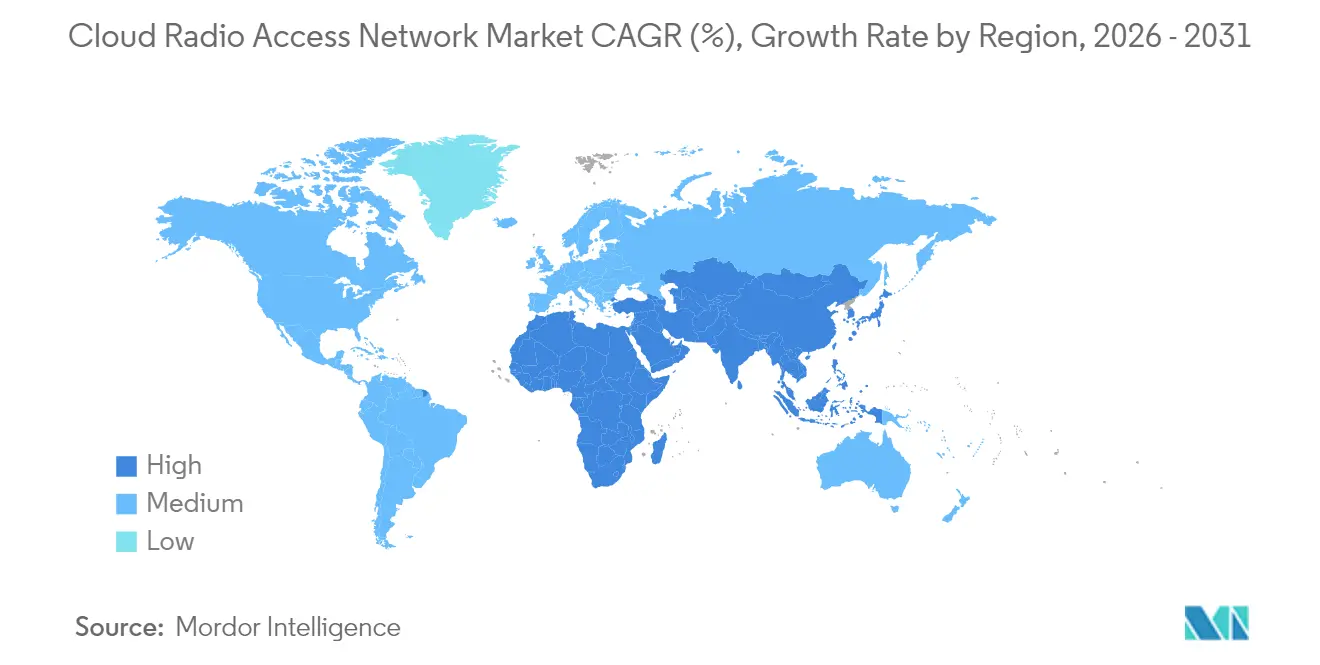
| Fastest Growing Market | Middle East and Africa |
| Largest Market | Asia Pacific |
| Market Concentration | Medium |
Major Players *Disclaimer: Major Players sorted in no particular order Image © Mordor Intelligence. Reuse requires attribution under CC BY 4.0. | |
Cloud Radio Access Network Market Analysis by Mordor Intelligence
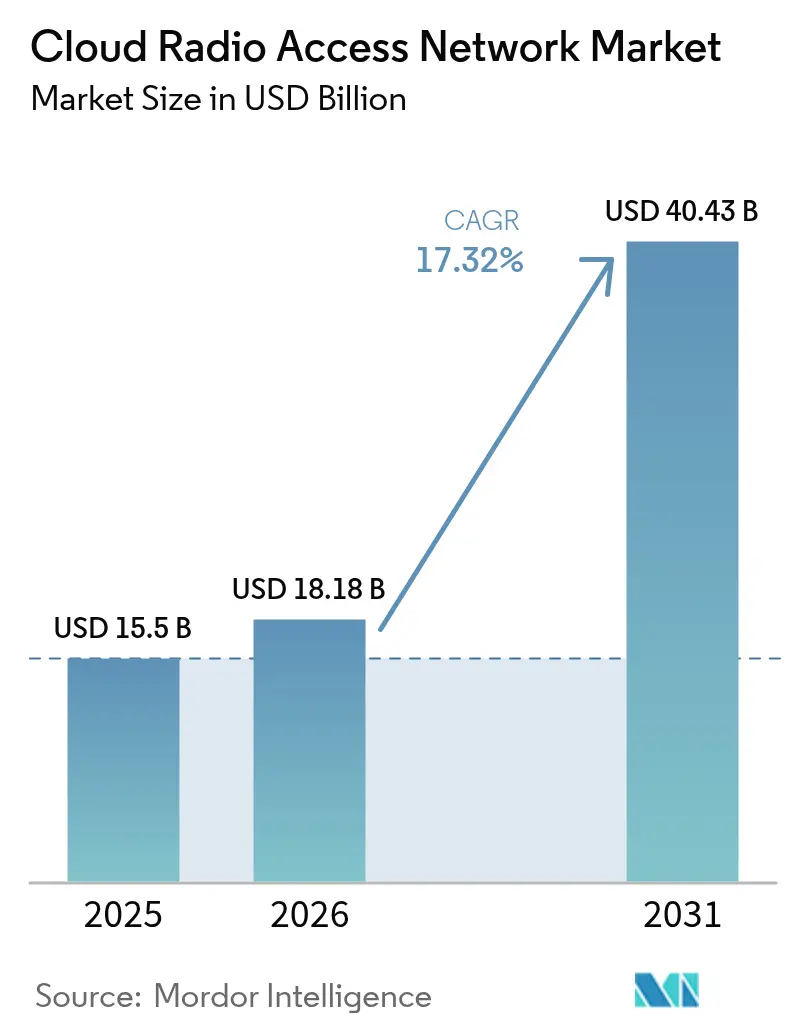
The Cloud Radio Access Network market size is expected to grow from USD 15.5 billion in 2025 to USD 18.18 billion in 2026 and is forecast to reach USD 40.43 billion by 2031 at 17.32% CAGR over 2026-2031.
Rapid 5G rollouts, the push for centralized baseband processing, and mounting pressure to trim network operating costs keep demand high. Operators are mapping out multi-layer coverage strategies in dense urban clusters, where pooling resources in the cloud has begun lifting cell-site throughput and spectrum utilization. Commercial proofs in the United States, Japan, and leading European capitals also indicate that AI-assisted scheduling can cut power draw across active radios, supporting sustainability targets alongside network modernization. Competition is intensifying as incumbent vendors defend their share against software-centric entrants, prompting a wave of partnerships that combine radio, compute, and silicon expertise to accelerate product road maps. While the cloud radio access network market benefits from supportive policy incentives, it still faces headwinds linked to spectrum release timetables and fronthaul bottlenecks that vary sharply by country.
Key Report Takeaways
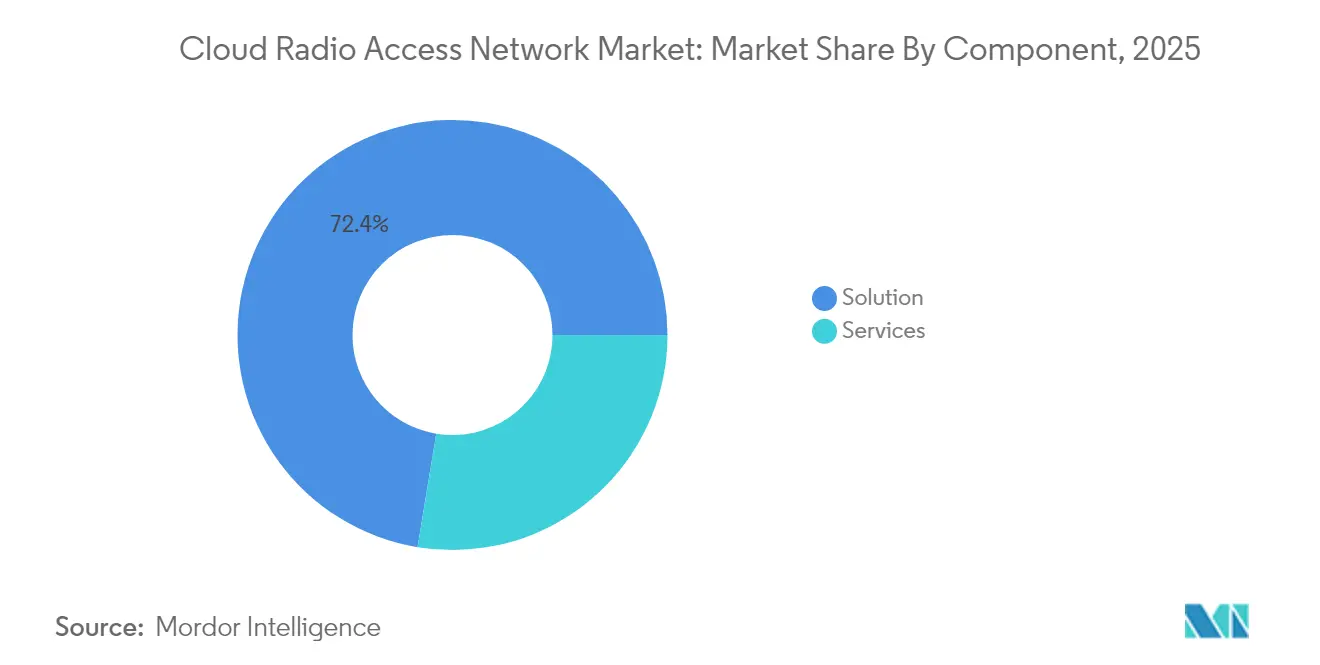
- By component, Solutions commanded 72.40% of the cloud radio access network market share in 2025, whereas Services are on track for the fastest 18.02% CAGR through 2031.
- By network type, 5G carried 61.80% revenue share in 2025; Open RAN is projected to expand at a 26.4% CAGR, topping segment growth.
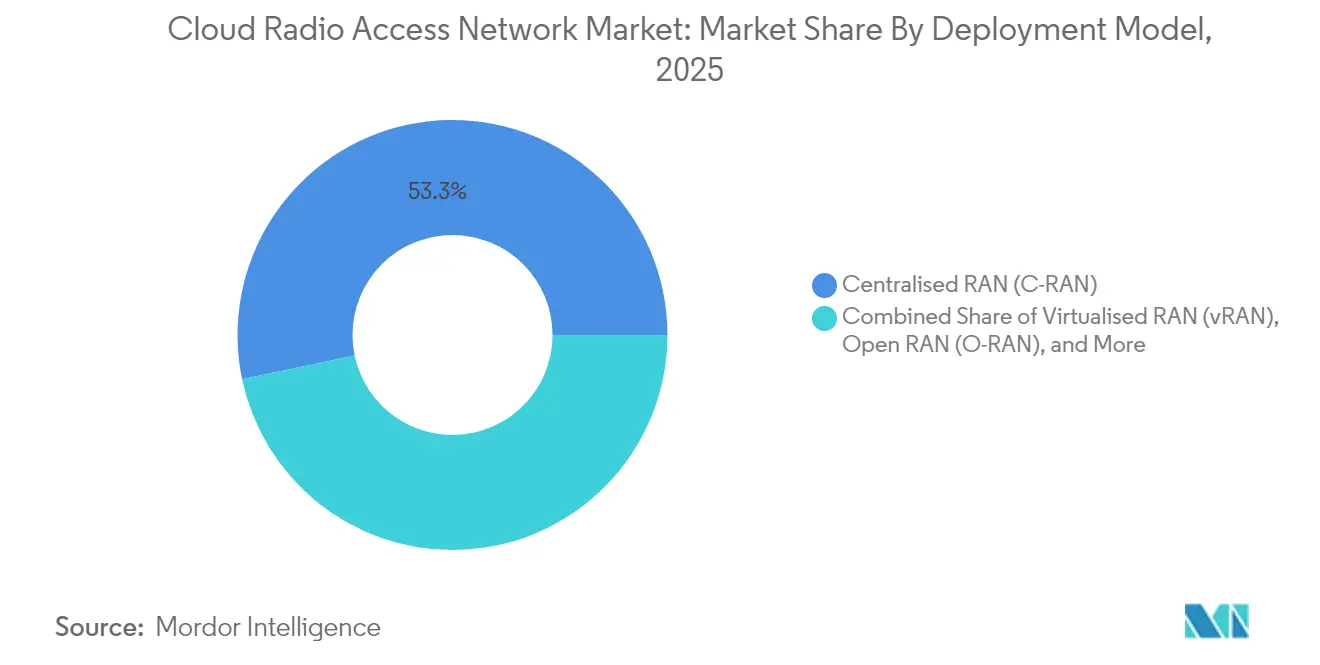
- By deployment model, Centralised RAN held 53.30% of the cloud radio access network market size in 2025, while Open RAN leads future growth at 26.4% CAGR.
- By end user, Mobile Network Operators accounted for 66.20% share in 2025, yet Enterprise networks are set to rise at a 18.93% CAGR.
- By geography, Asia Pacific captured 38.60% of the cloud radio access network market in 2025 and also shows the steepest 22.4% CAGR to 2031.
Note: Market size and forecast figures in this report are generated using Mordor Intelligence’s proprietary estimation framework, updated with the latest available data and insights as of 2026.
Market Trends and Insights
Drivers Impact Analysis of Cloud Radio Access Network Market*
| Driver | ( ~ ) % Impact on CAGR Forecast | Geographic Relevance | Impact Timeline |
|---|---|---|---|
| Rapid 5G rollouts and densification | +5.20% | Global, highest in Asia Pacific and North America | Medium term (2-4 years) |
| CAPEX and OPEX savings from a centralized baseband | +3.80% | Global | Short term (≤ 2 years) |
| Surging mobile-data traffic | +4.10% | Global, acute in metropolitan hubs | Medium term (2-4 years) |
| Network virtualization and SDN adoption | +2.90% | North America, Europe, advanced Asia Pacific markets | Medium term (2-4 years) |
| AI-driven RAN optimization adoption (under-the-radar) | +2.3% | North America, Europe, China, Japan, South Korea | Long term (≥ 4 years) |
| Energy-efficiency regulations push cloud RAN (under-the-radar) | +1.8% | Europe, North America, Japan | Long term (≥ 4 years) |
| Source: Mordor Intelligence | |||
Rapid 5G Rollouts and Densification Drive Architectural Change
Global operators are lighting up mid-band 5G layers and adding small cells to fill coverage gaps. In this environment, the cloud radio access network market delivers the centralized compute pools needed to manage thousands of radios without duplicating hardware. Field trials in Tokyo, Seoul, and New York show that dynamically shifting baseband workloads can raise utilisation by 30% and boost peak cell throughput by 25%. Commercial 5G standalone cores are now coordinating time-sensitive scheduling with virtual baseband functions, underscoring how cloud-native principles shorten feature release cycles. Large-scale deployments in China and the United States reveal that the same cloud site can host multiple radio generations, easing spectrum-refarming decisions and supporting progressive migration paths. These advantages spur continued investment, particularly where indoor coverage obligations require dense radio grids.
CAPEX and OPEX Savings Sustain the Business Case
The economic attraction of virtualized baseband pools is immediate: pooling reduces hardware duplication, trims real-estate expense, and simplifies upgrades. Vendor case studies from North America indicate that operators consolidating three legacy baseband types into a single cloud cluster recorded CAPEX cuts nearing one-third during year-one rollouts. OPEX declines follow as automation tools scale preventive maintenance and remote software updates. Energy bills fall when AI schedulers place lightly loaded radios in deep-sleep modes during off-peak periods, improving the network’s power-efficiency profile. These savings underpin aggressive 5G expansion plans, especially for carriers balancing dividend commitments with the need to enhance the quality of service. As consumption-based pricing models for public cloud gain traction, operators gain added flexibility to align spending with traffic peaks, reinforcing the appeal of cloud architecture.
Exponential Mobile-Data Growth Necessitates Architectural Innovation
Ericsson projects 6.3 billion 5G subscriptions by 2030, with 5G accounting for 80% of total mobile traffic[1]. This volume strains traditionally distributed RAN layouts, where baseband resources sit idle during demand lulls yet max out during peak events. The cloud radio access network market responds by shifting processing to central locations, allowing resource pooling across dozens of cell sites. Operators in Singapore and Stockholm reported a 20-30% uplink throughput lift after activating coordinated interference-management features enabled by pooled compute. Centralization further simplifies multi-band carrier aggregation, supporting video streaming and emerging XR services that escalate bandwidth requirements. As mobile-first economies pivot toward immersive applications, cloud RAN stands out as a scalable answer to unpredictable traffic bursts.
Network Virtualization and SDN Adoption Reshape Strategies
Core networks already run on cloud-native stacks, making the radio layer the next logical step toward full end-to-end elasticity. The O-RAN ALLIANCE confirms that most tier-one operators now operate virtualized RAN pilot clusters or early commercial sites[2]. Integrating RAN with broader SDN control frameworks lets engineering teams modify slicing policies in near real time, matching latency profiles to enterprise service-level agreements. Vendors have begun shipping containerized baseband functions deployable on generic servers, which harmonizes supply chains and lowers dependence on proprietary hardware. Early movers report that DevOps-style pipelines shorten software release lead times from quarters to weeks. Together, these factors support an ecosystem shift towards open interfaces, giving buyers greater bargaining power and stimulating healthy supplier competition across the cloud radio access network market.
Restraints Impact Analysis of Cloud Radio Access Network Market*
| Restraint | ( ~ ) % Impact on CAGR Forecast | Geographic Relevance | Impact Timeline |
|---|---|---|---|
| Spectrum scarcity & regulatory limits | -2.70% | Global, with higher impact in developing markets | Medium term (2-4 years) |
| Limited fronthaul fibre & latency challenges | -3.10% | Emerging markets, rural areas in developed markets | Short term (≤ 2 years) |
| Security & privacy risks in centralised architecture (mainstream) | -2.4% | North America, Europe, enterprise segments globally | Medium term (2-4 years) |
| Uncertain ROI in emerging markets (under-the-radar) | -1.8% | Latin America, Africa, Southeast Asia | Long term (≥ 4 years) |
| Source: Mordor Intelligence | |||
Spectrum Scarcity and Regulatory Limits Dent Momentum
Timely clearance and auction of mid-band spectrum remains a gating factor for nationwide 5G builds. The expiry of auction authority at the United States Federal Communications Commission in 2024 introduced uncertainty around future releases, slowing some carrier investment cycles[3]. Many emerging markets also grapple with opaque or politically driven allocation processes that delay turnkey deployment of 5G layers optimized for cloud RAN. Even where licenses are in place, guard-band conditions and power-level caps can restrict network layouts, forcing operators to rely on fragmented holdings that complicate radio planning. These realities moderate roll-out velocity and can postpone the point when pooling economics become compelling.
Limited Fronthaul Fibre and Latency Challenges Constrain Deployment
Centralizing the baseband demands high-capacity, low-latency fronthaul links. In rural North America and parts of Southeast Asia, insufficient fibre density compels operators to retain distributed baseband nodes, diluting pooling advantages. Cisco notes that packetized fronthaul architectures progress best where dark-fibre leases or utility rights-of-way lower trenching costs[4]. Where fibre reach remains sparse, carriers deploy adaptive compression or higher functional splits that relax latency budgets, but those options reduce some spectral-efficiency gains. Closing the gap will depend on coordinated public-private investment and wholesale neutral-host models that make high-bandwidth links affordable beyond metro cores.
*Our forecasts treat driver/restraint impacts as directional, not additive. The impact forecasts reflect baseline growth, mix effects, and variable interactions.
Cloud Radio Access Network Market Segment Analysis
By Component:
Services Unlock Value in Complex DeploymentsThe cloud radio access network market size derived from Solutions hit USD 11.22 billion in 2025, equal to 72.40% of segment revenue. Yet the Services market is expanding faster at an 18.02% CAGR as multi-vendor environments become the norm. Early greenfield installations chiefly required hardware and virtualized baseband licenses, but current brownfield upgrades demand integration, network optimization, and lifecycle support. Operators in Europe are signing multi-year managed-service contracts that bundle AI-driven performance analytics with DevOps enablement, letting internal teams prioritise new-service design. Consulting teams now guide spectrum-refarming, functional-split selection, and migration sequencing, roles critical for incumbent carriers balancing legacy 4G traffic and emerging private 5G use cases. Hardware providers respond by embedding open interfaces and reference automation workflows, blurring the line between product and professional service. In turn, this mix pushes the Services slice to account for a deeper share of the cloud radio access network market revenue pool as 2031 approaches.
A steady flow of innovation keeps the Solutions business vibrant. Silicon majors introduced integrated acceleration for beamforming and forward-error correction, lifting baseband capacity per rack unit by over 2× compared with 2023 blades. Radio suppliers complement these gains with lightweight Massive MIMO arrays tailored for rooftop and indoor settings. Such advancements compress the total cost of ownership while widening the addressable customer base, supporting consistent though moderate revenue growth on the Solutions side. The net result is a balanced landscape where software, silicon, and services each reinforce the transition to centrally orchestrated radio layers, widening adoption across incumbent and enterprise segments of the cloud radio access network market.

By Network Type:
5G Prevails as Open RAN Gains GroundIn 2025, the 5G tier commanded 61.80% of the overall cloud radio access network market revenue as carriers devoted capital to harness mid-band spectrum. Operators pivoted quickly to standalone architectures, which permit slicing and ultra-low-latency pipelines critical for Industry 4.0 workloads. Virtualized baseband pools make it feasible to run non-standalone 5G, LTE, and NR on common servers, letting carriers phase out 3G in favor of capacity upgrades. While 4G LTE still generates meaningful returns, its share declines each year as data-heavy consumer usage gravitates toward 5G bundles with subsidized devices.
Open RAN exhibits the fastest trajectory at a 26.4% CAGR through 2031, buoyed by high-profile commitments from North American and Asian tier-ones keen to diversify supply chains. The model’s open interfaces encourage best-of-breed combinations, but integration overhead remains considerable. Nevertheless, pilot results from live networks in Dallas and Seoul show that multi-vendor Massive MIMO stacks can reach spectral-efficiency parity with monolithic systems when orchestrated from a unified cloud platform. Regulatory support, such as grant programs from the United States government, offers added momentum. Collectively, these forces position Open RAN as a key disruptor, widening supplier diversity while intensifying competitive dynamics across the cloud radio access network market.
By Deployment Model:
Centralised RAN Sets Baseline, Open RAN AcceleratesCentralised RAN retained 53.30% share of the cloud radio access network market size in 2025, reflecting its maturity and ease of integration with existing transport topologies. Many operators adopt staged migration: fibre-rich urban clusters shift first, followed by suburban cells as backhaul upgrades complete. Open RAN deployment, however, brings a fresh cost curve. AT&T’s multiyear programme aims to carry 70% of traffic over open-capable platforms by 2026, anticipating both capital and operating cost relief. Early calculations from carriers in Europe suggest equipment savings above 40% versus proprietary stacks when volume thresholds are met.
Virtualized RAN on commercial off-the-shelf servers runs in parallel, supporting brownfield adaptations where complete openness is not yet feasible. Hybrid cloud RAN appears where fibre or power limits require local processing, blending edge-cloud instances with metro hubs. Orange publicly supports such a flexible stance, citing the need to balance spectrum reform with legacy site contracts. The result is a deployment mosaic that varies by geography, with greenfield entrants like Rakuten Mobile embracing full Open RAN, and incumbents layering virtualisation atop existing macro grids. This pluralism creates sustained spending opportunities along the whole value chain inside the cloud radio access network market.
By End User:
Enterprises Energize Demand Beyond TelcosMobile Network Operators generated 66.20% of the cloud radio access network market revenue in 2025, but private-wireless expansion lifts enterprise wallet-share quickly. Manufacturers, hospitals, and logistics hubs deploy on-premises 5G cores seated next to cloud RAN nodes to guarantee deterministic performance. These customers value indoor coverage, data sovereignty, and low-latency control loops that Wi-Fi cannot match. With vertical-specific applications emerging, solution providers add pre-integrated security gateways and network-slice templates, reducing setup time and easing IT integration.
Government and public-safety agencies pursue resilient campus coverage, often in partnership with neutral-host tower companies that pool capex across multiple tenant networks. TowerCos views cloud RAN as a lever to host multi-operator traffic without duplicating electronics, widening their services portfolio. This shared-infra model also accelerates rural coverage, a policy priority in many emerging economies. Collectively, these patterns lift the Enterprise CAGR to 18.93%, ensuring that non-telco clients become a central growth pillar for the cloud radio access network market while reinforcing innovation feedback loops into vendor road maps.
Geography Analysis
APAC Cloud Radio Access Network Market
Asia Pacific dominates the cloud radio access network market with 38.60% revenue share in 2025 and leads in growth with a 22.4% CAGR. Aggressive 5G rollouts in China, Japan, and South Korea rely on high-density small-cell grids linked to large regional data centres. Operators in Shenzhen and Seoul already operate commercial open-interface clusters in core business districts, showcasing real-time spectrum pooling for video streaming during peak festivals. Governments provide supportive policy frameworks, such as spectrum fee rebates for virtualisation investments. Vendor ecosystems flourish around open testbeds, and joint ventures like the OREX initiative target export opportunities, cementing the region’s leadership.
North America Cloud Radio Access Network Market
North America ranks second in terms of revenue. United States carriers earmarked multibillion-dollar budgets to swap legacy hardware for open-capable radios by 2026. Federal grants under the CHIPS and Science Act co-fund silicon research that empowers AI-based scheduling engines, giving domestic supply chains greater resilience. Early deployments in Las Vegas and Seattle prove that GPU-accelerated cloud nodes can meet stringent millisecond-level latency targets for XR gaming and industrial automation. Canadian operator collaborations with Finnish and Korean vendors extend the regional innovation sphere, highlighting cross-border technology exchange that supports the wider cloud radio access network market.
Europe Cloud Radio Access Network Market
Europe accelerates adoption through a blend of regulatory mandates and competitive necessity. Operators in the United Kingdom, Germany, and Spain rolled out the first commercial 5G Open RAN macro sites, supported by public test labs that certify interoperability among radios, basebands, and management systems. The European Union dedicates funding tranches to 5G and 6G network R&D, which bolsters an academic–industry pipeline for RAN software talent. Despite lagging standalone 5G coverage, incumbents pursue fast-track plans to cloudify their radio layers, citing lower total cost of ownership and faster service innovation as key motivators. Ongoing infrastructure programs upgrade fibre backbones through rural corridors, which will remove a historic bottleneck and further expand the cloud radio access network market footprint across the region.
Regulatory Landscape
Cloud RAN deployments sit at the intersection of telecom licensing and cloud security compliance, and spectrum policy and supply-chain rules can materially affect rollouts. In the United States, the lapse of Federal Communications Commission auction authority in 2024 introduced uncertainty around future spectrum release timetables, which can slow the pace of nationwide 5G layers that benefit most from centralized baseband pooling.
Security-led oversight is tightening alongside Open RAN adoption. In April 2026, the FCC adopted rules on covered authorizations (published in the Federal Register), with reporting requirements becoming effective June 9, 2026, increasing compliance obligations tied to national security and foreign adversary control for network authorizations. In parallel, industry standards bodies that influence procurement and interoperability continue to harden requirements, including ETSI-published specifications and O-RAN ALLIANCE work that aligns open-interface implementations with stronger baseline security expectations.
Value Chain Analysis
The cloud RAN value chain begins with silicon and compute (CPUs, accelerators, and GPUs), server platforms, and cloud-native software foundations (OS, container runtimes, and Kubernetes-based stacks), then moves into virtualized baseband, orchestration, and RAN intelligent control functions. Equipment vendors, including Ericsson, Nokia, Samsung, Huawei, and ZTE, integrate these layers with radios and transport. Hyperscaler and platform ecosystems, along with specialist software players, provide the O-Cloud and SMO building blocks that enable disaggregation. Downstream, operators (mobile network operators, enterprises, and neutral-host providers) purchase solutions and multi-year professional and managed services for integration, tuning, security hardening, and lifecycle operations.
Interoperability standards and multi-vendor integration determine where value accrues across the chain. O-RAN interface alignment (including A1, E2, O1, and O2) and O-Cloud definitions have become practical procurement requirements, reinforced by O-RAN ALLIANCE Specification Release 5 and related ETSI technical specifications that emphasize production readiness and security baselines. Recent operator-vendor demonstrations, including Ericsson and AT&T validating AI-native link adaptation on a Cloud RAN stack using Intel Xeon 6 SoC (March 2026), indicate that performance gains increasingly depend on tight coupling between RAN software, silicon features, and automation. That dynamic raises the importance of system integration, test and validation, and managed services for scaling deployments.
Competitive Landscape
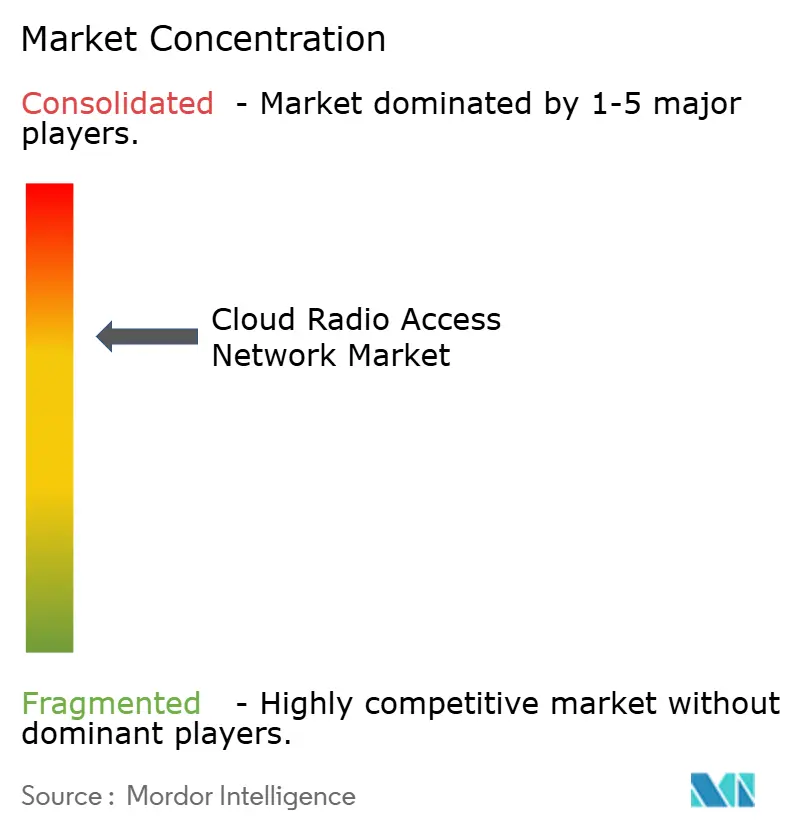
The cloud radio access network market shows moderate concentration, with the top five suppliers controlling a majority share outside China. Huawei secures leadership through scale deployments with domestic carriers, reinforcing its stronghold in emerging markets. Ericsson claims a roughly 37% share outside China, winning contracts with tier-one operators in North America and Europe that favour open-interface readiness. Nokia follows at close distance, leveraging broad service portfolios and recent optical-network acquisitions to integrate transport and radio solutions into cohesive packages.
Samsung rises as a strategic challenger by combining in-house silicon with Massive MIMO radios optimized for Open RAN. Its presence in the United States greenfield builds signals broader acceptance of diversifying supply chains. Software innovators Mavenir and Rakuten Symphony target disaggregation layers where value shifts towards orchestration and automation. They differentiate through cloud-native microservices and marketplace models that simplify the onboarding of third-party apps. Partnerships proliferate chipset vendors team with server OEMs, radio makers team with public cloud hyperscalers, and system integrators providing turnkey blueprints for enterprise verticals. AI sits at the heart of many new offers, where inference engines predict traffic loads and adjust power states. The result is a rich field of rivalry, cooperation, and co-opetition that propels ongoing advancement across the cloud radio access network market.
Cloud Radio Access Network Industry Leaders
-
Cisco System Inc.
-
Nokia Corporation
-
Huawei Technologies Co. Ltd.
-
Telefonaktiebolaget LM Ericsson
-
Intel Corporation
- *Disclaimer: Major Players sorted in no particular order
Cloud Radio Access Network Market Companies Covered in this Report
- Huawei Technologies Co. Ltd.
- Nokia Corporation
- Telefonaktiebolaget LM Ericsson
- Cisco Systems Inc.
- Samsung Electronics Co. Ltd.
- ZTE Corporation
- Intel Corporation
- Fujitsu Limited
- NEC Corporation
- Mavenir Systems Inc.
- Parallel Wireless Inc.
- Rakuten Symphony
- Altiostar (Rakuten)
- CommScope Holding Co. Inc.
- Casa Systems Inc.
- Airspan Networks Inc.
- Hewlett Packard Enterprise (HPE)
Market Opportunities and Future Outlook
AI-integrated RAN operations are a concrete whitespace where cloud RAN architectures translate pooled compute into measurable radio performance and energy-management outcomes. A visible proof point is Ericsson and AT&T demonstrating AI-native link adaptation on a Cloud RAN stack using Intel Xeon 6 SoC in March 2026, reporting up to a 20% throughput increase versus rule-based methods. This supports operator interest in software-driven gains without forklift radio swaps. Separately, O-RAN ALLIANCE Specification Release 5 formalized O-Cloud lifecycle management and energy-saving features for open radio units, expanding the scope for automation, security, and optimization toolchains across multi-vendor deployments.
Enterprise and hybrid deployments also broaden opportunity for vendors and integrators that can simplify design choices across centralized, virtualized, and Open RAN variants, particularly when fronthaul constraints prevent full centralization. Nokia’s positioning around anyRAN and broader server and partner ecosystems, including collaborations tied to enterprise deployment options and cloud-native platforms, reflects buyer demand for flexible blueprints spanning on-premises edge, regional data centers, and mixed-vendor stacks. As more operators move from pilots into scaled rollouts, integration, observability, security compliance, and CI/CD style upgrades should support a larger services monetization pool, especially in brownfield networks that must keep 4G/LTE and 5G running concurrently while adding open interfaces and AI-driven automation.
Recent Industry Developments in Cloud Radio Access Network Market
- March 2026: Ericsson and AT&T demonstrated AI-native Link Adaptation on a Cloud RAN stack powered by Intel Xeon 6 SoC, reporting up to a 20% throughput uplift versus rule-based methods. The result highlights how AI features are moving into the RAN data plane and raises the importance of optimized silicon-software co-design for cloud-native baseband performance.
- June 2025: Ericsson completed a 5G Cloud RAN call using an HPE ProLiant Compute DL110 Gen12 server and Intel Xeon 6 SoC. The milestone strengthened the validation path for Cloud RAN on commercial off-the-shelf compute, supporting broader supplier diversity across servers and infrastructure choices.
- December 2024: Nokia and du deployed the first commercial 5G standalone Cloud RAN solution in the Middle East and Africa using Dell PowerEdge XR8620 servers and Red Hat OpenShift. The commercial go-live expanded the geographic footprint of Cloud RAN outside early adopter markets and reinforced the role of cloud-native platforms in carrier-grade RAN deployments.
Cloud Radio Access Network Market Report Scope and Research Methodology
Market Definition and Coverage
For this report, the cloud radio access network (C-RAN) market is defined as the revenue tied to shifting radio baseband processing from distributed sites into pooled, virtualized, or cloud resources that support mobile and private networks, including related software, infrastructure, and managed services.
Scope exclusions: We exclude pure telecom core cloud functions and traditional distributed RAN hardware that does not use cloud or virtualization for baseband processing.
Segments Covered in This Report
- By Component
- Solution
- Services
- Professional
- Managed
- By Network Type
- 5G
- 4G
- LTE
- 3G (EDGE)
- By Deployment Model
- Centralised RAN (C-RAN)
- Virtualised RAN (vRAN)
- Open RAN (O-RAN)
- Hybrid Cloud RAN
- By End User
- Mobile Network Operators
- Enterprises
- Government and Public-Safety
- Neutral Host/TowerCos
- By Geography
- North America
- United States
- Canada
- Mexico
- Europe
- United Kingdom
- Germany
- France
- Rest of Europe
- Asia-Pacific
- China
- Japan
- South Korea
- India
- Rest of Asia-Pacific
- South America
- Brazil
- Argentina
- Rest of South America
- Middle East and Africa
- Middle East
- UAE
- Saudi Arabia
- Rest of the Middle East
- Africa
- South Africa
- Rest of Africa
- Middle East
- North America
Data Sources, Market Sizing, and Validation
Desk Research
Desk research was used to set the starting boundaries and to collect measurable demand and supply signals that can be checked repeatedly. Public sources such as the ITU, GSMA, and the FCC were reviewed for mobile subscription trends, spectrum actions, and rollout timing indicators that shape RAN investment.
We also referenced sources such as 3GPP releases for technology milestones, trade association and standards updates on Open RAN and virtualization, and public financial filings and investor decks for operator capex direction and vendor revenue commentary. Where needed, paid subscriptions for company financials and intelligence, news and financials, and patent databases were used to confirm timelines and to avoid double counting adjacent software categories. These examples are not exhaustive, and many other public and paid sources were also reviewed for data collection, validation, and clarification.
Primary Interviews and Surveys
Primary interviews and surveys were completed with a mix of mobile operators, enterprise network teams, tower and neutral host stakeholders, and ecosystem participants involved in deployment, integration, and operations. Because this is a global market, we checked inputs across APAC, EMEA, and the Americas to confirm adoption pace by network generation and to sanity check assumptions that were less visible in public data.
Distribution of primary research fieldwork respondents
| Company type | Respondent position | Region |
|---|---|---|
| Top tier: 30% | CXOs: 12% | APAC: 40% |
| Mid tier: 55% | Functional/Unit leaders: 29% | EMEA: 37% |
| Smaller Players: 15% | Managers: 59% | Americas: 23% |
Market-Sizing & Forecasting
Sizing started with a top-down approach where mobile network rollout activity and virtualization adoption were translated into an addressable C-RAN spend pool, and then filtered by what is actually deployed as centralized, virtualized, or Open RAN architectures. To keep totals grounded, we corroborated outputs with selective bottom-up checks, such as sampled deployments multiplied by typical per-site or per-sector spending, plus channel feedback on integration and managed service attach rates.
Key model inputs included indicators such as 4G and 5G site additions, spectrum auction and refarming timelines, split of centralized versus distributed architectures, expected share of virtualized baseband, and typical cost mix across software, infrastructure, and services. Where public numbers were incomplete, gaps were handled by using regional proxies from comparable operator profiles, then adjusting with interview feedback so unrealistic step changes were avoided.
Forecasting relied on scenario analysis supported by expert views on 5G densification timing, Open RAN readiness, and capex prioritization, which were then mapped to revenue timing by region. Assumptions were kept explicit so a junior analyst can rerun the model when a new spectrum award, policy shift, or major rollout plan changes the outlook.
Data Validation & Update Cycle
Validation was done through multiple checks, starting with internal consistency tests across regions, network generations, and the software versus infrastructure mix. We also compared the modeled totals against independent signals like operator capex commentary, announced rollout footprints, and the expected pace of virtualization adoption, and then reviewed any outliers before sign-off.
Reports are refreshed annually, and interim updates are made when material events occur, such as major policy changes, sharp shifts in operator spending, or meaningful changes in Open RAN deployment plans. Before delivery, a final analyst pass is completed so clients receive the latest updated view with assumptions aligned to current market conditions.
Mordor Intelligence's Cloud Radio Access Network Market Size Measured Against Other Published Estimates
Published estimates for cloud radio access network sizing often differ because the market boundary is not consistent, and because base years and growth windows are not aligned. Small choices, like treating Open RAN as a separate market or rolling it into cloud RAN, can move the total meaningfully.
By tracking network generation rollouts and refreshing the inclusion rules, Mordor Intelligence keeps the model focused on revenue linked to centralized, virtualized, and Open RAN architectures, rather than counting broader telecom cloud or legacy distributed RAN spend. Gaps also come from how quickly prices are assumed to fall, how managed services are treated, and whether currency timing and refresh cadence reflect recent deployment and capex changes.
Benchmark comparison
| Source | Market Size | Gaps in Research Methodology |
|---|---|---|
| Mordor Intelligence | USD 18.18 B (2026) | |
| Global Consultancy A | USD 25.64 B (2025) | Uses an earlier anchor year and appears to include a wider centralized RAN spend pool, which can pull in adjacent network modernization budgets beyond cloud and virtualization specific deployments. |
| Industry Publisher B | USD 23.90 B (2024) | Starts from a 2024 base and applies a broader component lens (including infrastructure and services) with fewer stated exclusions, which can raise totals by blending in traditional RAN infrastructure categories. |
The comparison shows that most of the spread is explained by base year selection and how tightly the scope is tied to cloud and virtualization driven RAN spend. With clear inclusion and exclusion rules and repeated cross checks against rollout and capex signals, the estimate stays traceable to practical demand drivers and can be updated without changing the logic each year.
Key Questions Answered in the Report
What is the current size of the cloud radio access network market in 2026?
The market stands at USD 18.18 billion in 2026.
What compound annual growth rate (CAGR) is projected for the cloud radio access network market through 2031?
Analysts forecast a 17.32% CAGR for 2026-2031.
Which region leads the cloud radio access network market, and how fast is it growing?
Asia Pacific holds 38.60% of 2025 revenue and is expanding at a 22.4% CAGR to 2031.
Which network type is expected to grow the fastest within cloud RAN deployments?
Open RAN shows the highest momentum with a 26.4% CAGR projected for 2026-2031.
How much cost relief can operators achieve by adopting cloud RAN architectures?
Independent studies indicate up to 49% first-year CAPEX savings and 31% cumulative OPEX savings over five years versus traditional distributed RAN.
What are the chief hurdles that could slow cloud RAN rollouts?
Spectrum scarcity, regulatory delays, limited fronthaul fiber, and strict latency requirements remain the primary obstacles.