
Cloud-based Solutions For Drug Discovery, Development And Manufacturing Market Size and Share
Market Overview
| Study Period | 2020 - 2031 |
|---|---|
| Forecast Data Period | 2026 - 2031 |
| Historical Data Period | 2020 - 2024 |
| Growth Rate | 12.32 % |
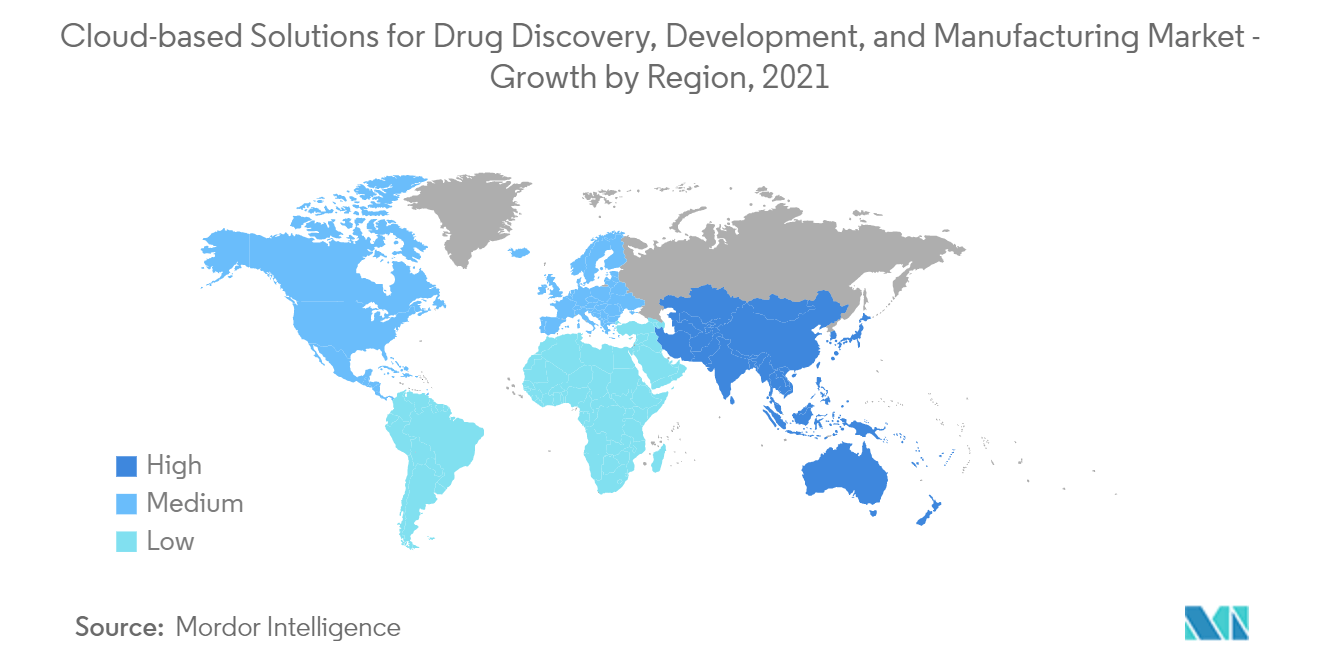
| Fastest Growing Market | Asia-Pacific |
| Largest Market | North America |
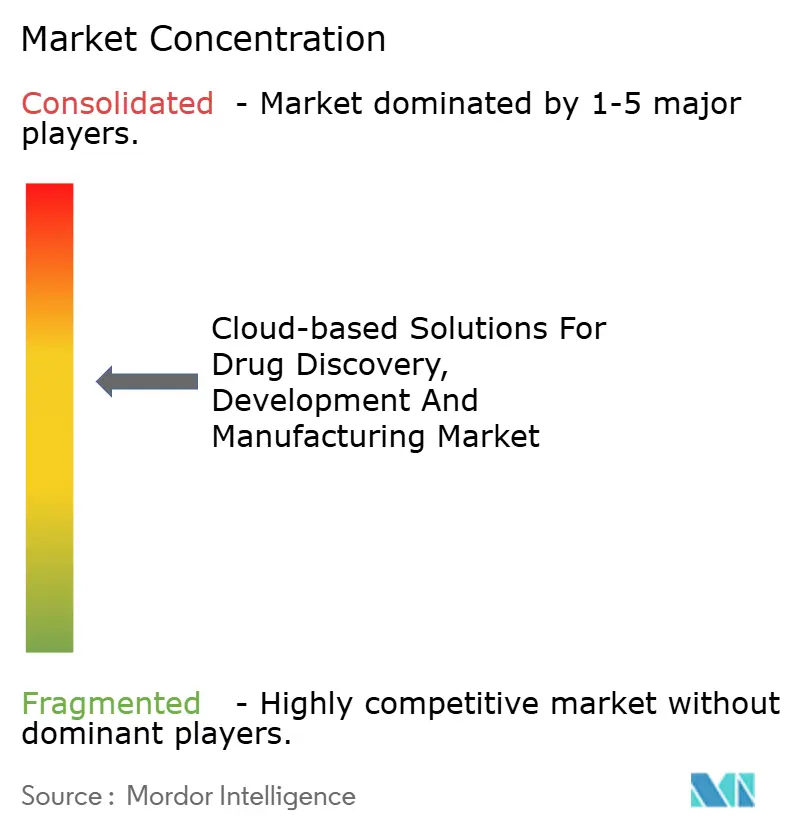
| Market Concentration | Medium |
Major Players *Disclaimer: Major Players sorted in no particular order Image © Mordor Intelligence. Reuse requires attribution under CC BY 4.0. | |
Cloud-based Solutions For Drug Discovery, Development And Manufacturing Market Analysis by Mordor Intelligence
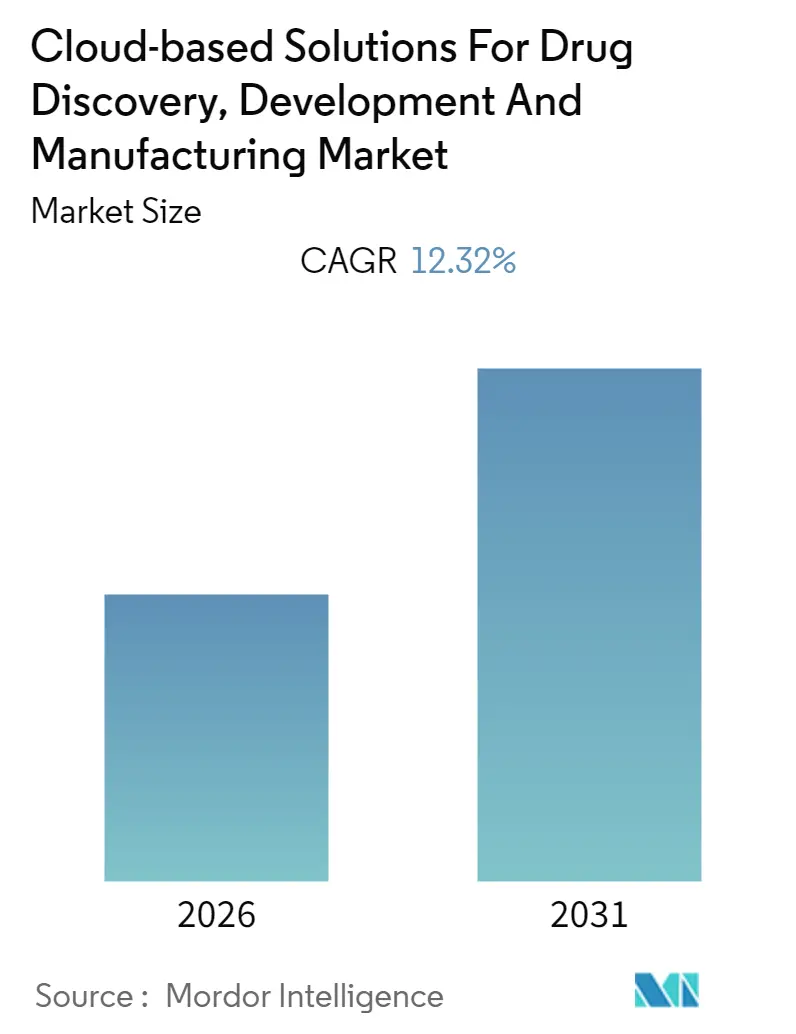
Cloud-based Solutions For Drug Discovery, Development And Manufacturing Market size in 2026 is estimated at USD 7.27 billion, growing from 2025 value of USD 6.47 billion with 2031 projections showing USD 12.99 billion, growing at 12.32% CAGR over 2026-2031.
As the impact of the COVID-19 pandemic grows worldwide, biotech and pharmaceutical companies, along with other healthcare organizations, have launched intensive research to learn more about the novel coronavirus. Cloud technology has been one of the most important tools for understanding and discovering the virus. The development of vaccines and drugs against it are expected to significantly impact the market. For example, according to a June 2020 article published by Ashima Gupta and Joe Corkery, Google Cloud user Schrödinger has partnered with Takeda, Novartis, Gilead Sciences, and WuXi AppTec in a charitable effort to share ideas, resources, and data to find an antiviral treatment for the coronavirus. Schrödinger, whose physics-based software platform facilitates the development of high-quality, unique compounds for therapies and materials, will use Google Cloud credits to rapidly explore and test potential new drugs under the agreement. In addition, high investment by pharmaceutical companies in the anti-coronavirus drug discovery and development initiative is expected to further influence cloud-based solutions for drug discovery, development, and manufacturing.
Increasing investment in drug discovery, development, and manufacturing by pharmaceutical, biopharmaceutical, and other entities and the increasing adoption of cloud services for these activities are the major drivers of the market growth. The adoption of cloud-based services for drug discovery, development, and manufacturing is growing due to cloud technology's various advantages. For example, cloud-based services could help streamline operations and develop business cases to determine whether a drug is likely to be useful and financially viable or not. Also, according to a research study published by Olivier J. Wouters et al., in a March 2020 base case analysis, the median capitalized R&D investment to bring a new drug to market was estimated at $985.3 million, with an average investment of $1335.9 million and estimates varying across therapeutic areas, with cancer drug development costs being the highest. These high costs associated with the research and development of a new drug can be significantly reduced by deploying cloud services as it speeds up the drug discovery and development process and minimizes the chance of errors. Due to this factor, the adoption of cloud services in drug discovery, development, and marketing is increasing, which is expected to drive growth in the market under review over the forecast period. For example, in December 2021, Pfizer Inc. and Amazon Web Services (AWS) agreed to collaborate on the development of new cloud technologies that could revolutionize the way new drugs are researched, manufactured, and distributed for clinical trials.
Further, increasing investment in drug discovery and development with the increasing prevalence of various diseases is expected to positively impact the growth of the market under study. For example, according to a report published by the Pharmaceutical Research and Manufacturers of America (PhRMA) in September 2021, biopharmaceutical companies invested more than a trillion dollars in research and development in the last decade alone, including a record year in 2020, when PhRMA member companies alone invested roughly 91 billion USD. Furthermore, according to the same source, more than 8,000 drugs were in development worldwide in 2021, with 74 percent potentially being first-in-class treatments or completely new ways to treat diseases. Due to heavy investments in the drug discovery and development initiative coupled with the benefits offered by cloud-based solutions, the adoption of cloud-based services in drug discovery, development, and manufacturing is expected to increase during the forecast period, fueling the growth of the studied market.
However, the high initial cost of implementation and deployment of cloud solutions and cybersecurity concerns are expected to restrain growth in the cloud-based solutions for drug discovery, development, and manufacturing market during the forecast period.
Note: Market size and forecast figures in this report are generated using Mordor Intelligence’s proprietary estimation framework, updated with the latest available data and insights as of 2026.
Global Cloud-based Solutions For Drug Discovery, Development And Manufacturing Market Trends and Insights
Private Cloud is Expected to Hold a Significant Share in the Cloud Type Segment in the Studied Market during the Forecast Period
A single organization or entity owns and operates private clouds. In a private cloud environment, the hardware, software, and associated infrastructure resides either in the organization's data center or a regulated service provider environment. Private clouds are preferred by government agencies, financial organizations such as banks, mid-sized to large companies, and any other entity involved in sensitive data such as drug discovery and development. This segment is expected to account for a significant market share under study.
Private clouds differ from public clouds in data control and flexibility; by definition, private clouds cannot be offered as a service. Microsoft, HP Data Centers, Ubuntu, Elastra-private cloud, and others are well-known examples of private cloud types. Other factors expected to drive growth in the private cloud segment include low deployment costs, greater efficiency and control over the cloud, ease of customization as needed, and greater security and privacy. And collectively, as a result of these factors, it is expected that the use of private cloud will increase during the forecast period of the study, and the segment will grow in the cloud solutions for discovery, development, and production market during the forecast period of the study.
North America is Expected to Hold a Significant Share in the Studied Market Over the Forecast Period
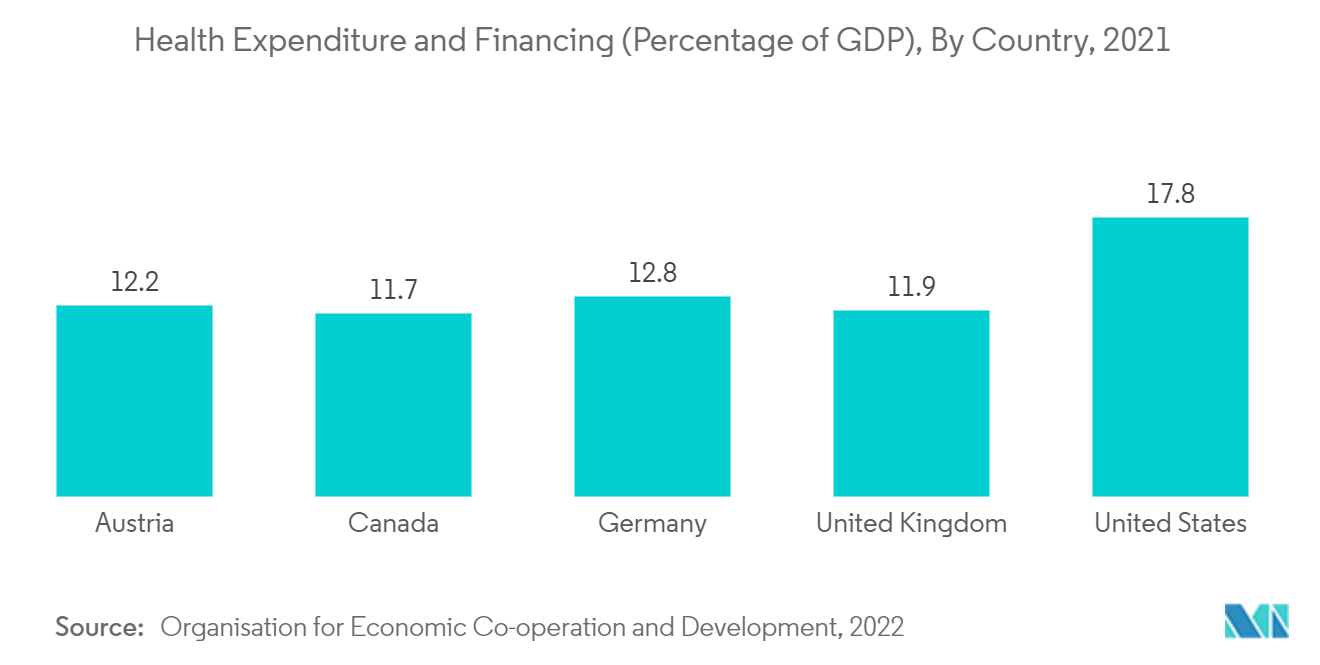
Geographically, the North American region (including the United States, Canada, and Mexico) is expected to account for a significant share of the cloud-based drug discovery, development, and manufacturing solutions market during the forecast period due to the presence of a large pharmaceutical market and high investment in development and discovery drugs by some of the largest pharmaceutical companies located in the region. For example, according to a 2021 report by the European Federation of Pharmaceutical Industries and Associations, the North American market, which includes the United States and Canada, had the largest share of the global pharmaceutical market at 49%, ahead of Europe, China, and Japan. Thus, due to the high demand for drugs in the region, investment in drug discovery, development, and manufacturing is significantly higher than in other regions, and this is expected to increase cloud services in the region, leading to growth in the researched market in North America during the forecast period of the study.
In the North American region, the United States is expected to account for a significant share of cloud-based solutions for drug discovery, development, and manufacturing market over the years due to factors such as increasing R&D investment by pharmaceutical and other companies and increasing adoption of cloud-based solutions for drug discovery, development, and manufacturing, which is expected to drive growth in the United States market under review.
In addition, new product launches, a collaboration between users and providers, and mergers and acquisitions are further expected to have a significant positive impact on the growth of the study market in the United States. For example, in March 2021, Cleveland Clinic and IBM entered into a landmark 10-year partnership agreement to support health and life sciences research. As part of the agreement, the Cleveland Clinic Global Center for Pathogens and Human Health Research will be built using IBM Hybrid Cloud, High-Performance Computing, Artificial Intelligence, and Quantum Computing technologies.
Additionally, in June 2022, Merck launched the Merck Digital Sciences Studio (MDSS) to enable the generation of innovative technologies for drug discovery and development. MDSS will support early-stage biomedical startups with direct investment, access to powerful Azure Cloud computing, and opportunities to pilot their technologies in collaboration with discovery and clinical scientists from Merck. Therefore, due to the above-mentioned factors, the United States is expected to have a significant share in the cloud-based solutions for drug discovery, development, and manufacturing market during the forecast period of the study in the North American region.
Competitive Landscape
The cloud-based solutions for drug discovery, development, and manufacturing market is fairly competitive with several global market players. With the technological advancements and funding, the new entrants in the market are expected to increase the competitive landscape in the studied market over the forecast period of the study. Some key players in the cloud-based solutions for drug discovery, development, and manufacturing market are International Business Machines (IBM) Corporation, Oracle, Amazon Web Services, Google, and Tata Consultancy Services, among others.
Cloud-based Solutions For Drug Discovery, Development And Manufacturing Industry Leaders
-
Amazon Web Services
-
Accenture
-
Tata Consultancy Services
-
Oracle
-
International Business Machines (IBM)
- *Disclaimer: Major Players sorted in no particular order
Market Opportunities and Future Outlook
Enterprise-scale deployments that link R&D, clinical operations, and manufacturing on a shared cloud data and AI backbone are widening the market scope beyond standalone discovery tools. A clear proof point is the April 2026 Merck (MSD) and Google Cloud partnership, positioned as an up to USD 1 billion multi-year investment to deploy an agentic AI platform across R&D and manufacturing functions. It also highlights the demand for secure, governed cloud environments that can operationalize AI within regulated workflows.
Regulatory and industry alignment around AI and GxP responsibilities is opening room for vendors that package compliance into cloud-native platforms and validation toolkits. In January 2026, the EMA and FDA published common principles for good AI practice across the medicines lifecycle, while ISPE GAMP guidance outlines shared responsibility models for regulated users and cloud providers (for example, AWS, Azure, and Google Cloud). This supports opportunities in private and hybrid cloud deployments for sensitive data, paired with GMP-oriented training and execution layers such as DeepHow PharmaCloud (general availability announced in January 2026) and cloud ERP and quality integration programs such as Chanelle Pharma's March 2026 SAP S/4HANA Cloud (private edition) initiative aimed at manufacturing excellence.
Recent Industry Developments
- July 2026: Accenture and Bristol Myers Squibb scaled generative AI use across R&D and supply operations, reporting implementation of more than 30 solutions including a clinical trial accelerator (Workbench) focused on standardizing operational data. This underscores how cloud-based platforms are being used to industrialize AI beyond pilots, with governance and auditability built into development workflows.
- August 2025: Unilab, Inc. selected Tata Consultancy Services (TCS) for a cloud-led enterprise modernization program spanning core business systems across its manufacturing and distribution network. The engagement reflects ongoing demand from pharma manufacturers for cloud migration and systems integration to support end-to-end visibility and quality-focused operations.
- October 2024: Accenture collaborated with and invested in 1910 Genetics to combine AI drug discovery capabilities with scalable infrastructure for biopharma use cases. The partnership reinforced the vendor ecosystem for cloud-delivered discovery platforms by linking model development with deployable enterprise-grade compute and data management.
Research Methodology Framework and Report Scope
Market Definition and Coverage
This market tracks revenue earned from cloud-based software and cloud services used to run, manage, and store workflows across drug discovery, drug development, and pharmaceutical manufacturing, including regulated data environments. We count spending by pharma, biotech, and outsourcing partners when the solution is delivered through a cloud deployment.
Scope exclusions: On-premise-only software licenses and general-purpose IT infrastructure that is not purchased for life science R&D or manufacturing use cases are excluded.
Segmentation Overview
- By Service Type
- Software as a Service (SaaS)
- Platform as a Service (PaaS)
- Infrastructure as a Service (IaaS)
- By Cloud Type
- Public Cloud
- Private Cloud
- Hybrid Cloud
- By Application
- Drug Discovery & Development
- Drug Manufacturing
- By End User
- Biotechnology and Pharmaceutical Companies
- Contract Research Organizations (CRO)
- Others
- Geography
- North America
- United States
- Canada
- Mexico
- Europe
- Germany
- United Kingdom
- France
- Italy
- Spain
- Rest of Europe
- Asia-Pacific
- China
- Japan
- India
- Australia
- South Korea
- Rest of Asia-Pacific
- Middle-East and Africa
- GCC
- South Africa
- Rest of Middle-East and Africa
- South America
- Brazil
- Argentina
- Rest of South America
- North America
Data Sources, Market Sizing, and Validation
Desk Research
Desk research was used to set the market boundary and to build a reliable starting dataset before we moved to interviews. We referred to public sources such as the US FDA and EMA guidance libraries (for validated systems expectations), clinical trial registries (to understand development activity), and the World Bank and OECD indicators (to normalize country level R&D and manufacturing intensity). We also used sources such as the USP and peer-reviewed journals for signals on data integrity, quality systems, and digital manufacturing practices that influence cloud adoption.
Along with that, we reviewed company filings, annual reports, product collateral, and trusted press coverage to map solution categories and typical buying centers. In a few places, paid subscriptions were used for company financial intelligence, patents, and news screening so that revenue attribution and product mapping stayed consistent. The desk research sources cited here are illustrative only, and many other references were also used to collect data, validate assumptions, and clarify open questions during the analysis.
Primary Interviews and Surveys
Primary work focused on confirming what gets counted as a cloud solution in real buyer budgets, and how spend is split across discovery, development, and manufacturing teams. We spoke with a mix of pharma and biotech users, outsourcing partners, and solution providers, and inputs were also gathered across major regions so assumptions like pricing, compliance scope, and deployment mix could be checked and then corrected where needed.
Distribution of primary research fieldwork respondents
| Company type | Respondent position | Region |
|---|---|---|
| Top tier: 30% | CXOs: 12% | APAC: 49% |
| Mid tier: 48% | Functional/Unit leaders: 29% | EMEA: 30% |
| Smaller Players: 22% | Managers: 59% | Americas: 21% |
Market-Sizing & Forecasting
Our core model is built using a top-down approach where the demand pool is reconstructed from life sciences digital spend and then filtered by cloud adoption across discovery informatics, development data platforms, and manufacturing quality and operations systems. To keep totals realistic, selective bottom-up checks were also run using supplier revenue splits, sampled price-per-user or price-per-workload patterns, and channel discussions, and then the overlaps were removed so the same workflow was not counted twice.
Key inputs were chosen because they can be tracked year to year without relying on private datasets. These include the number of active R&D programs moving into development, the growth in data-heavy modalities (such as omics and high-throughput screening outputs), the pace of regulated cloud validation practices in GxP settings, typical subscription and consumption pricing progression, and the share of workloads moving to hybrid or public cloud. Where bottom-up signals were incomplete for smaller providers, we filled gaps using proxy adoption rates by end user type and region, and then pressure-tested the result against interview feedback.
For forecasting, scenario analysis was applied and then anchored using trend smoothing on the historical adoption curve, which works well when cloud migration is steady but still affected by compliance cycles. The final forecast uses consensus assumptions from interviews on budget growth, refresh cycles for validated environments, and the timing of manufacturing modernization projects.
Data Validation & Update Cycle
Validation is done through multiple checks so the market total stays consistent with real-world activity. We compare model outputs with independent signals like R&D intensity indicators, software and services spending patterns in life sciences, and the pace of manufacturing digitalization initiatives, and then anomalies are reviewed before sign-off. If a large variance is seen in a region, application area, or pricing path, the team re-contacts relevant respondents and revisits the assumption that caused the change.
The report is refreshed annually, and interim updates are made when there are material events that can shift demand (such as major regulatory clarifications, large platform changes, or a sudden change in funding conditions). Before delivery, an analyst performs a final pass to ensure the latest public information and interview learnings are reflected in the model outputs.
Mordor Intelligence's Cloud Based Solutions for Drug Discovery Development and Manufacturing Market Size Measured Against Other Published Estimates
Published market sizes for cloud solutions in drug discovery, development, and manufacturing often differ because the boundaries are easy to stretch. Some studies mix broad pharma cloud IT with specialized scientific and manufacturing systems, and some include adjacent consulting or infrastructure spend even when it is not tied to these workflows.
Key gap drivers usually come from what is counted as in-scope (for example, GxP validated manufacturing systems versus general collaboration tools), how pricing is modeled for usage-based cloud consumption, and whether regional rollouts are treated as linear or stepwise due to compliance and validation cycles. By tracking workload migration indicators and refreshing interview-led adoption assumptions, Mordor Intelligence keeps the model focused on cloud-delivered solutions that directly support discovery, development, and manufacturing workstreams, which reduces inflation from generic pharma IT spend.
Benchmark comparison
| Source | Market Size | Gaps in Research Methodology |
|---|---|---|
| Mordor Intelligence | USD 6.47 B (2025) | |
| Trade Journal A | USD 11.78 B (2025) | Uses a broader pharma cloud computing definition that typically includes clinical, commercial, and enterprise IT workloads, which expands the spend base beyond discovery, development, and manufacturing specific solutions. |
| Industry Publisher B | USD 6.90 B (2024) | Uses a different base year and often blends platform revenue with surrounding implementation services, so totals can shift based on how services attach rates and currency timing are treated. |
The comparison shows that the biggest spread is driven by scope boundaries and the way cloud consumption pricing is translated into annual revenue. When the market is limited to cloud solutions tied to these three life science stages, and assumptions are checked against buyer validation cycles and deployment realities, the final number becomes easier to trace and repeat year after year.
Key Questions Answered in the Report
What is the current Global Cloud-based Solutions for Drug Discovery, Development and Manufacturing Market size?
The Global Cloud-based Solutions for Drug Discovery, Development and Manufacturing Market is projected to register a CAGR of 12.32% during the forecast period (2026-2031)
Who are the key players in Cloud-based Solutions for Drug Discovery, Development and Manufacturing Market?
Amazon Web Services, Accenture, Tata Consultancy Services, Oracle and International Business Machines (IBM) are the major companies operating in the Cloud-based Solutions for Drug Discovery, Development and Manufacturing Market.
Which is the fastest growing region in Cloud-based Solutions for Drug Discovery, Development and Manufacturing Market?
Asia-Pacific is estimated to grow at the highest CAGR over the forecast period (2026-2031).
Which region has the biggest share in Cloud-based Solutions for Drug Discovery, Development and Manufacturing Market?
In 2025, the North America accounts for the largest market share in Cloud-based Solutions for Drug Discovery, Development and Manufacturing Market.
What years does this Cloud-based Solutions for Drug Discovery, Development and Manufacturing Market cover?
The report covers the Cloud-based Solutions for Drug Discovery, Development and Manufacturing Market historical market size for years: 2019, 2020, 2021, 2022, 2023, 2024 and 2025. The report also forecasts the Cloud-based Solutions for Drug Discovery, Development and Manufacturing Market size for years: 2026, 2027, 2028, 2029, 2030 and 2031.