
Clinical Alarm Management Market Size and Share
Market Overview
| Study Period | 2022 - 2031 |
|---|---|
| Market Size (2026) | USD 4.21 Billion |
| Market Size (2031) | USD 13.39 Billion |
| Growth Rate (2026 - 2031) | 26.05 % |
| Fastest Growing Market | Asia Pacific |
| Largest Market | North America |
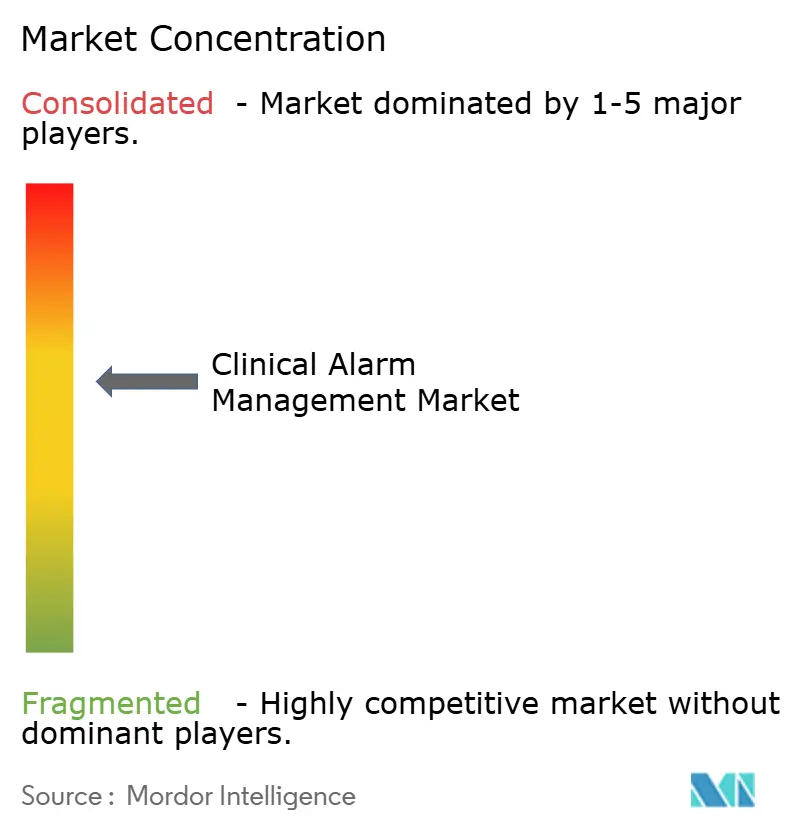
| Market Concentration | Medium |
Major Players *Disclaimer: Major Players sorted in no particular order Image © Mordor Intelligence. Reuse requires attribution under CC BY 4.0. | |
Clinical Alarm Management Market Analysis by Mordor Intelligence
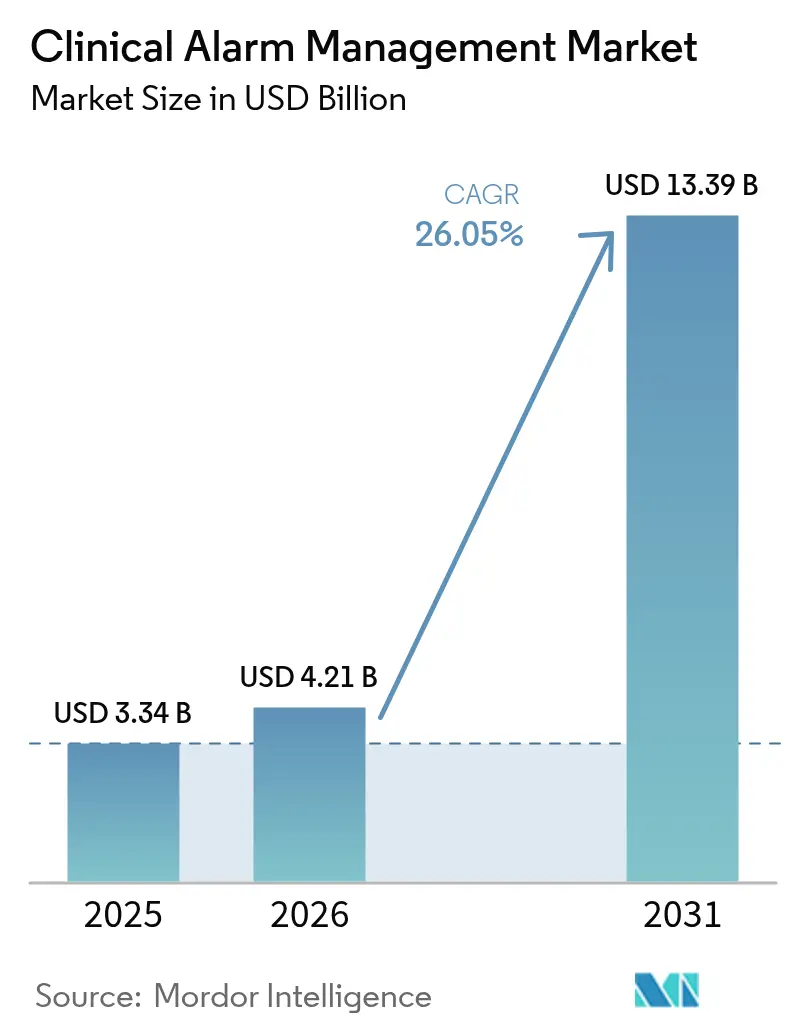
Clinical Alarm Management Market size in 2026 is estimated at USD 4.21 billion, growing from 2025 value of USD 3.34 billion with 2031 projections showing USD 13.39 billion, growing at 26.05% CAGR over 2026-2031.
Clinical alarm management is one of the industries that had a positive impact due to the COVID-19 pandemic owing to the extensive patient pool getting admitted to the hospital due to the infection. Moreover, during the COVID-19 pandemic, nurses were more stressed because of the more significant number of critically ill patients, and during this situation, the clinical alarms were of great use. For instance, according to the study by Elsevier, in October 2022, the alert system, according to nurses, is crucial to their ability to respond quickly. The power of the personnel to respond promptly declines as the number of devices grows along with the frequency of nuisance alerts caused by the increase in patients. False alarms have been a concern during the pandemic, creating unnecessary chaos among healthcare representatives, which increased the focus on properly implementing clinical alarm systems at hospitals and COVID-19 healthcare facilities. Clinical alarm management has demonstrated the ability to enhance health outcomes and reduce chaos during the pandemic which made the hospitals realize the advantage of clinical alarm management systems over manual systems. Hence, the demand for clinical alarm management systems increased, eventually driving the market growth.
The rise in the clinical alarm management market is attributed to the growing prevalence of chronic diseases coupled with longer hospital stays, increasing awareness among healthcare providers in optimizing patient safety using advanced technologies such as mHealth, alarm management systems, and growing investment in healthcare infrastructure by government and private health care providers. For instance, according to AIIMS, for the year 2021-2022 up to September 2021 about 0.83 million (8.3 lakh) people visited OPDs, and 33,830 surgeries were performed. 67,961 people got admission to AIIMS. Such a high number of admissions and surgeries increases the demand for the implementation of clinical alarm management, thereby boosting the market's growth over the forecast period.
Furthermore, the 2022 EU4Health work program has been allocated a budget of more than USD 706.41 million (EUR 835 million) to boost health systems in Europe, including around USD 65.14 million (EUR 77 million) for digital investment, USD 402.76 million (EUR 380.9 million) for crisis preparedness, USD 95.16 million (EUR 90 million) for health promotion and disease prevention, and USD 133.75 million (EUR 126.5 million) for health systems and health workforce. Investments in healthcare IT and digital healthcare are anticipated to boost market growth over the forecast period. Thus, the abovementioned factors such as an increase in chronic disease and investment in healthcare IT are impacting the market growth of the clinical alarm management market. However, high investment in clinical alarm systems and lack of product standardization, and false alarms are the factors expected to restrain the market growth.
Note: Market size and forecast figures in this report are generated using Mordor Intelligence’s proprietary estimation framework, updated with the latest available data and insights as of 2026.
Global Clinical Alarm Management Market Trends and Insights
Long term care Segment is Expected to Witness High Growth Over the Forecast Period
Long-term care facilities are healthcare centers that provide various services, including medical and personal care, to people who cannot live independently and geriatric patients. People frequently need long-term care for a severe, continuing health ailment or disability. The necessity for long-term care can arise suddenly, such as after a heart attack or stroke. Clinical alarm management services and solutions play an important role at long-term care centers as the patients at these centers are either critically ill or aged patients who require continuous monitoring and management of their health and wellness. Hence, the use of clinical alarms is increasing in long-term facilities. Furthermore, the growing prevalence of chronic diseases coupled with the increasing geriatric population globally are the major factors driving the respective segment in the market studied. For instance, according to 2022 statistics published by American Heart Association, the prevalence rate of heart failure in the United States was 6 million, 1.8% of the total population, in 2021. Thus, the high burden of heart failure cases in the country is expected to increase the demand for clinical alarm management to alert healthcare professionals and physicians which is further expected to boost the market's growth over the forecast period.
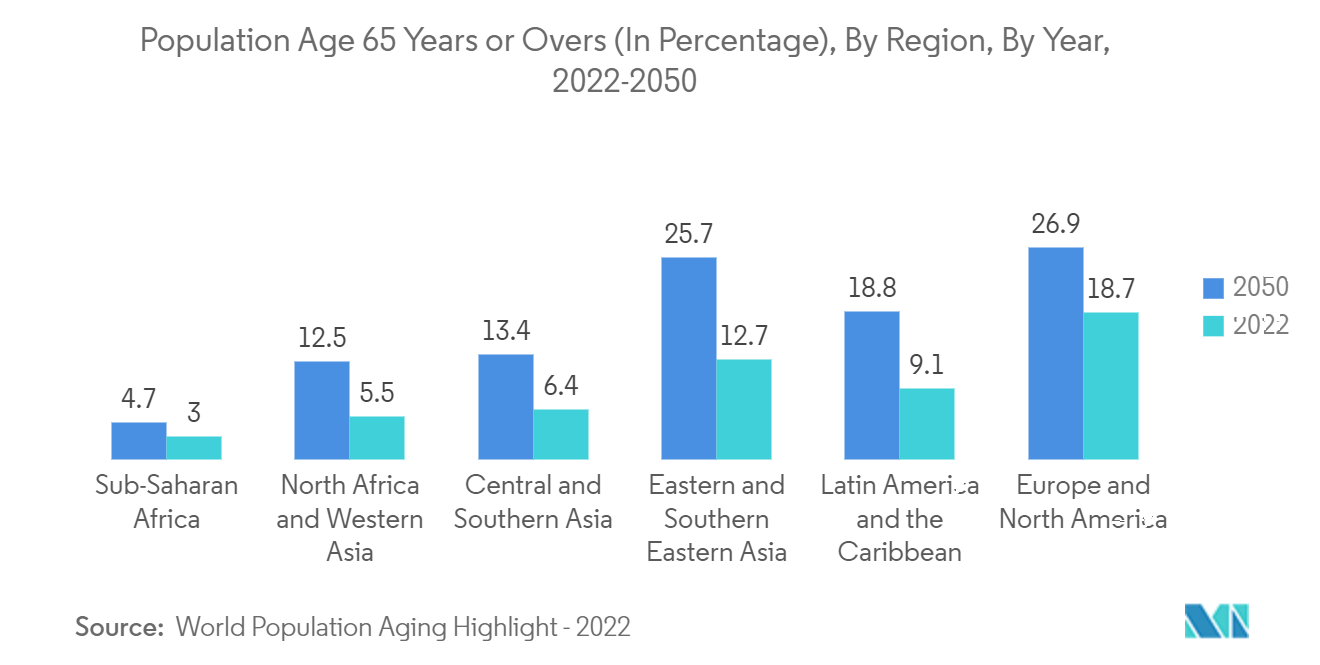
The older population is often susceptible to osteoarthritis, chronic obstructive pulmonary disease, depression, and dementia. This indicates the rising demand for devices required for the monitoring, assisting, and management of patients. For instance, according to World Population Aging Highlight United Nations 2022, in 2022, there were 771 million people aged 65 years or over globally. The older population is projected to reach 994 million by 2030. Thus, the increasing geriatric population is expected to increase hospital admission, which in turn is expected to drive market growth.
Thus, owing to the factors above the usage of clinical alarm management solutions and services is expected to grow significantly during the forecast period.
North America is Expected to Dominate the Clinical Alarm Management Market Over the Forecast Period
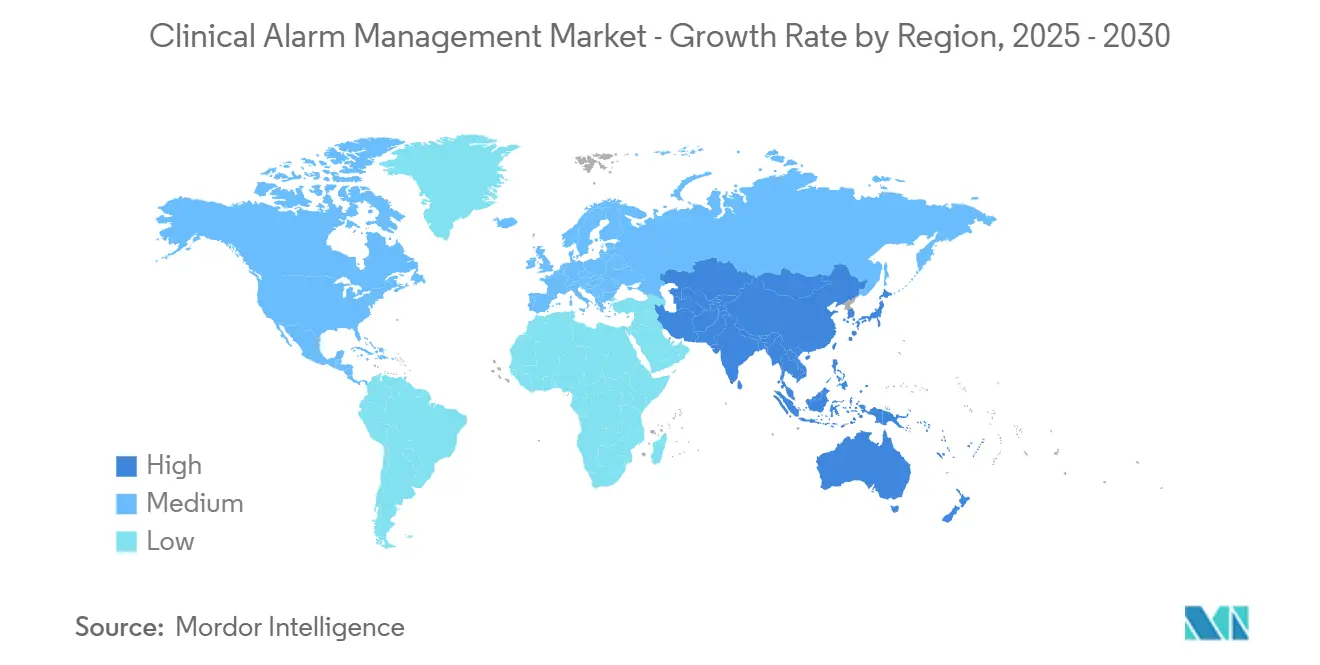
North America region is anticipated to have a significant market share owing to increased hospital stays due to chronic disease, and rising healthcare expenditure. For instance, as per the Centers for Medicare and Medicaid Services, national health spending was projected to grow at an average annual rate of 5.4% from 2019-2028 and reach USD 6.2 trillion by 2028. As national health expenditure is projected to grow 1.1% points faster than the average yearly GDP over 2019-2028, the health share of the economy is projected to rise by 19.7% in 2028. Thus, the increasing healthcare spending is anticipated to create opportunities for clinical alarm management, thereby propelling market growth.
Additionally, according to the National Health Expenditure Trend 2021 report from the Canadian Institute of Health Information, Canadian health expenditure increased to USD 308.1 billion in 2021 compared to USD 301.5 billion in 2020. Hence, with the increasing healthcare cost and information technology, the adoption of clinical alarm management is expected to increase in the region. Also, according to the OECD, in June 2022, Mexico's health spending as a share of GDP was 6.2% in 2020; this is expected to impact the market's growth positively.
The companies are actively involved in new product launch developments and collaborations to expand their footprint in the United States. For instance, in August 2022, AirStrip released an FDA-cleared alarm communication solution. The alarm communication platform is built on the core AirStrip ONE solution bundle to enable healthcare providers to focus on patient safety, reduce alarm fatigue, and notify mobile clinicians when critical, actionable alarm conditions occur for their patients and require attention.
Thus, owing to the abovementioned factors, the studied market in the North American region is expected to project growth over the forecast period.
Competitive Landscape
The clinical alarm management market is moderate due to the presence of companies operating globally as well as regionally. The competitive landscape includes an analysis of a few international as well as local companies which hold significant market shares and are well known including Baxter International Inc., Koninklijke Philips N.V., Ascom Holding AG, Capsule Technologies, Inc. and Vocera Communications among others.
Clinical Alarm Management Industry Leaders
-
Baxter International Inc.
-
Koninklijke Philips N.V.
-
Ascom Holding AG
-
Stryker (Vocera Communications)
-
Connexall USA, Inc.
- *Disclaimer: Major Players sorted in no particular order
Market Opportunities and Future Outlook
Cross-vendor interoperability and enterprise routing of alarms are gaining attention as hospitals move beyond point solutions toward standards-based alarm data exchange across patient monitors, nurse call, mobile endpoints, and EMR workflows. ISO/IEC 60601-1-8 (medical device alarm system requirements), IHE PCD Alarm Communication Management (ACM), and HL7 FHIR DeviceAlert are increasingly used as design anchors to normalize alarm priority, signaling, and transport across heterogeneous device fleets. This trend supports procurement and integration strategies that favor platforms able to ingest, contextualize, and distribute alerts consistently across vendors and care settings, rather than requiring proprietary gateways for each device type.
Cybersecurity and trust frameworks are also taking a larger role in clinical alarm architectures as alarm signals and alarm context move through clinical IoT and enterprise networks. IEEE/UL 2933-2024 (TIPPSS framework for clinical IoT interoperability, identity, privacy, and protection) and IEEE/ISO 11073-10701-2024 (service-oriented device connectivity requirements for exchanging alert data) reinforce demand for alarm management systems that can demonstrate secure identity, authorization, auditability, and resilience while still supporting near-real-time notification. On the demand side, The Joint Commission’s continued focus on alarm safety and governance keeps alarm fatigue on the operational agenda, which increases the value of solutions that combine device connectivity, alarm policy management, and escalation workflows across hospitals and long-term care facilities.
Recent Industry Developments
- January 2026: MUSC Health and Baxter announced a multi-year strategic partnership focused on transforming bedside care delivery using connected care technologies and addressing critical nursing challenges. The collaboration highlights how alarm management is being bundled with broader connected monitoring and workflow programs rather than purchased as a standalone capability.
- October 2025: Ascom, Drager, and B. Braun launched the Silent ICU solution at ESICM LIVES 2025, built around ISO/IEEE 11073 SDC interoperability to connect devices and coordinate notifications in critical care. The launch signals a shift toward vendor-neutral, standards-based alarm and device connectivity architectures that reduce integration friction in complex ICU environments.
- June 2024: Ascom signed a five-year contract with Children’s Health Ireland to support hospital digitalization using its Alerts and Notification Management System for a new hospital project. The long-duration award indicates alarm notification platforms are being implemented as core infrastructure in greenfield builds and large modernization programs.
Research Methodology Framework and Report Scope
Market Definition and Coverage
This market covers the revenues earned from solutions and services that help hospitals and other care settings monitor, route, prioritize, and respond to clinical device alarms, so the right caregiver gets the right alert at the right time.
Scope exclusions: It does not count general hospital IT that is not tied to clinical alarm workflows, or consumer wellness alerts that are not used for clinical decision-making.
Segmentation Overview
- By Component
- Product
- EMR Integration Systems
- Nurse Calling Systems
- Physiological Monitors
- Others
- Services
- Product
- By End-User
- Hospitals
- Long-term Care Centers
- Others
- Geography
- North America
- United States
- Canada
- Mexico
- Europe
- Germany
- United Kingdom
- France
- Italy
- Spain
- Rest of Europe
- Asia-Pacific
- China
- Japan
- India
- Australia
- South Korea
- Rest of Asia-Pacific
- Middle East and Africa
- GCC
- South Africa
- Rest of Middle East and Africa
- South America
- Brazil
- Argentina
- Rest of South America
- North America
Data Sources, Market Sizing, and Validation
Desk Research
Desk work started with grounding data that explains where alarms come from and how care settings adopt alarm workflows. We referenced public sources such as the US FDA medical device pages, the US FDA safety communication materials, the US Centers for Medicare and Medicaid Services facility and utilization datasets, Centers for Disease Control and Prevention healthcare statistics, and the World Health Organization health system indicators. For standards and good practices, we also reviewed materials from AAMI and similar clinical engineering groups, plus peer reviewed papers indexed in PubMed.
To translate this into a market model, we reviewed company filings, annual reports, investor decks, product documentation, and reported contract wins in reputable press. We also used paid subscriptions for company financials and intelligence, and for patent databases to understand product focus and innovation direction in alarm analytics and middleware. This list is not exhaustive, and we used additional public and paid sources for data collection, validation, and research clarification.
Primary Interviews and Surveys
Primary work was used to sanity check demand signals from hospitals and long term care centers, and to confirm what buyers typically purchase as software, middleware, services, or bundled modules inside monitoring systems. We spoke with a mix of clinical engineering, nursing leadership, IT, and solution delivery roles across APAC, EMEA, and the Americas to close gaps on pricing logic, deployment mix, and replacement cycles, and then aligned assumptions back to the desk research findings.
Distribution of primary research fieldwork respondents
| Company type | Respondent position | Region |
|---|---|---|
| Top tier: 33% | CXOs: 21% | APAC: 49% |
| Mid tier: 46% | Functional/Unit leaders: 23% | EMEA: 30% |
| Smaller Players: 21% | Managers: 56% | Americas: 21% |
Market-Sizing & Forecasting
Sizing started from a top down build where we reconstructed the addressable spend pool by care setting using facility counts, monitored bed footprints, and the penetration of alarm workflow software and related services. After the demand pool was built, we converted it into value using typical per bed, per site, or per license pricing ranges, and the observed split between products and services. To keep the totals realistic, we then ran selective bottom up checks using supplier revenue cues, channel feedback, and sampled ASP times volume math for common hospital rollouts.
Key inputs treated as market fingerprints included acute care admissions and inpatient days, ICU and monitored bed expansion, nurse staffing pressure and alarm fatigue initiatives, the pace of connected monitoring adoption, and the shift toward centralized monitoring and escalation policies. Forecasting leaned on scenario analysis supported by expert views on budget cycles, regulatory attention to patient safety, and expected refresh of monitoring infrastructure. Assumptions were tightened when interview feedback and desk indicators did not move in the same direction. Where bottom up signals were missing for smaller facilities, we inferred adoption rates from comparable settings and then adjusted them through follow up checks.
Data Validation & Update Cycle
Outputs were checked through multiple passes, first by comparing the model totals with independent signals such as monitored bed counts, facility level adoption stories, and reported pricing bands. We also reviewed any large year to year jumps for logical consistency. If a variance could not be explained by a clear driver like a policy change, a deployment shift, or one time catch up spending, the assumption was reworked, and in some cases experts were re contacted.
Before sign off, a separate analyst review confirms the math flow, unit consistency, and currency year treatment. The study is refreshed annually, and interim updates are triggered when material events occur, such as major guideline changes or large scale hospital digitization programs. Right before delivery, we run a fresh pass so clients receive the most current view available.
Mordor Intelligence's Clinical Alarm Management Market Size Compared Against Other Published Estimates
Published market sizes for clinical alarm management can look far apart because the scope line is drawn differently, and because pricing and adoption assumptions are refreshed at different times. In practice, the biggest differences usually come from what is counted as clinical alarm management versus adjacent monitoring and general hospital IT, and from how fast services attach rates are assumed to grow.
Some external estimates fold in broader patient monitoring and communication layers as a single bundled spend pool. Mordor Intelligence counts only alarm specific workflow software, related integration, and services that directly manage clinical alarms in care settings, and it keeps currency year alignment and adoption inputs updated through repeat checks with providers and solution teams.
Benchmark comparison
| Source | Market Size | Gaps in Research Methodology |
|---|---|---|
| Mordor Intelligence | USD 4.21 B (2026) | |
| Global Research Publisher A | USD 2.81 B (2025) | Uses a different base year and applies a narrower revenue capture that appears to emphasize standalone alarm management purchases, which can miss bundled modules and services attached to monitoring refresh cycles. |
| Healthcare Analytics Firm B | USD 2.49 B (2024) | Anchors the series on an earlier base year and likely limits scope to hospital focused deployments, with pricing progression that can understate the uplift from integration services and broader care setting adoption. |
The spread in the table is mainly explained by timing and what gets bundled into the total, not by arithmetic errors. By keeping the scope tied to alarm specific workflows and then cross checking the totals against facility and deployment signals, the estimate stays traceable to clear inputs that can be revisited as adoption and pricing move.
Key Questions Answered in the Report
How big is the Clinical Alarm Management Market?
The Clinical Alarm Management Market size is expected to reach USD 4.21 billion in 2026 and grow at a CAGR of 26.05% to reach USD 13.39 billion by 2031.
What is the current Clinical Alarm Management Market size?
In 2026, the Clinical Alarm Management Market size is expected to reach USD 4.21 billion.
Who are the key players in Clinical Alarm Management Market?
Baxter International Inc., Koninklijke Philips N.V., Ascom Holding AG, Stryker (Vocera Communications) and Connexall USA, Inc. are the major companies operating in the Clinical Alarm Management Market.
Which is the fastest growing region in Clinical Alarm Management Market?
Asia Pacific is estimated to grow at the highest CAGR over the forecast period (2026-2031).
Which region has the biggest share in Clinical Alarm Management Market?
In 2025, the North America accounts for the largest market share in Clinical Alarm Management Market.
What years does this Clinical Alarm Management Market cover, and what was the market size in 2025?
In 2025, the Clinical Alarm Management Market size was estimated at USD 4.21 billion. The report covers the Clinical Alarm Management Market historical market size for years: 2021, 2022, 2023 and 2024. The report also forecasts the Clinical Alarm Management Market size for years: 2026, 2027, 2028, 2029, 2030 and 2031.