
Cigar Market Size and Share
Market Overview
| Study Period | 2021 - 2031 |
|---|---|
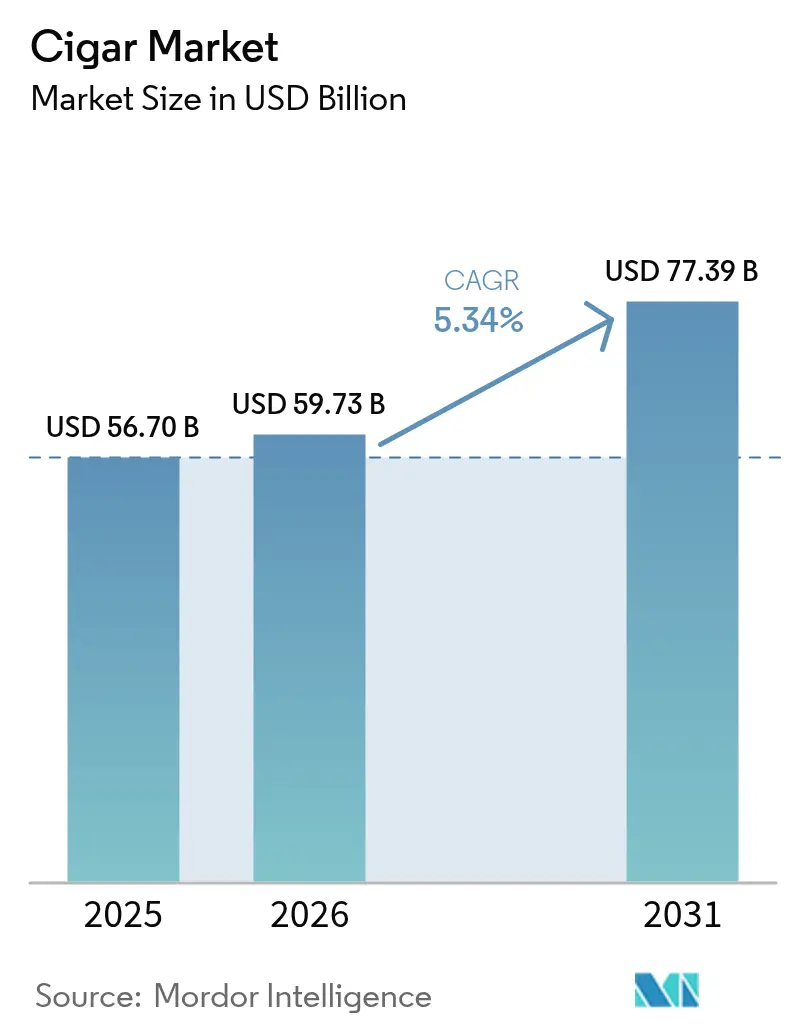
| Market Size (2026) | USD 59.73 Billion |
| Market Size (2031) | USD 77.39 Billion |
| Growth Rate (2026 - 2031) | 5.34 % |
| Fastest Growing Market | Asia Pacific |
| Largest Market | Asia Pacific |
| Market Concentration | Medium |
Major Players *Disclaimer: Major Players sorted in no particular order Image © Mordor Intelligence. Reuse requires attribution under CC BY 4.0. | |
Cigar Market Analysis by Mordor Intelligence
The cigar market size is expected to grow from USD 56.70 billion in 2025 to USD 59.73 billion in 2026 and is forecast to reach USD 77.39 billion by 2031 at 5.34% CAGR over 2026-2031. Manufacturers in the market benefit from the premium pricing of hand-rolled and limited-edition cigars, which enables them to effectively manage the impact of increased taxation and rising raw material expenses. The Asia-Pacific region exhibits remarkable market expansion, driven by its substantial population of high-net-worth individuals, the ongoing recovery in international tourism, and the growing cultural acceptance of cigars as prestigious luxury items. To maintain their market position, manufacturers are investing in developing tobacco varieties from specific geographical regions and implementing advanced storage technologies, which ensures product quality and supports their premium pricing strategies in the market.
Key Report Takeaways
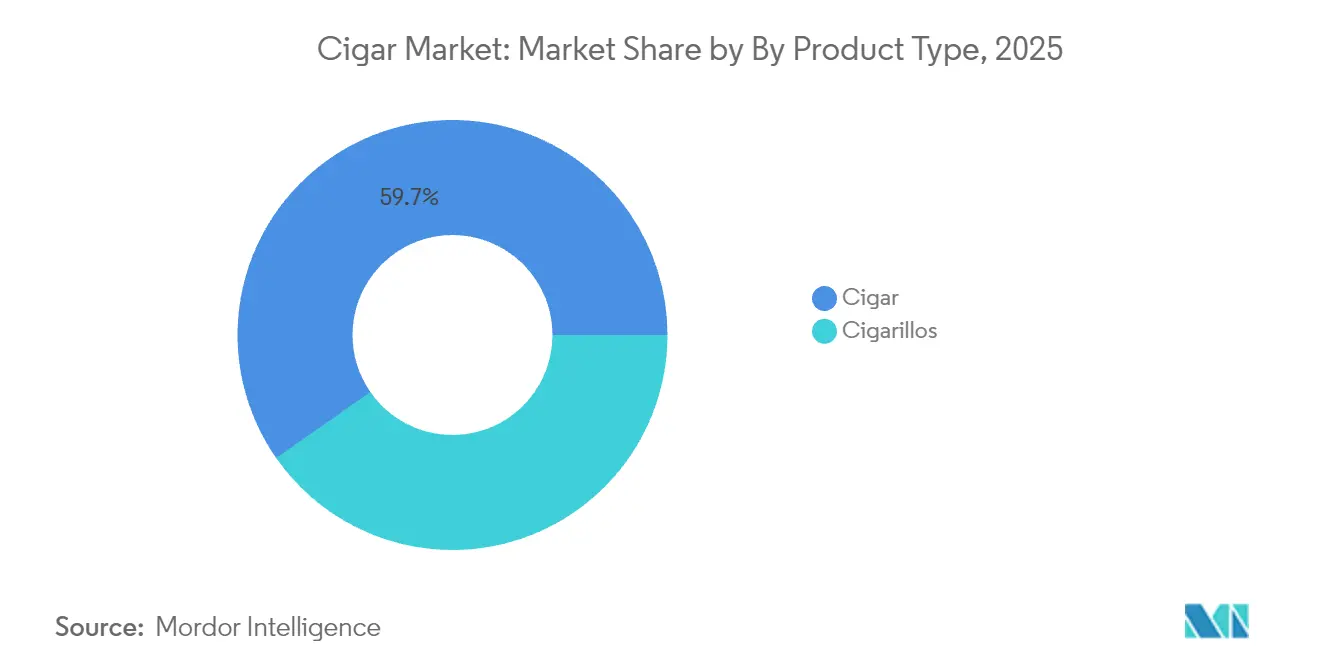
- By product type, traditional cigars led with 59.68% of global cigar market share in 2025, while cigarillos are set to climb at a 6.21% CAGR through 2031.
- By flavor, non-flavored variants accounted for 65.96% of global cigar market size in 2025; flavored offerings will pace ahead at a 6.53% CAGR to 2031.
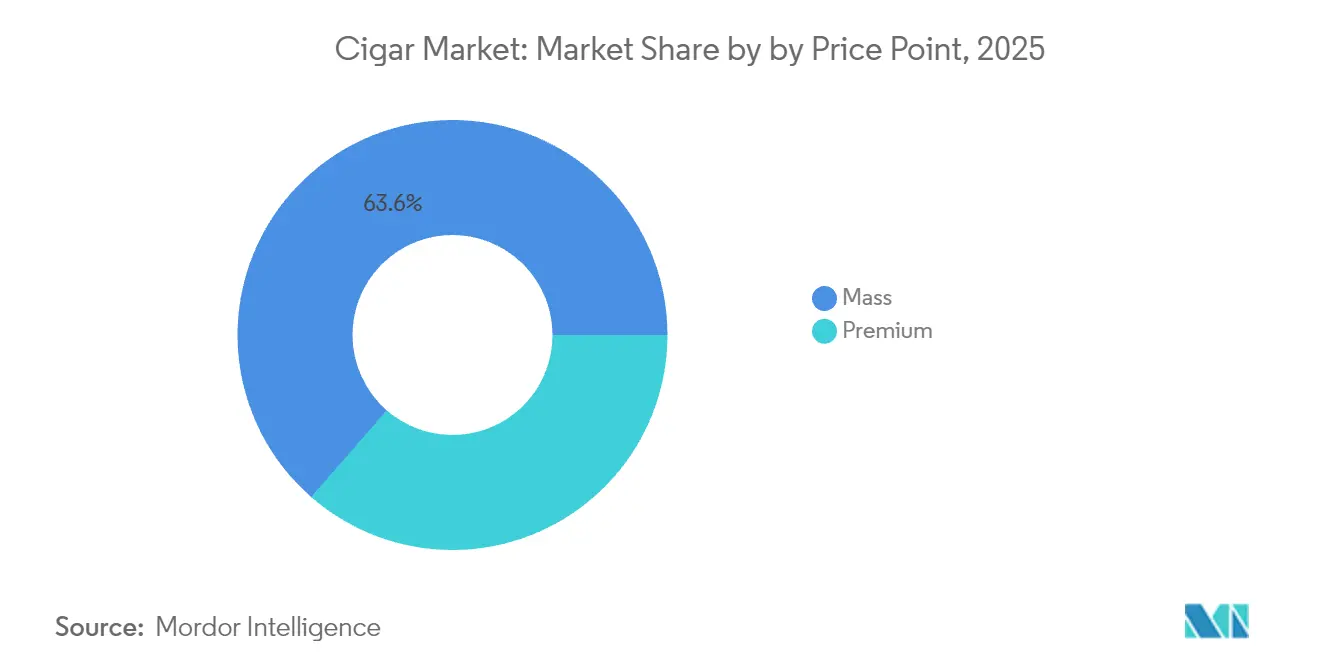
- By price point, mass-market cigars represented 63.58% of global cigar market size in 2025, whereas premium lines are projected to expand at a 6.44% CAGR through 2031.
- By distribution channel, offline retail stores controlled 87.94% of global cigar market share in 2025; online platforms will record the fastest 7.38% CAGR to 2031.
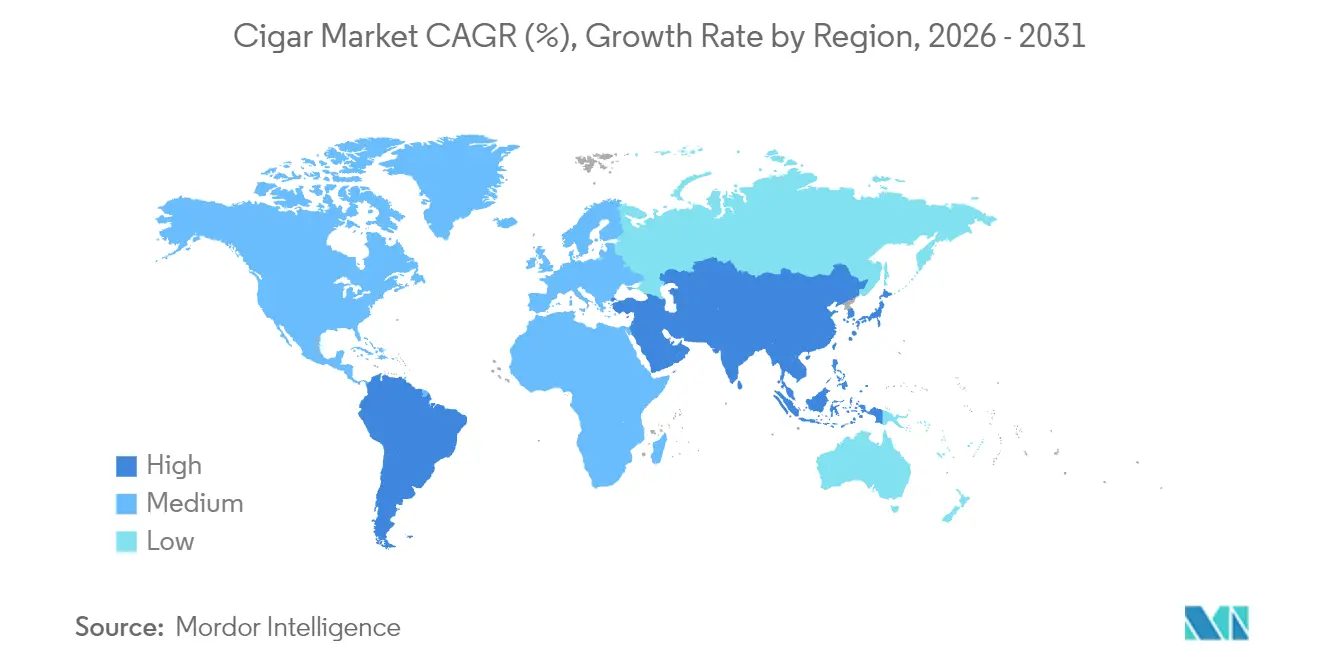
- By geography, Asia-Pacific held 54.21% of global cigar market share in 2025 and will maintain the highest 6.38% CAGR between 2026 and 2031.
Note: Market size and forecast figures in this report are generated using Mordor Intelligence’s proprietary estimation framework, updated with the latest available data and insights as of 2026.
Market Trends and Insights
Drivers Impact Analysis of Cigar Market*
| Driver | (~) % Impact on CAGR Forecast | Geographic Relevance | Impact Timeline |
|---|---|---|---|
| Rising Popularity of Premium and Hand-Rolled Cigars | +1.2% | Global, strongest in North America and Europe | Medium term (2-4 years) |
| Product Innovation in Cigar Blends and Packaging | +0.8% | Global, led by Dominican Republic and Nicaragua | Long term (≥ 4 years) |
| Rising Consumer Preference for Luxury and Status Symbol Products | +1.1% | Asia-Pacific core, spill-over to North America | Medium term (2-4 years) |
| Growth of Boutique and Artisan Cigar Brands | +0.7% | North America and Europe, emerging in Asia-Pacific | Long term (≥ 4 years) |
| Increasing Adoption of Humidor Technology for Better Preservation | +0.4% | Global, concentrated in premium segments | Short term (≤ 2 years) |
| Expansion of Online Retail Channels for Cigars | +0.6% | Global, fastest adoption in North America and Europe | Short term (≤ 2 years) |
| Source: Mordor Intelligence | |||


Rising Popularity of Premium and Hand-Rolled Cigars
Premium handmade cigars represent a small but highly valuable segment of the total cigar market, with United States imports showing steady growth in the current year. This segment demonstrates remarkable resilience during economic uncertainty, as consumers maintain their luxury tobacco purchases while reducing expenditure in other categories. Nicaragua maintains its position as the primary exporter of handmade cigars, while the Dominican Republic has experienced substantial growth in exports, indicating a significant shift in supply chain dynamics beyond traditional Cuban production. The market continues to evolve as mass-market consumers increasingly transition to artisanal products, influenced by social media engagement and changing consumption preferences focused on premium experiences. The pricing landscape has notably shifted upward, with entry-level premium cigars commanding higher price points, as tobacconists implement price adjustments in response to increased manufacturing costs.
Product Innovation in Cigar Blends and Packaging
The Dominican Republic's tobacco manufacturing sector has demonstrated remarkable progress, reaching USD 1.14 billion in exports during 2023 [1]Source: Observatory of Economic Complexity (OEC), “Cigars, cheroots and cigarillos, containing tobacco,” oec.world. This achievement stems from substantial investments in advanced climate-controlled facilities and robust quality assurance systems that align with rigorous international standards. Taking inspiration from the wine industry, manufacturers carefully select and promote specific growing regions and vintage tobacco leaves, creating distinctive products that resonate with premium market segments. Through meticulous attention to curing and fermentation processes, producers develop refined flavor profiles that meet consumer preferences. The industry has also embraced innovative packaging solutions, implementing sophisticated moisture control mechanisms and secure tamper-evident seals. These advancements ensure consistent product quality across extensive distribution networks, particularly benefiting the growing e-commerce sales channels.
Rising Consumer Preference for Luxury and Status Symbol Products
Cigar consumption has evolved into a significant social status indicator, moving beyond traditional tobacco use patterns, as consumers increasingly perceive premium cigars as sophisticated luxury items comparable to high-end wines or premium spirits. The Asia-Pacific region maintains a substantial 54.63% market share, demonstrating the rising affluence in emerging economies where premium cigars have become established symbols of professional achievement and cultural sophistication. The substantial recovery in Southeast Asian tourism, marked by a 32% increase in visitor arrivals during the first half of 2024, has strengthened the demand for luxury tobacco products across hotels, resorts, and upscale hospitality establishments [2]Source: Asian Development Bank, “Southeast Asia Outlook – September 2024,” adb.org. The prevalence of corporate gifting practices and special occasion consumption behaviors continues to support premium pricing strategies, effectively shielding manufacturers from the volume declines observed in mass-market segments. This transformation in consumption patterns enables companies to preserve their profit margins despite increasing regulatory oversight and tax implementations across major market regions.
Growth of Boutique and Artisan Cigar Brands
Small-batch cigar producers are gradually increasing their market share by focusing on meticulous craftsmanship, controlled production volumes, and fostering personal connections through direct-to-consumer sales channels. These boutique manufacturers effectively leverage social media platforms and immersive events to build strong customer relationships, particularly appealing to younger affluent consumers who value authenticity over mass production. By partnering with individual tobacco farms and specific growing regions, these companies develop origin-based narratives that support their premium pricing strategies and reinforce their unique market positioning. Additionally, the operational structure of artisan producers involves lower regulatory compliance costs compared to large-scale manufacturers, allowing them to respond swiftly to market demands and introduce product innovations efficiently. This shift in cigar production methods aligns with the broader consumer preference for artisanal products observed in the food and beverage industry.
Restraints Impact Analysis of Cigar Market*
| Restraint | (~) % Impact on CAGR Forecast | Geographic Relevance | Impact Timeline |
|---|---|---|---|
| Stringent Tobacco Regulations and Advertising Restrictions Globally | -1.8% | Global, most severe in Europe and developed markets | Long term (≥ 4 years) |
| High Taxation on Tobacco Products in Many Regions | -1.4% | Europe and North America, expanding to Asia-Pacific | Medium term (2-4 years) |
| Increasing Age Restrictions and Enforcement on Tobacco Sales | -0.6% | Global, strictest in developed markets | Short term (≤ 2 years) |
| Risks of Counterfeit and Smuggled Products Affecting Brand Trust | -0.4% | Global, concentrated in high-tax jurisdictions | Medium term (2-4 years) |
| Source: Mordor Intelligence | |||
Stringent Tobacco Regulations and Advertising Restrictions Globally
The European Union's proposed tobacco taxation directive plans to increase cigar excise duties from EUR 12 to EUR 143 per thousand units, representing a potential 1,100% increase that may significantly impact medium-sized producers [3]Source: Jaeger, “Revision of the Tobacco Excise Tax Directive,” Taxpayers Association of Europe, taxpayers-europe.org. The European Commission's tax harmonization initiative, set to take effect in 2028, aims to standardize rates across member states and incorporate new products, including heated tobacco, into existing regulatory frameworks [4]Source: European Commision, “European Commission modernises Tobacco Taxation Directive,” commission.europa.eu. In the United States, Food and Drug Administration regulatory oversight imposes compliance requirements on premium handmade cigars, despite their small market share, requiring manufacturers to complete extensive approval processes for new products. Current advertising restrictions constrain brand development opportunities, particularly affecting boutique producers who depend on direct marketing channels. These regulatory requirements concentrate market influence among larger manufacturers with sufficient resources to manage compliance costs, potentially limiting innovation from smaller companies.
High Taxation on Tobacco Products in Many Regions
Germany's upcoming tobacco tax increases, scheduled for implementation at the start of the next fiscal year, will raise cigarette taxes and impose additional levies on other tobacco products, including cigars. China's recent implementation of substantial combined tariff rates on cigar imports and significant reduction in duty-free allowances for individual travelers has created barriers to market access. Tax harmonization efforts across European Union member states have created competitive disadvantages for producers in high-tax jurisdictions while potentially increasing illicit trade activities. The rising taxation disproportionately affects price-sensitive consumers in mass-market segments, accelerating premiumization as manufacturers shift toward higher-margin products that can better absorb tax increases. While these policies generate substantial government revenues, they also create opportunities for black market activities that undermine legitimate business operations and brand integrity.
*Our forecasts treat driver/restraint impacts as directional, not additive. The impact forecasts reflect baseline growth, mix effects, and variable interactions.
Cigar Market Segment Analysis
By Product Type:
Traditional Cigars Anchor Market ValueThe traditional cigar segment maintains its market leadership with a substantial 59.68% share in 2025, demonstrating the enduring appeal of full-size cigars among consumers who value traditional smoking experiences. This dominance reflects deep-rooted brand loyalty within premium segments, where customers appreciate the craftsmanship and ritual associated with traditional cigars. Meanwhile, the cigarillo segment is experiencing robust growth, projected at a 6.21% CAGR through 2031. This growth is primarily attributed to changing consumer preferences, as cigarillos offer a more time-efficient smoking experience that accommodates modern lifestyle constraints and workplace smoking policies. The market received additional momentum when Swisher entered the cannabis segment in Michigan during October 2024, introducing blunts with hemp wrappers that circumvent FDA tobacco regulations.
The manufacturing landscape significantly influences market dynamics, with cigarillo producers benefiting from cost-effective automated production methods compared to the labor-intensive process of handmade traditional cigars. Premium cigar manufacturers have recognized this opportunity and are strategically expanding their product portfolios to include cigarillo variants, enabling them to capture a broader consumer base while preserving their premium brand positioning. The regulatory environment also shapes market development, as traditional cigar producers face higher compliance costs due to comprehensive FDA oversight, while cigarillo manufacturers operate under more streamlined approval processes. These market conditions indicate an ongoing convergence between segments, as consumers increasingly gravitate toward products that balance premium quality with convenience and shorter consumption times.


By Flavor:
Non-Flavored Dominance Faces Innovation PressureNon-flavored cigars accounted for a dominant 65.96% market share in 2025. This strong market position is attributed to traditional consumer preferences, which have remained consistent over time, and the regulatory advantages these products hold in regions with stringent flavor restrictions. Non-flavored cigars are often perceived as more authentic and closer to the original cigar experience, further solidifying their appeal among traditional consumers. Meanwhile, the flavored cigar segment is projected to grow at a compound annual growth rate (CAGR) of 6.53% through 2031. This growth is driven by manufacturers focusing on developing innovative products that align with regulatory requirements while catering to the evolving preferences of younger adult consumers who seek unique and diverse flavor options.
In the Philippines tobacco market, 58.49% of tobacco products feature flavor descriptors, with menthol being the most prominent category. This highlights a clear consumer preference for flavored tobacco products, which manufacturers are leveraging to expand their market presence. To address this demand, manufacturers are making strategic investments in advanced natural flavoring technologies and refined tobacco blending techniques. These innovations enable the creation of unique and appealing taste profiles that resonate with consumers while ensuring compliance with regulatory frameworks. Such efforts not only enhance product differentiation but also strengthen the competitive positioning of manufacturers in the market.
By Price Point:
Mass Market Volume Supports Premium GrowthMass-market products account for 63.58% of the market share in 2025, establishing a robust foundation for the industry's distribution network and manufacturing operations. This significant market presence enables companies to achieve substantial economies of scale, which in turn supports the broader industry infrastructure and operational efficiency.
The premium segment is projected to grow at a 6.44% CAGR through 2031, as consumers increasingly gravitate toward higher-priced products and manufacturers strategically focus on higher-margin offerings to counterbalance rising regulatory compliance costs and taxation. Imperial Brands' Backwoods brand demonstrates this trend effectively, having successfully positioned itself in the premium category within mass-market channels and continuing to gain market share despite economic headwinds. Market analysis of price elasticity reveals an interesting consumer behavior pattern - premium segment customers maintain their purchasing habits during economic uncertainty, while the mass-market segment experiences notable volume constraints due to increased taxation and regulatory restrictions.
By Distribution Channel:
Offline Dominance Faces Digital DisruptionPhysical retail stores maintain a dominant position with an 87.94% market share in 2025. This substantial market presence stems from strict regulatory requirements mandating in-person age verification for purchases. Additionally, many consumers prefer the traditional shopping experience, where they can physically examine and evaluate products before making purchasing decisions.
Online retail channels are projected to experience significant growth, with a 7.38% CAGR through 2031. This growth is driven by increasing consumer demand for convenient shopping options and access to a wider product selection than traditional stores can offer. Digital platforms have transformed the market landscape by enabling small-scale producers to reach international customers without investing in physical distribution networks. This shift has intensified market competition and is expected to accelerate further as potential FDA flavor restrictions could reduce convenience store inventory, compelling consumers to turn to online retailers for discontinued products.
Geography Analysis
APAC Cigar Market
Asia-Pacific currently dominates the global premium tobacco market, commanding a substantial 54.21% market share in 2025. The region's market leadership is underpinned by its large consumer base, established distribution networks, and the cultural significance of premium tobacco products. Japan serves as a notable example of the region's evolving market dynamics, where a significant 52.6% decline in cigarette sales from 2011-2023 has created new opportunities for premium cigars to position themselves as luxury alternatives.
North America Cigar Market
North America demonstrates the fastest market development, characterized by its mature premium cigar culture and sophisticated distribution infrastructure. The region's growth is supported by a well-established network of specialty retailers, knowledgeable consumers, and a strong presence of boutique brand manufacturers. The market benefits from consistent demand patterns and a regulatory environment that has historically accommodated premium tobacco products.
LATAM and EMEA Cigar Market
Other regions present diverse market opportunities and challenges. Latin American production regions maintain their significance, with the Dominican Republic achieving USD 1.14 billion in export value and Nicaragua producing 210.9 million units, leveraging their favorable growing conditions and manufacturing expertise. European markets face potential restructuring due to proposed taxation directives, which may lead to market consolidation among larger manufacturers. The Middle East and Africa regions show promise as emerging markets, with increasing demand driven by rising tourism and growing affluent consumer segments.

Regulatory Landscape
Regulation for cigars is tightening through excise harmonization, product definitions, and advertising and sales restrictions that vary by region and segment. In Europe, the European Commission advanced a formal proposal in July 2025 to recast the Tobacco Taxation Directive (2011/64/EU), which supports more standardized excise structures across member states and shifts the relative economics of mass and premium cigars in high-tax jurisdictions.
Value Chain Analysis
The cigar value chain runs from tobacco cultivation (seed selection, farming, curing) to fermentation and aging, manufacturing (handmade premium versus machine-made mass products), packaging and quality assurance, and then export/import, distribution, and retail. Premium handmade supply remains concentrated in key Central American and Caribbean hubs, with a large share of U.S.-bound premium handmade cigars sourced from Nicaragua, the Dominican Republic, and Honduras; upstream leaf constraints, particularly premium wrapper leaf from origins such as Ecuador and Mexico, can become bottlenecks that influence blend availability and pricing.
Downstream, importers and distributors manage customs compliance, excise documentation, and inventory across specialty tobacconists, convenience outlets, and a growing e-commerce channel that depends on age-verification processes and climate-controlled fulfillment for premium SKUs. Trade bodies such as the Cigar Association of America (CAA), Premium Cigar Association (PCA), and the European Cigar Manufacturers Association (ECMA) support coordination across the chain, but policy-driven cost volatility can move quickly through landed costs and margins. This was reflected in February 2026 when the United States applied a 10% global tariff, affecting offshore cigar production hubs and changing relative tariff rates for key origins.
Competitive Landscape
The cigar industry is experiencing significant transformation through strategic acquisitions and market consolidation. Japan Tobacco's substantial USD 2.4 billion acquisition of Vector Group in 2024 demonstrates this trend, as it successfully expanded its United States market presence from 2.3% to approximately 8%. This consolidation enables companies to build stronger market positions through economies of scale and geographic diversification, which helps them effectively manage increasing regulatory compliance costs and tax burdens while maintaining their competitive edge. Imperial Brands' strategic focus on five key markets, which generate 70% of its adjusted operating profit, showcases how geographic concentration and targeted resource allocation can optimize market penetration. Large manufacturers continue to leverage their established distribution networks and comprehensive brand portfolios to maintain market dominance, while boutique producers carve out their niche through specialized craftsmanship and direct customer relationships that circumvent traditional retail channels.
The integration of technology has become a crucial differentiator in the cigar industry, particularly in supply chain management, product preservation, and customer engagement. Companies are investing in advanced humidor systems and climate-controlled storage solutions to ensure consistent product quality and support premium positioning in the market. Digital marketing platforms have emerged as essential tools for targeted customer acquisition and retention strategies. This technological advancement is complemented by product innovation, as demonstrated by Swisher's development of cannabis blunt products using hemp wrappers, which showcases how companies can create new market segments while leveraging existing tobacco brand recognition. The online retail channel presents significant opportunities with a 7.53% CAGR, alongside growing potential in premium product categories and emerging geographic markets where regulatory environments remain conducive to industry growth.
The regulatory landscape continues to shape market dynamics and competitive intensity. The FDA's proposed flavor ban could significantly impact the industry by potentially eliminating up to half of convenience store inventory. This regulatory pressure is forcing manufacturers to compete more aggressively for reduced shelf space while simultaneously investing in product reformulation and enhanced compliance capabilities. Companies must navigate these challenges while maintaining their market position and exploring new growth opportunities.
Cigar Industry Leaders
Scandinavian Tobacco Group A/S
Imperial Brands PLC
China National Tobacco Corp.
Altria Group Inc.
Swisher International Inc.
- *Disclaimer: Major Players sorted in no particular order

Cigar Market Companies Covered in this Report
- Scandinavian Tobacco Group A/S
- Imperial Brands Plc
- China National Tobacco Corp (CNTC)
- Altria Group Inc
- Burger Holding AG
- British American Tobacco Plc
- Philip Morris International Inc
- PT Intertobacco Utama Industry
- Japan Tobacco Inc
- Villiger Sohne AG
- Arnold Andre Cigars GmbH & Co KG
- J Cortes Cigars NV
- Continental Tobacco Corp.S.C.
- Cia Canariense de Tabacos SA
- Djarum PT
- Tabacalera USA Inc
- Joh. Wilh. von Eicken GmbH
- Oettinger Davidoff AG
- Swisher International Inc.
- Corporacion Habanos SA

Market Opportunities and Future Outlook
Premiumization and experience-led branding are creating room for manufacturers and retailers to protect quality from the farm through to consumers while operating within tighter compliance boundaries. Investment is showing up in vertically integrated, premium-focused footprints: in January 2026, Selected Tobacco opened a 3,000 square meter premium cigar factory in Madrid with cedar-lined aging rooms, pointing to a strategy of bringing aging, quality control, and brand storytelling closer to end markets. At the same time, the April 2026 U.S. court order defining "premium cigars" draws a clearer line between exempt premium handmade products and other cigar categories, sharpening product portfolio decisions (construction, filler composition, and flavoring) and helping companies structure SKUs and documentation around the legal definition.
Supply-chain risk management and origin diversification are also practical opportunity areas, especially as disruptions in large-scale manufacturing can redirect sourcing and distribution priorities. In February 2026, Tabacalera de Garcia reduced operations to about 40-45% capacity following U.S. sanctions tied to Chen Zhi, then refocused production toward non-U.S. markets, highlighting the value of alternative manufacturing partnerships and multi-origin leaf strategies. Companies with stronger aging and storage capabilities, including climate-controlled warehousing that supports e-commerce shipping integrity, are better positioned to defend premium pricing while navigating excise changes, advertising limits, and enforcement-led pressure on illicit and counterfeit trade.
Recent Industry Developments in Cigar Market
- June 2026: Imperial Brands announced the acquisition of modern oral business Black Buffalo, extending its footprint in nicotine products alongside its combustible portfolio. The acquisition supports portfolio diversification and may affect capital allocation priorities across traditional tobacco categories, including cigars, within large multi-category groups.
- July 2025: European Commission advanced a formal proposal to recast the Tobacco Taxation Directive (2011/64/EU), aiming for standardized excise structures across member states and changes to pricing dynamics for cigar categories. The proposal is positioned to adjust how cigar tax burdens translate into consumer pricing across Europe.
- October 2024: Swisher entered the Michigan market with cannabis blunt products using hemp wrappers, showing how established cigarillo players can expand into adjacent categories while keeping brand presence at retail. The move also underscores the use of packaging formats that can support compliance strategy in overlapping categories.


Cigar Market Report Scope and Research Methodology
Market Definition and Coverage
For this methodology, the cigar market covers the retail value of cigars sold for adult consumption through offline and online channels, across major regions, and including differences in price positioning and basic product formats.
Scope exclusions: Cigarettes, e-cigarettes, heated tobacco devices, and loose tobacco used mainly for roll-your-own products are not counted in this market.
Segments Covered in This Report
- By Product Type
- Cigarillos
- Cigar
- By Flavor
- Flavored
- Non-Flavored
- By Price Point
- Mass
- Premium
- By Distribution Channel
- Offline Retail Stores
- Online Retail Stores
- By Geography
- North America
- United States
- Canada
- Mexico
- Rest of North America
- Europe
- Germany
- United Kingdom
- Italy
- France
- Spain
- Netherlands
- Poland
- Belgium
- Sweden
- Rest of Europe
- Asia-Pacific
- China
- India
- Japan
- Australia
- Indonesia
- South Korea
- Thailand
- Singapore
- Rest of Asia-Pacific
- South America
- Brazil
- Argentina
- Colombia
- Chile
- Peru
- Rest of South America
- Middle East and Africa
- South Africa
- Saudi Arabia
- United Arab Emirates
- Nigeria
- Egypt
- Morocco
- Turkey
- Rest of Middle East and Africa
- North America
Data Sources, Market Sizing, and Validation
Desk Research
Desk work starts by building a clean demand and supply context for cigars, then mapping it to measurable signals that can be checked over time. We mainly rely on public sources such as the World Health Organization for tobacco control indicators, the World Bank for income and population data, UN Comtrade for trade flows, and national statistics or customs agencies for excise and tobacco-related releases.
To keep the inputs practical, we also review company filings and investor presentations to understand category mix, pricing commentary, and distribution shifts. Trade association websites and reputed press are reviewed in parallel for regulatory and tax changes. Where needed, paid subscriptions for company financials and intelligence, import and export shipment-level records, and patent databases are used to support cross-checks on activity levels and product pipelines. These desk sources are not exhaustive, and many other public documents were also reviewed for data collection, validation, and clarification.
Primary Interviews and Surveys
Primary inputs come from expert interviews and structured surveys across manufacturers, distributors, retailers, and industry advisors, so gaps from desk signals can be closed with real-world checks. For a global market, we cover demand dynamics and pricing behavior across APAC, EMEA, and the Americas. We then confirm assumptions such as channel mix shifts and premiumization patterns before finalizing the model.
Distribution of primary research fieldwork respondents
| Company type | Respondent position | Region |
|---|---|---|
| Top tier: 33% | CXOs: 20% | APAC: 47% |
| Mid tier: 45% | Functional/Unit leaders: 33% | EMEA: 35% |
| Smaller Players: 22% | Managers: 47% | Americas: 18% |
Market-Sizing & Forecasting
The sizing starts with a top-down build where country-level demand pools are reconstructed using adult population, tobacco-use indicators, and macro affordability, then translated into cigar consumption value using price and channel realities. To keep totals realistic, we corroborate outputs with selective bottom-up approximations, such as sampled price points across offline and online retail, distributor and retailer channel checks, and supplier roll-ups where information is available.
A few market fingerprints are used as model inputs because they explain most of the movement in value. These include premium versus mass-market mix (which changes average selling price), excise tax and regulatory shifts (which change consumer downtrading and legal availability), tourism and gifting-linked demand in key markets (which affects premium volumes), online retail penetration (which changes reach and discounting), and regional income growth patterns (which influence premiumization). For forecasting, scenario analysis is applied around taxation and pricing pressure, and the base case is supported by a simple multivariate regression that ties value growth to income and adult population changes. Primary experts help us pick realistic ranges for premium share and channel mix. When bottom-up signals are thin in smaller countries, proxy benchmarks from similar markets are used and then adjusted using local tax and price context.
Data Validation & Update Cycle
Validation is done through repeated cross-checks so a single data series does not drive the full outcome. We compare the modeled market totals against independent signals such as trade direction, excise trend lines, and reported category commentary from public company disclosures, then investigate any large variances before sign-off.
A second analyst review is completed to test assumptions and confirm that growth rates align with real-world constraints, including price progression and regulation timing. The report is refreshed annually, with interim updates when material events occur, such as major tax changes or new restrictions that can shift channel mix quickly. Before delivery, a final pass is done so the published view reflects the latest available indicators.
Mordor Intelligence's Cigar Market Size Measured Against Other Published Estimates
Published cigar market values often differ because the underlying definitions, timeframes, and price assumptions are not the same across sources. We see the biggest gaps when one estimate blends adjacent tobacco categories, uses a different base year, or projects premium growth using a more aggressive price curve than what retail behavior supports.
Little cigars are a common add-on in some publications, but this item sits outside Mordor Intelligence's scope for the cigar market, which narrows the demand pool and keeps the value tied to cigars and cigarillos only. Differences also come from how average selling prices are handled, since premiumization can be modeled as a smooth uplift or as a step-change after excise moves, and not every source rechecks those steps with channel feedback. Currency conversion timing and refresh cadence matter too, especially when taxes or regulations change mid-year and the market needs a clean split between volume and price effects.
Benchmark comparison
| Source | Market Size | Gaps in Research Methodology |
|---|---|---|
| Mordor Intelligence | USD 59.73 B (2026) | |
| Global Consultancy A | USD 54.79 B (2024) | Uses an earlier base year, and the scope is sometimes presented as a combined cigar and cigarillo set without clearly separating price-point effects from volume changes, which can pull the starting value down versus a later-year base. |
| Industry Publisher B | USD 58.41 B (2025) | Often applies a broader product basket that can include little cigars and extended flavor splits, and it may rely more on stated growth trajectories over 2026-2034, which can shift the base-year alignment and pricing path versus a shorter forecast window. |
The table shows that year selection and product inclusion rules explain much of the spread, even before forecasting assumptions are compared. By keeping inputs traceable to demand indicators, channel reality, and tax timing, we end up with a balanced value estimate that can be repeated and stress-tested when new market events occur.


Key Questions Answered in the Report
How large is the global cigar market in 2026?
The global cigar market size is USD 59.73 billion in 2026 and is on track to reach USD 77.39 billion by 2031.
Which region leads cigar consumption?
Asia-Pacific commands 54.21% of global revenue, driven by rising incomes, tourism, and luxury positioning.
What is the outlook for flavored cigars?
Flavored variants are forecast to expand at 6.53% CAGR through 2031, although impending U.S. bans may accelerate reformulation toward naturally flavored blends.
Why are premium cigars growing faster than mass-market cigars?
Affluent consumers treat premium cigars as status goods, enabling 6.44% CAGR growth and higher margins despite regulatory costs.
Is online cigar retail significant?
Although offline shops still dominate, e-commerce is projected to rise 7.38% CAGR as age-verification tech and broader SKU access attract digital buyers.
Page last updated on:


 Your data is secure and never sold or shared.


