
Chocolate Flavor Market Size and Share
Market Overview
| Study Period | 2021 - 2031 |
|---|---|
| Market Size (2026) | USD 1.74 Billion |
| Market Size (2031) | USD 2.48 Billion |
| Growth Rate (2026 - 2031) | 7.34 % |
| Fastest Growing Market | Asia-Pacific |
| Largest Market | North America |
| Market Concentration | Low |
Major Players *Disclaimer: Major Players sorted in no particular order Image © Mordor Intelligence. Reuse requires attribution under CC BY 4.0. | |
Chocolate Flavor Market Analysis by Mordor Intelligence
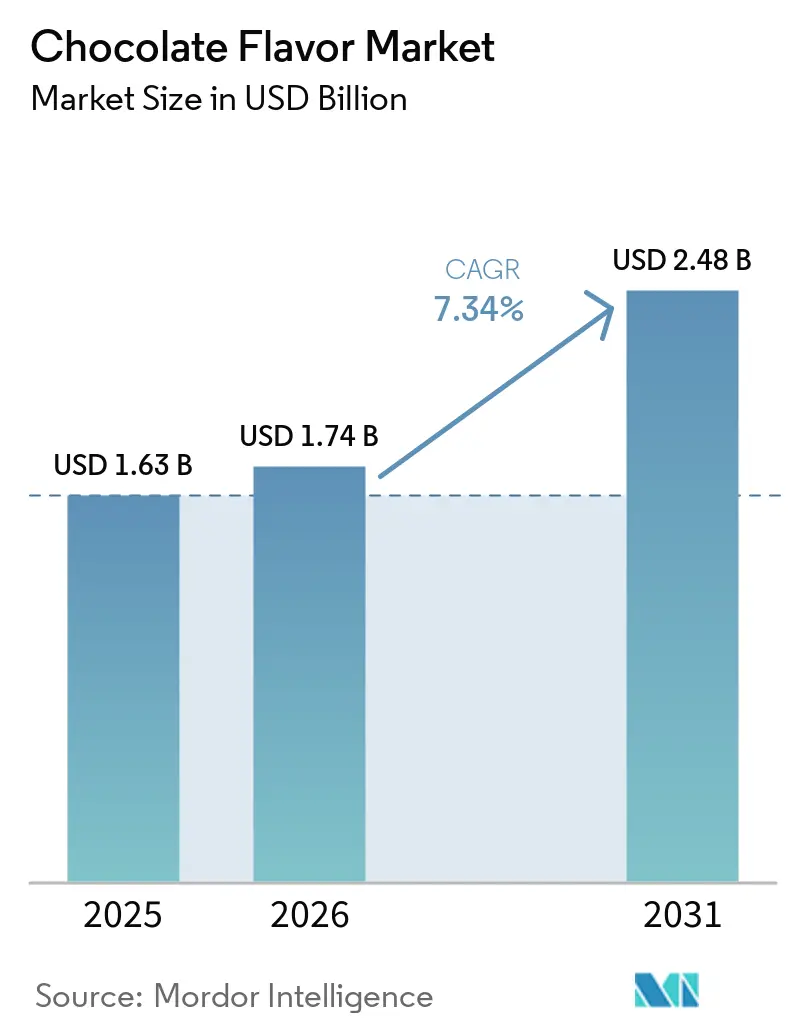
The chocolate flavor market was valued at USD 1.63 billion in 2025 and is projected to grow from USD 1.74 billion in 2026 to USD 2.48 billion by 2031, registering a CAGR of 7.34% during the forecast period (2026–2031). Manufacturers are increasingly relying on chocolate flavor systems to deliver consistent cocoa taste across confectionery, bakery, dairy, beverage, and snack applications. Rising cocoa costs have increased the importance of flavor systems in formulations that reduce cocoa powder usage while preserving the desired taste profile. Demand for premium chocolate products is also driving the need for differentiated flavor profiles, including layered, origin-inspired, and filled-product concepts. Clean-label requirements are prompting suppliers to develop natural alternatives that comply with labeling regulations without compromising processing performance. Meanwhile, the chocolate flavor market caters to both premium products that emphasize recognizable ingredients and high-volume products that require cost efficiency, stability, and reliable supply.
Key Report Takeaways
- By product type, milk chocolate held 38.11% of the chocolate flavor market share in 2025, while dark chocolate is forecast to grow at an 8.06% CAGR through 2031.
- By nature, natural flavors held 58.76% of the chocolate flavor market share in 2025, while artificial and synthetic flavors are forecast to grow at a CAGR of 8.74% through 2031.
- By form, powder held 67.09% of the 2025 value, while liquid flavor is projected to expand at an 8.28% CAGR through 2031.
- By end-use application, confectionery accounted for 37.41% of the 2025 value, while snacks are forecast to grow at an 8.21% CAGR through 2031.
- By geography, North America held 34.24% of the chocolate flavor market share in 2025, while Asia-Pacific is forecast to grow at a CAGR of 8.65% through 2031.
Note: Market size and forecast figures in this report are generated using Mordor Intelligence’s proprietary estimation framework, updated with the latest available data and insights as of January 2026.
Market Trends and Insights
Drivers Impact Analysis of Chocolate Flavor Market*
| Driver | (~) % Impact on CAGR Forecast | Geographic Relevance | Impact Timeline |
|---|---|---|---|
| Growing demand for indulgent and premium food products | +2.1% | Global, led by North America and Western Europe | Medium term (2–4 years) |
| Rising consumption of bakery and pastry products | +1.5% | Global, with strongest momentum in Europe and Asia-Pacific | Short term (≤ 2 years) |
| Demand for clean-label and naturally derived flavors | +1.2% | North America and Europe core, spill-over to Asia-Pacific and the Middle East and Africa | Medium term (2–4 years) |
| Expansion of functional and sports nutrition products | +0.8% | North America and Europe, spill-over to Asia-Pacific | Long term (≥ 4 years) |
| Use of chocolate flavors in reduced-sugar and reformulated products | +0.7% | Global, with early gains in North America, Germany, and United Kingdom | Short term (≤ 2 years) |
| Increasing flavor innovation and customization by food manufacturers | +0.6% | Global | Medium term (2–4 years) |
| Source: Mordor Intelligence | |||
Growing Demand for Indulgent and Premium Food Products
Consumers are increasingly seeking premium, high-quality indulgent food products, prompting manufacturers to develop distinctive and sophisticated chocolate flavor profiles. According to Barry Callebaut's "Top Chocolate Confectionery Trends 2026 & Beyond" report, 57% of surveyed consumers have changed their food and beverage habits, with this share rising to 71% among Gen Z consumers, who increasingly prioritize fewer, higher-quality indulgent purchases[1]. This shift is increasing demand for single-origin-inspired, roasted, intense cocoa and layered chocolate profiles in premium confectionery, desserts, bakery products, and filled chocolates. Manufacturers are using differentiated cocoa and roasted flavor profiles in premium chocolate bars and filled desserts to enhance sensory appeal, support product differentiation, and justify higher price points.
Rising Consumption of Bakery and Pastry Products
Growing demand for chocolate-flavored bakery products is increasing the need for high-quality chocolate flavor ingredients, particularly in cakes and other products associated with celebrations and special occasions. A July 2025 survey of consumers aged 18–24 in Anand City, Gujarat, found that celebratory occasions accounted for 91% of cake purchases, underscoring the importance of cakes in event-based consumption. Chocolate emerged as the most preferred flavor, selected by 86% of respondents, followed by Black Forest at 53% and Red Velvet at 36%. The survey also showed that 74% of consumers considered freshness very important, while 71% preferred modern or themed cake designs, reflecting demand for visually appealing and high-quality bakery offerings. In addition, 56% of respondents were willing to pay a premium for cakes made with organic or premium ingredients[2]. These preferences are creating opportunities for chocolate flavor suppliers to offer differentiated, consistent, and premium flavor profiles for cakes, pastries, fillings, desserts, and other bakery applications.
Demand for Clean-Label and Naturally Derived Flavors
Increasing consumer interest in products made with simple, recognizable ingredients is driving demand for natural and clean-label chocolate flavor solutions. According to the 2025 International Food Information Council's Food & Health Survey, 25% of Americans considered limited or no artificial ingredients or preservatives a key criterion when identifying healthy food options, underscoring the growing importance of clean-label formulations in food and beverage purchasing decisions[3]. This preference is encouraging manufacturers of confectionery, bakery, dairy, and beverage products to incorporate naturally derived chocolate flavors that align with consumer expectations for transparency and ingredient quality. Consequently, flavor suppliers have opportunities to develop authentic, high-performing chocolate profiles that deliver consistent taste, aroma, and application stability while helping manufacturers meet clean-label claims and reduce reliance on artificial ingredients.
Use of Chocolate Flavors in Reduced-Sugar and Reformulated Products
Growing consumer interest in reducing sugar consumption without compromising taste is expanding the application of chocolate flavors in reduced-sugar and reformulated food and beverage products. According to an IFIC survey, eight in ten Americans consider reducing the overall sweetness of their diet important, driven primarily by health concerns, blood-sugar management, and weight-management goals. In response, manufacturers are reformulating products to lower sugar content while preserving the indulgent sensory experience that consumers associate with chocolate. Chocolate flavors support this process by reinforcing cocoa notes, enhancing perceived richness, and maintaining a familiar chocolate profile in formulations with reduced sugar or alternative sweeteners. This trend is particularly significant across confectionery, bakery, dairy, beverages, and snack applications, where brands are developing lower-sugar offerings that meet evolving health preferences without sacrificing the taste, aroma, and overall appeal of chocolate-based products.
Restraints Impact Analysis of Chocolate Flavor Market*
| Restraint | (~) % Impact on CAGR Forecast | Geographic Relevance | Impact Timeline |
|---|---|---|---|
| Volatility in cocoa and raw material prices | -1.8% | Global, severe in European processing hubs and West Africa supply regions | Short term (≤ 2 years) |
| Stringent regulations governing food flavors and additives | -0.9% | Europe and North America, spill-over to Asia-Pacific regulatory frameworks | Long term (≥ 4 years) |
| Shelf-life and flavor stability challenges | -0.5% | Global, particularly acute in tropical Asia-Pacific and the Middle East and Africa markets | Medium term (2–4 years) |
| Availability and quality variability of natural raw materials | -0.7% | Global, concentrated in West Africa (cocoa) and Madagascar (vanilla) sourcing regions | Long term (≥ 4 years) |
| Source: Mordor Intelligence | |||
Volatility in Cocoa and Raw Material Prices
Fluctuations in cocoa prices and constrained supply conditions are intensifying cost, sourcing, and formulation challenges for chocolate flavor manufacturers and food producers. The International Cocoa Organization has highlighted significant supply pressures in the cocoa market, with challenging conditions expected to persist through 2025, making it more difficult for manufacturers to maintain stable ingredient costs, product recipes, profit margins, and retail prices. In response, manufacturers are increasingly exploring cocoa-reduction strategies, flavor-extension solutions, and alternative ingredients to preserve a desirable chocolate profile while managing higher raw material costs. However, these approaches can add complexity to procurement, inventory management, and product development processes, particularly when companies need to ensure consistent taste and quality across product batches. Furthermore, variations in the origin, harvest quality, and processing of natural cocoa-based raw materials can affect flavor intensity, aroma, and overall sensory performance, making it more challenging to deliver a consistent chocolate flavor experience.
Stringent Regulations Governing Food Flavors and Additives
Complex and evolving regulatory requirements across major markets can increase compliance costs, lengthen product development timelines, and create additional documentation burdens for chocolate flavor manufacturers. In the European Union, Regulation (EC) No. 1334/2008 sets requirements for flavoring substances, including the permitted use and labeling of natural flavorings, while United States Food and Drug Administration guidance differentiates between products marketed as “chocolate” and those labeled as “chocolate flavored.” Consequently, manufacturers must maintain detailed records related to ingredient sourcing, formulation, safety assessments, and labeling to ensure regulatory compliance across target markets. Additionally, chocolate flavors may undergo sensory changes during processing, heating, storage, and interactions with fats, proteins, and sweeteners. Manufacturers must therefore conduct extensive formulation and stability testing to preserve flavor consistency, product quality, and the intended sensory profile throughout the product’s shelf life.
*Our forecasts treat driver/restraint impacts as directional, not additive. The impact forecasts reflect baseline growth, mix effects, and variable interactions.
Chocolate Flavor Market Segment Analysis
By Product Type:
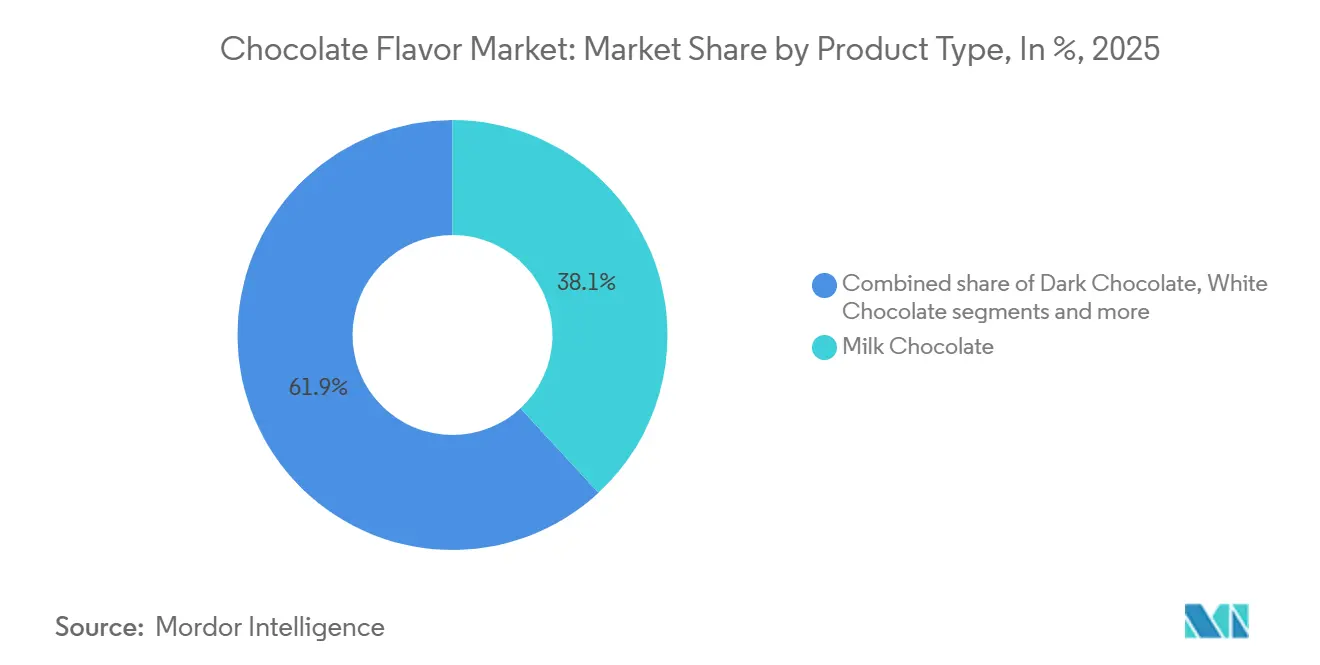
Milk Chocolate Leads While Dark Variants Grow FastestMilk chocolate held a 38.11% share of the chocolate flavor market in 2025, making it the largest product-type segment. Its leading position reflects widespread use across confectionery, dairy products, bakery and pastry products, and foodservice applications. The familiar, mild, and creamy chocolate profile of milk chocolate appeals to a broad consumer base across age groups and consumption occasions. Its versatility in both indulgent offerings and everyday food products continues to support stable demand. Manufacturers also use milk chocolate flavors extensively to create accessible, mainstream chocolate products with consistent taste profiles.
Dark chocolate is expected to emerge as the fastest-growing product type, recording a CAGR of 8.06% through 2031. This growth is driven by consumers' increasing preference for richer, more intense, and premium cocoa flavor profiles. Rising demand for high-cocoa-content products and premium confectionery is further strengthening the segment's expansion. Consumers' growing interest in dark chocolate's perceived nutritional value and antioxidant benefits also supports adoption. Flavor manufacturers are responding to this trend by developing dark chocolate profiles that deliver greater cocoa intensity and product differentiation across applications.

By Nature:
Natural Flavors Lead While Synthetic Variants Post Fastest GrowthNatural chocolate flavors accounted for 58.76% of the chocolate flavor market in 2025, reflecting strong consumer preference for clean-label and naturally sourced ingredients. Manufacturers increasingly use these flavors to create authentic chocolate profiles in confectionery, bakery, dairy, and beverage products. Demand is particularly strong among premium and health-conscious product categories, where ingredient transparency remains a key purchasing consideration. The segment also benefits from brand efforts to align product formulations with evolving clean-label standards and consumer expectations.
Artificial and synthetic chocolate flavors are projected to grow at a CAGR of 8.74% through 2031, supported by their cost efficiency, consistent performance, and formulation flexibility. These flavors enable manufacturers to maintain stable chocolate profiles across large-scale production of processed foods and beverages. Their extended stability and adaptability make them suitable for applications that require reliable flavor performance under varying processing conditions. Growing demand for customizable and affordable chocolate flavor solutions is expected to further support segment expansion.
By Form:
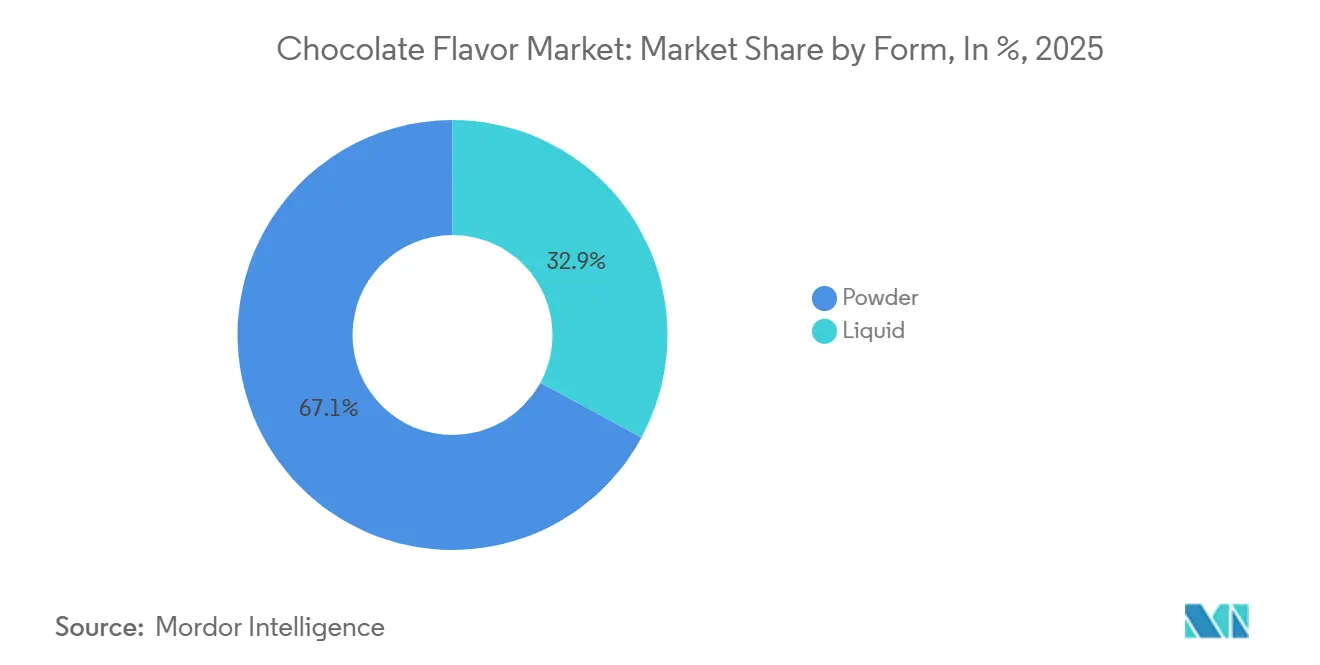
Powder Maintains Scale While Liquid Gains in BeveragesPowder chocolate flavors accounted for 67.09% of the chocolate flavor market in 2025, driven by their extensive use across dry-mix bakery products, cocoa-powder extensions, and shelf-stable snack applications. Manufacturers favor powder formats because they are easy to handle, measure, transport, and store. Their strong storage stability and long shelf life make them suitable for large-scale food production. Powder chocolate flavors also integrate effectively with dry formulations, supporting their continued adoption across diverse food applications.
Liquid chocolate flavors are projected to be the fastest-growing form, registering a CAGR of 8.28% through 2031. Their ease of incorporation into beverages, dairy products, confectionery, and other liquid or semi-liquid formulations supports this growth. These flavors allow manufacturers to achieve consistent dispersion and develop customized chocolate taste profiles. Rising demand for intense, premium, and tailored chocolate flavors is further expected to support the segment's expansion during the forecast period.
By End-Use Application:
Confectionery Anchors Volume While Snacks Lead GrowthConfectionery accounted for 37.41% of the chocolate flavor market in 2025, making it the leading end-use application segment. Chocolate flavors are widely used in chocolates, candies, gums, toffees, and other confectionery products to enhance taste and product appeal. The segment benefits from sustained consumer demand for indulgent, premium, and novel confectionery offerings. Manufacturers are also introducing diverse flavor combinations and formats to meet evolving consumer preferences and support product differentiation.
Snacks are projected to be the fastest-growing end-use application, registering a CAGR of 8.21% through 2031. Growth is driven by increasing demand for chocolate-flavored snack products, including protein bars, biscuits, cereal bars, and extruded snacks. Consumers increasingly prefer convenient snack options that combine indulgent flavors with functional or nutritional attributes. This trend is encouraging manufacturers to incorporate chocolate flavors into a broader range of on-the-go and better-for-you snack formulations.
Geography Analysis
North America Chocolate Flavor Market
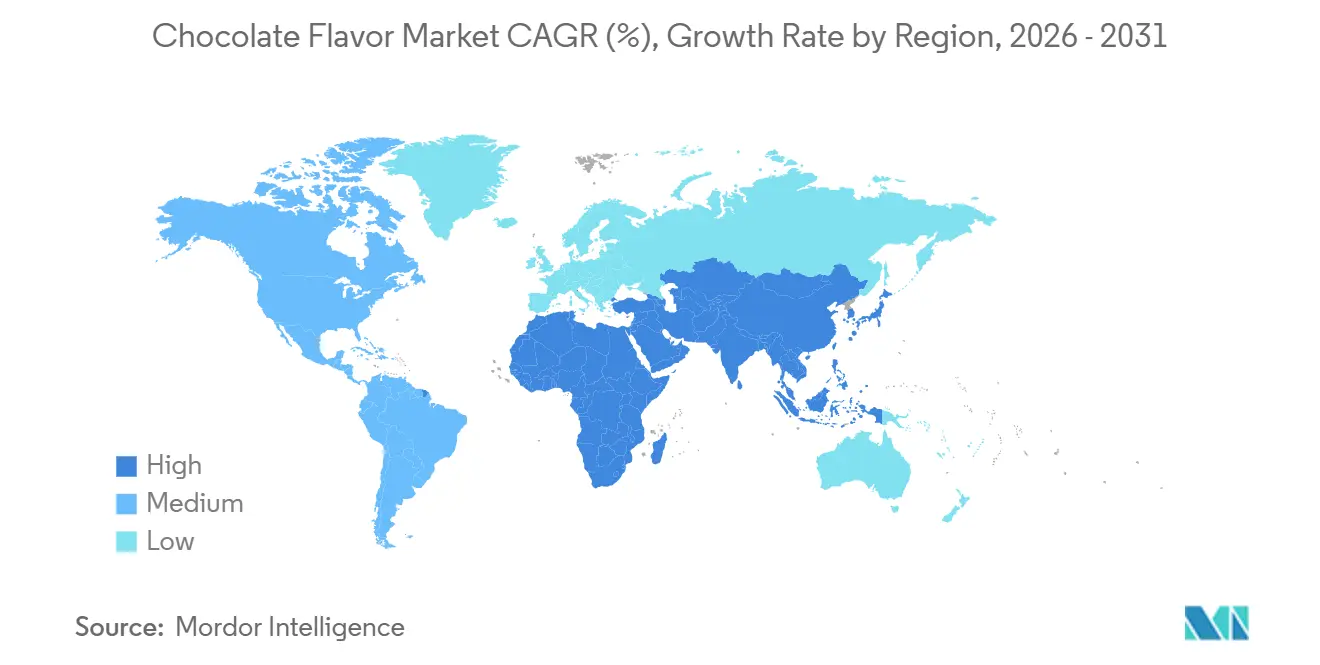
North America accounted for 34.24% of the chocolate flavor market in 2025, establishing it as the largest regional market. The region benefits from a mature processed food industry and strong demand from confectionery, bakery, dairy, and snack manufacturers. Clean-label preferences and cost pressures are encouraging manufacturers to adopt natural flavors and cocoa-reduction solutions. The United States remains the region’s primary demand center, supported by its large branded, private-label, and snack manufacturing industries.
APAC Chocolate Flavor Market
Asia-Pacific is projected to be the fastest-growing regional market, registering a CAGR of 8.65% through 2031. Rapid urbanization, rising disposable incomes, and expanding production of processed foods are increasing demand for chocolate flavors across China, India, Japan, and Southeast Asia. The region offers significant opportunities for premium natural flavors as well as cost-efficient synthetic alternatives. Growing launches of chocolate-flavored products across multiple price points are further supporting market expansion in the region.
EMEA and South America Chocolate Flavor Market
Europe represents the second-largest regional market, supported by well-established premium confectionery and bakery industries in Germany, France, the United Kingdom, and Italy. Demand in the region is shaped by cocoa price pressures, flavor-labeling regulations, and increasing consumer interest in natural formulations. South America, led by Brazil, benefits from growing confectionery consumption and expanding foodservice activity. In the Middle East and Africa, urban retail development and seasonal gifting occasions continue to support demand for chocolate-flavored products.
Competitive Landscape
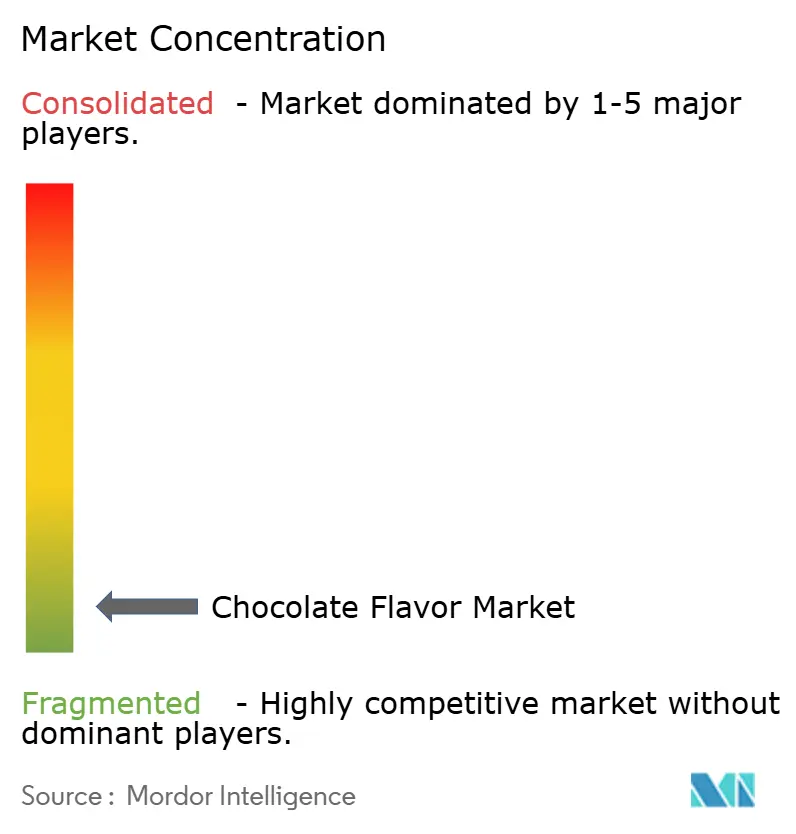
The chocolate flavor market is highly fragmented, with multinational flavor manufacturers, regional specialty houses, and local suppliers operating across key geographic markets. Leading companies compete by developing innovative chocolate profiles, natural and clean-label formulations, customized flavor solutions, and application-specific products. These offerings serve a broad range of end-use industries, including confectionery, bakery, dairy, beverages, and snacks. Givaudan, dsm-firmenich, IFF, Symrise, and Sensient are among the prominent global players, while numerous regional suppliers further intensify market competition.
Competition increasingly centers on natural flavor development, cocoa-reduction technologies, and advanced delivery systems that help manufacturers address cocoa price volatility without compromising sensory quality. Major suppliers are expanding their research, development, and application capabilities to create authentic and differentiated chocolate profiles in both powder and liquid formats. The growing preference for clean-label ingredients is increasing demand for formulations that deliver rich chocolate taste while meeting transparency and naturalness requirements. Technical expertise, formulation flexibility, and the ability to provide cost-efficient solutions are becoming key competitive differentiators in the market.
Strategic partnerships, new product development, and regional expansion remain important strategies for suppliers seeking to strengthen customer relationships and respond to local taste preferences. Companies are also investing in encapsulation and other flavor delivery technologies to improve flavor stability, release, and performance across different food and beverage applications. Global players benefit from extensive research capabilities and broad customer networks, while specialized regional manufacturers compete through flexible service and localized product offerings. This competitive environment creates opportunities for companies that can provide differentiated chocolate profiles, tailored formulations, and strong technical application support.
Chocolate Flavor Industry Leaders
-
Givaudan S.A.
-
dsm-firmenich AG
-
International Flavors & Fragrances Inc.
-
Symrise AG
-
Sensient Technologies Corporation
- *Disclaimer: Major Players sorted in no particular order
Chocolate Flavor Market Companies Covered in this Report
- Givaudan S.A.
- dsm-firmenich AG
- International Flavors & Fragrances Inc.
- Symrise AG
- Sensient Technologies Corporation
- Takasago International Corporation
- Kerry Group plc
- MANE SA
- Döhler GmbH
- Robertet Group
- Archer-Daniels-Midland Company (ADM)
- Cargill, Incorporated
- Bell Flavors & Fragrances, Inc.
- FlavorSum LLC
- T. Hasegawa Co., Ltd.
- Metarom Group
- Lionel Hitchen Limited
- Keva Flavours Pvt. Ltd.
- Custom Flavors, Inc.
- Aromatique Food S.R.L.
Recent Industry Developments in Chocolate Flavor Market
- July 2025: OSF Flavors introduced Angel Hair Chocolate, a specialty chocolate flavor inspired by the popular Dubai-style “angel hair” confectionery trend. This launch broadens OSF Flavors’ chocolate flavor portfolio and meets increasing demand for innovative, trend-driven chocolate profiles across bakery and confectionery applications.
- October 2024: At Gulfood Manufacturing 2024, IFF introduced new food and beverage innovations, including solutions that help reduce cocoa use while preserving the desired chocolate taste and sensory experience. These innovations reflect IFF’s emphasis on cocoa-reduction and flavor optimization technologies amid rising cocoa costs and supply constraints.
- July 2024: Cargill introduced its Gerkens® Revelry and Gerkens® Bliss cocoa powders, which deliver robust cocoa notes and a smooth, creamy chocolate profile for beverage applications. These solutions enable manufacturers to reduce sugar content by 15–30% while preserving a balanced chocolate taste, thereby supporting innovation in reduced-sugar chocolate beverages.
Global Chocolate Flavor Market Report Scope
Chocolate flavors are specialized ingredients that deliver, enhance, or replicate chocolate and cocoa taste profiles in a broad range of food and beverage products. The market is segmented by product type into milk chocolate, dark chocolate, white chocolate, and others; by nature into natural and artificial/synthetic; by form into powder and liquid; and by end-use application into confectionery, bakery and pastry, dairy products, ice cream and frozen desserts, snacks, beverages, and others. The geographic scope covers North America, Europe, Asia-Pacific, South America, and the Middle East and Africa, with market forecasts presented in terms of value (USD).
| Milk Chocolate |
| Dark Chocolate |
| White Chocolate |
| Others |
| Natural |
| Artificial/Synthetic |
| Powder |
| Liquid |
| Confectionery |
| Bakery and Pastry |
| Dairy Products |
| Ice Cream and Frozen Desserts |
| Snacks |
| Beverages |
| Others |
| North America | United States |
| Canada | |
| Mexico | |
| Rest of North America | |
| Europe | Germany |
| United Kingdom | |
| Italy | |
| France | |
| Spain | |
| Rest of Europe | |
| Asia-Pacific | China |
| Japan | |
| India | |
| Australia | |
| Rest of Asia-Pacific | |
| South America | Brazil |
| Argentina | |
| Rest of South America | |
| Middle East and Africa | South Africa |
| Saudi Arabia | |
| United Arab Emirates | |
| Rest of Middle East and Africa |
| By Product Type | Milk Chocolate | |
| Dark Chocolate | ||
| White Chocolate | ||
| Others | ||
| By Nature | Natural | |
| Artificial/Synthetic | ||
| By Form | Powder | |
| Liquid | ||
| By End-Use Application | Confectionery | |
| Bakery and Pastry | ||
| Dairy Products | ||
| Ice Cream and Frozen Desserts | ||
| Snacks | ||
| Beverages | ||
| Others | ||
| By Geography | North America | United States |
| Canada | ||
| Mexico | ||
| Rest of North America | ||
| Europe | Germany | |
| United Kingdom | ||
| Italy | ||
| France | ||
| Spain | ||
| Rest of Europe | ||
| Asia-Pacific | China | |
| Japan | ||
| India | ||
| Australia | ||
| Rest of Asia-Pacific | ||
| South America | Brazil | |
| Argentina | ||
| Rest of South America | ||
| Middle East and Africa | South Africa | |
| Saudi Arabia | ||
| United Arab Emirates | ||
| Rest of Middle East and Africa | ||
Key Questions Answered in the Report
What is the projected value of the chocolate flavor market by 2031?
The chocolate flavor market is forecast to reach USD 2.48 billion by 2031, projected to grow at a 7.34% CAGR from 2026.
Which chocolate flavor product type leads demand?
Milk chocolate led product types with 38.11% of 2025 value because it is used widely in confectionery, dairy, bakery, and foodservice products.
Are natural chocolate flavors more important than synthetic options?
Natural flavors held 58.76% of 2025 value, supported by clean-label demand, while synthetic options are growing faster at an 8.7% CAGR where cost efficiency and heat stability are priorities.
Which end-use segment is growing fastest for chocolate flavors?
Snacks are the fastest-growing end-use application at an 8.21% CAGR through 2031, supported by chocolate-coated nuts, protein bars, popcorn, and reduced-sugar snack products.