
Chitosan Market Size and Share
Market Overview
| Study Period | 2020 - 2031 |
|---|---|
| Market Size (2026) | USD 6.30 Billion |
| Market Size (2031) | USD 11.30 Billion |
| Growth Rate (2026 - 2031) | 12.38 % |
| Fastest Growing Market | Europe |
| Largest Market | North America |
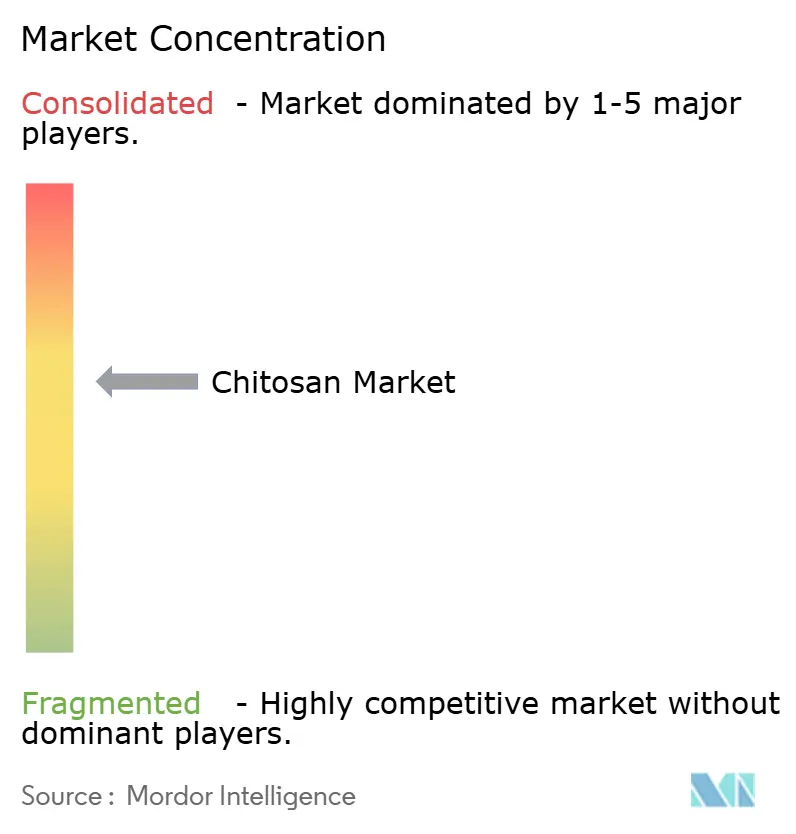
| Market Concentration | Medium |
Major Players *Disclaimer: Major Players sorted in no particular order Image © Mordor Intelligence. Reuse requires attribution under CC BY 4.0. | |

Chitosan Market Analysis by Mordor Intelligence
The Chitosan Market size is estimated at USD 6.30 billion in 2026, and is expected to reach USD 11.30 billion by 2031, at a CAGR of 12.38% during the forecast period (2026-2031).
Rising demand for biodegradable flocculants in municipal and industrial water treatment, regulatory recognition of chitosan as a plant biostimulant in Europe, and clinical validation of chitosan-based hemostatic dressings are the pivotal forces propelling the global chitosan market. Municipal utilities in the European Union are swapping synthetic polyacrylamide for chitosan to comply with the 2024 recast of the Urban Wastewater Treatment Directive, while industrial dischargers in the United States face tighter EPA heavy-metal limits that favor chitosan chelators. Pharmaceutical developers are scaling nano-chitosan carriers that triple tumor drug accumulation, and cosmetic formulators are harnessing chitosan oligosaccharides in “clean beauty” lines that tout marine-origin biodegradability. Venture funding in circular-economy processors, exemplified by Tidal Vision’s USD 6.5 million Series A round, signals investor confidence in the global chitosan market as a source of both environmental compliance and high-margin specialty products.
Key Report Takeaways
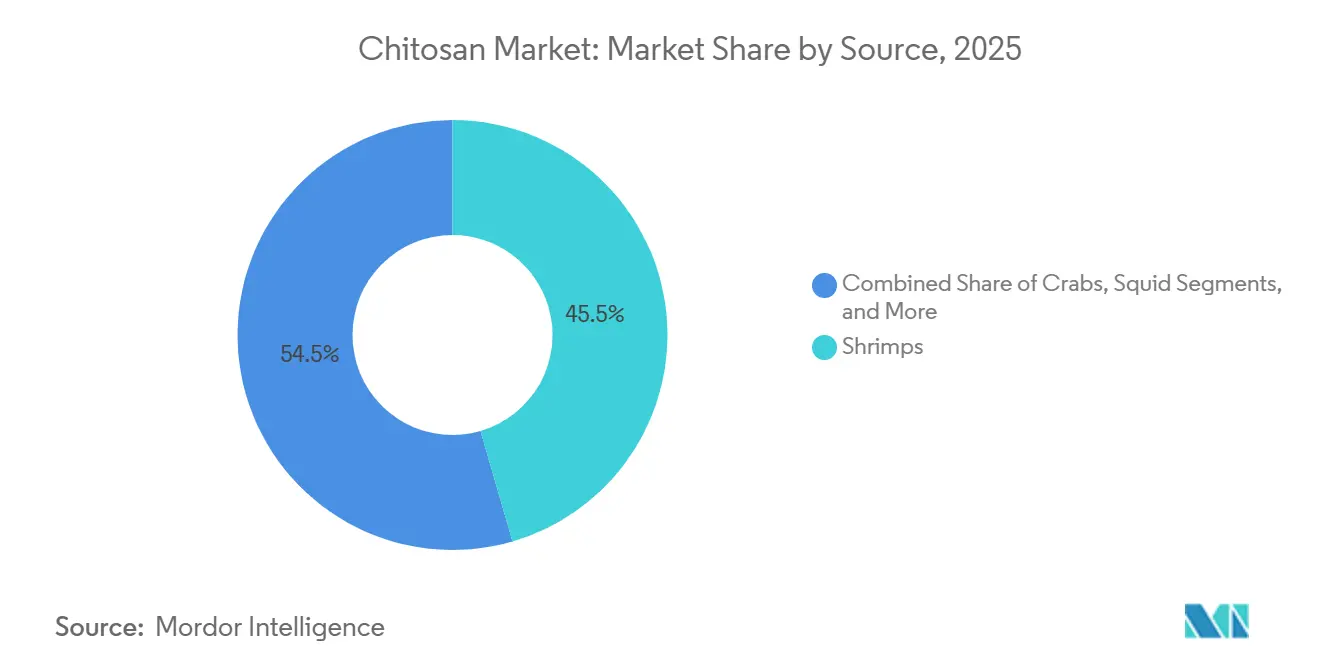
- By source, shrimps led with 45.55% of chitosan market share in 2025, while crabs are forecast to post a 13.25% CAGR through 2031.
- By grade, industrial specifications accounted for 45.53% of the chitosan market in 2025; pharmaceutical and biomedical grade is projected to expand at a 12.85% CAGR to 2031.
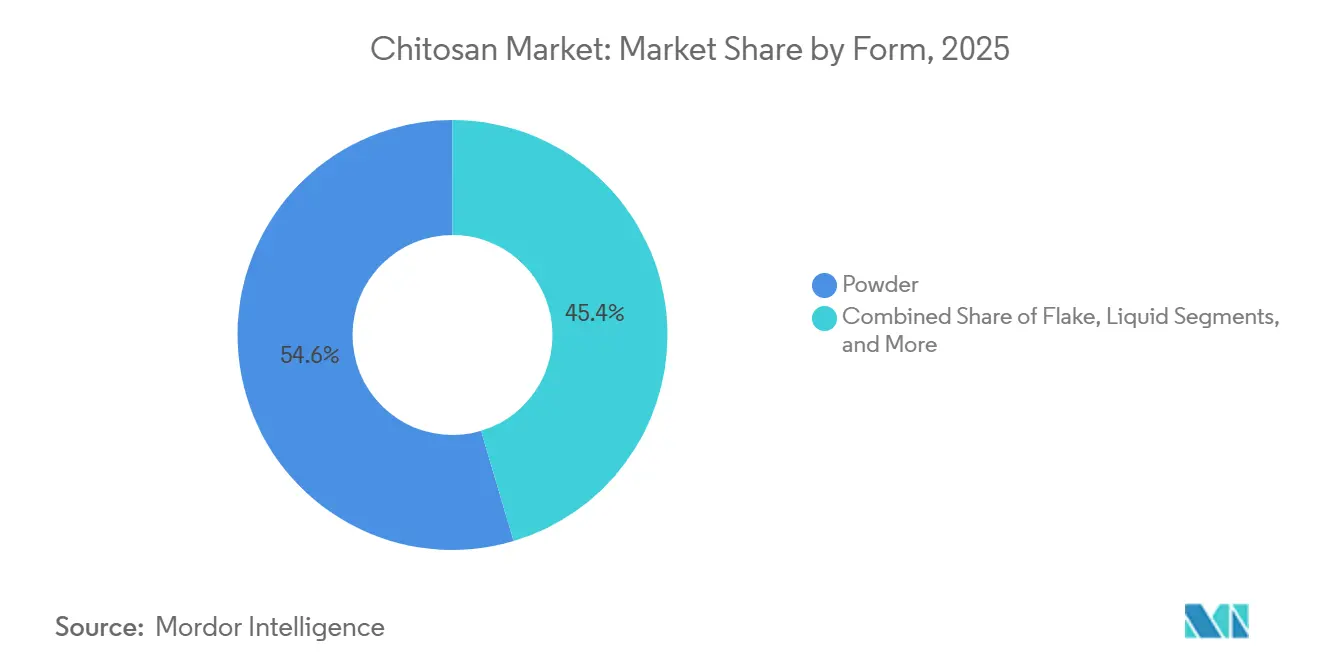
- By form, powders held 54.63% share of the chitosan market size in 2025, whereas nano and micro particles are advancing at a 13.87% CAGR during the outlook period.
- By application, water treatment represented 28.13% of the chitosan market in 2025, yet pharmaceutical and biomedical uses will register the fastest 13.7% CAGR to 2031.
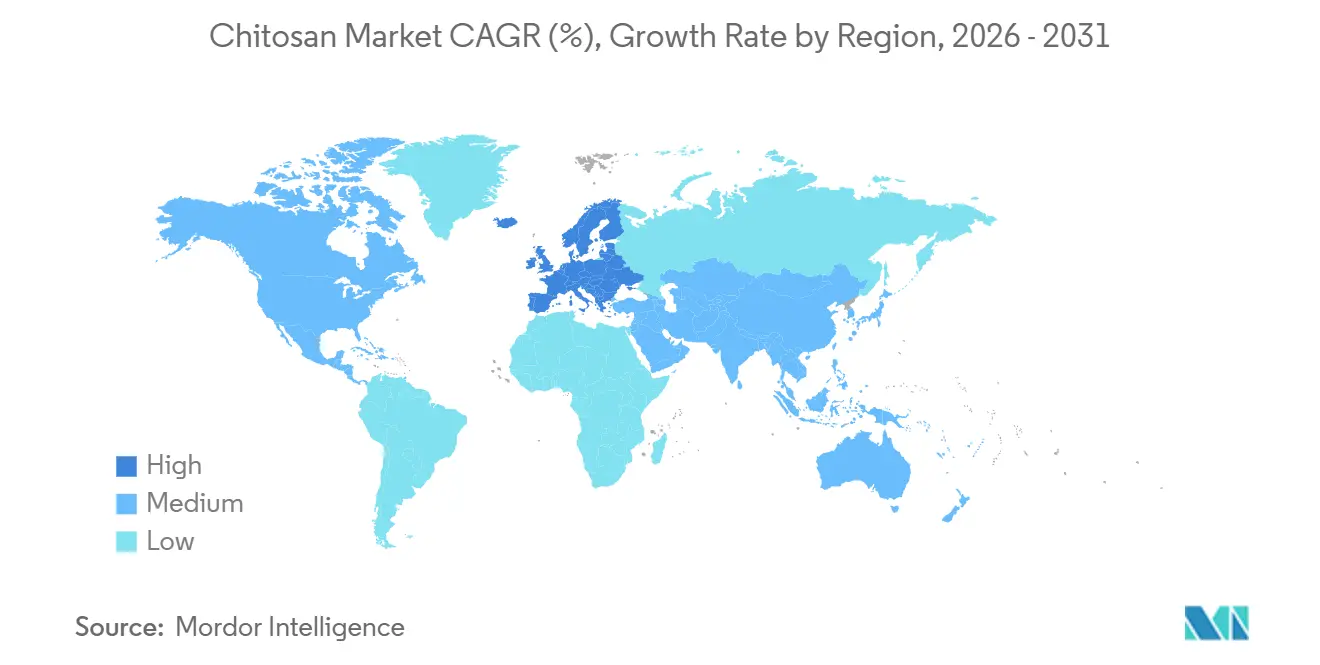
- By geography, North America commanded 25.13% share of the chitosan market in 2025; Europe is on track to expand at a 14.51% CAGR to 2031.
Note: Market size and forecast figures in this report are generated using Mordor Intelligence’s proprietary estimation framework, updated with the latest available data and insights as of January 2026.
Market Trends and Insights
Drivers Impact Analysis of Chitosan Market*
| Driver | (~) % Impact on CAGR Forecast | Geographic Relevance | Impact Timeline |
|---|---|---|---|
| Rising water-treatment regulations | +2.8% | EU, North America, China | Medium term (2-4 years) |
| Surging demand for biodegradable and eco-friendly materials | +2.5% | Global, led by EU and North America | Long term (≥ 4 years) |
| Expanding biomedical, cosmetics and food uses of chitosan oligosaccharides | +2.1% | North America, EU, Japan | Medium term (2-4 years) |
| Shift toward bio-based flocculants in industrial effluents | +1.9% | Asia-Pacific core, spill-over to MEA | Short term (≤ 2 years) |
| Adoption of fungal or plant-based chitosan for vegan and Halal markets | +1.4% | EU, Middle East, Southeast Asia | Long term (≥ 4 years) |
| Circular-economy valorization of seafood and insect waste streams | +1.1% | North America, Nordic countries, Asia-Pacific | Medium term (2-4 years) |
| Source: Mordor Intelligence | |||


Rising Water-Treatment Regulations
Utilities in the European Union must now install quaternary treatment that targets micropollutants, and chitosan simultaneously coagulates colloids and adsorbs trace organics, reducing alum use by up to 30%[1]European Commission, “Urban Waste Water Treatment Directive,” europa.eu. Industrial sites in the United States face stricter 40 CFR Part 125 limits for heavy metals, and chitosan derivatives remove 93–99% of iron, copper and zinc without hazardous sludge. China has cut total chromium limits for electroplating effluent to 0.5 mg L-1, prompting early adoption of chitosan flocculants in Zhejiang and Guangdong. These converging regulations enlarge the addressable market for high-deacetylation chitosan grades that assure both performance and biodegradability.
Surging Demand for Biodegradable and Eco-Friendly Materials
Brand owners pursuing plastic-free packaging and compostable agriculture inputs are specifying chitosan films that degrade 80–90% within 60 days under industrial composting, far faster than polyethylene. The Single-Use Plastics Directive in Europe curbs oxo-degradable polymers, directing formulators toward chitosan seed coatings and controlled-release fertilizers that leave no persistent residue. Hair-care brands are reformulating gels with quaternized chitosan that delivers hold without microplastics, leveraging marine-origin storytelling to command premium shelf pricing. These preferences move the global chitosan market beyond compliance, turning biodegradability into a marketing advantage.
Expanding Biomedical, Cosmetics and Food Uses of Chitosan Oligosaccharides
Clinical studies show chitosan oligosaccharides enrich gut Bifidobacterium and reduce fasting glucose in pre-diabetic adults, supporting their emergence as prebiotic supplements. Cosmetic serums formulated with low-molecular-weight chitosan penetrate the stratum corneum, lowering transepidermal water loss and calming UV-induced redness in human trials. Japanese producers employ enzymatic hydrolysis to control molecular weight distribution, optimizing bioavailability for dermal and oral applications. Food and beverage adoption awaits European Food Safety Authority clearance on allergenicity, yet U.S. dietary supplement use is climbing under Generally Recognized as Safe status.
Shift Toward Bio-Based Flocculants in Industrial Effluents
Polyacrylamide residue caps in China and India have spurred pulp and paper mills to trial chitosan alternatives that equal cationic polyacrylamide performance at 30% lower dosage. Quaternized chitosan flocculates across a broad pH window, making it suited to both acidic mining water and alkaline textile effluent without the need for multiple synthetic blends. Asia-Pacific suppliers are releasing tailored molecular-weight chitosan variants, securing multi-year contracts by delivering site-specific performance rather than competing solely on price.
Restraints Impact Analysis of Chitosan Market*
| Restraint | (~) % Impact on CAGR Forecast | Geographic Relevance | Impact Timeline |
|---|---|---|---|
| Allergenic concerns limiting food and cosmetic uptake | -1.6% | EU, North America | Short term (≤ 2 years) |
| High cost of ultra-high-purity medical-grade chitosan | -1.3% | Global, intense in value-sensitive segments | Medium term (2-4 years) |
| Limited scalability of fungal fermentation capacity | -0.9% | EU, North America | Long term (≥ 4 years) |
| Climate-driven volatility of crustacean biomass supply | -1.1% | Asia-Pacific, North America | Medium term (2-4 years) |
| Source: Mordor Intelligence | |||
Allergenic Concerns Limiting Food and Cosmetic Uptake
Residual proteins in lower-grade crustacean chitosan can trigger IgE reactions in shellfish-sensitized individuals, leading the European Food Safety Authority to delay opinions on direct food contact and forcing cosmetic brands to label shellfish origin[2]Journal of Allergy and Clinical Immunology, “Shellfish Allergenicity,” jacionline.org. Fungal and insect chitosan could bypass allergen labeling, but clinical safety dossiers remain incomplete, holding back full-scale commercialization. Until risk assessments conclude, formulators in mass-market foods and cosmetics will limit chitosan inclusion or invest in higher-purity grades, tempering near-term volume growth.
High Cost of Ultra-High-Purity Medical-Grade Chitosan
Meeting pharmaceutical specifications below 0.5 EU/mg endotoxin and above 95% deacetylation requires multi-stage acid-base hydrolysis, activated-carbon treatment and ultrafiltration that triples operating costs versus industrial chitosan. Good Manufacturing Practice compliance adds cleanroom overhead and batch traceability, confining supply to a few DMF-holding producers who exercise oligopolistic pricing. The resulting USD 500/kg price for nano-chitosan restricts penetration to premium wound-care dressings and oncology drug carriers, slowing broader clinical uptake.
*Our forecasts treat driver/restraint impacts as directional, not additive. The impact forecasts reflect baseline growth, mix effects, and variable interactions.
Chitosan Market Segment Analysis
By Source:
Crustacean Shells Sustain Volume while Crabs AccelerateShrimp shells yielded 45.55% of global chitosan market output in 2025, supported by established logistics in Thailand, Vietnam and India that channel 1.5 million t of shell waste into dedicated deacetylation lines. Crabs are forecast to lead growth at a 13.25% CAGR as processors in Alaska and Northern Europe consolidate shell recovery, boosting deacetylation yields and lowering unit costs. Insect exoskeletons and fungal biomass are emerging feedstocks with vegan, Halal and Kosher positioning, yet extraction costs remain 20–30% higher owing to immature infrastructure. Seasonal variability still influences the global chitosan market, as climate anomalies shrink shrimp harvests in El Niño years, prompting processors to hedge supply with mixed crustacean and fungal inputs. Although squid-derived chitosan remains a niche, its clarity and low viscosity command premium pricing in high-end cosmetics, revealing the diversification potential within marine feedstocks.
Crab-based capacity expansions in Norway and Canada are backed by grants that subsidize cold-water fishery waste valorization, reinforcing supply security for European buyers seeking traceability under the EU Green Deal. Asian government incentives for insect farming on food waste are likewise nurturing pilot-scale black soldier fly chitosan plants, opening a circular-economy storyline. While insect chitosan currently represents less than 2% of global chitosan market volume, favorable life-cycle assessments could accelerate its share once purification costs fall. Overall, feedstock diversification limits raw-material risk and supports stable pricing in a market vulnerable to aquaculture disease outbreaks.


By Grade:
Pharmaceutical Purity Unlocks Premium MarginsIndustrial-grade material commanded 45.53% of the global chitosan market size in 2025, filling water-treatment and textile niches where 75–85% deacetylation suffices. Pharmaceutical and biomedical grades, however, will outpace commodity specifications at 12.85% CAGR through 2031 as clinical evidence spreads and military procurement of hemostatic dressings rises. The degree of deacetylation, endotoxin burden and molecular-weight range define price tiers, with Good Manufacturing Practice batches retailing at 3–10 times industrial equivalents.
Drug-carrier patents covering chitosan-collagen composites and nano-gel matrices strengthen price resilience, while oligopolistic supply from Primex, Heppe Medical Chitosan and a few Chinese DMF holders preserves market discipline. Food-grade chitosan, positioned between industrial and medical benchmarks, benefits from Generally Recognized as Safe status in the United States yet awaits full clearance in Europe. As a result, the grade hierarchy widens, segmenting buyers by regulatory exposure and margin appetite rather than sheer volume requirements.
By Form:
Nano Particles Propel Drug-Delivery InnovationPowders retained 54.63% global chitosan market share in 2025 thanks to easy handling in water treatment and agriculture. Nano and micro particles will chart the fastest 13.87% CAGR, driven by oncology pipelines where sub-300 nm chitosan vectors triple tumor accumulation of doxorubicin and cut cardiotoxicity in half. Production routes such as ionic gelation with tripolyphosphate add USD 300-400/kg to cost, confining initial adoption to high-value indications including gene delivery and ophthalmic therapeutics.
Flake and bead forms serve agriculture and controlled-release fertilizers, hydrating slowly to maintain field persistence. Liquid chitosan solutions gain favor in cosmetics and food applications for mix-free incorporation, although their 6-to-12-month shelf life limits export horizons. The form factor range underpins the global chitosan market’s flexibility, allowing suppliers to target both high-volume industrial buyers and precision-dosing pharmaceutical companies.
By Application:
Pharmaceutical Uses Surpass Commodity Water TreatmentWater treatment contributed 28.13% to the global chitosan market in 2025 but faces moderating expansion as penetration peaks in mature economies. Pharmaceutical and biomedical applications are projected to grow at 13.7% CAGR, spurred by U.S. Department of Defense procurement of chitosan dressings and phase II trials of oxygenating hydrogels that cut bacterial load by 90% in chronic wounds. Cosmetics tap chitosan’s film-forming and moisturizing traits for anti-aging serums, while agriculture leverages foliar sprays that cut powdery mildew incidence by 60–80% in grapes and tomatoes without pesticide registration. Food and beverage uses remain cautious until allergen rulings conclude, though dietary supplement demand rises on prebiotic positioning. As specialty applications widen, dependence on commodity flocculation revenue declines, rebalancing the global chitosan market toward value-dense segments.
Geography Analysis
Europe Chitosan Market
Europe will post the strongest 14.51% CAGR through 2031, propelled by quaternary wastewater mandates and the biostimulant classification that simplifies chitosan deployment in farming. Germany funds municipal trials that replace polyacrylamide with chitosan, and Spain deploys chitosan sprays in viticulture to reduce synthetic fungicide load. United Kingdom trauma centers have standardized chitosan dressings, boosting hospital demand and reinforcing the region’s leadership in medical applications.
North America Chitosan Market
North America captured 25.13% of global chitosan market share in 2025, anchored by EPA pretreatment standards and early battlefield use of chitosan hemostats. Growth moderates as water-treatment installations mature, yet pharmaceutical prospects remain attractive as inhaled-drug-grade chitosan wins its first USP monograph. Canada’s cold-water crab fisheries provide low-contaminant shells, supporting premium pharmaceutical supply chains and reinforcing regional competitiveness.
APAC, Middle East and South America Chitosan Market
Asia-Pacific supplies most feedstock, processing about 2 million t of shell waste annually in Thailand, Vietnam and China. Domestic chitosan uptake is uneven; China tightened chromium discharge limits, catalyzing localized adoption, but enforcement gaps restrain nationwide penetration. Japan specializes in cosmetic-grade oligosaccharides with proprietary hydrolysis technology, while India’s aquaculture hubs expand industrial-grade output for global export. Emerging markets in the Middle East test chitosan as a pretreatment in desalination, and South America inches forward with Brazil deploying chitosan bio-pesticides in organic soy farming amid tariff and infrastructure headwinds.

Regulatory Landscape
Regulation for chitosan is application-led, with distinct pathways across agriculture, food, and medical/pharma end uses. In the European Union, chitosan and chitosan hydrochloride are handled as approved basic substances for plant protection, and EFSA activity has continued to refine and expand supported use cases. EFSA issued review-related outputs in April 2025 and published conclusions in June 2026 on extension-of-use applications for chitosan hydrochloride, including crop-specific scopes such as grapevine, oilseed rape, and amenity grassland, reinforcing Europe as an anchored market for agricultural and horticultural deployment.
Food and ingestible uses remain more source-specific and jurisdiction-dependent. FSANZ released supporting documentation in July 2025 tied to the approval process for mushroom-derived chitosan as a food preservative, creating a clearer specification route for fungal-derived material in Australia and New Zealand. In the United States, chitosan has GRAS positioning for defined uses (including fungal-origin chitosan for specific food processing applications) and is referenced in adjacent feed processing practices (for example, AAFCO acceptance as a flocculant in certain feed contexts). Higher-purity biomedical and pharmaceutical supply chains must also align with quality expectations and the recognized standards used by regulators and pharmacopoeial systems.
Value Chain Analysis
The chitosan value chain starts with feedstock aggregation from crustacean processing (shrimp and crab shells dominate global volumes) and, at smaller scale, fungal biomass and insect exoskeleton streams that support vegan and Halal positioning. Upstream players include fisheries and seafood processors that collect shells and maintain traceability, followed by chitin extraction and deacetylation operators that convert chitin to chitosan and then split supply into industrial, food, and pharmaceutical/biomedical grades. Downstream, formulators and compounders adjust molecular weight and degree of deacetylation for end uses in water treatment, agriculture, cosmetics, and biomedical applications, with distribution typically moving through specialty chemical channels for industrial grades and qualification-driven supply agreements for medical and pharmaceutical buyers.
Value creation and bottlenecks concentrate in purification, analytical release testing, and documentation required for regulated uses. Medical and pharmaceutical supply depends on tight batch consistency (such as degree of deacetylation and residual proteins/endotoxins) and alignment with regulator-recognized standards and pharmacopoeial expectations, which favors vertically integrated or quality-system-intensive producers. This is consistent with cGMP and USP-NF-aligned positioning by specialized suppliers such as trū Chitosan and GMP-focused offerings by Heppe Medical Chitosan. Key constraints include variable raw material quality, moisture sensitivity, and solubility limits at physiological pH for some biomedical formats, along with scalability challenges for fermentation-based supply. Together, these factors raise the cost and lead times for ultra-high-purity grades compared with industrial material used in flocculation and other commodity applications.
Competitive Landscape
The chitosan market is moderately concentrated; the top five suppliers control a significant share, leaving space for agile entrants to specialize in grades or feedstocks. Primex leverages Icelandic shrimp shells certified by the Marine Stewardship Council to market traceable, low-endotoxin material, while Advanced Biopolymers integrates extraction and downstream purification in Norway to stabilize margins despite biomass volatility. KitoZyme dominates oligosaccharides for nutraceuticals through proprietary enzymatic hydrolysis that fine-tunes molecular weight distribution, creating a defensible niche[3]KitoZyme, “Corporate Overview,” kitozyme.com.
Heppe Medical Chitosan capitalizes on multiple patents for chitosan-collagen composites and holds an FDA Drug Master File, anchoring its premium pricing strategy in biomedical consumables. Disruptors such as Tidal Vision target negative-cost crab shells from U.S. processors, projecting cost leadership once its proprietary green extraction line scales in 2026. Meron Biopolymers pilots submerged fermentation to supply vegan chitosan in the EU, though production volumes remain small. Competitive differentiation hinges on raw-material control, Good Manufacturing Practice compliance and formulation patents, barriers that discourage purely price-based competition.
Chitosan Industry Leaders
Primex ehf
Panvo Organics Pvt Ltd
KitoZyme SA
Heppe Medical Chitosan GmbH
GTC Bio Corporation
- *Disclaimer: Major Players sorted in no particular order
Chitosan Market Companies Covered in this Report
- Advanced Biopolymers AS
- Bio21 AS
- ChitoTech Co. Ltd
- D'Labs Chemicals Pvt Ltd
- Dainichiseika Color & Chemicals Mfg
- Golden-Shell Pharmaceutical Co. Ltd
- GTC Bio
- Heppe Medical Chitosan
- Japan BioKey Inc.
- KIMICA
- KitoZyme
- Koyo World
- Marsing & Co A/S
- Meron Biopolymers
- Panvo Organics
- Primex ehf
- Qingdao Yunzhou Biochemistry Co. Ltd
- Tidal Vision Products Inc.
- Zhejiang Aoxing Biotechnology Co. Ltd
- Zhejiang Golden-Shell Biotechnology Co. Ltd

Market Opportunities and Future Outlook
Near-term whitespace centers on expanding the addressable use-map where regulatory clarity and source-specific approvals are progressing, especially in agriculture and food-contact contexts. EFSA’s June 2026 outputs on chitosan hydrochloride extension-of-use applications in plant protection, combined with Europe’s existing basic-substance positioning, supports broader crop programs for growers and input suppliers that prefer bio-based actives and simpler compliance pathways. In Australia and New Zealand, FSANZ’s July 2025 supporting documentation tied to mushroom-derived chitosan approval provides a defined route for fungal-sourced specifications, which can help brands and ingredient suppliers address allergen-label concerns associated with crustacean-origin material.
On the supply side, new and localized capacity additions and circular-economy sourcing are creating room for differentiated grades and traceability-led propositions. CuanTec’s commencement of chitosan production at its Glenrothes, Scotland facility in May 2024 provides an example of European manufacturing buildout linked to seafood byproduct valorization and regional supply security. At the same time, biomedical innovation continues to broaden high-value use cases in drug delivery and regenerative medicine, but commercialization depends on standardized manufacturing and reproducible physicochemical properties. Suppliers with strong analytical controls and documentation are therefore positioned to capture premium demand from pharma and medtech programs that need consistent polymer performance rather than commodity flocculant specifications.
Recent Industry Developments in Chitosan Market
- June 2026: EFSA published conclusions extending the use of chitosan hydrochloride in plant protection, enabling extension of use across additional crop-specific scopes in Europe. The development reinforces Europe as an anchored market for agricultural deployment of bio-based actives and aligns with EFSA's ongoing review program.
- July 2025: trū Chitosan (iterro Life Sciences) introduced trū Chitosan USP Inhalant, positioned as a commercially available chitosan qualified for inhaled drug delivery. The introduction strengthens the pharma-grade supply layer by linking material specifications to USP expectations, supporting formulation teams seeking more standardized inputs for regulated development work.
- June 2024: KitoZyme partnered with DPH Biologicals to launch ChitoNox FC, a fungal chitosan-based seed treatment technology for the United States, with availability aligned to the 2025 crop season. The collaboration expands fungal-derived chitosan commercialization in agriculture, using a go-to-market partner to accelerate adoption beyond Europe-centric use patterns.


Chitosan Market Report Scope and Research Methodology
Market Definition and Coverage
For this study, the market covers revenues earned from selling primary chitosan polymer (made by de-acetylation of chitin from crustacean shells or fungal sources) in common commercial forms like powder, flake, liquid, and micro or nano formats.
Scope exclusions: Chitosan oligosaccharides, glucosamine supplements, and finished end products like wound dressings are excluded from the value totals.
Segments Covered in This Report
- By Source
- Shrimps
- Crabs
- Squid
- Fungi / Mycelium
- Insect Exoskeletons
- Others
- By Grade
- Industrial Grade
- Food Grade
- Pharmaceutical & Biomedical Grade
- By Form
- Powder
- Flake
- Liquid
- Nano / Micro Particles
- By Application
- Water Treatment
- Cosmetics & Personal Care
- Pharmaceutical & Biomedical
- Food & Beverage
- Agriculture & Horticulture
- Textile & Printing
- Others
- By Geography
- North America
- United States
- Canada
- Mexico
- Europe
- Germany
- United Kingdom
- France
- Italy
- Spain
- Rest of Europe
- Asia-Pacific
- China
- Japan
- India
- Australia
- South Korea
- Rest of Asia-Pacific
- Middle East & Africa
- GCC
- South Africa
- Rest of Middle East & Africa
- South America
- Brazil
- Argentina
- Rest of South America
- North America
Data Sources, Market Sizing, and Validation
Desk Research
Desk work starts by mapping the demand pool for chitosan into the end uses where it is most consistently consumed, and then aligning that with supply signals from chitin and chitosan processing. We typically review public sources such as UN Comtrade trade statistics, FAO fishery and aquaculture datasets, USGS materials references where applicable, and scientific journals that cover biopolymer extraction and performance. We also check FDA or EFSA pages that clarify food and biomedical usage boundaries.
To make the sizing inputs usable, we pull supporting details from company filings and investor presentations, technical datasheets, and association websites that discuss grades, purity, and application standards. We use paid subscriptions for company financials and intelligence, patent databases, and shipment-level import and export records to cross-check volumes, pricing direction, and where manufacturing activity is concentrated. The desk sources named above are illustrative rather than exhaustive, and additional public references were also used for data collection, validation, and clarification.
Primary Interviews and Surveys
Primary work is used to pressure test what the desk signals imply, especially on grade splits, typical pricing behavior by application, and where demand is genuinely repeatable versus trial-driven. We speak with raw-material processors, chitosan manufacturers, distributors, and downstream users in water treatment, food, cosmetics, agriculture, and biomedical areas across APAC, EMEA, and the Americas.
Distribution of primary research fieldwork respondents
| Company type | Respondent position | Region |
|---|---|---|
| Top tier: 39% | CXOs: 15% | APAC: 49% |
| Mid tier: 45% | Functional/Unit leaders: 28% | EMEA: 30% |
| Smaller Players: 16% | Managers: 57% | Americas: 21% |
Market-Sizing & Forecasting
The core model is built using a top-down approach where production, trade, and end-use consumption indicators are used to reconstruct the addressable chitosan demand by region, before values are converted using consistent currency timing. We then corroborate the totals with selective bottom-up approximations, such as sampled supplier capacity-to-sales checks, distributor channel checks, and ASP times volume sanity tests for major application pools, which helps us adjust for gaps.
Inputs are kept practical and repeatable, so the model relies on signals including availability of chitin-rich raw material from seafood processing, trade flows of chitin and chitosan-related material, average selling price bands by grade and purity, adoption intensity in water treatment and personal care formulations, and regulatory acceptance markers that shape food and biomedical usage. When country-level pricing or volume is not visible, assumptions are filled using nearest comparable markets and then rechecked through interview feedback.
For forecasting, we use scenario analysis supported by primary consensus, because end-use adoption and pricing can shift with regulation, raw material availability, and capacity additions. Growth paths are translated into yearly volumes and values, with sensitivity checks around ASP progression and the pace of substitution versus alternative biopolymers.
Data Validation & Update Cycle
Validation is handled through multiple checks, starting with reconciling the model outputs against independent signals such as trade deltas, capacity announcements, and application-level demand direction. If an input creates a step change that does not match these signals, the assumption is revisited and, when needed, respondents are re-contacted to confirm the reason.
Before sign-off, the work is reviewed in steps so that unit conversions, currency treatment, and scope boundaries are consistently applied across regions and years. The report is refreshed annually, and interim updates are made when material events occur, such as major capacity expansions, regulation shifts, or sharp raw material price moves. Right before delivery, a final pass is completed so clients receive the most current view available at that time.
Mordor Intelligence's Chitosan Market Size Compared With Other Published Estimates
Published market sizes for chitosan can look far apart even when they appear to be measuring the same thing, because the product boundary is easy to extend into adjacent derivatives and finished goods. Differences also come from how pricing is treated across grades and how quickly the model is refreshed when raw-material and capacity conditions change.
By tracking inclusion rules at the primary chitosan polymer level and refreshing grade-specific price bands, Mordor Intelligence keeps the total anchored to repeatable supply and usage signals rather than counting downstream derivative value that can inflate totals.
Benchmark comparison
| Source | Market Size | Gaps in Research Methodology |
|---|---|---|
| Mordor Intelligence | USD 6.30 B (2026) | |
| Global Consultancy A | USD 13.00 B (2023) | Uses an earlier base year and a broader value interpretation that can blend primary chitosan with higher value downstream formulations in end uses like cosmetics and pharma, which lifts the revenue pool and steepens the growth curve. |
| Regional Consultancy B | USD 19.15 B (2025) | Applies a wide application-led scope with aggressive long-range growth assumptions and faster ASP expansion, which can overstate the addressable pool when finished products and derivative chains are not cleanly separated. |
The spread across the table mainly comes from boundary choices and how fast pricing and adoption are assumed to move across applications. Our process stays transparent by keeping the counted revenue at the polymer-sales level, and by rechecking the total against trade, capacity, and interview feedback so the steps remain easy to follow and repeat.


Key Questions Answered in the Report
How large is the global chitosan market in 2026?
The global chitosan market size stands at USD 6.30 billion in 2026.
What CAGR is expected for chitosan through 2031?
The market is forecast to grow at a 12.38% CAGR during 2026-2031.
Which source segment is growing fastest?
Crab-derived chitosan is projected to record a 13.25% CAGR to 2031.
Why is Europe the fastest-expanding region?
EU wastewater and biostimulant regulations accelerate adoption, lifting regional growth to a 14.51% CAGR.
What is driving pharmaceutical demand for chitosan?
FDA-cleared hemostatic dressings and clinical trials of nano-chitosan drug carriers are spurring pharmaceutical uptake.
Page last updated on:


 Your data is secure and never sold or shared.


