
Market Overview
| Study Period | 2020 - 2031 |
|---|---|
| Forecast Data Period | 2026 - 2031 |
| Base Year Market Size (2025) | USD 406.36 Billion |
| Market Size (2026) | USD 427.74 Billion |
| Market Size (2031) | USD 552.77 Billion |
| Growth Rate (2026 - 2031) | 5.26 % |
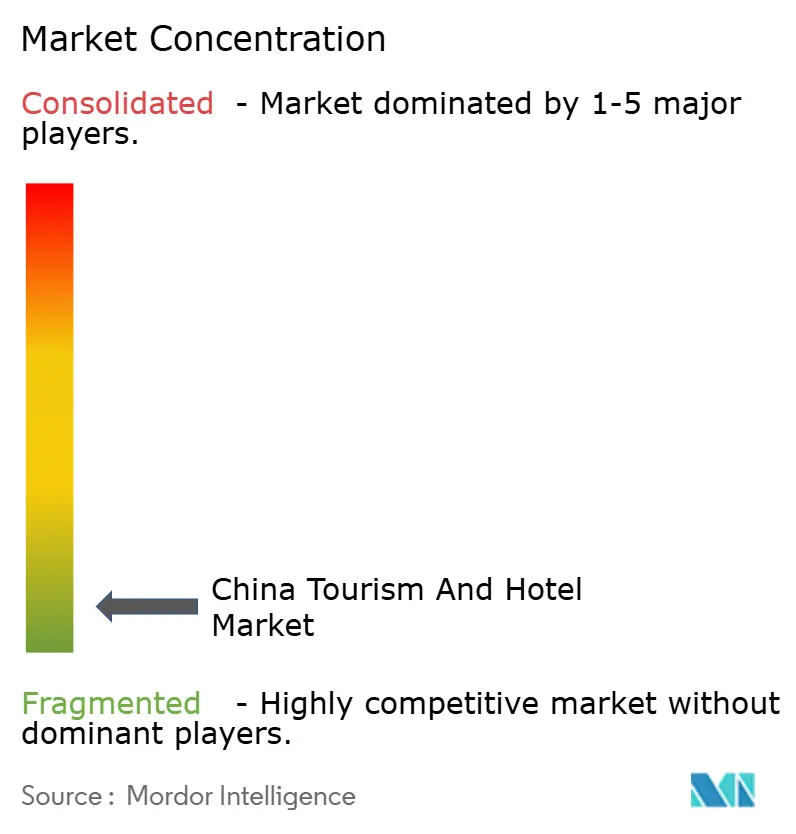
| Market Concentration | Low |
Major Players *Disclaimer: Major Players sorted in no particular order Image © Mordor Intelligence. Reuse requires attribution under CC BY 4.0. | |
China Tourism And Hotel Industry Analysis by Mordor Intelligence
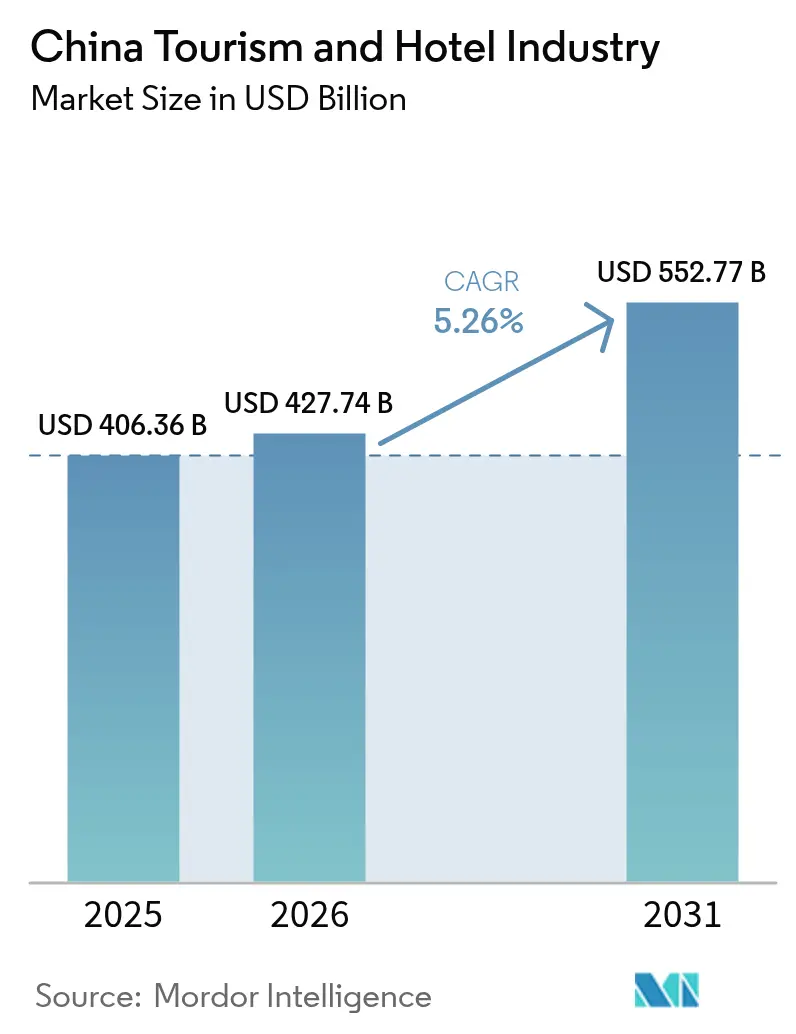
The China Tourism And Hotel Industry market size is expected to grow from USD 406.36 billion in 2025 to USD 427.74 billion in 2026 and is forecast to reach USD 552.77 billion by 2031 at 5.26% CAGR over 2026-2031.
The China tourism and hotel industry stands at USD 406.36 billion in 2025 and is on track to reach USD 531.86 billion by 2030, supported by a healthy 5.31% CAGR. Domestic travel remains the backbone of demand, but a rebound in inbound arrivals, an expanding middle class, and rising wealth in lower-tier cities are widening revenue streams. Large-scale investment in railways, airports, and highways has opened fresh development corridors for hotel operators, while digital booking ecosystems continue to reshape distribution economics. Competition is intensifying in the mid-scale tier, yet the luxury pipeline is accelerating as affluent Chinese consumers seek high-touch, experiential stays. Tightening environmental rules and price pressure in smaller cities will test operator margins, but policy support for tourism and steady growth in event-related demand give the sector breadth and resilience.
Key Report Takeaways
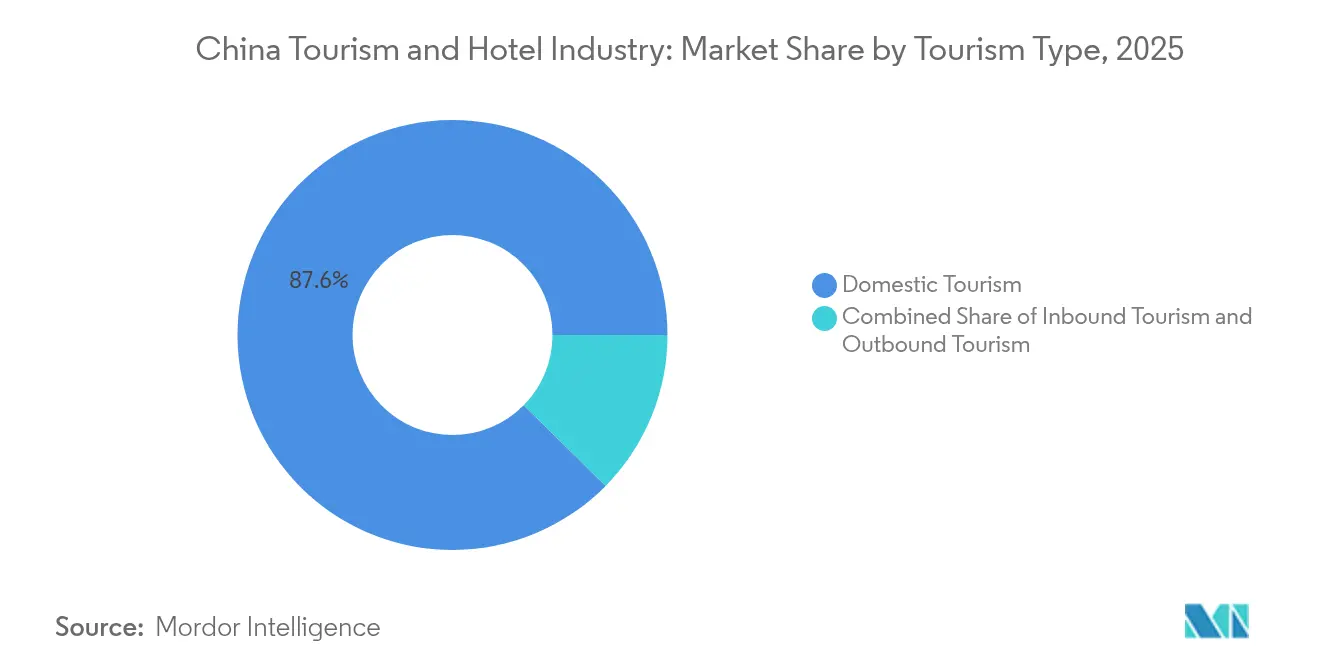
- By tourism type, domestic travel led with an 87.62% share of the China tourism and hotel industry in 2025; inbound tourism is forecast to expand at an 8.24% CAGR through 2031.
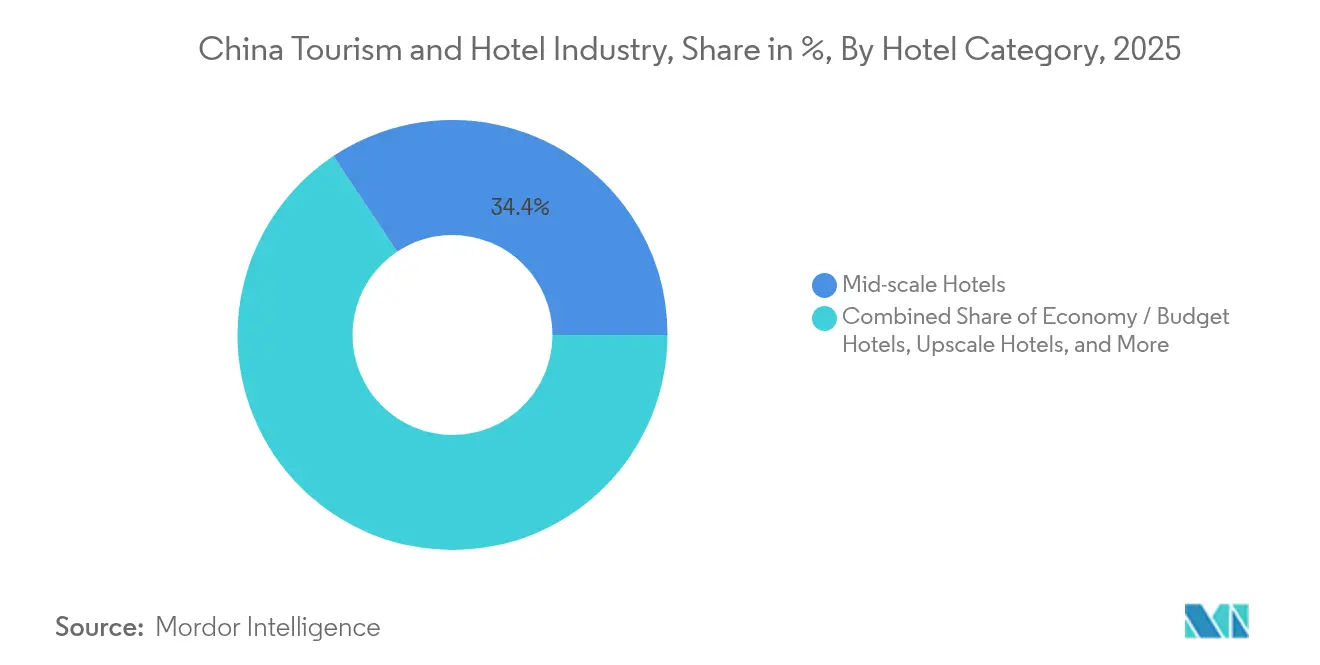
- By hotel category, mid-scale properties held 34.35% of the China tourism and hotel industry share in 2025, while luxury hotels are pacing the fastest growth at 9.52% CAGR to 2031.
- By purpose, leisure, adventure, and eco-tourism captured 63.25% of the China tourism and hotel industry size in 2025, whereas business and MICE postings are growing at a 12.05% CAGR through 2031.
- By booking channel, OTAs commanded 54.10% of the China tourism and hotel industry size in 2025; super-app ecosystems are rising at 11.78% CAGR between 2026-2031.
- By ownership, independent hotels accounted for 46.20% of the China tourism and hotel industry in 2025, but international chains are expanding at a 9.55% CAGR to 2031.
- The five leading operators—Jin Jiang International, Huazhu Group, BTG Homeinns, Marriott International, and Hilton Worldwide holds substantial market share of the China tourism in 2024.
Note: Market size and forecast figures in this report are generated using Mordor Intelligence’s proprietary estimation framework, updated with the latest available data and insights as of 2026.
China Tourism And Hotel Industry Trends and Insights
Drivers Impact Analysis*
| Driver | (~) % Impact on CAGR Forecast | Geographic Relevance | Impact Timeline |
|---|---|---|---|
| Urbanization & Infrastructure Development | +2.1% | National, with concentration in Tier 2 and Tier 3 cities | Long term (≥ 4 years) |
| Government Support & Policies Promoting Inbound and Domestic Tourism | +1.6% | Global, with emphasis on key source markets | Medium term (2-4 years) |
| Expansion of Luxury and Boutique Hotels | +0.8% | Tier 1 cities and premium tourism destinations | Medium term (2-4 years) |
| Increase in Event-Driven Tourism (MICE, Sports, Mega-Events) | +0.5% | Major urban centers (Beijing, Shanghai, Guangzhou) | Short term (≤ 2 years) |
| Growth in Domestic Tourism | +0.3% | National, with focus on cultural and natural attractions | Short term (≤ 2 years) |
| Source: Mordor Intelligence | |||
Urbanization and Infrastructure Development
Second- and third-tier cities are enjoying an unprecedented wave of hotel construction as high-speed rail and regional airports shorten travel times and lower trip costs. Developers have clustered around new transit hubs, converting land near stations into mixed-use districts anchored by mid-scale and upper-mid-scale hotels. The resulting spillover demand has broadened the China tourism and hotel market beyond traditional coastal gateways, spreading risk for operators and exposing investors to faster-growing local economies. The shift also underpins a deeper pipeline of domestically managed franchised hotels, many of which fit evolving government standards on green construction and energy efficiency.
Government Support and Policies Promoting Tourism
Streamlined e-visa procedures, expanded visa-free entry agreements, and nationwide destination marketing campaigns are spurring inbound arrivals, reinforcing confidence among international brands that paused projects in 2022-2023. Parallel reforms in mobile payment interoperability for foreign cards reduce day-to-day friction for guests, smoothing their path from the arrival hall to the hotel check-in. Local authorities continue to subsidize heritage site upgrades and rural homestay initiatives, widening the product mix under the China tourism and hotel market umbrella. These measures help stabilize seasonal occupancy swings and encourage hoteliers to maintain staff levels and service consistency.
Expansion of Luxury and Boutique Hotels
Affluent domestic travelers returning from overseas trips demand design-forward rooms, spa-centric wellness spaces, and hyper-local dining. Operators answer through soft-branded collections, cross-marketing heritage crafts, and revived urban mansions repurposed as intimate boutiques. International chains use flagship luxury hotels to showcase loyalty-program privileges, while leading domestic groups launch premium offshoots to capture upgrade traffic from their economy portfolios. Brand proliferation at the top end fosters service innovation and gives destinations like Sanya leverage to position themselves against other Asia-Pacific resort clusters.
Increase in Event-Driven Tourism (MICE, Sports, Mega-Events)
Purpose-built convention centers and stadium precincts in major cities are drawing corporate congresses, esports tournaments, and multiday music festivals. The resulting compression periods lift room rates and support higher F&B yields, cushioning hotels during weaker leisure windows. Developers are tailoring new properties around pillar-free ballrooms, broadcast-ready connectivity, and pop-up retail options that convert swiftly between conferences and consumer fairs. Technology adoption—from 5G to event-management apps—creates hybrid revenue models that range from livestream hosting to sponsorship partnerships.
Restraints Impact Analysis*
| Restraint | (~) % Impact on CAGR Forecast | Geographic Relevance | Impact Timeline |
|---|---|---|---|
| Lingering Pandemic-Era Visa & Quarantine Friction for Inbound Travelers | -0.8% | Global, particularly affecting long-haul source markets | Short term (≤ 2 years) |
| Intensifying Price Competition Among Domestic Hotel Chains | -0.5% | National, most acute in Tier 2 and Tier 3 cities | Medium term (2-4 years) |
| Rising ESG Compliance Costs for Hotel Properties | -0.3% | National, with greater impact on international chain properties | Medium term (2-4 years) |
| Geopolitical Tensions Dampening Long-Haul Source Markets | -0.3% | Primarily affecting North American and European source markets | Medium term (2-4 years) |
| Source: Mordor Intelligence | |||
Pandemic-Era Visa and Quarantine Friction
Although health protocols are lighter than in 2023, sporadic rule changes leave some long-haul travelers uncertain. Group bookings from Europe and North America remain sensitive to sudden testing requirements or flight capacity shifts. Hoteliers mitigate near-term volatility by targeting regional Asian traffic, offering flexible cancellation policies, and launching language-specific booking microsites to accelerate lead recovery once restrictions stabilize.
Intensifying price competition
Rapid franchising spurs a dense pipeline of mid-scale openings that compete on daily rates rather than differentiated brand experience. Operators chase economies of scale in procurement and central reservation systems, yet rising payroll and utility costs squeeze GOP margins. To defend share, chains experiment with paid memberships, dynamic pricing tied to app-based gamification, and cross-promotions with delivery platforms to grow non-room revenue.
*Our forecasts treat driver/restraint impacts as directional, not additive. The impact forecasts reflect baseline growth, mix effects, and variable interactions.
Segment Analysis
By Tourism Type: Domestic Demand Drives Market Resilience
Domestic travelers held 87.62% of the China tourism and hotel market in 2025, a dominance that kept nationwide occupancy above 60% even when borders tightened. Spending by city dwellers on weekend cultural escapes and multi-generational family trips continues to accelerate room demand in provincial capitals and scenic counties. Government holiday extensions and discounted rail passes encourage cross-province journeys that broaden stay patterns beyond the Golden Week peaks. Independent boutique hotels emphasize local heritage décor and farm-to-table menus to capture this culturally motivated segment.
Inbound tourism, though smaller, is the most dynamic component, posting an 8.24% CAGR to 2031. The China tourism and hotel market size attributable to international guests is expected to reach USD 74.63 billion by 2031 as flight capacity normalizes and visa-free corridors expand. Operators refurbish rooms with dual-language IPTV, foreign card-enabled kiosks, and globally recognized wellness amenities to raise RevPAR. Brand partnerships with international airlines and cruise lines further integrate booking funnels, reinforcing the nation’s ambitions to regain its pre-2020 status as a premier Asian gateway.

By Purpose: Leisure Travel Redefines Hotel Experiences
Leisure, adventure, and eco-oriented stays accounted for 63.25% of 2025 revenue, making pleasure trips the core engine of the China tourism and hotel market. Consumers seek curated journeys that blend outdoor activity with cultural immersion, prompting hotels to add bicycle rental stations, tea-ceremony workshops, and night-sky observation decks. Packages often bundle tickets to intangible heritage performances or geopark entry, driving higher total spend per guest and extending average length of stay.
Business and MICE travel is rebounding faster than total demand, with a 12.05% CAGR through 2031. The China tourism and hotel market size for meetings is projected to surpass USD 131.72 billion by the end of the decade as conferences scale alongside the digital-economy boom. Hoteliers install high-definition hybrid meeting studios, 24-hour co-working lounges, and carbon-offset calculators to cater to corporate policy shifts toward green events. Weekday occupancies buoyed by business groups allow stronger rate management over weekends, when leisure promotions fill remaining inventory.
By Traveler Age: Generational Preferences Reshape Hotel Design
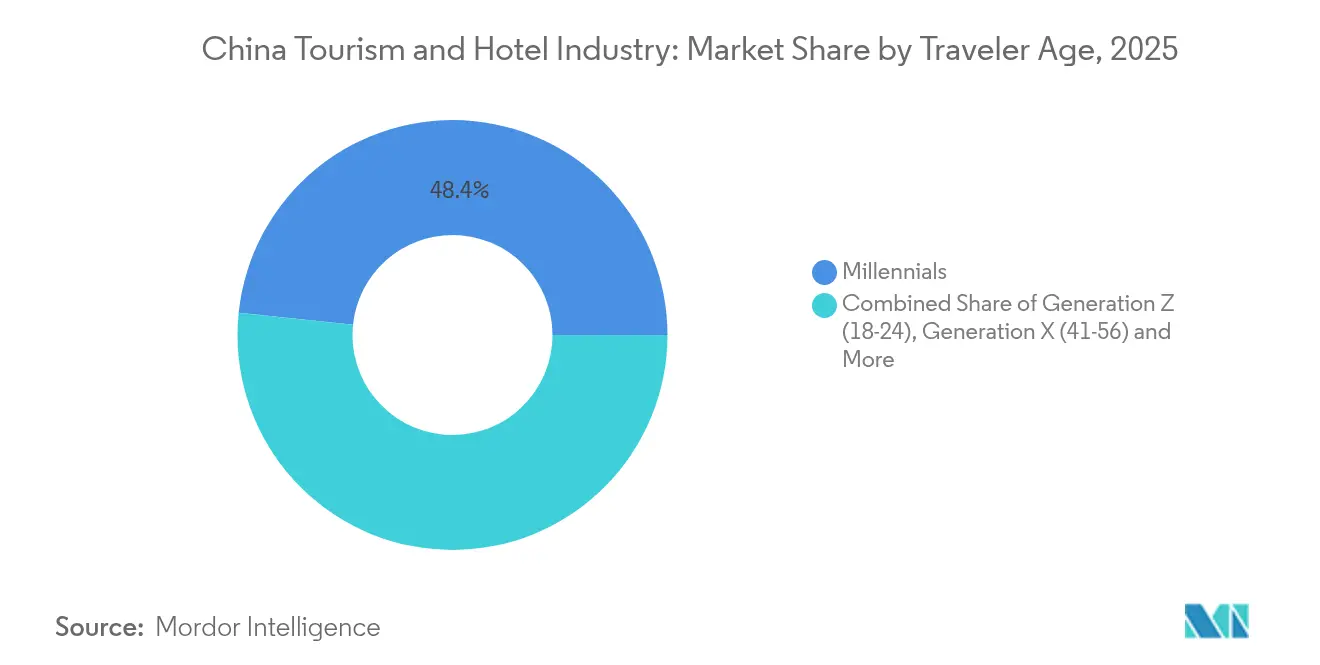
Millennials held a 48.35% share in 2025, shaping how brands approach loyalty, content, and amenity planning. A mobile-first mindset drives seamless check-in through QR codes and AI-powered room service chatbots. Hotels invest in open social spaces, communal kitchens, and pop-up art collaborations to foster peer engagement, reinforcing stickiness among this influential cohort within the wider China tourism and hotel market.
Baby Boomers, though numerically smaller, contribute a steady premium ADR through preference for upper-upscale properties that emphasize safety and wellness. Resorts increasingly add low-sodium menu options, barrier-free bathroom fittings, and guided mindfulness sessions to retain this demographic. Generation X balances both corporate and family priorities, favoring efficiency, express laundry, co-branded airport transfer packages, and clear loyalty-point redemption—thereby creating a bridge between younger and older guest expectations.
By Booking Channel: Digital Platforms Dominate Distribution Landscape
OTAs processed 54.10% of 2025 room transactions, cementing their position at the center of the China tourism and hotel market distribution chain. Their meta-search engines, livestream promotions, and deep discount flash sales sway price-sensitive consumers. Hotels seeking margin relief invest in direct-booking mini-programs embedded in social-commerce platforms, bundling extras such as complimentary breakfast or late checkout to lure guests away from commission-heavy intermediaries.
Super-app ecosystems, expanding at 11.78% CAGR, give consumers a one-stop path from trip inspiration to ride-hailing and dining reservations. Seamless linkage among payments, social feeds, and AI trip planners elevates convenience, triggering rapid share gains among Gen Z users. Hotels integrate loyalty status into these super-apps to deliver targeted push offers and real-time service chat, thereby nurturing lifetime value and data-driven upsell opportunities across the evolving China tourism and hotel market.
By Hotel Category: Mid-scale Dominance Amid Luxury Growth
Mid-scale hotels captured 34.35% of 2025 revenue, reflecting demand from price-aware travelers who still expect consistent quality. Chain groups standardize bedding, fragrance profiles, and breakfast buffets across thousands of units, using cloud-based PMS tools to optimize costs. The segment’s wide footprint shields operators during demand swings, but minor brand differentiation means continued rate competition in suburban nodes.
Luxury stock, while smaller today, is rising swiftly at 9.52% CAGR, and is forecast to comprise more than 13.25% of total rooms by 2031. Hotels differentiate through signature spas, destination restaurants helmed by celebrity chefs, and curated art collections echoing Chinese aesthetics. Enhanced RevPAR potential offsets higher build and operating costs, helping global brands justify aggressive expansion and fueling the experiential tier of the China tourism and hotel industry.
By Ownership/Branding: Chain Penetration Transforms Market Structure
Independent hotels represented 46.20% of rooms in 2025, giving the China tourism and hotel market its historically fragmented profile. Many properties leverage regional architectural styles and locally sourced amenities to retain character. Digital marketing partnerships with niche OTAs targeting heritage enthusiasts bolster occupancy, yet limited procurement scale and marketing budgets constrain competitiveness against larger chains.
Internationally branded chains, growing at 9.55% CAGR, add standardized service frameworks that reassure foreign visitors and upscale domestic travelers. Asset-light models centered on management contracts allow rapid penetration into secondary cities where land costs remain digestible. Domestic chains simultaneously scale their premium sub-brands, compressing the gap between global and local propositions and accelerating professionalization across the China tourism and hotel market.
Geography Analysis
East China retained the largest 36.72% revenue slice of the travel insurance market in 2025. The combined hotel inventory in Beijing, Shanghai, and Guangzhou delivers the highest ADR nationwide, yet maturity limits pipeline growth to selected repositioning’s and mixed-use megaprojects. Luxury clusters along the Bund or within Beijing’s historical courtyard zones anchor flagship launches by global brands that rely on gateway visibility to feed loyalty funnels and cross-sell across Asia.
Southwest China represents the most dynamic growth frontier, projected to advance at 7.62% CAGR over 2026-2031. Second-tier hubs such as Chengdu, Hangzhou, and Wuhan now supply the bulk of new room keys. Chengdu alone had 147 active projects at end-2024, mirroring its rise as a western logistics and digital-media node. Physical connectivity from expanded metro networks and high-speed rail spurs investor appetite, with developers seizing brownfield plots near tech parks or new convention centers. Average ADRs in these cities still trail coastal counterparts, yet faster RevPAR growth and lower land premiums create stronger yield potential within the broader China tourism and hotel market.
Destination resorts in Sanya, Guilin, and Lijiang ride seasonal peaks linked to school holidays and public festivals. High-season ADR surges above 40% of shoulder rates support year-round profitability despite occupancy dips in off-peak months. Operators deploy dynamic staffing models and short-term F&B pop-ups to match fluctuating demand, while bundling wellness, outdoor adventure, and cultural immersion into packaged offers that lengthen stays. Rural boutique clusters—often converted farmhouses—tap city-dweller appetites for nature and local cuisine, reinforcing geographic diversification and enriching the narrative of the China tourism and hotel market.
Regulatory Landscape
China’s tourism and lodging operators are governed by a mix of State Council direction and sector rules led by the Ministry of Culture and Tourism (MCT), alongside standardization bodies that increasingly codify service delivery in emerging formats. In January 2025, the State Council issued measures to cultivate new growth points in culture and tourism consumption, emphasizing tighter market supervision and more standardized travel-agency practices, which affects how hotels bundle tours and sell packaged products.
On the accommodation side, policy in 2025-2026 pairs service standardization with inbound facilitation. The MCT released a set of culture and tourism industry standards in May 2025 (effective August 2025) that include norms for online accommodation booking services and an e-sports hotel service requirements standard (WH/T 108-2025), increasing compliance expectations around digital service processes. For demand-side access, China extended its 30-day unilateral visa-free entry policy through December 31, 2026 for 45+ countries, and the National Immigration Administration expanded the 30-day visa-free program in February 2026 to include the United Kingdom and Canada, directly supporting inbound travel flows into the hotel pipeline.
Competitive Landscape
Domestic groups such as Jin Jiang International and Huazhu leverage extensive loyalty bases, rapid prototype rollouts, and deep relationships with municipal authorities to accelerate franchise count. Their cloud-PMS and unified procurement platforms drive cost synergies that undercut smaller rivals. International chains, by contrast, emphasize brand segmentation, offering everything from extended-stay suites to lifestyle-driven luxury to capture discrete demand pools within the China tourism and hotel market.
Mid-scale warfare is the fiercest arena. Domestic leaders flood Tier 3 cities with standardized builds, while foreign groups localize select-service concepts tailored to Chinese breakfast preferences and family-friendly room layouts. The luxury race sees Marriott and Hilton competing on art-curation partnerships and marquee Michelin-level dining, while local upscale challenger BTG Homeinns positions Chinese cultural storytelling as a counterweight to imported glamour.
Specialized niches yield untapped upside. Wellness resorts bundle traditional medicine consultations with modern spa therapy. Long-stay products track technology-sector talent mobility. Senior-focused brands experiment with barrier-free design, on-site clinics, and age-friendly excursions. Concurrently, ESG expectations rise; brands adopt solar panels, rain-water harvesting, and AI-directed smart energy systems to meet new regulations without eroding margin, reinforcing service differentiation in the modern China tourism and hotel market.
China Tourism And Hotel Market Leaders
-
Jin Jiang International Holdings Co., Ltd.
-
Huazhu Group Ltd.
-
BTG Homeinns Hotels Group Co., Ltd.
-
Marriott International Inc.
-
Hilton Worldwide Holdings Inc.
- *Disclaimer: Major Players sorted in no particular order
Market Opportunities and Future Outlook
Inbound travel facilitation and nationally framed tourism upgrading programs create clear whitespace in multilingual, foreign-friendly hotel operations and distribution. Visa-free policies were extended through December 31, 2026, and a May 2026 State Council-related briefing cited a broader visa-free and transit-visa exemption coverage, reinforcing the need for hotels to invest in internationalized guest journeys (payments, check-in, service recovery, and content). This aligns with the market structure where inbound tourism is the fastest-growing tourism type within the report scope, and where internationally branded chains are expanding via asset-light models into more cities.
Digitized selling and operations represent another opportunity area as policy and platform behavior converge. The MCT’s May 2025 standards around online accommodation booking services formalize expectations for platform-to-hotel booking workflows, while OTAs and super-app ecosystems continue to dominate booking in the market (OTAs held 54.10% of 2025 room transactions in-scope). At the same time, industry evidence points to AI moving from pilots toward an operating layer across tourism in 2025, with hotels a key adoption segment, supporting opportunities in automated service, revenue management, and direct conversion tools that reduce commission pressure. Regionally, destination programs such as Hainan’s 2030 tourism plan (with targets for inbound visitor trips and expanded routes plus cruise facility buildouts in Haikou, Sanya, and Danzhou) add investable nodes for resort, MICE, cruise-linked stays, and premium leisure products within China.
Recent Industry Developments
- July 2026: Accor and H World detailed a partnership to link loyalty programs and distribution platforms across China, Europe, and the Middle East, initially covering around 240 hotels. The collaboration broadens cross-network member reach and supports more direct, loyalty-led bookings that can shift mix away from high-commission channels. It also highlights the operational importance of data-governance compliance when integrating customer and reservation capabilities across jurisdictions.
- May 2026: H World Group reported first-quarter 2026 operating progress that included 537 new hotel openings in China. The pace of openings underscores continued supply growth and reinforces competitive pressure in standardized segments where scale and centralized systems matter. It also expands the company’s footprint for loyalty-driven distribution and procurement leverage in multiple city tiers.
- November 2024: IHG Hotels and Resorts launched the Atwell Suites lifestyle brand in Greater China. The move adds a fresh product option for developers seeking a differentiated extended-stay and lifestyle positioning. It broadens brand segmentation strategies in a market where mid-scale scale-up is intense and experiential concepts are used to defend rate and occupancy.
Research Methodology Framework and Report Scope
Market Definition and Coverage
This market is defined as the value of traveler spending in China that is realized through hotels and closely linked lodging-led travel services, including room revenue and related in-property services that move with stays.
Scope exclusions: We exclude airline passenger revenue, travel retail, and attraction-only ticketing when it is not packaged through hotels.
Segmentation Overview
- By Tourism Type
- Domestic Tourism
- Inbound Tourism
- Outbound Tourism
- By Purpose
- Leisure & Adventure & Eco-Tourism
- Business / MICE
- By Traveler Age
- Generation Z (18-24)
- Millennials (25-40)
- Generation X (41-56)
- Baby Boomers (57+)
- By Booking Channel
- Online Travel Agencies (OTAs)
- Direct Hotel Websites & Apps
- Offline Travel Agencies
- By Hotel Category
- Economy / Budget Hotels
- Mid-scale Hotels
- Upscale Hotels
- Luxury Hotels
- Serviced Apartments & Long-Stay
- By Ownership / Branding
- Independent Hotels
- Domestic Chain-Affiliated Hotels
- International Chain-Affiliated Hotels
- By Region
- Central China
- East China
- North China
- Northeast China
- Northwest China
- South China
- Southwest China
Data Sources, Market Sizing, and Validation
Desk Research
Desk work starts with building the demand and supply story for travel flows and lodging activity in China, and then mapping it to how hotel revenue is typically reported. We rely on public statistical releases and sector trackers such as the National Bureau of Statistics of China, the Ministry of Culture and Tourism, China Tourism Academy publications, and UN Tourism datasets for cross-checks on traveler volumes and seasonality.
To keep assumptions realistic, we also review listed-company filings, investor presentations, and reputable press coverage for room supply additions, brand expansion plans, and performance commentary. Where it helps fill gaps, we use paid subscriptions focused on company financials and intelligence, patent databases, and shipment-level import and export data for a few hotel equipment signals that move with openings and refurbishments. These examples are not exhaustive, and many other sources were also used for data collection, validation, and research clarification.
Primary Interviews and Surveys
Primary work is used to stress-test what the public series cannot fully explain, especially the split between hotel room revenue and adjacent travel spend that is sometimes bundled. We speak with hotel operators, travel intermediaries, property owners, and service partners across major city clusters and leisure destinations, and then confirm key assumptions using on-the-ground views from multiple regions in China.
Distribution of primary research fieldwork respondents
| Company type | Respondent position |
|---|---|
| Top tier: 30% | CXOs: 12% |
| Mid tier: 53% | Functional/Unit leaders: 31% |
| Smaller Players: 17% | Managers: 57% |
Market-Sizing & Forecasting
Sizing is built using a top-down structure where traveler volumes and lodging activity indicators are converted into revenue, and then filtered to the in-scope hotel and hotel-led bundle portion. The model is then cross-checked with selective bottom-up approximations, such as sampled room supply by city tier, occupancy and ADR checks from operator commentary, and channel mix checks to ensure totals do not drift away from what the market can actually generate.
Inputs used include domestic and inbound trip counts, hotel room supply additions and closures, occupancy and ADR movements, length of stay patterns around major holiday peaks, and the share of bookings that come through direct versus agency-led channels. When a local data series is missing for a province or a smaller destination, we fill it using proxy relationships, for example supply change alongside visitor flow change, and then review the output with interview feedback before finalizing.
For forecasting, we use scenario analysis supported by a simple multivariate regression view, where drivers like travel volume recovery pace, room supply pipeline timing, and ADR inflation are stress-tested under conservative and base assumptions. The final path is selected only after the driver ranges are aligned to what respondents expect to be feasible over the forecast period.
Data Validation & Update Cycle
Validation is done through multiple checks so outputs remain consistent with real-world signals. We compare modeled revenue against independent metrics like tourism receipts direction, hotel performance commentary, and supply pipeline movements, and then investigate outliers before sign-off.
A second analyst review is completed for key assumptions, unit conversions, and currency handling so the final tables remain internally consistent. Reports are refreshed annually, and interim updates are made when material events shift travel demand or hotel operating conditions. Before delivery, the latest public releases are rechecked so clients receive an updated view rather than a stale snapshot.
Mordor Intelligence's China Tourism and Hotel Market Size Compared With Other Published Estimates
Published market sizes for China tourism and hotels often differ because the boundaries can move depending on whether the estimate is hotel-only, hospitality-wide, or a blended travel spend view. Differences also come from how companies treat bundled services, which year is treated as the base, and how currency and inflation are handled in revenue projections.
The key gap drivers in this market usually show up in three places: scope breadth, price and occupancy assumptions, and refresh timing after travel demand shifts. Some sources fold in broader hospitality items such as standalone food and beverage, while others focus more tightly on hotel stay economics. This single choice can materially change the number, sometimes by hundreds of billions.
Benchmark comparison
| Source | Market Size | Gaps in Research Methodology |
|---|---|---|
| Mordor Intelligence | USD 406.36 B (2025) | |
| Industry Research Publisher A | USD 300.00 B (2024) | Uses an earlier base year and frames the market as a tourism plus hotel mix with segmented lenses like luxury tourism, which can undercount hotel-linked in-property revenue when compared year to year. |
| Industry Publisher B | USD 516.64 B (2024) | Covers a wider hospitality definition where accommodation is combined with broader service revenue, which tends to lift totals beyond hotel stay and hotel-led bundle spending. |
The table shows a wide spread that largely comes from what is counted as in-scope revenue and which base year anchors the calculation. In Mordor Intelligence's model, the value is tied to traveler spending realized through accommodation, in-property food and beverage tied to stays, and hotel-led tour bundles rather than the full hospitality wallet. Once the scope is aligned, remaining differences are typically explained by ADR progression choices and how quickly post-event demand normalization is reflected in the forecast assumptions.
Key Questions Answered in the Report
What is the current size of the China tourism and hotel market?
The market is valued at USD 427.7 billion in 2026 and is projected to climb to USD 552.8 billion by 2031.
Which hotel category holds the largest share?
Mid-scale hotels command 34.35% of 2025 revenue, benefiting from strong demand among value-conscious domestic travelers.
How fast is inbound tourism growing?
Inbound tourism is the fastest-growing segment, advancing at an 8.24% CAGR through 2031 as visa facilitation and flight recovery support arrivals.
What role do digital channels play in hotel bookings?
OTAs account for 54.10% of room nights, while super-app ecosystems are expanding at a 11.78% CAGR by bundling travel with everyday services.
Which cities are the hottest development markets?
Chengdu leads the construction pipeline, with Hangzhou and Wuhan close behind, driven by improved transport links and rising business activity.