
China Switchgear Market Size and Share
Market Overview
| Study Period | 2021 - 2031 |
|---|---|
| Forecast Data Period | 2026 - 2031 |
| Base Year Market Size (2025) | USD 31.01 Billion |
| Market Size (2026) | USD 33.62 Billion |
| Market Size (2031) | USD 50.38 Billion |
| Growth Rate (2026 - 2031) | 8.42 % |
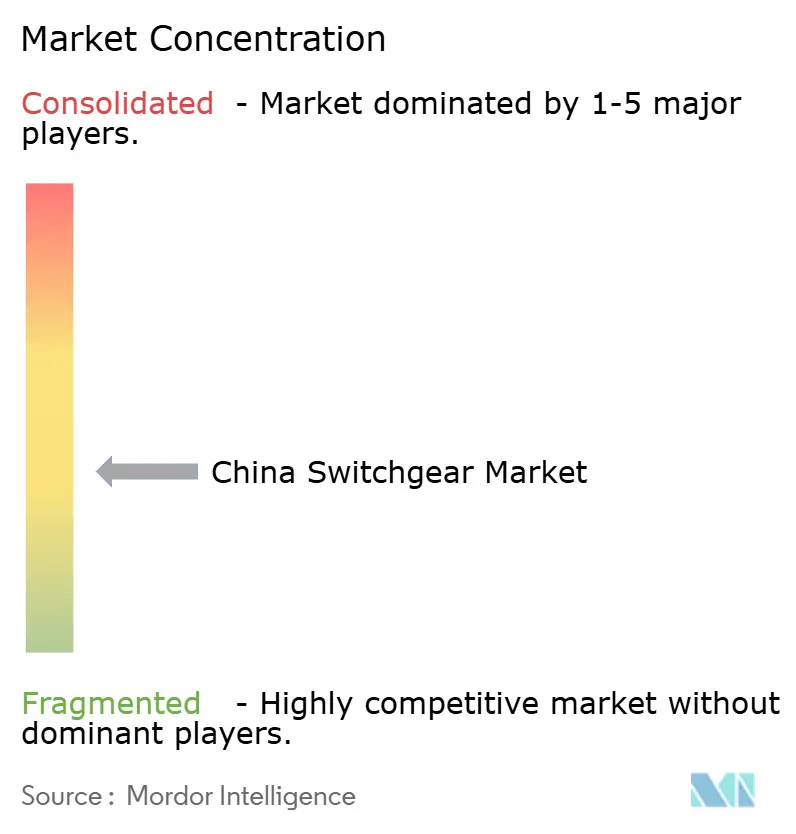
| Market Concentration | Medium |
Major Players *Disclaimer: Major Players sorted in no particular order Image © Mordor Intelligence. Reuse requires attribution under CC BY 4.0. | |
China Switchgear Market Analysis by Mordor Intelligence
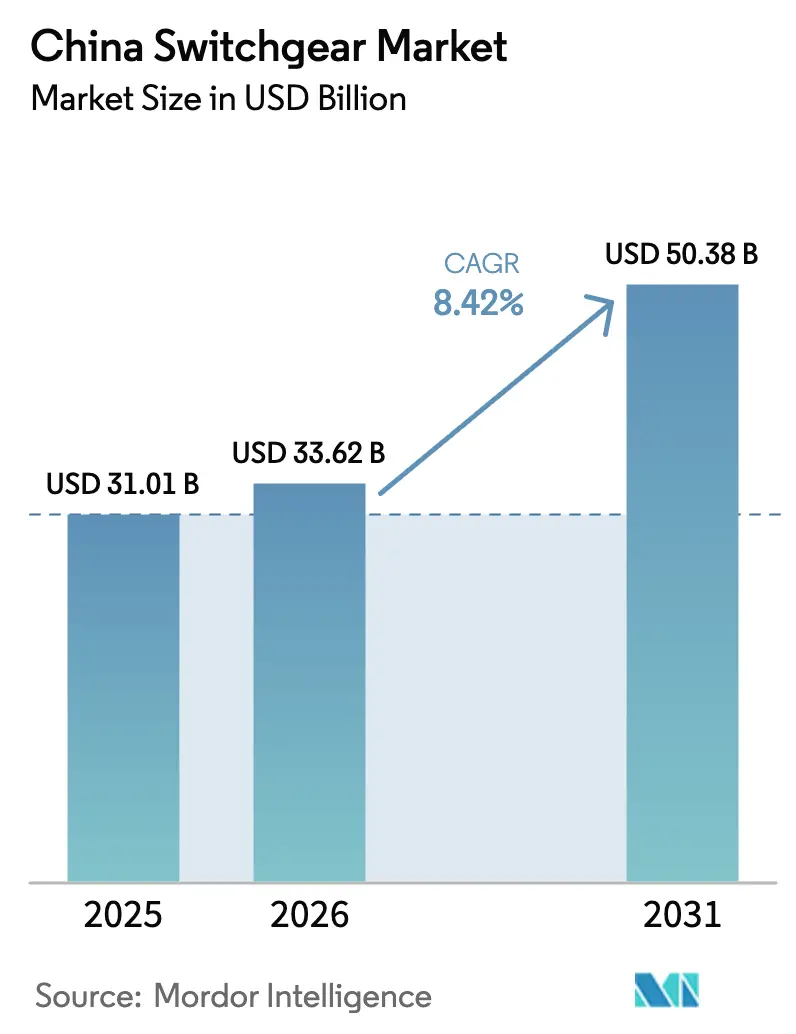
The China Switchgear Market size is expected to grow from USD 31.01 billion in 2025 to USD 33.62 billion in 2026 and is forecast to reach USD 50.38 billion by 2031 at 8.42% CAGR over 2026-2031.
Accelerated ultra-high-voltage (UHV) transmission construction, rapid renewable additions, and the build-out of data centers and 5G base stations underpin steady demand across voltage classes. Momentum also comes from Beijing’s SF₆-phase-out policy that is shifting procurement toward vacuum and fluoroketone technologies. Medium-voltage gear benefits from urban smart-grid upgrades, while high-voltage equipment gains from new ±800 kV DC and 1 000 kV AC corridors that move western wind and solar power east. Manufacturers that embed AI-driven diagnostics and IEC 61850 communication are capturing premium pricing despite intensifying price competition.
Key Report Takeaways
- By voltage, low-voltage equipment led with 40.02% revenue share of the China switchgear market in 2025, whereas high-voltage products are forecast to expand at a 10.41% CAGR to 2031.
- By insulation, air-insulated systems accounted for a 70.35% share in 2025; the “others” category, including vacuum and solid-state solutions, is advancing at a 16.22% CAGR through 2031.
- By current type, AC installations held 82.41% of demand in 2025, while DC switchgear records the fastest 9.32% CAGR to 2031.
- By installation, indoor assemblies commanded an 80.85% share in 2025; outdoor units are growing at an 11.08% CAGR on the back of remote renewable projects.
- By end-user, utilities captured 41.62% of 2025 spend and will continue to lead with a 8.97% CAGR through 2031.
Note: Market size and forecast figures in this report are generated using Mordor Intelligence’s proprietary estimation framework, updated with the latest available data and insights as of 2026.
China Switchgear Market Trends and Insights
Drivers Impact Analysis*
| Driver | (~) % Impact on CAGR Forecast | Geographic Relevance | Impact Timeline |
|---|---|---|---|
| Ultra-high-voltage transmission build-out | +2.10% | Northwest-to-east corridors | Medium term (2-4 years) |
| Renewable capacity additions accelerating upgrades | +1.80% | Western renewables, offshore Jiangsu & Guangdong | Long term (≥ 4 years) |
| Urban distribution smart-grid retrofits | +1.30% | Tier-1 and tier-2 cities | Medium term (2-4 years) |
| Data-center & 5G rollouts boosting MV demand | +1.50% | Greater Bay Area, Yangtze River Delta, Beijing-Tianjin-Hebei | Short term (≤ 2 years) |
| SF₆-free eco-switchgear replacement cycle | +1.20% | Coastal provinces with strict emission policies | Long term (≥ 4 years) |
| AI-enabled digital switchgear | +1.00% | National pilot deployments | Medium term (2-4 years) |
| Source: Mordor Intelligence | |||
Ultra-High-Voltage Transmission Build-Out
China energized the 1000 kV Sichuan-Chongqing AC line in late 2024, adding 3.4 GW of transfer capacity and ordering more than 200 GIS bays rated at 1,100 kV.(1)National Development and Reform Commission, “UHV Transmission Investment Plan,” ndrc.gov.cn Each corridor raises one-off demand for breakers that interrupt 63 kA fault currents. State Grid’s 14th Five-Year Plan sets annual UHV capex near CNY 500 billion, translating into 15-18 new cross-provincial links by 2025 [NDRC.GOV.CN]. High-voltage switchgear, therefore, outpaces the broader China switchgear market as provincial bidders fight for supply slots. However, price ceilings of roughly CNY 2.5 million per 1,100 kV bay keep gross-margin expansion limited.
Renewable Capacity Additions Accelerating Grid Upgrades
China added 217 GW of solar and 76 GW of wind in 2024, lifting cumulative renewables above 1450 GW.(2)National Energy Administration, “2024 Renewable Installation Statistics,” nea.gov.cn Inverter-based resources need fast-acting protection that recognizes sub-cycle transients. Gansu’s Jiuquan wind hub retrofitted 340 kV collector substations with IEC 61850-90-5 relays, cutting coordinated-trip times to 15 ms. National grid-code updates require new projects above 50 MW to install fault-ride-through-capable switchgear, adding 8-12% to substation costs yet curbing curtailment. Offshore wind farms adopt 66 kV subsea gear that avoids platforms and trims installation time by 30%.
Urban Distribution Smart-Grid Retrofits
Tier-1 cities face rising peak loads from electric vehicles and air-conditioning. Distribution utilities now specify ring-main units with solid insulation, embedded sensors, and Modbus-enabled breakers that push real-time data to control centers. Shanghai has mandated IEC 61850 profiles for all 10 kV feeders since mid-2024, spurring secondary demand for retrofit-friendly cabinets that occupy 40% less floor space. The upgrade cycle underpins medium-voltage strength within the China switchgear market from 2025-2028.
Data-Center & 5G Roll-Outs Boosting MV Demand
China’s data-center spend hit USD 47.23 billion in 2024 and could double by 2030. Each 10 MW hall needs four to six medium-voltage line-ups that step down utility feeds. Meanwhile, 680,000 new 5G base stations installed in 2024 require outdoor ring-main units that secure 99.99% uptime. Vendors offering compact, IP65-rated cabinets that can be installed by a single crew win a share of the China switchgear market.
Restraints Impact Analysis*
| Restraint | (~) % Impact on CAGR Forecast | Geographic Relevance | Impact Timeline |
|---|---|---|---|
| Stringent SF₆ phase-out compliance cost | -0.80% | Coastal provinces with strict enforcement | Medium term (2-4 years) |
| Margin squeeze from price competition | -1.10% | Low-voltage and air-insulated segments nationwide | Short term (≤ 2 years) |
| Power-electronics chip supply bottlenecks | -0.60% | Digital switchgear and DC gear countrywide | Short term (≤ 2 years) |
| Slow standardization of grid protocols | -0.40% | Provincial grid variations | Long term (≥ 4 years) |
| Source: Mordor Intelligence | |||
Stringent SF₆ Phase-Out Compliance Cost
Utilities replacing SF₆ bays face outlays 30% above original prices, plus CNY 150 000-250 000 per site for continuous monitoring.(3) Smaller municipalities choose between costly retrofits and rising carbon offset liabilities under the national ETS. Vacuum breakers introduce chopping overvoltages that need extra surge protection, adding 6-9% to the bill-of-materials. Procurement consortia in Guangdong and Zhejiang negotiate multi-year fluoroketone supply to spread risk, yet not all utilities enjoy this leverage.
Margin Squeeze from Intense Domestic Price Competition
Over 100 domestic makers compete in low-voltage panels, driving 2-3 percentage-point margin erosion since 2023. Provincial tenders often award contracts on price alone, pushing vendors to bundle IoT software to preserve value. Mid-tier firms lacking R&D scale risk consolidation as they struggle to fund digital upgrades demanded by buyers of the Chinese switchgear market.
*Our forecasts treat driver/restraint impacts as directional, not additive. The impact forecasts reflect baseline growth, mix effects, and variable interactions.
Segment Analysis
By Voltage: High-Voltage Growth Accelerates
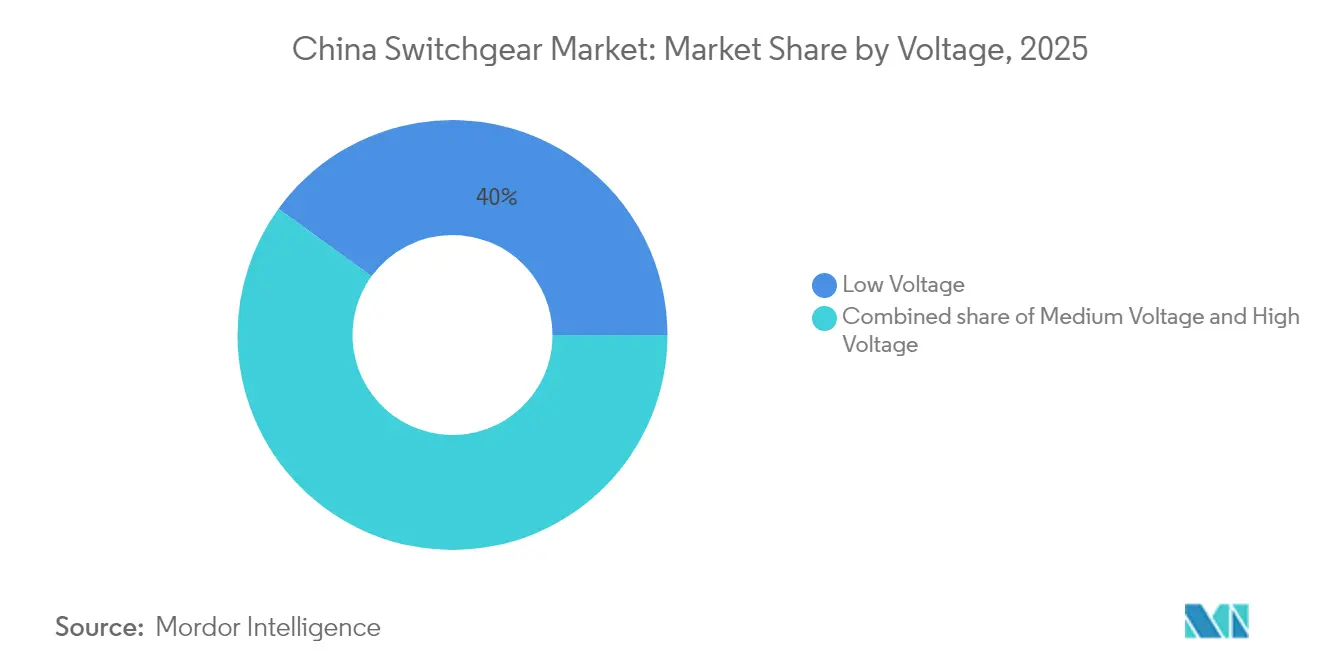
Low-voltage equipment retained 40.02% revenue in 2025, anchored by residential and commercial builds. High-voltage products between 72.5 kV and 1,100 kV are on a steep 10.41% CAGR, reflecting fifteen new UHV projects in State Grid’s pipeline. Medium-voltage remains the backbone of urban distribution networks, yet its share inches down as high-voltage units claim a larger revenue mix. The Sichuan-Chongqing 1,000 kV link alone required 220 fluoroketone-insulated GIS bays. Schneider Electric’s smart molded-case breakers with plug-and-play Modbus captured 22% of Chinese MCCB sales in 2024. Solid-insulation ring-main units save 35% of floor space, a critical advantage where real estate exceeds CNY 80 000/m². Premature retirements of legacy electromechanical gear installed before 2000 add a replacement wave that sustains double-digit high-voltage expansion.
The China switchgear market size for the high-voltage segment is expected to climb from USD 12.83 billion in 2025 to USD 23.25 billion by 2031. High-voltage products thereby widen their contribution to more than 44.60% of total revenue in 2031. Conversely, the China switchgear market share of low-voltage gear is projected to slide below 35.40% as building code-driven demand loses weight against grid investments.


By Insulation: Vacuum and Solid-State Disrupt Air Dominance
Air-insulated systems held 70.35% of 2025 sales. Utilities, however, favor vacuum interrupters that avoid greenhouse-gas handling. Vacuum already powers 62% of medium-voltage shipments, and solid dielectric designs now target coastal regions where salt-fog accelerates metal corrosion. ABB’s VD4 range boasts 40,000 mechanical operations and 100 fault interruptions, underpinning wide adoption. Siemens’ 8DJH fluoronitrile GIS met Chinese type tests in 2024 and entered mass production in Jinan. Solid-insulation switchgear positions epoxy-embedded busbars inside compact enclosures, reducing footprint by 50%.
The China switchgear market size tied to the “others” category is forecast to jump from USD 9.78 billion in 2025 to USD 24.12 billion in 2031, reflecting a 16.22% CAGR. Air-insulated units remain price leaders for rural greenfield sites, yet face gradual dilution in urban settings as land costs and emission rules tighten.
By Current Type: DC Gains Critical Mass
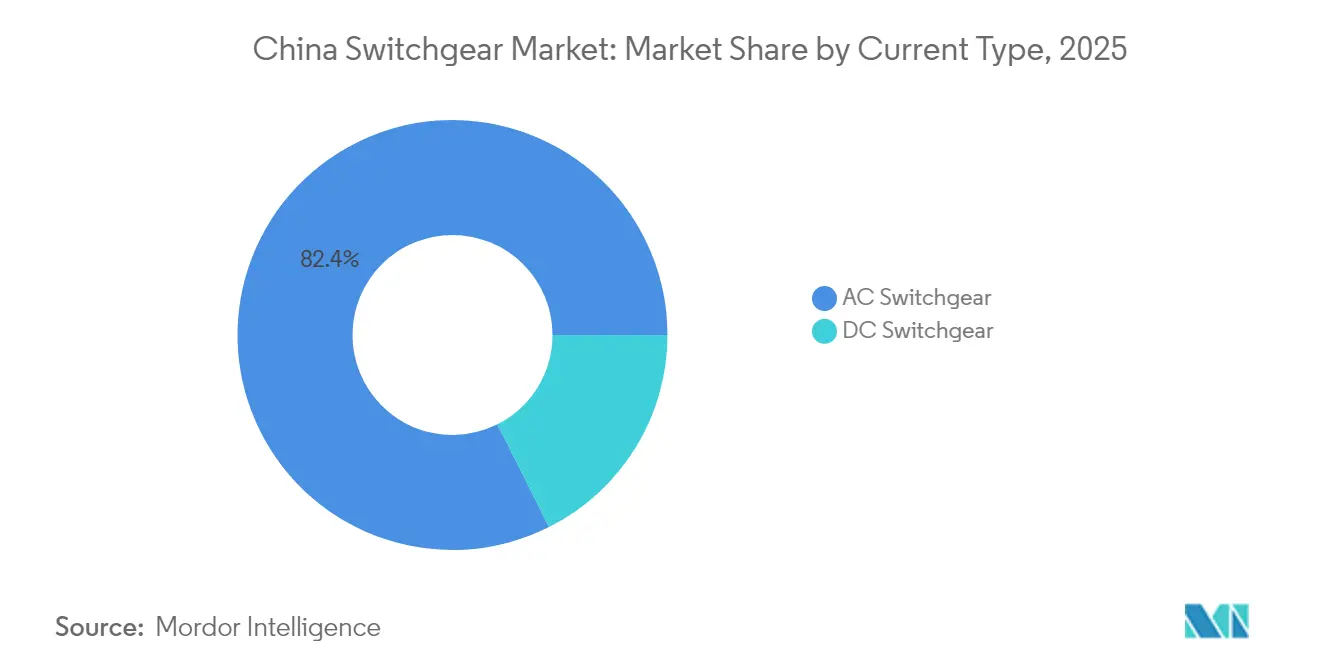
AC systems still dominate at 82.41% but DC solutions grow at 9.32% annually. ±800 kV and ±1 100 kV HVDC corridors, DC-coupled solar farms, and 350 kW fast-charging corridors propel demand. Shenzhen’s 10 MW DC microgrid isolates from the main grid in under 1 ms using solid-state breakers. HVDC breakers remain expensive, yet policy favors local sourcing, spurring R&D among domestic firms.
By Installation: Indoor Prevalence Meets Outdoor Expansion
Indoor assemblies commanded 80.85% in 2025, backed by urban substations that value controlled environments. Outdoor gear records 11.08% CAGR as western renewable bases and offshore wind farms require IP65-rated cabinets resilient to sand, salt, and temperature extremes. Modular outdoor units that integrate protection relays and communication gateways cut civil-works costs by near 20%.
By End-User: Utilities Remain Demand Anchor
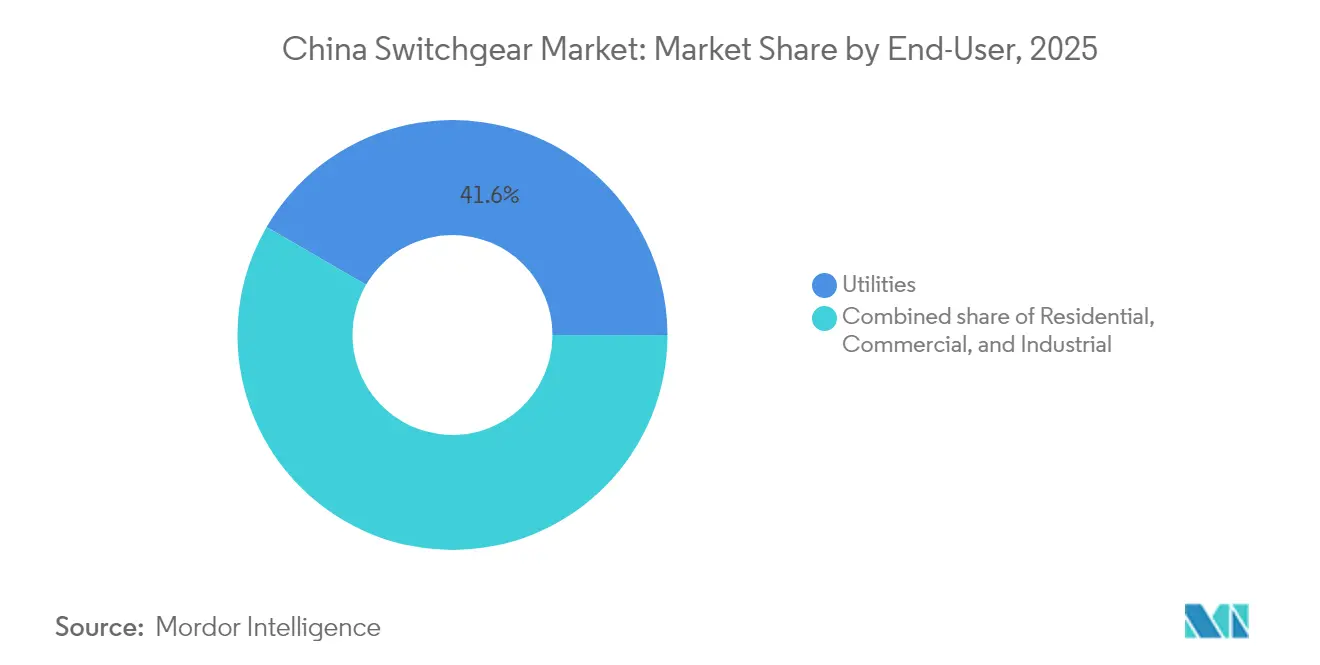
Utilities held 41.62% of spend in 2025 and will expand at a 8.97% CAGR as grid modernization and renewable integration intensify. Industrial users upgrade to harmonic-filtering switchgear to meet GB/T 14549 limits, while commercial buildings adopt intelligent low-voltage boards that link with building-management systems.
Geography Analysis
Eastern coastal provinces, Jiangsu, Zhejiang, Guangdong, and Shandong, generated 47.60% of 2025 revenue. Jiangsu installed 12 GW of offshore wind last year, needing 66 kV subsea switchgear and onshore collectors.The Greater Bay Area pilots AI-enabled substations that anticipate failures six months ahead. Western provinces, Gansu, Qinghai, Inner Mongolia, Xinjiang, supplied 28.30% of revenue despite sparse populations, owing to their role as renewable power bases. Substations in these regions specify outdoor IP65 cabinets capable of handling -40 °C winters and +50 °C summers.
Central provinces, Henan, Hubei, Hunan, and Anhui, captured 16.20% of demand, fueled by automotive and machinery clusters. Zhengzhou and Wuhan deploy smart-grid pilots that merge distributed solar and battery storage, calling for bi-directional switchgear. The northeast, Liaoning, Jilin, and Heilongjiang, took 7.90% share and are upgrading grids to support electric heating. Provincial SF₆ rules vary: Zhejiang and Guangdong enforce stricter standards, accelerating vacuum uptake. The Yangtze River Delta pilots cross-provincial grid interconnection that requires unified IEC 61850 profiles.
Tier-three cities in Sichuan, Yunnan, and Guizhou see annual growth near 12.60%, backed by hydropower and rural electrification. As disposable incomes rise, residential upgrades contribute modest yet rising low-voltage demand.
Regulatory Landscape
China switchgear procurement is shaped by a mix of mandatory GB/T national standards and sector guidance, with the State Administration for Market Regulation (SAMR) and the Standardization Administration of China (SAC) setting the core standard-setting framework. In 2026, new standardization activity tightened technical and safety requirements for high-voltage and DC applications, including GB/Z 36271.3-2026 (released March 31, 2026) for the safety of high-voltage installations, and GB/T 22390.6-2026 for control and protection equipment of HVDC transmission systems (effective August 1, 2026).
Beyond national standards, industry and group standards are also moving digitalization requirements into switchgear specifications used by utilities and industrial buyers. For example, T/ACCEM 806-2026 (implemented February 14, 2026) set technical specifications for digital twin systems of high-voltage switchgear, reinforcing the shift toward sensorized, communication-ready equipment and lifecycle monitoring. In the same direction, the report context of stricter SF6 controls in select coastal provinces supports demand for eco-design alternatives (vacuum and fluoroketone technologies) and for digital communication profiles (including IEC 61850 adoption in distribution upgrades).
Competitive Landscape
The top five suppliers, ABB, Siemens, Schneider Electric, CHINT Group, and Pinggao Electric, hold roughly 35% of the Chinese switchgear market. Multinationals dominate UHV tenders by leveraging advanced R&D, while domestic players lead in volume-driven low- and medium-voltage orders. ABB’s USD 300 million Xiamen smart-factory expansion strengthens local presence. Siemens co-develops SF₆-free solutions with provincial utilities. Schneider partners with CHINT’s 8,000-dealer network to widen reach.
Domestic consolidation continues: TBEA’s 51% stake in NR Electric created a CNY 40 billion group spanning transformers and protection relays. Pinggao and China XD benefit from State Grid ties, but face mandated cost reductions. Start-ups like Starpower Semiconductor raise capital for silicon-carbide DC breakers targeting solar farms and EV chargers. Digital platforms that bundle cloud analytics secure service contracts worth 12-15% of revenue, cushioning hardware margin pressure.
China Switchgear Industry Leaders
Pinggao Group Co. Ltd
China XD Electric Co. Ltd
CHINT Group Co. Ltd
ABB Ltd (China operations)
Siemens AG (China operations)
- *Disclaimer: Major Players sorted in no particular order

Market Opportunities and Future Outlook
The upgrade and replacement cycle toward SF6-free and digitally enabled switchgear is the main opportunity area, with buyers tightening specifications in line with both emissions-control direction and digital-engineering practices. The 2026 implementation of a group standard for digital twins in high-voltage switchgear (T/ACCEM 806-2026) creates headroom for OEMs and integrators to combine sensors, condition monitoring, and asset models with primary equipment, extending value beyond one-off equipment sales into longer-tail service and software revenue. At the product level, the 2026 release and pending effectiveness of HVDC-related national standards (for example, GB/T 22390.6-2026 effective August 1, 2026) supports localization and type-tested portfolios for DC protection and control, aligning with the report’s HVDC corridor, DC-coupled renewables, and fast-charging demand drivers.
Incumbent investment also suggests competitive dynamics are moving beyond price-only tenders. In May 2026, Henan Pinggao Electric announced a CNY 1.4 billion GIS smart-factory project, pointing to scaled advanced GIS manufacturing, quality automation, and faster delivery for utility-grade orders. On the demand side, large-scale data-center build-outs and UHV transmission expansion continue to act as key pull factors within the report scope. Suppliers able to offer compact medium-voltage line-ups for high-availability loads, and high-capacity interrupting solutions for UHV nodes, while aligning with low-GWP insulation preferences, can differentiate through engineered solutions, retrofit packages, and monitoring-enabled service contracts rather than commoditized panel supply.
Recent Industry Developments
- June 2026: Pinggao Electric Co. / China XD Electric Co. Expanded overseas localized service by establishing warehouses and service centers in Southeast Asia, the Middle East, and Africa. The expansion broadens the Chinese HV/MV switchgear service footprint and increases competitive reach against incumbent suppliers in key export markets.
- May 2026: ABB (Beijing ABB Switchgear Co., Ltd.) Launched two new SF6-free, environmentally friendly products: 24kV Safe Air gas-insulated ring main unit/compact switchgear and 12kV Safe Air gas-insulated load break switch unit. The SF6-free transition in high-voltage GIS underscores eco-design leadership and strengthens ABB position in China switchgear portfolio.
- May 2025: ABB (China operations) Completed acquisition of Siemens’ wiring-accessories business in China. Consolidation of wiring-accessories segment within Chinese market strengthens ABB’s channel, product range, and distribution for Chinese switchgear ecosystems.


Research Methodology Framework and Report Scope
Market Definition and Coverage
For this study, the market covers switchgear equipment sold in China that is used to control, protect, and isolate electrical circuits across power networks and end-user facilities, with sizing captured in revenue terms across the value chain.
Scope exclusions: We exclude electricity generation equipment, standalone transformers, and purely aftermarket service-only contracts that are not bundled with switchgear product sales.
Segmentation Overview
- By Voltage
- Low Voltage
- Medium Voltage
- High Voltage
- By Insulation
- Gas Insulated Switchgear (GIS)
- Air Insulated Switchgear (AIS)
- Others
- By Current Type
- AC Switchgear
- DC Switchgear
- By Installation
- Indoor
- Outdoor
- By End-User
- Utilities
- Residential
- Commercial
- Industrial
Data Sources, Market Sizing, and Validation
Desk Research
Desk research is used to build the base structure of the market model and to anchor China-specific demand signals that influence switchgear ordering cycles. We reviewed public energy and grid statistics, such as releases from the National Energy Administration and the National Bureau of Statistics of China, plus international energy datasets like the IEA, to interpret power demand, generation mix, and grid expansion activity.
To keep assumptions realistic, we also used sources such as IEC and IEEE standards documentation for voltage and application context, along with customs trade statistics for electrical apparatus categories where relevant. Company annual reports, investor presentations, and reputable press were checked to understand capacity additions, order momentum, and pricing commentary. For cross-checking, we selectively used paid subscriptions for company financials and intelligence, news and financials, import and export shipment-level records, and patent databases. These sources are illustrative and not exhaustive, since many other public documents were also used for data collection, validation, and clarification.
Primary Interviews and Surveys
Primary work focused on validating what is being bought and installed in China, and how buying decisions shift across voltage classes and indoor versus outdoor deployments. We spoke with a mix of manufacturers, distributors, EPC-facing experts, utility-linked stakeholders, and industrial facility decision-makers, and then used those inputs to confirm pricing ranges, ordering lead times, and realistic adoption trends for GIS versus AIS.
Distribution of primary research fieldwork respondents
| Company type | Respondent position |
|---|---|
| Top tier: 39% | CXOs: 14% |
| Mid tier: 44% | Functional/Unit leaders: 34% |
| Smaller Players: 17% | Managers: 52% |
Market-Sizing & Forecasting
Sizing starts from a top-down reconstruction where power demand growth, grid capex direction, and commissioning activity are translated into a switchgear demand pool for China, then split into buying buckets by voltage and installation type. After that structure is set, selective bottom-up approximations are used to test the totals, such as sampled supplier roll-ups, channel checks, and a price times volume sanity check for major use cases.
Key inputs that shape the model include grid expansion and refurbishment intensity, renewable capacity additions that drive substation and feeder build-outs, industrial electrification and new facility construction, typical replacement cycles for installed equipment, and the share shift between GIS and AIS in space-constrained projects. Forecasts are built using scenario analysis, where the expected direction of policy and investment is translated into demand growth cases, then tuned through expert consensus from interviews. When bottom-up checks reveal gaps, we use conservative ranges and reconcile them back to the demand pool, so the final totals remain traceable.
Data Validation & Update Cycle
Outputs are validated through multiple checks that look for mismatches between the model and independent signals, such as grid build activity, macro power indicators, and stated expansion priorities from credible institutions. When variances are found, assumptions are revisited, and interview follow-ups are triggered when pricing, mix, or timing shifts appear material.
Before sign-off, the model and narrative go through stepwise analyst reviews to ensure the logic is consistent across voltage, insulation type, and end-user demand drivers. Reports are refreshed annually, and interim updates are completed when material events occur that can change procurement cycles or pricing. Right before delivery, a final pass is completed so clients receive the latest updated view.
Mordor Intelligence's China Switchgear Market Size Compared With Other Published Estimates
Published market sizes for China switchgear can look far apart because studies often use different product boundaries and may treat voltage coverage and end-user demand differently. Timing differences also matter, since a market tied to grid projects can shift when major capex plans and commissioning schedules move.
By tracking voltage-wise demand drivers and refreshing pricing and mix assumptions through recent interview checks, Mordor Intelligence keeps the total focused on switchgear revenue in China rather than folding in adjacent electrical equipment or service-only revenue, which is a common reason estimates drift.
Benchmark comparison
| Source | Market Size | Gaps in Research Methodology |
|---|---|---|
| Mordor Intelligence | USD 31.01 B (2025) | |
| Trade Journal A | USD 28.40 B (2025) | Often emphasizes medium-voltage procurement trends and may undercount high-voltage and utility-led spending, which can pull down the total when grid expansion is the main demand engine. |
| Industry Association B | USD 35.90 B (2025) | Can include broader switchboard and controlgear categories, and sometimes bundles maintenance and retrofit services into market value, which increases the headline size versus product-only revenue. |
The comparison shows that the biggest spread comes from what gets counted as switchgear revenue and how fully utility and high-voltage demand is captured. When scope is kept tight and inputs like voltage mix, project timing, and pricing are checked against real buyer and supplier feedback, the resulting number stays easier to explain and repeat over time.


Key Questions Answered in the Report
What is the current value of the China Switchgear Market?
The China Switchgear Market size was USD 33.62 billion in 2026 and is projected to reach USD 50.38 billion by 2031.
Which segment is growing fastest within Chinese switchgear?
High-voltage equipment, buoyed by UHV projects, is expanding at a 10.41% CAGR through 2031.
How strict are China’s new SF₆ regulations?
Draft rules cap leak rates at 0.5% and mandate annual reporting, effectively pushing utilities toward vacuum and fluoronitrile solutions by 2028.
Why is DC switchgear gaining ground?
Growth in HVDC links, DC-coupled solar farms, and 350 kW fast-charging corridors lifts DC switchgear demand at a 9.32% CAGR.
Which provinces buy the most switchgear?
Coastal Jiangsu, Zhejiang, Guangdong, and Shandong together generated 47.60% of 2025 demand due to dense urban loads and offshore wind installs.
Who are the top suppliers in China’s switchgear field?
ABB, Siemens, Schneider Electric, CHINT Group, and Pinggao Electric account for about 35% of total revenue.
Page last updated on:


 Your data is secure and never sold or shared.


