
Market Overview
| Study Period | 2020 - 2031 |
|---|---|
| Forecast Data Period | 2026 - 2031 |
| Base Year Market Size (2025) | USD 131.97 Billion |
| Market Size (2026) | USD 141.14 Billion |
| Market Size (2031) | USD 197.46 Billion |
| Growth Rate (2026 - 2031) | 6.95 % |
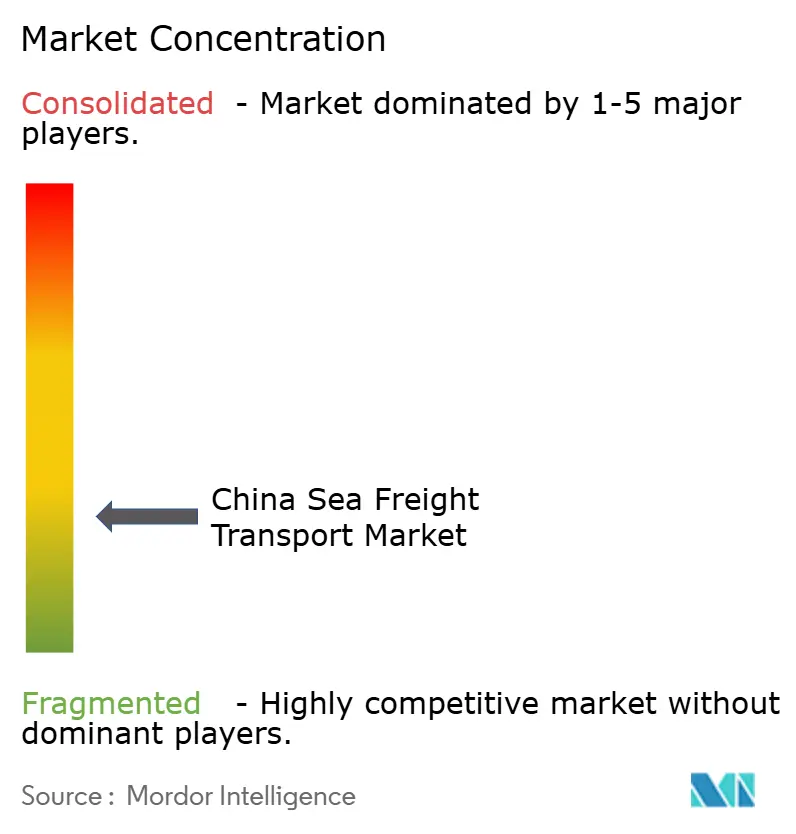
| Market Concentration | Low |
Major Players *Disclaimer: Major Players sorted in no particular order Image © Mordor Intelligence. Reuse requires attribution under CC BY 4.0. | |
China Sea Freight Transport Market Analysis by Mordor Intelligence
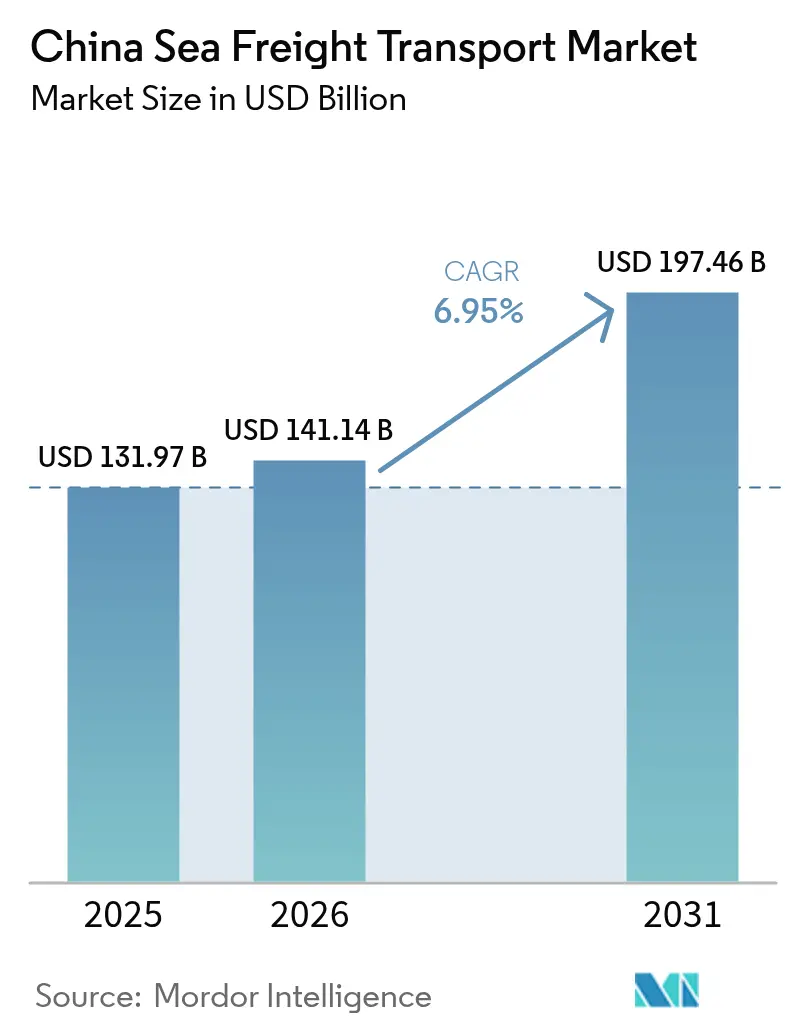
The China Sea Freight Transport Market size was valued at USD 131.97 billion in 2025 and estimated to grow from USD 141.14 billion in 2026 to reach USD 197.46 billion by 2031, at a CAGR of 6.95% during the forecast period (2026-2031).
Even amid geopolitical frictions, the country’s dominance endures as multi-billion-dollar Belt and Road port projects unlock fresh trade corridors and anchor long-term shipping contracts. Automation rollouts at flagship terminals—paired with the deployment of ever larger, fuel-efficient vessels—are raising berth productivity while keeping operating costs in check [1]. Surging cross-border e-commerce volumes now fill containers that once sailed with slack capacity, encouraging carriers to refine networks and secure guaranteed load agreements. At the same time, accelerated adoption of dual-fuel and methanol-ready ships is trimming emissions and positioning Chinese lines favorably against impending environmental levies, creating a virtuous cycle in which lower freight costs draw more cargo and justify further investment.
Key Report Takeaways
- By cargo type, containerized cargo captured 43.55% of the China Sea Freight Transport market share in 2025, while the China Sea Freight Transport market size for RoRo shipments is projected to expand at an 7.95 % CAGR during 2026-2031.
- By end-use industry, manufacturing maintained 28.85 % China Sea Freight Transport market share in 2025, yet the China Sea Freight Transport market size attributed to FMCG and retail is forecast to rise at a 9.45 % CAGR over 2026-2031.
- By trade lane, Intra-Asia services commanded a 37.35% China Sea Freight Transport market share in 2025, and the China Sea Freight Transport market size linked to Africa-bound routes is expected to register an 7.9 % CAGR through 2031
Note: Market size and forecast figures in this report are generated using Mordor Intelligence’s proprietary estimation framework, updated with the latest available data and insights as of 2026.
China Sea Freight Transport Market Trends and Insights
Drivers Impact Analysis*
| Driver | (~) % Impact on CAGR Forecast | Geographic Relevance | Impact Timeline |
|---|---|---|---|
| Belt & Road Maritime Silk Road Infrastructure Build-out Amplifying Outbound Sea Freight Volumes | +1.8% | Global focus on Africa & Latin America | Medium-term |
| Cross-Border E-Commerce Boom Elevating China-Origin Containerized Shipments | +1.5% | North America & Europe | Short-term |
| Port Automation & Mega-Vessel Berth Expansion in Yangtze & Pearl River Deltas Enhancing Throughput Capacity | +1.2% | Yangtze & Pearl River hubs | Medium-term |
| Rising LNG & Petrochemical Import Demand Driving Specialized Tanker Traffic | +0.9% | Middle East & Australia routes | Medium-term |
| Increased High-Grade Iron Ore Imports Fueling Capesize Bulk Carrier Utilization | +0.8% | Australia & Brazil routes | Short-term |
| Government Incentives for Green & Dual-Fuel Vessels Accelerating Fleet Renewal | +0.7% | Domestic & EU routes | Long-term |
| Source: Mordor Intelligence | |||
Belt & Road Maritime Silk Road Infrastructure Build-out Amplifying Outbound Sea Freight Volumes
China’s sustained port investments under the Maritime Silk Road banner are adding throughput faster than most trading partners can absorb, enabling shippers to reroute cargo flows with minimal friction. Newly completed deep-water hubs in Latin America and Southeast Asia shorten transit times on previously underserved corridors, a shift that encourages exporters to diversify destination portfolios. By pairing equity stakes with long-term terminal concessions, Chinese operators ensure preferential berth windows that lock in volume commitments. This integrated approach strengthens bargaining power in freight-rate negotiations, an advantage that is likely to endure as ports monetise ancillary services such as bonded warehousing.
Cross-Border E-Commerce Boom Elevating China-Origin Containerized Shipments
Double-digit growth in cross-border online retail continues to reshape shipping patterns, pulling parcelised goods into consolidated container loads bound for micro-fulfilment centres overseas. Dedicated e-commerce pilot zones inside free-trade areas offer streamlined customs clearance, compressing order-to-ship lead times and making sea freight viable for categories once flown by air. Major platforms are now negotiating annual service contracts directly with carriers, guaranteeing baseline volumes that smooth capacity planning. This predictable demand profile is prompting liners to allocate more reefer and high-cube containers to fast-moving consumer segments, nudging equipment fleets toward greater specialisation.
Port Automation & Mega-Vessel Berth Expansion in Yangtze & Pearl River Deltas Enhancing Throughput Capacity
Smart-port retrofits featuring artificial intelligence, digital twins, and 5G connectivity are lifting crane productivity and reducing labour intensity on China’s busiest quays. The capability to handle 24 000-TEU class vessels at multiple terminals simultaneously spreads operational risk and minimises congestion during peak export seasons. Automated truck-marshalling yards further shrink turnaround times, effectively converting space savings into added berth length for future growth. The cascade effect is that second-tier ports adopt similar technologies to remain relevant, forming a nationwide mesh of high-efficiency gateways that lowers inland logistics costs.
Rising LNG & Petrochemical Import Demand Driving Specialized Tanker Traffic
China’s long-term gasification policy and its commitment to petrochemical self-sufficiency underpin a steady rise in specialised tanker calls [2]. Additional regasification terminals along the eastern seaboard create incremental berth demand for Q-Max LNG carriers, stimulating orders for locally built cryogenic vessels. Parallel investments in ethane and propane dehydrogenation complexes draw more liquid bulk cargo, encouraging shipyards to prioritise dual-fuel tanker designs. The combined outcome is a fleet mix skewed toward higher-value vessels, which supports charter-rate resilience even amid broader market softness.
Restraints Impact Analysis*
| Restraint | (~) % Impact on CAGR Forecast | Geographic Relevance | Impact Timeline |
|---|---|---|---|
| Container Fleet Overcapacity Post-2023 Newbuild Wave Suppressing Freight Rates | -1.6% | Asia-Europe & Transpacific | Short-term |
| Rail & Pipeline Substitution Curtailing Seaborne Coal and Bulk Commodity Volumes | -0.9% | Domestic inland corridors | Medium-term |
| Escalating IMO / China Emission Compliance Costs Impacting Operator Margins | -0.8% | EU-China lanes | Medium-term |
| Geopolitical Trade Disruptions Introducing Route Volatility & Demand Uncertainty | -1.2% | South China Sea & US-China | Short-term |
| Source: Mordor Intelligence | |||
Container Fleet Overcapacity Post-2023 Newbuild Wave Suppressing Freight Rates
The orderbook expansion that peaked in 2024 is now filtering into active service, outpacing incremental demand and placing downward pressure on spot rates across mainline routes. Carriers respond with strategic blank sailings, but persistent vessel deliveries continue to inflate idle capacity, especially in the 8 000-to-12 000 TEU band. This surplus is pushing some operators to reposition tonnage into secondary trades, a tactic that dampens rate recovery even where demand is firm. An unintended consequence is that shippers gain more leverage in contract talks, encouraging them to negotiate longer validity periods at lower base rates.
Rail & Pipeline Substitution Curtailing Seaborne Coal and Bulk Commodity Volumes
Government incentives for rail-water intermodal corridors are diverting bulk commodities like coal from coastal loading points to inland rail depots, trimming voyage counts for Handymax and Panamax vessels. Container-on-flat-car services now capture a larger share of domestic distribution, indicating that shippers value the lower carbon footprint and predictability of rail. As electrified freight corridors expand westward, some energy producers are revisiting pipeline projects that could bypass coastal export entirely. These shifts introduce a structural headwind for sea-borne bulk growth, yet create complementary demand for last-mile feeder services out of inland ports.
*Our forecasts treat driver/restraint impacts as directional, not additive. The impact forecasts reflect baseline growth, mix effects, and variable interactions.
Segment Analysis
Cargo Type: Containerised Cargo Dominates Amid Diversification
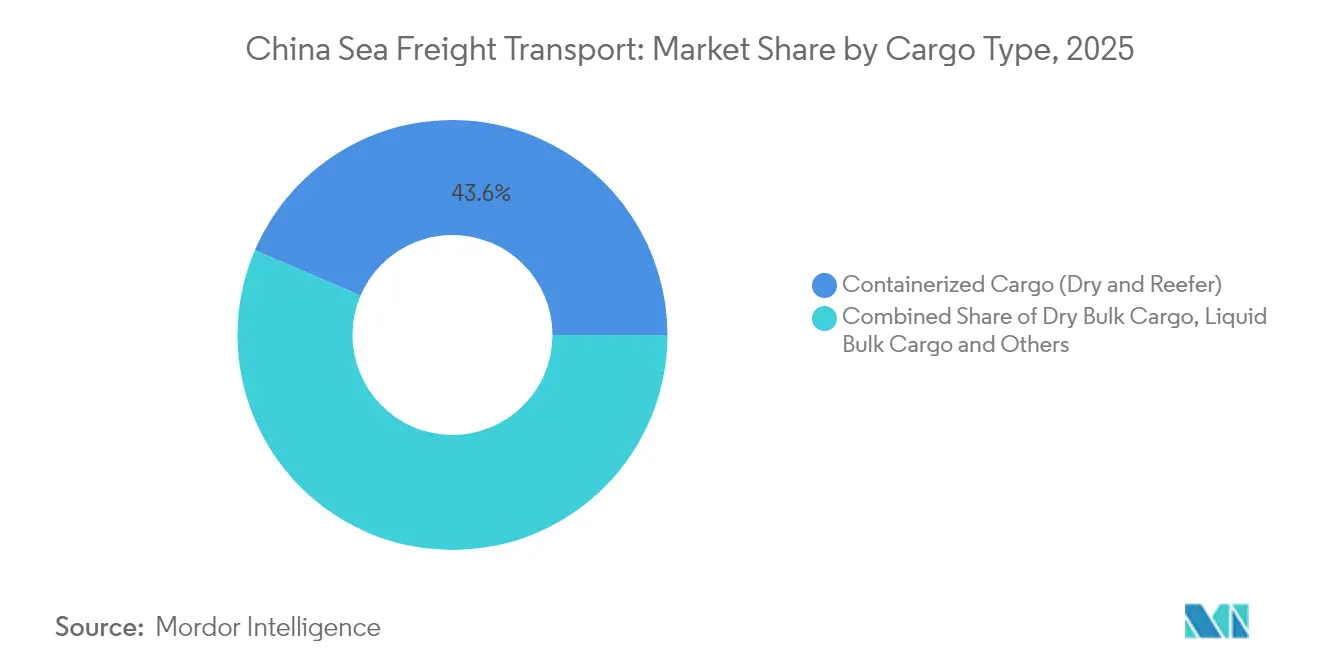
The containerised segment commands a 43.55 % China Sea Freight Transport market share in 2025, a position anchored by the country’s manufacturing scale and flourishing e-commerce exports. Continuous berth enhancements at flagship ports allow 24,000-TEU vessels to call without tidal restrictions, giving shippers confidence in schedule reliability. Within the container pool, demand for reefer boxes grows faster than dry units as pharmaceutical and fresh-produce exporters seek temperature-controlled integrity. This evolution nudges carriers to rebalance fleet mix toward higher-power generator sets, an investment that raises slot yields per voyage.
Roll-on/Roll-off cargo is expanding at a forecast CAGR of 7.95 %, fuelled by rising vehicle exports and new-energy-vehicle shipments that require purpose-built car carriers. The segment’s momentum is prompting specialised terminals to add multistorey ramps, which increases hourly throughput and reduces berth time variance. Dry-bulk flows remain substantial, yet incremental gains concentrate in premium-grade ores that support steel decarbonisation targets, indicating a qualitative shift rather than pure volume growth. In liquid bulk, robust LNG import programmes sustain demand for membrane-type tankers, reinforcing the strategic value of shipyards capable of cryogenic construction.

End-Use Industry: Manufacturing Dominance Challenged by Retail Growth
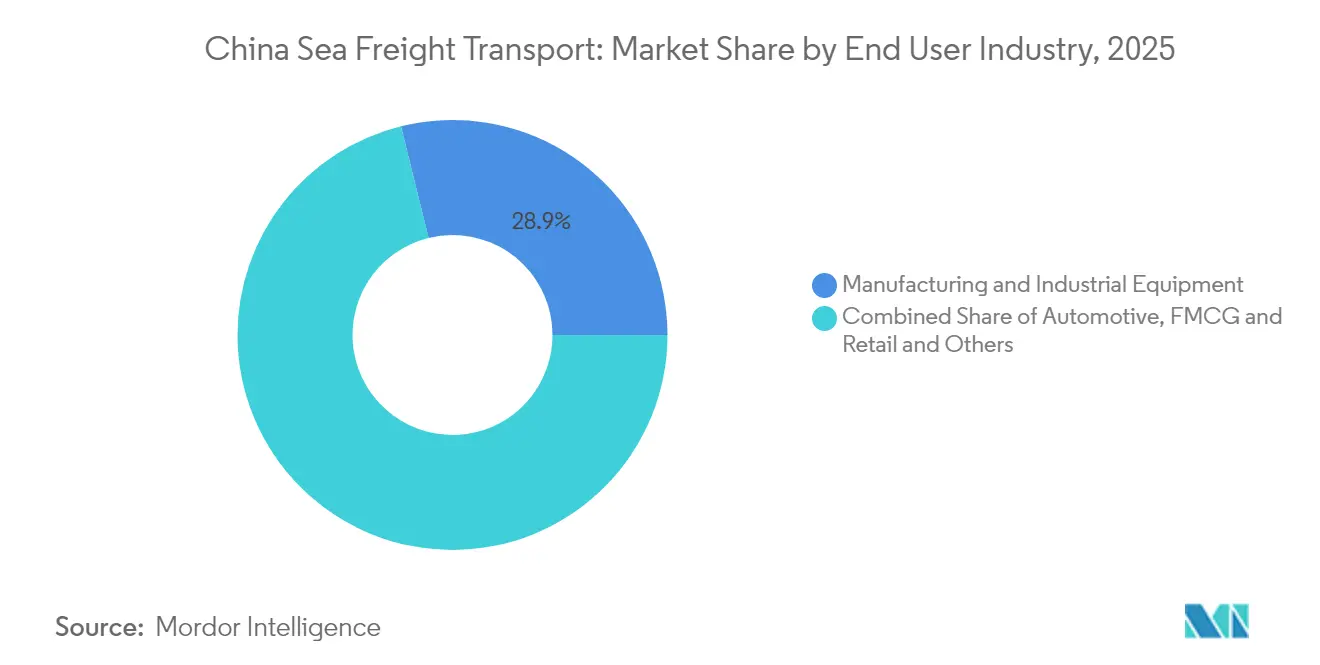
Manufacturing retains a 28.85 % share of the China Sea Freight Transport market size in 2025, underlining its enduring weight in national GDP despite marginal year-on-year contractions. Machinery and consumer electronics occupy the largest container slots, and their complexity sustains a requirement for value-added logistics such as kitting and postponement. A fresh implication is that carriers offering integrated supply-chain visibility tools are now more strongly preferred by exporters, suggesting technology capability is supplanting simple scale as a differentiator.
Fast-moving consumer goods and retail exhibit a forecast 9.45 % CAGR, marking them as the most dynamic cargo class in the China Sea Freight Transport industry. High-frequency promotions by online platforms compress replenishment cycles, compelling shippers to treat seaborne freight as a quasi-inventory buffer rather than a cost centre. This behavioural change increases the appeal of time-definite ocean services, creating an opening for premium no-roll guarantees that carry higher margins. Automotive exports also rise sharply, with new-energy models boosting the utilisation of RoRo decks while underscoring the need for enhanced fire-suppression standards onboard.
Trade Lane / Destination: Intra-Asia Dominates as Africa Emerges
Intra-Asia corridors account for a 37.35 % China Sea Freight Transport market share in 2025, illustrating the gravitational pull of regional supply-chain clustering under the Regional Comprehensive Economic Partnership. Short-haul services benefit from weekly sailing frequencies that smooth inventory planning for just-in-time manufacturers, an arrangement that tightens economic links across the region. Because voyage distances are shorter, carriers deploy smaller gearless vessels that cycle faster, indirectly freeing larger tonnage for long-haul trades.
Africa-bound volumes register the fastest forecast CAGR at 7.9 %, buoyed by tariff-free access for agricultural imports and a wave of Chinese-financed port concessions that guarantee berth priority. The emerging traffic supports a rise in direct services from South-central China, avoiding transhipment and reducing cargo dwell times. North American and European lanes remain critical for container line profitability, yet heightened compliance and security levies are tempering growth, prompting shippers to weigh alternate gateways such as Mexico and the Mediterranean.
Regulatory Landscape
China sea freight transport operates under a national framework led by the Ministry of Transport (MOT), with trade-facing measures and standards influencing carrier costs, documentation, and service design. A key 2026 inflection point was the Tariff Adjustment Plan for 2026, effective January 1, 2026, issued by the Customs Tariff Commission of the State Council. This adjusted import tariffs on 935 items and reshaped demand and routing for selected commodities moving through Chinese ports.
Policy in 2026 has also emphasized logistics cost reduction and cross-modal efficiency, which feeds into port and shipping utilization. In June 2026, MOT and other departments issued the Implementation Plan for Multimodal Transport Tackling Bottlenecks (2026-2030), targeting node facility upgrades, information connectivity, and harmonized standards across modes. In parallel, MOT continued to release transport industry standards, including an April 2026 batch, supporting standardized planning and operations across the freight system and reinforcing compliance and data requirements that affect ocean carriers and their bundled services.
Value Chain Analysis
The value chain spans cargo owners (manufacturers, e-commerce merchants, energy and commodity importers/exporters), freight forwarders and NVOCCs, ocean carriers (liner, bulk, and RoRo), port groups and terminal operators, marine service providers (pilotage, towage, bunkering, ship agency), and hinterland connectors such as rail, trucking, and inland waterways. Port and terminal capability remains a central value lever. In 2025, China ports handled 18.34 billion tonnes of cargo and about 350 million TEUs, supported by a growing base of automation, with 30 automated container terminals and 30 automated dry bulk terminals as of 2025. This raises berth productivity and shortens vessel turnaround.
Execution risk in the chain concentrates around node disruption and schedule variability, which then propagates into equipment imbalance and higher inventory buffers for shippers. In 2026, seasonal weather and operational shocks, including heavy fog and typhoons such as Typhoon Bavi, alongside vessel bunching linked to wider network disruptions, resurfaced as bottlenecks at North Asian gateways. This increased the value of digital yard planning, dynamic berthing, and inland-sea coordination. Network building via industry platforms and port-logistics partnerships also supports connectivity. The Silk Road Maritime Association reported 375 members after adding eight new members in March 2026, and SIPG Logistics signed a cooperation agreement with FESCO Transportation Group in June 2026 to expand container shipping, intermodal logistics, and route development, reinforcing integrated service offerings around major Chinese port nodes.
Competitive Landscape
State-owned enterprises dominate the China Sea Freight Transport market, but their competitive posture is increasingly shaped by technology adoption rather than fleet tonnage alone. COSCO Shipping, the market leader, operates 1,417 vessels with 116 million deadweight tons of capacity, giving it unmatched scheduling flexibility and bargaining power with terminals [3]. The group’s decision to standardise digital platforms across subsidiaries signals a pivot toward data-driven network orchestration that compresses cost per box.
Second-tier players hedge against scale disadvantages through strategic alliances that provide global reach without duplicating assets. Joint ventures with port operators secure priority berths and safeguard service integrity during peak seasons, illustrating how relationship capital translates into operational resilience. Smaller niche carriers differentiate by focusing on specialised trades such as project cargo or short-sea feeder loops, where agility and local knowledge trump sheer size. This tiered structure yields a market that is concentrated yet competitive, encouraging continual service upgrades and rate discipline.
Technology is the new fault line in competitive positioning. Real-time cargo visibility, predictive maintenance powered by machine learning, and blockchain-enabled documentation are transitioning from optional add-ons to baseline expectations. Firms that embed these capabilities report lower detention and demurrage charges, effectively converting tech spend into revenue protection. The cascading benefit is a widening performance gap that accelerates consolidation, as laggards struggle to secure investor confidence amid rising compliance costs.
China Sea Freight Transport Industry Leaders
-
COSCO Shipping Lines
-
SINOTRANS Limited
-
China Merchants Group
-
SITC International Holdings Company Limited
-
Hebei Ocean Shipping (HOSCO)
- *Disclaimer: Major Players sorted in no particular order
Market Opportunities and Future Outlook
Port automation and high-capacity terminal build-outs are creating space for carriers and logistics providers to bundle time-definite services, visibility tools, and equipment solutions around high-throughput gateways. Shanghai International Port Group reported Phase 4 of Yangshan Port reaching an annual capacity of 8 million TEUs, supported by an automated terminal footprint of 2.23 million square meters using remote cranes and autonomous vehicles. This supports premium service configurations such as guaranteed cutoffs, no-roll products, and integrated documentation flows that reduce dwell time for e-commerce and high-frequency retail replenishment cargo.
New corridors and shoreline additions broaden routing options and shift cargo gravity toward ports and trade lanes that can absorb larger vessels and support smoother inland distribution. Guangzhou Port reported acceptance of projects including Nansha Port Phase IV and associated expansions, adding 4.7 km of foreign-trade shoreline and increasing foreign-trade container capacity by 4.9 million TEUs. This strengthens direct-call potential and reduces reliance on transshipment for selected export flows. Inland-waterway-to-sea connectivity is also being reinforced by works such as the Pinglu Canal, with overall construction progress reported above 96% in June 2026 and water testing underway. These developments expand options for inland-origin cargo to reach coastal gateways via waterborne legs that can complement ocean services and reduce road dependence.
Recent Industry Developments
- May 2026: Sinotrans Limited ordered 12 new containerships across affiliated shipyards (including China Merchants Heavy Industry, China Merchants Jinling Shipbuilding, and Wuhan Qingshan Shipyard), adding a reported 52,000 TEU of capacity with deliveries starting in 2027. The order strengthens long-term access to tonnage and aligns fleet planning with export-driven container flows. It also tightens links between state-backed logistics operators and domestic shipbuilding.
- March 2026: COSCO Shipping Special Transport launched a joint venture with FOTON Motor and Guangzhou Yuanfu Automotive Supply Chain Co., Ltd. to integrate RoRo vessel shipping into FOTONs overseas vehicle export supply chain. The venture deepens shipper-carrier integration in the automotive export segment. It supports more controlled end-to-end capacity and scheduling for finished vehicles.
- March 2025: COSCO conducted parallel refueling with B24 biofuel on two container vessels to collect operational data for broader bio-blended fuel usage. The trial supported practical readiness for lower-carbon marine fuels. It also helped inform fuel procurement and vessel-operating procedures under tightening emissions compliance requirements.
Research Methodology Framework and Report Scope
Market Definition and Coverage
This market covers the value of sea freight transport services tied to moving commercial goods by ocean-going vessels connected to China, measured as revenue earned for the ocean leg and related charges commonly included in the freight invoice.
Scope exclusions: We exclude coastal cabotage, passenger ferry services, inland trucking or rail beyond the port gate, port real estate income, and stand-alone warehousing billed outside the ocean freight invoice.
Segmentation Overview
- By Cargo Type
- Containerized Cargo
- Dry
- Reefer
- Dry Bulk Cargo
- Liquid Bulk Cargo
- General Cargo
- Roll-On/Roll-Off Cargo
- Containerized Cargo
- By End-Use Industry
- Manufacturing & Industrial Equipment
- Automotive
- FMCG & Retail (incl. E-commerce)
- Agriculture & Food Products
- Energy & Mining (Coal, Minerals & Ores)
- Chemicals & Petrochemicals
- Pharmaceutical & Healthcare
- Others
- By Trade Lane / Destination Region
- Intra-Asia
- North America
- Europe
- Middle East
- Africa
- South America
- Oceania
Data Sources, Market Sizing, and Validation
Desk Research
Desk research started with mapping China-linked seaborne trade volumes, vessel activity, and freight rate signals so the model stays grounded in observable transport demand. Public sources were used to anchor baseline direction and seasonality, such as China Customs trade statistics, UN Comtrade, UNCTAD maritime transport indicators, and port authority throughput releases (TEU and tonnage) from major coastal port groups.
To translate activity into value, we paired those demand indicators with published shipping price and cost markers, including World Bank commodity and fuel series for bunker-linked movements, and freight rate indices and market commentary from industry associations and reputable press. We also screened company filings and investor presentations to understand revenue mix, service inclusions, and surcharge practices that can change what is billed on the invoice. Where needed, paid subscriptions for news and financials, patent databases, and shipment-level import export intelligence were used to cross-check assumptions on cargo flows and pricing dispersion. These sources are illustrative, and we reviewed many other public and paid references for data collection, validation, and clarification.
Primary Interviews and Surveys
Primary work focused on validating how revenue is recognized in China sea freight invoices and how pricing is applied by lane, cargo type, and contract structure. We spoke with carriers, freight intermediaries, port and terminal stakeholders, and large shippers to confirm typical surcharge bundles, the spot versus contract share, and recent shifts in capacity discipline.
To reduce blind spots, we covered respondents tied to key export and import corridors, as well as domestic coastal manufacturing clusters. We also used follow-up checks when desk signals and interview insights did not align.
Distribution of primary research fieldwork respondents
| Company type | Respondent position |
|---|---|
| Top tier: 33% | CXOs: 13% |
| Mid tier: 47% | Functional/Unit leaders: 30% |
| Smaller Players: 20% | Managers: 57% |
Market-Sizing & Forecasting
The sizing model starts with a top-down build where seaborne trade and port throughput signals are converted into a transport demand pool, which is then translated into value using lane-level price patterns and typical surcharge structures. To keep the totals realistic, selective bottom-up approximations were used as checks, such as sampled rate card reviews, carrier and intermediary revenue splits, and volume times average price cross-checks for container, dry bulk, and liquid bulk movements.
Key inputs that shaped the model included TEU throughput, dry and liquid bulk tonnage, bunker fuel price trends, the share of spot versus contract pricing, and capacity utilization signals that influence rate firmness. We adjusted for mix shifts such as reefer share, roll-on roll-off activity, and changes in export versus import balance, since these can change average realized revenue per unit moved.
For forecasting, we used scenario analysis so the outlook reflects different but plausible paths for trade growth, freight rate normalization, and fuel-linked surcharges. When bottom-up checks were incomplete for certain corridors or cargo types, we handled gaps through conservative proxy pricing based on similar lanes, then re-tested with interview feedback before finalizing the series.
Data Validation & Update Cycle
Outputs were validated through multiple checks so the final market value matches real-world signals, not just model math. We compared the implied revenue per TEU and per ton against independent rate markers, fuel movements, and interview-confirmed surcharge bundles. We also investigated sharp breaks that did not align with known trade or capacity events.
Before sign-off, the work goes through step-by-step analyst reviews where assumptions, conversions, and scope boundaries are rechecked, followed by targeted re-contacts if a variance stays unexplained. Reports are refreshed annually, and interim updates are made when material events occur, such as major trade disruptions, regulatory shifts affecting coastal shipping, or unusual freight rate spikes. Right before delivery, a final review pass is completed so clients receive the latest updated view.
Mordor Intelligence's China Sea Freight Transport Market Size Versus Other Published Estimates
Published market values for China sea freight transport can vary a lot because each publisher draws the boundary differently and applies different pricing logic to convert volumes into revenue. The biggest swings usually come from what is counted inside the freight invoice, how domestic coastal movements are treated, and whether the pricing path assumes a fast normalization or a longer period of elevated rates.
By tracking invoice-level surcharge bundles and refreshing the scope boundary in Mordor Intelligence so coastal cabotage and beyond-port inland legs stay excluded, the estimate stays tied to ocean freight revenue instead of drifting into broader logistics totals.
Benchmark comparison
| Source | Market Size | Gaps in Research Methodology |
|---|---|---|
| Mordor Intelligence | USD 131.97 B (2025) | |
| Industry Association A | USD 118.40 B (2025) | Uses a narrower revenue definition that strips out common carrier-billed add-ons (such as terminal handling and fuel-linked surcharges), and it may understate the value in years with higher surcharge intensity. |
| Global Consultancy B | USD 154.60 B (2025) | Blends ocean freight with adjacent logistics services around ports (for example, inland drayage or third-party handling billed outside the ocean leg), which lifts the total even when seaborne volumes are similar. |
The spread across sources mainly traces back to what gets counted as sea freight revenue versus nearby logistics services, and how surcharge treatment is handled when fuel and rates move quickly. Our approach keeps the market traceable to throughput, trade, and price indicators, and the assumptions are written so they can be rechecked and updated when conditions change.
Key Questions Answered in the Report
What is the current China Sea Freight Transport market size?
The market is valued at USD 141.14 billion in 2026, reflecting solid demand across container, bulk, and liquid cargo categories.
How fast is the China Sea Freight Transport market expected to grow?
Analysts forecast a CAGR of 6.95% through 2031, supported by infrastructure investment, technology adoption, and expanding trade partnerships.
Which cargo type holds the largest China Sea Freight Transport market share?
Containerized cargo accounts for the largest share at 43.55%, driven by robust manufacturing and surging cross-border e-commerce volumes.
Why is Africa becoming a key destination for Chinese sea freight?
China-funded port developments and tariff-free access for African imports are propelling rapid growth in China-to-Africa trade lanes.
How are environmental regulations affecting the China Sea Freight Transport industry?
Lifecycle emissions standards and FuelEU Maritime rules are raising compliance costs but also accelerating the shift to dual-fuel and alternative-fuel vessels.
Which companies dominate the China Sea Freight Transport market?
Large state-owned enterprises, led by COSCO Shipping, control the majority of fleet capacity and terminal investments, setting service benchmarks for the industry.