
Market Overview
| Study Period | 2020 - 2031 |
|---|---|
| Forecast Data Period | 2026 - 2031 |
| Base Year Market Size (2025) | USD 397.4 Billion |
| Market Size (2026) | USD 428.24 Billion |
| Market Size (2031) | USD 622.04 Billion |
| Growth Rate (2026 - 2031) | 7.76 % |
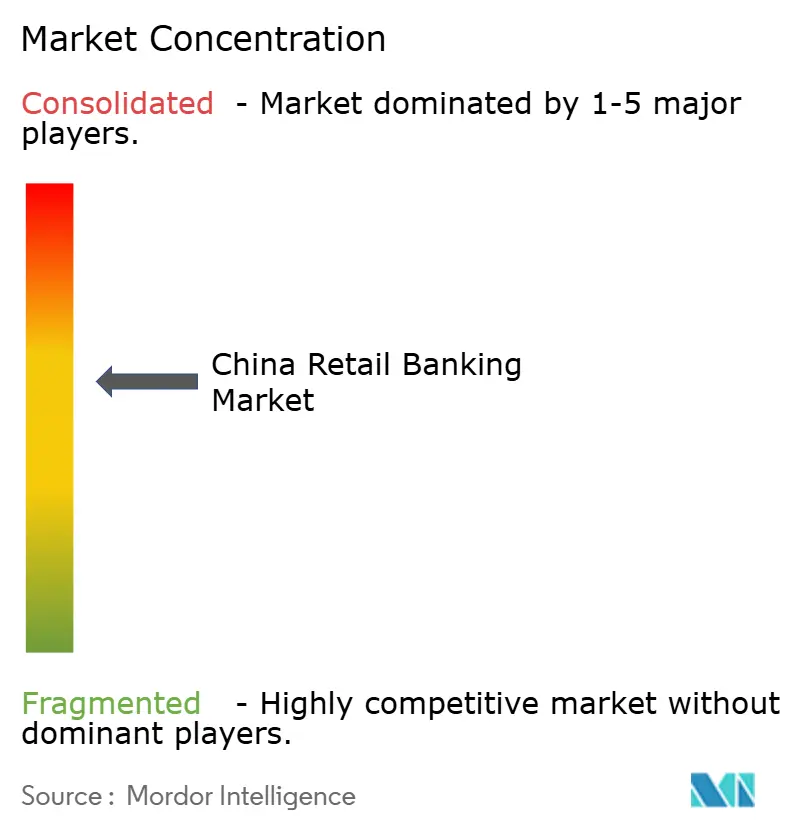
| Market Concentration | Medium |
Major Players *Disclaimer: Major Players sorted in no particular order Image © Mordor Intelligence. Reuse requires attribution under CC BY 4.0. | |
China Retail Banking Market Analysis by Mordor Intelligence
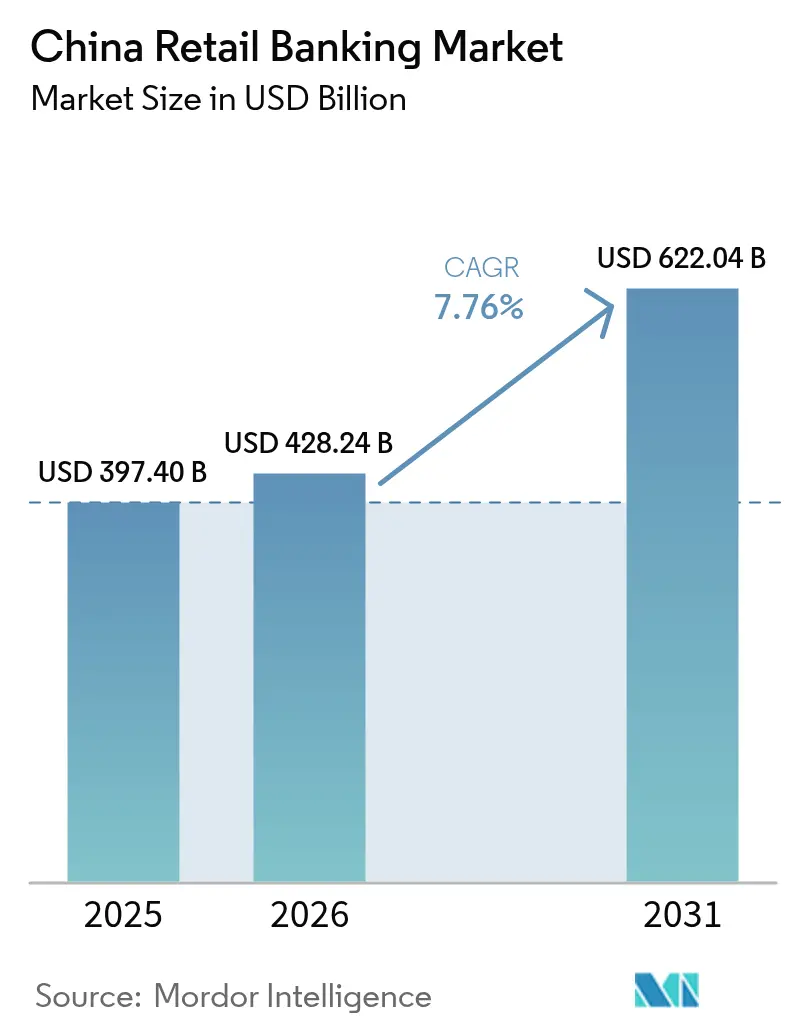
China retail banking market size in 2026 is estimated at USD 428.24 billion, growing from 2025 value of USD 397.4 billion with 2031 projections showing USD 622.04 billion, growing at 7.76% CAGR over 2026-2031. The expansion quickens as mobile payments, open-banking APIs, and biometric onboarding push traditional institutions to re-architect service delivery around digital channels. Government mandates on rural inclusion increase the addressable base, while green finance programs create fresh lending categories. Competition from super-apps compresses fee margins, so banks lean on data-driven cross-selling to defend profitability. Intensifying capital standards encourage a pivot toward fee income and asset-light advisory services, and the rising mass-affluent population supports demand for higher-yield investment products.
Key Report Takeaways
- By product, loans held 31.12% of China retail banking market share in 2025; credit cards are forecasted to expand at a 8.95% CAGR through 2031.
- By channel, online banking led with a 64.02% share of the China retail banking market in 2025, while mobile-first platforms are projected to grow at a 10.35% CAGR to 2031.
- By customer age group, the 29-44 cohort accounted for 44.62% of the China retail banking market size in 2025; the 18-28 cohort is projected to advance at a 9.55% CAGR between 2026-2031.
- By bank type, national banks commanded 67.15% of the market in 2025, whereas neobanks registered the highest projected CAGR at 11.05% through 2031.
Note: Market size and forecast figures in this report are generated using Mordor Intelligence’s proprietary estimation framework, updated with the latest available data and insights as of 2026.
China Retail Banking Market Trends and Insights
Drivers Impact Analysis*
| Driver | (~) % Impact on CAGR Forecast | Geographic Relevance | Impact Timeline |
|---|---|---|---|
| Mobile-payment ecosystem integration | +1.2% | Tier-1 cities (Beijing, Shanghai, Guangzhou, Shenzhen); expanding to Tier-2 | Short term (≤ 2 years) |
| Rural financial-inclusion push | +0.5% | Central and western rural provinces | Medium term (2-4 years) |
| Mass-affluent income growth | +1.8% | Eastern coastal provinces (Yangtze and Pearl River Deltas) | Short term (≤ 2 years) |
| Open-banking API adoption | +2.1% | National; strongest in technology hubs (Beijing, Shanghai, Hangzhou, Shenzhen) | Medium term (2-4 years) |
| Biometric authentication uptake | +1.7% | National; early adoption in urban centers | Short term (≤ 2 years) |
| Green-finance lending mandates | +1.0% | National; heightened in economically advanced regions | Long term (≥ 4 years) |
| Source: Mordor Intelligence | |||
Rise in Mobile Payment Ecosystem Integration
Transaction volumes on mobile platforms surpassed USD 12.8 trillion in 2024, and Alipay plus WeChat Pay captured 90% of that flow[1]. Banks that embed current-account, lending, and investment functions into these super-apps gain access to granular spending data that improves risk scoring and personalization. QR payments now dominate Tier-1 city point-of-sale environments, so branch and ATM usage continue to decline. Institutions unable to plug into these ecosystems risk losing visibility, prompting accelerated partnership activity and white-label wallet launches. The shift positions smartphones as the default branch for China's retail banking market and compresses legacy interchange revenues.
Regulatory Push for Rural Financial Inclusion
Village banks backed by large institutions extend basic deposit and micro-credit services deep into rural counties, aided by low-bandwidth mobile interfaces and biometrics that simplify know-your-customer compliance. Digital benefit disbursement platforms streamline welfare payments, raising household income stability and thus loan eligibility. While provincial gaps persist in fiber and 5G coverage, targeted infrastructure subsidies aim to narrow the divide by 2027. The initiative adds millions of new customers to China's retail banking market, though profitability hinges on low-cost digital servicing models that offset smaller ticket sizes.
High Disposable Income Growth Propelling Mass Affluent Segment
Average disposable income reached CNY 54,188 for urban households in 2024, creating a sizable tier seeking yield above basic deposit returns. Banks respond with tiered wealth-management centres that bundle funds, brokerage links, and robo-advice under premium loyalty plans. Relationship managers push structured deposits and ESG funds that align with green-lending priorities. Competition intensifies as securities firms and big-tech platforms court the same demographic, compelling banks to integrate lifestyle benefits within accounts. Mass-affluent dynamics increasingly shape product roadmaps across China's retail banking market.
Emergence of Open Banking APIs Facilitating Collaboration
Standardized APIs accelerate digital-product launches from years to months, enabling community banks to distribute third-party robo-advisors, buy-now-pay-later widgets, and insurance modules without large IT overhauls. The People’s Bank pilot on integrated cash pooling shows regulators embracing data-sharing under strict security rules[2]. Technology hubs such as Shenzhen host vibrant sandbox programs where fintechs test niche propositions before nationwide scale-up. API ecosystems democratize innovation yet raise cyber-risk, so banks bolster tokenization and zero-trust architectures to protect customer assets.
Restraints Impact Analysis*
| Restraint | (~) % Impact on CAGR Forecast | Geographic Relevance | Impact Timeline |
|---|---|---|---|
| Super-app competition | -1.3% | National; greatest in Tier-1 and Tier-2 cities | Medium term (2-4 years) |
| Capital-adequacy reforms | -0.9% | National; sharper effect on smaller regional lenders | Medium term (2-4 years) |
| Aging population curbing mortgage demand | -0.4% | Lower-tier cities and rural areas, especially in northeastern China | Long term (≥ 4 years) |
| Cybersecurity breach incidents | -0.3% | National | Short term (≤ 2 years) |
| Source: Mordor Intelligence | |||
Intensifying Competition from Super-Apps
Alipay and WeChat Pay surround users with embedded wealth, micro-loan, and insurance tabs that displace bank mobile apps. Banks face a strategic crossroads: partner and pay referral fees or invest heavily in standalone digital experiences. The distraction pulls fee income away from card interchange, remittances, and FX spreads. Younger customers open accounts passively within super-apps, never setting foot in a physical branch. Defensive strategies include loyalty programs that tie rate boosts to broader product bundling, but margins tighten across China's retail banking market.
Stringent Capital Adequacy Reforms
The 2025 TLAC rollout requires higher buffers, constraining balance-sheet capacity for unsecured consumer loans. Large state-owned lenders tap domestic bond markets for fresh Tier-2 capital, whereas regional banks curb card issuance and pivot to brokered deposits. Fee-based services such as asset custody and credit-risk transfer gain traction because they consume minimal capital. Credit rationing opens a window for fintech lenders that operate under lighter rules, prompting regulators to consider a level-playing-field framework.
*Our forecasts treat driver/restraint impacts as directional, not additive. The impact forecasts reflect baseline growth, mix effects, and variable interactions.
Segment Analysis
By Product: Loans Drive Profitability Despite Digital Shift
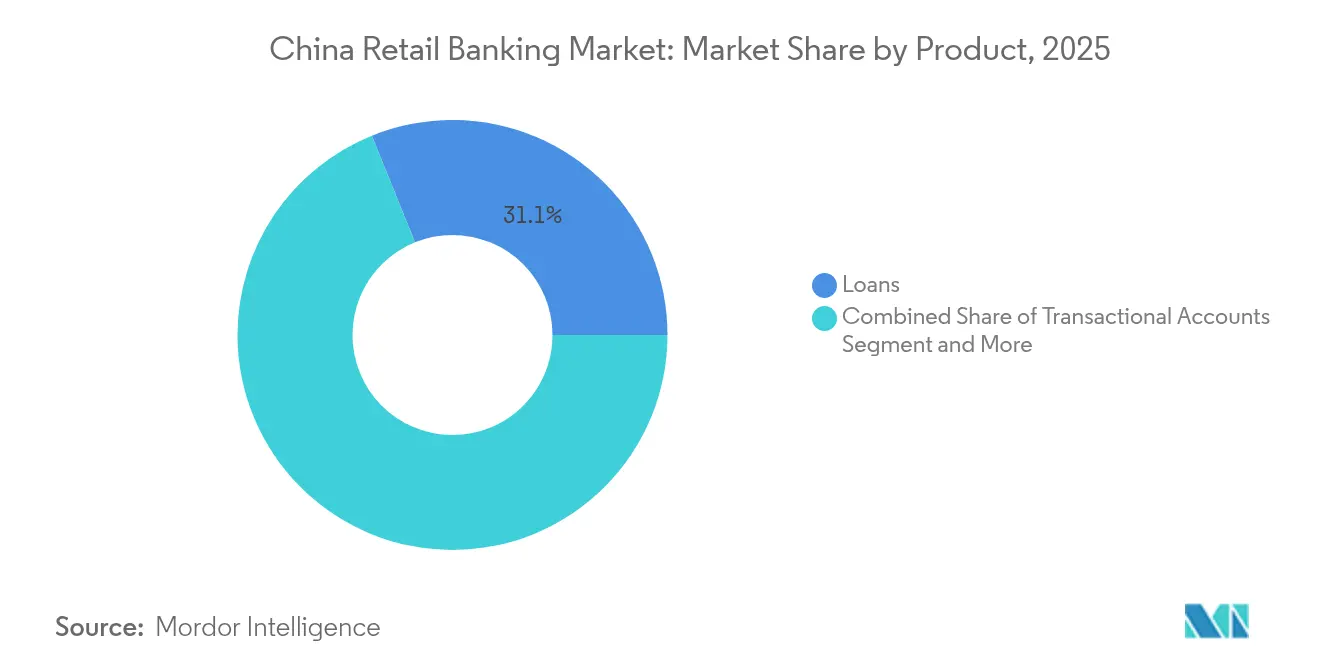
The loans segment contributed 31.12% to China's retail banking market share in 2025 and remains the primary earnings engine even as digital competition rises. Mortgage growth cooled with property-sector stress, yet mortgages still anchor relationship banking by generating stable funding and cross-sell flows. Rural revitalization policies push consumption and agricultural loans, while green lending balances jumped to CNY 30.1 trillion in 2024. Major banks package carbon-reduction mortgages that offer rate discounts when homes meet efficiency benchmarks, aligning product design with national sustainability goals.
Credit cards, though smaller in absolute volume, are projected to record a 8.95% CAGR, making them the fastest expanding line within China's retail banking market. Digital-issuance journeys now take under five minutes with near-instant biometric verification, sharply reducing acquisition costs. Revolving-credit margins offset interchange pressure from super-apps, and gamified cashback schemes resonate with digital natives. Savings and current accounts continue to anchor deposit franchises but face leakage to money-market funds marketed inside super-apps. As yields stay compressed, fee-bearing bundles that include wealth portals and lifestyle perks maintain account stickiness.

By Channel: Digital Dominance Reshapes Distribution
Online channels captured 64.02% of the market share in 2025, and mobile sessions eclipse desktop use by a five-to-one ratio. Industrial and Commercial Bank of China reported 260 million active mobile users, showing the centrality of handheld devices to customer engagement. Branch networks are being retooled into advisory lounges that focus on complex wealth and SME financing discussions rather than routine cash handling. Self-service kiosks and AI chatbots migrate simple service tasks out of branches, lowering cost-to-serve across China's retail banking market.
Offline distribution still matters for trust-building in high-ticket wealth or mortgage consultations. Large state-owned banks deploy smaller “light” outlets in remote towns to satisfy inclusion targets while avoiding full-service overhead. Fintech adoption has created a substitution effect for teller-based transactions in saturated metros and a complementary role in under-banked counties, illustrating a nuanced geographic interplay. The hybrid model balances digital convenience with human reassurance, keeping retention high among older customers and mass affluent segments.
By Customer Age Group: Demographic Shifts Drive Strategy
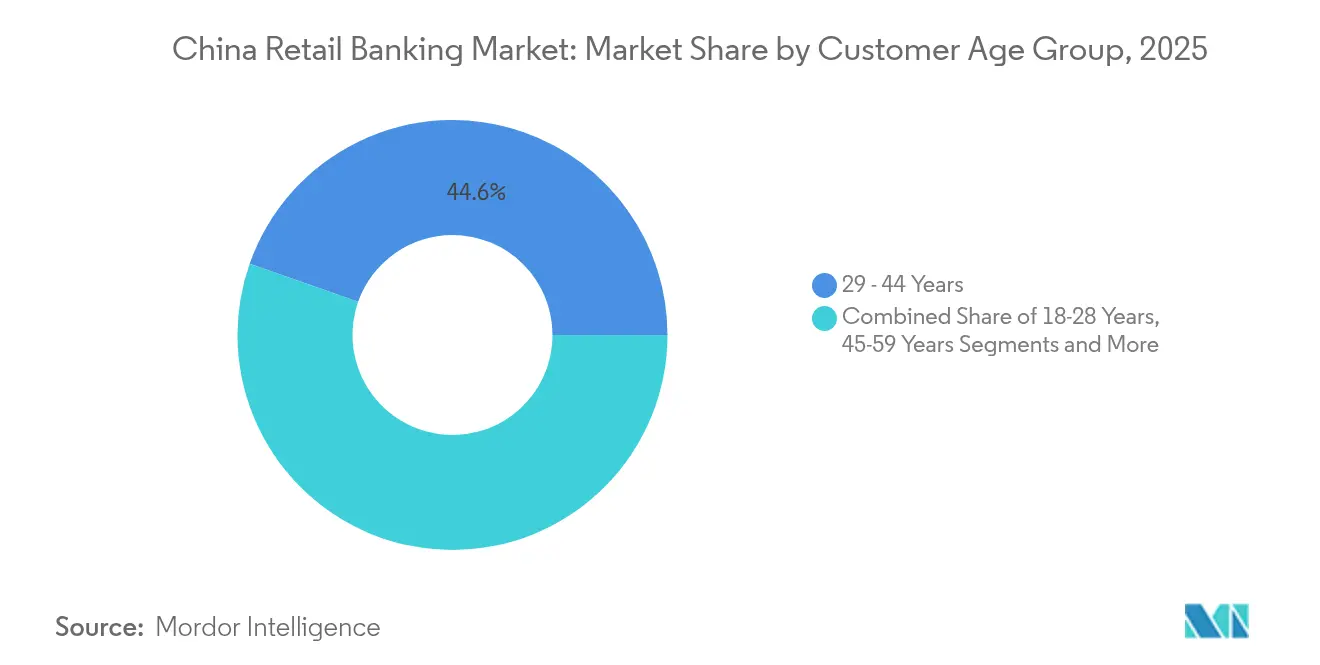
The 29-44 demographic held 44.62% of the China retail banking market size in 2025 and anchors profitability due to multi-product uptake covering housing, education, and investment needs. Banks segment this cohort further by life-stage triggers such as childbirth or entrepreneurship, pushing tailored bundles that combine insurance, loans, and asset-management plans. Digital service expectations are high, but personal advisory still influences complex decisions such as overseas education funding.
Youth aged 18-28 represent the fastest-growing slice, expanding at 9.55% CAGR through 2031. These digital natives open accounts entirely online, use QR codes for daily spend, and gravitate toward buy-now-pay-later modules embedded in e-commerce checkouts. Gamified savings pots and social-media badges boost engagement, while micro-investment features introduce wealth habits early. Banks that master personalized nudges and zero-fee student cards win early mind-share, laying the foundation for future wallet-share as incomes rise.
By Bank Type: National Champions Face Digital Challengers
National players controlled 67.15% of the China retail banking market in 2025, leveraging extensive branch grids and privileged policy roles. They channel significant credit toward strategic sectors and rural revitalization, reinforcing systemic importance. To stay relevant, these incumbents invest heavily in proprietary cloud cores and AI-driven risk engines that shorten loan approvals.
Neobanks clock an 11.05% forecast CAGR and carve niches with fee-free accounts, AI chatbots, and algorithmic credit scoring. Backed by tech giants, they deploy super-app distribution that on-boards customers in seconds and cross-sells merchant services. Regional banks adopt a hyper-local angle, emphasizing community ties and supply-chain finance for local SMEs. Cooperative models emerge as smaller lenders plug into open APIs from large banks, gaining scale in payments while retaining brand identity. The coexistence of these models enriches product diversity and accelerates digital standards across the China retail banking market.
Geography Analysis
Eastern coastal provinces, particularly the Yangtze and Pearl River Deltas, host the most mature slice of the China retail banking market. Urbanization reached 67.00% in 2024, and disposable incomes exceed the national average, fueling sophisticated demand for wealth management and foreign-currency services. Digital adoption is near universal in top-tier cities where mobile payments dominate daily life, and super-app ecosystems generate intense rivalry for customer attention.
Central provinces represent a second-wave growth corridor as inland city clusters industrialize and household incomes rise. Government stimulus funnels infrastructure spending into these regions, spurring SME formation and consumer-credit appetite. Banks strengthen branch-plus-digital hybrids here, pairing local relationship managers with mobile self-service platforms to expand reach cost-effectively. The China retail banking market experiences rapid gains in these zones, particularly in small-ticket consumer loans and first-time investment products.
Western and remote areas remain the frontier for inclusion. Sparse populations once made full branches uneconomic, yet satellite broadband and 5G are changing the equation. Village banks and fintech partnerships deliver micro-savings accounts and agricultural loans via simplified mobile apps. Regulatory subsidies lower network-deployment costs, and biometric KYC removes paperwork barriers for residents lacking traditional IDs. Successful penetration of these territories could add millions of new accounts, materially lifting the overall China retail banking market size.
Regulatory Landscape
China retail banking operates under a consolidated supervisory model led by the National Financial Regulatory Administration (NFRA) for banking and insurance, while the People’s Bank of China (PBOC) oversees monetary policy and core payment-system infrastructure. NFRA’s Financial Institutions Product Suitability Management Measures, effective February 1, 2026, are a near-term compliance anchor, requiring dynamic product risk rating and investor classification across retail distribution, including digitally originated sales.
Digital customer acquisition and product sales face tighter governance in 2026 through the Financial Product Online Marketing Management Measures (Announcement No. 9), issued on April 21, 2026 and implemented on September 30, 2026, tightening conduct standards for online marketing of financial products. At the framework level, the July 2024 Third Plenary Session decision called for integrating all financial activities into regulation and advancing a unified Financial Law. This was followed by the March 20, 2026 release of the Financial Law (Draft) for public comment by relevant authorities (including PBOC, NFRA, CSRC, and SAFE), signaling a push toward comprehensive legal coverage and clearer firewalls between industrial and financial capital.
Value Chain Analysis
China’s retail banking value chain starts with funding and balance-sheet inputs, including retail deposits, interbank funding, and capital instruments. It then proceeds through product origination (deposit and card issuance, consumer and mortgage lending, and wealth-linked savings products), underwriting and risk management, and finally distribution via bank apps, super-app ecosystems, and physical advisory outlets. PBOC-run payment rails and identity/KYC workflows sit alongside the chain as core infrastructure and compliance enablers, while NFRA conduct rules shape product suitability, disclosures, and marketing practices for both banks and regulated neobanks.
The ecosystem layer extends beyond banks to include fintech and platform partners that provide data, customer journeys, and merchant touchpoints. Partnerships connecting banks with core enterprises and platform transaction data support automated credit decisioning and supply-chain style consumer and SME adjacency offerings. At the same time, margin pressure and capital requirements, including TLAC-related buffers highlighted in the report context, are pushing institutions toward fee-based services and more capital-efficient structures. Bottlenecks are concentrated in regulatory tightening around consumer protection and lending cost transparency, cybersecurity controls for API-based integration, and the need to modernize legacy cores to support open-banking style collaboration without increasing operational risk.
Competitive Landscape
Four state-owned giants—ICBC, CCB, ABC, and BOC—account for a significant share of total banking assets, making the market structurally concentrated. Their scale affords funding cost advantages and positions them as primary conduits for policy lending. To counter digital disintermediation, each has launched proprietary super-apps, rolled out voice assistants, and migrated core systems to cloud-native stacks.
Mid-tier joint-stock and city commercial banks differentiate through regional specialization and niche verticals such as supply-chain finance for local manufacturers. Capital constraints limit expansive tech investment, so many subscribe to banking-as-a-service platforms that provide digital wallets, robo-advice, and risk models on demand. Strategic alliances with fintechs accelerate product cycles, allowing mid-tiers to defend share in the China retail banking market without large capex.
Neobanks backed by internet titans leverage vast social and e-commerce ecosystems to amass customers at low marginal cost. AI-driven credit engines enable near-instant micro-loans, and open-loop QR payment rails encourage embedded finance starts. They are moving upstream into wealth and SME lending, challenging incumbents beyond entry-level accounts. The competitive mix elevates customer expectations for seamless, contextual, and personalized services across the China retail banking market.
China Retail Banking Industry Leaders
-
Industrial and Commercial Bank of China Ltd.
-
China Construction Bank Corp.
-
Agricultural Bank of China Ltd.
-
Bank of China Ltd.
-
Bank of Communications Co., Ltd.
- *Disclaimer: Major Players sorted in no particular order
Market Opportunities and Future Outlook
Near-term opportunity areas center on compliant digital distribution and governance upgrades as regulators formalize rules for product suitability and online marketing. With NFRA product suitability measures effective February 1, 2026 and online financial product marketing measures implementing on September 30, 2026, banks have room to differentiate through stronger risk profiling, clearer disclosures, and controlled third-party distribution workflows inside mobile channels. The report’s shift toward open-banking APIs and biometric onboarding also points to faster acquisition and more modular product delivery, provided conduct controls stay tight.
A second opportunity set is policy-aligned retail propositions that map to national priorities such as green and inclusive finance. Banks can use their distribution scale and data to originate smaller-ticket loans profitably, but the model depends on low-cost servicing. In-market evidence includes the report’s green lending reference, with green-loan balances reaching CNY 30.1 trillion in 2024, and the rural inclusion push via village banks and digital channels, which expands the addressable base while requiring tighter cost management. Banks can also deepen ecosystem integration with Alipay and WeChat Pay, where 2024 mobile-platform transaction volumes exceeded USD 12.8 trillion and the two platforms captured about 90% of flow. For institutions that structure embedded journeys in a compliant way, this supports a clearer channel-access and data advantage than relying only on standalone bank apps.
Recent Industry Developments
- April 2026: Industrial and Commercial Bank of China Ltd. received approval from the National Financial Regulatory Administration to issue capital instruments and TLAC non-capital debt instruments totaling RMB 800.0 billion. The authorization supports capital and loss-absorbing capacity planning under tighter buffer requirements, helping sustain retail asset growth while meeting prudential constraints.
- April 2025: The Chinese government injected RMB 520 billion into major banks, including ICBC and Agricultural Bank of China, to offset property-sector stress, while Bank of China and China Construction Bank raised additional equity. The recapitalization strengthened system stability and protected retail credit transmission at a time of heightened balance-sheet pressure.
- December 2024: The National Development and Reform Commission tightened foreign-debt approvals, affecting large syndicated financing activity such as a reported RMB 75 billion loan for Guangzhou Metro Group. Tighter external debt scrutiny can influence banks’ funding and risk appetite, indirectly shaping retail pricing and liquidity management priorities.
Research Methodology Framework and Report Scope
Market Definition and Coverage
For this methodology, the China retail banking market is counted as the fee and interest income earned from individual customers through core retail products offered by licensed banks and regulated neobanks in mainland China.
Scope exclusions: corporate and investment banking income, and offshore-booked income that is not recorded in mainland China, are excluded from this market sizing.
Segmentation Overview
- By Product
- Transactional Accounts
- Savings Accounts
- Debit Cards
- Credit Cards
- Loans
- Other Products
- By Channel
- Online Banking
- Offline Banking
- By Customer Age Group
- 18-28 Years
- 29-44 Years
- 45-59 Years
- 60 Years and Above
- By Bank Type
- National Banks
- Regional Banks
- Neobanks & Others
Data Sources, Market Sizing, and Validation
Desk Research
Desk work starts with building a clean fact base for how retail banking revenues are formed in China, and where they are reported consistently. We use public statistics and releases such as the People's Bank of China, the National Financial Regulatory Administration, the National Bureau of Statistics of China, and BIS indicators to align on deposits, household credit, and interest rate conditions.
Next, annual reports and investor presentations of banks operating in China are reviewed to understand revenue mix, loan and deposit trends, and channel shifts. Supporting checks come from sources such as IMF data series, World Bank indicators, and peer-reviewed finance journals that explain structural changes like digital onboarding and consumer credit behavior. When needed, our model is cross-checked using paid subscriptions for company financials and intelligence, news and financials, and patent databases to verify timelines and product rollout signals. These desk sources are illustrative, and many other public materials were also used for collection, validation, and clarification.
Primary Interviews and Surveys
Primary work is used to pressure-test assumptions that desk sources do not fully settle, such as typical pricing spreads, product take-up by customer cohort, and the pace of mix shift from branch-led to app-led origination. We spoke with banking executives, product and risk leaders, and operational managers across major provinces to validate the direction of household deposit behavior, retail credit appetite, and fee income resilience under different rate environments.
Distribution of primary research fieldwork respondents
| Company type | Respondent position |
|---|---|
| Top tier: 38% | CXOs: 12% |
| Mid tier: 45% | Functional/Unit leaders: 31% |
| Smaller Players: 17% | Managers: 57% |
Market-Sizing & Forecasting
Market sizing is built using a top-down model that reconstructs the retail banking revenue pool from system-level signals and then allocates it to retail product lines. In practice, we start from reported banking income and balance metrics, and then filter down using retail-linked indicators so only household-driven activity remains at the end.
Key inputs include household deposit outstanding, household loan and mortgage outstanding, effective interest rate and margin movement, payment card and account usage intensity, and the share of digital origination that can change cost and fee profiles. Since each input moves differently across rate cycles, the model is kept flexible, so the revenue impact can be traced to a small set of drivers.
To corroborate totals, selective bottom-up approximations are run using sampled bank disclosures, typical spreads, and volume proxies, which helps adjust for gaps where income lines are bundled in reporting. For forecasting, multivariate regression is used because it links revenue progression to rates, household credit growth, and deposit formation, and then scenario checks are applied when policy or macro conditions shift quickly.
Data Validation & Update Cycle
Validation is done through triangulation across independent signals, and then reviewed again through variance checks at the product and total-market level. If a metric moves in a way that breaks historical relationships, the driver is rechecked and the assumption is revisited, followed by targeted re-contact with industry participants when the change looks structural.
Before sign-off, the model goes through a multi-step analyst review so calculation logic, units, and year alignment stay consistent. The report is refreshed annually, and interim updates are triggered when material events occur, such as major policy changes, rate shifts, or reporting revisions. Right before delivery, a final pass is completed so clients receive the latest updated view.
Mordor Intelligence's China Retail Banking Market Estimate Compared With Other Published Estimates
Published market sizes for China retail banking can look far apart because different studies do not always measure the same thing. In our experience, the main reasons are whether the value is based on revenue or on balance sheet totals, how strictly geography is treated, and how consistently product lines are separated.
Household deposit and loan trends, together with reported interest and fee income patterns in regulated filings, are the checks that keep Mordor Intelligence's estimate tied to a revenue pool that is generated by retail customers inside mainland China. When those evidence signals are not used, some estimates can unintentionally drift toward counting assets, transactions, or broader banking income that is outside the intended retail boundary.
Benchmark comparison
| Source | Market Size | Gaps in Research Methodology |
|---|---|---|
| Mordor Intelligence | USD 397.40 B (2025) | |
| Industry Databook A | USD 170.50 B (2024) | Uses an earlier base year and a narrower revenue capture that is organized mainly by bank type, which can miss parts of retail fee income when products are reported under broader banking lines. |
| Global Consultancy B | USD 18.50 T (2024) | The value appears to be defined closer to assets or a broad value proxy because the scale is in trillions, and the scope language does not clearly separate revenue from balances, which inflates comparability against a revenue-based retail banking definition. |
Taken together, the spread mostly comes down to what is being measured and how strictly the retail boundary is applied. By keeping the unit as retail-generated fee and interest income and by aligning drivers to deposits, household credit, and rate conditions, we end up with a market total that can be traced back to clear inputs and repeated in future updates.
Key Questions Answered in the Report
What is the current size of the China retail banking market?
The market stands at USD 428.24 billion in 2026 and is projected to grow to USD 622.04 billion by 2031.
Which product segment is the largest within China’s retail banking?
Loans dominate with a 31.12% market share in 2025, driven mainly by mortgages and inclusive-finance lending.
How fast is online banking growing in China?
Online channels already handle 64.02% of revenue and are forecast to expand at a 10.35% CAGR through 2031.
Which customer group is expanding fastest?
The 18-28 age cohort is growing at a 9.55% CAGR, propelled by digital-first banking habits and rising incomes.
What impact do super-apps have on traditional banks?
Super-apps like Alipay and WeChat Pay erode fee income and intercept customer relationships, reducing bank margins and forcing deeper digital integration.
How significant is green finance in Chinese retail banking?
Major banks reported green-loan balances rising more than 20% in 2024, underscoring sustainable lending as a key growth theme.