
Market Overview
| Study Period | 2020 - 2031 |
|---|---|
| Forecast Data Period | 2026 - 2031 |
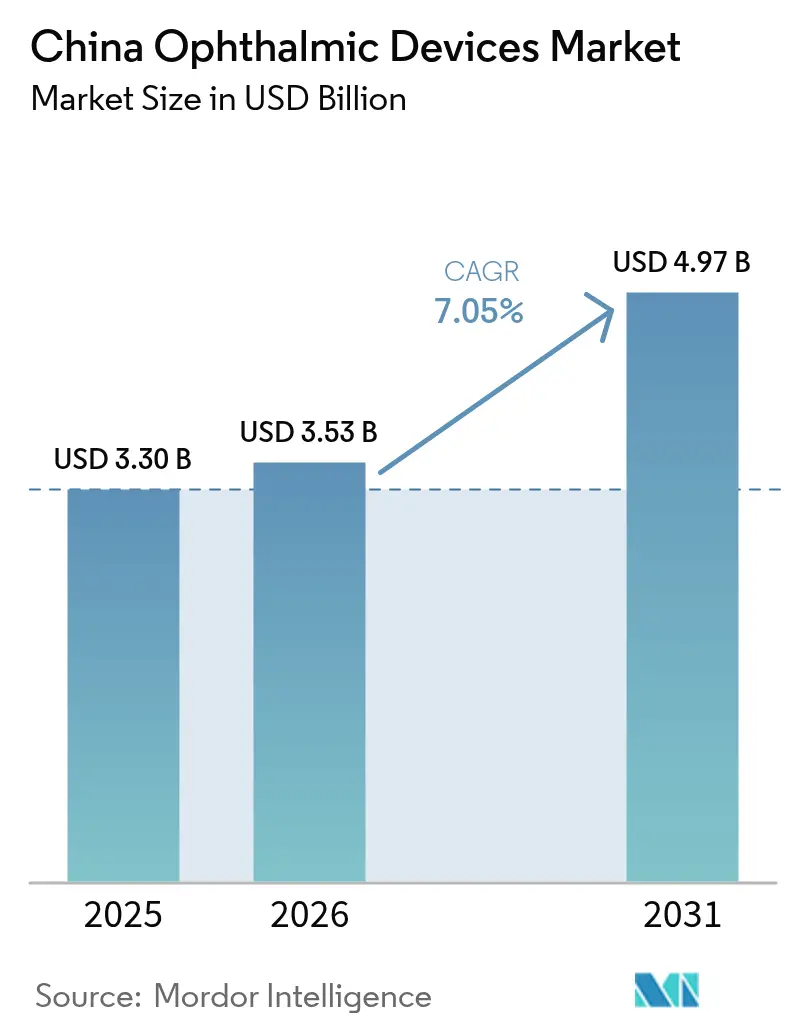
| Base Year Market Size (2025) | USD 3.30 Billion |
| Market Size (2026) | USD 3.53 Billion |
| Market Size (2031) | USD 4.97 Billion |
| Growth Rate (2026 - 2031) | 7.05 % |
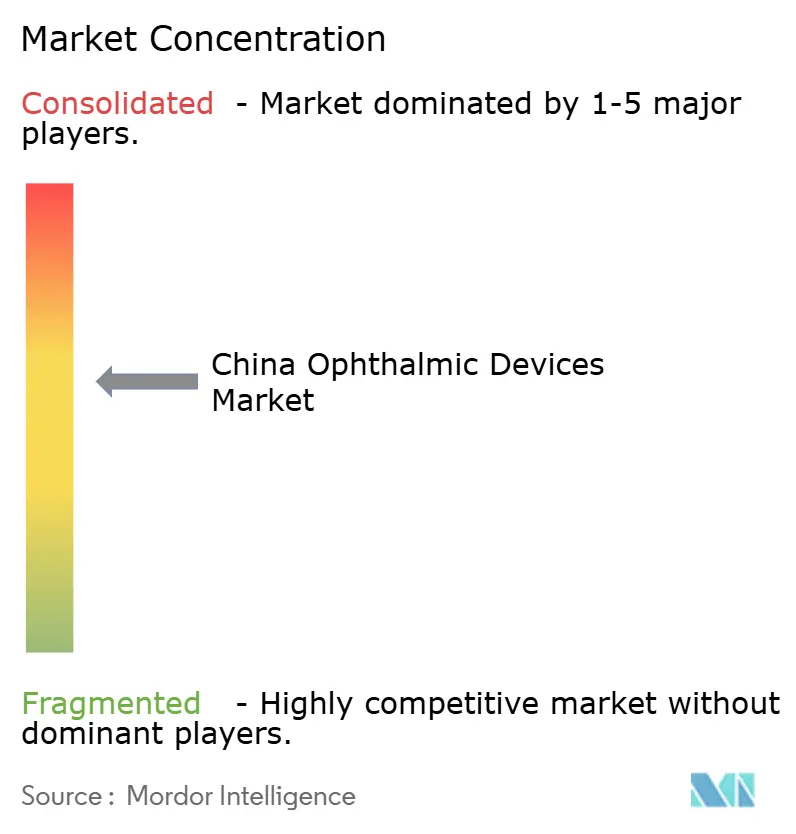
| Market Concentration | Medium |
Major Players *Disclaimer: Major Players sorted in no particular order Image © Mordor Intelligence. Reuse requires attribution under CC BY 4.0. | |
China Ophthalmic Devices Market Analysis by Mordor Intelligence
China ophthalmic devices market size in 2026 is estimated at USD 3.53 billion, growing from 2025 value of USD 3.30 billion with 2031 projections showing USD 4.97 billion, growing at 7.05% CAGR over 2026-2031. Demographic ageing, a steep rise in juvenile myopia and a national cataract-reimbursement program are enlarging procedure volumes, while government-run bulk-buy auctions propel domestically engineered imaging, surgical and vision-care products into mainstream procurement. Hospitals facing tariff-inflated import prices now trial Chinese premium lasers that meet global accuracy thresholds, accelerating import substitution and diversifying supply. In parallel, private eye-care chains are equipping Tier-II and Tier-III cities with turnkey diagnostic suites, widening geographic coverage and reinforcing the China ophthalmic devices market’s momentum through the decade.
Key Report Takeaways
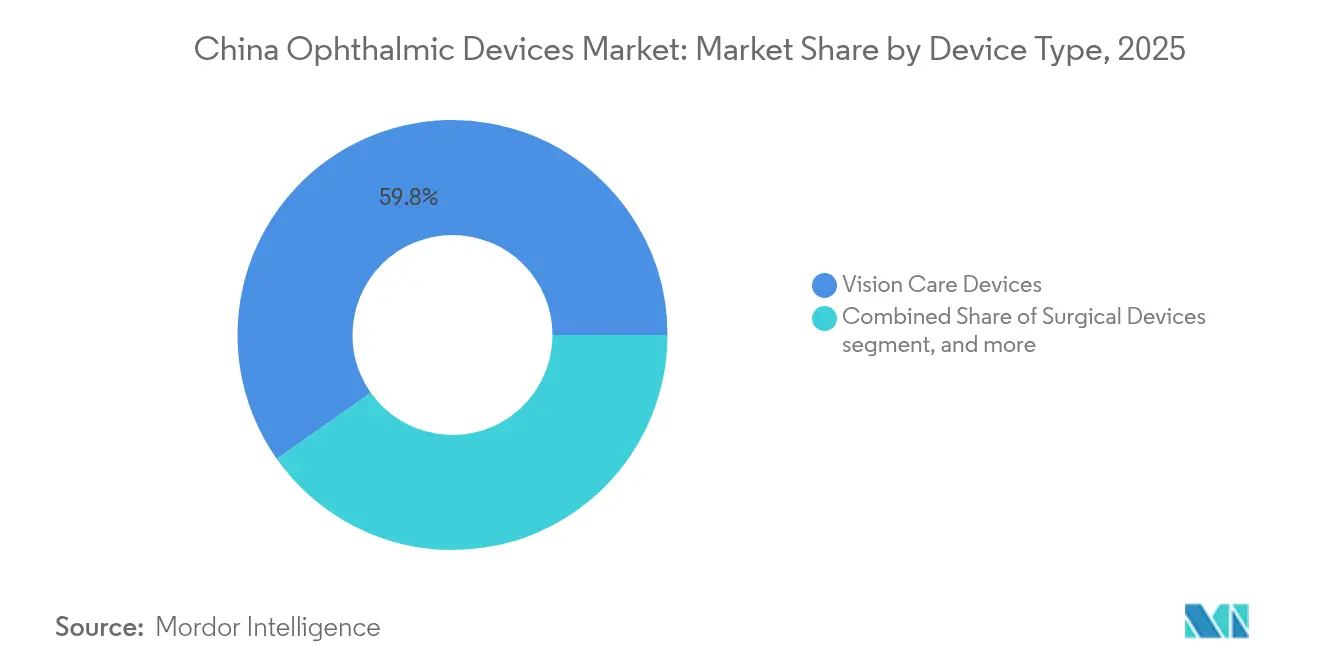
- By device type, vision care held 59.78% of the China ophthalmic devices market share in 2025; diagnostic and monitoring devices are projected to grow at a 9.68% CAGR to 2031.
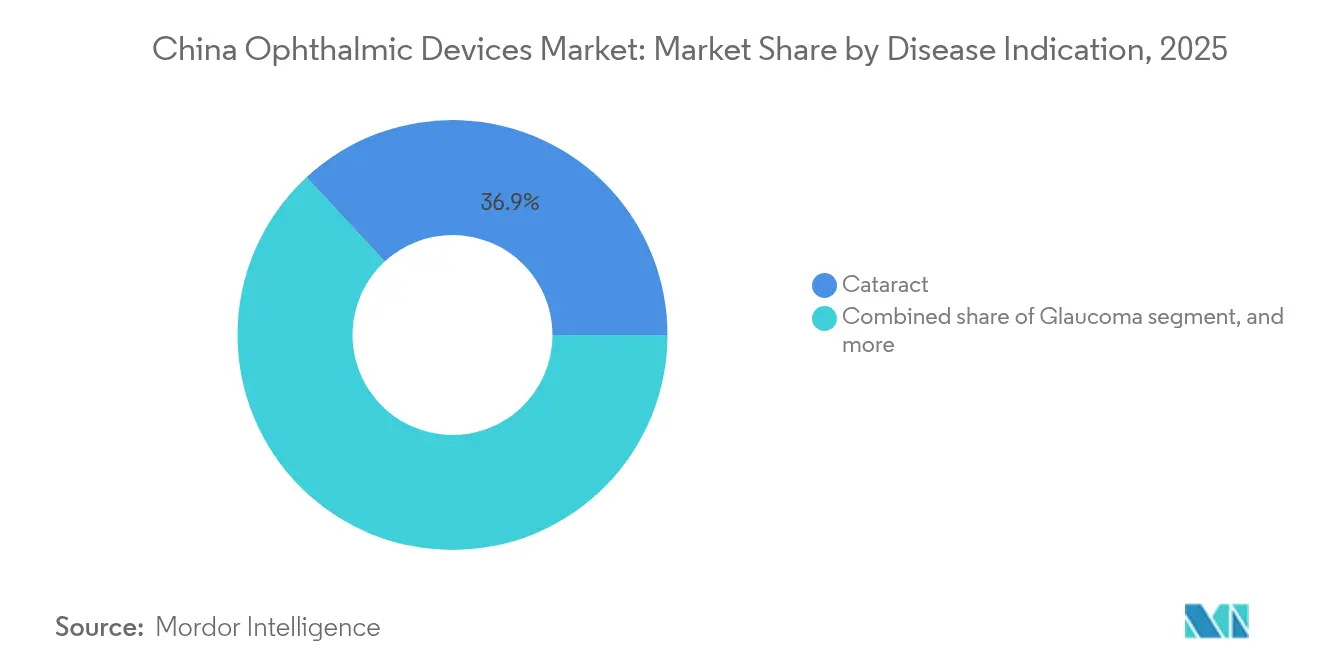
- By disease indication, cataract accounted for a 36.88% share of the China ophthalmic devices market size in 2025, while diabetic retinopathy is set to expand at a 10.56% CAGR through 2031.
- By end-user, hospitals dominated with 43.62% revenue in 2025, whereas ambulatory surgery centers are expected to post a 7.21% CAGR between 2026 and 2031.
Note: Market size and forecast figures in this report are generated using Mordor Intelligence’s proprietary estimation framework, updated with the latest available data and insights as of 2026.
Market Trends and Insights
Drivers Impact Analysis of China Ophthalmic Devices Market*
| Driver | % Impact on CAGR Forecast | Geographic Relevance | Impact Timeline |
|---|---|---|---|
| Rapid urban myopia surge among Chinese youth | +1.4% | Tier-I & Tier-II cities | Medium term (2-4 years) |
| Government-led cataract surgery reimbursement expansion | +1.2% | Nationwide | Long term (≥ 4 years) |
| Growing private eye-care chain investments in Tier-II & III cities | +0.9% | Tier-II & Tier-III cities | Medium term (2-4 years) |
| Aging-related cataract & glaucoma incidence spike in coastal provinces | +0.8% | Coastal provinces | Long term (≥ 4 years) |
| AI-enabled screening kiosks adoption by community hospitals | +0.7% | County-level & community hospitals | Short term (≤ 2 years) |
| NMPA fast-track approvals for innovative ophthalmic implants | +0.5% | Nationwide | Short term (≤ 2 years) |
| Source: Mordor Intelligence | |||
Rapid Urban Myopia Surge Transforms Device Demand
Escalating juvenile myopia has reoriented family spending from basic spectacles toward premium screening and treatment, lifting high-margin segments inside the China Ophthalmic Devices market. National-Medical-Products-Administration-cleared phakic intraocular lenses now extend surgical correction to teenagers, evidencing a leap from adult-only procedures[1]. Community clinics deploy AI fundus cameras with >95% diagnostic accuracy, accelerating early detection and feeding referrals into surgical hubs. Parents increasingly choose daily disposable lenses promising axial-elongation control, boosting retailer revenue and sustaining demand for axial-length biometers that track therapy outcomes. Shorter innovation cycles in diagnostic software drive system upgrades ahead of hardware depreciation, reinforcing repeat-purchase behaviour.
Government-Led Cataract Surgery Reimbursement Expansion
National reimbursement doubled cataract surgeries in five years, elevating use of viscoelastics, phaco handpieces and intraocular lenses. Budget certainty prompts hospitals to replace aging consoles with femtosecond platforms that lower complication rates, confident that higher capital outlays are offset by guaranteed case volumes[2]. Bulk-buy tenders favour domestic consumables meeting price ceilings, anchoring a long-run revenue engine for the China Ophthalmic Devices market. Suppliers bundling capsulotomy add-ons and single-use packs gain advantage by compressing turnover times and operating-room staffing.
Private Eye-Care Chain Investments in Tier-II & III Cities
Chain operators employ a “1 + 8 + N” hub-and-spoke expansion, whereby each flagship tertiary hospital anchors multiple satellite clinics, each requiring autorefractors, slit-lamps and fundus suites. Foreign-funded hospitals entering pilot zones raise base diagnostic specifications, forcing vendors to include maintenance, training and inventory pooling in bids. Nationwide contracts reward suppliers with dense service footprints, enhancing the China Ophthalmic Devices market’s scale outside metropolitan cores.
Ageing-Related Cataract & Glaucoma Incidence Spike
Coastal provinces show the fastest growth in populations aged ≥55, lifting cataract and glaucoma caseloads. Hospitals compressed inpatient stays via day-surgery pathways, selecting compact phaco consoles and portable microscopes that fit small theatres. Glaucoma specialists adopt minimally invasive canaloplasty tools that shorten case time, supporting higher daily throughput. Community centers prioritise optic-nerve OCT in suburban screening camps, spreading advanced imaging across lower-tier facilities.
Restraints Impact Analysis of China Ophthalmic Devices Market*
| Restraints Impact Analysis | (~) % Impact on CAGR Forecast | Geographic Relevance | Impact Timeline |
|---|---|---|---|
| Shortage of fellowship-trained ophthalmic surgeons in inland China | –0.7% | Inland provinces | Short term (≤ 2 years) |
| High import tariffs on premium surgical lasers | –0.5% | Nationwide | Medium term (2-4 years) |
| Price-sensitive public hospital procurement auctions | –0.6% | Nationwide | Short term (≤ 2 years) |
| Counterfeit diagnostic hand-helds in informal distribution channels | –0.4% | Rural areas & informal marketplaces | Medium term (2-4 years) |
| Source: Mordor Intelligence | |||
Shortage of Fellowship-Trained Ophthalmic Surgeons
Surgeon-to-population ratios lag national targets in inland counties, capping surgical throughput despite equipment availability. Provincial grants subsidise AI-triage kiosks that refer only confirmed cases to city hospitals, easing workload but constraining adoption of complex vitreoretinal platforms. Training partnerships mandate donation of simulation systems, boosting capital equipment sales in teaching centres yet not fully eliminating the manpower bottleneck that tempers China Ophthalmic Devices market growth.
High Import Tariffs on Premium Surgical Lasers
Successive tariff rounds inflate landed costs on imported femtosecond and excimer lasers, narrowing their cost-benefit margin in public tenders. Domestic OEMs unveil 1 000 Hz ablation systems meeting global benchmarks, capturing pilots and extending supply contracts once clinical outcomes hold steady[3]. Some multinationals re-assemble units in bonded zones to mitigate duties, but transition delays widen the substitution window for local competitors.
*Our forecasts treat driver/restraint impacts as directional, not additive. The impact forecasts reflect baseline growth, mix effects, and variable interactions.
China Ophthalmic Devices Market Segment Analysis
By Device Type:
Domestic Diagnostics Disrupt Import DominanceDiagnostic & Monitoring devices represented 23.62% of the 2025 China Ophthalmic Devices market size and are expected to compound at 9.68%CAGR to 2031. Local suppliers now install more than half of OCT workstations in county hospitals, buoyed by AI modules that allow technicians to deliver referral-ready reports without specialist oversight. Faster software release cycles persuade facilities to refresh equipment ahead of depreciation schedules, lifting replacement revenue. Vision Care remains the largest slice at 59.78%, driven by daily disposable silicone-hydrogel lenses that benefit from e-commerce penetration. Surgical devices contribute 16.60% and gain from bulk tender guarantees that underpin cataract lens offtake, while ambulatory centres purchase phaco consoles with integrated capsulotomy to minimize theatre time.

By Disease Indication:
Myopia Management Drives InnovationMyopia solutions constitute 32.58% of the 2025 China Ophthalmic Devices market size and carry a 8.74%CAGR forecast through 2031, propelled by ortho-k lenses, atropine therapy and axial-length tracking tools bundled into integrated practice platforms. Cataract remains dominant at 36.88% and grows at 6.85%CAGR on the back of reimbursement and extended life expectancy. Diabetic-retinopathy devices, though smaller, post an 10.56%CAGR as hand-held fundus cameras linked to cloud AI enable rural screening and trigger follow-up laser interventions.
By End-User:
Ambulatory Centres Reshape Care DeliveryAmbulatory Surgery Centres (ASCs) accounted for 28.74% China ophthalmic devices market share in 2025 and are forecast to deliver an 7.21%CAGR through 2031 as regulators mandate that day-surgery constitute 60% of elective ophthalmic procedures. Rising throughput pushes operators to favour compact phaco consoles, refractive-laser suites and vitrectomy units that maintain sterility in small, high-turnover theatres. Suppliers strengthen bids by offering leasing, pay-per-use and managed-service contracts that align equipment costs with procedure revenue, a model that lowers entry barriers for independent chains eager to expand into Tier-III cities.
Hospitals retained 43.62% of China ophthalmic devices market size in 2025, largely because complex vitreoretinal and corneal graft cases still centralise around tertiary centres able to invest in intraoperative OCT, 3-D heads-up microscopes and hybrid laminar-flow theatres. Management teams expand simulation labs to accelerate resident training and shorten credentialing timelines, thereby boosting demand for trainer-configured microscopes and practice phaco units. Specialty ophthalmic clinics hold the remaining share and scale through franchise templates that pre-specify autorefractors, slit-lamps and visual-field analysers, giving manufacturers predictable refresh cycles tied to centrally negotiated replacement windows.
Geography Analysis
Eastern coastal provinces contributed more than half of the China ophthalmic devices market size in 2025 and continue to set the technology agenda with early uptake of femtosecond cataract platforms and multifocal intraocular lenses, reflecting patient readiness to self-fund premium outcomes. Urban hospitals integrate AI screening into electronic medical record ecosystems and link imaging archives to provincial cloud platforms, accelerating replacement of legacy fundus cameras with smart systems that meet cybersecurity standards. In parallel, 5 G roll-outs enable real-time surgical mentoring, reinforcing the referral magnetism of coastal centres and sustaining incremental equipment demand.
Tier-II and Tier-III cities exhibit the fastest 8.73%CAGR through 2031, propelled by municipal subsidies that underwrite private-chain clinic construction. Local authorities exchange rent concessions for commitments to train community optometrists, sparking cluster orders for turnkey diagnostic packages of autorefractors, slit-lamps, tonometers and portable OCT workstations. Equipment makers win contracts by bundling cloud telemetry, remote troubleshooting and shared-inventory depots that minimise downtime in geographies with fragmented service coverage. These measures close the technology gap between metropolitan and mid-sized cities, deepening the China Ophthalmic Devices market.
Rural counties still lag specialist coverage but progress through mobile outreach programs that deploy vans equipped with dust-proof, battery-backed fundus cameras, slit-lamps and autorefraction kiosks. Provincial tele-medicine grants link these units to tertiary reading centres, creating a pipeline of surgically eligible patients routed toward county hubs. Over time, rising referral volumes justify investments in compact phaco consoles, single-use surgical packs and pre-loaded intraocular lenses optimized for resource-constrained settings. The bottom-up expansion narrows urban–rural care gaps and seeds long-run growth for the China Ophthalmic Devices market.
Regulatory Landscape
Ophthalmic devices and device-drug combination products in China are regulated by the National Medical Products Administration (NMPA), with combination products governed by a Primary Mode of Action (PMOA) determination framework under NMPA Notice No. 52 (2021). Where the lead mode of action is unclear, sponsors can seek an official attribute determination managed by the NMPA Center for Medical Device Standards Management (CMDSM), which reviews dossiers covering composition, combination method, dosage, and evidence on the regulatory status of component parts in China or the country of origin.
CMDSM published attribute determination results for June 1, 2025, to May 31, 2026, covering 99 products, with outcomes including 51 classified as device-led combinations and 18 as drug-led combinations, while others were categorized outside the combination-product pathway (26 as drugs and 4 as medical devices). This increases the execution importance of PMOA-aligned development and labeling strategies for ophthalmic products that incorporate pharmaceutical ingredients (for example, lidocaine or growth factors), since misclassification can trigger supplemental evidence requests and extend registration timelines.
Competitive Landscape
Competitive balance in the China ophthalmic devices market has shifted toward domestic innovators after 121 high-end devices received National Medical Products Administration clearance over the last 24 months, ensuring home-grown options in segments once dominated by imports. Policy guarantees that at least one domestic brand receives a tender slot in every bulk-procurement round deliver baseline volumes that de-risk R&D spending and motivate venture investors to keep funding iterative upgrades.
Global incumbents retain strongholds in premium refractive lasers and advanced vitreoretinal platforms, yet tariff escalations continue to compress imported average selling prices. Carl Zeiss Meditec answered by acquiring Dutch Ophthalmic Research Center to bolster its surgical-device mix and by localising cloud-based software upgrades that add intraoperative imaging functions without hardware swaps. Alcon partnered with Shanghai-based service providers to reduce spare-part lead times, a move aimed at protecting hospital renewals even as bulk-buy committees scrutinise total lifecycle cost.
Emerging Chinese companies specialise in unmet niches such as phakic intraocular lenses for high myopia and AI triage platforms for diabetic retinopathy. Eyebright Medical’s Loong Crystal PR lens received Class III approval and is now marketed across major refractive centres. Nova Eye Medical’s iTrack Advance canaloplasty system posted USD 360,000 China sales within one quarter and expanded its Shanghai training hub to support surgeon onboarding. Domestic OEMs also unveil 1,000 Hz femtosecond prototypes, leveraging local supply chains to accelerate iteration cycles and erode the remaining import premium in laser refractive surgery.
China Ophthalmic Devices Industry Leaders
-
Alcon Inc.
-
Johnson & Johnson Vision Care Inc.
-
Carl Zeiss Meditec AG
-
Bausch + Lomb Corp.
-
Topcon Corp.
- *Disclaimer: Major Players sorted in no particular order
China Ophthalmic Devices Market Companies Covered in this Report
- Alcon
- Johnson & Johnson
- Carl Zeiss
- Bausch + Lomb Corp.
- HOYO Corporation
- Nidek
- Topcon Corp.
- Lumenis
- Mindray Bio-Medical Electronics Co., Ltd.
- Shenzhen Certainn Technology Co., Ltd.
- Brighten Optix Corp.
- Shanghai Haohai Biological Technology Co., Ltd.
- Kanghua Ruiming Medical (VisionStar)
- Oculus
Market Opportunities and Future Outlook
Procurement and care-delivery shifts continue to open whitespace for suppliers that can bundle hardware, software, and service at scale across public hospitals, ambulatory surgery centers, and expanding private eye-care chains in Tier-II and Tier-III cities. A near-term opportunity is visible in high-throughput refractive and cataract workflows where provider networks standardize platforms across multiple sites, as shown by ZEISS Medical Technology's June 2026 strategic agreement with Aier Eye Hospital Group to install 25 VISUMAX 800 femtosecond lasers across the Aier network, which reinforces demand for connected planning, calibration, and lifecycle service capabilities rather than standalone capital sales.
On the regulatory and manufacturing side, whole-life-cycle oversight and manufacturing control tightening creates both compliance work and differentiation space for companies with strong quality systems, local supply resilience, and clinical-evidence generation. Signals on optimized life-cycle regulation for high-end devices (including AI-enabled systems) and the updated implantable-device GMP requirements taking effect in November 2026 raise the focus on traceability, process validation, and supplier control for products such as intraocular lenses, favoring manufacturers and distributors that can provide auditable documentation, stable post-market support, and multi-site training programs to manage surgeon and technician variability.
Recent Industry Developments in China Ophthalmic Devices Market
- June 2026: ZEISS Medical Technology entered a strategic agreement with Aier Eye Hospital Group to install 25 VISUMAX 800 femtosecond lasers across Aier's network. The rollout supports standardized refractive workflows across a large provider chain and increases the importance of integrated service, training, and digital connectivity for high-throughput laser platforms.
- July 2025: Carl Zeiss Meditec received China NMPA approval for the ZEISS PENTERO 800 S surgical microscope, with manufacturing referenced in Suzhou. The approval strengthens ZEISS's ability to compete in hospital operating rooms with locally relevant supply and service footprints as procurement becomes more price and uptime sensitive.
- October 2024: Alcon completed the divestment of China rights for Bion Tears, Tears Naturale, and certain procedural eye drops to OcuMension Therapeutics in exchange for a 16.7% equity stake. The transaction deepens reliance on a domestic commercialization platform and tightens the link between consumables availability and procedure-driven demand in ophthalmology channels.
China Ophthalmic Devices Market Report Scope and Research Methodology
Market Definition and Coverage
This market covers the value of ophthalmic devices sold and used in China for eye diagnosis and monitoring, eye surgery, and vision care, as captured across hospital, clinic, and ambulatory settings.
Scope exclusions: We exclude ophthalmic drugs and purely service-based eye care fees that are not billed as a device.
Segments Covered in This Report
- By Device Type
- Diagnostic & Monitoring Devices
- OCT Scanners
- Fundus & Retinal Cameras
- Autorefractors & Keratometers
- Corneal Topography Systems
- Ultrasound Imaging Systems
- Perimeters & Tonometers
- Other Diagnostic & Monitoring Devices
- Surgical Devices
- Cataract Surgical Devices
- Vitreoretinal Surgical Devices
- Refreactive Surgical Devices
- Glaucoma Surgical Devices
- Other Surgical Devices
- Vision Care Devices
- Spectacles Frames & Lenses
- Contact Lenses
- Diagnostic & Monitoring Devices
- By Disease Indication
- Cataract
- Glaucoma
- Diabetic Retinopathy
- Other Disease Indications
- By End-user
- Hospitals
- Specialty Ophthalmic Clinics
- Ambulatory Surgery Centers (ASCs)
- Other End-users
Data Sources, Market Sizing, and Validation
Desk Research
Desk research was used to build the foundation for the model and to keep assumptions realistic for China. We reviewed public health statistics and procedure context from the National Health Commission of the PRC, the National Bureau of Statistics of China, and the World Health Organization, and then cross-checked trade direction using Chinese customs and import-export publication outputs.
To understand technology adoption and clinical practice shifts, we also referenced peer-reviewed ophthalmology journals on outcomes, major public hospital announcements, and publicly available regulatory and standards information (where available). For pricing and company revenue sanity checks, we used company filings and investor materials, plus a paid subscription focused on company financials and news, followed by selective patent database screening to track device innovation themes. The desk sources listed are illustrative only, and many other public references were also used during data collection, validation, and clarification.
Primary Interviews and Surveys
Primary work focused on validating device demand drivers and pricing behavior inside China, since procurement routes and use rates can vary by hospital tier. We spoke with hospital procurement and clinical users, distributors, and device category specialists, which helped confirm assumptions on procedure volumes, replacement cycles, and how sales are counted as a device versus a bundled service.
Inputs were also tested across major demand centers and secondary cities so the final totals reflect a realistic mix of high-end and mid-market purchasing patterns.
Distribution of primary research fieldwork respondents
| Company type | Respondent position |
|---|---|
| Top tier: 26% | CXOs: 19% |
| Mid tier: 53% | Functional/Unit leaders: 28% |
| Smaller Players: 21% | Managers: 53% |
Market-Sizing & Forecasting
Market sizing starts with a top-down build, reconstructing China demand from the expected pool of eye care activity and the device intensity of that activity, and then it is checked against selective bottom-up roll ups to keep totals grounded. In practice, we link the market to a small set of repeatable inputs, such as cataract and glaucoma procedure volumes, outpatient ophthalmology visit loads, penetration of imaging modalities like OCT in routine diagnosis, intraocular lens usage per surgery, and replacement or upgrade cycles for capital equipment.
Once the demand pool is set, average selling prices are applied by device cluster, and pricing is adjusted using interview feedback on tender discounts, mix shifts toward domestic versus imported systems, and the pace of feature upgrades. Where supplier roll ups are incomplete, gaps are handled using channel checks, category share splits, and conservative interpolation across comparable provinces.
For forecasting, we use scenario analysis supported by trend lines in the key drivers, and we refresh assumptions using expert views on procedure growth, hospital capacity expansion, and expected pricing pressure from centralized procurement. The final forecast is produced only after the top-down and bottom-up results align within a reasonable variance band.
Data Validation & Update Cycle
Validation is done in layers so that inconsistencies get caught early. Model outputs are compared with independent signals such as procedure growth, import patterns for high value systems, and the implied spend per treated patient, and then outliers are reviewed by an analyst who did not build the first draft.
If a large variance shows up by device type or end user, we re-check source assumptions and, when needed, re-contact primary respondents to confirm whether the change is real or a definition issue. Reports are refreshed annually, and interim updates are triggered when material events occur, including major procurement policy shifts or abrupt currency moves. Before delivery, a final analyst pass is completed so clients receive the most current view available.
Mordor Intelligence's China Ophthalmic Devices Market Size Compared With Other Published Estimates
Published market values for ophthalmic devices in China do not always match because each study makes its own choices on what to include, which year is treated as the baseline, and how pricing and procurement discounts are reflected in the final value.
By tracking procedure-linked device intensity and refresh timing, then re-checking tender-driven ASP resets, Mordor Intelligence keeps the 2026 total tied to actual usage patterns rather than relying mainly on a single product list or older base-year pricing.
Benchmark comparison
| Source | Market Size | Gaps in Research Methodology |
|---|---|---|
| Mordor Intelligence | USD 3.53 B (2026) | |
| Trade Databook A | USD 1.33 B (2025) | This estimate appears to focus on a defined list of ophthalmic instrument categories, which can undercount surgical consumables and broader vision care device revenue. It also uses a 2025 base year with its own category mapping. |
| Market Publisher B | USD 3.50 B (2023) | This value is anchored to a 2023 base year and may apply a different treatment of procurement discounts and channel coverage (such as retail and online). That changes the implied ASP and shifts the total when rolled forward. |
Taken together, the spread mainly comes from category boundaries, base-year choices, and how pricing is updated as procurement policies shift. A model that is explicit about procedure linkage, device mix, and ASP update steps is easier to reproduce and makes it clearer why the market total moves from one year to the next.
Key Questions Answered in the Report
What is the current size of the China ophthalmic devices market?
The China ophthalmic devices market size is USD 3.53 billion in 2026 and is forecast to reach USD 4.97 billion by 2031.
Which device category leads revenue in China’s ophthalmic sector?
Vision-care products hold the largest 59.78% share of 2025 revenue, reflecting strong demand for disposable contact lenses and lens-care solutions.
Which segment is growing the fastest through 2031?
Diagnostic and monitoring devices are projected to register the highest 9.68%CAGR by 2031, propelled by AI-enabled imaging upgrades.
How are ambulatory surgery centres influencing equipment demand?
Policy shifts that mandate 60% day-surgery rates drive ASCs to adopt compact phaco consoles and pay-per-use financing, supporting a 7.21%CAGR for this end-user group.
What is the chief regulatory trend shaping market competition?
Bulk-procurement rules that reserve at least one tender slot for a domestic brand are increasing local manufacturers’ market access and hastening import substitution.