
Market Overview
| Study Period | 2020 - 2031 |
|---|---|
| Forecast Data Period | 2026 - 2031 |
| Base Year Market Size (2025) | USD 43.24 Billion |
| Market Size (2026) | USD 45.91 Billion |
| Market Size (2031) | USD 61.94 Billion |
| Growth Rate (2026 - 2031) | 6.18 % |
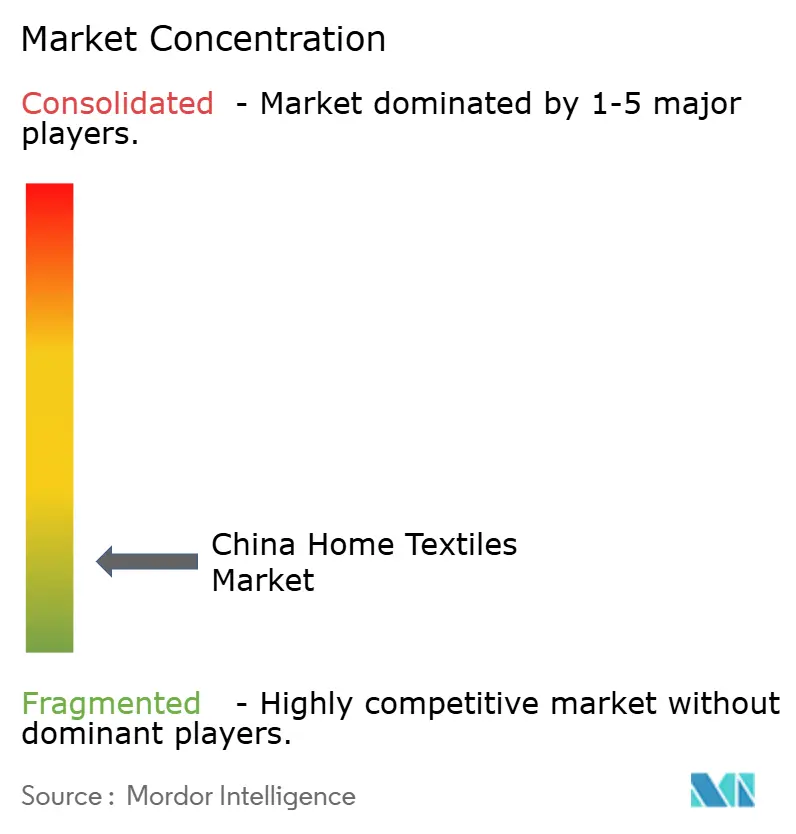
| Market Concentration | Low |
Major Players *Disclaimer: Major Players sorted in no particular order Image © Mordor Intelligence. Reuse requires attribution under CC BY 4.0. | |
China Home Textile Market Analysis by Mordor Intelligence
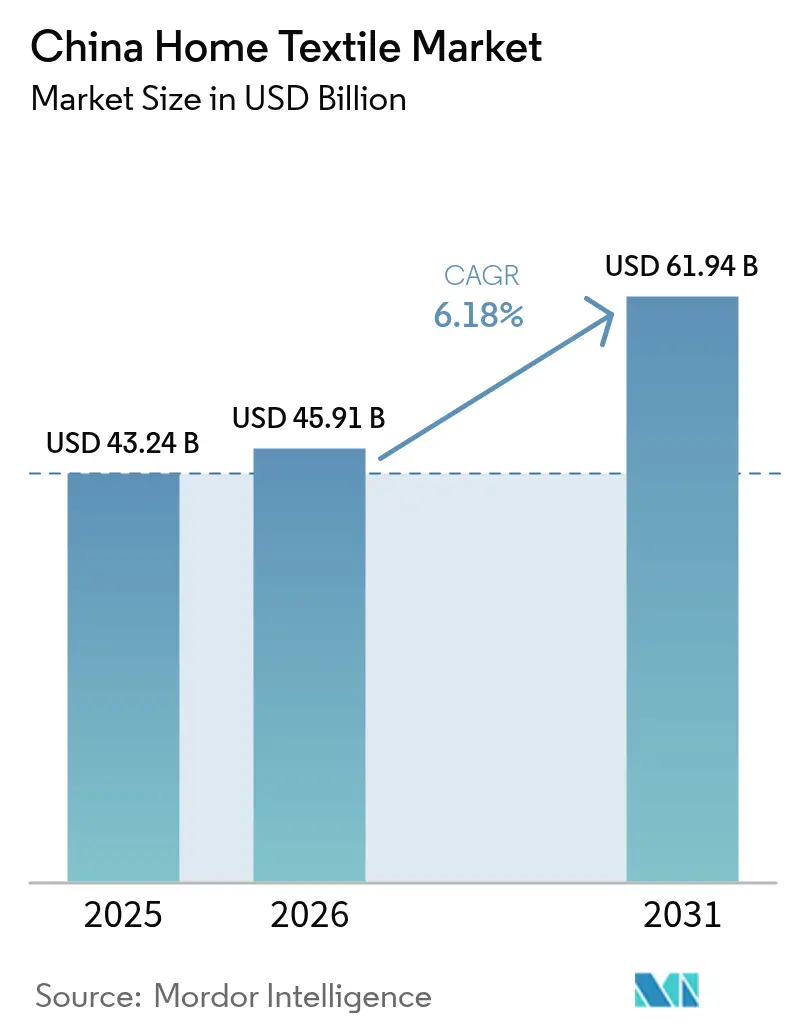
The China Home Textile Market size was valued at USD 43.24 billion in 2025 and estimated to grow from USD 45.91 billion in 2026 to reach USD 61.94 billion by 2031, at a CAGR of 6.18% during the forecast period (2026-2031).
Continued middle-class expansion, sustained urban migration, and rapid digital-commerce uptake collectively reinforce steady demand in the China home textile market, even as cotton-price volatility and international sourcing restrictions create cost uncertainties. Mobile-first shoppers now treat textiles as affordable lifestyle upgrades, pushing branded suppliers toward faster style refreshes and eco-labeled fabrics. Platform retailers use data analytics to shorten design-to-market cycles, while manufacturers invest in AI-assisted production to counter rising labor costs. Across distribution, offline stores retain tactile-product appeal, but their dominance erodes each year as live-streaming and same-day delivery turn smartphones into primary purchase engines. Lastly, corporate ESG targets, government carbon-neutrality mandates, and intensifying traceability rules elevate demand for natural and recycled fibers, accelerating the transition from conventional cotton to bamboo, hemp, and other niche naturals.
Key Report Takeaways
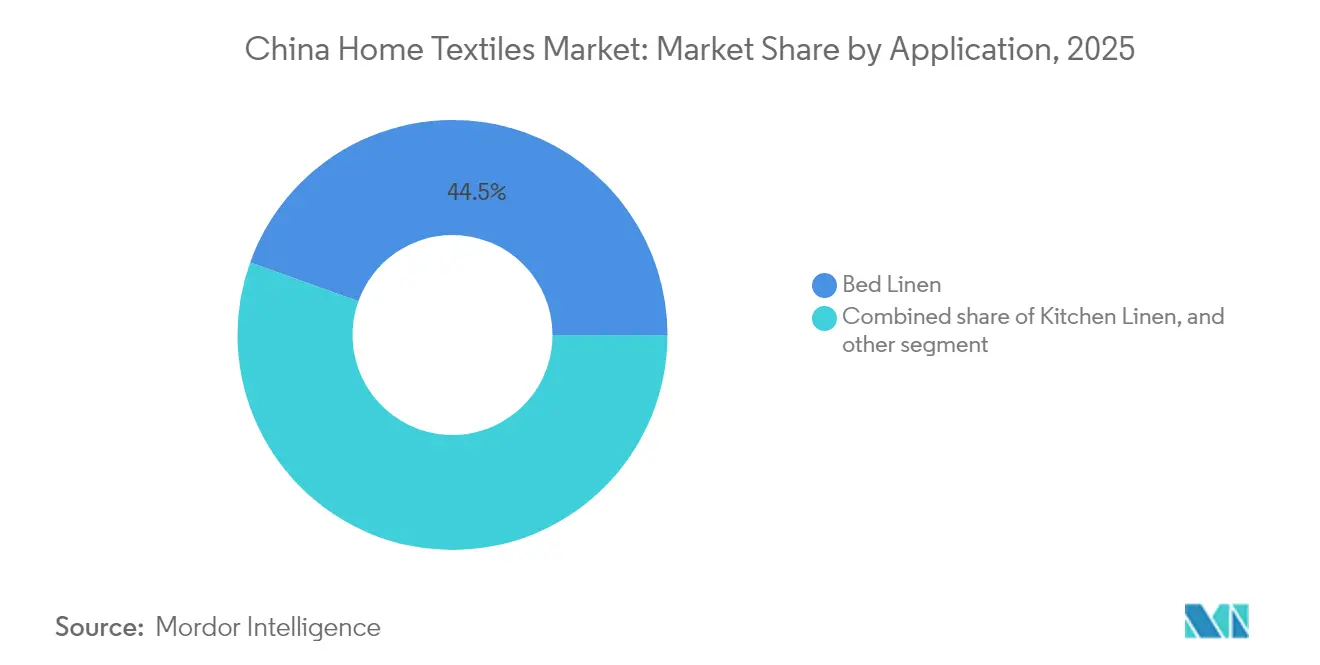
- By application, bed linen led with 44.52% of the China home textile market share in 2025; carpets and area rugs are forecast to grow at an 8.45% CAGR through 2031.
- By material, cotton held 48.93% of the China home textile market share in 2025, whereas bamboo and other niche naturals are projected to expand at an 10.84% CAGR to 2031.
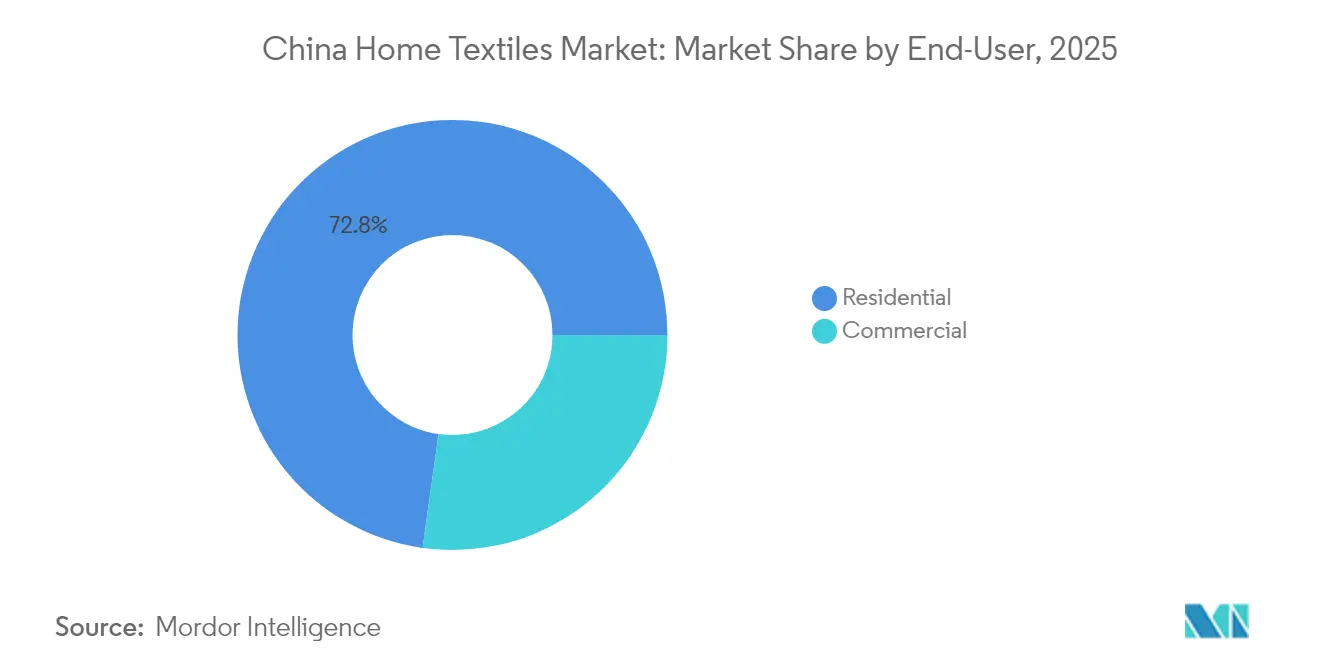
- By end-user, residential accounted for 72.78% of the China home textile market size in 2025, while the commercial/hospitality segment advances at an 8.05% CAGR to 2031.
- By distribution channel, offline retail retained 63.85% of the China home textile market size in 2025, but online platforms are expanding at a 14.72% CAGR.
- By geography, East China captured 35.05% of the China home textile market share in 2025, yet Southwest China is expected to post a 9.92% CAGR between 2026 and 2031.
Note: Market size and forecast figures in this report are generated using Mordor Intelligence’s proprietary estimation framework, updated with the latest available data and insights as of 2026.
China Home Textile Market Trends and Insights
Drivers Impact Analysis*
| Driver | (~) % Impact on CAGR Forecast | Geographic Relevance | Impact Timeline |
|---|---|---|---|
| Rising disposable incomes & urbanization | +2.1% | Nationwide, the highest in tier-2/3 cities | Medium term (2-4 years) |
| Expansion of e-commerce & omnichannel retail | +1.8% | Nationwide, strongest in East & South-Central China | Short term (≤ 2 years) |
| Government push for sustainable fibers & green manufacturing | +1.2% | Policy-driven in Xinjiang and coastal provinces | Long term (≥ 4 years) |
| Digital design & AI-driven on-demand production | +0.9% | East China hubs with spill-over to Southwest | Medium term (2-4 years) |
| Domestic tourism-led hotel linen upgrade cycle | +0.7% | Tourism clusters in Beijing, Shanghai, Guangzhou | Short term (≤ 2 years) |
| Break-through functional textiles (e.g., Y-Warm nano-insulation) | +0.8% | Global demand, production centered in East China | Long term (≥ 4 years) |
| Source: Mordor Intelligence | |||


Rising Disposable Incomes & Urbanization Drive Premium Segment Expansion
Urban household spending on furnishings has grown faster than national income, especially in tier-2 and tier-3 cities, where new apartments foster first-time purchases of coordinated textile sets. Younger buyers prioritize aesthetics and sleep quality, lifting demand for premium thread counts, organic cotton, and branded matching collections. This consumer shift elongates replacement cycles into seasonal refreshes, generating recurrent revenue streams for suppliers. Retailers respond by curating themed bedroom bundles and limited-edition color palettes. The ongoing influx of rural workers into urban areas sustains baseline volume growth, anchoring the Chinese home textile market at both value and mass-market price points.
E-Commerce Platform Revolution Reshapes Distribution Dynamics
Online channels already contribute more than one-third of sales, and live-streaming, augmented-reality “try-on” apps, and same-day fulfillment now blur the line between discovery and purchase. Marketplaces such as Tmall and JD.com leverage behavioral data to micro-target shoppers with personalized style feeds and dynamic discounting. Direct-to-consumer brands exploit this infrastructure to sidestep legacy wholesalers, allowing them to release micro-collections weekly. For suppliers, these data loops slash forecasting errors and inventory write-downs, improving working-capital efficiency while broadening geographic reach into lower-tier cities. As rural broadband coverage widens, incremental e-commerce penetration still offers at least a decade of upside.
Government Sustainability Mandates Accelerate Green Manufacturing Adoption
Beijing’s dual-carbon roadmap incentivizes mills to upgrade from coal to renewable electricity and to integrate water-recycling systems, cutting emissions and effluent. Subsidies for bamboo, hemp, and recycled fibers lower their cost disadvantage versus cotton, encouraging brands to launch eco-certified SKUs that command higher shelf prices. Textile exporters also face stricter compliance audits under EU environmental regulations and U.S. Customs traceability checks; blockchain tracking solutions have therefore become standard among leading mills. This regulatory environment underpins the double-digit CAGR forecast for bamboo and other niche naturals, positioning sustainability as both a compliance necessity and a marketing differentiator[1]Fred Gale, “Cotton and Products Update,” United States Department of Agriculture, usda.gov.
Digital Design & AI-Driven Production Enable Mass Customization
Cloud-based design studios now let consumers adjust patterns, colors, and dimensions on mobile screens, with AI automatically converting specifications into machine-readable production files. 3D knitting equipment, paired with predictive demand algorithms, drastically cuts fabric waste and shortens order-to-ship cycles to as little as 72 hours. For bedding, buyers select thread count, fabric blend, and embroidery, creating virtual exclusivity without high cost. Manufacturers deploy machine-vision quality control and automated packing lines, mitigating rising labor expenses while maintaining consistency. These efficiency gains strengthen local suppliers against imports and embed personalization as a mainstream value proposition [2]Advancing Textile Waste Recycling: Challenges and Opportunities,” Polymers, mdpi.com.
Restraints Impact Analysis*
| Restraint | (~) % Impact on CAGR Forecast | Geographic Relevance | Impact Timeline |
|---|---|---|---|
| Volatile cotton prices & supply-chain shocks | –1.2% | Nationwide, acute in cotton-dependent clusters | Short term (≤ 2 years) |
| Forced-labor/Xinjiang-related sourcing restrictions | –0.9% | Export-oriented manufacturers nationwide | Long term (≥ 4 years) |
| Forced-labor/Xinjiang-related sourcing restrictions | –0.9% | Export-oriented manufacturers nationwide | Long term (≥ 4 years) |
| Tier-1 city market saturation & price wars | –0.6% | Beijing, Shanghai, Guangzhou, Shenzhen | Medium term (2-4 years) |
| Source: Mordor Intelligence | |||
Cotton Price Volatility Creates Input Cost Pressures
ICE cotton futures swung to four-year lows in early 2025 after tariff escalations, yet freight bottlenecks and quality disparities between Xinjiang stocks and imported yarn keep mill procurement unpredictable. Mills hedge with synthetic or blended yarns, but substitution raises re-engineering costs and can dilute brand positioning in premium cotton lines. Financial volatility forces smaller spinners to operate on razor-thin margins, curbing R&D budgets and delaying equipment upgrades. Government stock-release mechanisms provide some stability but cannot fully offset global price swings, making cost pass-through to consumers unavoidable in the near term.
Xinjiang Sourcing Restrictions Force Supply-Chain Restructuring
The Uyghur Forced Labor Prevention Act prompts retailers in the United States to demand end-to-end traceability, pushing Chinese exporters to adopt blockchain tracking, third-party audits, and segregated warehouses. Mills outside Xinjiang gain overseas orders but must absorb higher logistics costs to secure cotton from Pakistan, Brazil, or Australia. Compliance spending disproportionately burdens SMEs, spurring consolidation as larger groups acquire smaller peers to expand traceable capacity. Domestically, retailers reassure consumers through QR-code provenance labels, signaling a permanent shift toward transparent supply chains and increasing investment in traceability technologies.
*Our forecasts treat driver/restraint impacts as directional, not additive. The impact forecasts reflect baseline growth, mix effects, and variable interactions.
Segment Analysis
By Application: Bed Linen Dominance Amid Carpet Innovation
Bed linen accounted for 44.52% of the China home textile market size in 2025, buoyed by multiple-set ownership, seasonal refresh cycles, and increasing preference for organic cotton and higher thread counts. Upmarket brands bundle pillowcases, duvet covers, and fitted sheets to raise average selling prices and encourage coordinated bedroom aesthetics. Wellness marketing links sleep quality to breathable fabrics and accelerates premiumization within this category. Industry players also experiment with antimicrobial finishes and phase-change cooling fibers to differentiate beyond design and color.
Carpets and area rugs, though comprising a smaller revenue base, are projected to register an 8.45% CAGR through 2031—the fastest among all applications—as urban apartment dwellers adopt Western-style décor and demand sound-absorbing floor coverings. Platform-enabled “room-in-a-box” kits often include complementary rugs, driving cross-category pull-through. Innovations in stain-resistant yarns and modular tile configurations elevate ease of cleaning and simplify replacement, making rugs more attractive for families with young children or pets. Commercial builders add further momentum by specifying flame-retardant carpet tiles that qualify for green-building credits.


By Material: Cotton Leadership Challenged by Sustainable Alternatives
Cotton maintained 48.93% of China home textile market share in 2025 due to its established supply chain and consumer familiarity. However, sustainability-oriented shoppers now scrutinize water consumption and pesticide use in cotton farming, pushing brands to source organic certificates or blend in recycled cotton. Polyester and other synthetics secure footholds in performance-driven segments through moisture-wicking, wrinkle-free, and quick-dry attributes, particularly for hospitality linens that require frequent laundering. These blends also temper cost spikes during cotton-price surges.
In the China home textile market, bamboo and other niche naturals are expected to expand at an 10.84% CAGR to 2031, capitalizing on antibacterial properties, soft hand feel, and storytelling appeal around renewable agriculture. Government subsidies for bamboo pulp and lower-emission viscose processing reduce raw-material premiums, making eco-certified SKUs more price-competitive. Hemp, jute, and silk likewise benefit from policy incentives and premium positioning, though limited farming acreage keeps their volume share modest. Across materials, brands increasingly adopt digital traceability tags to reassure consumers about provenance and processing practices.
By End-User: Commercial Sector Drives Growth Innovation
Residential buyers generated 72.78% of 2025 revenue in the China home textile market, reflecting China’s vast household base and ongoing urban apartment completions. Tier-2 and tier-3 city homeowners allocate higher discretionary budgets to home décor, drawing inspiration from social-media influencers and livestream hosts who curate coordinated bedding and window-treatment schemes. In tier-1 cities, where replacement cycles dominate, retrofits favor premium smart-textile functions such as temperature regulation and dust-mite resistance.
The commercial/hospitality segment in the China home textile market is forecast to post an 8.05% CAGR on the back of resumed domestic tourism and a new wave of mid-scale hotel openings across transport hubs. Property owners upgrade to higher GSM towels and long-staple cotton sheets to differentiate guest experience, simultaneously specifying durable, chlorine-resistant fabrics to curb operating costs. Institutional demand from healthcare, education, and senior-living facilities further boosts volume, with procurement committees prioritizing antimicrobial and flame-retardant certifications. Smart linen closets equipped with RFID tags track usage and trigger automated re-ordering, underscoring the segment’s leadership in IoT integration.
By Distribution Channel: Digital Transformation Accelerates
Offline outlets—department stores, shopping-mall flagships, and franchised specialty shops—accounted for 63.85% of 2025 sales in the China home textile market, thanks to tactile evaluation preferences and immediate take-home convenience. Brands invest in experiential showrooms that feature bedroom vignettes and on-site monogramming to defend foot traffic. However, per-store productivity is plateauing in saturated tier-1 markets, encouraging retailers to pivot toward smaller pop-up kiosks and shop-in-shop partnerships.
Online channels, projected to climb at a 14.72% CAGR, deliver nationwide reach and enable algorithm-driven personalization. Livestream flash-sales compress decision cycles, while virtual-reality room planners help shoppers visualize pattern coordination at scale. Brands gather first-party data—from fabric-preference quizzes to predictive size recommendations—to refine product roadmaps and reduce returns. Cross-border e-commerce platforms further diversify assortments, allowing Chinese consumers to purchase Scandinavian minimalism or Japanese zen-style linens without overseas travel. The digital shift, therefore, functions as both a sales engine and a product-development laboratory for the China home textile market.
Geography Analysis
East China commanded 35.05% of 2025 revenue in the China home textile market, leveraging dense manufacturing clusters in Jiangsu, Zhejiang, and Shanghai that integrate spinning, dyeing, cut-and-sew, and port logistics within a 250 km radius. Proximity to Ningbo-Zhoushan and Shanghai ports accelerates export processing, while local consumer wealth sustains premium price points. Provincial governments subsidize robotics and water-recycling retrofits, keeping factories globally cost-competitive despite higher wages. Retail penetration is mature; flagship stores in Shanghai’s prime malls anchor brand visibility, but most incremental sales now stem from online orders shipped from regional fulfillment centers.
South-Central China—including Guangdong, Fujian, Hunan, and Hubei—benefits from a balanced mix of manufacturing know-how and rising local purchasing power. Pearl River Delta mills pivot from apparel to higher-margin home-textile runs, repurpose circular-knit machines for towel loops and jacquard sheeting. Guangzhou’s wholesale mega centers still funnel bulk orders to domestic mom-and-pop shops, yet digital adoption is brisk: merchants livestream product auctions via mobile apps. Provincial infrastructure upgrades, notably high-speed rail links, compress freight lead times to inland consumers, feeding omnichannel growth.
Southwest China is poised for the fastest expansion in the China home textile market, at a 9.92% CAGR through 2031, propelled by inland industrial-relocation incentives that reduce land lease costs up to 40% versus coastal peers. Chongqing and Chengdu attract greenfield mills equipped with automated looms and renewable-energy power purchase agreements. The region’s proximity to Xinjiang’s cotton output cuts raw-material transit time, though logistics bottlenecks across the Hengduan mountains necessitate ongoing road and rail investment. Local governments partner with vocational schools to upskill labor, mitigating talent shortages and enabling quality convergence with coastal production benchmarks.
Regulatory Landscape
China's home textile compliance environment is tightening around product quality supervision, labeling, and performance standards, with a visible step-up in 2025-2026. The State Administration for Market Regulation (SAMR) issued the Fiber Product Quality Supervision Management Measures and referenced updated technical requirements such as GB 18383-2025 for flocculent fiber products, with implementation cited from July 1, 2026. This expands oversight to a broader set of consumer fiber products and reinforces scrutiny on labeling and safety categorization for sensitive-use items, including children and infant-related products. In parallel, GB/T 46396-2025 (thermal insulation performance requirements and test methods for home textiles) was issued in October 2025 and implemented from May 1, 2026, pushing brands and OEMs to substantiate functional performance claims with standardized testing.
On the industrial policy and standardization front, MIIT and other departments released the Standard Leading Textile Industry Optimization and Upgrading Action Plan (2026-2028), which targets development of more than 300 standards by 2028, covering digitalization, green manufacturing, health, and safety. This standard-led push connects to ongoing dual-carbon goals and raises the practical value of traceability systems, cleaner processing upgrades, and auditable claims for recycled or sustainable fibers, particularly for exporters facing higher compliance expectations in overseas markets.
Value Chain Analysis
The China home textile value chain runs from upstream fiber and chemical inputs (cotton, bamboo and other cellulosics, synthetics, dyes and auxiliaries) through midstream spinning, weaving or knitting, dyeing and finishing, and then cut-and-sew conversion into categories such as bed linen and towels. It then moves into branding and multi-channel retail. Production and conversion remain concentrated in established clusters in East China, including the Yangtze River Delta, with hubs such as Nantong in Jiangsu and parts of Zhejiang benefiting from port proximity and dense subcontracting networks that support fast replenishment. Brand owners and integrated manufacturers, including Luolai Lifestyle Technology, Fuanna Bedding, Hunan Mengjie, and Shanghai Shuixing, increasingly use small-batch, rapid-response models aligned with platform-led demand signals.
Downstream, offline retail (department stores, specialty stores, and wholesale markets) continues alongside high-velocity e-commerce channels anchored by Tmall, JD.com, and livestream commerce, which compress design-to-shelf cycles and shift bargaining power toward data-rich platforms and DTC operations. Key friction points across the chain include raw material price volatility (especially cotton), rising labor and logistics costs, and compliance-driven segregation and traceability requirements linked to Xinjiang-related sourcing restrictions. These pressures are pushing investment in automation, quality systems, and traceability tooling, while also favoring scaled players that can manage audits, maintain segregated inventories, and finance faster inventory turns.
Competitive Landscape
China’s home-textile arena exhibits moderate concentration: the top five players hold a cumulative revenue share in the China home textile industry, while a long tail of regional specialists and digital-native brands fills niche demands. Incumbents such as Luolai Lifestyle Technology and Fuanna Bedding respond to price-aggressive online entrants by deepening vertical integration—extending from upstream yarn spinning to downstream branded e-stores—capturing margin and real-time consumer data. Cross-border competitors, notably IKEA and Zara Home, expand localized sourcing to sidestep tariffs and shorten delivery schedules. IKEA alone activated 47 new supplier contracts in 2025, pushing its renewable-energy adoption above 90% within its Chinese value chain [3]Linqin Sun, “IKEA ‘planning now for the next 60 years’ in nation,” China Daily, chinadaily.com.cn.
Product innovation in the China home textile market focuses on functionality: nano-insulated Y-Warm quilts, anti-odor modal-cotton blends, and phase-change cooling pillows cater to wellness-centric shoppers. Early movers patent proprietary fiber treatments, erecting IP barriers that temper commoditization. Concurrently, investments in AI-linked planning tools trim design-to-shelf cycles from six months to six weeks, enabling rapid reaction to influencer-driven micro-trends. Blockchain traceability platforms, now mainstream among major exporters, serve dual roles—regulatory compliance and brand storytelling—by showcasing cotton provenance and emissions metrics to eco-conscious consumers.
M&A activity accelerates as leading groups pursue capacity scale and digital capabilities. Fuanna’s 2025 acquisition of Guangzhou Textile Manufacturing expanded its smart-textile line by 35% and embedded RFID stitching into high-turnover SKUs. Meanwhile, Sunvim Group’s new automated Chongqing facility integrates machine-vision defect detection and AI-driven scheduling, enabling 2.5 million annual units with 30% lower labor input. Smaller specialty labels, unable to match technology capex, increasingly partner with platform influencers or license designs to volume producers, ensuring continued category diversity yet reinforcing the scale advantages of top-tier enterprises.
China Home Textile Industry Leaders
Luolai Lifestyle Technology Co., Ltd.
Shenzhen Fuanna Bedding & Furnishing
Hunan Mengjie Home Textile
Violet Home Textile
Ningbo Veken Elite Group
- *Disclaimer: Major Players sorted in no particular order

Market Opportunities and Future Outlook
Standard-led upgrading and product compliance create room for differentiated, test-backed functional home textiles and greener material portfolios. The rollout of GB/T 46396-2025, implemented May 1, 2026, supports commercialization of measurable performance attributes, such as thermal insulation for quilts and bedding. It also encourages brands to move functional claims from general marketing language to standardized verification, which can raise entry barriers for smaller, non-compliant sellers. At the same time, SAMR's expanded fiber product supervision framework taking effect from July 1, 2026 broadens the set of consumer fiber products under tighter oversight, making compliant labeling, safety categorization, and traceability more direct levers for brand trust and channel access.
On the manufacturing and channel side, MIIT and other departments' Standard Leading Textile Industry Optimization and Upgrading Action Plan (2026-2028), targeting over 300 standards by 2028, anchors investment themes around digital manufacturing, green processes, and health and safety specifications. This aligns with observed market behavior in China, where platforms such as Tmall and JD.com use consumer data loops to shorten style refresh cycles, and where leading groups invest in AI-assisted planning and automated quality control to improve speed and consistency. Opportunities concentrate around (i) small-batch customization enabled by digital design and on-demand production, which fits livestream-driven demand volatility, and (ii) scalable bamboo and other niche natural fiber lines that support dual-carbon compliance narratives and eco-labeled assortments, supported by policy emphasis on greener manufacturing and higher-quality, personalized supply.
Recent Industry Developments
- May 2026: Luolai Lifestyle Technology Co., Ltd. implemented its 2025 final profit distribution plan, completing a cash dividend payment on May 22, 2026. While not tied to an operational expansion, completing the payout indicates balance-sheet capacity and governance continuity that can support continued investments in omnichannel operations and product innovation in a highly competitive home textile category.
- April 2026: Shenzhen Fuanna Bedding and Furnishing Co., Ltd. released its 2025 annual report via exchange disclosure, reiterating its focus across design, production, and sales of textile home furnishings and sleeping products. The disclosure reaffirmed the company's bedding-led assortment approach and provides a public baseline for tracking category mix and channel emphasis as online and O2O retail models intensify.
- December 2024: Beyond Home Textile invested RMB 45 million to deploy a blockchain-based supply chain platform covering cotton bales through finished SKUs. By enabling QR-code provenance and strengthening audit readiness for U.S. UFLPA-related checks, the move elevated traceability from a niche capability to a more central competitive requirement for exporters and brand suppliers.


Research Methodology Framework and Report Scope
Market Definition and Coverage
For this study, the China home textile market covers finished textile products used inside homes and commercial spaces for comfort, hygiene, and decoration. The market is measured as revenue generated within China.
Scope exclusions: It excludes apparel textiles, industrial textiles, and raw fiber or yarn sales that are not sold as home textile end-products.
Segmentation Overview
- By Application
- Bed Linen
- Bath Linen
- Kitchen Linen
- Upholstery
- Others (Carpets and Area Rugs)
- By Material
- Cotton
- Linen
- Synthetic Fibres
- Other Materials (Wool, Hemp, Silk, Jute, Bamboo etc.)
- By End-User
- Residential
- Commercial
- By Distribution Channel
- Offline
- Online
- By Geography
- East China
- South-Central China
- North and Northeast China
- Southwest China
- Northwest China
Data Sources, Market Sizing, and Validation
Desk Research
Desk research was used to set the base structure of the model and to anchor it to visible, repeatable data points. We referred to public sources such as the National Bureau of Statistics of China for household consumption and manufacturing indicators, China Customs trade statistics for textile imports and exports, and ministry level releases tied to textile industry policy and standards.
To keep category boundaries consistent, we also reviewed trade association publications and statistics (such as textile and home furnishing bodies), peer reviewed papers that discuss home textile demand and materials, and reputable press coverage on retail trends and e-commerce shifts. Company annual reports, listed-firm filings, and investor presentations were used to understand price bands, channel mix, and product focus, which then helped calibrate assumptions. In addition, a paid subscription focused on company financials and another for shipment-level import and export intelligence were used selectively to cross-check scale and direction. The desk sources mentioned above are illustrative, and many other public references were also used for data collection, validation, and clarification.
Primary Interviews and Surveys
Primary work was used to confirm what secondary sources cannot show cleanly, such as practical product boundaries, realized pricing, and channel-level demand shifts in China. We spoke with manufacturers, distributors, retailers, and commercial buyers across major consuming and producing regions so assumptions around mix, seasonality, and regional pricing could be checked and adjusted before finalizing outputs.
Distribution of primary research fieldwork respondents
| Company type | Respondent position |
|---|---|
| Top tier: 27% | CXOs: 14% |
| Mid tier: 52% | Functional/Unit leaders: 26% |
| Smaller Players: 21% | Managers: 60% |
Market-Sizing & Forecasting
The core sizing uses a top-down build that reconstructs demand from household and commercial textile spend, category splits for home textile products, and the portion captured through formal retail and online channels in China. Once the demand pool is set, results are corroborated with selective bottom-up approximations, such as sampled average selling price (ASP) by product group multiplied by estimated unit volumes, plus channel checks with retailers and distributors.
Inputs that matter in this market include urban household formation and disposable income trends, residential renovation and home furnishing cycles, e-commerce penetration in home categories, cotton and polyester price movements that influence ASPs, and hospitality activity that affects commercial replacement demand. Where direct visibility is weak, for example in fragmented offline channels, we handle gaps by using bounded ranges from interviews and then tightening the range using trade flows and publicly reported production indicators.
For forecasting, scenario analysis is used around consumer sentiment, housing related demand, and raw material cost pass-through, and then the selected scenario is converted into annual values through exponential smoothing on the most stable time series. The final forecast is reviewed with expert feedback so the variables and direction match what is being seen in procurement and pricing discussions.
Data Validation & Update Cycle
Each output is cross-checked against independent signals, and then the main drivers are reviewed again to ensure the direction makes sense for China, not just for the overall textile sector. Variance checks are run across product groups and channels so sudden step changes are challenged, and supporting assumptions are traced back to either a public data point or a primary confirmation.
Before sign-off, the model goes through multi-step internal review, and follow-up calls are triggered when input ranges stay wide or when pricing feedback conflicts by region. Reports are refreshed annually, with interim updates when material events move demand or pricing, such as a sharp raw material swing or a channel disruption. Right before delivery, an analyst completes a final pass so clients receive the latest updated view.
Mordor Intelligence's China Home Textile Market Size Compared With Other Published Estimates
Published market sizes for China home textiles often diverge because the underlying year, currency timing, and what gets counted as a home textile sale can shift between studies. Differences also come from how ASPs are carried forward when raw material costs and promotion intensity change quickly.
In our work, the refresh cycle matters because price and mix can move within a year. We re-check current-year ASP logic against trade indicators and channel feedback, which then reduces drift in the final number. This is also where Mordor Intelligence separates confirmed selling prices from list prices that do not reflect real realization.
Benchmark comparison
| Source | Market Size | Gaps in Research Methodology |
|---|---|---|
| Mordor Intelligence | USD 45.91 B (2026) | |
| Global Research Publisher A | USD 55.70 B (2024) | Uses an earlier base year and may apply different currency timing, while the published figure can be sensitive to how fast ASP inflation is assumed between 2024 and the forecast window. |
| Industry Research Publisher B | USD 31.63 B (2022) | Starts from a 2022 base and applies a higher growth path, and the lower starting value can reflect a narrower coverage of channels or a different treatment of commercial demand and replacement cycles. |
The spread across the three values is best explained by base-year choice and how pricing and channel mix are updated, rather than by a single data source. By keeping the scope tied to defined home textile products and validating ASPs and mix through repeatable checks, the estimate stays easier to reconcile back to real demand drivers and observable market signals.


Key Questions Answered in the Report
How large is the China home textile market in 2026?
The sector recorded USD 45.91 billion in revenue in 2026.
What is the projected CAGR for China’s home textile demand to 2031?
The market is forecast to grow at 6.18% annually through 2031 during the 2026-2031 forecast period.
Which application category grows the fastest through 2031?
Carpets and area rugs are expected to register an 8.45% CAGR.
Why are bamboo and other niche naturals gaining market share?
Sustainability mandates, subsidies, and antibacterial qualities fuel an 10.84% CAGR for these fibers.
Which sales channel is expanding most quickly?
Online platforms are rising at a 14.72% CAGR as livestreaming and same-day fulfillment attract shoppers.
How are Xinjiang sourcing restrictions affecting exporters?
Brands invest in blockchain traceability and alternative cotton sourcing to maintain overseas market access.
Page last updated on:


 Your data is secure and never sold or shared.


