
Market Overview
| Study Period | 2021 - 2031 |
|---|---|
| Forecast Data Period | 2026 - 2031 |
| Base Year Market Size (2025) | USD 2.29 Billion |
| Market Size (2026) | USD 2.48 Billion |
| Market Size (2031) | USD 3.7 Billion |
| Growth Rate (2026 - 2031) | 8.32 % |
| Market Concentration | Medium |
Major Players *Disclaimer: Major Players sorted in no particular order Image © Mordor Intelligence. Reuse requires attribution under CC BY 4.0. | |
China Freeze-Dried Food Market Analysis by Mordor Intelligence
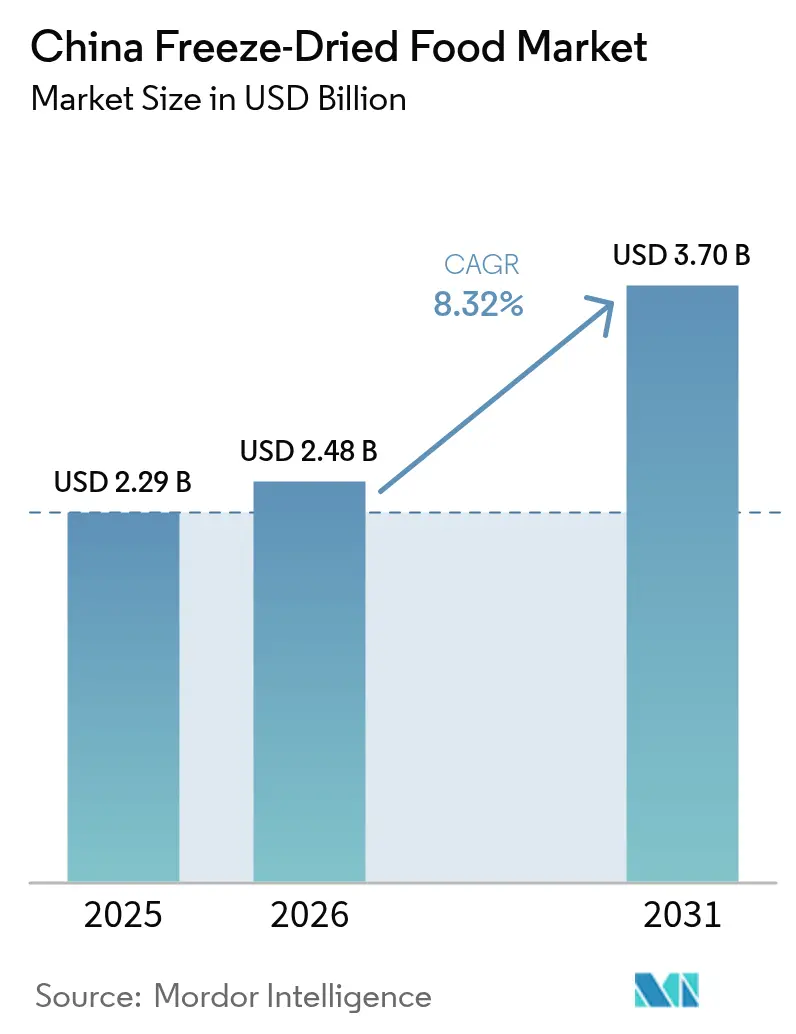
The China freeze-dried food market size was valued at USD 2.29 billion in 2025 and estimated to grow from USD 2.48 billion in 2026 to reach USD 3.7 billion by 2031, at a CAGR of 8.32% during the forecast period (2026-2031). Capacity additions in Gansu, Henan, and Shaanxi are closing cost gaps with coastal exporters, while the State Council’s draft “Freeze-dried Food General Rules” promises unified standards that should lower compliance overheads for small and mid-sized plants. Supermarkets, hypermarkets, and convenience stores still account for the majority of offline sales; however, live-streaming sessions on Douyin and Xiaohongshu are transforming single-ingredient snack packs into impulse buys and drawing tier-2 consumers into premium price tiers. Equipment makers are benefiting from 30% R&D subsidies under the 14th Five-Year Plan, driving innovations such as alternating cold-trap systems that reduce energy use by 40% per kilogram and cut payback periods. Against this favorable backdrop, headline risks remain: capital-intensive vacuum chambers, volatile power tariffs, fragmented raw-material supply, and a lingering “space food” stigma in lower-income cities.
Key Report Takeaways
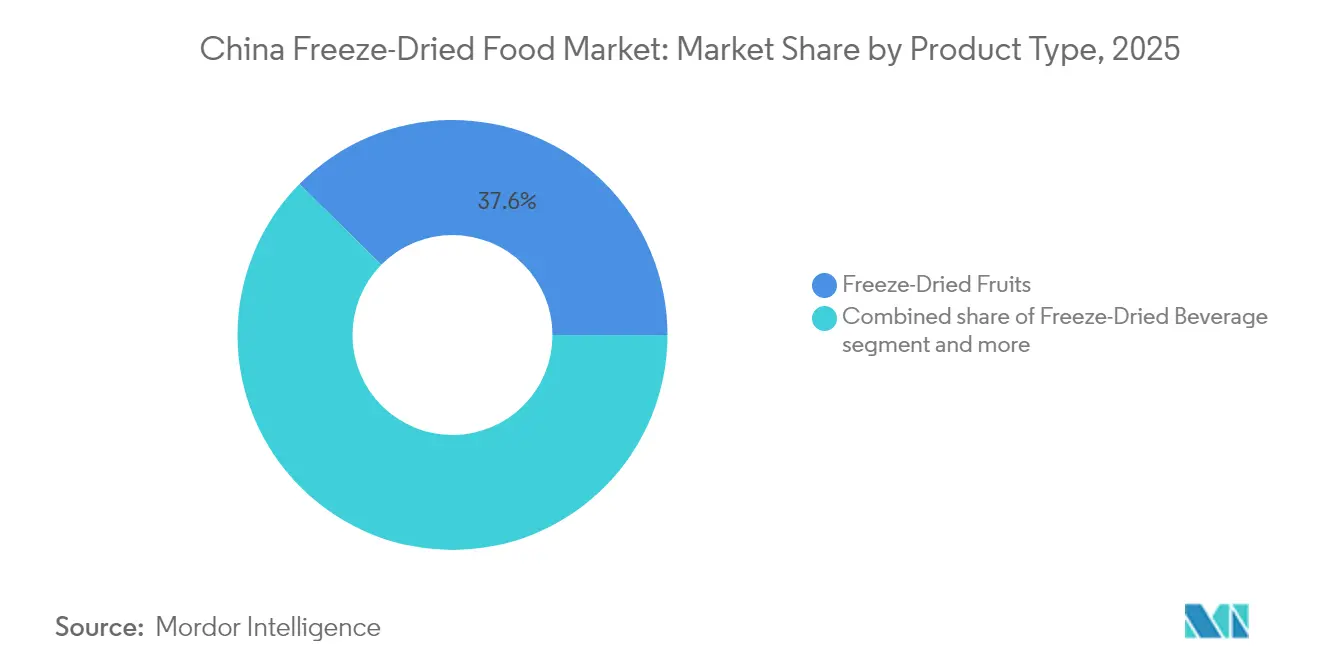
- By product type, freeze-dried fruits captured 37.62% of China's freeze-dried food market share in 2025, while beverages are projected to post the fastest 10.05% CAGR through 2031.
- By nature, conventional lines held an 83.05% share of the China freeze-dried food market size in 2025, but the organic tier is advancing at an 11.32% CAGR, driven by clean-label premiums.
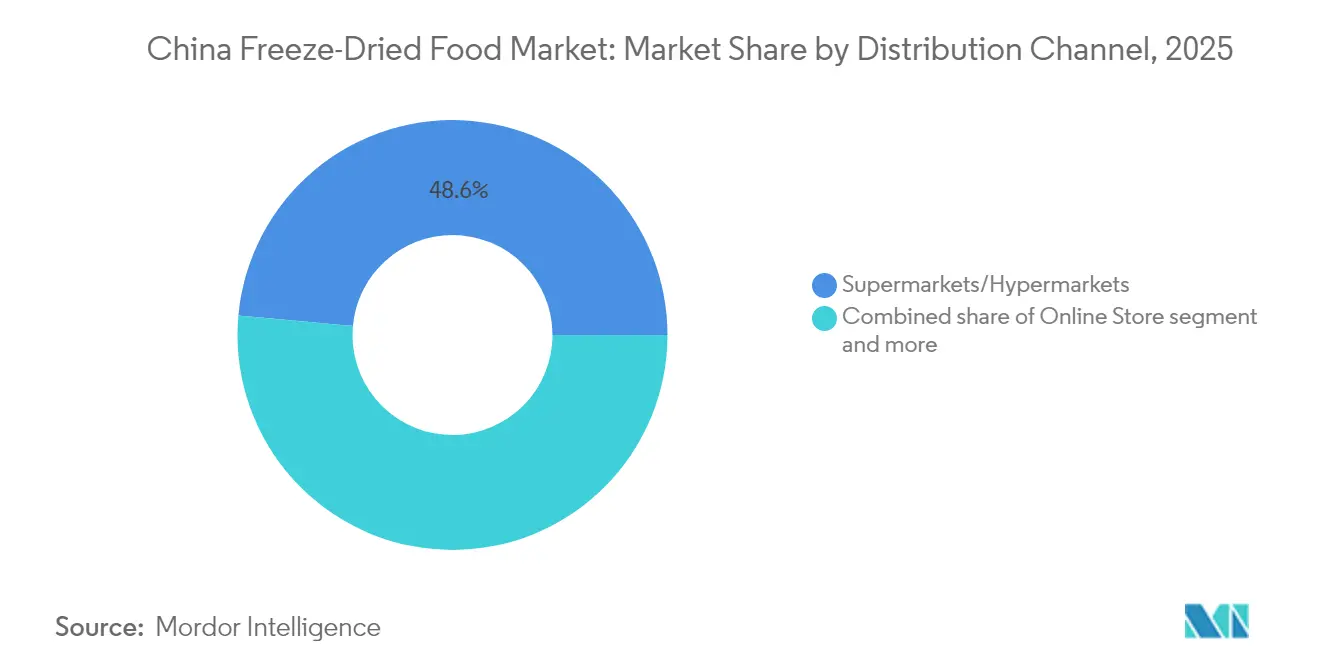
- By distribution channel, supermarkets and hypermarkets accounted for 48.55% of sales in 2025, whereas online stores are projected to grow at a 10.89% CAGR to 2031, as live-streaming expands its reach beyond tier-1 cities.
Note: Market size and forecast figures in this report are generated using Mordor Intelligence’s proprietary estimation framework, updated with the latest available data and insights as of 2026.
Market Trends and Insights
Drivers Impact Analysis of China Freeze-Dried Food Market*
| Driver | (~) % Impact on CAGR Forecast | Geographic Relevance | Impact Timeline |
|---|---|---|---|
| Rising demand for natural, clean-label snacks | +2.1% | National, with premium demand concentrated in Beijing, Shanghai, Guangzhou, Shenzhen | Medium term (2-4 years) |
| Rapid penetration of freeze-drying capacity in inland provinces | +1.8% | Gansu, Shaanxi, Henan, Sichuan, Heilongjiang | Short term (≤ 2 years) |
| Government incentives for agri-processing in rural revitalization zones | +1.5% | National, with early gains in Tianshui (Gansu), Shangqiu (Henan), Guyuan (Ningxia) | Long term (≥ 4 years) |
| Social media influence boosting market growth | +1.3% | National, strongest in tier-1 and tier-2 cities with high Douyin/Xiaohongshu penetration | Short term (≤ 2 years) |
| Rise in infant and toddler freeze-dried snacks | +0.9% | National, with early adoption in coastal urban centers | Medium term (2-4 years) |
| Culinary and foodservice innovation | +0.7% | National, with pilot adoption in premium hotel chains and QSR formats | Medium term (2-4 years) |
| Source: Mordor Intelligence | |||
Rising Demand for Natural, Clean-Label Snacks
Urban Chinese consumers are increasingly scrutinizing ingredient lists, with 57% reviewing nutrition labels before purchase (USDA, 2024). This trend is driving demand for freeze-dried products that list single ingredients, such as “100% strawberry” or “pure mango,” which are free from preservatives, colorants, and added sugars. The organic segment is growing, as consumers are willing to pay 30–50% premiums for certified products, despite labeling distrust and limited availability outside tier-1 cities. Chocolate manufacturers are incorporating freeze-dried fruits into “Chocolate+” formulations to reduce cocoa costs while enhancing visual appeal and taste, reflecting cross-category demand beyond standalone snacks. Compliance with GB 10770-2025, effective March 2026, which enforces stricter limits on additives and contaminants in infant complementary foods, is further accelerating reformulation toward the inclusion of freeze-dried fruit and vegetables that meet clean-label standards without compromising shelf life (USDA)[1].
Rapid Penetration of Freeze-Drying Capacity in Inland Provinces
Provincial governments in Gansu, Shaanxi, Henan, and Heilongjiang offered targeted subsidies and tax incentives in 2024-2025 to attract freeze-drying equipment manufacturers and processors, leveraging lower land and labor costs compared with coastal regions. Tianshui City (Gansu) allocated RMB 25.7 million (approximately USD 3.5 million) in subsidies, stimulating RMB 65 million (approximately USD 9 million) in private investment and supporting the development of 3,468 cold-chain facilities with a capacity of 1.14 million tons since 2020 (USDA). In April 2025, Jiangsu BoLaiKe supplied industrial freeze-dryers to a Shaanxi pet food enterprise, highlighting its focus on serving inland processors in both domestic and export markets. Guyuan (Ningxia) cultivates over 500,000 mu of cold-climate vegetables, producing 2 million tonnes annually, with 18 geographic-indication products exported to Malaysia and Saudi Arabia. Proximity to raw materials reduces logistics costs by 12-18% for co-located freeze-dried producers. Regional specialization, with Heilongjiang focusing on vegetables and Henan on fruits, enhances supply-chain efficiency and product consistency (USDA).
Government Incentives for Agri-Processing in Rural Revitalization Zones
China’s 2024–2027 rural revitalization plan promotes value-added agri-processing, with 31 provinces issuing supportive measures (USDA). The 14th Five-Year Plan prioritizes freeze-drying equipment, offering R&D subsidies of over 30% for energy-efficient technologies. Zhejiang Tongking’s alternating cold-trap system reduces energy consumption by 24% per trap and 40% per kilogram, resulting in an annual savings of approximately RMB 110,000 (USD 15,200) at 5,000 hours, benefiting processors with thin margins. The draft "Freeze-dried Food General Rules" (Nov 2024) will harmonize standards and labeling nationwide, lowering compliance costs and enabling smaller processors to reach national distribution[2]. The clarity is expected to attract foreign investment and joint ventures for localized supply chains in prepared meals and infant nutrition.
Social Media Influence Boosting Market Growth
Live-streaming generated USD 514 billion in gross merchandise value in 2024, and freeze-dried snacks benefit from demonstrations that dramatize rehydration and texture in seconds, as per the USDA Foreign Agricultural Service. JD.com and Tmall now run self-operated cold-chain warehouses that place inventory within 48 hours of tier-2 and tier-3 addresses, allowing hosts to promise next-day delivery. Conversion rates run 20-30% higher in tier-1 cities, but influencer-led education is narrowing the gap in lower-income zones. Convenience chains such as Sinopec Easy Joy Coffee amplify visibility by stocking single-serve sachets at petrol stations, merging digital impulse with offline availability.
Restraints Impact Analysis of China Freeze-Dried Food Market*
| Restraint | (~) % Impact on CAGR Forecast | Geographic Relevance | Geographic Relevance |
|---|---|---|---|
| High capex and energy costs of vacuum freeze-dryers | -1.4% | National, with acute impact on tier-2 and tier-3 processors lacking subsidy access | Short term (≤ 2 years) |
| Fragmented raw-material supply chain quality issues | -1.1% | National, particularly inland provinces with nascent cold-chain infrastructure | Medium term (2-4 years) |
| Consumer perception as "Artificial" or "Space Food" | -0.8% | Tier-3 and tier-4 cities with lower exposure to premium food trends | Long term (≥ 4 years) |
| Competition from alternatives | -0.6% | National, with strongest pressure in prepared-meal and snack categories | Medium term (2-4 years) |
| Source: Mordor Intelligence | |||
High Capex and Energy Costs of Vacuum Freeze-Dryers
Industrial vacuum freeze-dryers range from USD 10,000 for entry-level units to USD 350,000 for large-scale automated systems, creating a capital barrier for smaller processors without subsidized financing (USDA). Energy use during sublimation, typically 40-70°C at 5-50 Pa for 10-15 hours per batch, can account for 30-40% of operating costs, especially in provinces lacking preferential electricity rates. Zhejiang Tongking’s alternating cold-trap system cuts energy consumption by 40% per kilogram, but adoption is largely limited to processors with technical expertise and capital to retrofit existing lines. Subsidies exceeding 30% under the 14th Five-Year Plan benefit processors in Gansu and Shaanxi, while those in provinces without incentives face payback periods of 4-6 years, discouraging investment and reinforcing regional capacity disparities.
Fragmented Raw-Material Supply Chain Quality Issues
China’s agricultural sector remains fragmented, with smallholder farms supplying inconsistent grades of fruits, vegetables, and meats, complicating batch-to-batch quality control for freeze-dried processors. By Q3 2024, cold-storage capacity reached 66.945 million tonnes, but inland provinces lack sufficient refrigerated logistics to preserve peak freshness (USDA). Food safety enforcement is intensifying: in Q1 2024, the Supreme People’s Procuratorate filed 5,126 public-interest lawsuits, 4,235 of which involved agricultural products, highlighting the pressures of traceability and testing on processors sourcing from multiple suppliers (Mérieux NutriSciences)[3]. A national eight-month crackdown launched in March 2024 targeted illegal practices in livestock and poultry, prompting stricter supplier audits and third-party testing for freeze-dried meat and seafood producers. Consumer distrust in organic certification, stemming from past labeling scandals, limits the willingness to pay premiums above 50%, thereby constraining the revenue potential for certified supply chains. The draft "Freeze-dried Food General Rules" (November 2024) will mandate enhanced origin documentation and microbial testing, accelerating upstream consolidation while raising near-term compliance costs (China–Africa SPS Cooperation Information Platform).
*Our forecasts treat driver/restraint impacts as directional, not additive. The impact forecasts reflect baseline growth, mix effects, and variable interactions.
China Freeze-Dried Food Market Segment Analysis
By Product Type:
Fruits Dominate, Beverages AccelerateFreeze-dried fruits dominated the largest slice of the China freeze-dried food market in 2025, accounting for 37.62%, thanks to eye-catching strawberry and mango slices that shine in livestream demos. Instant coffee and tea lines, while starting from a smaller base, are on track for a 10.05% CAGR through 2031, helped by office culture and capsule systems in convenience stores. The China freeze-dried food market size for beverages could therefore double by mid-decade, attracting both global brands and local startups. Vegetables, meat, dairy, and prepared meals round out the basket, supplying foodservice and pet-food channels that prize ease of storage. Product innovation now ranges from freeze-dried wontons for quick-service restaurants to heat-stable chocolate for warm-chain distribution, hinting at broader culinary applications ahead.
A second growth layer stems from inland specialization: Henan and Gansu concentrate on strawberry and apple feeds, while Heilongjiang focuses on carrots and mushrooms, shortening farm-to-factory legs by up to 18%. This clustering supports quality consistency that livestream hosts can showcase with close-up texture shots, further widening consumer acceptance. Meanwhile, pet-food demand is at the premium end, and processors are securing supply by co-investing in freeze-dryer fleets near livestock bases. Overall, diversified demand across snacks, beverages, pet, and prepared meals steadies utilization rates and limits over-reliance on any single product line.

By Nature:
Conventional Still Leads, Organic Scales UpConventional SKUs captured 83.05% of sales in 2025 thanks to price points aligned with supermarket shoppers, and they remain the default in mass-market gift boxes sold during Lunar New Year. Yet the organic tier is growing at a 11.32% CAGR, faster than any other attribute, as label-conscious millennials pay a premium for pesticide-free claims. China freeze-dried food industry players are responding with QR-code farm videos, on-pack audit certificates, and live-stream tours that demystify supply chains. The China freeze-dried food market size for organic snacks remains small, but rising urban incomes suggest potential headroom as trust infrastructure strengthens.
A critical bottleneck is certification credibility: past scandals have dampened the willingness to pay premiums over 50%. Regulators are tightening audits, and public-interest lawsuits on food safety keep pressure high. Processors that invest early in traceable upstream partnerships are poised to win shelf space once GB 10770-2025 raises the bar on infant food additives. Over time, organic penetration is likely to exceed today’s 16% volume share, nudging conventional players toward incremental pesticide-residue tests to defend relevance.
By Distribution Channel:
Online Races Ahead of Brick-and-MortarSupermarkets and hypermarkets still hold the largest share at 48.55%, supported by in-store sampling tables that allow shoppers to taste crispy fruit slices. Yet online stores are racing ahead at an 10.89% CAGR, powered by live-stream flash sales where hosts demonstrate instant rehydration. The Chinese freeze-dried food market benefits from JD.com and Tmall's cold-chain hubs, which guarantee 48-hour delivery to inland households, expanding beyond the coastal comfort zone. Convenience chains such as Sinopec Easy Joy Coffee offer on-the-go sachets, providing a physical touchpoint that reinforces digital exposure.
Hybrid retail models are emerging: Freshippo blends app ordering with 30-minute pickup, and stores stock up to 1,500 freeze-dried SKUs. Private-label brands exploit platform algorithms, bidding on “pure mango” keywords to surface during primetime streams. Meanwhile, specialty health-food shops cater to organic lines that require educated staff to explain traceability. Distribution diversity, therefore, spreads risk and ensures that supply shocks in any one channel do not derail overall growth.
Geography Analysis
China's freeze-dried food market activity is split between coastal export hubs and inland subsidy zones, creating a complementary two-track system that stabilizes national output. Inland provinces such as Gansu and Henan utilized subsidy packages worth tens of millions of renminbi to establish more than 3,000 cold-chain sites and attract processors closer to orchards and vegetable plots. These moves trimmed raw-material costs by 15-25% and reduced transit-damage claims, as fruits now reach chambers within hours of harvest. Guyuan in Ningxia exemplifies the model, nurturing 2 million tonnes of cold-climate vegetables annually and funneling them into nearby freeze-dryers that serve both domestic and Gulf markets.
Coastal provinces continue to dominate export volume; Shandong alone shipped 2,044 containers of freeze-dried fruit to North America in the 12 months ending May 2025, reflecting a logistics advantage in port proximity. Fujian and Zhejiang leverage deep-water harbors to ship fresh pineapple and mushroom chips onto reefer vessels bound for ASEAN and Japan. The coastal cluster also houses multinational R&D centers that pilot new textures before rolling them inland for cost-optimized scaling. Energy-saving retrofits, such as Zhejiang Tongking’s alternating cold-trap systems, often debut in Zhejiang plants before wider rollout, illustrating a technology cascade from coast to hinterland.
Tier-1 cities, Beijing, Shanghai, Guangzhou, Shenzhen, command premium demand; 68% of 18-35-year-olds there express willingness to trial freeze-dried snacks on health grounds. They also anchor live-stream ecosystems that broadcast nationwide, making them trend incubators. Tier-2 and tier-3 cities represent the fastest incremental gains as cross-border e-commerce cuts delivery times, while price-sensitive tier-4 towns still equate freeze-dry with astronaut rations. Over time, demographic shifts and improving logistics should narrow perception gaps, boosting per-capita uptake across inland counties.
Regulatory Landscape
Freeze-dried foods in China sit under the Food Safety Law framework and are governed in practice through a mix of national mandatory standards for additives, contaminants, and labeling (notably GB 2760, GB 2762, and GB 7718) plus category-specific requirements that processors reflect in specifications, COAs, and finished-pack claims. Alongside this, China has moved toward more harmonized technical guidance for freeze-dried categories through newer standards such as T/ACCEM 038-2024 (effective October 2024), which sets out technical and labeling requirements across multiple freeze-dried product forms, supporting more consistent acceptance across channels and regions.
For imported freeze-dried foods, market access is shaped by controls from the General Administration of Customs of China (GACC), including overseas facility registration under Decree 248 and ongoing updates under Decree 280, with declarations filed through the China International Trade Single Window. These requirements raise the practical need for maintained registration status and document consistency, since import clearance depends on valid facility registration and conformance to China food safety standards.
Value Chain Analysis
The value chain starts with fragmented farm supply for fruits, vegetables, fungi, and animal proteins, then moves through aggregation, grading, preprocessing (washing, cutting, blanching where relevant), and rapid cold-chain transfer to freeze-drying sites to protect color, structure, and yield. Processing is centered on capital-intensive vacuum freeze-drying (freezing, primary drying, secondary drying), followed by post-drying steps such as sorting, metal detection, blending (for beverage powders and mixed snacks), and packaging into moisture- and oxygen-barrier formats for domestic distribution and export. Compliance checkpoints are embedded throughout the workflow, with processors aligning finished goods to labeling and additives/contaminant limits, and increasingly referencing standardized requirements cited in industry standards (for example, GH/T 1326-2021 for freeze-dried fruits and vegetables and T/ACCEM 038-2024 for broader freeze-dried categories).
China also shows a cluster-based production structure: coastal export-oriented hubs such as Fujian connect to ports and international buyers, while inland provinces leverage proximity to raw materials and local incentive packages to reduce inbound logistics costs and stabilize procurement. On the downstream side, supermarkets and hypermarkets remain major offline outlets, but e-commerce and live-streaming have accelerated single-ingredient snack and beverage adoption, supported by platform warehousing and faster delivery to non-coastal cities. Equipment and technology providers act as an enabling layer as energy use and vacuum system reliability affect both unit costs and quality consistency, making retrofits and process-control upgrades a practical lever for processors across inland and coastal footprints.
Competitive Landscape
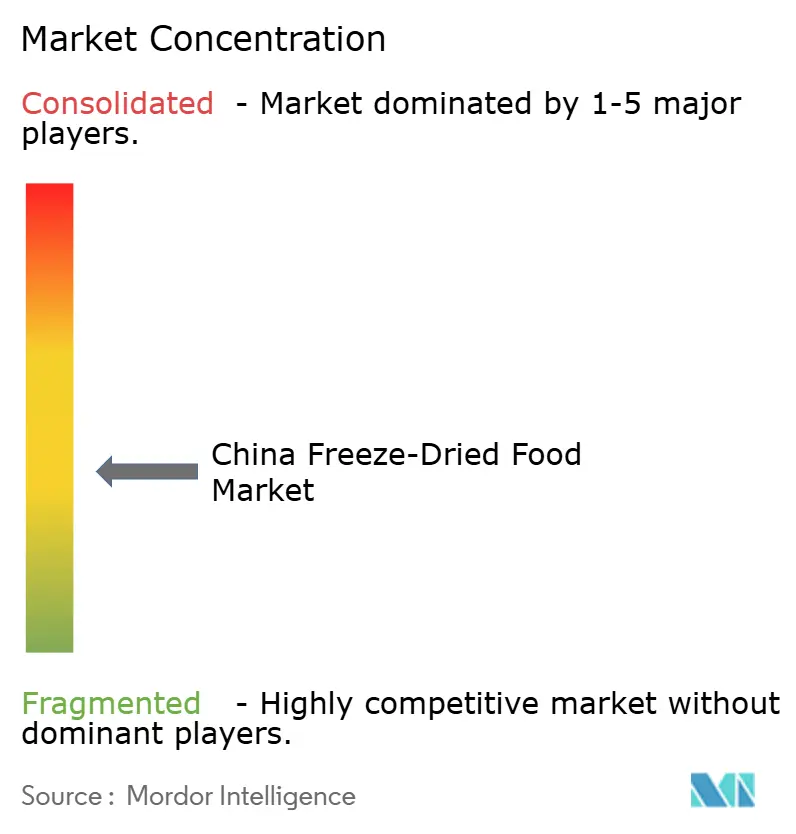
The Chinese freeze-dried food market is moderately concentrated, meaning the top five players hold sizeable yet non-dominant influence, leaving room for regional upstarts. Fujian Lixing runs more than 29 lines in an 80,000 m² plant and leads innovation with quick-rehydration wontons that target hotel buffets. Chaucer Foods’ Qingdao arm exported over 10 million kg to North America in the past year, underscoring China’s cost competitiveness in fruit inputs. Kerry Group, after acquiring Greatang, now cross-sells taste systems into its local freeze-dry portfolio, reinforcing flavor customization for infant and beverage clients.
Strategically, incumbents are pushing inland to secure subsidies and raw material clusters, while private-label brands are leveraging e-commerce algorithms to win millennial baskets. Energy efficiency is a differentiator; plants that retrofit alternating cold traps cut unit costs and can underprice rivals without sacrificing margin. Technology partnerships with equipment vendors accelerate adoption: Zhejiang Tongking’s 40% energy-saving modules are now integrated into lines at both Fujian Lixing and Anyang General Foods, demonstrating a rising standard for operational excellence.
Emerging disruptors include pet-food specialists leveraging single-ingredient positioning and livestream-native snack labels that sell directly through Douyin without traditional distributors. Patents like Qingdao Anxin Zhiguo’s heat-stable chocolate broaden possible categories and set higher bars for R&D agility. Overall, the race is tilting toward brands that combine cost-efficient inland production, flavor systems tailored to local palates, and digital-first storytelling that resonates with health-seeking shoppers.
China Freeze-Dried Food Industry Leaders
-
Tianjin Sai Yu Food Co., Ltd.
-
Anyang General Foods Co. Ltd
-
Fujian Lixing Foods Co. Ltd
-
Chaucer Foods Ltd (China ops.)
-
Kerry Group plc
- *Disclaimer: Major Players sorted in no particular order
China Freeze-Dried Food Market Companies Covered in this Report
- Tianjin Sai Yu Food Co., Ltd
- Anyang General Foods Co. Ltd (AGICO)
- Fujian Lixing Foods Co. Ltd (Lixing Group)
- Zhengzhou Donsen Foods Co. Ltd
- Shanghai Richfield International Co. Ltd
- Shenzhen Lujia FD Food Co. Ltd (Lujia / LUJIA)
- China Mark Foods Co. Ltd
- Chaucer Foods Ltd
- Kerry Group plc
- Ajinomoto Co., Inc.
- Fonterra Co-operative Group Ltd
- Ningbo Li-tong Freeze-Dried Foods
- Gansu Beidahuang Freeze-Drying Co.
- Heilongjiang Green Agriculture FD Foods
- Zhejiang YiFei Freeze-Dried Tech
- Zhejiang Haijie Freeze-Dried Seafood
- Hubei Xinwen Freeze-Dried Foods
- Shandong Senyou Freeze-Dried Fruits
- Guangdong Dingyi FD Snacks
- Hebei Dongfang FD Vegetable Base
Market Opportunities and Future Outlook
Opportunity is emerging where tighter standards align with category diversification. The State Council draft "Freeze-dried Food General Rules" (released November 2024), together with wider adoption of standards such as T/ACCEM 038-2024, provides clearer guardrails for labeling, hygiene, and technical specifications across fruits, vegetables, yogurt-style products, and beverage powders. That helps small and mid-sized plants support national distribution when products meet defined requirements, and it reduces friction for cross-region listings. Separately, GB 10770-2025 taking effect in March 2026 for infant complementary foods pushes manufacturers toward cleaner formulations and tighter contaminant control, which aligns with the role of single-ingredient freeze-dried fruit and vegetable inclusions in infant and toddler snack formats.
A second opportunity runs through cost-down and supply-chain localization, supported by inland capacity build-out and energy-efficiency upgrades. Inland provinces have used subsidy programs and cold-chain build-outs to bring processors closer to orchards and vegetable bases, while the 14th Five-Year Plan emphasis on equipment R&D, supported by cited levels of over 30% for energy-efficient technologies, underpins adoption of lower-energy solutions such as alternating cold-trap systems. Commercial traction is also visible in China’s live-streaming commerce scale (USD 514 billion GMV in 2024) and in platform-led fulfillment improvements that extend reach beyond tier-1 cities, giving brands a path to repeatable, education-led selling models for premium snack packs, beverage powders, and pet-food inclusions without relying only on traditional distributors.
Recent Industry Developments in China Freeze-Dried Food Market
- March 2026: China implemented GB 10770-2025 for infant complementary foods, tightening requirements around additives and contaminant control. This change accelerates reformulation and supplier qualification for freeze-dried fruit and vegetable ingredients used in infant and toddler snack formats, and raises the compliance advantage of processors with stronger testing and traceability systems.
- April 2025: Jiangsu BoLaiKe dispatched industrial freeze-dryers to a Shaanxi pet food enterprise, expanding inland processing capability tied to higher-margin pet applications. The shipment highlights the equipment-led scaling pathway in provinces closer to raw materials and reinforces the role of specialized demand segments in improving plant utilization.
- June 2024: Qingdao Anxin Zhiguo filed patent CN118160802A for freeze-dried chocolate featuring embedded oil and water cores to maintain stability up to 70 C. This innovation broadens confectionery use cases that were previously constrained by warm-chain handling and supports product differentiation beyond single-ingredient fruit and vegetable crisps.
China Freeze-Dried Food Market Report Scope and Research Methodology
Market Definition and Coverage
This market covers the value of freeze-dried food products sold in China for human consumption, counted at the point where products are sold through retail, foodservice, or as ingredients to food processors.
Scope exclusions: This sizing does not include freeze-dried pet food, industrial non-food freeze-dried items, or freeze-drying equipment and contract processing services.
Segments Covered in This Report
- By Product Type
- Freeze-Dried Fruits
- Strawberry
- Raspberry
- Pineapple
- Apple
- Mango
- Other Fruits
- Freeze-Dried Vegetables
- Pea
- Corn
- Carrot
- Potato
- Mushroom
- Other Vegetables
- Freeze-Dried Meat and Seafood
- Freeze-Dried Dairy Products
- Freeze-Dried Beverages (Instant Coffee, Tea)
- Prepared Meals
- Pet Foods
- Freeze-Dried Fruits
- By Nature
- Conventional
- Organic
- By Distribution Channel
- Supermarkets/Hypermarkets
- Convenience Stores
- Online Stores
- Other Distribution Channels
Data Sources, Market Sizing, and Validation
Desk Research
Desk research is used to set a realistic demand pool and to align inputs with observable China food indicators. We review public statistics and standards sources such as China National Bureau of Statistics food manufacturing output series, China Customs trade data for relevant HS codes, and National Medical Products Administration or related regulator releases where nutrition and labeling rules affect product claims.
To anchor consumption and channel assumptions, we also use sources such as FAO food supply and agriculture tables, academic and peer-reviewed articles on freeze-drying yield and retention for fruits and vegetables, and association or exhibition disclosures that summarize processed food and snack trends. This is supported with company annual reports, investor presentations, and reputable press for product mix signals. For cross-checking company scale and patent activity, we selectively use paid subscriptions for company financials and patent databases. The sources mentioned here are illustrative, and other public documents are also reviewed to clarify and validate inputs.
Primary Interviews and Surveys
Primary work is used to test what desk research cannot fully confirm, mainly the split between retail snacks and B2B ingredient demand, typical pricing ladders, and the adoption speed of new freeze-dried formats. We speak with manufacturers, ingredient buyers at processed food companies, distributors, and channel operators across major consuming regions in China, then adjust the assumptions only after consistent feedback is received.
Distribution of primary research fieldwork respondents
| Company type | Respondent position |
|---|---|
| Top tier: 35% | CXOs: 12% |
| Mid tier: 44% | Functional/Unit leaders: 36% |
| Smaller Players: 21% | Managers: 52% |
Market-Sizing & Forecasting
The model starts with a top-down demand pool built from China processed food and snack consumption indicators, and then it is filtered using freeze-dried penetration by key uses (snacks, ingredients for bakery and dairy, and ready-to-eat meal components). To keep the totals realistic, we corroborate the result with selective bottom-up checks, such as sampled supplier revenue ranges, channel checks on sell-in volumes, and observed price per kilogram ranges multiplied by plausible throughput.
Inputs used in the sizing include freeze-dried product pricing bands by format, share of sales through e-commerce versus offline retail, import and export movement for freeze-dried categories, new product launches that signal mix shift toward multi-ingredient snack packs, and capacity utilization direction shared by producers. Where supplier-side information is incomplete, we use conservative fill rates based on production seasonality for fruits and vegetables, then validate the implied volumes against trade and channel signals.
For forecasting, scenario analysis is applied around three drivers that respondents consistently link to growth, which are household snacking frequency, expansion of ingredient use in processed food, and cost movement tied to raw material availability. Growth paths are then translated into yearly market values through updated ASP progression assumptions and channel mix changes.
Data Validation & Update Cycle
Validation is done by checking whether the implied volumes and values make sense against independent signals, such as trade direction, major channel growth, and feasible production throughput. Outliers are flagged, reviewed, and recalculated when an assumption creates a jump that cannot be explained by pricing, mix, or a known market event.
Before numbers are finalized, the model and key assumptions are reviewed in more than one analyst pass, and expert respondents are re-contacted when a variance remains unresolved. Reports are refreshed on an annual cycle, and interim updates are triggered when material events occur, such as policy changes, sharp raw material price moves, or demand shocks. Right before delivery, a final check is completed so the latest data releases are reflected.
Mordor Intelligence's China Freeze Dried Food Market Size Versus Other Published Estimates
Published market sizes for China freeze-dried food can vary because the category can be treated as a narrow snack market, or it can be expanded into adjacent freeze-dried uses sold through different channels. Differences also come from how each publisher treats pricing, whether values are reported at the manufacturer level or closer to retail, and how frequently assumptions are refreshed.
Some estimates roll in pet food and other non-human consumption uses, and they also apply broad average prices across many product types. In Mordor Intelligence, the value is limited to freeze-dried food products for human consumption in China, and pet food plus equipment and contract processing are kept out, which changes the total even when the growth rate looks similar.
Benchmark comparison
| Source | Market Size | Gaps in Research Methodology |
|---|---|---|
| Mordor Intelligence | USD 2.29 B (2025) | |
| Industry Publisher A | USD 6.40 B (2025) | Uses a wider product scope that includes multiple freeze-dried categories beyond human food-only counting, and the pricing basis is not clearly tied to a consistent manufacturer versus retail value point. |
| Regional Publisher B | USD 1.95 B (2025) | Applies a narrower view that appears to emphasize retail snack formats and undercounts B2B ingredient demand to processed food manufacturers, which reduces the implied volume and value. |
The spread across the table mainly comes from what gets counted as part of the market and how prices are translated into value. By tying the model to a defined demand pool, cross-checking with trade and channel signals, and keeping inclusions consistent year to year, the final number stays traceable to clear inputs that can be re-tested during updates.
Key Questions Answered in the Report
How fast is demand growing for freeze-dried snacks in China?
Retail sales are projected to rise at an 8.32% CAGR through 2031, lifted by clean-label preferences and rapid online adoption.
Which product line is expanding quickest?
Freeze-dried beverages, mainly instant coffee and tea, are forecast to post a 10.05% CAGR between 2026 and 2031.
What share do conventional products hold today?
Conventional SKUs account for 83.05% of current sales, but organic lines are steadily gaining ground.
Why are inland provinces attracting new plants?
Subsidies, lower land costs, and proximity to farms cut raw-material expenses by up to 25% and shorten payback times on equipment.
Which sales channel is growing the fastest?
Online stores, buoyed by live-stream commerce and enhanced cold-chain logistics, are expanding at 10.89% CAGR to 2031.