
Market Overview
| Study Period | 2020 - 2031 |
|---|---|
| Forecast Data Period | 2026 - 2031 |
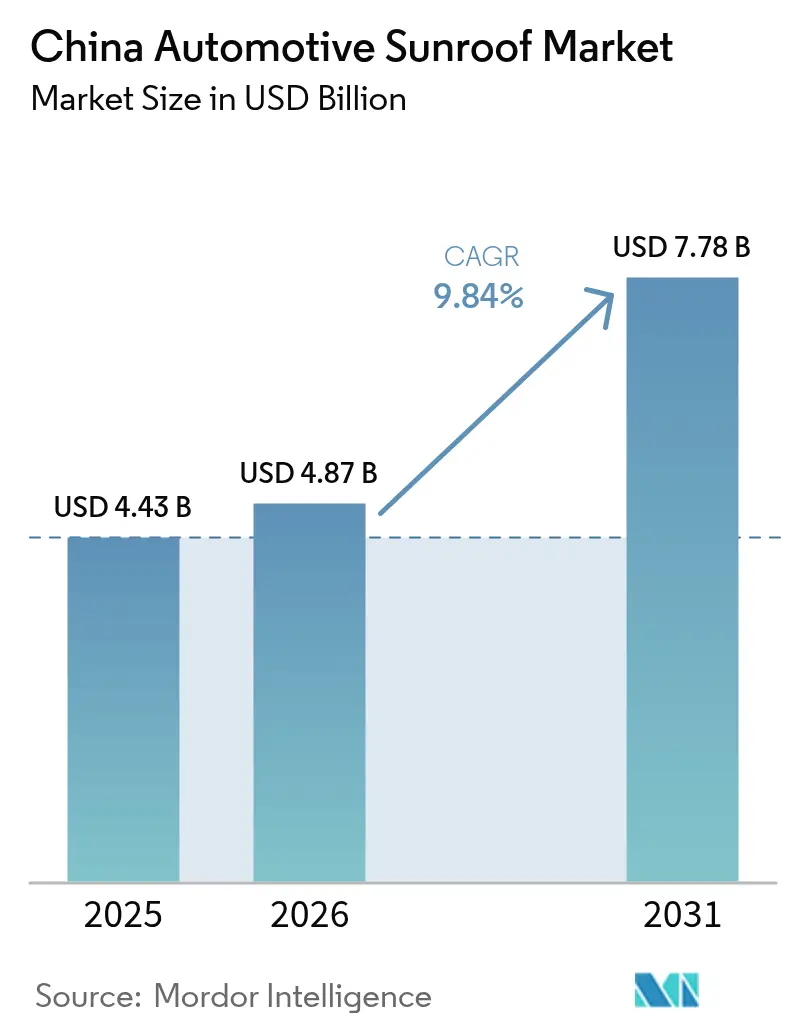
| Base Year Market Size (2025) | USD 4.43 Billion |
| Market Size (2026) | USD 4.87 Billion |
| Market Size (2031) | USD 7.78 Billion |
| Growth Rate (2026 - 2031) | 9.84 % |
| Market Concentration | Medium |
Major Players *Disclaimer: Major Players sorted in no particular order Image © Mordor Intelligence. Reuse requires attribution under CC BY 4.0. | |
China Automotive Sunroof Market Analysis by Mordor Intelligence
The Chinese automotive sunroof market size is expected to grow from USD 4.43 billion in 2025 to USD 4.87 billion in 2026 and is forecast to reach USD 7.78 billion by 2031 at 9.84% CAGR over 2026-2031. New energy vehicles (NEVs) are being rapidly adopted, SUV sales are strong, and consumers increasingly desire premium cabin features. These trends have driven installation rates to levels significantly surpassing the global average. OEMs are now prominently showcasing large glass roofs as technological highlights. Meanwhile, government dual-credit regulations ensure BEV models remain a focal point. The trade balance has been notably affected by exports, with a substantial number of roof modules sent abroad compared to a minimal quantity imported. This disparity highlights the maturity of the domestic supply chain. A moderate concentration in the market empowers local suppliers to rival global players, capitalizing on vertical integration, cost benefits, and strategies aimed at expanding into Europe.
Key Report Takeaways
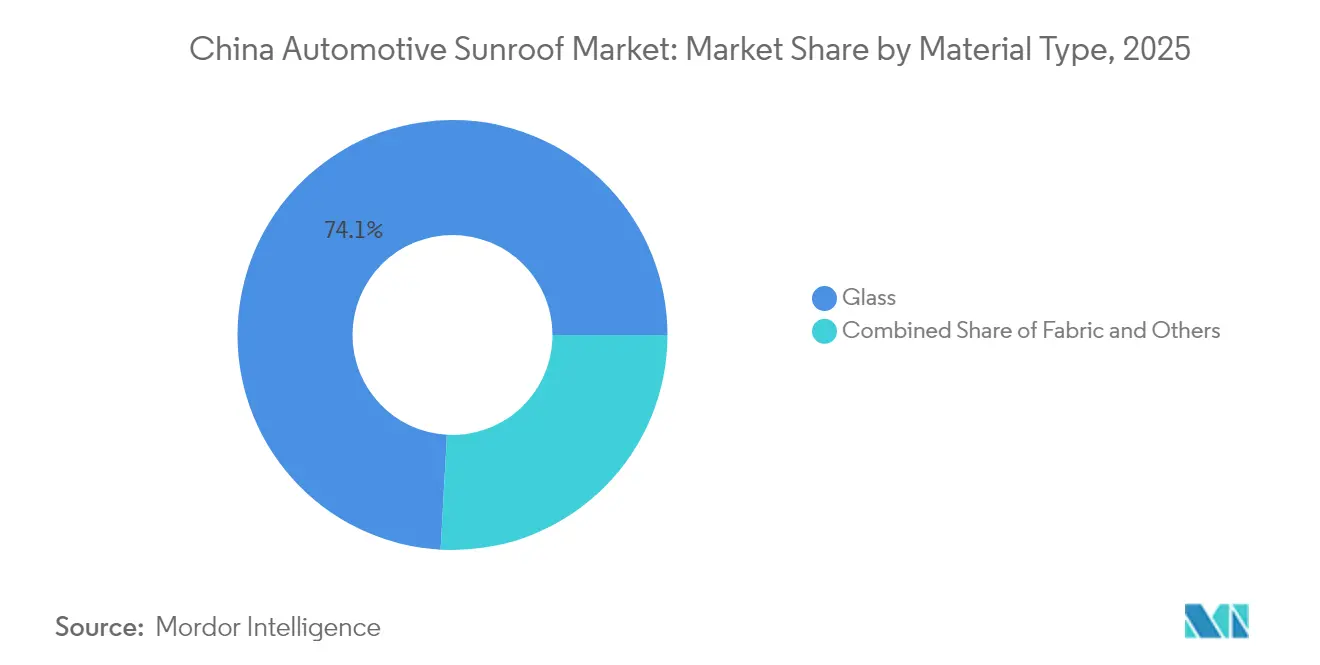
- By material, glass maintained leadership with 74.12% of the Chinese automotive sunroof market share in 2025, while fabric alternatives are projected to climb at a 9.86% CAGR through 2031.
- By sunroof system type, panoramic configurations led with a 56.05% revenue share in 2025; the segment is projected to advance at a 9.89% CAGR to 2031.
- By operation type, electric mechanisms controlled 82.95% of the Chinese automotive sunroof market share in 2025, and it is also expected to record the highest projected CAGR at 9.94% through 2031.
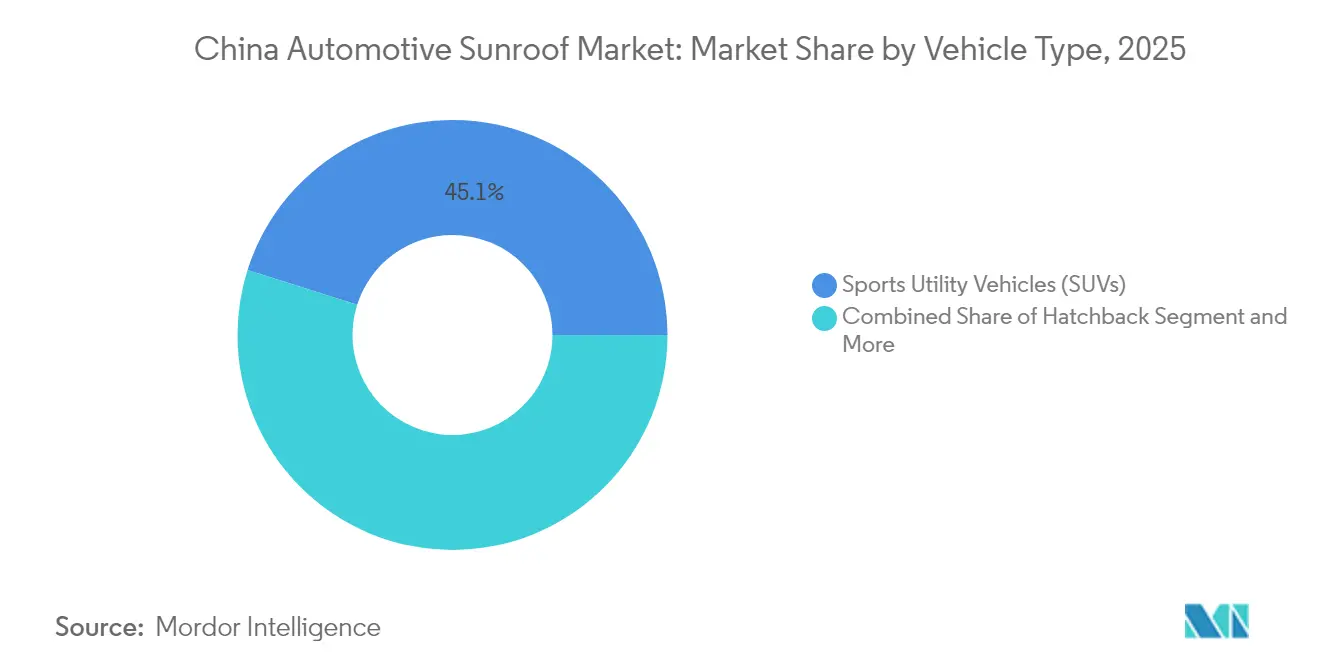
- By vehicle type, sports utility vehicles accounted for 45.12% of the China automotive sunroof market size in 2025 and are set to grow at a 9.91% CAGR between 2026 and 2031.
- By propulsion, internal combustion engine cars held 60.74% of the Chinese automotive sunroof market size in 2025, but BEVs are forecast to register a 9.95% CAGR to the end of the decade.
Note: Market size and forecast figures in this report are generated using Mordor Intelligence’s proprietary estimation framework, updated with the latest available data and insights as of 2026.
China Automotive Sunroof Market Trends and Insights
Drivers Impact Analysis*
| Driver | (~) % Impact on CAGR Forecast | Geographic Relevance | Impact Timeline |
|---|---|---|---|
| Rising Consumer Demand | +2.8% | National, with early gains in Tier-1 cities | Medium term (2-4 years) |
| SUV Body-Style Proliferation | +2.1% | National, strongest in urban markets | Short term (≤ 2 years) |
| Government NEV Incentives | +1.9% | National, with policy concentration in major cities | Long term (≥ 4 years) |
| OEM Differentiation | +1.6% | National, with premium segment focus | Medium term (2-4 years) |
| Low-E & Solar Glass Lowering Cabin Heat Load | +1.2% | National, with southern China emphasis | Long term (≥ 4 years) |
| Tier-2 Vertical Integration Cutting Module Costs | +0.4% | National, with manufacturing hub concentration | Short term (≤ 2 years) |
| Source: Mordor Intelligence | |||
Rising Consumer Demand for Premium Vehicle Features
A significant majority of EV customers in China are willing to pay additional costs for panoramic roofs. This trend, reflecting rising disposable incomes, is particularly pronounced among younger urban residents who cherish an open-cabin ambiance. Mainstream brands like BYD and Geely are now equipping their volume models with rail-to-rail glass, leading to a notable increase in overall adoption rates when this feature is standard. This shift in consumer behavior, once confined to luxury segments, is now benefiting OEMs with higher margins and ensuring stable volume growth for suppliers in China's sunroof market.
SUV Body-Style Proliferation with High Sunroof Penetration
In 2024, SUVs constitute a significant portion of unit demand and are experiencing robust growth, driven by their roofline design that accommodates larger openings. Premium SUV trims demonstrate much higher penetration rates compared to their sedan counterparts. Domestic manufacturers prioritize panoramic integration during the platform design stage, resulting in cabins that feel more spacious and brighter. A shift in consumer preferences towards family-oriented features continues to support the strong demand in China's automotive sunroof market.
Government New Energy Vehicle (NEV) Incentives Favouring Panoramic Glass Roofs
China’s dual-credit system and purchase subsidies push OEMs to upscale EV interiors and differentiate through visible technology cues. Panoramic roofs, especially those with solar harvesting films, align with national carbon goals and qualify for supplemental local incentives in megacities such as Shanghai and Shenzhen [1]. The resulting pull effect magnifies BEV penetration and cements demand momentum over the long term.
OEM Differentiation Via Comfort and Aesthetics
From NIO to SAIC-Volkswagen, brands rely on panoramic glazing to stand out in crowded segments. Electrochromic dimming, ambient lighting, and integrated solar cells enable premium pricing without requiring redesign of major mechanical systems. The strategy enhances customer satisfaction scores, boosts repeat-purchase intent, and strengthens the company's competitive position in the Chinese automotive sunroof market.
Restraints Impact Analysis*
| Restraint | (~) % Impact on CAGR Forecast | Geographic Relevance | Impact Timeline |
|---|---|---|---|
| Sunroof Shatter/Leakage Recalls | -1.8% | National, with premium segment concentration | Short term (≤ 2 years) |
| Weight Penalty Reducing EV Range | -1.2% | National, with BEV segment focus | Medium term (2-4 years) |
| Panoramic Windshield Designs | -0.8% | National, with luxury segment concentration | Medium term (2-4 years) |
| Stricter GB/T Glazing Standards | -0.6% | National, with SME supplier impact | Long term (≥ 4 years) |
| Source: Mordor Intelligence | |||
Sunroof Shatter/Leakage Recalls Harming OEM Trust
High-profile incidents, such as the Polestar 3 glass detachment and drainage failures in FAW-Volkswagen Golf models, have eroded consumer confidence. China’s State Administration for Market Regulation has tightened enforcement of glazing norms under GB 9656-2021, increasing recall risk and warranty costs for automakers [2]. Reputational damage can hinder adoption in premium tiers and impact overall growth.
Weight Penalty Reducing EV Range and Fuel Efficiency
As battery energy density improvements plateau, the additional weight from panoramic modules becomes a significant concern. This weight is particularly critical for compact BEVs aimed at city commuters; even a small reduction can diminish the rated range and jeopardize government subsidy eligibility. While lightweight frames and composite panes have been introduced, they still haven't reached economies of scale in China's automotive sunroof sector.
*Our forecasts treat driver/restraint impacts as directional, not additive. The impact forecasts reflect baseline growth, mix effects, and variable interactions.
Segment Analysis
By Material Type: Glass Dominance Drives Premium Positioning
Glass commanded a 74.12% share in 2025, anchoring a premium image and benefiting from the rapid adoption of Low-E. This material contributed significantly to the China automotive sunroof market size in 2025, underlining its commercial importance. Fuyao Glass's intensive investment helps meet escalating OEM demand while reducing per-unit costs. Advanced electrochromic sheets, mass-produced through a cooperation between Ambilight and NIO, offer a 40-fold dimming range, reinforcing their leadership in the glass industry.
Fabric roofs cater to cost-sensitive buyers, expanding at a 9.86% CAGR, yet still representing a minority share. They offer lighter weight and lower install cost, making them viable for compact EVs. Composite and hybrid substrates remain exploratory but show promise in integrating solar cells and switchable opacity layers, potentially reshaping future demand curves within the Chinese automotive sunroof market.

By Sunroof System Type: Panoramic Systems Lead Innovation Wave
Panoramic units held a 56.05% share in 2025, translating into over 4 million installations. Their 9.89% CAGR outpaces all other formats as consumers seek expansive views and improved ventilation. New-generation rail-to-rail mechanisms provide nearly full-roof transparency without compromising torsional rigidity, thereby fulfilling the updated GB 26134-2024 crush standards.
Built-in and tilt-n-slide variants remain relevant in sedans and compacts, but their growth is slower. Spoiler types stay niche among sports models. Webasto’s Jiaxing plant manufactures external-sliding solutions tailored for local SUVs. It exports them to Southeast Asia, indicating that Chinese engineering can influence the global design language in the Chinese automotive sunroof market.
By Operation Type: Electric Systems Reflect Electrification Leadership
Electric drives accounted for 82.95% of units shipped in 2025, reflecting consumer expectations for push-button convenience. It is also projected to grow at a robust CAGR of 9.94% by 2031, driven by integrated voice control, smartphone apps, and sensor-based auto-close functions.
Manual operation maintains relevance in low-cost models and aftermarket retrofits, favored by fleet buyers aiming to minimize repair complexity. Safety upgrades—such as pinch protection, rain detection, and emergency override—solidify regulatory compliance and underscore why electric systems will remain dominant despite marginal price premiums.
By Vehicle Type: Sports Utility Vehicles Drive Market Expansion
Sports utility vehicles contributed a 45.12% share in 2025 and are projected to grow at a 9.91% CAGR, resulting in an additional multiple roofs by 2031. Elevated seating and headroom enhance the experiential value of panoramic roofs, making them a staple option for family buyers. Rail-to-rail glazing enhances rear-seat daylight, a selling point emphasized in the marketing for the BYD Song L and Geely Boyue L.
Sedans and hatchbacks account for nearly one-third of demand, but they suffer from spatial constraints that limit the length of their glass. MPVs rely on luxury shuttle use cases and remain stable. Sports coupes and convertibles maintain limited volumes yet showcase cutting-edge integrations, such as electrochromic spoilers, reinforcing brand halo effects within the Chinese automotive sunroof market.
By Vehicle Propulsion: Battery Electric Vehicles Emerge as Growth Engine
Internal combustion engine platforms still occupy 60.74% of 2025 installations. However, BEVs represent the fastest-moving cohort with a 9.95% CAGR, adding numerous incremental roofs by 2031. Government mandates targeting two-fifths NEV penetration encourage OEMs to bundle premium features, including full-length glass, to differentiate electric trims.
Solar cell-infused glass facilitates auxiliary charging and heat mitigation, thereby extending the perceived driving range. Hybrid and plug-in hybrid vehicles serve as transitional vehicles, with a moderate annual growth rate of less than one-fifth. As BEV prices fall, their share of the Chinese automotive market will broaden from premium to mass segments, accelerating the trickle-down of technology.
Geography Analysis
Eastern coastal provinces lead in both production and consumption. In Jiangsu, Zhejiang, and Guangdong, companies like Webasto and Fuyao, along with several Tier-2 suppliers, offer OEMs advantages in logistics and reduced freight costs. These provinces boast high sunroof penetration rates in premium vehicles, positioning them as trendsetters in automotive design.
In Tier-1 metros—Beijing, Shanghai, Guangzhou, and Shenzhen—a significant proportion of premium vehicles feature sunroofs, with a growing preference for electrochromic panels. Rising disposable incomes and traffic regulations favoring new energy vehicles (NEVs) pave the way for the swift adoption of solar roofs. Surveys indicate consumers in these cities are willing to pay a premium for electrochromic upgrades, which is notably higher than the national average.
While Tier-2 urban centers like Chengdu, Hangzhou, and Wuhan have comparatively lower sunroof penetration, they're rapidly catching up, bolstered by credit-friendly financing and promotions for NEVs. Although western provinces lag, ongoing infrastructure projects and factory expansions in Chongqing and Xi’an are streamlining supply chains, signaling potential growth for China's automotive sunroof market.
Regulatory Landscape
China automotive sunroof design and validation sit under a mix of component and whole-vehicle standards, and market-access rules administered by MIIT, SAMR, CNCA, and SAC. For assemblies, GB/T 30037-2013 is a core reference for automotive electric sunroof assemblies, while roof strength compliance increasingly ties sunroof engineering to the mandatory roof crush standard GB 26134-2024 (replacing GB 26134-2010). The standard explicitly defines sunroofs and folds them into type-approval criteria for roof crush resistance.
In 2026, regulatory and conformity processes tightened around certification and standardization. CNCA issued 11 new CCC implementation rules on April 16, 2026 for 16 product categories, with a transition toward third-party certification effective July 1, 2026, which raises documentation, testing, and audit demands for component suppliers and exporters. MIIT also released its 2026 Automotive Standardization Work Plan on May 26, 2026, with SAC/TC114 tasked on priority items that affect smart-roof electronics and software (data security, AI risk assessment, and vehicle operating systems). MIIT revised product access review requirements (MIIT Announcement 2026 No. 1), taking effect January 1, 2027, reinforcing quality, traceability, and compliance readiness across the roof module supply base.
Value Chain Analysis
The value chain starts with upstream materials and subcomponents, including float and coated automotive glass (Low-E and increasingly functional layers), aluminum/steel frames and stamped parts, sealants and drainage components, motors and drive mechanisms, and roof electronics (ECUs, sensors, switches, harnesses). Tier-1 roof system suppliers integrate these inputs into complete panoramic or operable modules, validate them to vehicle-level roof crush and glazing requirements, and deliver just-in-sequence to OEM assembly plants. After-sales service then flows back through OEM dealer networks, reflecting warranty sensitivity around leakage and shatter concerns.
China has a mature, localized supply base that supports high penetration of panoramic and electric systems in OEM fitment. The report context points to a strong domestic module ecosystem with meaningful export activity and minimal imports, along with positioning built on vertical integration. On the electronics side, control units and related hardware are increasingly sourced domestically, supported by automotive-grade quality and functional-safety processes (including IATF 16949 and ISO 26262 practices). Film and smart-glass specialists (such as PDLC/electrochromic providers) and glass producers (including Fuyao Glass) also add capability for dimming and thermal management features that OEMs use as visible differentiators in NEV and SUV trims.
Competitive Landscape
The field shows moderate concentration. Webasto leads, relying on its Jiaxing megaplant and localized R&D to tailor modules for Chinese SUVs. Inalfa, now under BAIC Hainachuan, holds a solid share through JV synergies [3]. In recent times, domestic challenger Yutian Guanjia secured a significant market share, capitalizing on its vertically integrated strengths in stamping, glazing, and electronics to drive down system costs.
Local entrants benefit from cost leadership and rapid iteration cycles. Suppliers like Ambilight and Wicue, specializing in electrochromic and PDLC films, enhance the feature offerings for OEMs. In an effort to counter domestic competition and capitalize on foreign exchange revenues, a majority of leading Chinese roof manufacturers are investing in European sites, underscoring their global ambitions.
Webasto is set to debut cross-strut-free panoramic roofs at Auto Shanghai in the near future, a move that champions full-glass visibility for BEVs. Meanwhile, Fuyao's large-scale capacity expansion not only secures upstream float glass and coatings but also ensures locked-in profit margins. XPeng's patent filings on smart window controls and ADAS sensor mounts underscore the rising significance of software integration in the competitive landscape of China's automotive sunroof sector.
China Automotive Sunroof Industry Leaders
-
AISIN SEIKI Co. Ltd
-
Inalfa Roof Systems Group B.V.
-
Yachiyo Industry Co. Ltd
-
Inteva Products LLC
-
Webasto Group
- *Disclaimer: Major Players sorted in no particular order

Market Opportunities and Future Outlook
One clear whitespace is the shift from traditional opening sunroofs toward fixed transparent modules and multifunctional smart roofs that bundle lighting, intelligent shading or dimming, solar elements, and in-cabin interface features into large glass surfaces. This direction shows up in supplier actions as well, including Webasto announcing in May 2026 a joint venture with Zhejiang Fujia Technology to develop and manufacture Fixed Transparent Modules in China (with Webasto holding a 30% stake, pending antitrust approval). The partnership ties product development to Chinese OEM demand for large-format glass roofs as a technology cue.
Opportunities also run through compliance-driven engineering upgrades and localization of advanced glazing and electronics. The move to GB 26134-2024 roof crush requirements, along with tighter enforcement of glazing and recall expectations, increases demand for robust sealing, drainage validation, and structural integration, creating space for suppliers that can demonstrate durability and reduce warranty risk. At the same time, MIIT's 2026 automotive standardization priorities around intelligent connected vehicles and software-adjacent standards support deeper integration of roof ECUs, sensor-linked auto-close, and vehicle OS connectivity. This fits with the domestic supply-chain maturity and export orientation highlighted in the report context as Chinese roof module suppliers push beyond home-market growth.
Recent Industry Developments
- May 2026: Webasto announced a joint venture agreement with Zhejiang Fujia Technology (FJT) to develop and manufacture Fixed Transparent Modules (FTMs) and advanced glass roof systems in China, with Webasto holding a 30% stake pending antitrust approval. The FTMs target higher-value integration such as lighting, intelligent shading, solar technology, and entertainment features, supporting OEM demand for large glass roofs as a smart-cabin differentiator.
- April 2025: Webasto introduced an openable BEV roof module at Auto Shanghai that removes traditional cross struts to maximize transparency and headroom. The concept points to a design push toward larger uninterrupted glass areas while retaining an operable function, influencing competitive product roadmaps in panoramic systems.
- March 2024: Webasto reported that its Chongqing plant reached Start of Production for its first AVP (Automated Valet Parking) sunroof project. The SOP milestone indicates rising integration between roof modules and vehicle automation or sensor-linked features, which raises the bar for electronics validation and manufacturing quality at China-based roof facilities.
Research Methodology Framework and Report Scope
Market Definition and Coverage
This market covers the value of automotive sunroof systems installed in passenger and commercial vehicles sold in China. It includes sunroof hardware and functional systems, counted in USD, and is tracked using a mix of vehicle production, fitment, and pricing signals.
Scope exclusions: Standalone roof glass sold for non-sunroof applications and general body glazing are excluded from this market sizing.
Segmentation Overview
- By Material Type
- Glass
- Fabric
- Others
- By Sunroof System Type
- Built-in
- Tilt-n-Slide
- Panoramic
- Pop-Up / Spoiler
- By Operation Type
- Electric
- Manual
- By Vehicle Type
- Hatchback
- Sedan
- Sports Utility Vehicles (SUVs)
- Multi-Purpose Vehicles (MPVs) / Others
- By Vehicle Propulsion
- Internal Combustion Engines (ICEs)
- Battery Electric Vehicles (BEVs)
- Hybrid Electric Vehicles (HEVs)
- Plug-in Hybrid Electric Vehicles (PHEVs)
Data Sources, Market Sizing, and Validation
Desk Research
Desk research was used to build the base structure of the model and to lock the right demand pool for China. We relied on public production and sales statistics, plus technology and safety references, before translating those signals into sunroof penetration and value.
Typical sources included public releases such as China Association of Automobile Manufacturers statistics, National Bureau of Statistics of China industrial data, China Customs trade data for relevant components, SAE and similar technical papers on glazing and roof systems, and regulator or standards references where roof openings and glazing performance are discussed. We also reviewed automaker annual reports, investor presentations, supplier brochures, and trusted press coverage, and then supplemented remaining gaps with paid subscriptions for company financials and intelligence, patents, and import and export shipment level checks. These examples are not exhaustive, and many other public sources were used to collect, validate, and clarify data points.
Primary Interviews and Surveys
Primary inputs were gathered through interviews and surveys with OEM-facing suppliers, component specialists, distributors, and industry consultants active in China. These discussions were used to confirm fitment rates by vehicle class, typical content per vehicle (including panoramic adoption), and realistic price movement, then to sanity-check the modeled totals across major manufacturing clusters.
Distribution of primary research fieldwork respondents
| Company type | Respondent position |
|---|---|
| Top tier: 39% | CXOs: 15% |
| Mid tier: 42% | Functional/Unit leaders: 36% |
| Smaller Players: 19% | Managers: 49% |
Market-Sizing & Forecasting
Market sizing started with a top-down build where China vehicle production and sales were reconstructed by major vehicle categories, then translated into an addressable sunroof demand pool using fitment and option take-rate assumptions. Those rates were adjusted using indicators like SUV mix, new energy vehicle penetration, the share of panoramic roofs, electric versus manual operation preference, and material mix shifts toward glass.
Once the volume pool was established, value was derived using average selling prices that reflect system type, motorization, and complexity, then converted into USD using consistent exchange-rate timing. To keep totals realistic, we corroborated results with selective bottom-up approximations such as sample supplier revenue splits, OEM program checks, and channel checks on typical price bands, then corrected for gaps where smaller suppliers are not fully visible in public data. Forecasts were built using scenario analysis tied to expected vehicle output, feature penetration trends, and pricing progression, and the inputs were stress-tested through expert feedback so the assumptions stay explainable and repeatable.
Data Validation & Update Cycle
Outputs were validated through multiple checks so the totals align with independent market signals. We compared implied units to vehicle builds, checked penetration results against observed model launches and trim strategies, and reviewed pricing against known bill-of-material direction and material mix.
If a variance looked material, analysts revisited the assumption, rechecked the supporting source, and re-contacted respondents to confirm what changed and why. The report is refreshed annually, and interim updates are triggered when there are clear events such as sharp vehicle demand swings, major regulation changes, or large pricing moves in key inputs. Before delivery, a final analyst pass is completed so the latest public releases are reflected in the numbers.
Mordor Intelligence's China Automotive Sunroof Market Estimate Compared With Other Published Estimates
Published market sizes for China automotive sunroofs do not always line up because each publisher can count a different revenue boundary, use different base years, and apply different price and penetration assumptions. Differences also show up when a model leans more on production-led signals versus reported revenues, or when currency timing and inflation handling are not consistent.
Key gap drivers usually come from what is counted as the market and how fast the average system price is assumed to move as panoramic and electric systems gain share. Some estimates also blend OEM-installed demand with retrofit activity, or they carry forward older vehicle mix assumptions even though the SUV share and NEV mix in China can shift quickly year to year.
Benchmark comparison
| Source | Market Size | Gaps in Research Methodology |
|---|---|---|
| Mordor Intelligence | USD 4.43 B (2025) | |
| Industry Publisher A | USD 3.16 B (2023) | Uses an earlier base year, and the value appears to be anchored to a narrower installed base at that time, which can understate the impact of later SUV and panoramic fitment gains. |
| Research Provider B | USD 3.37 B (2024) | Counts OEM and aftermarket together, which can shift totals depending on how retrofit volumes and prices are assumed, and it can also change year-to-year comparability if channel splits are not validated. |
Aftermarket sunroof retrofits sit outside Mordor Intelligence's scope, and that exclusion explains part of the spread when another publisher blends OEM installation value with retrofit demand. When the scope is kept consistent and the model is tied back to vehicle output, penetration, and realistic price bands, the result is easier to trace and to update as China vehicle mix changes.
Key Questions Answered in the Report
What is the current value of the Chinese automotive sunroof market?
The market is valued at USD 4.87 billion in 2026 and is on track to reach USD 7.78 billion by 2031.
How fast is demand for panoramic sunroofs growing?
Panoramic systems are expanding at a 9.89% CAGR through 2031, well above the overall market pace.
Which vehicle category installs sunroofs most frequently?
SUVs lead with a 45.12% share in 2025 and remain the fastest-growing body style at a 9.91% CAGR.
Why are electric sunroof mechanisms so dominant?
Electric drives hold an 82.95% share because Chinese buyers expect automated one-touch operation, and OEMs integrate voice or app control to add value.
How do quality recalls affect market growth?
Recalls tied to glass detachment and leakage can shave up to 1.8 percentage points off forecast CAGR by damaging consumer trust and prompting stricter regulation.
Which companies are gaining share in China’s sunroof space?
Webasto retains leadership, but domestic supplier Yutian Guanjia rose a significant share in 2025 by combining vertical integration with competitive pricing.