
China Almond Market Size and Share
China Almond Market Analysis by Mordor Intelligence
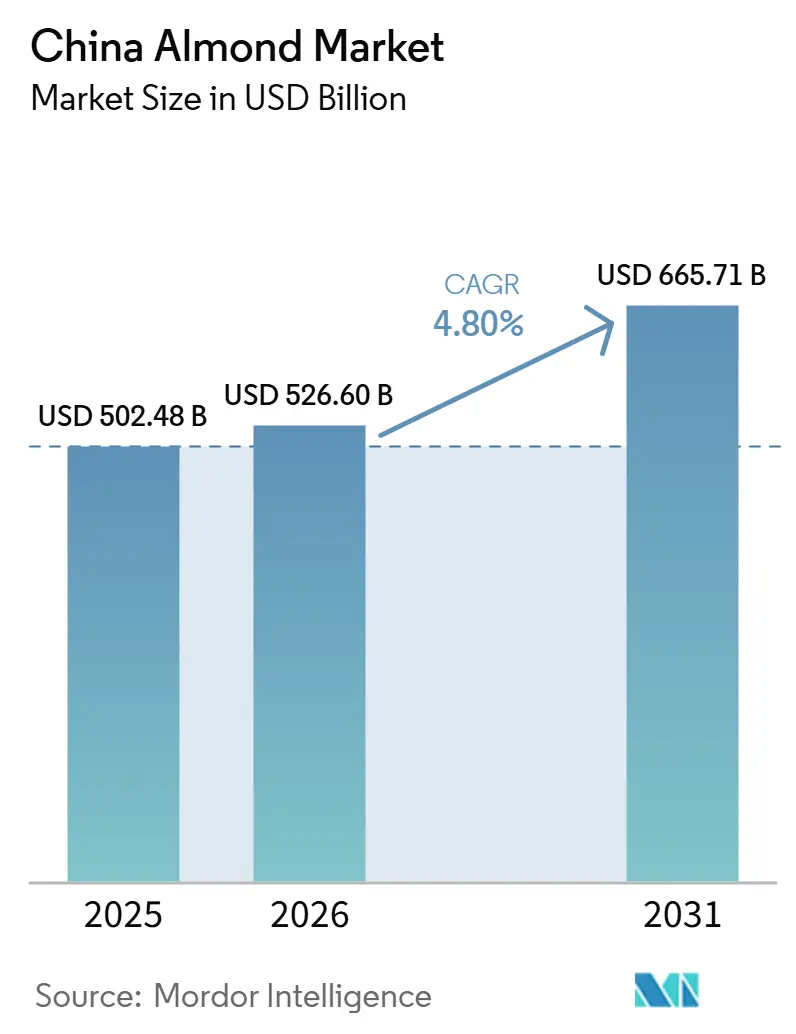
The China almond market size was valued at USD 502.48 billion in 2025 and is forecast to grow from USD 526.60 billion in 2026 to USD 665.71 billion by 2031, at a CAGR of 4.80% from 2026 to 2031.. China relies heavily on imported almonds, as domestic cultivation remains limited and insufficient to meet rising consumption across food and beverage applications. Consumption is expanding due to growing preference for healthier snacks, premium bakery products, confectionery, dairy alternatives, and functional food formulations. International suppliers, particularly from Australia and the United States, play a key role in ensuring consistent product availability, while changes in trade policies, import costs, and sourcing strategies continue to influence procurement decisions. Market participants are increasingly focusing on product innovation, premium packaging, and diversified distribution channels to strengthen their presence across retail, foodservice, and e-commerce platforms.
Key Report Takeaways
China's almond supply is heavily dependent on imports, with Australia emerging as the primary supplier following zero-tariff access under the China-Australia Free Trade Agreement. Domestic production remains concentrated in Xinjiang, while demand is driven by snack foods, bakery and confectionery products, plant-based beverages, and food ingredient applications.
Note: Market size and forecast figures in this report are generated using Mordor Intelligence’s proprietary estimation framework, updated with the latest available data and insights as of January 2026.
Worldwide, activity is shaped by contributions from multiple countries and regions, with China representing one among them. The global report on almond market by Mordor Intelligence reflects how these countries and regional layers combine into a single system.
China Almond Market Trends and Insights
Drivers Impact Analysis*
| Driver | (~) % Impact on CAGR Forecast | Geographic Relevance | Impact Timeline |
|---|---|---|---|
| Health-oriented snacking and functional nutrition | +1.5% | National, with strongest uptake in Beijing, Shanghai, Shenzhen, and Chengdu | Medium term (2-4 years) |
| Expansion of plant-based dairy alternatives | +1.1% | National, with early momentum in coastal urban centers and growing adoption in inland cities | Long term (≥ 4 years) |
| E-commerce and live-commerce penetration | +0.8% | National, with demand concentrated among urban consumers aged 18-35 | Short term (≤ 2 years) |
| Growing bakery, confectionery and café applications | +0.7% | National, with activity in East China food-processing clusters and urban café markets | Medium term (2-4 years) |
| Zero-tariff and supply-diversification benefits for Australian almonds | +0.9% | National import market, with sourcing moving from California to Australia | Short term (≤ 2 years) |
| Almond-based product localization for Chinese taste preferences | +0.5% | National, with flavor development centered among Chinese snack brands | Medium term (2-4 years) |
| Source: Mordor Intelligence | |||
Health-Oriented Snacking and Functional Nutrition
Health-oriented snacking is driving almond consumption in China as consumers increasingly prefer nutritious, convenient, and portion-controlled foods for everyday use rather than seasonal gifting. Branded manufacturers are expanding roasted, flavored, and mixed-nut offerings through modern retail and e-commerce channels, supporting higher demand for imported almond kernels. According to the United States Department of Agriculture (USDA) Foreign Agricultural Service (2025), China had more than 338,000 bakery outlets as of April 2025, reflecting the growing use of almonds in healthy snacks and value-added food products beyond traditional consumption[1]Source: USDA Foreign Agricultural Service, “Baking Ingredients Market Update 2025,” apps.fas.usda.gov.. This trend continues to support sustained growth in almond imports and packaged nut sales.
Expansion of Plant-Based Dairy Alternatives
Plant-based dairy alternatives are creating new growth opportunities for the China almond market as consumers increasingly seek lactose-free and health-focused beverage options. Almond milk is gaining wider adoption in cafés, bakeries, and food manufacturing, driving demand for almond flour, paste, and blanched kernels as functional ingredients. According to Olam Food Ingredients (2024), the company opened its fifth Customer Solutions Center in Shanghai to support Chinese food manufacturers with application development for bakery, beverage, and dairy-alternative products. The expansion reflects rising industry demand for value-added almond ingredients and continued innovation across China's plant-based food market.
E-Commerce and Live-Commerce Penetration
E-commerce and live-commerce are accelerating almond consumption in China by improving product visibility, consumer engagement, and repeat purchasing across digital retail platforms. Online channels enable brands to introduce new flavors, packaging formats, and promotional campaigns while reaching consumers beyond traditional retail networks. According to the Three Squirrels Co., Ltd. 2025 Annual Report, online sales generated RMB 7.176 billion (USD 1.06 billion), accounting for 70.43% of the company's total revenue in 2025, highlighting the growing importance of digital commerce in nut product sales. This trend continues to strengthen demand for imported almonds across China's branded snack market.
Zero-Tariff and Supply-Diversification Benefits for Australian Almonds
Growing bakery, confectionery, and café applications are strengthening industrial demand for almonds in China, as manufacturers increasingly use almond flour, sliced almonds, paste, and butter in premium baked goods, desserts, chocolates, and specialty beverages. Food processors require a consistent supply of value-added almond ingredients, thereby encouraging imports beyond whole kernels. According to the Almond Board of Australia (2025), Australian almond exports to China increased by 128% during the 2024–25 selling season, while in-shell exports reached 79,696 metric tons[2]Source: Almond Board of Australia, “Unprecedented Sales Year for Australian Almonds,” almondboard.org.au.. The strong export growth reflects rising demand from China's expanding bakery, confectionery, café, and food ingredient industries.
Restraints Impact Analysis*
| Restraint | (~) % Impact on CAGR Forecast | Geographic Relevance | Impact Timeline |
|---|---|---|---|
| Import-cost and tariff volatility | -1.2% | National import market, with a strong effect on United States-origin almonds entering major ports | Short term (≤ 2 years) |
| Climate-sensitive domestic production in Xinjiang | -0.5% | Xinjiang, primarily Shache County, affecting domestic supply and price stability | Medium term (2-4 years) |
| Stringent import compliance and allergen-control requirements | -0.4% | National, including border inspections and food-labeling compliance | Medium term (2-4 years) |
| Competition from lower-priced nuts and snack alternatives | -0.8% | National, with a stronger effect in lower-tier cities | Long term (≥ 4 years) |
| Source: Mordor Intelligence | |||
Import-Cost and Tariff Volatility
Import costs and tariff uncertainty continue to constrain China's almond market by raising procurement costs and limiting sourcing flexibility for importers. China's limited domestic almond production makes the market highly dependent on imports, exposing processors to trade policy changes and price volatility. According to the Almond Board of California (2025), United States-origin almonds remain subject to an effective 45% import tariff in China, while Australian almonds continue to benefit from zero-duty access under the China-Australia Free Trade Agreement. This tariff disparity has shifted sourcing patterns toward Australia and increased cost pressures across China's almond supply chain.
Climate-Sensitive Domestic Production in Xinjiang
Climate-sensitive domestic production affects the China almond market by creating supply uncertainty and increasing dependence on imports. Almond orchards remain highly vulnerable to spring sandstorms, frost, and cold winter temperatures, which reduce pollination and lower yields. According to Produce Report China (2025), China's almond production is estimated at 22,000 metric tons in MY 2025/26, down 8% from the previous season, following spring sandstorms that disrupted pollination in Xinjiang[3]Source: Jing Zang, "China's Macadamia and Pecan Production Set To Surge in 2025/26," Produce Report.. This weather-induced decline highlights the limited resilience of domestic production and reinforces the market's reliance on imported almonds to meet growing industrial and consumer demand.
*Our forecasts treat driver/restraint impacts as directional, not additive. The impact forecasts reflect baseline growth, mix effects, and variable interactions.
Geography Analysis
Australia has become the primary external supplier of almonds to China due to reliable production, stable logistics, and preferential market access under the China-Australia Free Trade Agreement. Australian exporters supply almonds for snack foods, bakery, confectionery, dairy alternatives, and food ingredient applications. This competitive advantage has encouraged Chinese importers and food manufacturers to strengthen long-term procurement relationships while reducing sourcing risks associated with changing global trade conditions. Consistent quality standards and efficient shipping routes continue to reinforce Australia's position in China's almond import supply chain.
The United States remains an important global almond producer, though its competitiveness in China has declined due to higher import duties and shifting procurement strategies. Chinese buyers are increasingly diversifying sourcing across Australia, the United States, and Spain to improve supply security and maintain year-round product availability. Imported almonds primarily enter through major coastal ports before being distributed to food manufacturers, retailers, and e-commerce channels across key consumption centers. Xinjiang remains China's principal domestic production region, although most locally produced almonds are consumed within the province rather than distributed nationwide.
Domestic production remains insufficient to meet China's growing almond demand, making imports essential to maintaining a stable year-round supply. Multiple sourcing origins help reduce procurement risks, although imported almonds continue to dominate industrial applications. According to the Almond Board of Australia (2025), exports increased by 35% year-over-year during the 2024–25 March–February selling season, contributing to Australia's record almond sales performance. The continued expansion of export shipments reflects China's importance as a destination within Australia's broader almond export strategy.
Competitive Landscape
The China almond market has a concentrated upstream supply base supported by international exporters and a fragmented downstream segment comprising domestic snack brands, ingredient suppliers, and food manufacturers. Competition is primarily based on product quality, pricing, supply reliability, and long-term commercial relationships. Australian suppliers continue to strengthen their presence through favorable trade access, while Chinese companies compete by expanding their value-added product portfolios, strengthening omnichannel distribution, and improving consumer engagement through retail, e-commerce, and live-commerce platforms.
International suppliers increasingly differentiate themselves by offering customized ingredient formats, including blanched kernels, sliced almonds, flour, paste, and butter for bakery, confectionery, dairy alternatives, and foodservice applications. Chinese brands such as Three Squirrels, Bestore, and Chacha focus on product innovation, premium packaging, and digital marketing to expand market reach. Companies are also investing in technical support and application development to strengthen relationships with commercial food manufacturers and improve customer retention across industrial and retail distribution channels.
Competition continues to evolve through portfolio diversification and strategic collaborations that strengthen brand visibility and consumer engagement. Suppliers are expanding beyond traditional almond products by introducing new snack formats and forming retail partnerships to reach new consumer segments. According to the Blue Diamond 2025 Annual Report, the company partnered with Oppy to launch fresh almond-fruit blends in 2025, expanding its presence in the fresh produce category. This demonstrates how almond companies are differentiating themselves through product innovation and strategic partnerships.
Recent Industry Developments
- August 2025: The Xinjiang Uygur Autonomous Region Government released the Three-Year Action Plan for High-Quality Development of Agricultural Product Processing (2025–2027), which supports the modernization of agricultural processing, value-added food manufacturing, and the development of regional processing clusters. The initiative benefits nut-processing industries, including almond processing in Xinjiang.
- June 2025: HBAF Company expanded its retail presence in China by opening a new offline store in Shanghai. This is the company's second physical store in China, following the launch of its Chongqing outlet in 2024, and further strengthens its distribution network for flavored almond products in the Chinese market.
- October 2024: Olam Food Ingredients Pte. Ltd. (Olam Group Limited) opened its fifth Customer Solutions Center in Shanghai, expanding local application development and technical support for food manufacturers using ingredients including almonds.


China Almond Market Report Scope
Almonds are the edible seeds of the almond tree, valued for their high protein content, healthy fats, vitamins, and minerals. They are widely consumed as snacks and used in bakery, confectionery, dairy alternatives, beverages, and food ingredient applications.
The China Almond Market Report Includes Production Analysis (Volume), Consumption Analysis (Value and Volume), Export Analysis (Value and Volume), Import Analysis (Value and Volume), Wholesale Price Trend Analysis and Forecast, Regulatory Framework, Logistics and Infrastructure, and Seasonality Analysis. The Market Forecasts are Provided in Terms of Value (USD) and Volume (Metric Tons).
| Production Volume |
| Area Harvested and Yield |
| Import Market Analysis | Import Value and Volume |
| Key Supplying Markets | |
| Export Market Analysis | Export Value and Volume |
| Key Destinations Markets |
| Production Analysis | Production Volume | |
| Area Harvested and Yield | ||
| Trade Analysis (Value and Volume) | Import Market Analysis | Import Value and Volume |
| Key Supplying Markets | ||
| Export Market Analysis | Export Value and Volume | |
| Key Destinations Markets | ||


Key Questions Answered in the Report
What is the forecast growth rate for almonds in China?
The China almond market is forecast to grow at a CAGR of 4.80% from 2026 to 2031, increasing from USD 526.60 billion in 2026 to USD 665.71 billion by 2031.
Which country is China's leading almond supplier?
Australia is the leading supplier of the almonds to China.
Why have Australian almond imports increased in China?
Australian almonds have zero-tariff access under the China-Australia Free Trade Agreement, while United States-origin almonds face a 45% effective import tariff.
What are the main uses of almonds in China?
The main uses include snacks, bakery and confectionery products, plant-based beverages and dairy alternatives, and food ingredient processing.
Page last updated on:


 Your data is secure and never sold or shared.


