
Market Overview
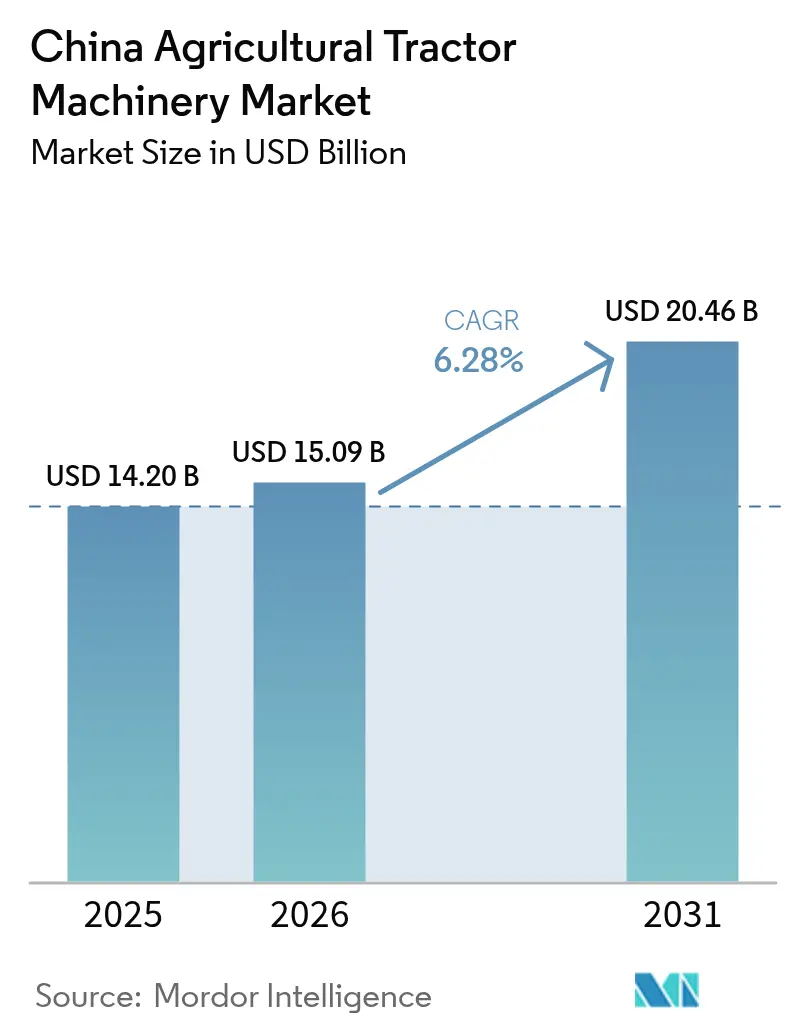
| Study Period | 2021 - 2031 |
|---|---|
| Forecast Data Period | 2026 - 2031 |
| Base Year Market Size (2025) | USD 14.20 Billion |
| Market Size (2026) | USD 15.09 Billion |
| Market Size (2031) | USD 20.46 Billion |
| Growth Rate (2026 - 2031) | 6.28 % |
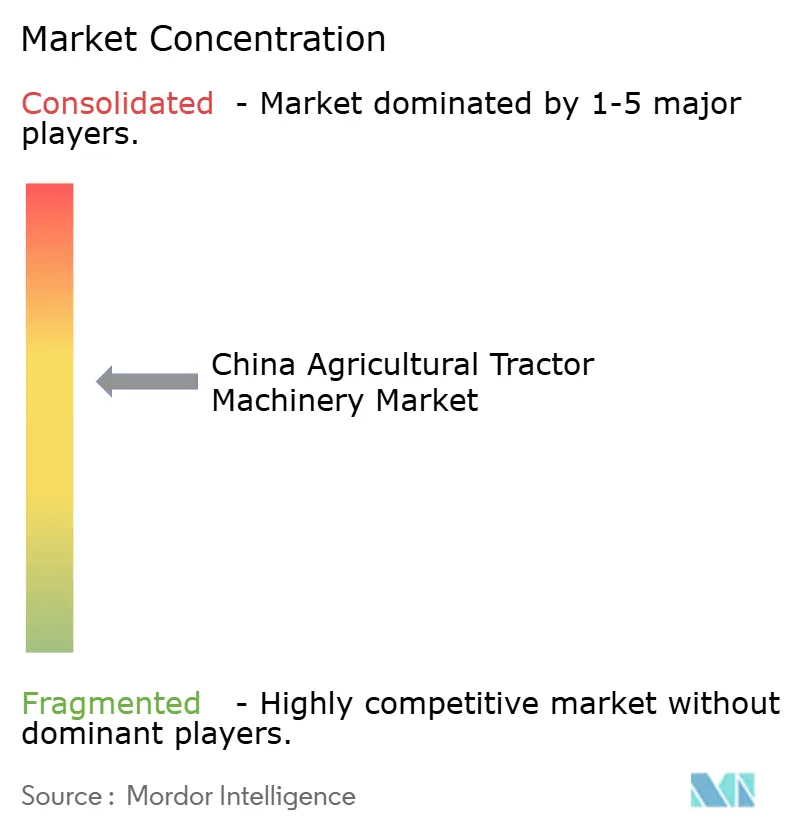
| Market Concentration | Medium |
Major Players *Disclaimer: Major Players sorted in no particular order Image © Mordor Intelligence. Reuse requires attribution under CC BY 4.0. | |
China Agricultural Tractor Machinery Market Analysis by Mordor Intelligence
The China agricultural tractor machinery market size is expected to grow from USD 14.20 billion in 2025 to USD 15.09 billion in 2026 and is forecast to reach USD 20.46 billion by 2031 at 6.28% CAGR over 2026-2031. Robust trade-in subsidies now cover not just tractors but precision implements, helping growers replace underpowered seed drills and sprayers with high-tech, Beidou-enabled solutions that lift productivity while meeting National IV compatibility rules. Land-consolidation policies fuel demand for wider implements that single operators can run efficiently, while Beijing’s spectrum-fee waiver slashes the cost of field guidance packages. At the same time, rural wage inflation and an aging labor force are compressing seasonal windows, creating a clear business case for 12-row planters, eighteen-meter boom sprayers, and net-wrap round balers that significantly reduce labor hours. Yet adoption remains uneven, tight credit quotas and a shortage of International Organization for Standardization Bus-certified technicians lengthen the payback horizons for smallholders, slowing unit turnover and maintaining a two-speed equipment landscape inside the China agricultural tractor machinery market.
Key Report Takeaways
- By product type, plowing and cultivating machinery led with 43.55% of the China agricultural tractor machinery market size in 2025, and sprayers are forecast to expand at an 8.02% CAGR through 2031.
Note: Market size and forecast figures in this report are generated using Mordor Intelligence’s proprietary estimation framework, updated with the latest available data and insights as of 2026.
China Agricultural Tractor Machinery Market Trends and Insights
Drivers Impact Analysis*
| Driver | (~) % Impact on CAGR Forecast | Geographic Relevance | Impact Timeline |
|---|---|---|---|
| Government trade-in subsidies for implements | +1.80% | National, strongest in Heilongjiang, Henan, and Shandong | Short term (≤ 2 years) |
| Rural labor shortage and aging workforce | +1.50% | Nationwide, and most acute in Northeast grain belt | Medium term (2-4 years) |
| Upgrade to National IV emission standards | +1.20% | Nationwide, and strict audits in Beijing-Tianjin-Hebei and Yangtze Delta | Short term (≤ 2 years) |
| Expansion of large-scale commercial farms | +1.10% | Northeast and Northwest, notably Xinjiang and Inner Mongolia | Long term (≥ 4 years) |
| Beidou-enabled autonomous guidance for implements | +0.70% | Nationwide, and early wins in Heilongjiang and Xinjiang | Medium term (2-4 years) |
| Telematics-based machinery service cooperatives | +0.40% | East and Central China, and radiating to Southwest | Medium term (2-4 years) |
| Source: Mordor Intelligence | |||
Government Trade-In Subsidies for Implements
Beijing earmarked CNY 300 billion (USD 41.7 billion) for machinery upgrades through 2026, funneling roughly 28%, around CNY 84 billion (USD 11.7 billion) into implements that meet National IV compatibility, Beidou guidance, or variable-rate criteria.[1] Rebates shave 12-18% off purchase prices, propelling the rapid retirement of 280,000 legacy implements in 2024 and tilting market share toward domestic brands that satisfy 55% local-content thresholds. The incentive cut replacement cycle was extended to eight years, giving the China agricultural tractor machinery market fresh momentum as provincial match funding stacked on top of central support.
Rural Labor Shortage and Aging Workforce
The farm workforce shrank by 8.3 million between 2020 and 2024, and the median age touched 56 years, forcing growers to pivot toward single-operator solutions.[2] No-till planters reduced labor inputs by 44% per hectare, while net-wrap round balers reduced the number of baling crews from four individuals to one, helping to implement sales above a six-meter working width surge by 13.2%. The trend directly contributes to rising unit values and increased demand for pull-through parts within the China agricultural tractor machinery market.
Upgraded to National IV Emission Standards
Cleaner engines consume 8-12% more parasitic power, prompting implement manufacturers to redesign hydraulic circuits and replace fluid motors with electric drives, adding (CNY 12,000–CNY 25,000) USD 1,665–USD 3,470 to manufacturing costs.[3] Regions with strict enforcement check for ISO 11783 compliance before granting subsidies, accelerating consolidation among suppliers, and nudging average selling prices higher across the China agricultural tractor machinery market.
Expansion of Large-Scale Commercial Farms
Land-transfer reforms have consolidated small plots into 500-mu blocks, particularly in Heilongjiang, Xinjiang, and Inner Mongolia. Large cooperatives are turning to 12-row planters and eighteen-meter sprayers that reduce field passes and conserve fuel, resulting in a 16.8% increase in wide-planter sales during 2024.[4] In turn, premium electric metering, heavy-duty coulters, and residue managers enter mainstream demand, raising the technical baseline of the China agricultural tractor machinery market.
Restraints Impact Analysis*
| Restraint | (~) % Impact on CAGR Forecast | Geographic Relevance | Impact Timeline |
|---|---|---|---|
| High upfront price of precision implements | −0.9% | Nationwide, and toughest in Southwest and Central counties | Short term (≤ 2 years) |
| Farm-income volatility from commodity and weather swings | −0.6% | Nationwide, and heightened in rain-fed North and Southwest | Medium term (2-4 years) |
| Shortage of precision-implement technicians | −0.4% | Remote counties in Southwest and Northwest | Long term (≥ 4 years) |
| Tight rural credit quotas for smallholders | −0.3% | Nationwide, and severe where real-estate exposure is high | Short term (≤ 2 years) |
| Source: Mordor Intelligence | |||
Farm-Income Volatility from Commodity and Weather Swings
Significant corn price fluctuations, combined with climate-related yield losses, continue to reduce free cash flow for farmers, constraining their ability to invest in equipment upgrades. In provinces such as Henan and Shandong, these financial pressures have led to a 14–19% decline in cash purchases of agricultural implements in 2024. While larger farms are increasingly adopting lease-to-own arrangements, demand for high-specification or specialty attachments remains weak, limiting short-term growth prospects for the China agricultural tractor machinery market.
Shortage of Precision-Implement Technicians
Only 11% of rural dealerships employ technicians certified in ISOBUS (International Organization for Standardization Bus) diagnostics, resulting in extended repair times for electronic and precision-control faults. The average service turnaround time has reached nearly ten days, and limited technical expertise has driven repair costs to nearly three times the usual levels. This prolonged downtime discourages some farmers from adopting advanced, electronically integrated systems, leading them to continue relying on older mechanical gear-drive platforms. Consequently, the adoption of smart tractor-mounted technologies remains slow.
*Our forecasts treat driver/restraint impacts as directional, not additive. The impact forecasts reflect baseline growth, mix effects, and variable interactions.
Segment Analysis
By Product Type: Sprayers Surge While Plowing and Cultivating Machinery Dominates Market
Plowing and cultivating machinery accounted for about 43.55% of the China agricultural tractor machinery market in 2025. This dominance is due to the continued importance of rotovators and strip-till cultivators in rice–wheat and wheat–maize rotations, which maintains their significance in farming operations. In the plowing segment, conservation-tillage equipment offers higher margins, with demand for strip-till units increasing significantly in 2024 as farmers responded to incentives promoting soil health. These agronomic and economic drivers ensure that conservation-tillage implements will remain a key element of the agricultural tractor machinery market in China. Sprayers register the fastest 8.02% CAGR as pesticide-reduction mandates encourage GPS-guided boom rigs and UAV applicators that cut chemical overlap by up to 25%.
Planting machinery is witnessing steady growth as cooperatives increasingly adopt electric-meter planters compatible with tractor ISOBUS (International Organization for Standardization Bus) terminals. The haying and forage equipment segment is also expanding, driven by demand from the dairy sector in regions such as Inner Mongolia and Xinjiang, where net-wrap balers are gaining significant traction. Additionally, specialty implements, including orchard sprayers and narrow-track cultivators, are benefiting from zero-emission regulations in peri-urban areas, contributing to sustained growth in these niche segments of the China agricultural tractor machinery market.


Geography Analysis
Northeast China remains a key hub for agricultural implement revenue, driven by the needs of large farms for wide planters, high-capacity sprayers, and net-wrap balers. The region benefits from a provincial smart-agriculture fund valued at (CNY 8 billion) USD 1.1 billion, which supports the adoption of Beidou-compatible machinery, fostering modernization. In North China, versatile cultivators and haying equipment are in demand, particularly to support Inner Mongolia’s livestock clusters. Together, these regions are shaping the demand for advanced implements and contributing to the growth of China’s tractor-mounted machinery market.
In East China, the prevalence of fragmented 1-hectare (15-mu) plots encourages the use of compact and efficient implements, such as small rotovators and rice transplanters, which are well-suited to the region's highly subdivided farm structures. Cooperative initiatives in Shandong are gradually shifting the machinery mix toward larger 8-row planters, increasing the average selling price of equipment. These developments highlight how smallholder consolidation and mechanization incentives are reshaping demand patterns, promoting the adoption of precision planting solutions while ensuring compatibility with existing tractor-mounted machinery.
Central and South China rely predominantly on rice–wheat double-cropping systems, sustaining steady demand for transplanters and related implements. In Southwest China, the hilly terrain has driven the adoption of UAV sprayers, which efficiently navigate steep slopes. Meanwhile, Northwest China, led by Xinjiang’s extensive cotton cultivation spanning 5.3 million hectares, is increasingly adopting drip irrigation and precision planting technologies, generating strong demand for advanced implements. Across these regions, mechanization trends are accelerating, enhancing farm productivity and expanding the adoption of tractor-mounted machinery in China.
Regulatory Landscape
China's agricultural tractor machinery market operates under a policy-led compliance framework shaped by the Ministry of Agriculture and Rural Affairs (MARA) subsidy administration, the Ministry of Ecology and Environment (MEE) for non-road emissions compliance, and standards oversight involving bodies such as SAMR and MIIT. National IV requirements for non-road diesel machinery (implemented since December 2022 under the active GB 20891-2014 framework) are reinforced through subsidy eligibility checks, with stricter verification practices in key enforcement regions. As a result, purchases for tractor-mounted implements are increasingly tied to compatibility, electronic integration, and documented conformity.
On the demand-creation side, the 2024-2026 Agricultural Machinery Purchase and Application Subsidy policy provides a structured mechanism for provinces to differentiate support, including higher subsidy intensity for prioritized categories such as hill/mountain machinery and new-energy equipment. This directly influences the mix of sprayers, planters, and specialty implements procured through formal channels. Safety and supervision standardization has also tightened via T/ZPP 122-2025 (implemented May 2025), while the State Council's June 2026 15th Five-Year Plan for Agricultural and Rural Modernization elevates intelligent and advanced agricultural machinery as a named priority. That policy direction strengthens the pull for connected and higher-spec tractor-mounted systems.
Competitive Landscape
The China agricultural tractor machinery market is moderately fragmented, with the top five implement suppliers projected to account for a modest percentage of revenue in 2024. This leaves significant opportunities for niche innovators. Domestic manufacturers dominate the lower-priced segments by leveraging extensive dealer networks and locally produced electric seed meters. Leading companies, such as YTO Group Corporation and Lovol Heavy Industry Co., Ltd., have begun producing electric-drive meters and section valves in-house, reducing dependence on imports. Additionally, Zoomlion Heavy Industry Science & Technology Co., Ltd. has expanded its compact implement offerings through the acquisition of Changzhou Dongfeng Agricultural Machinery Group Co., Ltd., enhancing its market coverage.
Advanced technology is increasingly shaping competition within the market. Deere & Company offers integrated farm-management platforms that consolidate field data and support decision-making for large-acre operators. Domestic collaborations, such as Kubota Corporation-compatible systems equipped with BeiDou GNSS receivers, are reducing guidance costs while maintaining precision. Meanwhile, smaller players and startups are promoting the adoption of conservation-tillage implements and battery-electric rotovators, addressing environmental mandates in key regions. Companies that incorporate smart systems, data analytics, and precision guidance are gaining a competitive edge over less technologically advanced rivals.
Adherence to industry standards is becoming essential for securing market access and subsidies. Compliance with ISO 11783 and Green Agricultural Machinery certification enables manufacturers to qualify for higher subsidy tiers, providing a competitive advantage to well-resourced domestic and international OEMs such as YTO Group Corporation, Lovol Heavy Industry Co., Ltd., Zoomlion Heavy Industry Science & Technology Co., Ltd., Deere & Company, and AGCO Corporation. Investments in high-quality, standards-compliant implements are allowing these manufacturers to outpace smaller competitors, foster long-term customer loyalty, and strengthen their positions in both traditional and emerging segments of the China agricultural tractor machinery market.
China Agricultural Tractor Machinery Industry Leaders
-
Kubota Corporation
-
YTO Group Corporation
-
Lovol Heavy Industry Co., Ltd.
-
Deere & Company
-
Zoomlion Heavy Industry Science & Technology Co., Ltd.
- *Disclaimer: Major Players sorted in no particular order
Market Opportunities and Future Outlook
Policy instruments and program design create clearer selection pressure for higher-spec tractor-mounted implements that can pass subsidy and compliance filters. The 2024-2026 national subsidy framework, alongside provincial flexibility to raise support for critical equipment, intersects with the February 2025 expansion of old-for-new replacement scope to include categories such as plant protection drones, grain dryers, and farmland monitoring terminals. That broadens the procurement basket, linking sprayers and planters with digital field hardware. With the report's cited trade-in momentum and Beidou-enabled precision adoption, the strongest fit is for implement packages that combine guidance, section control, and variable-rate capabilities with National IV-compatible power and hydraulics.
The June 2026 State Council 15th Five-Year Plan for Agricultural and Rural Modernization and MARA's 2026 work implementation focus on high-quality agricultural machinery development also formalize a shift toward intelligent equipment scaling, hillside-specific machinery, and full-chain supervision from identification to quality control. For suppliers, opportunities center on compliant electronic integration, such as ISO 11783/ISOBUS-ready planters and sprayers, along with ruggedized designs for hill and fragmented-plot use cases. Service models that reduce the adoption penalty from technician scarcity, and localization of key subsystems that supports documentation, diagnostics, and connected uptime during seasonal windows, can help manufacturers and dealer networks capture more of that spending.
Recent Industry Developments
- June 2026: Kubota Corporation announced the JB and NB tractor series, with market launch timing communicated for July 2026. The new tractor platforms can pull through demand for compatible, higher-spec tractor-mounted implements and interfaces, supporting bundled sales of planters, sprayers, and guidance-ready attachments.
- May 2025: Weichai Lovol commenced operation of an intelligent tractor manufacturing base in Shandong, a 3 billion yuan investment over 776 mu with designed annual capacity of 100,000 units. Larger-scale smart manufacturing improves supply availability and can accelerate standardization efforts around hydraulic and digital interfaces used by tractor-mounted implements.
- February 2024: The 2024-2026 Agricultural Machinery Purchase and Application Subsidy policy was introduced, enabling provinces to differentiate support and offering higher subsidy intensity for prioritized categories such as hill/mountain machinery and new-energy equipment. This policy framework shapes procurement by favoring more capable tractors and digital field hardware, aligning with Beidou-enabled precision adoption.
Research Methodology Framework and Report Scope
Market Definition and Coverage
This market covers the value of agricultural tractor machinery sold for farm operations in China, tracked in USD and counted at the equipment level across the main implement groups used with tractors.
Scope exclusions: It excludes non-agricultural tractors, aftermarket parts and routine repairs, and on-farm services that are not sold as equipment.
Segmentation Overview
- By Product Type
- Plowing and Cultivating Machinery
- Plows
- Harrows
- Rotovators and Cultivators
- Other Equipment
- Planting Machinery
- Seed Drills
- Planters
- Spreaders
- Other Planting Machinery
- Sprayers
- Haying and Forage Machinery
- Mowers and Conditioners
- Balers
- Other Haying and Forage Machinery
- Other Types
- Plowing and Cultivating Machinery
Data Sources, Market Sizing, and Validation
Desk Research
Desk research was used to set the factual base for the model and to keep assumptions realistic for China. We mainly relied on public statistics and policy disclosures that reflect mechanization direction and equipment adoption, such as publications from China's agriculture authorities, customs trade statistics, the National Bureau of Statistics, FAOSTAT, and ISO or standards-related documents that describe emissions or equipment compliance.
To translate those signals into usable sizing inputs, we also reviewed manufacturer annual reports and investor materials, importer and exporter disclosures, association and exhibition websites, and reputable business press coverage on subsidy programs, modernization, and credit availability. For cross-checking company-level scale and product mix, we referenced paid subscriptions for company financials, news and financials, and patent databases, plus an import and export shipment-level database where it helped clarify trade movements. The sources listed here are illustrative, and many other references were also used for data collection, validation, and research clarification.
Primary Interviews and Surveys
Primary work was used to pressure-test what desk sources cannot show cleanly, especially how demand shifts between implement types and how pricing moves across horsepower bands and compliance levels. We spoke with manufacturers and distributors, large and mid-sized farms, and service and financing ecosystem participants across major farming provinces, then used those inputs to adjust penetration, replacement timing, and price assumptions.
Distribution of primary research fieldwork respondents
| Company type | Respondent position |
|---|---|
| Top tier: 34% | CXOs: 15% |
| Mid tier: 51% | Functional/Unit leaders: 34% |
| Smaller Players: 15% | Managers: 51% |
Market-Sizing & Forecasting
Sizing started with a top-down build that reconstructs tractor machinery demand from China's mechanization activity and equipment turnover patterns, and then maps that demand into implement categories and value. The totals were corroborated with selective bottom-up approximations, including sampled supplier revenue ranges, distributor channel checks, and price-per-unit times volume checks for common machinery groups. Those checks were then used to tighten the final number.
Key inputs in the model included tractor and implement replacement cycles, subsidy and trade-in intensity, shifts toward higher horsepower and compliant equipment (including National IV readiness), average selling price movement by machinery type, and the balance of domestic supply versus import and export flows. Where direct volume signals were thin, gaps were handled through informed ranges from interviews and then anchored back to observable indicators like trade data, production announcements, and farm mechanization targets.
For forecasting, scenario analysis was applied so growth could be tied to a small set of drivers that practitioners agreed were most decisive, including subsidy continuity, farm consolidation pace, financing access, and product mix shifts toward higher-value implements. Each scenario was quantified and then blended into a base case after checking it against near-term order patterns and normalized pricing assumptions.
Data Validation & Update Cycle
Validation was done in several passes so the result stayed consistent with real market signals. We compared computed totals against independent checks such as machinery category growth cues, trade direction, and reported production and sales trends, and then any outliers were reworked until they matched the expected relationship between units, pricing, and mechanization policy.
Before sign-off, variance checks were run across years and categories, followed by an internal review that challenges assumptions and confirms arithmetic logic. Reports are refreshed annually, and interim updates are triggered if material events occur, such as major subsidy redesigns, abrupt pricing moves, or regulation changes. Right before delivery, a fresh analyst pass is completed so clients receive the latest updated view.
Mordor Intelligence's China Agricultural Tractor Machinery Market Size Compared With Other Published Estimates
Different publishers often show different values for this market because they do not always count the same equipment scope, and they also use different price points and timing when converting local values into USD. Another common reason is that some estimates lean heavily on shipment value or producer revenue only, which can move differently than end-market demand when trade and subsidy cycles change.
Import and export flows, implement-category adoption signals, and product compliance cues (including National IV alignment) are the checks that tie Mordor Intelligence's estimate to tractor-linked implements like planting machinery, sprayers, and haying and forage machinery, rather than treating the market as tractors only or as a wider agriculture equipment pool.
Benchmark comparison
| Source | Market Size | Gaps in Research Methodology |
|---|---|---|
| Mordor Intelligence | USD 14.20 B (2025) | |
| Market Research Publisher A | USD 21.09 B (2024) | Uses an earlier base year and a broader scope description that appears to mix tractor machinery with tractor categories and geographic splits, which can expand the counted equipment basket and shift pricing timing versus an implement-group based build. |
| Trade Data Publisher B | USD 12.80 B (2024) | Tracks producer and importer revenues at nominal wholesale prices and explicitly excludes logistics and retail margins, and it also reflects a tractor-focused definition rather than implement-category machinery breadth. |
Taken together, the spread is mainly explained by what gets counted as tractor machinery versus tractors, and by whether the value is measured at wholesale or closer to an end-market equipment value. Our method stays traceable to a defined equipment basket and a small set of observable demand and pricing signals, which makes the result easier to reproduce and update as conditions change.
Key Questions Answered in the Report
How large is the China agricultural tractor machinery market in 2026?
The market is valued at USD 15.09 billion in 2026.
What growth rate is projected through 2031?
Revenue is projected to rise at a 6.28% CAGR through 2031.
Which implement segment is growing fastest?
Sprayers, driven by guidance technology and pesticide-reduction mandates, are forecast at an 8.02% CAGR.
What technology saves the most inputs?
Beidou-guided row shutoff and section control can trim seed and chemical use by up to 25%.