
Market Overview
| Study Period | 2020 - 2031 |
|---|---|
| Forecast Data Period | 2026 - 2031 |
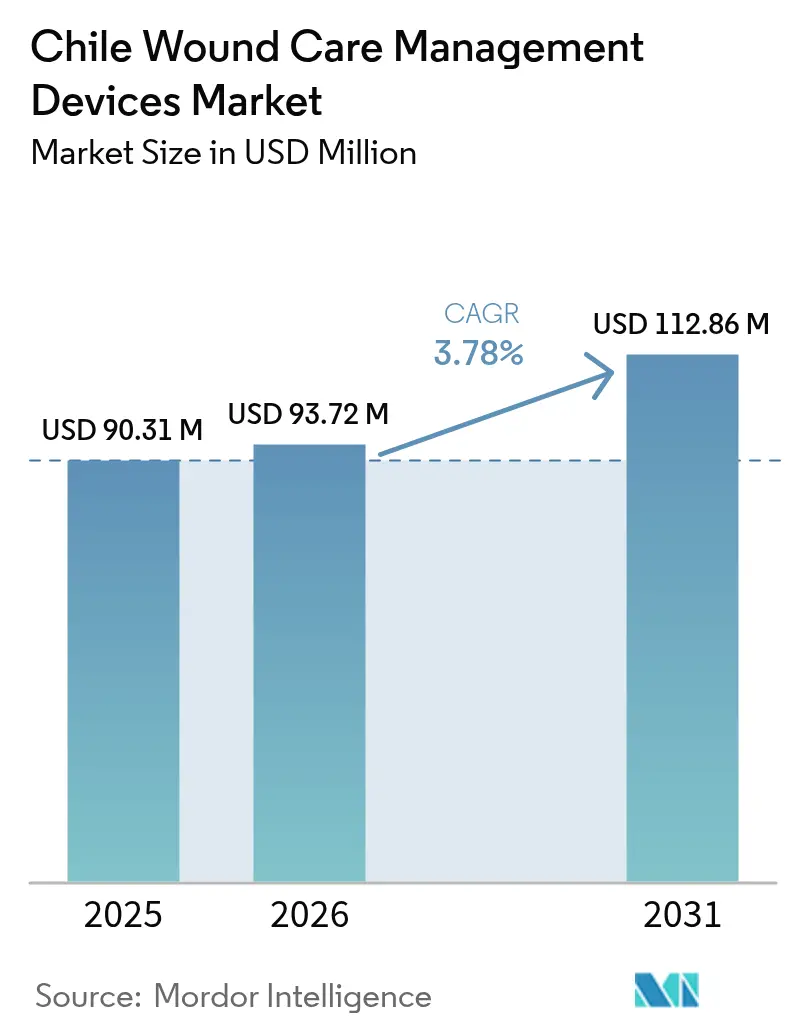
| Base Year Market Size (2025) | USD 90.31 Million |
| Market Size (2026) | USD 93.72 Million |
| Market Size (2031) | USD 112.86 Million |
| Growth Rate (2026 - 2031) | 3.78 % |
| Market Concentration | Medium |
Major Players
*Disclaimer: Major Players sorted in no particular order Image © Mordor Intelligence. Reuse requires attribution under CC BY 4.0. |
|
Chile Wound Care Management Devices Market Analysis by Mordor Intelligence
The Chile wound care management devices market size was valued at USD 90.31 million in 2025 and estimated to grow from USD 93.72 million in 2026 to reach USD 112.86 million by 2031, at a CAGR of 3.78% during the forecast period (2026-2031). This growth curve reflects the country’s demographic shift toward an older society, the sustained diabetes burden, and hospital infrastructure modernization. Higher surgical throughput in private ISAPRE facilities, 2.8 times that of public FONASA hospitals, accelerates demand for advanced dressings, closure systems, and negative pressure wound therapy (NPWT) units [1]María Jesús Lira, "Disparity in access to orthopedic surgery between public and private healthcare insurance: a nationwide population-based study," BMC Musculoskeletal Disorders, bmcmusculoskeletdisord.biomedcentral.com. Government investments in specialized wound units, coupled with regulatory reforms that enable online pharmaceutical sales, further widen patient access to sophisticated products. At the same time, import-dependent supply chains and limited outpatient reimbursement temper short-term momentum but do not derail the upward trajectory of the Chile wound care management devices market.
Key Report Takeaways
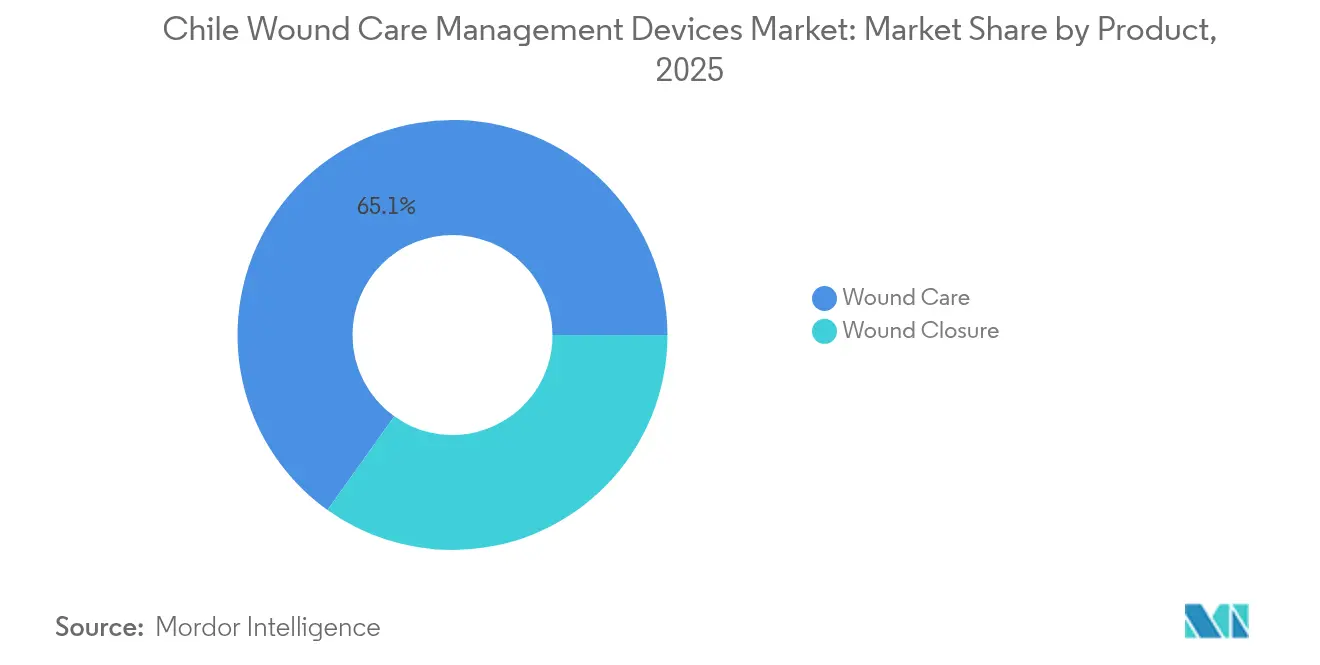
- By product category, wound care devices captured 65.12% of the Chile wound care management devices market share in 2025, whereas wound closure is on track to expand at a 4.21% CAGR through 2031.
- By wound type, chronic wounds held 61.85% share of the Chile wound care management devices market size in 2025; acute wounds are projected to advance at a 4.24% CAGR to 2031.
- By end user, hospitals and specialty wound clinics commanded 51.98% share in 2025, while home healthcare settings are set to grow fastest at 4.38% CAGR.
- By mode of purchase, institutional procurement controlled 64.62% of transactions in 2025, whereas the retail/OTC channel is forecast to rise at a 4.27% CAGR through 2031.
Note: Market size and forecast figures in this report are generated using Mordor Intelligence’s proprietary estimation framework, updated with the latest available data and insights as of 2026.
Chile Wound Care Management Devices Market Trends and Insights
Drivers Impact Analysis*
| Driver | (~) % Impact on CAGR Forecast | Geographic Relevance | Impact Timeline |
|---|---|---|---|
| Rising burden of chronic wounds, ulcers & diabetic ulcers | +1.2% | National, with concentration in Santiago, Valparaíso, Concepción | Long term (≥ 4 years) |
| Growing incidence of injuries from road traffic & sports accidents | +0.8% | National, with higher impact in urban centers | Medium term (2-4 years) |
| Ageing population increasing demand for advanced wound care | +1.1% | National, accelerating in metropolitan regions | Long term (≥ 4 years) |
| Government investment in public-hospital wound units | +0.6% | National, prioritizing underserved regions | Medium term (2-4 years) |
| Expansion of private health-insurance coverage boosting AWC adoption | +0.7% | National, with early gains in Santiago, Valparaíso, Concepción | Medium term (2-4 years) |
| Emergence of locally-made cost-competitive NPWT systems | +0.4% | National, with manufacturing focus in central regions | Short term (≤ 2 years) |
| Source: Mordor Intelligence | |||
Rising burden of chronic wounds, ulcers & diabetic ulcers
Diabetes affects 11% of Chilean adults, and diabetic foot ulcers afflict 11% of those patients, translating into persistent demand for advanced dressings, NPWT units, and limb-salvage technologies. Venous ulcers constitute 70% of chronic wounds nationwide, while pressure ulcers appear in 28% of hospitalized patients, increasing material consumption in public and private hospitals alike. Multidisciplinary programs that prioritize limb preservation are spreading from metropolitan hospitals to regional centers, stimulating adoption of microsurgical techniques and tissue-regeneration devices. Cost-effective local manufacturing initiatives target the public sector, ensuring that the Chile wound care management devices market remains accessible despite pricing pressures.
Growing incidence of injuries from road traffic & sports accidents
Rapid urbanization and rising sports participation translate into higher trauma volumes and post-operative wound care needs. Emergency departments increasingly deploy tissue adhesives and surgical staplers that shorten closure time and reduce infection risk. ISAPRE facilities first integrate these advanced tools, but diffusion to FONASA hospitals is expected as national trauma protocols standardize. This pathway underpins medium-term growth in the Chile wound care management devices market and reinforces demand for disposable closure and dressing kits.
Ageing population increasing demand for advanced wound care
By 2040, more than 20% of Chile’s population will be aged 60 or older, and multimorbidity drives complex wound profiles requiring sustained management. Home healthcare programs record that 73.8% of participants are seniors with high dependency levels, prompting the Ministry of Health to publish gerontogeriatric nursing guidelines that highlight prevention, rapid diagnosis, and evidence-based therapy selection. Consequently, easy-to-use foam dressings, silver-impregnated antimicrobials, and portable NPWT devices gain traction in the Chile wound care management devices market.
Government investment in public-hospital wound units
Chile’s inclusion in the Alliance for Primary Health Care in the Americas underscores its commitment to upgrade public hospital capabilities, including specialized wound units staffed by multidisciplinary teams [2]PAHO, "Chile becomes latest country to join the Alliance for Primary Health Care in the Americas," paho.org. Procurement policies emphasize cost-effective standardized kits, opening the door for domestic suppliers of gauze, hydrocolloids, and second-generation NPWT systems. The resulting infrastructure improvement narrows the treatment gap between public and private facilities and delivers a predictable demand stream that supports the Chile wound care management devices market.
Restraints Impact Analysis*
| Restraint | (~) % Impact on CAGR Forecast | Geographic Relevance | Impact Timeline |
|---|---|---|---|
| High treatment cost of advanced wound care devices | -0.9% | National, with greater impact in public healthcare sector | Medium term (2-4 years) |
| Limited reimbursement for outpatient wound therapies | -0.7% | National, affecting both public and private sectors | Long term (≥ 4 years) |
| Shortage of certified wound-care nurses in regional hospitals | -0.5% | National, with concentration in rural and peripheral regions | Medium term (2-4 years) |
| Import-dependent supply chain vulnerable to FX volatility | -0.3% | National, with higher impact on premium device segments | Short term (≤ 2 years) |
| Source: Mordor Intelligence | |||
High treatment cost of advanced wound care devices
Commercial NPWT sessions exceed USD 870 per treatment, compared with open-source alternatives under USD 75, a 58-fold differential that restricts uptake in the public sector. Private patients also experience out-of-pocket strain because healthcare spending exceeds 30% of total expenditure, limiting premium device penetration. Local innovators now prototype affordable NPWT kits, yet regulatory clearance remains a hurdle that slows adoption and marginally suppresses the Chile wound care management devices market [3]Carla Castillo-Laborde, "Access to medicines for the treatment of chronic diseases in Chile: qualitative analysis of perceived patient barriers and facilitators in five regions of the country," BMC Health Services Research, bmchealthservres.biomedcentral.com.
Limited reimbursement for outpatient wound therapies
Chile’s guaranteed benefits scheme omits many chronic wound consumables, pushing patients toward self-funded purchases. This gap deters widespread use of home-based NPWT and advanced dressings despite clinical necessity, redirecting complex cases back to inpatient settings. Online pharmacies partially alleviate access barriers, but sustained policy reform is required to unleash the full potential of home management within the Chile wound care management devices market.
*Our forecasts treat driver/restraint impacts as directional, not additive. The impact forecasts reflect baseline growth, mix effects, and variable interactions.
Segment Analysis
By Product: Wound care dominance drives innovation
In 2025, wound care devices commanded 65.12% of the Chile wound care management devices market share due to the prevalence of chronic ulcers and pressure injuries. Advanced dressings deliver 47.1% fewer changes and 58.6% cost savings relative to traditional gauze, fostering rapid uptake in tertiary hospitals. The Chile wound care management devices market size for wound care products is projected to grow at a 3.92% CAGR to 2031, underpinned by local NPWT prototypes that close the affordability gap for public clinics. Traditional materials still circulate in resource-constrained rural hospitals, while silver and hydrogel variants expand fastest in private facilities.
Wound closure is the fastest-growing product category at 4.21% CAGR, propelled by higher orthopedic procedures and sports injury repairs. Surgical staplers and cyanoacrylate adhesives reduce operating room time and lower infection risk, making them attractive to both private and public surgeons. The uptick in device clinical trials—33 registrations in 2024—signals that multinational firms view Chile as a test bed for next-generation closure platforms, further enriching the Chile wound care management devices market.


By Wound Type: Chronic wounds reflect demographic reality
Chronic wounds held 61.85% of the Chile wound care management devices market size in 2025, mainly attributable to diabetic foot ulcers, venous leg ulcers, and pressure ulcers in bedridden seniors. Multidisciplinary limb-salvage teams are mainstreaming epidermal growth factor therapies and integrated offloading protocols that extend dressing lifespans and minimize amputations. Advanced compression systems earn steady adoption within public diabetes clinics, confirming the long-term volume base for chronic wound supplies across the Chile wound care management devices market.
Acute wounds expand at 4.24% CAGR as urban trauma volumes climb. Emergency services embed single-use stapling kits and antimicrobial suture materials that accelerate closure while containing infection. The popularity of adventure sports in metropolitan regions such as Santiago and Valparaíso fuels retail demand for waterproof adhesive dressings that support rapid return to activity. This momentum keeps the acute segment a vibrant contributor to the Chile wound care management devices market.
By End User: Home healthcare transformation accelerates
Hospitals and specialty wound clinics accounted for 51.98% revenue in 2025, sustaining high usage of advanced dressings, biologics, and NPWT. Yet the move toward decentralized care shifts growth to patient homes where portable devices and easy-application dressings prevail. The home care segment is forecast to rise at 4.38% CAGR through 2031, supported by national gerontogeriatric guidelines and family caregiver training programs. As a result, the Chile wound care management devices market continually innovates toward smaller, battery-operated NPWT units and simplified dressing kits suitable for layperson use.
Long-term care facilities maintain a stable share because of entrenched pressure ulcer protocols for residents with mobility limitations. In regional hospitals, the shortage of certified wound nurses encourages adoption of foam dressings with wear indicators and pre-set suction pumps that reduce manual oversight. These dynamics collectively broaden the customer base inside the Chile wound care management devices market.

By Mode of Purchase: Retail channel gains momentum
Institutional procurement dominated 64.62% of 2025 orders thanks to centralized tenders that prioritize cost-effectiveness and supply-chain reliability. Local manufacturers exploit this environment by courting public buyers with standardized kits that satisfy nationwide formularies. These large-volume contracts underpin predictable demand patterns for the Chile wound care management devices market.
The retail/OTC channel is growing at a 4.27% CAGR as regulatory changes allow licensed online pharmacies to ship wound products directly to patients. Chronic ulcer sufferers who face reimbursement gaps increasingly buy foam dressings, antimicrobial gels, and compression wraps out of pocket. Pharmacies partner with courier services to guarantee 48-hour delivery across metropolitan regions, enhancing convenience and fueling consumer trust in e-commerce within the Chile wound care management devices market.
Geography Analysis
Chile’s highly centralized population places the largest share of the Chile wound care management devices market in the Santiago Metropolitan Region, followed by Valparaíso and Concepción. These hubs host the majority of tertiary hospitals and private surgical centers, which adopt advanced dressings early and generate strong demand for NPWT rentals. ISAPRE-insured patients in these cities undergo surgeries at rates 2.8 times greater than their FONASA counterparts, ensuring a receptive audience for premium wound closure systems.
Outside metropolitan zones, northern macro-regions such as Antofagasta and Atacama display steady yet lower consumption, constrained by fewer specialists and longer referral pathways. The sale of Bupa-owned San José Clinic in Arica exemplifies ongoing realignment among secondary hospitals seeking operational efficiencies. Consequently, public tenders in these areas favor economical foam dressings and reusable compression wraps that match budget limits, yet still add volume to the Chile wound care management devices market.
In southern zones like Los Ríos and Aysén, harsh weather and dispersed communities complicate logistics and lengthen lead times for imported devices. Government investments in telehealth and primary-care wound programs bridge access gaps by enabling remote follow-up and nurse-guided home dressing changes. As infrastructure improves, regional consumption of portable NPWT and infection-control dressings rises, incrementally boosting the overall Chile wound care management devices market.
The Ñuble Health Service posts the highest diabetic screening coverage at 49.5%, indicating robust chronic-disease management infrastructure that supports early ulcer intervention. In contrast, the Central Metropolitan Service lags at 15%, illuminating disparities even within urban settings. Public-private partnership programs are targeting these gaps through mobile wound caravans and shared clinical-rotation schemes, ensuring that the Chile wound care management devices market expands on a nationwide, rather than purely metropolitan, basis.
Regulatory Landscape
Medical devices in Chile are regulated by the Instituto de Salud Publica de Chile (ISP) through its medical device functions (including ANDID/ANDIM pathways), with sanitary control grounded in the Codigo Sanitario (including Article 111) and Supreme Decree No. 825 (1998). For manufacturers and distributors, a key structural requirement is the ability to hold and maintain sanitary registration in-country, typically via a local legal representative or authorized holder when there is no direct Chilean presence.
Oversight expanded with the Ministry of Health publication of Exempt Decree No. 25 in March 2026, which incorporated additional categories of medical devices and IVDs into mandatory sanitary control. This broadening increases the compliance workload for importers and brand owners across regulated device lines used in wound management (including NPWT and closure-related hardware), with registration and post-market obligations becoming a more central determinant of market access alongside public procurement requirements.
Value Chain Analysis
The Chile wound care management devices value chain is anchored by imported finished devices and components. Multinational manufacturers supply through authorized local distributors and representatives who manage ISP sanitary registration and conformity documentation. From there, product moves through national logistics nodes, commonly concentrated around Santiago distribution infrastructure, into hospital and specialty clinic channels, and finally into home-care via retail and online-pharmacy fulfillment where permitted.
Demand aggregation and tendering in the public network shape downstream flows, with centralized purchasing mechanisms (including CENABAST programming for hundreds of medical device items) and institutional procurement representing a dominant purchasing mode in the market context. Key value-chain friction points remain import dependence, including exposure to FX and maritime lead times, and an administrative burden as the regulatory perimeter expands. Decree No. 5 (2025) and Exempt Decree No. 25 (March 2026) increase the importance of compliant local representation, reliable documentation, and consistent after-sales support for regulated wound care equipment.
Competitive Landscape
The Chile wound care management devices market shows moderate concentration, where multinationals and agile local firms share turf. Smith+Nephew reported 3.8% growth in its Advanced Wound Management portfolio in Q1 2025, crediting demand for foam dressings and NPWT. Its recent USD 75 million Department of Defense contract may yield technology spillovers that reach Chilean buyers. Baxter International also logged high single-digit gains in its Medical Products & Therapies unit as hospitals replenish dressing and closure inventories.
Domestic innovators focus on low-cost NPWT devices made from locally sourced components, addressing the public sector’s strict pricing ceilings. Prototype pumps priced below USD 75 have completed clinical pilot studies, and ongoing regulatory reviews aim to grant market entry in 2026. These developments intensify competition by offering an attractive alternative to imported systems in the Chile wound care management devices market.
Strategic alliances between pharmaceutical distributors and medical device firms enable bundled offerings that package antimicrobial dressings with oral antibiotics or pain management kits. Such integration appeals to hospital procurement offices seeking comprehensive solutions that reduce vendor fragmentation. Concurrently, Chile’s role as a regional clinical-trial hub—hosting 33 device trials in 2024—draws global companies to establish in-country subsidiaries, raising the innovation bar across the Chile wound care management devices market.
Chile Wound Care Management Devices Industry Leaders
-
Smith & Nephew
-
Solventum
-
Medtronic
-
Convatec
-
Coloplast
- *Disclaimer: Major Players sorted in no particular order


Market Opportunities and Future Outlook
A primary opportunity is supporting suppliers and providers as they operationalize the expanded medical-device sanitary control regime following Exempt Decree No. 25 (published March 19, 2026), including accelerated readiness of ISP registration dossiers and strengthened capabilities for local representatives for regulated wound care device lines. Companies that can combine compliant market access with continuity of supply also gain leverage in public tenders and aggregated procurement, where CENABASTs 2026 annual programming spans 427 medical devices and supports standardized adoption pathways across the public health network.
Technology diffusion beyond Santiago into regional care pathways is visible through complex-wound initiatives in public hospitals, creating room for advanced, protocolized solutions that reduce hospitalization and support outpatient and home transitions. For example, Hospital de La Serena reported use of the Dr. Invivo 3D bioprinting platform (Rokit Healthcare, implemented by Varifarma) to treat complex wounds, including diabetic-foot cases, which provides a regional reference model that can be replicated through training, consumable-device bundling, and referral-network alignment. Separately, Ministry of Health digitalization priorities, including AI and interoperability initiatives highlighted in June 2026, support opportunities for suppliers that integrate inventory traceability, usage analytics, and service models for NPWT and other reusable hardware deployed across dispersed geographies.
Recent Industry Developments
- May 2026: ConvaTec Chile S.A. recorded multiple public procurement transactions in Chile for medical supplies that include wound and ostomy care-related products. This reinforces the role of Mercado Publico purchasing activity as a near-term demand signal for suppliers with tender readiness and local fulfillment capacity.
- March 2026: Chiles Ministry of Health published Exempt Decree No. 25, adding 39 categories of medical devices and IVDs to the mandatory sanitary control regime under Article 111 of the Health Code. The change elevates the importance of ISP registration, local representation, and compliant documentation for continued commercialization of regulated wound care equipment.
- December 2025: Solventum confirmed the build-out of its Chile operations, including a local distribution center, following its spin-off from 3M Health Care, and increased local ecosystem engagement through industry association participation (ADIMECH). The move strengthens in-country logistics and channel support for wound care portfolios sold into institutional and retail pathways.


Research Methodology Framework and Report Scope
Market Definition and Coverage
This market covers wound care management devices sold and used in Chile to help prevent, monitor, close, or treat acute and chronic wounds in clinical and home settings, with values tracked in USD at the manufacturer invoice level.
Scope exclusions: consumable wound dressings and topical pharmaceutical products are excluded because they are not classified as devices in this sizing.
Segmentation Overview
-
By Product
-
Wound Care
-
Dressings
- Traditional Gauze & Tape Dressings
- Advanced Dressings
-
Wound-Care Devices
- Negative Pressure Wound Therapy (NPWT)
- Oxygen & Hyperbaric Systems
- Electrical Stimulation Devices
- Other Wound Care Devices
- Topical Agents
- Other Wound Care Products
-
Dressings
-
Wound Closure
- Sutures
- Surgical Staplers
- Tissue Adhesives, Strips, Sealants & Glues
-
Wound Care
-
By Wound Type
-
Chronic Wounds
- Diabetic Foot Ulcer
- Pressure Ulcer
- Venous Leg Ulcer
- Other Chronic Wounds
-
Acute Wounds
- Surgical/Traumatic Wounds
- Burns
- Other Acute Wounds
-
Chronic Wounds
-
By End User
- Hospitals & Specialty Wound Clinics
- Long-term Care Facilities
- Home-Healthcare Settings
-
By Mode of Purchase
- Institutional Procurement
- Retail / OTC Channel
Data Sources, Market Sizing, and Validation
Desk Research
Desk work started with mapping Chile healthcare demand and funding signals, then translating them into a practical device demand pool. We referred to public sources such as the Chile Ministry of Health publications, national statistics releases, customs and trade data portals, and WHO and PAHO datasets, along with peer-reviewed clinical and epidemiology literature that reports diabetes prevalence, pressure injuries, and surgical volumes.
To anchor pricing and supply-side structure, we also reviewed company filings and investor materials, public procurement notices, and hospital and clinic network publications, plus credible press coverage on device availability and policy changes. Where needed, paid subscriptions were used only as support for company financial intelligence, patent lookups, and shipment-level import-export context to sanity check the direction of volumes and mix. These source examples are illustrative, and additional public references were used throughout for data collection, validation, and clarification.
Primary Interviews and Surveys
Primary work focused on validating what is actually adopted in Chile across hospitals, specialty wound clinics, and home care pathways, and on checking how utilization shifts between acute and chronic wound loads. We spoke with manufacturers, distributors, clinical users, and procurement stakeholders so that pricing bands, replacement cycles, and channel mix assumptions could be adjusted when desk signals did not align with on-the-ground purchasing behavior.
Distribution of primary research fieldwork respondents
| Company type | Respondent position |
|---|---|
| Top tier: 25% | CXOs: 13% |
| Mid tier: 59% | Functional/Unit leaders: 34% |
| Smaller Players: 16% | Managers: 53% |
Market-Sizing & Forecasting
Sizing was built using a top-down approach after reconstructing the Chile treated patient pool and care-setting mix from public health indicators, procedure activity, and device adoption rates. The totals were then corroborated with selective bottom-up checks, including sampled average selling price by device category multiplied by expected unit volumes, plus distributor and channel checks to adjust for import reliance and margin structure.
Key inputs for this market included the chronic wound burden linked to diabetes and vascular disease, surgical throughput trends, hospital procurement patterns versus retail or home care sourcing, typical therapy duration for NPWT and related systems, and the split between capital equipment and disposables tied to device use. Forecasts were developed using scenario analysis, where base case demand growth was shaped by primary feedback on adoption headroom and budget tightness, then stress tested for currency timing and tender cycle delays. When bottom-up views had gaps, we used conservative proxy ratios from similar care settings and rechecked them with interviews before locking the final series.
Data Validation & Update Cycle
Validation was handled in layers so the final numbers do not depend on a single assumption. Model outputs were compared against independent signals such as import trends for relevant device categories, public procurement activity, and the implied per-facility usage intensity, and any sharp variances were reviewed and documented before sign off.
A second analyst review is done to recheck formulas, unit economics logic, and year to year movements, followed by targeted re-contact when the variance cannot be explained by a clear market event. Reports are refreshed annually, and interim updates are made when there are material policy, reimbursement, or supply disruptions. Before delivery, a final pass is completed so clients receive the most current view available at that time.
Mordor Intelligence's Chile Wound Care Management Devices Market Sizing Compared With Other Published Estimates
Published market sizes for Chile wound care management devices often differ because the category boundary is not consistent, and because some studies mix consumables with devices or use different price points and timing for currency conversion. Differences also show up when sources rely on a single proxy, such as hospital spending, without checking how much of that spend is actually tied to device-based therapies.
By tracking treated patient pathways, procurement cycles, and invoice level pricing, Mordor Intelligence keeps the model limited to device revenues used in Chile and refreshes adoption assumptions when clinical practice patterns shift, which reduces overcounting from adjacent wound care consumables.
Benchmark comparison
| Source | Market Size | Gaps in Research Methodology |
|---|---|---|
| Mordor Intelligence | USD 90.31 M (2025) | |
| Industry Data Provider A | USD 159.40 M (2025) | The scope appears broader and can include therapy adjacencies such as hyperbaric oxygen and compression systems, which expands the device basket beyond typical wound care management device definitions used in Chile. |
| Insights Publisher B | USD 79.61 M (2024) | This estimate is anchored to an earlier year and highlights product lines like advanced dressings, which can pull the number downward or upward depending on whether consumables are treated as the main market boundary instead of durable and therapy devices. |
The spread is mainly explained by what gets counted as a device, plus the year used and the pricing level applied to value sales. Keeping the scope tied to device therapies, then cross checking totals against trade and procurement signals, makes the final number easier to reconcile and repeat in future updates.


Key Questions Answered in the Report
What is the current size of the Chile wound care management devices market?
The market is valued at USD 93.72 million in 2026.
Which product category holds the largest share?
Wound care devices lead with 65.12% market share in 2025.
Which segment is growing fastest by end user?
Home healthcare settings are expanding at a 4.38% CAGR through 2031.
How does diabetes influence demand for wound care solutions in Chile?
Diabetes affects 11% of adults and drives persistent demand for advanced dressings, NPWT, and limb-salvage technologies.
What is the key regulatory change affecting retail access to wound products?
A 2020 decree authorizes online pharmaceutical sales, boosting growth of the retail/OTC channel.
Why are locally manufactured NPWT systems important?
They lower therapy costs, easing adoption in public hospitals and supporting market expansion despite budget constraints.
Page last updated on:


 Your data is secure and never sold or shared.


