
Market Overview
| Study Period | 2020 - 2031 |
|---|---|
| Forecast Data Period | 2026 - 2031 |
| Base Year Market Size (2025) | USD 4.34 Billion |
| Market Size (2026) | USD 4.44 Billion |
| Market Size (2031) | USD 4.97 Billion |
| Growth Rate (2026 - 2031) | 2.27 % |
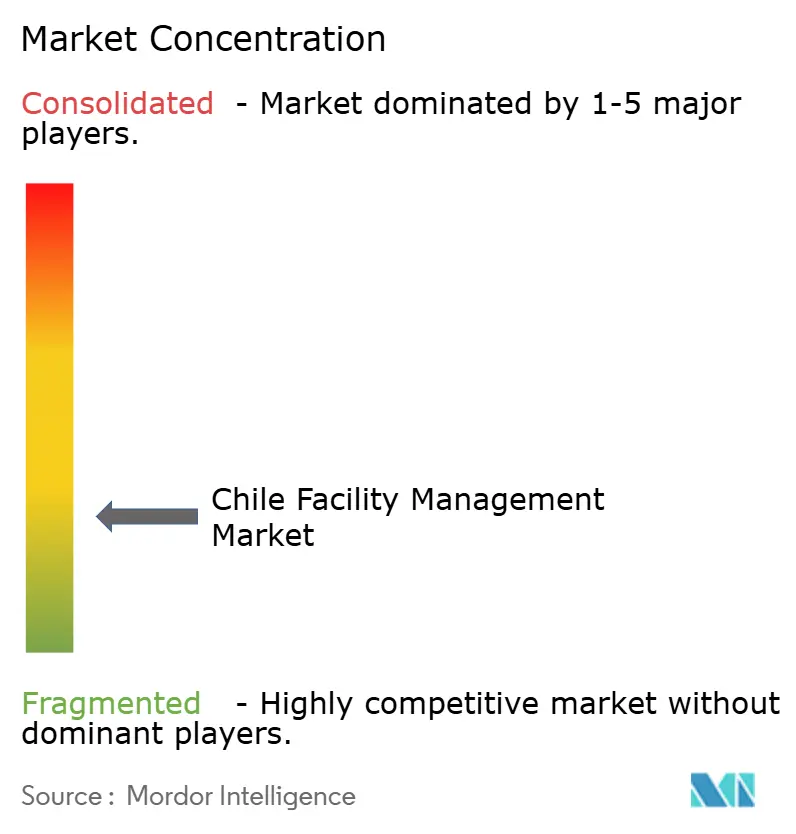
| Market Concentration | Low |
Major Players *Disclaimer: Major Players sorted in no particular order Image © Mordor Intelligence. Reuse requires attribution under CC BY 4.0. | |
Chile Facility Management Market Analysis by Mordor Intelligence
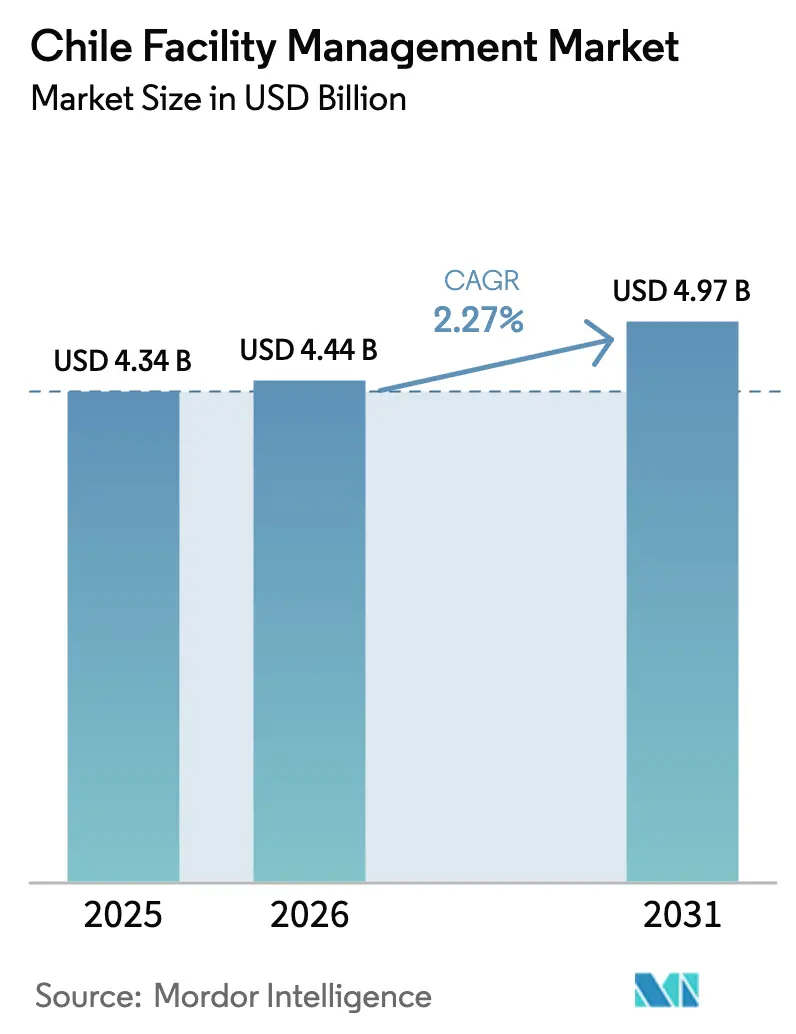
The Chile facility management market size in 2026 is estimated at USD 4.44 billion, growing from 2025 value of USD 4.34 billion with 2031 projections showing USD 4.97 billion, growing at 2.27% CAGR over 2026-2031. This moderate pace reflects a maturing competitive landscape where post-pandemic workplace re-openings, a stronger regulatory push for energy efficiency, and rapid digital-infrastructure buildouts are reshaping service demand patterns. Large-scale cloud investments such as Amazon’s USD 4 billion regional cloud hub commitment have begun to elevate expectations for 24/7 critical‐environment support, while Chile’s Energy Efficiency Law is steering spending toward retro-commissioning and smart-building upgrades. Mining and renewable-energy CAPEX pipelines continue to broaden the opportunity set for providers able to work in remote, high-risk locations. At the same time, peso volatility and a nationwide shortage of certified HVAC and fire-safety technicians are compressing margins and accelerating the shift toward integrated contracts that spread risk across a broader service bundle. Together, these forces keep the Chile facility management market competitive yet primed for consolidation as global incumbents double down on high-growth verticals.[1]
Key Report Takeaways
- Soft services held 55.60% of the 2025 Chile facility management market share, while integrated facility management is projected to expand at a 6.45% CAGR through 2031.
- Long-term agreements (longer than three years) captured 40.85% share of overall contract value in 2025; however, short-term contracts are advancing at a 5.63% CAGR as clients pursue flexibility.
- In-house delivery retained 63.75% share in 2025, yet outsourced integrated models represent the fastest-growing delivery mode with a 6.45% CAGR to 2031.
- The commercial segment led with 38.10% revenue share in 2025, whereas healthcare facilities are on track to post a 6.52% CAGR on the back of Chile’s active hospital construction program.
Note: Market size and forecast figures in this report are generated using Mordor Intelligence’s proprietary estimation framework, updated with the latest available data and insights as of 2026.
Chile Facility Management Market Trends and Insights
Drivers Impact Analysis*
| Driver | (~) % Impact on CAGR Forecast | Geographic Relevance | Impact Timeline |
|---|---|---|---|
| Rising Grade-A office occupancy rates post-pandemic recovery | +0.80% | Santiago Metropolitan Region, with spillover to Valparaíso | Short term (≤ 2 years) |
| Corporate cost-optimisation pushing outsourcing penetration | +0.60% | National, with early gains in Santiago, Valparaíso, Concepción | Medium term (2-4 years) |
| Growth of mining and energy CAPEX boosting industrial FM demand | +0.70% | Northern Chile (Antofagasta, Tarapacá, Atacama) | Long term (≥ 4 years) |
| Mandatory energy-efficiency audits in public buildings drive retro-commissioning contracts | +0.40% | National, concentrated in Santiago and regional capitals | Medium term (2-4 years) |
| Expansion of Santiago data-centre footprint triggering 24/7 critical-environment FM demand | +0.50% | Santiago Metropolitan Region | Short term (≤ 2 years) |
| Modular prefabricated hospitals in remote north require integrated FM logistics support | +0.30% | Northern Chile (Antofagasta, Tarapacá, Atacama) | Long term (≥ 4 years) |
| Source: Mordor Intelligence | |||
Rising Grade-A Office Occupancy Rates Post-Pandemic Recovery
Santiago’s Grade-A vacancy dropped below pre-2020 levels as multinationals reconsolidated hub operations, creating a sustained premium for high-service office towers. FM providers that integrate wellness-focused soft services with IoT-enabled hard services are winning long-term deals because tenants now view workplace experience as a productivity lever rather than a cost line. Stable 2.5% GDP growth projected for 2025 underpins renewed leasing momentum, and foreign direct investment inflows reinforce the city’s role as a regional hub for headquarters locations. However, occupancy gains are concentrated in the Sanhattan submarket, leaving Grade-B assets exposed to downsizing and, therefore, to shorter FM commitments. The uneven rebound prompts service companies to carefully segment their offerings between high-touch financial tenants and price-sensitive secondary assets. Robust demand in Grade-A stock nonetheless sets a clear floor under revenue forecasts for the Chile facility management market.[2]
Corporate Cost-Optimization Pushing Outsourcing Penetration
National surveys show 57% of Chilean firms anticipate higher profits in 2025, yet the same companies cite cost control as a top strategic priority, triggering a more decisive pivot from in-house maintenance teams to third-party experts. Mid-market enterprises that historically managed cleaning and security internally are migrating to bundled or integrated solutions to access specialist talent and regulatory knowledge. As contracts migrate, providers are pressured to prove value through digital KPIs and transparent SLAs, reducing tolerance for fragmented vendor lists. The new outsourcing wave is also diluting hybrid models, creating a clearer split between full in-house control and fully outsourced end-to-end delivery. Transitional friction remains, particularly during knowledge transfer phases, but successful pilots in the banking and telecom sectors are acting as proof points that accelerate adoption in manufacturing, retail, and logistics.
Growth of Mining and Energy CAPEX Boosting Industrial FM Demand
The Ministry of Mining tracks USD 65.71 billion in committed projects through 2032, mainly copper and lithium expansions, each requiring resilient FM programs able to operate in desert climates and comply with strict environmental permits.[3] Facility managers are therefore embedding remote monitoring, predictive maintenance, and modular accommodation services into their standard industrial offer. Renewable-power targets 80% clean electricity by 2030, adding solar, wind, and storage assets to the FM footprint, broadening the portfolio beyond traditional concentrators and smelters. Demand concentration in Antofagasta and Tarapacá intensifies technician shortages, driving up wages and increasing entry barriers for smaller local firms. While project timelines remain sensitive to community consultations, every construction mobilization still triggers interim FM contracts, creating a steady revenue pipeline even before mines reach steady state.
Mandatory Energy-Efficiency Audits in Public Buildings Drive Retro-Commissioning Contracts
Chile’s Energy Efficiency Law obliges large consumers to install certified energy-management systems and to cut intensity by 10% by 2030, a mandate expected to save USD 15.2 billion in cumulative energy costs. Public buildings must complete systematic audits, and the new National Registry of Energy Evaluators formalises the qualification path for service providers. Facility managers able to pair HVAC optimisation with compliant reporting tools are booking multi-year retro-commissioning contracts that blend engineering and advisory work. In private portfolios, executives increasingly align audit projects with ESG disclosures, positioning efficiency upgrades as both cost and reputation levers. Bottlenecks arise from the limited pool of certified evaluators and from retrofitting challenges in pre-2000 properties, yet early movers are locking in advantageous fee structures before market capacity tightens further.
Restraints Impact Analysis*
| Restraint | (~) % Impact on CAGR Forecast | Geographic Relevance | Impact Timeline |
|---|---|---|---|
| Delays and budget cuts in Chile's national infrastructure pipeline | -0.40% | National, with concentrated impact in Santiago and regional capitals | Medium term (2-4 years) |
| Escalating labour-safety compliance costs and liability premiums | -0.30% | National, with higher impact in industrial regions | Short term (≤ 2 years) |
| Acute skilled-technician shortage in HVAC and fire-safety systems | -0.50% | National, with severe impact in Northern Chile mining regions | Long term (≥ 4 years) |
| Peso volatility inflates imported spare-part costs for high-tech FM equipment | -0.20% | National, with higher impact on technology-intensive facilities | Short term (≤ 2 years) |
| Source: Mordor Intelligence | |||
Acute Skilled-Technician Shortage in HVAC and Fire-Safety Systems
Chile’s 8.4% unemployment rate masks a persistent mismatch between available labour and certified technical roles, especially in HVAC, fire detection, and clean-room maintenance. Retirement-age demographics mirror global patterns: more than half of HVAC specialists are older than 45, reducing the incoming talent pipeline. Mining sites in Atacama require technicians able to operate at high altitude and in saline conditions, intensifying recruitment costs. The scarcity forces providers to over-time existing teams, elevating risk of burnout and wage inflation. To mitigate, larger integrators are co-funding vocational programmes with regional universities, but the talent gap is unlikely to close before 2028, constraining the Chile facility management market in its highest-margin service lines.
Peso Volatility Inflates Imported Spare-Part Costs for High-Tech FM Equipment
Chile’s peso has traded within a 20% range against the United States dollar since 2023, complicating budgeting for data-centre UPS components, MRI chillers, and specialised fire suppression gas cylinders. Many long-term FM contracts are denominated in Unidad de Fomento (UF) to hedge inflation; however, spare-part purchases settle in real-time USD, creating a spread that erodes margins. Providers have responded by adding currency adjustment clauses and hedging through forward contracts; however, such instruments can increase transaction complexity and hinder competitiveness in public tenders. Large global incumbents can spread exposure across multi-country procurement portfolios, whereas local specialists face tougher cost pass-through negotiations, keeping pressure on consolidation trajectories within the Chile facility management market.
*Our forecasts treat driver/restraint impacts as directional, not additive. The impact forecasts reflect baseline growth, mix effects, and variable interactions.
Segment Analysis
By Service Type: Soft Services Dominate as Integration Gains Traction
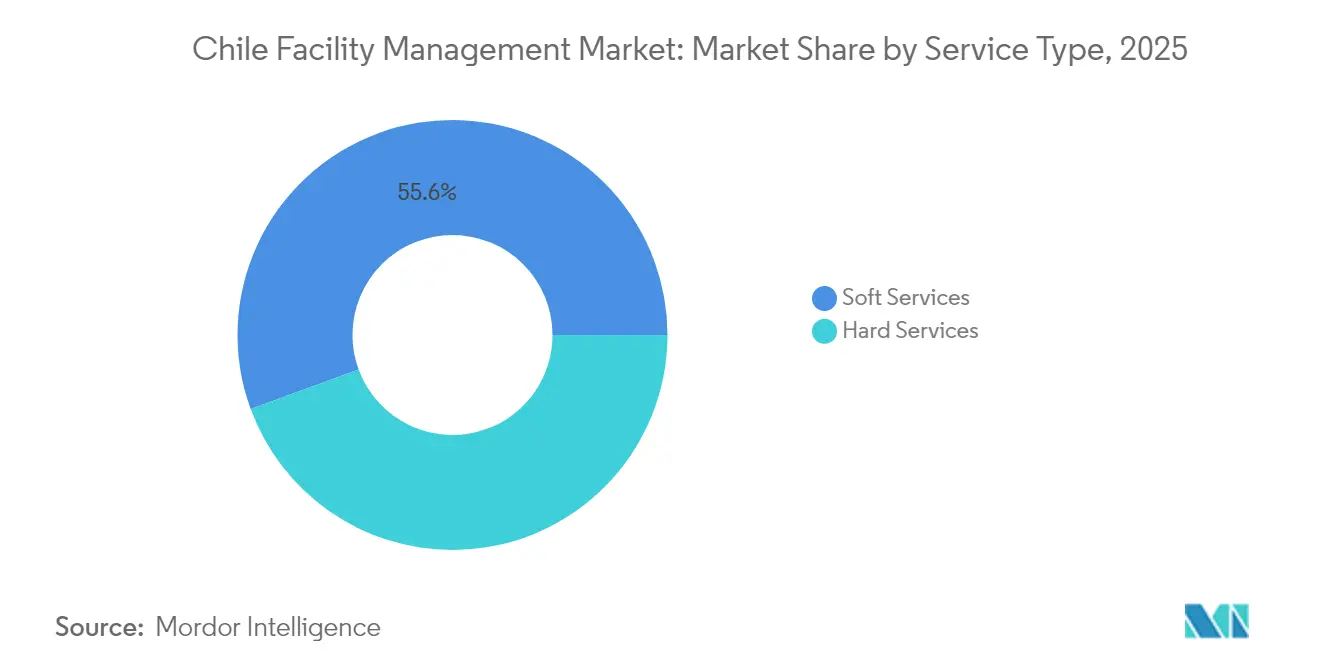
Soft services accounted for 55.60% of 2025 revenue, underscoring a client preference for outsourced cleaning, security, and front-of-house functions that sustain day-to-day business continuity. Within Santiago’s financial district, multi-tenant towers now bundle concierge desks, interior landscaping, and wellness protocols into single invoices, raising ticket values and increasing retention. Hard services, including MEP, HVAC, and fire-safety maintenance, remain indispensable but contribute a smaller share because clients frequently defer heavy-equipment overhauls amid economic uncertainty. Integrated facility management, which merges both categories under unified governance, is projected to outpace all other service formats at a 6.45% CAGR, confirming its role as the prime growth engine of the Chile facility management market. The Energy Efficiency Law further lifts demand for predictive HVAC upgrades and sensor-based fault detection, bridging the gap between classic soft and hard scopes.
Predictive analytics and IoT retrofits allow providers to guarantee uptime, justifying premium pricing and longer contract tenures. As a result, mixed hard-and-soft packages are gaining traction among hospitals and data centres that cannot tolerate downtime. Other hard FM services and niche soft functions such as specialised cleaning for sterile environments are expanding more slowly but still benefit from rising compliance complexity. By reshaping offer design around scalability and outcome-based KPIs, leading vendors are repositioning themselves from mere maintenance suppliers to strategic partners, an evolution that keeps the Chile facility management industry relevant to C-suite agendas.

By Service-Delivery Mode: Outsourcing Accelerates, Yet In-House Remains Predominant
In-house teams delivered 63.75% of total 2025 spend, mirroring a longstanding corporate culture of direct head-count control. Nonetheless, the current cost-optimisation cycle is shifting sentiment. Integrated outsourcing is expected to grow at 6.45% CAGR, grabbing share in mining, healthcare, and data-centre environments where technical depth, safety accreditation, and 24/7 coverage are critical. Bundled and single-service contracts fill the transitional gap for organisations experimenting with selective outsourcing while retaining a core supervisory crew.
Even conservative public-sector entities are piloting third-party solutions for energy monitoring and waste management to comply with national sustainability targets. As more contracts migrate, providers able to prove seamless onboarding, workforce transfer, and KPI transparency will consolidate gains, reinforcing the Chile facility management market as a platform play rather than a labour arbitrage business. Resistance persists, especially among unions wary of job security, but clear demonstrations of lifecycle savings and audit compliance continue to weaken the in-house preference over time.
By Contract Duration: Stability Favoured, Flexibility Rising
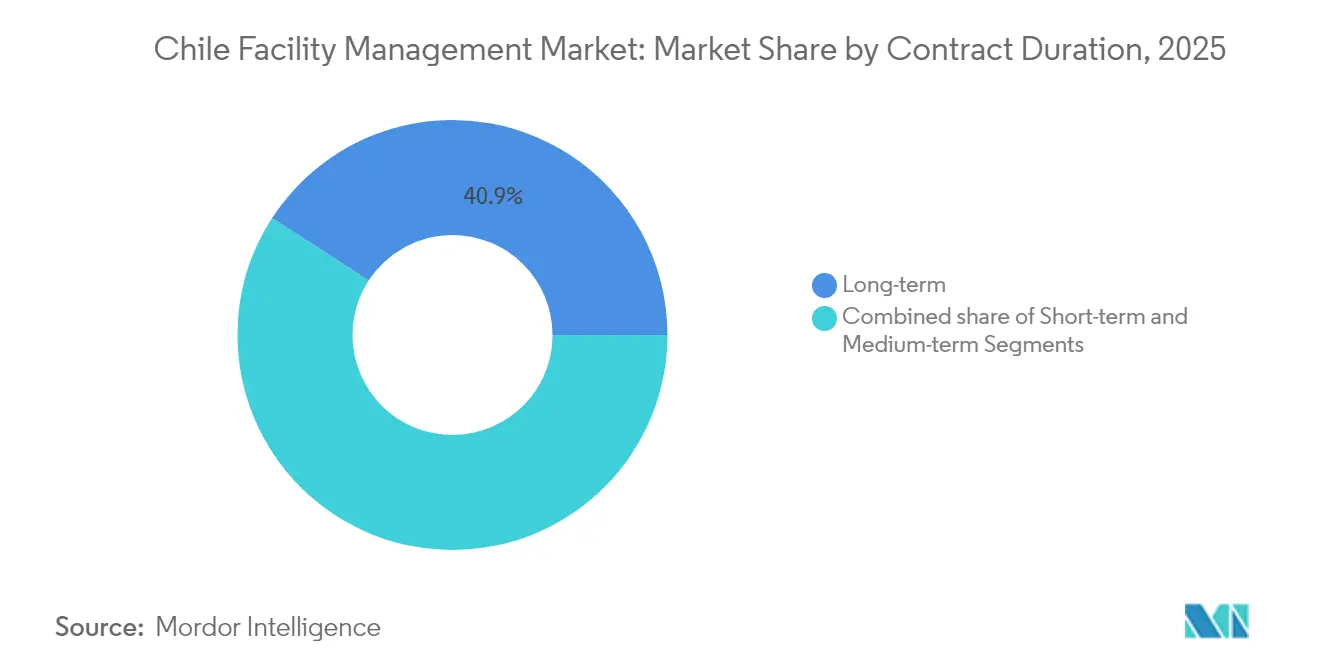
Long-term agreements longer than three years commanded 40.85% share in 2025, particularly in heavy-industry and healthcare portfolios were asset complexity merits capital-intensive mobilisation. Such duration grants FM operators the runway to deploy digital twins, robotics, and specialised training, raising switching costs in the client’s eyes. However, volatile economic conditions and rapid technological change have fuelled a parallel rise in sub-one-year contracts, which are advancing at 5.63% CAGR. Short-cycle deals dominate in Grade-B offices and co-working spaces where landlords watch occupancy trends before locking in multiyear service levels.
Medium-term frameworks between one and three years serve as a compromise, giving both parties flexibility to renegotiate scope as buildings adopt new environmental or safety regulations. Providers therefore maintain modular service catalogues that scale with client demands without breaking contractual continuity, an approach that reinforces the resilient revenue outlook for the Chile facility management market.
By End-User Industry: Commercial Leads, Healthcare Accelerates
Commercial real estate, including corporate offices, retail venues, and logistics hubs, generated 38.10% of 2025 revenue, leveraged by Santiago’s role as the financial and digital centre of Chile. Yet, healthcare facilities represent the fastest-growing vertical, with a 6.52% CAGR, thanks to 25 hospitals under construction, including the USD 177 million Rengo and Pichilemu projects. Industrial and process plants in the mining and energy sectors also account for a sizable slice, demanding mission-critical maintenance, remote camp operations, and stringent safety compliance.
Hospitality, still recovering from tourism swings, depends heavily on soft-service quality to differentiate guest experience, whereas institutional and public buildings adopt integrated FM to meet budget constraints while satisfying energy-audit mandates. Converging hygiene expectations mean commercial towers are increasingly requesting hospital-grade cleaning, while industrial sites are mirroring office environments in offering knowledge-worker amenities. Such cross-pollination further integrates service lines and sustains the expansion of the Chile facility management market.
Geography Analysis
The Chile facility management market in 2024 accounted for 45% of the national GDP and nearly 6 million residents. The Sanhattan financial area alone supports dense Grade-A towers that require round-the-clock engineering, security, and tenant-experience services. Data-centre investments are accelerating. AWS secured environmental approval for a USD 205 million facility, and Equinix earmarked USD 130 million for its new Santiago campus, each underpinning multi-year critical-environment FM contracts. Stringent air-quality regulations and concerns about traffic congestion simultaneously boost demand for smart-building automation to curb emissions and enhance occupant comfort.
Northern Chile, specifically Antofagasta, Tarapacá, and Atacama, is delivering the fastest regional expansion for the Chilean facility management market. USD 65.71 billion in mining CAPEX, plus emerging green-hydrogen and ammonia plants, widens the industrial FM footprint well beyond traditional copper assets. Harsh desert climates, altitude, and remoteness require robust logistics, on-site accommodations, and specialized safety protocols, which increase service premiums. Technician shortages are acute, prompting providers to rotate crews from Santiago or rely on international specialists, which drives up costs and also creates barriers to entry.
Central regions such as Valparaíso and O’Higgins benefit from port logistics, vineyards, and an expanding warehouse cluster that supports Chile’s export economy. Southern provinces Biobío, Los Lagos, and Araucanía round out the addressable market with forestry, agro-industry, and growing adventure-tourism infrastructure. Seismic risk and weather volatility push public entities to elevate business-continuity benchmarks, thereby parking new opportunities for holistic FM solutions. These combined dynamics keep the Chile facility management market resilient nationwide even as growth vectors differ sharply by locality.
Regulatory Landscape
Facility management in Chile is shaped by cross-cutting compliance spanning energy efficiency, environmental oversight, public health, and sector-specific infrastructure rules. The Ministry of Energy-driven Energy Efficiency Law requirements, including mandated audits in public buildings and a formal qualification pathway through the National Registry of Energy Evaluators, continue to steer FM scopes toward measurable HVAC optimization, retro-commissioning, and auditable reporting in 2025-2026.
For technology and critical infrastructure facilities, operational compliance also extends into telecom and environmental regimes. SUBTEL updated administrative requirements in January 2026 through Resolution 2614 (Manual de Tramites), reinforcing process standardization for authorizations and modifications tied to telecommunications services and related infrastructure interventions. In parallel, the Superintendencia del Medio Ambiente (SMA) executes annual fiscalization programs via SNIFA, increasing the compliance burden for waste, recycling (Law 20.920), and site environmental obligations that often sit within integrated FM responsibilities, especially for large campuses and industrial sites that also require municipal qualification and sanitary permits via SEREMI de Salud pathways.
Value Chain Analysis
The Chile facility management value chain begins with upstream labor and inputs (cleaning consumables, security equipment, MEP and HVAC spares, fire systems parts, and building-automation components), then moves into on-site execution by in-house teams or outsourced vendors delivering soft services, hard services, and integrated FM. Compliance and assurance services (energy evaluators for audits, safety and fire-system inspection capability, and environmental reporting workflows) increasingly sit alongside core operations, particularly for public buildings under audit obligations and for critical environments such as data centers.
Midstream, FM providers and specialist subcontractors coordinate mobilization, workforce certification, and digital work-order management, with procurement models splitting between bundled/integrated contracts in commercial and institutional assets and more specialized contracting in industrial/mining settings. Industry coordination is becoming more formalized: FMCL (Asociacion Chilena de Facility Management) was established as a non-profit trade association and registered with the Ministry of Economy on April 17, 2024 (No. 5382), supporting professionalization and shared standards. Downstream, service outcomes are governed by client SLAs and auditability, while property administration dynamics in multi-owner assets are influenced by Law 21.442 (Copropiedad Inmobiliaria), reinforcing transparency expectations that cascade into contractor selection, documentation, and reporting across residential and mixed-use portfolios.
Competitive Landscape
The competitive field is moderately fragmented, yet consolidation momentum is building as capital-intensive integrated projects favour well-capitalised multinationals. ISS Chile reported 5.8% organic growth worldwide in Q2 2024, leveraging its global scale and digital interface to capture bundled contracts in banking and retail. Sodexo and Aramark both leverage their cross-border procurement reach to mitigate import cost volatility, thereby enhancing value propositions for price-sensitive public entities.
Compass Group’s exit from Chile opens white-space share for incumbents, especially in food services attached to integrated FM packages. Local specialists, such as Grupo EULEN and Mancorp, compete on geographic intimacy and bespoke service depth, but rising compliance costs and technology requirements may erode their margins unless they forge alliances or accept acquisition overtures.
Technology startups offering cloud-based work-order platforms challenge legacy operators on cost transparency and real-time reporting, pushing the entire Chile facility management market toward data-driven decision-making. Strategic partnerships, M and A, and co-innovation with prop-tech providers therefore headline boardroom agendas as companies seek durable differentiation.
Chile Facility Management Industry Leaders
-
ISS Chile S.A.
-
Sodexo Servicios de Gestión Chile SpA
-
Compass Group Chile Ltda.
-
Aramark Servicios y Aseo Chile SpA
-
Grupo EULEN Chile S.A.
- *Disclaimer: Major Players sorted in no particular order
Market Opportunities and Future Outlook
Energy efficiency compliance and interoperable building automation create clear whitespace for FM providers that combine hard-services engineering with digital reporting, particularly in commercial towers and public/institutional estates where auditability is becoming a procurement requirement. Market activity in 2026 highlights standardization momentum: KNX LATAM held Building Automation Days Chile 2026 (April 2026) with an emphasis on KNX as an open building-automation standard, supporting opportunities for multi-vendor integration across HVAC, lighting, and security rather than single-proprietary stacks.
Critical-environment operations also expand the addressable scope for integrated FM beyond traditional cleaning and security. Data center and remote industrial footprints in Chile are pulling demand toward 24/7 uptime, power-quality management, and faster deployment of technical rooms, evidenced by Schneider Electric commentary (May 2026) that modular electrical rooms (E-Houses) are being adopted across mining, renewable energy (including BESS), and hyperscale data centers. For FM vendors, this reinforces opportunities in lifecycle maintenance for modular power and controls, cyber-hygiene around building systems, and technician training pipelines to address the documented scarcity in HVAC and fire-safety roles, especially in northern regions supporting mining and energy CAPEX.
Recent Industry Developments
- June 2026: ISS announced the non-renewal of a large contract with an annual value of approximately DKK 100 million, scheduled to expire in Q3 2026. The development underscores how contract churn at large accounts can quickly reallocate outsourced volumes and sharpen competition for replacement integrated FM scopes. It also highlights the importance of differentiated critical-environment and compliance capability in retaining multi-year mandates.
- March 2025: Compass Group completed the divestment of its operating subsidiaries in Chile as part of a broader regional exit, reducing its direct participation in local outsourced services. The transaction reshaped competitive positioning in large multi-site accounts and opened share for incumbents and challengers that can absorb mobilizations and workforce transitions. For integrated FM packages that include catering, the move increased the relevance of alternative providers and cross-service bundling.
- December 2024: Chile's Ministry of Science and Technology unveiled a USD 2.5 billion National Data Centers Plan to position the country as a regional digital hub. The program elevated requirements for specialized FM around power, cooling, and security in mission-critical facilities, encouraging more structured procurement of 24/7 hard services. It also strengthened the business case for digital work-order platforms and predictive maintenance in Santiago-linked data center clusters.
Research Methodology Framework and Report Scope
Market Definition and Coverage
For this report, the Chile facility management market is defined as the annual value of services used to operate and maintain built facilities so they stay safe, functional, and efficient, covering both outsourced and in-house delivery across end-user sites in Chile.
Scope exclusions: We exclude stand-alone new construction and major capital projects that are not procured and billed as ongoing facility management services.
Segmentation Overview
- By Service Type
- Hard Services
- Asset Management
- MEP and HVAC Services
- Fire Systems and Safety
- Other Hard FM Services
- Soft Services
- Office Support and Security
- Cleaning Services
- Catering Services
- Other Soft FM Services
- Hard Services
- By Service-Delivery Mode
- In-house
- Outsourced
- Single FM
- Bundled FM
- Integrated FM
- By Contract Duration
- Short-term (Less than 1 yr)
- Medium-term (1-3 yrs)
- Long-term (More than 3 yrs)
- By End-User Industry
- Commercial (IT, Retail, Warehouses)
- Hospitality (Hotels, Restaurants)
- Institutional and Public Infrastructure
- Healthcare (Public and Private)
- Industrial and Process (Manufacturing, Energy, Mining)
- Other End-users (Multi-housing, Entertainment, Leisure)
Data Sources, Market Sizing, and Validation
Desk Research
Desk research was used to set the Chile context first, and then to anchor a realistic demand pool for facility services across commercial, industrial, and public sites. We referenced public sources such as Chilean national statistics publications, central bank macro series, and labor market datasets to track wage movement and services inflation, which are directly relevant for FM pricing. We also reviewed public procurement portals and ministry or municipal infrastructure updates to understand where public building operations budgets were trending.
On the supply and operating side, we checked company annual reports, investor decks, and local press coverage to map common contract structures and bundled service patterns. In a few places, we used paid subscriptions for company financials and intelligence, plus news and financials, to validate ownership changes and contract announcements, without relying on a single press source. The sources listed here are illustrative only, and many other public documents and data tables were used for collection, validation, and clarification.
Primary Interviews and Surveys
Primary work focused on interviews and short surveys with facility service providers, subcontractors, and buyer-side stakeholders who manage multi-site portfolios, including property and operations teams. We used these discussions to confirm what is typically included in Chile FM contracts, how hard and soft services are priced, and what drives contract value changes over time. Where secondary sources were incomplete, experts helped us sanity-check assumptions on outsourcing share, contract duration mix, and recent repricing behavior across major cities and industrial corridors.
Distribution of primary research fieldwork respondents
| Company type | Respondent position |
|---|---|
| Top tier: 27% | CXOs: 21% |
| Mid tier: 51% | Functional/Unit leaders: 33% |
| Smaller Players: 22% | Managers: 46% |
Market-Sizing & Forecasting
The model starts with a top-down build where building stock and active end-user footprint in Chile are converted into an addressable facilities workload, which is then translated into spend using observed service intensity and pricing bands. We then corroborate totals using selective bottom-up approximations, such as rolling up sampled contract values, applying typical monthly rates by service bundle, and checking implied revenue per active site for key provider types.
Inputs that influenced the sizing include the outsourced share versus in-house delivery, the hard-to-soft mix, contract duration patterns, wage and services inflation pass-through, and the pace of energy-efficiency retrofits that change maintenance needs. Where direct observations were thin, gaps were handled through ranges agreed with interviewees, followed by conservative midpoint selection and re-checks against public procurement awards and large-site operational benchmarks.
For forecasting, we used scenario analysis supported by a simple multivariate regression layer that ties spend growth to Chile macro indicators (such as services inflation and employment) and sector activity signals that affect sites needing FM coverage. Assumptions on repricing cadence, outsourcing adoption, and the share of integrated contracts were refreshed based on what practitioners reported in current renewals, and then applied consistently across the forecast window.
Data Validation & Update Cycle
We validate outputs by triangulating several independent checks, including implied spend per square meter or per site, contract value ranges from interviews, and the direction of public-sector awards alongside services cost inflation. Outliers are flagged early, and the assumptions behind them are reviewed by another analyst before numbers are finalized, so the logic is easier to follow and repeat.
The report is refreshed annually, and interim updates are made when material events occur, such as major contract wins, regulatory changes affecting labor or safety compliance, or sharp inflation shifts that change service pricing. Before delivery, a final verification pass is completed to align the model with the latest available public data and any newly confirmed primary insights.
Mordor Intelligence's Chile Facility Management Market Estimate Compared With Other Published Estimates
Published market sizes for Chile facility management can vary because groups do not always count the same service boundary, and they may also apply different inflation and outsourcing assumptions when converting activity into spend. Timing also matters since contract repricing and wage movement can shift the value of the market even when the number of serviced sites stays similar.
By tracking contract scope boundaries and repricing cadence, Mordor Intelligence separates routine hard and soft FM services from adjacent project-heavy work, and then checks totals against procurement awards and interview-led rate bands, which tends to reduce overcounting in years with higher one-off retrofit activity.
Benchmark comparison
| Source | Market Size | Gaps in Research Methodology |
|---|---|---|
| Mordor Intelligence | USD 4.34 B (2025) | |
| Industry Association A | USD 4.80 B (2025) | Often broadens scope to include larger one-time building upgrade and energy retrofit packages that are procured alongside FM, which inflates value in years with heavier modernization programs. |
| Global Consultancy B | USD 3.90 B (2024) | Uses an earlier base year and may apply conservative outsourcing penetration and slower price step-ups, which can understate current spend after wage and services inflation resets. |
The spread in estimates is mainly explained by what is counted as recurring FM versus adjacent project work, plus the year and pricing logic used to translate activity into value. Our approach keeps each assumption tied to observable contract patterns in Chile and to simple checks that can be repeated as new procurement and pricing signals appear.
Key Questions Answered in the Report
What is the current value of the Chile facility management market?
The Chile facility management market size is valued at USD 4.44 billion in 2026.
How fast is the Chile facility management market expected to grow?
It is projected to expand at a 2.27% CAGR, reaching USD 4.97 billion by 2031.
Which service type dominates spending?
Soft services hold the largest share at 55.60% of 2025 revenue, driven by cleaning, security, and front-of-house needs.
Why is healthcare the fastest-growing end-user segment?
Chile’s hospital construction program, including the Rengo and Pichilemu projects, is fueling a 6.52% CAGR in healthcare FM demand.
How is peso volatility affecting providers?
Exchange-rate swings inflate imported spare-part costs, prompting currency hedging and price-adjustment clauses in FM contracts.