
Market Overview
| Study Period | 2021 - 2031 |
|---|---|
| Forecast Data Period | 2026 - 2031 |
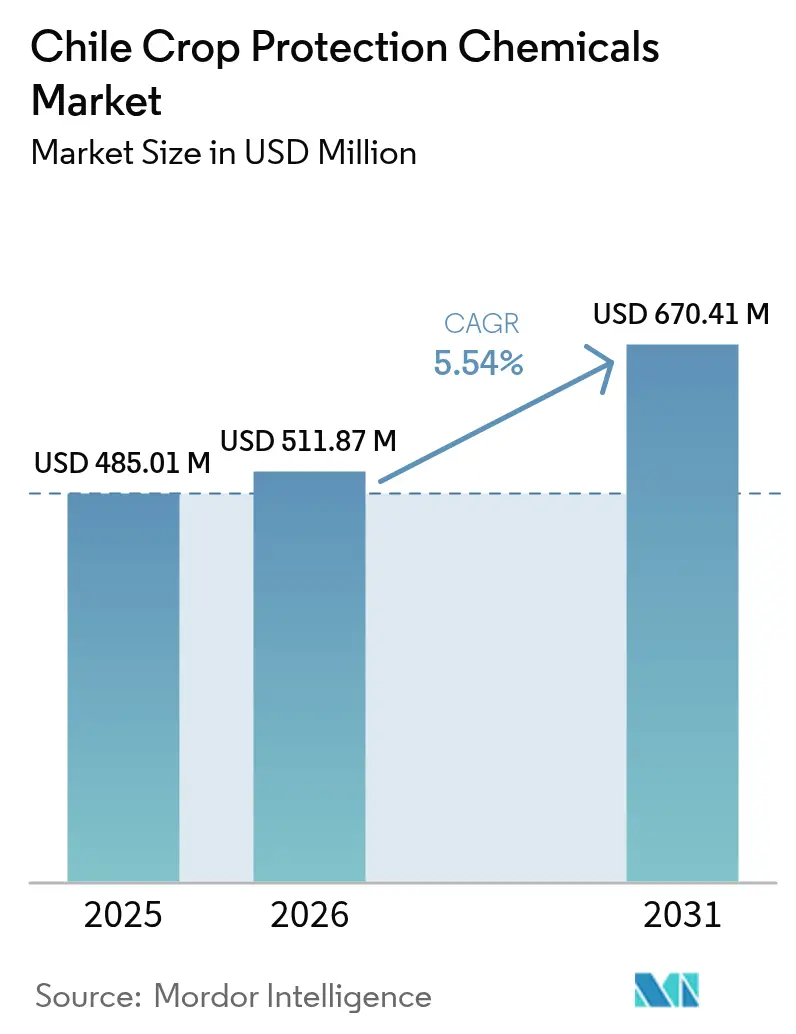
| Base Year Market Size (2025) | USD 485.01 Million |
| Market Size (2026) | USD 511.87 Million |
| Market Size (2031) | USD 670.41 Million |
| Growth Rate (2026 - 2031) | 5.54 % |
| Market Concentration | High |
Major Players *Disclaimer: Major Players sorted in no particular order Image © Mordor Intelligence. Reuse requires attribution under CC BY 4.0. | |
Chile Crop Protection Chemicals Market Analysis by Mordor Intelligence
The Chile crop protection chemicals market size is expected to grow from USD 485.01 million in 2025 to USD 511.87 million in 2026 and is forecast to reach USD 670.41 million by 2031 at 5.54% CAGR over 2026-2031. Sustained export demand for premium fruit and vegetable crops, rising climate-driven pest pressures, and continued government credit programs for smallholders underpin near-term volume growth. Multinationals are accelerating portfolio renewal to address tightening maximum residue limits, while local innovators leverage biological formulations to capture zero-residue niches. The market's expansion is underpinned by Chile's export-oriented agricultural sector, which contributes approximately 4.7% to the country's GDP. Wider deployment of drone-based precision spraying is lifting application efficiency and mitigating labor shortages in the central valleys. Long-term growth opportunities center on chemigation systems that conserve scarce irrigation water and on commercial crop expansion into avocados and nuts.
Key Report Takeaways
- By chemical type, synthetic led with 67.74% of the Chile crop protection chemicals market share in 2025, while biologicals are advancing at a 9.07% CAGR through 2031.
- By product type, fungicides led with 39.15% revenue share in 2025. Insecticides are forecast to grow at a 9.66% CAGR through 2031.
- By application method, foliar spraying accounted for 46.25% of the market share in 2025, while chemigation is projected to expand at a 7.39% CAGR between 2026 and 2031.
- By crop type, fruits and vegetables accounted for a 33.92% share of the Chile crop protection chemicals market size in 2025, and commercial crops are growing at an 8.67% CAGR through 2031.
Note: Market size and forecast figures in this report are generated using Mordor Intelligence’s proprietary estimation framework, updated with the latest available data and insights as of 2026.
Market Trends and Insights
Drivers Impact Analysis of Chile Crop Protection Chemicals Market*
| Driver | (~) % Impact on CAGR Forecast | Geographic Relevance | Impact Timeline |
|---|---|---|---|
| Climate-change–driven expansion of desert locust corridors | +0.8% | Northern agricultural regions, expanding southward | Medium term (2-4 years) |
| Escalating fungicide resistance in the table-grape export supply chain | +1.2% | Central valleys, O'Higgins and Maule regions | Short term (≤ 2 years) |
| Government emergency-credit lines for smallholder input purchases | +0.6% | National, concentrated in smallholder regions | Short term (≤ 2 years) |
| Growing adoption of drone-based spot spraying in fruit orchards | +0.9% | Fruit-growing regions, Santiago Metropolitan, and Valparaíso | Medium term (2-4 years) |
| Rapid shift toward zero-residue labels by Chilean retailers | +1.1% | Export-oriented production areas nationwide | Long term (≥ 4 years) |
| Re-registration of paraquat alternatives approved by SAG | +0.7% | National, particularly in grain and commercial crop areas | Short term (≤ 2 years) |
| Source: Mordor Intelligence | |||
Climate-Change–Driven Expansion of Desert Locust Corridors
Warming temperatures and altered rainfall are enabling South American locust species (Schistocerca cancellata) to colonize previously inhospitable zones, forcing growers to invest in broad-spectrum insecticides and real-time monitoring tools[1]. New incursions threaten high-value crops in the Atacama rim, where historically low pesticide use leaves plants vulnerable. Research institutes are piloting integrated control programs that blend entomopathogenic fungi with low-dose synthetics to maintain export compliance. Suppliers able to provide dual-mode products are well positioned as the Chile crop protection chemicals market pivots toward rapid-response solutions. Extension services emphasize early warning and coordinated spraying to reduce migration into the central valleys.
Escalating Fungicide Resistance in Table-Grape Export Supply Chain
Gray mold populations in table grapes are displaying growing resistance to single-site fungicides, jeopardizing shipments that must withstand long, cold-chain journeys to Asia and North America. Exporters now rotate multi-mode chemistries with biological additives to preserve efficacy and meet stricter residue caps. The strategy raises per-hectare spend, supporting value growth for premium formulations in the Chile crop protection chemicals market. Syngenta group and BASF SE have introduced new Succinate Dehydrogenase Inhibitors (SDHI)-based mixtures targeting Botrytis, while Bio Insumos Nativa supplies Trichoderma blends that cut residue loads without compromising shelf life. Continued surveillance of resistance genes informs the development of tailored spray programs every season.
Government Emergency Credit Lines for Smallholder Input Purchases
Inter-American Institute for Agricultural Cooperation (INDAP) and BancoEstado (Bank of the State of Chile) expanded short-term credit to cover seed, fertilizer, and pesticide bills, thereby increasing the adoption of higher-cost biologicals among small orchards. Immediate liquidity eases the cash-flow squeeze at flowering, when timely sprays prevent downgrades that erode export premiums. Suppliers bundle agronomic advice with financing, widening their rural footprint. As more smallholders access modern inputs, volume penetration rises even though consolidation trims the absolute farm count, keeping the Chile crop protection chemicals market on a steady upward path.
Growing Adoption of Drone-Based Spot Spraying in Fruit Orchards
XAG P100 PRO units treat 19 hectares per hour while cutting water use by 96%, a critical gain in drought-exposed central valleys. Orchards with complex canopies benefit from uniform coverage and reduced drift, aligning with new Screen Actors Guild (SAG) buffer rules. Service contractors offering per-acre drone spraying alleviate labor shortages and open a platform for digital prescription maps. This precision trend supports premium price points for low-volume adjuvanted formulations within the Chile crop protection chemicals market.
Restraints Impact Analysis of Chile Crop Protection Chemicals Market*
| Restraint | (~) % Impact on CAGR Forecast | Geographic Relevance | Impact Timeline |
|---|---|---|---|
| Rise of regenerative agriculture acreage | -0.9% | Coquimbo, Maule, and organic transition zones | Long term (≥ 4 years) |
| Tightening MRLs on export blueberries | -0.6% | Southern regions, blueberry production areas | Medium term (2-4 years) |
| Labor-shortage–induced under-application of field pesticides | -0.8% | National, particularly seasonal crop areas | Short term (≤ 2 years) |
| Capital-intensive drift-mitigation equipment requirements | -0.4% | High-density production areas near sensitive crops | Medium term (2-4 years) |
| Source: Mordor Intelligence | |||
Rise of Regenerative Agriculture Acreage
INDAP’s Temporary Activities Sponsor (TAS) program sponsors compost-based fertility and sheep grazing to suppress weeds, trimming synthetic demand on 2,000 hectares in Coquimbo. Premium farmgate prices offset yield dips, yet total chemical volumes contract on transitioning farms. Suppliers counter by promoting biostimulants and microbial pesticides aligned with soil-health goals, cushioning revenue erosion in the Chile crop protection chemicals market. The trend is supported by premium pricing for regeneratively produced crops and increasing consumer demand for environmentally sustainable production methods. While currently concentrated in niche markets, the market represents a structural headwi nd for synthetic chemical demand as adoption scales across Chile's diverse agricultural systems.
Tightening MRLs on Export Blueberries
International market access requirements are constraining chemical options for Chile's expanding blueberry industry, limiting growth in certain product categories. EU and Asian buyers lowered the export for key insecticides, prompting costly switch-outs to compliant actives and biologicals[2]. Extended harvest windows increase the risk of residue buildup, forcing growers to space sprays and accept lower intervention intensity. Although unit prices rise, aggregate insecticide use per hectare falls, mitigating the value upside for certain chemistries. The tightening of Maximum Residue Limits (MRLs) is creating opportunities for biological alternatives while constraining sales of conventional chemistry in one of Chile's fastest-growing export crops.
*Our forecasts treat driver/restraint impacts as directional, not additive. The impact forecasts reflect baseline growth, mix effects, and variable interactions.
Chile Crop Protection Chemicals Market Segment Analysis
By Chemical Type:
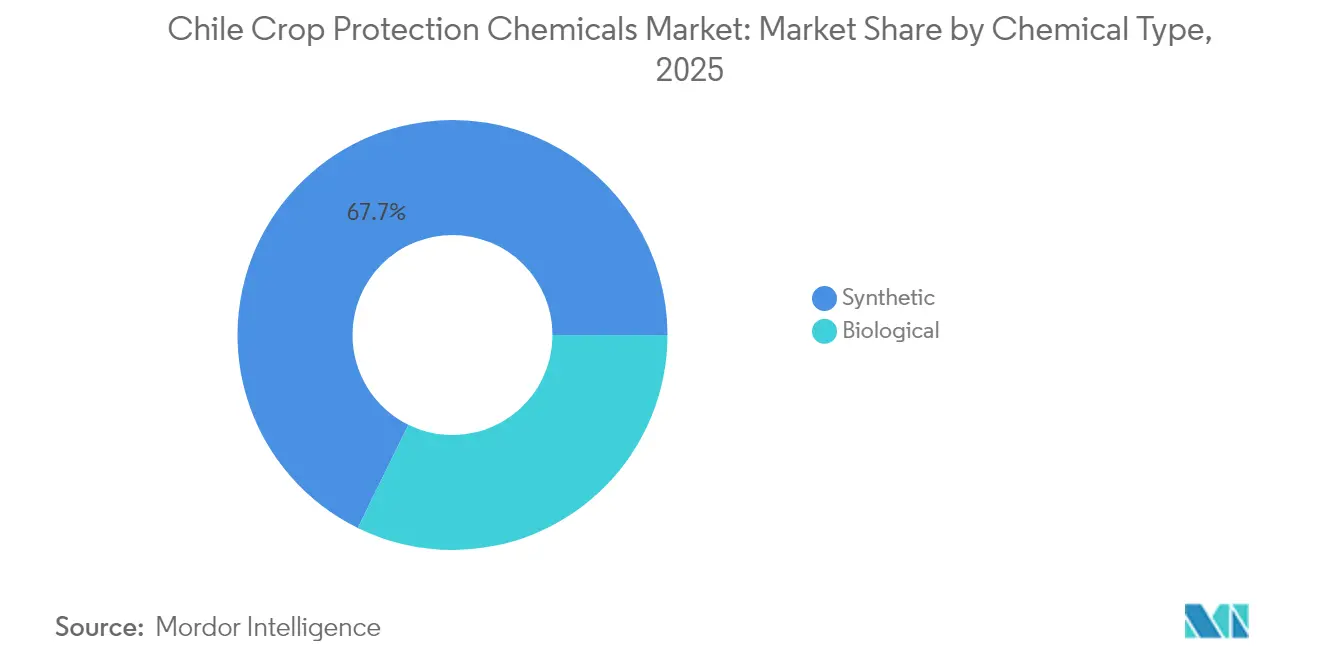
Synthetic Leadership Meets Rapid Biological UptakeSynthetic products held 67.74% of the Chile crop protection chemicals market share in 2025 as their fast knock-down and broad spectrum remain indispensable for export quality. The segment benefits from multi-site innovations that manage resistance while satisfying low-residue mandates. However, biologicals are expanding at a 9.07% CAGR, fueled by retailer zero-residue pledges and SAG’s streamlined bio-pesticide registration. The Chile crop protection chemicals market size captured by biologicals is on track to surpass its 2025 base by 2031, doubling its current value.
Local player Bio Insumos Nativa commands roughly 30% of the national biocontrol sales market and leverages Sumitomo’s capital to scale its fermentation capacity. National Association for Agriculture and Health's (ANASAC) Xilema division distributes Bacillus and Trichoderma lines, while Bayer partners with Koppert for predatory mites. Growers now integrate microbial sprays at bloom and pre-harvest windows, reducing the frequency of synthetic applications yet increasing total spend per hectare due to higher unit prices. The combined approach underpins balanced growth across both chemistry classes in the Chile crop protection chemicals market.

By Product Type:
Fungicides Dominate but Insecticides AccelerateFungicides generated 39.15% of 2025 revenue, anchored in disease-prone grapes, cherries, and blueberries. Complex export logistics mean that a single Botrytis outbreak can erase margin gains, sustaining high per-acre fungicide bills. Conversely, insecticides post the fastest 9.66% CAGR as climate shifts introduce Australian leaf miner, spotted-wing drosophila, and new aphid biotypes. The market size for insecticides is set to climb.
Novel diamide and spinosyn classes gain traction where resistance troubles older pyrethroids. BASF’s Inscalis formulation, launched in 2024, shows quick adoption in citrus against woolly whitefly. Herbicide demand remains steady after paraquat’s exit, with diquat and PPO inhibitors priced at 12-15% premiums over legacy products. Niche lines such as nematicides grow slowly, constrained to high-value berry and grape nurseries.
By Application Method:
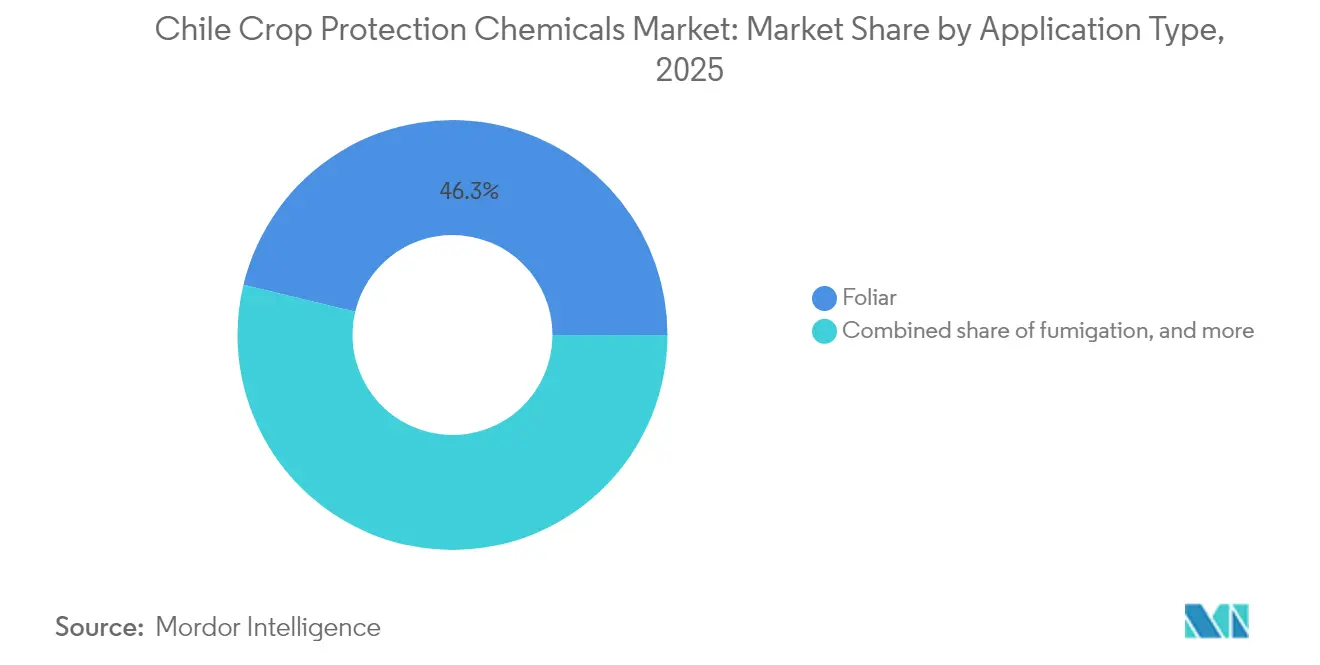
Chemigation Makes Inroads in Water-Stressed ZonesFoliar spraying still accounts for 46.25% of all treated hectares, yet chemigation grows 7.39% each year as drip systems dominate new orchard plantings. The market size linked to chemigation already exceeds and benefits from metered dosing that lowers runoff. Drone-assisted spot spraying complements chemigation during peak pest waves, synergizing input optimization. The technology is particularly valuable in cherry and avocado orchards, where terrain challenges and tree architecture make ground-based application inefficient.
Fumigation and seed treatment remain specialty niches. Soil treatment gains modest traction in new hazelnut orchards where nematode suppression is critical for early vigor. Suppliers bundle moisture sensors with fertigated pesticide cartridges, positioning themselves as water-savvy partners in Chile’s drought landscape. Labor shortage pressures are accelerating the mechanization and automated application systems that reduce manual workforce requirements while maintaining application quality standards.
By Crop Type:
Commercial Crops Outpace Traditional Fruit MainstaysFruits and vegetables retained a 33.92% revenue lead in 2025, sustained by cherries whose export receipts hit in season 2023-24. Yet commercial crops, chiefly avocados, citrus, and almonds, expand at an 8.67% CAGR as investors allocate fresh capital into long-life orchards. The market size generated by commercial crops is projected to reach a high in 2031, narrowing the gap with the fruit segments.
Grains and oilseeds require reliable herbicides to offset labor constraints, but limited acreage caps absolute value. Emerging turf and ornamental demand clusters around Santiago’s urban expansion, providing stable, though modest, outlets for selective herbicides and fungicides. This shift toward perennial crops is creating demand for specialized pest management programs designed for long-term orchard and vineyard production systems that require different chemical application strategies than annual crop rotations.
Geography Analysis
Chile’s central valleys, O’Higgins, Maule, Metropolitan Santiago, and Valparaíso command a combined 78.3% of the national fruit area and thus anchor the Chile crop protection chemicals market. The Mediterranean climate aligns with export-grade production yet fosters pathogen proliferation, driving intensive fungicide programs. Easy truck access to San Antonio and Valparaíso ports streamlines input logistics and technical service coverage.
Northern Atacama parcels now receive locust and leaf-miner incursions as warming temperatures redraw pest maps. Growers who once sprayed twice a year now budget for up to six interventions, boosting market value in regions traditionally regarded as marginal. Southern Los Ríos and Los Lagos blueberry belts grapple with stricter European residue caps, pivoting toward biological insecticides and protective nets rather than high-volume sprays.
Regional policy also shapes demand. Coquimbo pioneers regenerative pilots that phase out synthetics, trimming local market size but unlocking sales for biostimulants. Conversely, Biobío intensifies pyrethroid use to combat rising aphid pressure in grains. Nationally consistent SAG rules on drift mitigation standardize equipment upgrades, but adoption speed varies, with wealthier central orchards transitioning first.
Regulatory Landscape
Chile regulates agricultural pesticides primarily through the Servicio Agricola y Ganadero (SAG). Resolution No. 1,557 (2014) sets the core authorization requirements, based on efficacy and human, animal, and environmental risk assessment. The framework distinguishes authorization routes (identity, equivalence, and special authorizations) and is supported by SAG norms covering labeling, authorized, restricted, and cancelled lists, along with official food-safety oversight for pesticide residues in fruit and vegetables, which is central for Chile's export-oriented fruit sector.
Recent updates tightened operational compliance and expanded fit-for-purpose pathways. SAG Resolution 243 (January 2025) introduced obligations covering the purchase, sale, storage, handling, and application of agricultural pesticides, later consolidated via Resolution 7093 (September 2025). SAG also updated pollinator-related controls via Resolution 7068 (October 2024), which approved an ecotoxicological classification for bees and introduced mandatory notification and technical norms for applications near apiaries, aligned with Apiculture Law No. 21,489. More recently, Resolution 641 (published February 2026) modified procedures for authorizing pesticide uses in minor crops and required applicants to submit new-use requests through the dedicated SAG pesticide system.
Value Chain Analysis
Chile's crop protection chemicals value chain starts with SAG-led registration and import controls (under Decree Law 3,557), then moves into formulation and manufacturing or importation, followed by wholesale distribution, retail to farms, and stewardship services tied to application, storage, and traceability compliance. Multinationals and local manufacturers/importers supply the market, where synthetic products still account for most value (67.74% share in 2025). Biologicals scale through specialized local fermentation and formulation capabilities. Trade bodies such as AFIPA A.G. and IMPPA A.G. represent key importers/producers, while national distributors and manufacturers, including ANASAC and large distributors such as Copeval S.A., provide last-mile access and technical support across the central valleys and other production regions.
Registration throughput and compliance documentation act as core gating factors, affecting time-to-market and portfolio renewal as export supply chains tighten residue and pollinator safeguards. The chain is also responding to illicit and counterfeit pesticide flows through authentication and traceability initiatives, including QR-code and secure-label approaches coordinated with SAG and industry. On-farm adoption increasingly combines product supply with agronomy, monitoring, and application services (including precision spraying and chemigation support), shifting value capture toward suppliers that bundle stewardship, digital records, and compliance-ready programs for export crops.
Competitive Landscape
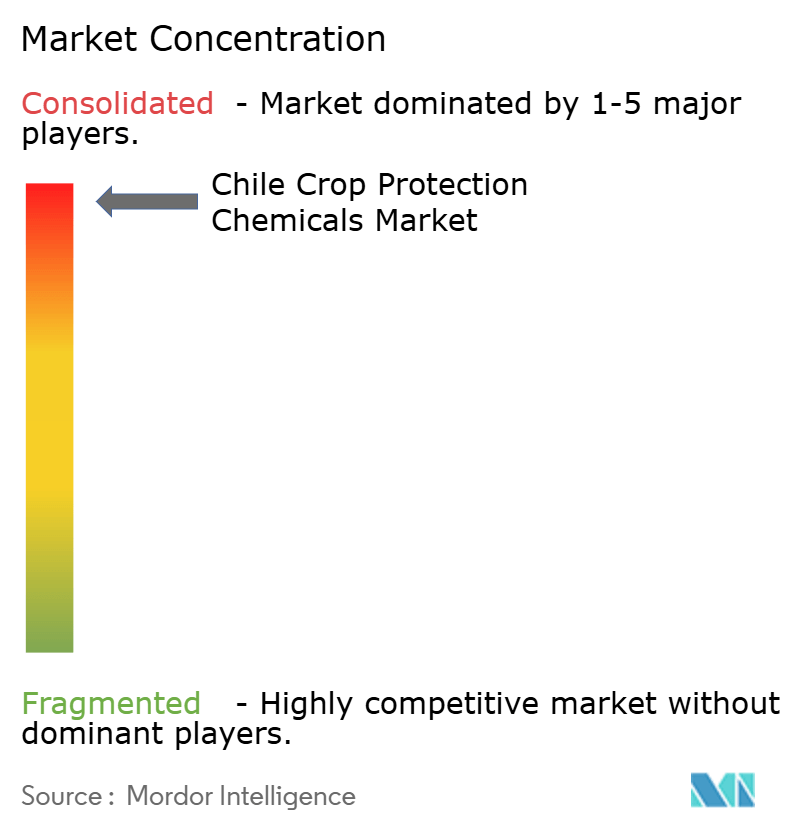
The Chile crop protection chemicals market is consolidated, with global multinational corporations maintaining dominant positions alongside emerging regional specialists and biological innovators. Global companies such as Syngenta Group, Bayer AG, BASF SE, UPL Ltd., and Corteva Agriscience collectively account for a significant share of revenue, supplying integrated portfolios that marry chemistry with digital agronomy platforms. Syngenta’s Cropwise suite logs over 120,000 monitored hectares, feeding prescription maps into drone fleets for variable-rate sprays[3]. BASF’s Revylution fungicide family secures early-season bookings among table grape exporters chasing residue margins.
Regional challenger ANASAC leverages its 600-agent network to penetrate remote zones, while UPL Ltd. bundles post-patent actives with stewardship workshops for smallholders. Biological specialist Bio Insumos Nativa controls 30% of the domestic biocontrol niche following Sumitomo’s investment, which injected scale capital. Med-X’s Nature-Cide tie-up with ANASAC widens retail shelf space for essential-oil formulations.
Competitive intensity centers on proving residue compliance and water-saving credentials rather than sheer product breadth. Firms investing in registration dossiers for paraquat replacements and bee-safe adjuvants gain first-mover rents. Concentration remains high, the top five vendors approach major share, yet dozens of niche importers thrive in specialty segments, preserving choice for growers.
Chile Crop Protection Chemicals Industry Leaders
-
Bayer AG
-
BASF SE
-
Syngenta Group
-
UPL Ltd.
-
Corteva Agriscience
- *Disclaimer: Major Players sorted in no particular order
Chile Crop Protection Chemicals Market Companies Covered in this Report
- Syngenta Group
- Bayer AG
- BASF SE
- Corteva Inc.
- UPL Ltd.
- FMC Corporation
- Sumitomo Chemical Co., Ltd.
- Nufarm Ltd.
- Gowan Company LLC
- Albaugh Group LLC
- Lallemand Plant Care (Lallemand Inc.)
- Sipcam-Nichino Chile (Sipcam Oxon and Nihon Nohyaku Co., Ltd.)
- Bioceres S.A.
- Rotam CropSciences (Rotam Global)
- Nutrien Ltd.
Market Opportunities and Future Outlook
Opportunities in Chile concentrate on residue-management and compliance-ready programs for export fruit, where buyer scrutiny and SAG oversight shape demand toward newer chemistries, biologicals, and decision-support tools. The regulatory system provides distinct channels for biological and low-concern products, including microbial, semiochemical, and natural pesticides. SAG actions in 2025-2026 also expanded compliance obligations and digitized pathways for new uses, including minor crops, creating room for suppliers that can carry dossiers and stewardship through to commercialization.
Recent market actions point to where commercial activity is building in the near term. In 2026, Fyteko signed a distribution agreement with ANASAC to commercialize the biological solution NURSPRAY HC for cherries, table grapes, and apples. In parallel, Eden Research reported Chile registration approval for Novellus+ in grapes via Sipcam Chile SpA. These steps reinforce active demand for differentiated disease-control options in export orchards and vineyards. Public and semi-public programs further support integrated pest management and bio-input adoption, including the INIA Carillanca and FIA-backed Papa Huella Cero project in Araucania (2026), which targets reducing synthetic pesticide use in potatoes, and Corfo-led technology transfer activity in La Araucania aimed at improved pest control in European hazelnut orchards. Together, these initiatives increase field validation and pull-through for bio-inputs, monitoring, and IPM-compatible portfolios.
Recent Industry Developments in Chile Crop Protection Chemicals Market
- July 2026: Corfo and Biofuturo initiated a technology transfer program (25PDT-286724) in La Araucania to strengthen pest control in European hazelnut orchards, with emphasis on integrated pest management and bio-input utilization. The program formalizes technical assistance and on-farm implementation pathways, creating a clearer route for suppliers of biologicals, monitoring tools, and IPM-aligned programs to scale into expanding permanent-crop areas.
- January 2025: Med-X formed a partnership with ANASAC to distribute Nature-Cide biological products across Chile. The tie-up expanded retail and technical reach for essential-oil-based options in fruit and vegetable supply chains that are increasingly managed around low-residue and differentiated labels.
- October 2024: Sumitomo Corporation completed a strategic investment in Bio Insumos Nativa (BIN), Chile's largest biocontrol company, to expand biological crop protection capabilities in the country. The investment strengthened local production and commercialization capacity for microbial and biological formulations, supporting faster penetration into export-oriented crop programs.
Chile Crop Protection Chemicals Market Report Scope and Research Methodology
Market Definition and Coverage
This market covers the value of commercially manufactured crop protection chemicals used in Chile to control weeds, insects, and crop diseases across field and specialty crops, measured at the country level in USD.
Scope exclusions: We exclude fertilizers, adjuvants sold as standalone products, farm-made mixtures, and application service fees unless they are bundled in the product selling price.
Segments Covered in This Report
- By Chemical Type
- Synthetic
- Biological
- By Product Type
- Herbicides
- Insecticides
- Fungicides
- Molluscicides
- Nematicides
- By Application
- Chemigation
- Foliar
- Fumigation
- Seed Treatment
- Soil Treatment
- By Crop Type
- Grains and Cereals
- Oilseeds and Pulses
- Fruits and Vegetables
- Commercial Crops
- Turf and Ornamental Grass
Data Sources, Market Sizing, and Validation
Desk Research
Desk work started with building a clean fact base on cropped area, crop mix, and trade flows for key produce, because these are the demand anchors for crop protection use. Public sources such as the FAOSTAT database, Chilean agriculture and plant health agencies, the national statistics institute, customs and tariff portals, and pesticide registration lists were used to confirm what is approved for sale and which crop groups matter most.
We then reviewed company annual reports, investor presentations, and reputable local news to understand portfolio focus and pricing direction. In a few cases, paid subscriptions were used for company financials, patent lookups, and shipment-level trade checks to pressure test volumes and average selling price assumptions. These examples are not exhaustive, and many other public sources were also used during data collection and validation.
Primary Interviews and Surveys
Primary calls and short surveys were used to convert the desk indicators into workable assumptions, especially around application intensity by crop and seasonal buying patterns. We spoke with a mix of manufacturers, importers, distributors, agronomists, and large growers across Chile so gaps in public data could be closed and then checked back against what the channel is actually seeing.
Distribution of primary research fieldwork respondents
| Company type | Respondent position |
|---|---|
| Top tier: 37% | CXOs: 16% |
| Mid tier: 43% | Functional/Unit leaders: 31% |
| Smaller Players: 20% | Managers: 53% |
Market-Sizing & Forecasting
Sizing began from a top-down reconstruction of the addressable demand pool using Chile crop area by crop group, pest pressure patterns, and typical treatment intensity, which were then converted into product demand by category. Once the country demand pool was formed, pricing was applied through category-level average selling prices that reflect formulation mix and import parity signals.
To keep totals realistic, selective bottom-up approximations were used as a cross-check, such as rolling up a sample of supplier and importer revenues, distributor sell-out discussions, and simple volume times price sanity checks for major crop groups. When direct volume clues were missing for smaller use cases, the gaps were handled with proxy ratios (for example, relating minor crops to comparable crop protection spend per hectare), and then reviewed again in primary follow-ups.
For forecasting, we relied on scenario analysis supported by a light time-series view of historical growth, because year-to-year outcomes are shaped by weather swings and pest outbreaks. The forward curve was guided by expected changes in planted area, export-oriented fruit and vegetable trends, regulatory constraints on active ingredients, and the adoption pace of biological products, and then aligned to what interviewees expect for channel pricing and product mix.
Data Validation & Update Cycle
Outputs were triangulated across at least three independent checks, including crop area reality checks, trade and registration consistency, and category share logic that fits how products are used in Chile. If a number looked out of range, the inputs were reopened and rechecked, and follow-up questions were sent to primary contacts to confirm whether the issue was price timing, a crop shift, or a one-off season effect.
Before sign-off, the model is reviewed in steps by another analyst to catch math errors, duplicated scope, or inconsistent units. The report is refreshed annually, and material events such as regulatory bans, sharp currency moves, or unusual seasons can trigger interim revisions. Right before delivery, we do a final pass to ensure the latest public releases are reflected.
Mordor Intelligence's Chile Crop Protection Chemicals Market Size Measured Against Other Published Estimates
Published values for this market can differ even when they sound similar, because the boundaries are not always the same and the year used as the anchor can shift. Differences usually come from what is counted as crop protection, how biological products are treated, and whether the number reflects manufacturer sales, channel sales, or farm-level spend.
Import and customs signals, pesticide registration coverage, and crop-area based demand checks are the main evidence used to keep Mordor Intelligence's estimate tied to what can actually be sold and used inside Chile, rather than a broader regional or spend-based construct. Currency conversion timing, inclusion of application services, and the way price progression is modeled by product type also tend to widen the spread.
Benchmark comparison
| Source | Market Size | Gaps in Research Methodology |
|---|---|---|
| Mordor Intelligence | USD 485.01 M (2025) | |
| Industry Data Provider A | USD 380.00 M (2024) | Uses an earlier anchor year and appears to apply a narrower realized revenue lens, which can understate value when channel restocking and price changes happen after the base period. |
| Publisher B | USD 465.44 M (2023) | Presents a global framing and an older base year, and the path to Chile-only value can blend regional assumptions that do not match local crop mix, registration limits, and category share splits. |
The comparison mainly shows that base-year choice and scope boundaries drive most of the gap, not just growth rates. By grounding the number in Chile-specific sellable categories and demand signals that can be rechecked, the outcome stays traceable to clear inputs and is easier to update when regulations or seasons change.
Key Questions Answered in the Report
How large is the Chile crop protection chemicals market in 2026?
The market is valued at USD 511.87 million in 2026 and is forecast to grow steadily through 2031.
Which product category dominates grower spending?
Fungicides remain the leading category, generating 39.15% of 2025 revenue due to intensive disease control in fruit crops.
What is driving faster uptake of biological crop protection in Chile?
Export buyers zero-residue standards and SAG's streamlined registration process are pushing biologicals to a 9.07% CAGR through 2031.
Which regions account for most pesticide demand?
The central valley's O'Higgins, Maule, Metropolitan Santiago, and Valparaíso collectively host over 78% of fruit hectares and thus lead national chemical consumption.