
Chile Commercial Vehicle Market Size and Share
Market Overview
| Study Period | 2019 - 2031 |
|---|---|
| Forecast Data Period | 2026 - 2031 |
| Base Year Market Size (2025) | USD 5.55 Billion |
| Market Size (2026) | USD 5.85 Billion |
| Market Size (2031) | USD 7.59 Billion |
| Growth Rate (2026 - 2031) | 5.35 % |
| Market Concentration | Medium |
Major Players *Disclaimer: Major Players sorted in no particular order Image © Mordor Intelligence. Reuse requires attribution under CC BY 4.0. | |

Chile Commercial Vehicle Market Analysis by Mordor Intelligence
The Chile commercial vehicles market size was valued at USD 5.55 billion in 2025, and is projected to expand from USD 5.85 billion in 2026 to USD 7.59 billion by 2031, registering a CAGR of 5.35% between 2026 and 2031. Fleet replacement remained an important source of demand after registrations reached an unusually high level in 2025. The transition to Euro VI rules changed purchase timing and created a weaker opening period in 2026 for trucks and buses. Mining, city distribution, and public transport procurement continue to shape the product mix and the route to market. Suppliers with compliant vehicles, service coverage, and practical electrification offers are better placed to respond to these needs. The Chile commercial vehicles market also faces uneven regional demand because mining activity, urban delivery networks, and public transport are concentrated in different parts of the country.
Key Report Takeaways
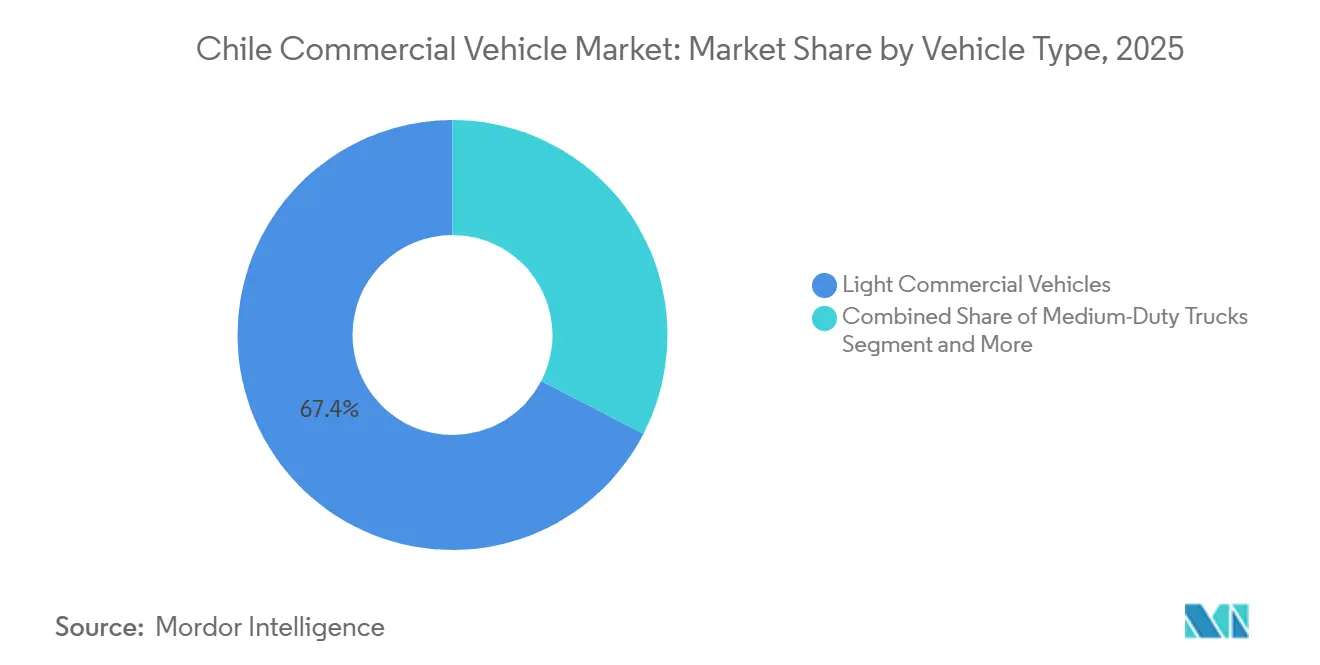
- By vehicle type, light commercial vehicles accounted for 67.41% of Chile's commercial vehicle market share in 2025, while buses and coaches are projected to record the highest projected CAGR at 6.97% through 2031.
- By propulsion type, internal combustion engine vehicles held 84.77% of the Chile commercial vehicles market share in 2025, while electric and hybrid vehicles are set to record the highest projected CAGR at 13.32% through 2031.
- By body and configuration, pickup trucks and chassis cabs held 52.09% of the Chile commercial vehicles market share in 2025, while panel vans and cargo vans are expected to record the highest projected CAGR at 5.74% through 2031.
- By application and end use, freight and logistics held 42.89% of the Chile commercial vehicles market size in 2025 and is projected to record the highest projected CAGR at 7.71% through 2031.
- By buyer type, large fleet operators held 53.11% of the Chile commercial vehicles market share in 2025, while rental and leasing companies are projected to record the highest projected CAGR at 6.46% through 2031.
Note: Market size and forecast figures in this report are generated using Mordor Intelligence’s proprietary estimation framework, updated with the latest available data and insights as of January 2026.
Chile Commercial Vehicle Market Trends and Insights
Drivers Impact Analysis*
| Driver | (~)% Impact on CAGR Forecast | Geographic Relevance | Impact Timeline |
|---|---|---|---|
| Copper-Lithium Project Development | +1.4% | Antofagasta, Atacama, Tarapacá Regions | Long term (≥ 4 years) |
| E-Commerce Expansion | +1.2% | Región Metropolitana, Valparaíso, Biobío, Maule | Medium term (2-4 years) |
| Public-Transport Electrification Procurement | +0.9% | Región Metropolitana; expanding to Valparaíso, Antofagasta, Coquimbo | Short term (≤ 2 years) |
| Urban Freight Density and Compact Vehicle Demand | +0.7% | Región Metropolitana, Valparaíso, Biobío | Medium term (2-4 years) |
| Main-Corridor Charging Infrastructure Deployment | +0.5% | Maule, Ñuble (Ruta 5 Sur); Atacama, Coquimbo (Ruta 5 Norte) | Medium term (2-4 years) |
| Predictive-Maintenance Adoption | +0.3% | Región Metropolitana, Antofagasta, Biobío | Long term (≥ 4 years) |
| Source: Mordor Intelligence | |||
Mining Fleet Replacement and Copper-Lithium Project Development
Mining activity supports demand for heavy vehicles, specialized trucks, underground equipment, and worker transport across northern Chile. Copper and lithium projects require regular movement of people, materials, and equipment across long distances and demanding terrain. This makes fleet availability and maintenance capacity important purchasing factors for operators. The Chile commercial vehicles market benefits when mines replace vehicles that face high use and strict operating requirements. Suppliers increasingly need to provide repair support, vehicle monitoring, and dependable parts access with the vehicle itself. These conditions favor manufacturers and dealers that can support fleets through the full operating cycle rather than only at the point of sale.
E-Commerce and Last-Mile Delivery Expansion
Online commerce has increased the need for delivery vehicles that can operate efficiently in dense urban areas. The national urban freight strategy introduced by the Ministry of Transport and Telecommunications supports micro-distribution hubs, better loading practices, and improved cargo movement in cities. This policy direction favors panel vans, compact trucks, and other vehicles suited to short delivery routes. The Chile commercial vehicles market, therefore, serves both local delivery fleets and larger vehicles that connect cities, ports, warehouses, and mining sites. Operators are likely to use different vehicle types for urban cores and intercity routes as delivery needs become more specific. This creates room for dealers to offer tailored fleet packages instead of relying on one vehicle format.
Public-Transport Electrification Procurement
Public transport electrification has become a major source of bus demand in Santiago and is extending to other Chilean cities. Red Movilidad continued to add electric buses through 2025, while the government set out a further electrification objective for the system in 2026[1]. The procurement model gives bus suppliers a more structured demand channel than many other commercial vehicle categories. It also increases the need for depot charging, maintenance arrangements, driver training, and technical support. Regional fleet procurement gives manufacturers an opportunity to extend their support networks beyond the capital. The Chile commercial vehicles market can gain from this shift when suppliers combine vehicle sales with charging and service partnerships.
Urban Freight Density and Compact Vehicle Demand
Urban freight activity is increasing the need for compact commercial vehicles that can work efficiently in congested city areas. Delivery fleets need vehicles that can make frequent stops, use limited loading space, and operate within dense commercial districts. The urban freight strategy supports loading zones, local distribution points, and operating practices that can reduce unnecessary movement in central areas. These conditions favor compact cargo vans and light trucks over larger vehicles for many last-mile routes. Manufacturers can respond by offering vehicles with practical cargo layouts, low operating costs, and service support suited to intensive urban use. The Chile commercial vehicles market benefits when vehicle design and delivery operations are matched to the needs of each city route.
Restraints Impact Analysis*
| Restraint | (~)% Impact on CAGR Forecast | Geographic Relevance | Impact Timeline |
|---|---|---|---|
| Demand Dip Due to Euro VI Transition | -0.9% | Región Metropolitana, Valparaíso, Biobío (urban trade centers) | Short term (≤ 2 years) |
| Higher Vehicle Prices from Emission Compliance | -0.7% | National; strongest pressure in Atacama, Antofagasta (mining corridors) | Medium term (2-4 years) |
| Mining-Linked Capital Expenditure Volatility | -0.4% | Antofagasta, Atacama Regions | Long term (≥ 4 years) |
| Limited Heavy-Duty Charging Coverage | -0.3% | La Araucanía, Los Lagos, Aysén, Magallanes Regions | Long term (≥ 4 years) |
| Source: Mordor Intelligence | |||
Euro VI Transition Pull-Forward and Post-Transition Demand Dip
Chile requires Euro VI compliance for new heavy-duty vehicles from January 2026 under DS-55[2]. The rule encouraged some operators to bring purchases forward before the new requirements took effect. That pattern contributed to a weaker registration environment at the start of 2026 as fleets adjusted inventories and purchasing plans. Vehicle buyers must now consider the requirements of more advanced emissions-control systems. Smaller transport firms and owner-operators may delay replacement when the upfront cost is difficult to absorb. The Chile commercial vehicles market must balance long-term compliance with the near-term purchasing capacity of smaller buyers.
Higher Vehicle Prices from Emissions and Input-Cost Compliance
Euro VI compliance can increase vehicle acquisition costs because new equipment requires more advanced emissions-control technology. The cost pressure can be more visible for smaller firms that replace vehicles one at a time rather than through large fleet programs. Higher input costs can also affect the price of chassis, bodies, and other vehicle components. Mining operators and long-distance carriers face this issue when regular fleet replacement is needed to maintain service availability. Buyers may extend the use of existing vehicles or consider leasing when the cost of new equipment rises. The Chile commercial vehicles market may therefore see a slower replacement cycle in customer groups with limited financing capacity.
*Our forecasts treat driver/restraint impacts as directional, not additive. The impact forecasts reflect baseline growth, mix effects, and variable interactions.
Segment Analysis
By Vehicle Type: Light Commercial Vehicles Provide Scale While Buses and Coaches Lead Growth
Light commercial vehicles held 67.41% of the Chile commercial vehicles market share in 2025. Their broad customer base includes delivery businesses, contractors, mining support providers, public agencies, and owner-operated firms. Pickup-based and light truck fleets are useful where road conditions, payload needs, and short-distance travel vary across assignments. They also support access to mine sites and industrial areas where vehicle versatility is important. Urban distribution strengthens demand for vans and compact trucks, as these vehicles can manage frequent stops and limited parking spaces.
Buses and coaches are forecast to expand at a CAGR of 6.97% through 2031. Public transport procurement is the main driver behind this growth, particularly in Santiago, where electric buses remain central to fleet renewal plans. The transition to electric fleets requires manufacturers to coordinate vehicle delivery with charging infrastructure, maintenance, and spare-parts availability. Regional procurement can extend this opportunity beyond the capital as cities renew urban services. Bus manufacturers also benefit from service contracts that create longer-term relationships with operators after the initial purchase.

By Propulsion Type: Internal Combustion Engines Retain Scale While Electric and Hybrid Vehicles Grow Fastest
Internal combustion engine vehicles held 84.77% of the Chile commercial vehicles market share in 2025. Diesel remains widely used in long-haul freight, mining operations, refrigerated transport, and regional distribution. The installed base is large, and commercial vehicles often remain in service for extended periods, making a rapid replacement of conventional powertrains unlikely across all applications. Euro VI requirements raise the technology standard for new heavy vehicles without removing diesel's practical role in demanding routes. The market will continue to depend on compliant combustion vehicles while charging infrastructure develops.
Electric and hybrid vehicles are forecast to grow at a CAGR of 13.32% through 2031. Electric buses are the clearest current example, as public fleet programs create planned routes and centralized charging. Battery-electric trucks are beginning to demonstrate their role on selected commercial routes in Chile, providing operational experience for carriers, dealers, and fleet managers. Suppliers that help customers plan charging, technical support, and route scheduling can reduce the risk of early electric vehicle deployment. The market is likely to maintain a mixed-powertrain structure for an extended period.
By Body and Configuration: Pickup Trucks and Chassis Cabs Set the Base While Panel Vans and Cargo Vans Gain Ground
Pickup trucks and chassis cabs held 52.09% of the Chile commercial vehicles market share in 2025. These vehicles serve mining, construction, agriculture, utilities, and field service operations. Their value lies in flexibility, as they can carry people, tools, materials, or specialized bodies. Chassis cabs can be adapted for equipment transport, maintenance work, and service applications. Chile's geographic conditions make adequate ground clearance and robust vehicle construction important for many buyers. This configuration serves as a common link between urban work and remote industrial activity.
Panel vans and cargo vans are forecast to grow at a CAGR of 5.74% through 2031. Delivery operations use these vehicles because the enclosed cargo space protects parcels and goods during repeated urban stops. They are well-suited to the growing use of local distribution facilities and short delivery routes in large cities. Electric van options can be appropriate when operators work from a central depot and have predictable daily mileage. The Chile commercial vehicles market benefits from distributors that understand local operating conditions and can support vehicle adaptation. Their coordination affects how quickly a customer can put a vehicle into service.
By Application and End Use: Freight and Logistics Lead Both Current Use and Future Expansion
Freight and logistics accounted for 42.89% of the Chile commercial vehicles market in 2025. This application covers local delivery, regional distribution, port-linked freight, and mining-related transport. It requires a wide range of vehicles, as cargo type, travel distance, and route conditions vary significantly across the country. Last-mile delivery favors compact vans and light trucks, while port and mine corridors require larger vehicles. Mining and quarrying represent a separate and significant source of demand for heavy equipment and workforce transport. Construction and infrastructure projects also require commercial vehicles for personnel, materials, and service operations. Public and private passenger transport depend on buses and coaches, which operate on different cycles from freight fleets.
Freight and logistics are forecast to grow at a CAGR of 7.71% through 2031. E-commerce activity and the need to move goods through urban areas support the delivery segment. Mining and port activity support heavier freight movements across longer routes. Urban freight planning can influence vehicle choice by encouraging more efficient loading and routing. Companies that translate vehicle capabilities into practical operating benefits can build stronger long-term customer relationships. Clear guidance on route use and maintenance can help buyers select a suitable vehicle, which is particularly important when newer technology changes operating routines.

By Buyer Type: Large Fleet Operators Hold the Largest Position While Rental and Leasing Companies Expand Fastest
Large fleet operators held 53.11% of the Chile commercial vehicles market share in 2025. Mining companies, large logistics providers, public transport operators, and major service businesses purchase vehicles through centralized fleet programs. These buyers typically evaluate vehicles alongside financing, maintenance, parts supply, and vehicle availability. Their purchasing processes tend to favor established suppliers with local technical support and experience in formal tenders. Large fleet operators are also better positioned to plan for Euro VI replacement requirements than smaller firms. Government and municipal buyers remain important for public transport, utility fleets, and service vehicles, and their procurement processes can influence both technical specifications and order timing. Owner-operators remain a meaningful buyer group in freight and service activity, though they may be more cautious when replacement costs rise. Dealers require different sales and financing approaches for each buyer type, as financing terms, repair access, and vehicle specifications need to reflect each customer's circumstances.
Rental and leasing companies are forecast to grow at a CAGR of 6.46% through 2031. Leasing can make new equipment more accessible for businesses that prefer to avoid large upfront purchases, which is relevant where customers are concerned about the cost and technology requirements of newer emissions-compliant vehicles. Rental arrangements also give operators flexibility when transport needs vary by project or season. Large fleets may seek data services, planned maintenance, and dedicated account support, while smaller buyers may place more weight on financing, local repair access, and parts availability. These differences create several routes to market within the Chile commercial vehicles industry and support the role of distributors that offer financing and service alongside vehicle sales.
Geography Analysis
Northern Chile, including Tarapacá, Antofagasta, Atacama, and parts of Coquimbo, remains the country's primary concentration of heavy commercial vehicle activity. Mining operations require vehicles for material movement, worker transport, maintenance work, and site services. Long distances and difficult conditions make uptime, repair capacity, and durable specifications important. Suppliers need strong parts access and field service capabilities, as vehicle downtime can disrupt industrial operations. Conventional Euro VI vehicles will continue to play a major role where electric alternatives are not yet practical, resulting in a gradual rather than immediate shift in the northern fleet mix.
The central zone, particularly Región Metropolitana and Valparaíso, is the primary center for light commercial vehicles, city buses, and urban freight operations. Santiago has the country's largest urban vehicle base and remains the key location for electric bus procurement. Delivery networks, warehouses, and consumer activity also generate strong demand for vans and light trucks in and around the capital. Valparaíso and San Antonio add an important port-related freight dimension, with corridors connecting ports, warehouses, the capital, and inland customers. The region is likely to remain a key market for both conventional freight vehicles and targeted electric deployments.
South-Central and Southern Chile combine agricultural, forestry, salmon, food distribution, and interurban transport activity, requiring reliable freight vehicles, including refrigerated units. Varied road conditions and long travel distances make fleet planning more complex than on dense urban routes. Charging availability and service coverage are especially important for operators considering electric vehicles. New powertrains are likely to be adopted at different rates across these regions. Manufacturers cannot treat Chile as a single, uniform operating environment, making local distribution and after-sales capability important competitive assets.
Competitive Landscape
The commercial vehicles market in Chile remains fragmented, with several European and Chinese suppliers competing across trucks, buses, vans, and pickups. Mercedes-Benz, represented by Kaufmann, offers a broad range of trucks and commercial vans, supported by established service arrangements and a growing electric product line. Mercedes-Benz confirmed the first Chile delivery of eActros 600 trucks for commercial use in 2026, giving the company an early role in battery-electric long-haul freight trials. Scania competes through heavy vehicles and relationships with industrial and fleet buyers, while Volvo Group remains relevant in heavy trucks and public transport, including zero-emission bus offerings for the Santiago system.
Chinese manufacturers have expanded their presence in buses, trucks, vans, and pickups, catering to price-sensitive and electrification-focused demand. Yutong and BYD are well established in electric bus supply, while Foton and JAC compete in vans, trucks, and pickups through local distribution networks. Their growth has increased competitive pressure on established manufacturers. The bus segment is particularly important as public procurement creates visible opportunities for electric vehicle suppliers, and government deployment of electric buses in Red Movilidad has made Santiago a notable reference point for electric public transport.
Competitive advantage also depends on support in mining and remote regions, where heavy-vehicle customers require reliable field maintenance, rapid parts delivery, and technical expertise for demanding applications. Suppliers entering the market through a single product category may need to build broader service capability before competing for larger fleet accounts. The Chile commercial vehicles market remains open to new entrants, but sustained success depends on local support as well as product availability. Competition is likely to remain active as electrification expands the range of vehicle and service choices.
Chile Commercial Vehicle Industry Leaders
-
Mercedes-Benz Group
-
Chevrolet Trucks
-
Scania AB
-
Volvo Group
-
Volkswagen Truck & Bus
- *Disclaimer: Major Players sorted in no particular order

Recent Industry Developments
- May 2026: DSV introduced its first fully electric truck for local distribution in Chile. The launch formed part of the company’s effort to expand lower-emission logistics services in the country.
- February 2026: Cummins deployed a hybrid-electric ultra-class mining truck in daily production at Caserones. The retrofit project uses the company’s First Mode technology in a 300-ton Komatsu mining haul truck.
- February 2026: Mercedes-Benz Trucks, through Kaufmann, delivered the first eActros 600 battery-electric long-haul trucks in Chile and South America to Empresas Cavalieri. The vehicles entered commercial beverage-haulage service on the Santiago-Viña del Mar route, with 6 additional units planned for subsequent delivery.
- November 2025: Chery introduced its HIMLA pickup in Portillo, Chile, through a regional Latin American launch and media driving event. The model is intended for demanding terrain and heavy-duty applications in the region.
Chile Commercial Vehicle Market Report Scope
The Chile Commercial Vehicle market is segmented by vehicle type, propulsion type, body and configuration, application and end use, and buyer type. By Vehicle Type, the market is segmented into Light Commercial Vehicles, Medium-Duty Trucks, Heavy-Duty Trucks, and Buses and Coaches. By Propulsion Type, the market is segmented into Internal Combustion Engine (Petrol and Diesel) and Electric and Hybrid (Battery Electric Vehicles, Plug-In Hybrid Electric Vehicles, and Fuel-Cell Electric Vehicles). By Body and Configuration, the market is segmented into Panel Vans and Cargo Vans, Pickup Trucks and Chassis Cabs, Rigid Trucks, Tractor Units, Urban Buses, Intercity and Long-Distance Coaches, and Minibuses and Taxibuses. By Application and End Use, the market is segmented into Freight and Logistics (Last-Mile Delivery, Port and Intermodal Logistics, and Refrigerated Transport), Mining and Quarrying, Construction and Infrastructure, Public and Private Passenger Transport, and Utility, Municipal and Service Fleets. By Buyer Type, the market is segmented into Large Fleet Operators, Small and Medium-Sized Enterprises (SMEs), Government and Municipal Bodies, Rental and Leasing Companies, and Owner-Operators. Market forecasts are provided in terms of Value (USD) and Volume (Units).
| Light Commercial Vehicles |
| Medium-Duty Trucks |
| Heavy-Duty Trucks |
| Buses and Coaches |
| Internal Combustion Engine | Petrol |
| Diesel | |
| Electric and Hybrid | Battery Electric |
| Plug-In Hybrid | |
| Fuel-Cell Electric |
| Panel Vans and Cargo Vans |
| Pickup Trucks and Chassis Cabs |
| Rigid Trucks |
| Tractor Units |
| Urban Buses |
| Intercity and Long-Distance Buses |
| Minibuses and Taxibuses |
| Freight and Logistics | Last-Mile Delivery |
| Port and Intermodal Haulage | |
| Refrigerated Transport | |
| Mining and Quarrying | |
| Construction and Infrastructure | |
| Public and Private Passenger Transport | |
| Utility, Municipal and Service Fleets |
| Large Fleet Operators |
| Small and Medium-Sized Enterprises |
| Government and Municipal Buyers |
| Rental and Leasing Companies |
| Owner-Operators |
| By Vehicle Type | Light Commercial Vehicles | |
| Medium-Duty Trucks | ||
| Heavy-Duty Trucks | ||
| Buses and Coaches | ||
| By Propulsion Type | Internal Combustion Engine | Petrol |
| Diesel | ||
| Electric and Hybrid | Battery Electric | |
| Plug-In Hybrid | ||
| Fuel-Cell Electric | ||
| By Body and Configuration | Panel Vans and Cargo Vans | |
| Pickup Trucks and Chassis Cabs | ||
| Rigid Trucks | ||
| Tractor Units | ||
| Urban Buses | ||
| Intercity and Long-Distance Buses | ||
| Minibuses and Taxibuses | ||
| By Application and End Use | Freight and Logistics | Last-Mile Delivery |
| Port and Intermodal Haulage | ||
| Refrigerated Transport | ||
| Mining and Quarrying | ||
| Construction and Infrastructure | ||
| Public and Private Passenger Transport | ||
| Utility, Municipal and Service Fleets | ||
| By Buyer Type | Large Fleet Operators | |
| Small and Medium-Sized Enterprises | ||
| Government and Municipal Buyers | ||
| Rental and Leasing Companies | ||
| Owner-Operators | ||
Key Questions Answered in the Report
What is the forecast for Chile commercial vehicles through 2031?
The Chile commercial vehicles market size is projected to reach USD 7.59 billion by 2031 from USD 5.85 billion in 2026, with a 5.35% CAGR.
Which vehicle type has the largest position in Chile?
Light commercial vehicles held the largest position, with 67.41% share in 2025.
What is driving demand for electric commercial vehicles in Chile?
Public bus electrification, planned depot operations, and selected delivery and freight routes are supporting adoption.
How does Euro VI affect new heavy vehicles in Chile?
Euro VI has applied to new heavy-duty vehicles since January 2026, increasing the importance of compliant vehicle technology and maintenance support.