
Certification and Testing Market Size and Share
Market Overview
| Study Period | 2020 - 2031 |
|---|---|
| Market Size (2026) | USD 218.04 Billion |
| Market Size (2031) | USD 262.84 Billion |
| Growth Rate (2026 - 2031) | 3.81 % |
| Fastest Growing Market | Asia Pacific |
| Largest Market | Asia Pacific |
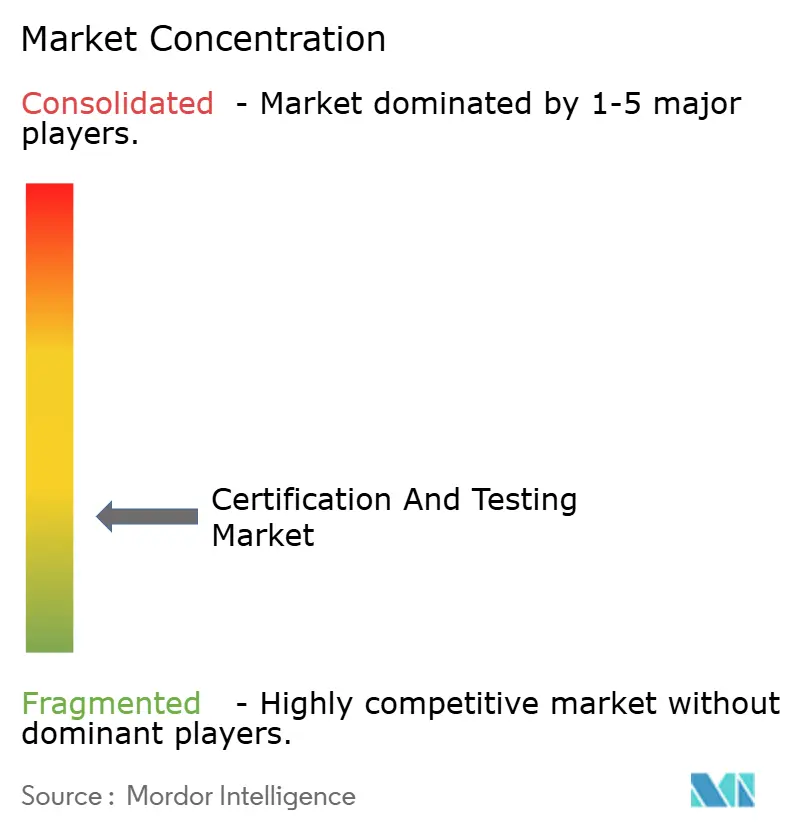
| Market Concentration | Low |
Major Players *Disclaimer: Major Players sorted in no particular order Image © Mordor Intelligence. Reuse requires attribution under CC BY 4.0. | |
Certification and Testing Market Analysis by Mordor Intelligence
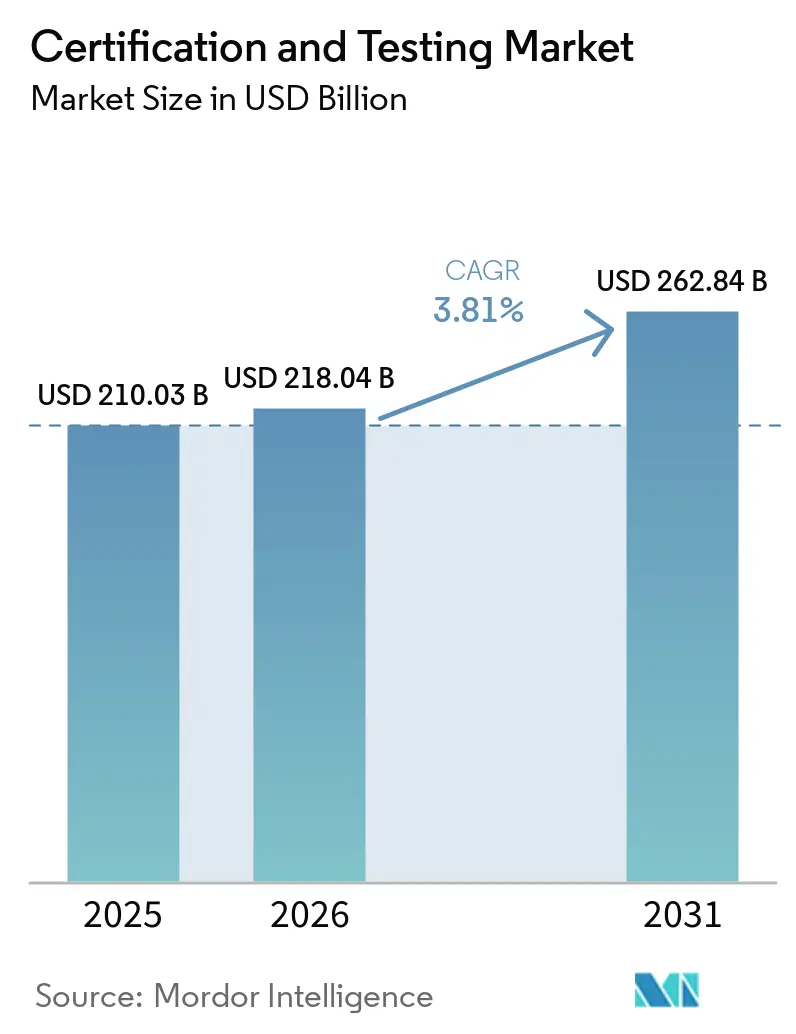
The certification and testing market size was valued at USD 210.03 billion in 2025 and estimated to grow from USD 218.04 billion in 2026 to reach USD 262.84 billion by 2031, at a CAGR of 3.81% during the forecast period (2026-2031). Outsourced providers already handle two-thirds of all compliance work, and their share is widening as manufacturers shift budgets from laboratory infrastructure to R&D. Digital platforms such as the U.S. Customs and Border Protection’s eCERT portal shorten origin-certificate processing from days to minutes, pointing to faster cross-border turnaround times. Demand is also rotating toward management system audits, with ISO 27001 cybersecurity and ISO 50001 energy certifications expanding more quickly than traditional product testing. The Asia-Pacific region remains the growth engine, aided by China’s expanded CCC catalog and India’s broader BIS mandates. Meanwhile, food and healthcare companies dominate volume, yet transportation is the fastest-rising vertical as UN Regulations 155 and 156 reshape automotive cyber-risk rules.
Key Report Takeaways
- By sourcing type, outsourced testing captured a 63.98% certification and testing market share in 2025 and is projected to advance at a 4.42% CAGR through 2031.
- By end-user vertical, the food and healthcare sectors held 28.15% of the certification and testing market size in 2025, while the transportation sector is expected to expand at a 5.28% CAGR through 2031.
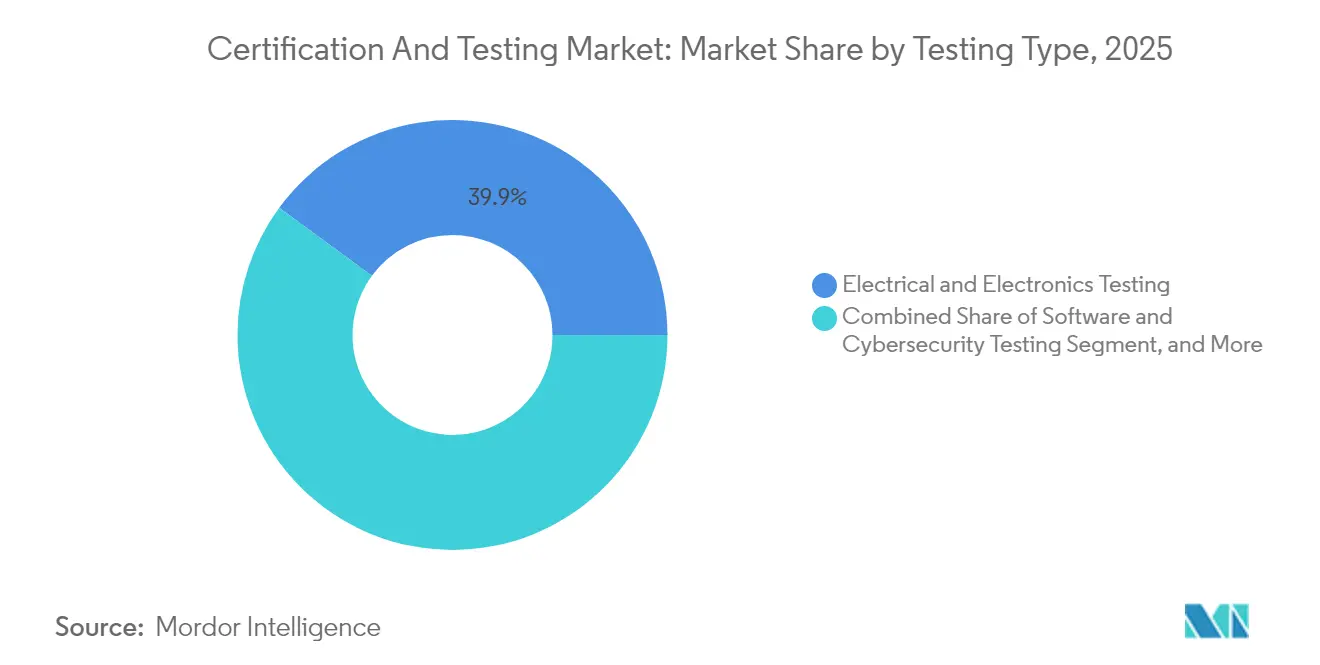
- By testing type, electrical and electronics testing led with 39.92% share of the certification and testing market in 2025. However, software and cybersecurity testing are projected to expand at a 5.03% CAGR between 2026 and 2031.
- By certification type, management system certification accounted for the fastest growth, recording a 5.62% CAGR versus product certification’s 3.41% baseline.
- By service type, testing services represented 52.31% of 2025 revenue, while certification services are projected to rise at a 4.69% CAGR through 2031.
- By geography, Asia-Pacific generated 39.88% of 2025 revenue and is forecast to grow at a 4.21% CAGR, nearly double the global pace.
Note: Market size and forecast figures in this report are generated using Mordor Intelligence’s proprietary estimation framework, updated with the latest available data and insights as of 2026.
Market Trends and Insights
Drivers Impact Analysis of Certification and Testing Market*
| Driver | (~) % Impact on CAGR Forecast | Geographic Relevance | Impact Timeline |
|---|---|---|---|
| Intensifying Global Trade Compliance Mandates | +0.9% | Global, concentrated in North America, EU, APAC export hubs | Medium term (2-4 years) |
| Rapid Expansion of Cross-Border E-Commerce | +0.7% | Global, led by APAC and North America | Short term (≤ 2 years) |
| Proliferation of IoT and Smart Devices | +0.6% | Global, early adoption in North America, EU, East Asia | Medium term (2-4 years) |
| Rising Focus on Product Safety and Quality | +0.5% | Global, especially North America, EU, Japan | Long term (≥ 4 years) |
| Growing Adoption of Digital Twin-Based Remote Certification | +0.4% | North America and EU, gradual APAC uptake | Long term (≥ 4 years) |
| Emergence of Sustainability-Linked Certification Schemes | +0.3% | EU leading, followed by North America and select APAC markets | Long term (≥ 4 years) |
| Source: Mordor Intelligence | |||
Intensifying Global Trade Compliance Mandates
Governments continue to tighten origin-verification and conformity documentation. The World Customs Organization issued digital certificate guidelines in 2024, prompting exporters to provide accredited laboratory data that matches treaty annexes.[1] The EU’s Registered Exporter scheme now requires ISO 17025 test reports on select goods, doubling certification queues from Southeast Asian suppliers since mid-2024.[2] The United States added third-party test evidence for dual-use items under updated Export Administration Regulations. Large multi-accredited labs, therefore, win volume as their certificates travel globally, while regional providers rush to secure International Accreditation Forum recognition and strengthen their role as trusted certificate authorities.
Rapid Expansion of Cross-Border E-Commerce
Major marketplaces have imposed stricter pre-listing protocols. Amazon requires ISO 17025 reports for electronics, toys, and personal-care items in the United States, the EU, and Japan, thereby excluding untested goods.[3] Alibaba’s Tmall Global auto-delists products lacking FCC, CE, or CCC marks, resulting in a 40% surge in certification inquiries from Chinese exporters in 2024. The EU Digital Services Act makes platforms jointly liable for unsafe products, reinforcing these rules. Smaller brands, therefore, outsource compliance work to external labs, accelerating the shift toward asset-light operations in the certification and testing market.
Proliferation of IoT and Smart Devices Requiring Certification
Connected products face a range of tests, including layered radio, cybersecurity, and privacy assessments. NIST finalized the 8259 series in 2024 for federal IoT procurements. Europe followed with ETSI EN 303 645, now a harmonized Radio Equipment Directive standard that mandates secure boot and encrypted communication for consumer IoT. Certification cycles can stretch three to six months for non-compliant designs, prompting a rush to security-ready chipsets. PSA Certified logged more than 200 approvals by end-2024, signaling pre-silicon convergence. Labs with deep cybersecurity benches, therefore, gain share as device counts climb.
Rising Focus on Product Safety and Quality Among Consumers
Social media amplifies recalls, driving brands toward voluntary marks that exceed statutory minimums. The Global Food Safety Initiative recorded 400 new scheme adoptions in 2024, led by FSSC 22000 and SQF. Europe’s Medical Device Regulation expanded audits to many Class I devices, resulting in a tripling of testing backlogs in Germany and the Netherlands. UL Solutions launched a voluntary smart-home cybersecurity seal in 2024, with adopters reporting double-digit price premiums in North American retail channels. As quality credentials become marketing levers, demand rises beyond mandatory compliance.
Restraints Impact Analysis of Certification and Testing Market*
| Restraint | (~) % Impact on CAGR Forecast | Geographic Relevance | Impact Timeline |
|---|---|---|---|
| Volatility in Industrial Capex Cycles | -0.5% | Global, large swings in APAC and North America manufacturing hubs | Short term (≤ 2 years) |
| Complex and Fragmented Regulatory Standards | -0.4% | Global, most acute for multi-jurisdiction exporters | Medium term (2-4 years) |
| Talent Shortage in Specialized Disciplines | -0.3% | Global, acute in North America and EU | Medium term (2-4 years) |
| Cybersecurity Concerns Over Remote Platforms | -0.2% | Global, heightened in regulated sectors | Long term (≥ 4 years) |
| Source: Mordor Intelligence | |||
Volatility in Industrial Capex Cycles
Testing volume tracks new-product launches and plant startups. India’s statistical office documented a 66.3% increase in private-sector capital expenditure (capex) between fiscal 2021-22 and 2024-25, temporarily boosting laboratory demand. When global PMI indices dipped in Q2 2024, certification queues thinned within two quarters, leaving spare capacity. In-house labs feel the squeeze more acutely because they carry fixed overhead, which hastens the move to outsourcing. Regional providers often cut prices during downturns, squeezing margins across the certification and testing market.
Complex and Fragmented Regulatory Standards Across Regions
Despite harmonization efforts, duplicate testing continues to persist. China’s CCC scheme covers 17 product groups, yet it seldom accepts foreign test results, forcing re-tests in CNCA-approved labs. India’s BIS extension to electronics and telecom equipment introduced similar hurdles, as few bilateral agreements exist. In the Middle East, SASO and ESMA run overlapping but non-identical programs, adding weeks to product launches. Compliance costs thus rise 20-30% for global rollouts, restraining growth for resource-constrained exporters.
*Our forecasts treat driver/restraint impacts as directional, not additive. The impact forecasts reflect baseline growth, mix effects, and variable interactions.
Certification and Testing Market Segment Analysis
By Sourcing Type:
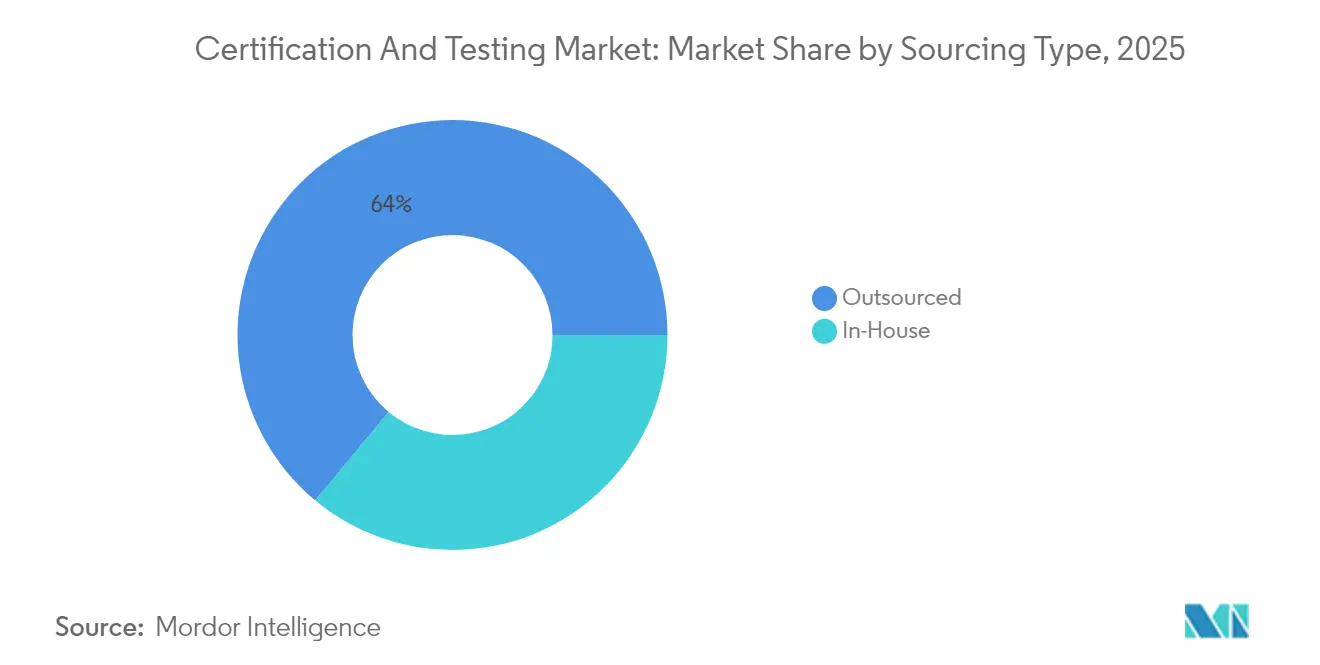
Outsourcing Extends Its LeadOutsourced providers controlled 63.98% certification and testing market share in 2025 and will climb at a 4.42% CAGR through 2031, well above the headline rate. This dominance stems from the significant investment required to keep ISO 17025 labs current, a cost that most manufacturers now treat as variable rather than fixed. UL Solutions’ 8.1% revenue jump in Q3 2024 demonstrates how large networks capture flows as clients exit captive facilities.
Hybrid models still matter. Pharmaceutical and semiconductor firms maintain in-house labs to protect IP, yet 60% now outsource at least 30% of test volume, chiefly for peak loads or niche disciplines. Digital-twin standards under ISO 23247 could blur boundaries further by allowing internal simulation to screen designs before external confirmation. Overall, outsourced specialists set the pace, and their scale unlocks the analytics and automation budgets required to maintain high efficiency in the certification and testing market.

By End-User Vertical:
Transportation Surges AheadFood and healthcare accounted for 28.15% of 2025 revenue, as the FDA FSMA Rule 204 and GFSI schemes tightened traceability and hygiene demands. The certification and testing market size for these verticals remains resilient because audits occur across planting, processing, and distribution.
Transportation, however, registers the fastest 5.28% CAGR. UN Regulations 155 and 156 compel cybersecurity and software-update audits for every new vehicle type sold in the EU and Japan, expanding laboratory pipelines for penetration tests and over-the-air update validation. IATF 16949 certifications increased by 12% in 2024, indicating a cascading pressure on supply chains. Battery safety work adds another layer, with Intertek and UL constructing dedicated centers to meet UN 38.3 and IEC 62133 demands. As electrification and autonomy advance, transportation becomes the primary driver of growth within the certification and testing market.
By Certification Type:
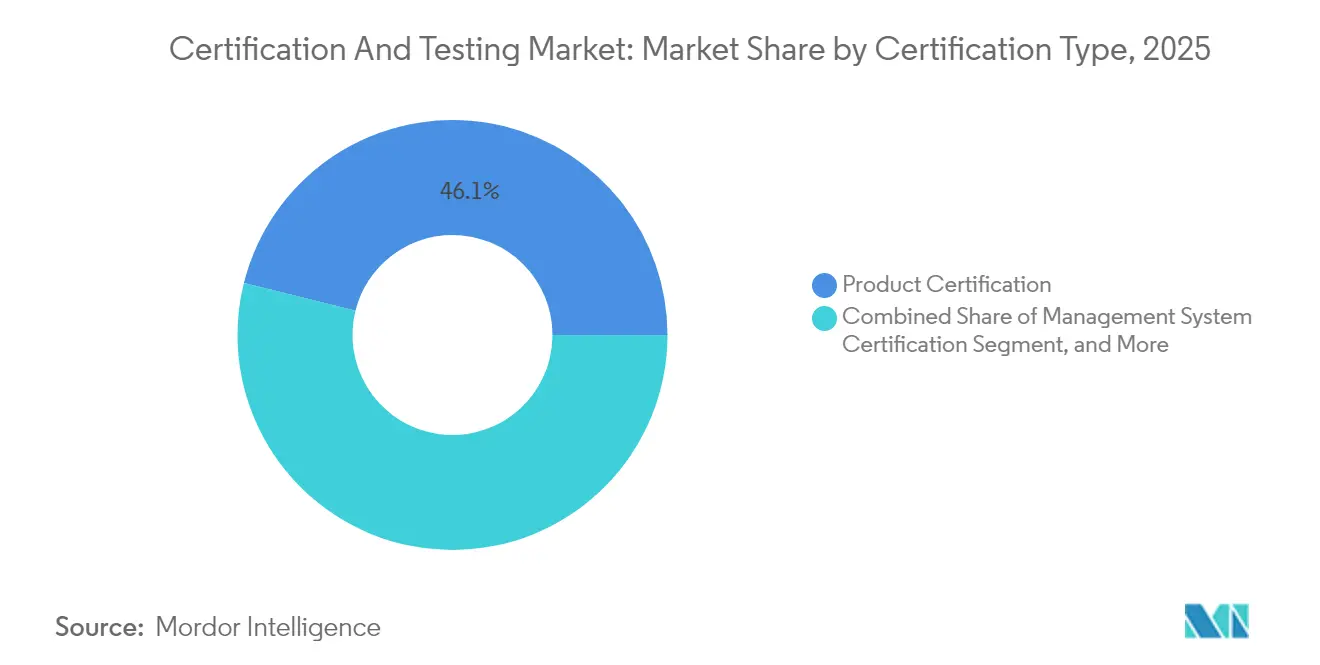
Management Systems Gain MomentumProduct marks still represented 46.12% of 2025 turnover, reflecting their gatekeeper role in CE, CCC, and FCC approvals. Yet management system audits are the growth engine, advancing at 5.62% CAGR as firms seek ISO 9001, ISO 14001, ISO 45001, and ISO 27001 credentials to satisfy ESG-minded investors. ISO 27001:2022 attracted a 25% jump in new sign-ups after addressing cloud and AI governance.
Integrated audits now combine multiple standards under a single cycle, reducing downtime and costs for mid-sized firms. Service certification and personnel qualification remain smaller but steady contributors. The International Accreditation Forum’s mutual recognition arrangement, covering over 100 economies, eases global acceptance of management certificates, helping to widen the market size for certificates and testing in this category.
By Service Type:
Certification Margins Outperform TestingTesting accounted for 52.31% of 2025 revenue, largely due to its equipment-intensive nature. Still, certification services log a 4.69% CAGR through 2031, slightly ahead of the market, because bundled audits spread cost across multiple standards and deepen client lock-in.
Commodity tests such as textile flammability face price erosion, but high-skill niches 5G electromagnetic compatibility, battery thermal-runaway modeling, and IoT penetration tests command premium rates. Remote auditing cuts travel time 40% under ISO 27001 safeguards, while digital-twin validation halves prototype cycles under ISO 23247. Large providers absorb the software spend required to deliver these tools, reinforcing their edge in the certification and testing market.
By Testing Type:
Electrical and Electronics Dominate as Cybersecurity AcceleratesElectrical and electronics testing accounted for 39.92% of the certification and testing market size in 2025, the highest market share among all testing categories. Mandatory safety marks such as UL, CE, CCC, and PSE make this service a non-negotiable gatekeeper for global product launches, driving a steady stream of high-volume work. SGS added new anechoic chambers to its Munich laboratory in May 2024 to handle 5G and IoT electromagnetic-compatibility loads, underscoring its sustained capital commitments to this core segment. Electrical and electronics testing also benefits from adjacent demand in environmental, mechanical, and chemical evaluations, because batteries, power supplies, and printed circuit boards must clear performance, endurance, and restricted-substance screens before reaching the market.
Software and cybersecurity testing is the fastest-growing category, advancing at a 5.03% CAGR between 2026 and 2031. UN Regulations 155 and 156 require every new vehicle type sold in the EU and Japan to undergo penetration and software update validation, shifting new volume toward specialized cyber labs. DEKRA’s Stuttgart cybersecurity center, opened in March 2024, performs vulnerability assessments and ISO 27001 audits for automotive and industrial clients, illustrating how providers build dedicated capacity for this frontier service. In the United States, the NIST 8259 framework and CTIA’s annual certification program extend similar pressure to IoT handsets and wearables, ensuring recurring demand for third-party validation.
Geography Analysis
APAC Certification and Testing Market
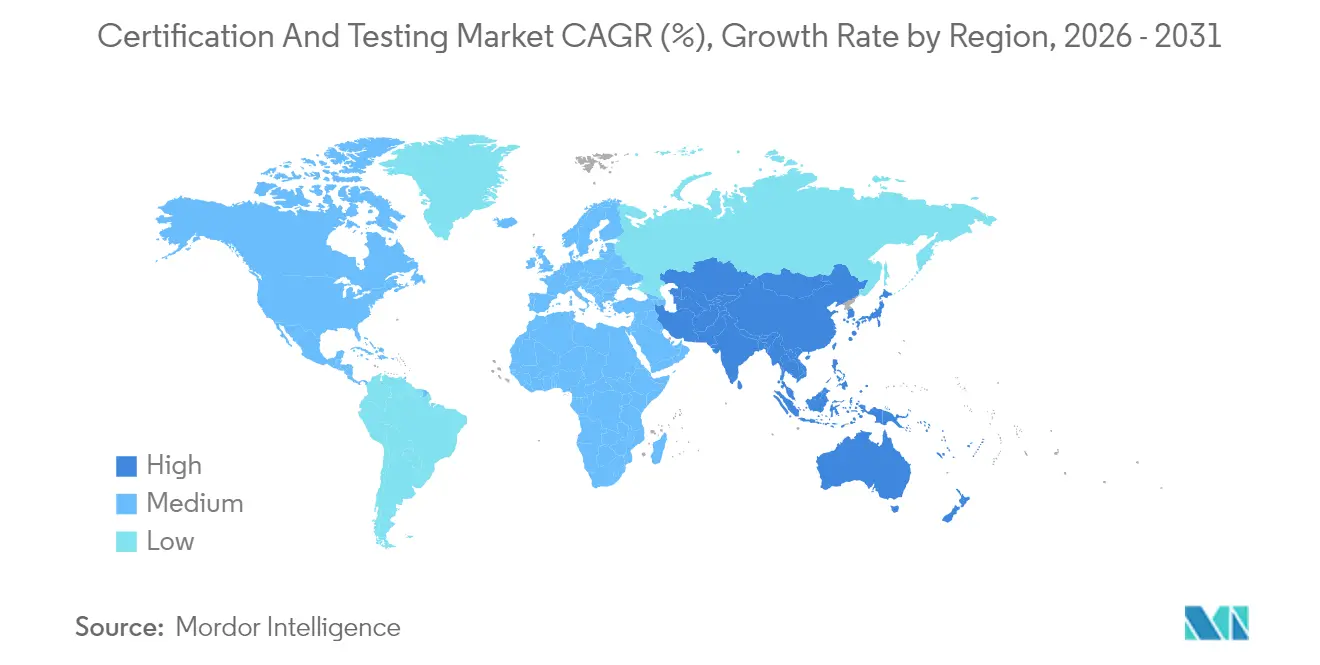
Asia-Pacific contributed 39.88% of 2025 turnover and is advancing at a 4.21% CAGR, almost double the global clip. China’s widened CCC catalog now spans chargers and industrial robots, lifting local laboratory volume 15% year-over-year. India’s BIS move into electronics and telecom equipment created processing backlogs and spurred capacity additions in Bangalore and Pune.
North America Certification and Testing Market
North America expands near the market average. FCC equipment authorization and OSHA safety marks remain evergreen requirements, while Inflation Reduction Act incentives for batteries introduce new test categories. Canada’s Standards Council upholds ISO 17025 accreditation, sustaining cross-border equivalence.
EMEA and South America Certification and Testing Market
Europe exhibits steady demand under CE marking rules, although Brexit necessitates dual certification for suppliers selling into both the EU and the United Kingdom. The Middle East is tightening rules as Saudi Arabia’s SASO and the UAE’s ESMA implement distinct conformity assessment schemes, creating parallel pathways that lengthen launch cycles. South America and Africa remain modest contributors, yet Brazil’s INMETRO and South Africa’s SABS are expanding lists of compulsory items, hinting at gradual upside.
Regulatory Landscape
The regulatory environment for certification and testing continues to be shaped by conformity-assessment rules tied to market access, with ISO/IEC 17025 accreditation and recognition via official registries remaining central to acceptance. In Europe, notified body visibility through the EU NANDO database is a key pathway for buyers to verify designated conformity assessment bodies. Policy work in 2026 around mutual recognition agreements (MRAs) also underscores government efforts to reduce duplicative testing, especially for traded electronics and other regulated products.
The United Kingdom introduced The Treatment of Conformity Assessment Bodies (Comprehensive Economic and Trade Agreement between the Government of Great Britain and Northern Ireland and the Government of the Republic of India) Regulations 2026 (SI 2026/40), a concrete step that operationalizes recognition mechanisms for conformity assessment bodies under a trade framework. Standards updates continue to expand compliance testing scope and cadence, including ITU-T Recommendation Q.5035 (January 2026) and multiple IEC updates in 2026, such as IEC 62680-1-3:2026 and IEC 62351:2026. This is increasing demand for laboratories that can maintain current accredited scope and produce traceable, standards-aligned test evidence.
Value Chain Analysis
The value chain starts with standards and rule-setting bodies (ISO/IEC, ITU, national regulators) and the accreditation and recognition layers that determine which test results are accepted, including ISO/IEC 17025 lab accreditation and mutual recognition arrangements. Demand then comes from manufacturers, importers, platforms, and regulated operators that need test reports and certificates for product launch, customs clearance, or ongoing system audits. Service delivery is carried out by testing and certification providers operating laboratories, audit teams, and domain specialists covering areas such as EMC, radio, cybersecurity, and battery safety.
This delivery is supported by equipment OEMs, calibration services, reference-material suppliers, and specialist software vendors for scheduling, data capture, and secure report issuance. Workflow digitization and supply-chain compliance tools are increasingly embedded in the midstream of the chain, connecting regulatory intelligence to execution and documentation. In May 2025, Intertek launched SupplyTek as an end-to-end global market access solution, reflecting a shift toward integrated platforms that bundle regulatory content, workflow management, and test and certification execution. Also in May 2025, TÜV Rheinland signed a strategic cooperation agreement with Circulor to connect traceability and digital product passport capabilities to compliance services, reinforcing a data-to-assurance loop that extends beyond one-time lab tests into upstream material provenance and downstream customer disclosure. Bottlenecks persist where mandates require in-country testing, especially for telecom and electronics certification regimes with limited lab capacity, making accredited capacity, audit talent, and interoperable digital evidence trails key constraints and differentiators.
Competitive Landscape
The top players include SGS, Intertek, Bureau Veritas, DEKRA, and TÜV SÜD. The strategy revolves around adding accredited scope, expanding the geographic reach, and digitizing workflows. UL Solutions deployed AI-assisted textile defect detection in 2024 and opened a 50,000-square-foot Fire Science Center in 2025 to address bottlenecks in battery and EV infrastructure. SGS expanded its Munich EMC capacity for 5G and IoT equipment. while Bureau Veritas rolled out an AI-enhanced remote audit portal that trims certification cycles to 10 days.
White-space opportunities lie in cybersecurity for IoT, sustainability-linked claims, and digital-twin validation. MET Laboratories focuses on battery testing from U.S. hubs, and Element Materials Technology serves aerospace composites near production clusters.
Merger activity is modest because relationship networks and asset intensity limit scale synergies, so leaders pursue tuck-in buys and greenfield labs instead. The competitive dynamic should persist as the certification and testing market rewards providers that marry multi-standard scope with fast, transparent digital delivery.
Certification and Testing Industry Leaders
-
Intertek Group plc
-
Bureau Veritas S.A.
-
Underwriters Laboratories (UL)
-
SGS S.A.
-
Eurofins Scientific SE
- *Disclaimer: Major Players sorted in no particular order
Certification and Testing Market Companies Covered in this Report
- SGS SA
- Intertek Group PLC
- Bureau Veritas SA
- DEKRA SE
- TÜV SÜD AG
- Underwriters Laboratories Inc.
- DNV AS
- Eurofins Scientific SE
- ALS Limited
- BSI Group
- SAI Global Pty Limited
- MISTRAS Group Inc.
- Element Materials Technology Group Ltd.
- TÜV Rheinland AG
- TÜV NORD GROUP
- Applus Services SA
- Kiwa NV
- Lloyd’s Register Group Ltd.
- MET Laboratories Inc.
- UL Solutions Inc.
Market Opportunities and Future Outlook
Regulatory shifts that tighten trust requirements for telecommunications and wireless device compliance create near-term whitespace for testing providers with recognized status in accepted jurisdictions. In the United States, the FCC moved in 2026 with actions and proposals that favor device approvals supported by testing performed in trusted U.S. or MRA-country laboratories, while also exploring limits on recognition of labs, TCBs, and accreditation bodies in non-reciprocal territories. The result is demand concentration among globally networked providers that can deliver compliant test execution alongside documentation packages aligned to FCC equipment authorization workflows, supporting expanded accredited capacity in the United States and in MRA-participating countries.
Opportunities also show up as standards updates and national refresh cycles expand the required test matrix for connectivity and safety, pushing clients toward specialists that can keep scope current and automate evidence handling. For 2026, examples include updated wireless and SAR testing requirements such as Brazil Anatel updates for 5G and Wi-Fi 6/6E and South Korea RRA updates tied to KSC 3350:2024, alongside broader movement toward IEC 62368-1-aligned product safety regimes for ICT and A/V equipment. On the delivery side, industry bodies are formalizing digital assurance models: the TIC Council published a digitalization framework in February 2026 for hybrid digital-human assurance and independent validation of AI-based conformity assessment, which creates room for providers to package remote evidence collection, secure audit trails, and continuous compliance monitoring for management systems and cybersecurity testing, beyond one-off certification events.
Recent Industry Developments in Certification and Testing Market
- July 2026: Intertek announced it awarded the first batch of EU Battery Regulation Notified Body compliance certificates for energy storage systems. The milestone strengthens Intertek's position in battery and energy storage assurance, supporting manufacturers that need third-party conformity evidence for regulated placement in the EU.
- April 2026: UL Solutions announced a definitive agreement to acquire Eurofins Scientific's electrical and electronics business for an enterprise value of about EUR 575 million, with closing targeted for Q4 2026. The deal expands UL Solutions' lab footprint and technical scope in a core testing segment where multi-country coverage and accredited capacity influence customer selection.
- March 2025: UL Solutions inaugurated a 30,000 square-foot IoT and connectivity laboratory in Songshan Lake, China, equipped for 5G emulation and penetration tests. The site adds in-region capacity for wireless and cybersecurity validation, shortening turnaround times for device makers selling across major regulatory regimes.
Certification and Testing Market Report Scope and Research Methodology
Market Definition and Coverage
This market covers third-party and in-house activities where testing and related certification services are used to confirm that products, systems, or processes meet a defined standard, regulation, or customer requirement, and the output is a test report or certificate.
Scope exclusions: Pure consulting, training-only programs, and routine internal quality checks that do not result in a formal test report or certificate are excluded.
Segments Covered in This Report
- By Sourcing Type
- In-House
- Outsourced
- By End-User Vertical
- Construction and Engineering
- Chemicals
- Food and Healthcare
- Energy and Commodities
- Transportation
- Products and Retail
- Industrial
- Other End-User Verticals
- By Testing Type
- Mechanical Testing
- Electrical and Electronics Testing
- Chemical Testing
- Environmental and Climatic Testing
- Non-Destructive Testing (NDT)
- EMC and Radio Testing
- Software and Cybersecurity Testing
- By Certification Type
- Product Certification
- Management System Certification
- Personnel Certification
- Service Certification
- By Service Type
- Testing
- Certification
- By Geography
- North America
- United States
- Canada
- Mexico
- South America
- Brazil
- Argentina
- Rest of South America
- Europe
- Germany
- United Kingdom
- France
- Italy
- Spain
- Rest of Europe
- Asia-Pacific
- China
- Japan
- India
- South Korea
- Australia
- Rest of Asia-Pacific
- Middle East and Africa
- Middle East
- Saudi Arabia
- United Arab Emirates
- Turkey
- Rest of Middle East
- Africa
- South Africa
- Egypt
- Nigeria
- Rest of Africa
- Middle East
- North America
Data Sources, Market Sizing, and Validation
Desk Research
For desk research, we start by building the demand context around regulated products and compliance-led industries, then map how testing and certification services are typically purchased.
Public sources that helped here include ISO and IEC standards pages, US agencies such as NIST and the FDA for conformity and testing references, and European Commission materials for EU product safety and conformity guidance. We also reviewed guidance published by trade and industry bodies that publish conformity, inspection, or assessment processes.
Along with these, we review company filings, annual reports, investor presentations, and reputed press coverage to understand service mix, exposure by end market, and how pricing is discussed. Where needed, paid subscriptions for company financials and intelligence, patent databases, and an import-export shipment level database were used to cross-check activity signals tied to regulated goods. The desk sources mentioned are illustrative and not exhaustive, and we reviewed additional public references for data collection, validation, and research clarification.
Primary Interviews and Surveys
Primary work was used to test the realism of our desk assumptions, especially around how contracts are structured, what drives a retest, and how pricing changes across service types and end-user verticals. We spoke with a mix of testing labs, certification bodies, inspection providers, and procurement or quality leaders from end users, and we kept coverage spread across APAC, EMEA, and the Americas so regional regulation intensity and trade exposure were not overgeneralized.
Distribution of primary research fieldwork respondents
| Company type | Respondent position | Region |
|---|---|---|
| Top tier: 32% | CXOs: 12% | APAC: 39% |
| Mid tier: 51% | Functional/Unit leaders: 30% | EMEA: 36% |
| Smaller Players: 17% | Managers: 58% | Americas: 25% |
Market-Sizing & Forecasting
Sizing starts with a top-down build where regulated production and trade flows, conformity requirements, and compliance-driven testing intensity are used to reconstruct an addressable spend pool by region. This is then checked with selective bottom-up approximations, such as sampled price points for common test and certification packages multiplied by realistic volumes, plus channel checks on outsourced versus in-house mix to keep totals practical.
Key inputs used in the model include the outsourced share of testing and certification work, renewal and recertification cycles, retest triggers from regulation changes, capacity and utilization signals at labs, and average pricing movement by service type (testing versus certification) and by end-use vertical. When primary feedback shows large pricing dispersion, we do not force one average price, and instead apply bands and weight them by the mix reported across verticals. For forecasting, scenario analysis is applied around regulatory tightening, export growth, and compliance program adoption, and the final year-by-year path is smoothed using simple time-series logic so the curve reflects how contracts and renewals typically behave. Where bottom-up inputs are thin for a country or niche vertical, we use proxy ratios from similar regulatory environments and then recheck with experts before locking.
Data Validation & Update Cycle
Outputs are validated by comparing the model against independent signals such as certification volume trends, manufacturing and export indicators tied to regulated goods, and disclosed revenue mix cues from major service providers. Variances are reviewed in steps, first at the assumption level and then at the roll-up level, and outliers are challenged until the drivers are clearly explained. If a large mismatch is found, we re-contact relevant respondents to confirm whether the issue is a definition gap, a regional mismatch, or a timing difference in pricing.
The report is refreshed annually, and interim updates are triggered when there are material events such as major regulatory changes, shifts in trade flows, or sudden changes in outsourcing behavior. Before delivery, an analyst completes a fresh pass on the core inputs, so the final numbers reflect the latest available public data and field feedback.
Mordor Intelligence's Certificate Testing Market Size Versus Other Published Estimates
Published market values for certificate testing often differ because the included service set, the base year, and the way renewals and retests are counted are not consistent across sources. Currency timing and the treatment of in-house work also tend to widen the spread, especially when a global number is built using a few regional assumptions.
Training-only certification programs sit outside Mordor Intelligence's scope here, and that scope line can move totals a lot because training revenue is sometimes bundled into compliance services in broader write-ups. Differences also show up when a source treats digital certificate validation as the same as industrial testing and certification, or when it uses aggressive growth assumptions without checking regional regulation intensity and typical contract renewal patterns.
Benchmark comparison
| Source | Market Size | Gaps in Research Methodology |
|---|---|---|
| Mordor Intelligence | USD 218.04 B (2026) | |
| Industry Research House A | USD 3.80 B (2024) | Uses a narrower definition that reads like digital certificate and software-led testing categories, which can exclude large parts of industrial testing, inspection, and certification services, and it also anchors sizing to a different base year. |
| Industry Research House B | USD 8.60 B (2025) | Leans toward an IT and cloud deployment framing and applies higher growth assumptions through 2034, which can miss regulated physical-goods testing activity and change how renewal and recertification cycles are represented. |
The spread across the table is mainly explained by what is counted as certificate testing and by which year is used for the anchor value, since both points directly change the addressable spend pool. When the inputs are tied back to practical signals like outsourcing mix, renewal cycles, and region-level compliance intensity, the final totals are easier to reproduce and to update without forcing one-size-fits-all assumptions.
Key Questions Answered in the Report
What is the current global value of the certification and testing market?
The certification and testing market size is USD 218.04 billion in 2026 and should reach USD 262.84 billion by 2031.
Which region grows fastest in certification and testing through 2031?
Asia-Pacific leads with a 4.21% CAGR, driven by China’s wider CCC scope and India’s BIS expansion.
Why are management system audits expanding more quickly than product marks?
Enterprises pursue integrated ISO 9001, ISO 14001, ISO 45001, and ISO 27001 certificates to meet ESG and cybersecurity demands, raising management system audit demand at a 5.62% CAGR.
How large is outsourced participation in certification and testing?
Outsourced providers ran 63.98% of the global compliance workload in 2025, and their share is still climbing.
Which end-user vertical is set to grow the fastest?
Transportation posts a 5.28% CAGR to 2031 due to UN cybersecurity and software-update regulations for new vehicles.
What factors restrain market growth despite rising compliance needs?
Industrial capex volatility and fragmented regional rules impose cost and timing hurdles that subtract up to 0.9 percentage points from forecast CAGR.