
Ceramic Foam Market Size and Share
Market Overview
| Study Period | 2020 - 2031 |
|---|---|
| Market Size (2026) | USD 518.04 Million |
| Market Size (2031) | USD 665.90 Million |
| Growth Rate (2026 - 2031) | 5.15 % |
| Fastest Growing Market | Asia Pacific |
| Largest Market | Asia Pacific |
| Market Concentration | Medium |
Major Players *Disclaimer: Major Players sorted in no particular order Image © Mordor Intelligence. Reuse requires attribution under CC BY 4.0. | |
Ceramic Foam Market Analysis by Mordor Intelligence
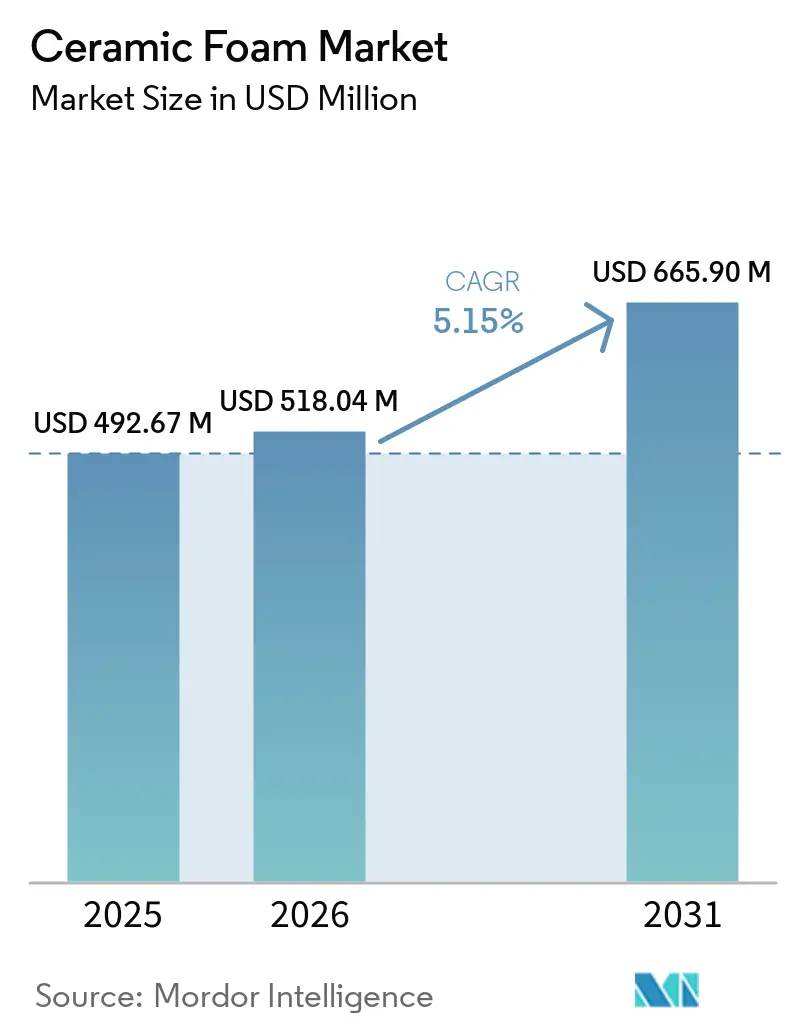
Ceramic Foam market size in 2026 is estimated at USD 518.04 million, growing from 2025 value of USD 492.67 million with 2031 projections showing USD 665.9 million, growing at 5.15% CAGR over 2026-2031. Demand is accelerating as ceramic foam delivers high-temperature stability, chemical resistance and well-controlled porosity that outperform many legacy refractory and filtration media. Rapid growth in electric-vehicle casting hubs, hydrogen production facilities and circular-economy steel mini-mills is widening the customer base. Advanced replica processes retain cost advantages in high-volume production, while additive manufacturing opens profitable niches for complex open-cell geometries. Producers also see new insulation opportunities as North American and European zero-energy building codes tighten. Meanwhile, raw-material price volatility and brittleness challenges in fully automated foundries temper near-term margins, prompting suppliers to pursue material toughening and supply-chain hedging strategies.
Key Report Takeaways
- By material type, silicon carbide held 44.74% of the ceramic foam market share in 2025, while magnesium aluminate spinel and other advanced composites are forecast to expand at a 7.41% CAGR to 2031.
- By manufacturing process, the replica/polymer sponge route led with 66.58% revenue share in 2025, whereas additive manufacturing is projected to register the highest 7.55% CAGR through 2031.
- By application, molten metal filtration accounted for 39.05% of the ceramic foam market size in 2025 and catalyst support is advancing at an 7.72% CAGR to 2031.
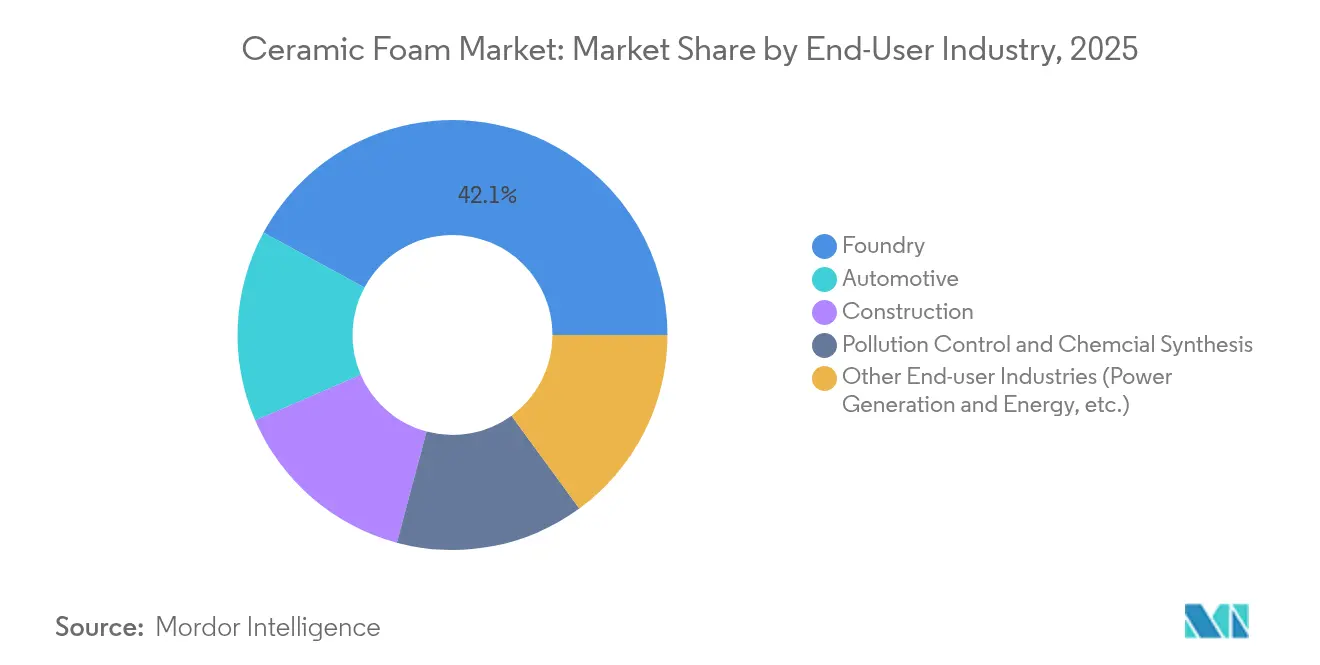
- By end-user industry, foundries dominated with 42.10% share of the ceramic foam market size in 2025; power generation and other emerging energy applications are expected to post an 7.63% CAGR between 2026 and 2031.
- By geography, Asia-Pacific contributed 46.25% revenue in 2025 and is set to grow at a 7.08% CAGR through 2031.
Note: Market size and forecast figures in this report are generated using Mordor Intelligence’s proprietary estimation framework, updated with the latest available data and insights as of 2026.
Global Ceramic Foam Market Trends and Insights
Drivers Impact Analysis*
| Driver | (~) % Impact on CAGR Forecast | Geographic Relevance | Impact Timeline |
|---|---|---|---|
| Surging demand for low-emission molten metal filtration in EV casting hubs | +1.20% | Asia-Pacific core, spill-over to North America | Medium term (2-4 years) |
| Rapid expansion of hydrogen production requiring high-temperature catalyst supports | +0.90% | Global, early gains in Europe and North America | Long term (≥ 4 years) |
| Additive manufacturing enabling complex, cost-efficient open-cell foam geometries | +0.80% | North America and EU, expanding into Asia-Pacific | Short term (≤ 2 years) |
| Circular-economy push for recyclable refractory linings in steel mini-mills | +0.60% | Global, concentrated in major steel regions | Medium term (2-4 years) |
| Government incentives for zero-energy buildings boosting ceramic-foam insulation panels | +0.40% | North America & EU, selective Asia-Pacific markets | Long term (≥ 4 years) |
| Source: Mordor Intelligence | |||
Surging demand for low-emission molten metal filtration in EV casting hubs
Electric-vehicle platforms use large aluminum structural castings that require exceptionally clean melts to meet conductivity and fatigue targets. Ceramic foam filters now enable sub-10 ppm inclusion levels in battery housings and motor casings. Vesuvius reports 40% higher uptake of SEDEX silicon-carbide filters in EV-dedicated foundries compared with conventional automotive lines[1]. Tesla’s Shanghai operations and similar Asian facilities specify silicon-carbide foams for high-pressure die casting, driving regional volume. These specifications raise throughput and repeatability criteria that favor robust open-cell geometries produced via improved replica methods. Supply-chain localization efforts in Asia-Pacific further cement regional dominance of the ceramic foam market.
Rapid expansion of hydrogen production requiring high-temperature catalyst supports
Global electrolyzer and steam-reform expansion demands refractory carriers that withstand cyclic 600-900 °C operation in corrosive atmospheres. The Ceramics UK consortium validated 100% hydrogen-fired kilns, confirming ceramic foam suitability for next-generation energy systems. Saint-Gobain is investing USD 40 million in New York to scale catalyst-carrier output, highlighting North American momentum[2]. Cordierite monoliths reinforced with ceramic foam achieve optimal selectivity at 800 °C, extending service intervals for reformers and solid-oxide fuel cells. As more regions publish national hydrogen roadmaps, catalyst support orders provide a durable growth pathway for the ceramic foam market.
Additive manufacturing enabling complex, cost-efficient open-cell foam geometries
Three-dimensional printers using direct-ink writing and selective-laser-sintering now fabricate foams with graded porosity and tailored strut alignment. Parts reach 95% porosity yet retain flexural strength through strategic material deposition. These geometries improve mass-transfer coefficients in catalyst beds and raise filtration efficiency without raising pressure drop. Additive routes shorten prototyping cycles to days, suiting low-volume aerospace foams and research contracts. As printer throughput rises and powder costs fall, additive manufacturing is expected to capture specialized sub-segments of the ceramic foam market at premium margins.
Circular-economy push for recyclable refractory linings in steel mini-mills
Electric-arc-furnace steel capacity growth requires linings that survive rapid thermal cycling while supporting scrap-based, low-carbon operations. Studies show recycled ceramic waste can replace 70% of virgin raw materials in castables, reducing CO₂ footprint and cost. Tata Steel targets net-zero emissions in 2045 and is adding mini-mill capacity that specifies low-density spinel-calcium-aluminate foams. Such linings cut bulk density to 2.8 g/cm³ and extend service life from 18 to 31 heats, lowering refractory consumption. These gains underpin medium-term demand growth in the ceramic foam market.
Restraints Impact Analysis*
| Restraint | (~) % Impact on CAGR Forecast | Geographic Relevance | Impact Timeline |
|---|---|---|---|
| Volatile alumina & zirconia prices pressuring profit margins | -1.10% | Global, with acute impact on Asian producers | Short term (≤ 2 years) |
| Brittleness leading to handling losses in automated foundries | -0.70% | North America and EU, spreading to Asia-Pacific | Medium term (2-4 years) |
| Emerging polymer-derived foams offering cheaper insulation alternatives | -0.50% | Global, concentrated in construction applications | Long term (≥ 4 years) |
| Source: Mordor Intelligence | |||
Volatile alumina and zirconia prices pressuring profit margins
High-purity alumina and zirconia constitute a significant portion of the variable costs in ceramic foam production. Sharp price swings have forced quarterly contract renegotiations and spot purchases at elevated premiums. Zirconia toughening boosts compressive strength by 206% yet becomes less economical when raw-material indices spike. Morgan Advanced Materials noted a 4.6% revenue dip in its Thermal Ceramics unit despite stable order intake because surcharges lagged cost inflation. Smaller Asian producers, lacking long-term contracts, experienced margin compression that slowed plant upgrades and capacity additions within the ceramic foam industry.
Brittleness leading to handling losses in automated foundries
Open-cell foams fracture if robotic grippers apply uneven force or accelerated trajectories in high-throughput lines. Increased rejection rates lead to higher per-part costs and disrupt takt times. Carbon-bonded alumina filters trialed for steel casting performed well in metallurgical terms but demanded bespoke handling jigs, adding capital outlays. Continuous direct-foaming research eliminates template-burnout defects and could raise green strength, yet commercial readiness remains two to three years away. Until then, brittleness remains a mid-term adoption hurdle in automated nodes of the ceramic foam market.
*Our forecasts treat driver/restraint impacts as directional, not additive. The impact forecasts reflect baseline growth, mix effects, and variable interactions.
Segment Analysis
By Type: Silicon carbide maintains leadership on thermal performance
Silicon carbide commanded 44.74% share of the ceramic foam market in 2025 due to its stability above 1,500 °C, resistance to molten aluminum and superior thermal conductivity. Rising EV casting volumes and stringent inclusion limits underpin sustained demand. Other advanced compositions such as magnesium-aluminate spinel, boride ceramics and hybrid composites form the fastest-growing cluster at a 7.41% CAGR, fulfilling aerospace, nuclear and ultra-high-temperature needs. Aluminum oxide remains attractive for general-purpose iron casting thanks to cost-efficiency, though its temperature ceiling constrains penetration into new EV and hydrogen segments. Zirconium oxide retains a niche in chemically aggressive melts, where its premium price is justified by extended service life and enhanced corrosion resistance.
Second-generation boride foams demonstrate oxidation resistance above 1,800 °C, positioning them for hypersonic vehicle thermal-protection components. Research prototypes exhibit less than 5% mass loss after 1,000 thermal cycles, a milestone that could spur future commercialization. As material scientists synthesize multiphase foams combining whisker reinforcement and oxide scales, the ceramic foam market may witness incremental displacement of legacy alumina in extreme environments.


By Manufacturing Process: Replica method faces additive manufacturing disruption
The replica or polymer-sponge process produced 66.58% of all ceramic foams shipped in 2025 owing to decades of equipment amortization, low scrap rates and familiar quality controls. It excels in producing filters with consistent pore sizes from 10 to 60 ppi, serving high-volume non-ferrous foundries. Despite its dominance, the ceramic foam market is pivoting toward additive manufacturing, the fastest-growing process at 7.55% CAGR. Laser-sintered alumina lattices and direct-ink-written cordierite carriers allow graded porosity and topology optimization unattainable with replica routes. Early adopters in catalyst support and aerospace exploit design freedom to enhance flow uniformity and mechanical resilience.
Direct foaming, which mixes gas into ceramic slurry then sinters the resulting froth, eliminates polyurethane templates and their associated burn-out emissions. Uptake is strongest in insulation panels targeting green-building credits. Gel casting endures in applications requiring near-net-shape precision, such as biomedical implants and semiconductor wafer supports, though its relatively long cycle times limit broader diffusion.
By Application: Catalyst support emerges as growth leader
Molten-metal filtration contributed 39.05% of 2025 revenue and remains the backbone of the ceramic foam market. Foundry engineers value its proven ability to cut inclusions, improve surface finish and reduce scrap. Yet catalyst support exhibits the quickest 7.72% CAGR to 2031 as hydrogen reformers, ammonia crackers and automotive exhaust after-treatment demand high performance foam with high void-volume, high-surface-area carriers. Ceramic foam substrates outperform honeycomb structures by boosting mass transfer and turbulence, allowing reduced precious-metal loading without sacrificing conversion efficiency.
Automotive exhaust filters are poised for moderate growth as the US EPA implements model-year 2027–2032 emissions rules that tighten particulate limits. Thermal and acoustic insulation panels gain from zero-energy building codes, delivering 42% lower heat loss than conventional walls. Furnace linings steadily expand via recyclable spinel-based foams that drop energy consumption and extend campaign life in electric arc furnaces.
By End-User Industry: Foundry leadership challenged by diversification
Foundries consumed 42.10% of ceramic foam shipments in 2025 and will retain top rank, but their share gradually erodes as power-generation and energy infrastructures accelerate. The ceramic foam market size tied to hydrogen and advanced-energy applications is forecast to grow at an 7.63% CAGR, benefiting membrane-reactor, solid-oxide fuel cell and concentrated-solar plant deployments. Automotive EV programs create dual streams of demand: filtration for aluminum mega-castings and battery thermal management pads. Construction uptake hinges on fire-resistant insulation panels favored in North American and European retrofit policies aimed at achieving net-zero operating emissions.
Pollution control and chemical synthesis maintain stable mid-single-digit growth, supported by ever-stricter industrial emission caps worldwide. Chemical processors adopt zirconia and spinel foams in corrosive hydrofluoric and hydrochloric acid environments, extending catalyst-bed life and lowering shutdown frequency.
Geography Analysis
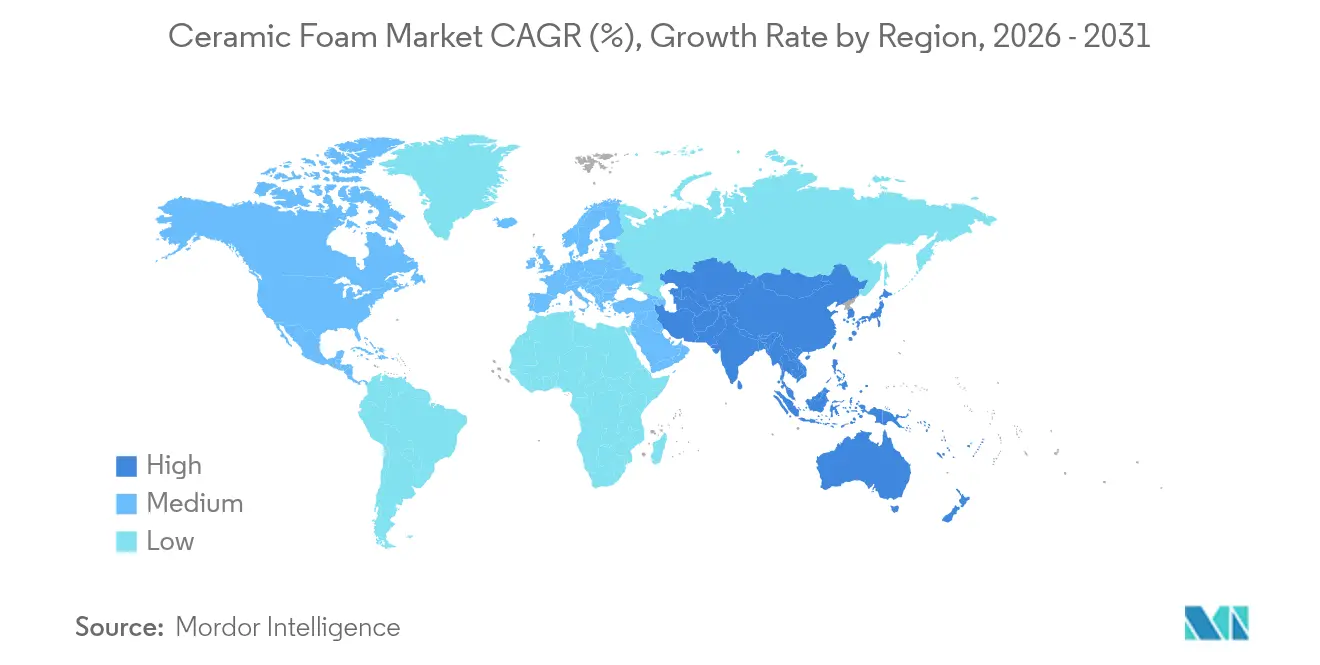
Asia-Pacific’s 46.25% revenue share in 2025 reflects its integrated supply chain encompassing raw materials, casting facilities and downstream EV production. China’s continual steel output and Japan’s advanced ceramics research sustain baseline volumes, while South Korea’s hydrogen-economy roadmap raises future demand for catalyst foams. Forecasts indicate the region's ceramic foam market is projected to witness significant growth, supported by a robust 7.08% CAGR during the forecast period. Government grants for smart manufacturing and energy efficiency amplify adoption across foundry, automotive, and construction sectors.
North America represents a mature yet innovative arena. The region fields additive-manufacturing pioneers and benefits from federal hydrogen and battery-supply-chain funding. Saint-Gobain’s New York expansion confirms confidence in domestic catalyst-support demand. Tightening US vehicle emissions rules stimulate ceramic exhaust filter consumption. Stable iron foundry operations in the Midwest and growing aluminum casting for EV parts ensure demand resilience.
Europe prioritizes circular economy mandates and carbon-neutral steel, driving uptake of recyclable refractory foams in mini-mills. Germany, France and Italy upgrade casting lines with automated filter-handling systems, spurring research into tougher foam formulations. EU grants back additive-manufacturing pilot lines that fabricate customized pore architectures for aerospace and defense. Stringent building energy directives stimulate ceramic insulation panel deployment in renovation projects.
South America and Middle East & Africa are smaller but rising. Brazilian and Argentinian automakers adopt aluminum casting filters, while new steel capacity in Saudi Arabia’s Vision 2030 bolsters refractory demand. Foreign direct investment underpins advanced-materials institutes that enhance local competence. Infrastructure gaps and limited technical expertise slow adoption, yet localized production partnerships could unlock latent potential for the ceramic foam industry.
Value Chain Analysis
The ceramic foam value chain begins with upstream feedstocks such as alumina, silicon carbide, and chemically stabilized zirconia, with supply exposure where high-purity zirconia production is concentrated in Australia and South Africa and SiC sourcing is concentrated in China. These inputs move to foam manufacturers that shape filters and foams via replica/polymer sponge or direct foaming routes and then complete high-temperature sintering (typically 1200 to 1600 degrees C), making kiln energy costs and availability of specialized labor practical constraints on throughput and cost.
Midstream, suppliers often support qualification and co-development with end users, particularly large automotive and aerospace casters that increasingly consolidate procurement into multi-year volume commitments tied to technical clauses and documentation requirements. Downstream, ceramic foams are sold through direct OEM foundry accounts and industrial distributors to foundries, catalyst-system integrators, and refractory/insulation channels, with production clusters spanning Europe (Germany, UK, Czech Republic), North America (United States, Mexico), and China (including Shandong, Jiangsu, and Henan). Recent shop-floor results reported by Liaoning Xinda Casting Technology in April 2026, including zirconia foam filters used in high-end stainless steel valve body production and an automotive piston foundry scrap reduction from 25% to 10%, illustrate how performance validation at the customer line can accelerate repeat orders and tighten supplier qualification cycles.
Competitive Landscape
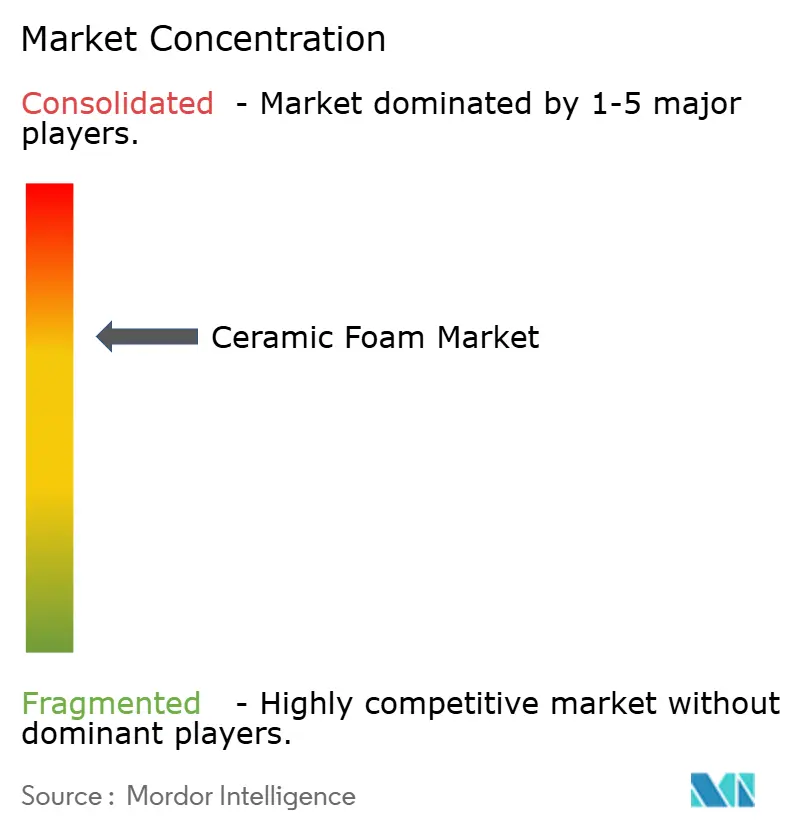
The ceramic foam market is moderately consolidated, with regional specialists operating alongside global materials conglomerates. Five leading suppliers account for around 63% of global revenue, underscoring significant yet not overwhelming concentration. Vesuvius, Pyrotek and SELEE leverage decades of foundry relationships to co-engineer filter designs that fit customer gating systems. Advanced research centers on coating chemistries that boost filtration efficiency without increasing pressure drop.
Strategic investments emphasize vertical integration to secure raw materials and internalize additive-manufacturing competencies. Patent filings reveal a pivot toward hybrid processes that marry replica foaming with laser finishing, cutting total cycle time by 30%. Emerging disruptors such as Lithoz and 3DCeram specialize in ceramic-printing systems that fabricate geometrically intricate lattice foams for aerospace and biomedical clients.
Collaborations with automakers and fuel-cell developers accelerate application-specific innovation. Tier-one suppliers embed data-logging chips into filter frames, allowing foundries to track real-time melt cleanliness and predict change-out schedules. Such digital services differentiate offerings in an otherwise price-sensitive environment. Geographical expansion strategies include joint ventures in India and Vietnam to serve burgeoning EV supply chains, lowering logistics costs and customs barriers.
Ceramic Foam Industry Leaders
-
ERG Aerospace Corporation
-
LANIK s.r.o.
-
Pyrotek
-
SELEE Corp.
-
Vesuvius
- *Disclaimer: Major Players sorted in no particular order
Market Opportunities and Future Outlook
A core whitespace is premium filtration for EV-focused aluminum casting lines where inclusion limits and throughput stability translate into demand for tighter pore-size control, robust handling characteristics, and application-specific filter frames. This is reinforced by supplier-side moves toward customized SiC filter offerings, for example SEFU CERAMICs May 2026 confirmation of mass-production capability for custom silicon carbide ceramic foam filters following a client-led technical evaluation and process demonstration. Another opportunity sits in catalyst support and high-temperature process equipment tied to hydrogen and other energy applications, where ceramic foam architectures and surface functionalization can be differentiated versus commodity foams.
On the technology front, additive manufacturing and AI-enabled design tools create room for suppliers to sell graded-porosity and topology-optimized foams into higher-margin, lower-volume programs (aerospace, specialty catalysts, and advanced industrial filtration), while improving yield consistency in repeat production. Value capture also extends to the surrounding process ecosystem, including auxiliary equipment and handling solutions that reduce breakage and improve start-up performance in automated foundries, aligning with the markets current constraint around brittleness and line losses. Suppliers that pair raw-material risk management (alumina/zirconia volatility) with nearshored or diversified sourcing and documented qualification packages are positioned to compete for consolidated, multi-year procurement programs from large casters and industrial integrators.
Recent Industry Developments
- April 2026: ERG Aerospace participated in Sea-Air-Space 2026 in the United States, showcasing engineered ceramic foam filtration modules for aerospace applications and highlighting ongoing capability expansion in high-temperature filtration systems. The presence at the event underscores sustained interest from aerospace OEMs for high-performance foam components, aiming to shorten qualification cycles.
- May 2025: ERG Aerospace engaged Space Tech USA to showcase foam-based components for aerospace and space systems, signaling continued commercialization efforts beyond traditional molten metal filtration. The activity demonstrates ongoing collaboration with end users to validate performance in high-temperature environments and to broaden qualification for ceramic foams in high-temperature applications.
- March 2024: The US Environmental Protection Agency introduced new emissions standards for light-duty and medium-duty vehicles for model years 2027-2032. The tighter regulatory pathway supports adoption of advanced emissions-control technologies, sustaining a use case for ceramic foam in exhaust filtration and related after-treatment systems.
Research Methodology Framework and Report Scope
Market Definition and Coverage
This market covers revenue generated from ceramic foam materials sold for industrial use, where the material has a porous structure designed to filter, insulate, or support high temperature processes across end users.
Scope exclusions: We exclude conventional polymer foams, metallic foams, and ceramic fiber blankets or boards that do not have a foam structure.
Segmentation Overview
- By Type
- Aluminum Oxide (Al₂O₃)
- Silicon Carbide (SiC)
- Zirconium Oxide (ZrO₂)
- Others Types (Magnesium Aluminate Spinel, etc.)
- By Manufacturing Process
- Replica/Polymer Sponge Method
- Direct Foaming
- Gel Casting
- Additive Manufacturing
- By Application
- Molten Metal Filtration
- Automotive Exhaust Filters
- Thermal and Acoustic Insulation
- Catalyst Support
- Furnace Lining
- Other Applications (Biomedical Scaffolds, etc.)
- By End-User Industry
- Foundry
- Automotive
- Construction
- Pollution Control and Chemical Synthesis
- Other End-user Industries (Power Generation and Energy, etc.)
- By Geography
- Asia-Pacific
- China
- Japan
- India
- South Korea
- ASEAN Countries
- Rest of Asia-Pacific
- North America
- United States
- Canada
- Mexico
- Europe
- Germany
- United Kingdom
- France
- Italy
- Spain
- Russia
- NORDIC Countries
- Rest of Europe
- South America
- Brazil
- Argentina
- Rest of South America
- Middle East and Africa
- Saudi Arabia
- South Africa
- Rest of Middle East and Africa
- Asia-Pacific
Data Sources, Market Sizing, and Validation
Desk Research
Desk work started with pinning down how ceramic foams are produced and where they are consumed, so the model follows real demand pools instead of broad materials spending. Public sources such as USGS minerals statistics, UN Comtrade trade flows, the World Bank macro series, and OECD industrial indicators helped us set context for metals output, construction activity, and manufacturing cycles.
We also used regulatory and technical references, such as standards and testing guidance published by bodies like ASTM and ISO, plus peer reviewed papers describing performance needs in molten metal filtration and high temperature insulation. Company annual reports, investor decks, and press releases were used to understand capacity moves, product positioning, and end market exposure. In a few places, we leaned on paid subscriptions for company financials and intelligence, and patent databases to sense technology direction. The sources listed here are illustrative, and many other public and paid references were reviewed to collect, cross check, and clarify data points.
Primary Interviews and Surveys
Primary work was used to sanity check the demand drivers behind ceramic foams, especially the split between filtration in foundry use, automotive exhaust filtration, and insulation related applications. We spoke with a mix of material suppliers, foam producers, distributors, and downstream users, and we balanced inputs across APAC, EMEA, and the Americas so regional mixes and pricing assumptions did not drift.
Distribution of primary research fieldwork respondents
| Company type | Respondent position | Region |
|---|---|---|
| Top tier: 36% | CXOs: 13% | APAC: 48% |
| Mid tier: 47% | Functional/Unit leaders: 29% | EMEA: 33% |
| Smaller Players: 17% | Managers: 58% | Americas: 19% |
Market-Sizing & Forecasting
Market sizing was built using a top-down approach where metals casting and processing activity, filtration adoption, and high temperature insulation demand were reconstructed by region and then converted into revenue using application level pricing. To keep the totals realistic, the outputs were cross checked with selective bottom-up approximations, such as sampled price points by material type (aluminum oxide and silicon carbide), channel feedback on typical order sizes, and supplier level revenue cues where disclosures were available.
Key inputs that shaped the model included foundry and casting output trends, vehicle production and powertrain mix (which influences exhaust filtration needs), industrial furnace installations and relines, and the mix shift between foam manufacturing routes like replica and direct foaming because it can move cost and pricing. Where a clean volume trail was not available for a niche application, we used penetration ranges validated in interviews and kept the estimate anchored to observable indicators (trade flows for inputs, industrial output indices, and end user capacity changes).
For forecasting, scenario analysis was used with a base case shaped by expert views on casting growth, emissions related filtration pull, and energy and construction cycle direction, followed by sensitivity checks on pricing and adoption. Assumptions were kept simple enough to be repeatable, and any step that materially moved the total was rechecked against at least one independent signal.
Data Validation & Update Cycle
Before sign-off, the model is put through triangulation where results are compared against independent signals like regional foundry activity, industrial production momentum, and the implied pricing ladder across foam types and applications. If a region shows an unusual jump, we review the drivers, recheck the conversion math, and then recontact sources when the variance cannot be explained by a real event such as a capacity addition or a demand shock.
Each study goes through multi step internal reviews, including logic checks on assumptions, year-on-year movement, and alignment between qualitative drivers and numeric outputs. Reports are refreshed annually, and interim updates are made when material events occur that can change the outlook. Right before delivery, a final pass is completed so the figures and narrative reflect the latest available developments.
Mordor Intelligence's Ceramic Foams Market Sizing Compared With Other Published Estimates
Published market values for ceramic foams can vary even when the product sounds identical, because the counting rules for foam types, end uses, and the year used for price conversion are not consistent. Differences also show up when one estimate emphasizes filtration demand in foundries while another leans more into insulation and environmental uses.
The main gap comes from whether adjacent porous ceramics and non-foam high temperature materials are rolled into the number, and in Mordor Intelligence the estimate is kept limited to ceramic foam products and is validated using application level adoption checks for molten metal filtration and exhaust filtration rather than broad ceramics spending.
Benchmark comparison
| Source | Market Size | Gaps in Research Methodology |
|---|---|---|
| Mordor Intelligence | USD 492.67 M (2025) | |
| Global Consultancy A | USD 480.00 M (2024) | Uses a different base year and a faster growth path, and the scope discussion suggests broader end uses that can lift the total when pricing is not tied back to filtration grade foam mixes. |
| Trade Publisher B | USD 370.48 M (2024) | Runs a lower 2024 starting point and a slower CAGR, and the method appears more conservative on adoption in foundry filtration and on price progression across silicon carbide versus alumina foam grades. |
The spread in values is mainly explained by base year choice, how tightly the product definition is kept to ceramic foam, and how pricing is moved forward across foam grades and applications. By keeping the model traceable to casting related demand, filtration penetration, and application level pricing, our estimate stays practical to audit and easier to reconcile across regions.
Key Questions Answered in the Report
What is the current value of the ceramic foam market?
The ceramic foam market size is USD 518.04 million in 2026.
How fast will the ceramic foam market grow through 2031?
The market is forecast to expand at a 5.15% CAGR, reaching USD 665.9 million by 2031.
Which material type leads the ceramic foam market?
Silicon carbide leads with a 44.74% share thanks to superior thermal and chemical performance in molten-metal filtration.
Why is additive manufacturing important for ceramic foam producers?
Additive techniques let manufacturers create complex graded porosity, improving filtration and catalyst functions while shortening prototyping cycles.
Which region accounts for the largest ceramic foam demand?
Asia-Pacific holds 46.25% of global revenue due to its dense foundry base, EV production and steel capacity.
What key restraint could limit short-term market growth?
Volatile alumina and zirconia prices are squeezing margins, particularly for producers without long-term supply contracts.