
Cell Lysis Market Size and Share
Market Overview
| Study Period | 2020 - 2031 |
|---|---|
| Market Size (2026) | USD 4.36 Billion |
| Market Size (2031) | USD 6.54 Billion |
| Growth Rate (2026 - 2031) | 8.44 % |
| Fastest Growing Market | Asia Pacific |
| Largest Market | North America |
| Market Concentration | Medium |
Major Players *Disclaimer: Major Players sorted in no particular order Image © Mordor Intelligence. Reuse requires attribution under CC BY 4.0. | |
Cell Lysis Market Analysis by Mordor Intelligence
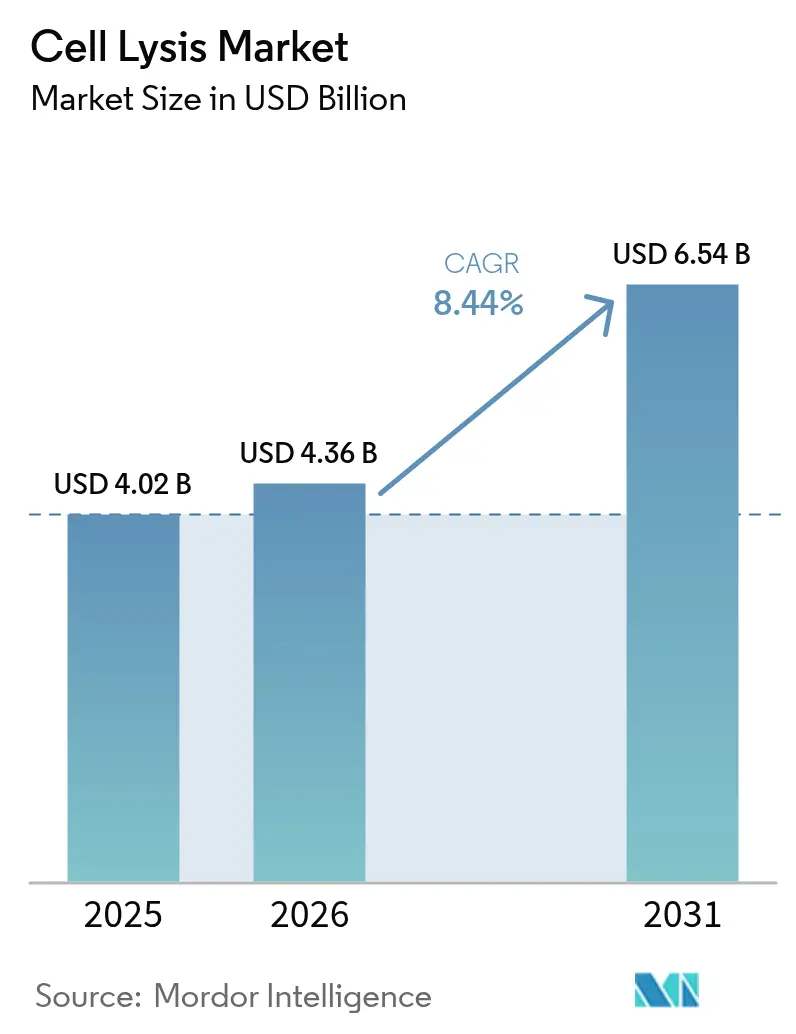
The cell lysis market size is expected to grow from USD 4.02 billion in 2025 to USD 4.36 billion in 2026 and is forecast to reach USD 6.54 billion by 2031 at 8.44% CAGR over 2026-2031. Sustained investment in single-cell omics, continuous bioprocessing, and automated sample-prep platforms anchors this growth trajectory. Broad adoption of gentle yet high-throughput lysis protocols supports expanding gene-therapy pipelines, while scalable mechanical systems protect product integrity in mammalian perfusion runs. Tight alignment with precision-medicine requirements has elevated lysis efficiency and reproducibility to core purchasing criteria. Companies are prioritizing closed, automated hardware to reduce contamination risk and accelerate regulatory filings. Meanwhile, environmental mandates that phase out cytotoxic detergents are steering procurement toward eco-compliant reagents and validated enzyme cocktails.
Key Report Takeaways
- By product type, reagents led with 52.07% revenue share in 2025; instruments are forecast to expand at a 12.03% CAGR through 2031.
- By cell type, mammalian cells held 45.13% of the cell lysis market share in 2025, while viral particles are projected to grow at a 16.62% CAGR to 2031.
- By lysis technique, mechanical methods captured 45.32% share of the cell lysis market size in 2025; enzymatic lysis is advancing at a 10.45% CAGR through 2031.
- By application, protein purification & proteomics accounted for a 42.52% share of the cell lysis market size in 2025, while cell-based vaccines are expanding at a 12.04% CAGR through 2031.
- By end user, biotechnology & biopharma firms led with 41.22% revenue share in 2025; the CRO/CMO segment is growing at a 13.25% CAGR to 2031.
- By geography, North America commanded 38.52% revenue share in 2025, while Asia-Pacific is projected to expand at an 11.35% CAGR through 2031.
Note: Market size and forecast figures in this report are generated using Mordor Intelligence’s proprietary estimation framework, updated with the latest available data and insights as of 2026.
Market Trends and Insights
Drivers Impact Analysis of Cell Lysis Market*
| Driver | (~) % Impact on CAGR Forecast | Geographic Relevance | Impact Timeline |
|---|---|---|---|
| Surge In Single-Cell Omics Sample-Prep Demand | +2.1% | Global, with concentration in North America & EU research hubs | Medium term (2-4 years) |
| Expanding Biologics & Biosimilars Pipeline | +1.8% | Global, led by APAC manufacturing expansion | Long term (≥ 4 years) |
| Uptake Of High-Throughput Automated Workflows | +1.5% | North America & EU early adoption, APAC rapid scaling | Short term (≤ 2 years) |
| Growing Funding For Cell-Based Vaccines | +1.2% | Global, with government-backed initiatives in developed markets | Medium term (2-4 years) |
| Adoption Of Plant Molecular Farming Platforms | +0.8% | EU & North America regulatory leadership, APAC production scaling | Long term (≥ 4 years) |
| CRISPR-Based Synthetic Biology Toolkits Requiring Gentle Lysis | +1.1% | Global research centers, commercial applications in North America & EU | Medium term (2-4 years) |
| Source: Mordor Intelligence | |||
Surge in Single-Cell Omics Sample-Prep Demand
Rapid growth in single-cell sequencing and proteomics has recalibrated lysis requirements toward extreme gentleness and contamination control. Advanced droplet and microwell platforms now process thousands of cells in parallel, demanding reagent formulations that preserve RNA and protein integrity for downstream barcoding. Vendors have responded with enzyme buffers tuned for sub-microliter reaction volumes and microfluidic hardware that shortens library-prep cycles to under 10 hours. Clinical labs now leverage these kits for minimal-invasive tumor profiling, expanding the addressable cell lysis market. Continuous feedback between reagent chemistry and consumable design accelerates protocol standardization, driving multi-site reproducibility and regulatory confidence.
Expanding Biologics & Biosimilars Pipeline
Patent expiries on blockbuster antibodies have triggered a manufacturing build-out that raises demand for large-volume, scalable lysis hardware capable of processing high-cell-density mammalian cultures. Asia-Pacific facilities contribute more than 4.7 million L of stainless and single-use capacity, reinforcing regional pull for robust homogenizers and microfluidizers. Regulatory pathways for biosimilars require validated, consistent release of intracellular product, incentivizing producers to adopt closed, automated lysis skids that integrate real-time monitoring. As continuous perfusion achieves titers above 1 g/L/day, gentle lysis becomes essential for maintaining glycosylation patterns and minimizing aggregation. Reagent suppliers benefit from multi-lot qualification programs that lock in long-term purchasing.
Uptake of High-Throughput Automated Workflows
Automation has shifted from operational convenience to strategic necessity. AI-guided sonication systems now equalize acoustic energy across 96-well plates, slashing operator variability and batch-release deviations[1]Hielscher Ultrasonics, “96-Well Plate Sonicator UIP400MTP,” hielscher.com. Capital spend is justified by lower labor costs, higher sample throughput, and tighter process-validation packages. Instruments equipped with closed-loop temperature control protect thermolabile proteins, widening applicability to fragile viral vectors. Vendors expanding software ecosystems that log every run facilitate CFR Part 11 compliance and accelerate regulatory review, further enlarging the cell lysis market.
Growing Funding for Cell-Based Vaccines
Public-sector grants are catalyzing specialized lysis solutions for viral vector and mRNA platforms. CEPI-backed spin-freezing tech and living-bioreactor projects require detergents that inactivate host cells while safeguarding enveloped virions. NIH SBIR awards for dynamic single-cell analytics highlight government recognition of upstream lysis as a rate-limiting step in vaccine R&D. These initiatives amplify demand for GMP-grade enzymes and low-shear mechanical devices that can be rapidly scaled under biosafety constraints.
Restraints Impact Analysis of Cell Lysis Market*
| Restraint | (~) % Impact on CAGR Forecast | Geographic Relevance | Impact Timeline |
|---|---|---|---|
| Stringent Bioprocess Validation & QA/QC Protocols | -1.4% | Global, with heightened requirements in North America & EU | Long term (≥ 4 years) |
| High Capital Cost Of Microfluidic Lysis Systems | -0.9% | Emerging markets and smaller biotech firms globally | Medium term (2-4 years) |
| Cytotoxic Detergent Disposal & ESG Pressures | -0.7% | EU leadership, expanding to North America & APAC | Short term (≤ 2 years) |
| Scale-Up Inefficiencies For Mammalian-Cell Intensification | -1.1% | Global manufacturing hubs, particularly APAC expansion | Medium term (2-4 years) |
| Source: Mordor Intelligence | |||
Stringent Bioprocess Validation & QA/QC Protocols
Increased FDA emphasis on real-time release tests forces manufacturers to prove lysis consistency across scales and environmental variables, lengthening development timelines and raising cost of goods. Advanced therapy developers must document viral integrity, impurity clearance, and residual-detergent profiles, often requiring multi-year comparability studies. Smaller firms without dedicated quality teams face steep barriers, reinforcing buyer preference for platforms with extensive validation dossiers and historical performance data.
High Capital Cost of Microfluidic Lysis Systems
Cutting-edge microfluidic devices deliver unrivaled gentleness and sample conservation but command premium pricing that deters adoption in resource-constrained settings. Total installed costs encompass specialized pumps, disposable chips, and proprietary software, pushing breakeven analyses beyond the reach of many pre-revenue start-ups. While contract manufacturers offer rental models, budget limitations continue to cap penetration in academic labs and emerging markets, tempering the overall cell lysis market expansion.
*Our forecasts treat driver/restraint impacts as directional, not additive. The impact forecasts reflect baseline growth, mix effects, and variable interactions.
Cell Lysis Market Segment Analysis
By Product Type:
Instruments Drive Innovation Despite Reagent DominanceReagents produced 52.07% of 2025 revenue as routine workflows rely on consumables for every batch, yet instruments are set to outpace with a 12.03% CAGR through 2031, underscoring their strategic importance to automated bioprocessing. Demand for smart homogenizers and bead-mill lysers is climbing as sponsors move toward 24/7 continuous operations that require minimal operator intervention. Ultrasonic disruptors now include embedded sensors that track cavitation intensity, ensuring protein integrity during high-throughput runs.
Instrument growth is also propelled by microfluidizers designed for gentle disruption of viral particles and engineered cells. Suppliers offering single-use flow-paths mitigate cross-contamination risks and streamline cleaning validation, creating long-term recurring revenue from cartridge sales. On the reagent side, enzyme cocktails tailored for plant or algal cells are gaining traction, while eco-friendly detergent replacements address Triton X-100 restrictions. Complete lysis kits integrate buffers, inhibitors, and protocols, enabling small labs to meet regulatory expectations without in-house method development.


By Cell Type:
Mammalian Cells Lead While Viral Particles SurgeMammalian cells maintained 45.13% of 2025 demand, reflecting their centrality in monoclonal antibody and recombinant protein production. The cell lysis market size for mammalian cultures is projected to expand steadily as intensified perfusion bioreactors raise cell densities that require robust yet gentle disruption. Viral particles, however, represent the fastest-growing opportunity at a 16.62% CAGR, fueled by adeno-associated virus (AAV) and lentiviral vector programs in gene and cell therapy.
Viral-specific lysis protocols combine enzymatic digestion and low-shear microfluidics to preserve capsid integrity, a prerequisite for high infectious titers downstream. Microbial cells continue to supply enzymes and industrial metabolites, sustaining solid demand for bead-beating and high-pressure homogenization. Plant cells, driven by molecular-farming initiatives, open niche avenues for proprietary enzymes that break robust cell walls while maintaining glycoprotein quality.
By Lysis Technique:
Mechanical Methods Dominate Despite Enzymatic GrowthMechanical disruption held 45.32% revenue share in 2025, confirming its status as the default choice for scale-up due to proven robustness and straightforward validation. High-pressure homogenizers and bead-mills deliver consistent particle-size reduction across batch volumes, forming the backbone of large-scale antibody purification. The cell lysis market is nevertheless witnessing a 10.45% CAGR in enzymatic methods as recombinant enzymes enable low-temperature processing that preserves conformational epitopes vital for downstream analytics.
Chemical detergents are under scrutiny following EU regulation, accelerating a shift toward biodegradable surfactants that match historic performance. Hybrid workflows integrating pulsed electric fields with enzymes illustrate a convergence of gentleness and efficiency. Osmotic shock remains confined to specialized research applications but continues to serve as a low-cost alternative when product stability permits.
By Application:
Protein Purification Leads While Cell-Based Vaccines AccelerateProtein purification & proteomics represented 42.52% of 2025 revenue, anchoring the cell lysis market with mature, validated protocols across research and manufacturing. Rising antibody titers and growing interest in subunit vaccines keep this segment resilient. Cell-based vaccines, expanding at 12.04% CAGR, benefit from global pandemic preparedness funding that fast-tracks advanced lysis solutions capable of preserving viral infectivity.
Nucleic-acid extraction supports booming sequencing and CRISPR-editing workflows, maintaining double-digit growth. Drug discovery labs rely on automated lysis in high-throughput screening to improve hit-identification fidelity. Decentralized diagnostic platforms require cartridge-integrated lysis that operates at room temperature, widening adoption in emerging healthcare settings.

By End User:
Biotechnology Firms Lead While CRO/CMO Segment SurgesBiotechnology and biopharma enterprises commanded 41.22% of 2025 spending, leveraging in-house process-development teams to specify bespoke lysis hardware and reagents. The CRO/CMO sector, posting a 13.25% CAGR, scales capacity to meet global outsourcing demand, creating sizable recurring orders for turnkey lysis skids compatible with diverse client protocols.
Academic research institutes retain steady purchasing but increasingly favor eco-friendly reagents that ease laboratory disposal. Clinical diagnostic centers adopt cartridge-based systems that integrate lysis, extraction, and amplification to reduce hands-on time and biohazard exposure. Government laboratories and quality-control units complete the demand landscape, focusing on validated kits that support standardized testing frameworks.
Geography Analysis
North America Cell Lysis Market
North America captured 38.52% revenue in 2025, supported by a deep biopharmaceutical manufacturing base, significant NIH and BARDA funding, and an FDA framework that rewards validated automation. Large multi-site manufacturers deploy enterprise-wide specifications that harmonize lysis protocols across drug-substance and drug-product facilities. The United States continues to lead new-drug approvals in advanced therapies, reinforcing domestic demand for GMP-grade kits.
APAC Cell Lysis Market
Asia-Pacific is forecast to achieve an 11.35% CAGR, driven by aggressive government incentives and rising CDMO activity. China’s USD 4.17 billion biomanufacturing commitment for 2025 anchors multiple industrial parks that specify closed, automated lysis modules for monoclonal and gene-therapy programs. India expands as an alternative supply-chain hub, benefiting from policy alignment with the US BioSecure Act and large domestic talent pools. Regional producers target export-grade quality, elevating demand for systems with comprehensive validation packages.
Europe Cell Lysis Market
Europe remains a pivotal market where stringent environmental policies shape purchasing decisions. The ban on Triton X-100 forces rapid transition to biodegradable detergents, placing early-mover suppliers at an advantage. Manufacturers adapt by certifying alternative surfactants and updating master batch records, a process that drives reagent sales but slows new-equipment procurement until qualification completes. Northern Europe’s focus on circular economy principles encourages adoption of energy-efficient ultrasonic devices.
South America and MEA Cell Lysis Market
South America and the Middle East & Africa collectively represent smaller shares but register rising interest in decentralized diagnostic kits and local vaccine fill-finish plants. Brazil’s public vaccine institutes allocate capital toward low-shear viral-lysis technology, while Gulf region free zones court CDMOs with tax incentives covering bioprocess equipment importation. Infrastructure constraints, however, temper near-term uptake of high-cost microfluidic instruments, aligning demand toward proven mechanical systems with flexible financing.


Competitive Landscape
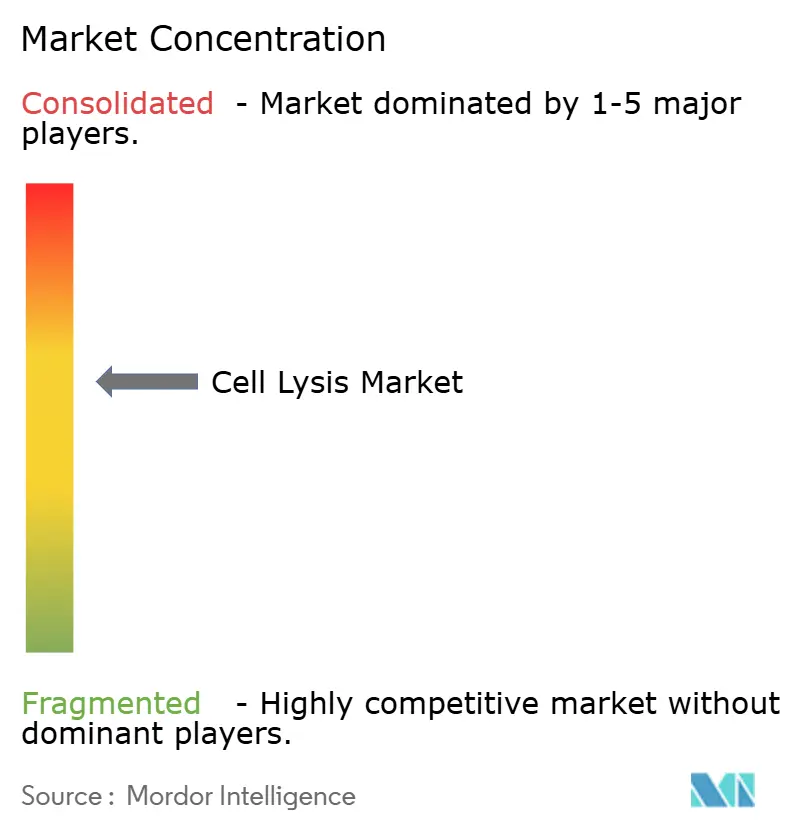
The cell lysis market features medium concentration: global multinationals hold sizable shares, yet niche innovators continue to enter. Thermo Fisher Scientific leads with an acquisitive strategy targeting USD 40–50 billion in M&A to extend its automation and reagent portfolio. Sartorius partners with contract manufacturers to bundle high-performance cell lines with downstream process equipment, creating turnkey packages that shorten client timelines.
Technological differentiation centers on closed automation, AI-assisted parameter control, and eco-compliant reagent chemistry. QIAGEN’s upcoming sample-prep instruments promise reduced plastic use and streamlined robotic integration, positioning the firm for laboratories seeking green credentials. Microfluidics firms emphasize gentle shear environments favorable to CAR-T workflows, while ultrasonic specialists refine cavitation management software.
White-space opportunities lie in single-cell mammalian workflows, enzymatic kits for plant molecular farming, and regional distribution in Latin America. Vendors pursuing joint ventures with local CDMOs gain early access to expansion projects, locking in preferred-supplier status before large-scale procurement cycles begin. Regulatory expertise, particularly in validation documentation, remains a decisive advantage for established players when bidding for GMP installations.
Cell Lysis Industry Leaders
Thermo Fisher Scientific
Bio-Rad Laboratories, Inc.
F. Hoffmann-La Roche Ltd.
Merck KGaA
Danaher Corporation
- *Disclaimer: Major Players sorted in no particular order
Cell Lysis Market Companies Covered in this Report
- Thermo Fisher Scientific
- Danaher
- Merck
- Beckton Dickinson
- Bio-Rad Laboratories
- Eppendorf
- Roche
- Takara Bio
- QIAGEN
- Miltenyi Biotec
- Qsonica
- Claremont BioSolutions
- Microfluidics International Corp.
- Labfreez Instruments Group Co.
- Cell Signaling Technology
- PerkinElmer (Revvity)
- Agilent Technologies
- Promega
- New England Biolabs
- Sigma-Aldrich (SAFC)
- Illumina
- Sartorius

Market Opportunities and Future Outlook
Opportunities are concentrating around automated, closed sample-prep and bioprocess lysis workflows where reproducibility, contamination control, and electronic run records support validation needs. The market already shows a pivot toward hardware-enabled standardization as instruments outpace reagents in growth, and buyers increasingly specify low-shear processing for viral particles and intensified mammalian cultures.
Product opportunities also track eco-compliant chemistry that replaces legacy detergents affected by restrictions such as Triton X-100, creating room for biodegradable surfactants and validated enzyme and nuclease cocktails that can be qualified across multi-site manufacturing and CRO/CMO networks. Technology development is also pushing lysis into integrated systems rather than standalone steps, with 2026 academic work describing continuous cell lysis combined with downstream RPA-CRISPR/Cas reactions for decentralized molecular diagnostics. On scale-up, suppliers continue to emphasize high-pressure homogenization and enhanced cooling to protect thermosensitive biomolecules, while a 2026 patent filing describes sterile, cartridge-based mechanical lysis architectures intended for scalable operation under lower pressures. These directions align with demand signals in single-cell omics, gene and cell therapy, and outsourced bioprocessing, where standardized, closed, and automation-friendly lysis methods reduce method-development burden and support multi-lot comparability requirements.
Recent Industry Developments in Cell Lysis Market
- May 2026: Roche entered into a definitive merger agreement to acquire PathAI, expanding its AI-driven diagnostics and digital pathology footprint. The deal reinforces data-centric pathology workflows that depend on standardized upstream sample preparation, supporting demand for reproducible lysis and extraction methods in translational and clinical lab settings.
- June 2025: Bio-Rad Laboratories completed the acquisition of Stilla Technologies to broaden its digital PCR portfolio and related automation capabilities. This expands integrated genomics workflows where consistent lysis and nucleic-acid preparation are critical for assay performance and throughput in research and applied testing labs.
- June 2024: Thermo Fisher Scientific introduced the KingFisher PlasmidPro Maxi Processor for fully automated plasmid DNA purification. By pushing automation deeper into nucleic-acid workflows, the introduction supports higher-throughput, lower-variability upstream processing and increases pull-through for compatible sample-prep consumables.


Cell Lysis Market Report Scope and Research Methodology
Market Definition and Coverage
This market covers the tools and reagents used to break open cells so intracellular contents such as proteins and nucleic acids can be collected for downstream lab and bioprocess workflows.
Scope exclusions: It does not count general lab consumables that are not used for lysis, and it excludes upstream cell culture media and growth supplements.
Segments Covered in This Report
- By Product Type
- Instruments
- Homogenizers
- Bead-mill Lyser
- Ultrasonic Disruptors
- Microfluidizers
- Centrifuges
- Reagents
- Detergent Kits
- Enzymes & Nucleases
- Chemical Buffers
- Complete Lysis Kits
- Instruments
- By Cell Type
- Mammalian Cells
- Microbial Cells
- Plant Cells
- Viral Particles
- Others
- By Lysis Technique
- Mechanical (Physical)
- Chemical / Detergent
- Enzymatic
- Osmotic Shock
- By Application
- Protein Purification & Proteomics
- Nucleic-Acid Extraction & Genomics
- Cell-Based Vaccines
- Drug Discovery & Screening
- Diagnostics
- By End User
- Biotechnology & Biopharma Firms
- Contract Research & Manufacturing Organizations (CRO/CMO)
- Academic & Research Labs
- Clinical Diagnostics Centers
- Others
- Geography
- North America
- United States
- Canada
- Mexico
- Europe
- Germany
- United Kingdom
- France
- Italy
- Spain
- Rest of Europe
- Asia-Pacific
- China
- Japan
- India
- South Korea
- Australia
- Rest of Asia-Pacific
- Middle East and Africa
- GCC
- South Africa
- Rest of Middle East and Africa
- South America
- Brazil
- Argentina
- Rest of South America
- North America
Data Sources, Market Sizing, and Validation
Desk Research
Desk research started with building a clear view of demand drivers for cell lysis in research, diagnostics, and biomanufacturing, and then mapping what is typically purchased in these workflows. We reviewed public sources such as the US FDA database and guidance updates for molecular testing, the US NIH funding database for life science research activity, OECD health statistics, and World Bank macro indicators to normalize country-level lab spending.
To keep the model grounded in what is actually shipped and used, we also relied on sources such as UN Comtrade for relevant trade codes, WIPO patent filings to understand innovation intensity around lysis instruments and chemistries, and peer-reviewed journals that describe standard sample preparation protocols and throughput trends. Company annual reports, investor presentations, and reputable press were used to cross-check product mix shifts and broad pricing direction, while paid subscriptions for company financials and patent databases were used selectively to fill disclosure gaps. These sources are illustrative and not exhaustive, and we used additional references for data collection, validation, and clarification.
Primary Interviews and Surveys
Primary validation was done through expert interviews and surveys across instrument suppliers, reagent providers, distributors, and lab operations teams who buy and use lysis solutions in routine workflows. The discussions were used to confirm typical purchasing bundles (kits versus separate buffers and enzymes), average replacement cycles for hardware, and the practical split between research use and regulated testing use cases across major regions.
Distribution of primary research fieldwork respondents
| Company type | Respondent position | Region |
|---|---|---|
| Top tier: 26% | CXOs: 17% | APAC: 41% |
| Mid tier: 54% | Functional/Unit leaders: 41% | EMEA: 34% |
| Smaller Players: 20% | Managers: 42% | Americas: 25% |
Market-Sizing & Forecasting
The core sizing logic uses a top-down approach where life science research intensity and testing volumes are translated into a practical demand pool for lysis kits, reagents, and instruments, and then converted into value using observed pricing ranges. To keep the total anchored, we corroborated outputs with selective bottom-up approximations, such as supplier revenue splits where disclosed, sampled average selling price by unit throughput, and channel checks on recurring reagent consumption.
Key inputs that shaped the model included growth in molecular biology and omics workflows, expansion of bioprocessing and cell-based manufacturing, the shift toward automated and closed sample preparation, average instrument replacement and service cycles, and typical reagent consumption per run for common protocols (with differences between mammalian and microbial samples handled explicitly). Where direct volume signals were weak, gaps were handled using proxy indicators and then narrowed using interview-based ranges so outliers did not drive totals.
For forecasting, scenario analysis was used around the most sensitive variables, mainly assay volume growth, lab funding direction, and mix shift toward higher throughput automation. Those scenarios were then anchored to expert consensus captured during primary discussions. The final forecast is traceable to a small set of explainable inputs, and it can be reproduced and stress-tested without requiring proprietary end-user transaction data.
Data Validation & Update Cycle
Outputs were checked against independent signals such as trade movement direction for relevant instrument categories, public funding and publication momentum for high-use workflows, and the expected spend share of sample preparation within lab budgets. When a region or product line showed an unusual jump, we re-reviewed the underlying assumptions, and follow-up calls were triggered to confirm whether the change came from pricing, mix, or true volume growth.
Before sign-off, the model goes through multi-step analyst reviews where calculations are re-run and assumptions are compared against interview notes and public documentation. Reports are refreshed annually, and interim updates are made when material events occur, such as regulation changes that impact testing volumes or a clear shift in automation adoption. Right before delivery, a final pass is completed so clients receive an updated view tied to the latest available indicators.
Mordor Intelligence's Cell Lysis Market Sizing Compared With Other Published Estimates
Published estimates for cell lysis rarely match exactly because the market boundary is not always defined the same way, and small choices around what is counted can materially change totals. Differences usually come from whether the study includes adjacent disruption workflows, how instruments versus reagents are treated, and what base-year pricing is assumed before the forecast is extended.
By tracking instrument installed base signals and running reagent run-rate checks, Mordor Intelligence keeps the 2025 value aligned with purchase behavior for lysis-specific kits, buffers, enzymes, and dedicated instruments, instead of widening the scope into broader disruption and downstream processing spend. The spread below is mainly explained by scope expansion into disruption categories and by different base-year timing and inflation handling in average selling prices and currency conversion.
Benchmark comparison
| Source | Market Size | Gaps in Research Methodology |
|---|---|---|
| Mordor Intelligence | USD 4.02 B (2025) | |
| Global Consultancy A | USD 6.23 B (2025) | Uses a broader cell lysis and disruption scope, which can pull in adjacent disruption workflows and some downstream processing related spending, lifting the 2025 total versus a lysis-only product boundary. |
| Industry Publisher B | USD 4.40 B (2025) | Applies different product mapping and base-year pricing, and the uplift also reflects a more aggressive assumption for automation-driven ASP progression over the early forecast years. |
Overall, the gap is less about math and more about what gets counted and how pricing is carried forward. When the scope is kept tight to lysis-specific reagents and instruments and then cross-checked against real workflow signals, the outcome stays easier to explain and to repeat in updates.


Key Questions Answered in the Report
What is the current value of the cell lysis market?
The market is valued at USD 4.36 billion in 2026 and is projected to reach USD 6.54 billion by 2031.
Which product category is growing fastest?
Instruments are forecast to register a 12.03% CAGR through 2031 as labs invest in automation.
Why are viral-particle lysis solutions gaining traction?
Gene-therapy and vaccine programs require gentle disruption methods that protect viral infectivity, driving a 16.62% CAGR for this segment.
How do environmental regulations affect reagent choices?
The EU ban on Triton X-100 is pushing manufacturers toward biodegradable detergents and enzyme-based kits.
Which region offers the highest growth potential?
Asia-Pacific is projected to expand at an 11.35% CAGR thanks to large-scale capacity additions in China and India.
Page last updated on:


 Your data is secure and never sold or shared.


