
Cassava Flour Market Size and Share
Market Overview
| Study Period | 2021 - 2031 |
|---|---|
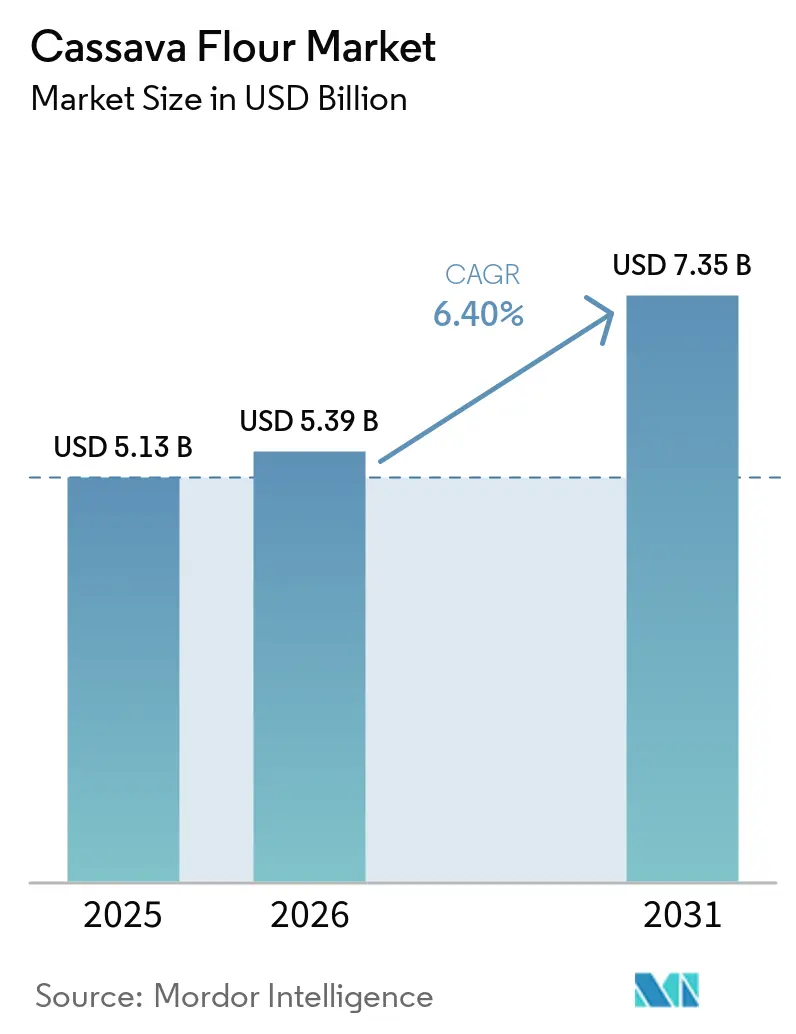
| Market Size (2026) | USD 5.39 Billion |
| Market Size (2031) | USD 7.35 Billion |
| Growth Rate (2026 - 2031) | 6.40 % |
| Fastest Growing Market | South America |
| Largest Market | Asia-Pacific |
| Market Concentration | Medium |
Major Players *Disclaimer: Major Players sorted in no particular order Image © Mordor Intelligence. Reuse requires attribution under CC BY 4.0. | |
Cassava Flour Market Analysis by Mordor Intelligence
The cassava flour market size was USD 5.13 billion in 2025 and is forecast to reach USD 7.35 billion by 2031, growing at a CAGR of 6.40% from 2026 to 2031. Demand is moving beyond gluten-free retail products because processors can use cassava ingredients in food, feed, pharmaceutical, and personal care applications. The cassava flour market also benefits from public programs that seek to reduce dependence on imported wheat, particularly where cassava is already an important crop. Certified organic and gluten-free products give qualified processors access to higher-value buyers, although they also raise documentation and testing requirements. Supply reliability, processing quality, and compliance with hydrocyanic acid limits will determine whether producers can turn rising demand into durable export sales. The competitive field remains dispersed, which leaves room for regional processors with reliable farmer networks, food-safety systems, and specialized processing capabilities.
Key Report Takeaways
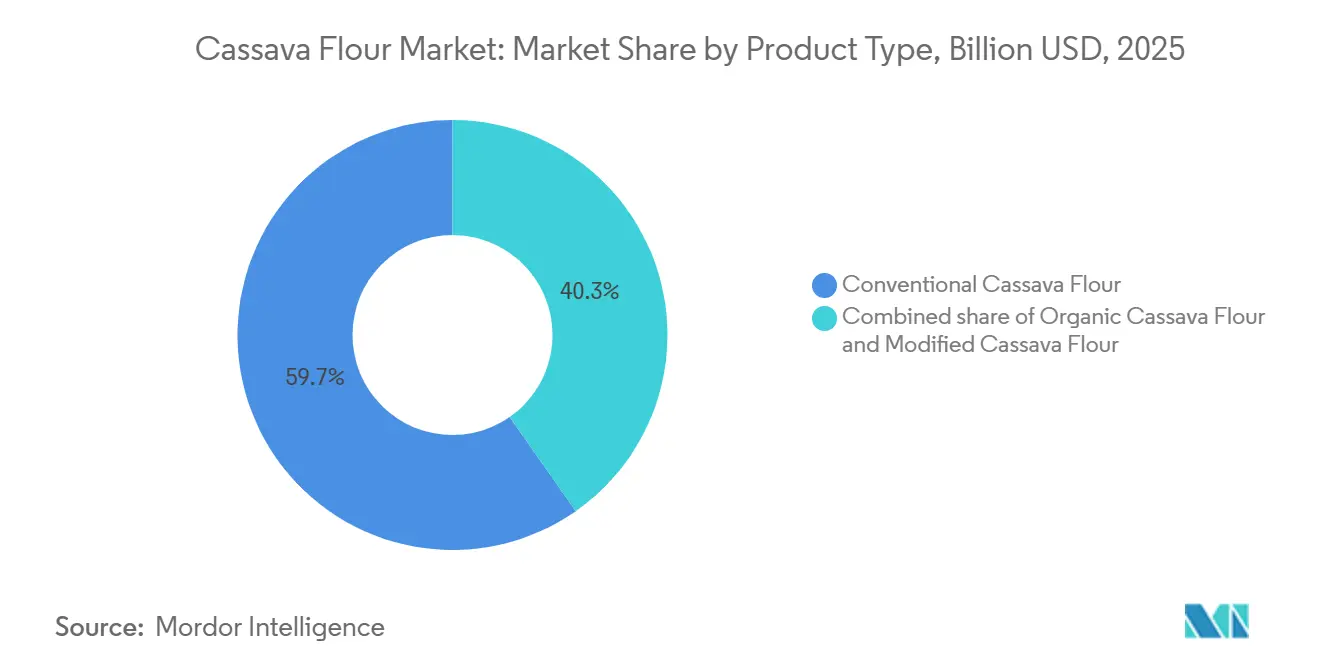
- By product type, conventional cassava flour was the largest category in 2025 with a 59.71% market share in the market, while organic cassava flour is forecast to grow at a 7.46% CAGR through 2031.
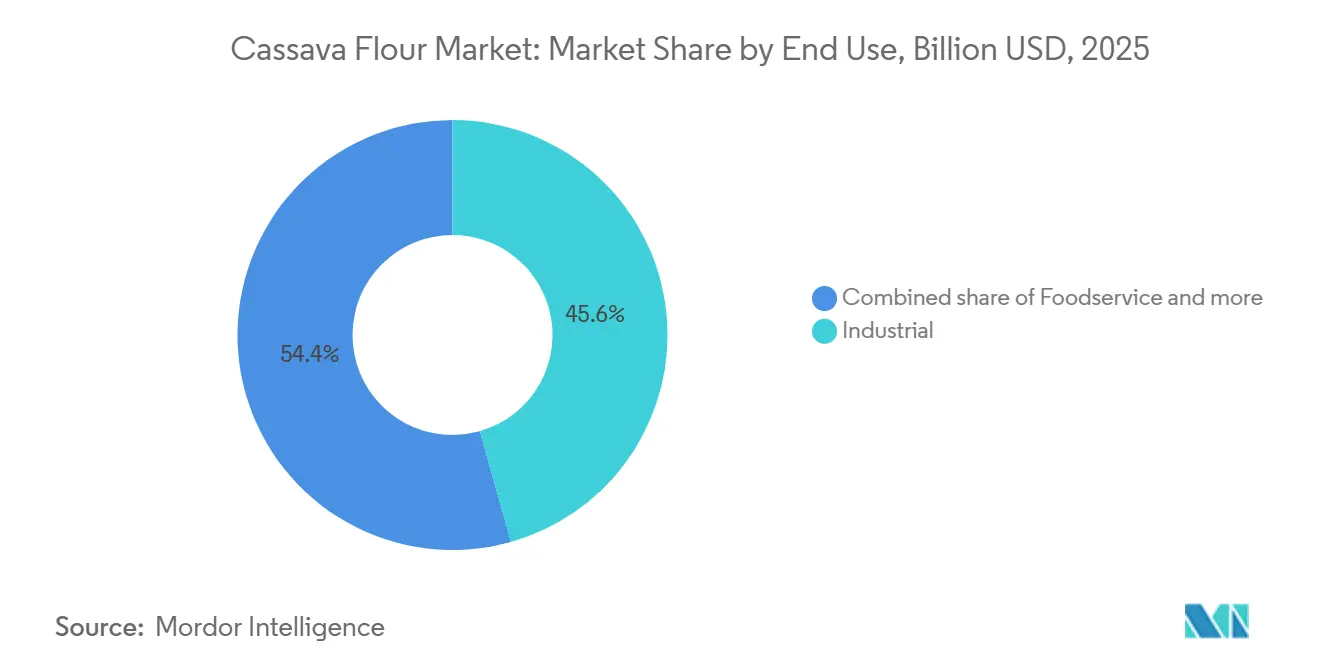
- By end use, industrial applications held 45.62% of the cassava flour market share in 2025, while foodservice is projected to grow at an 8.11% CAGR through 2031.
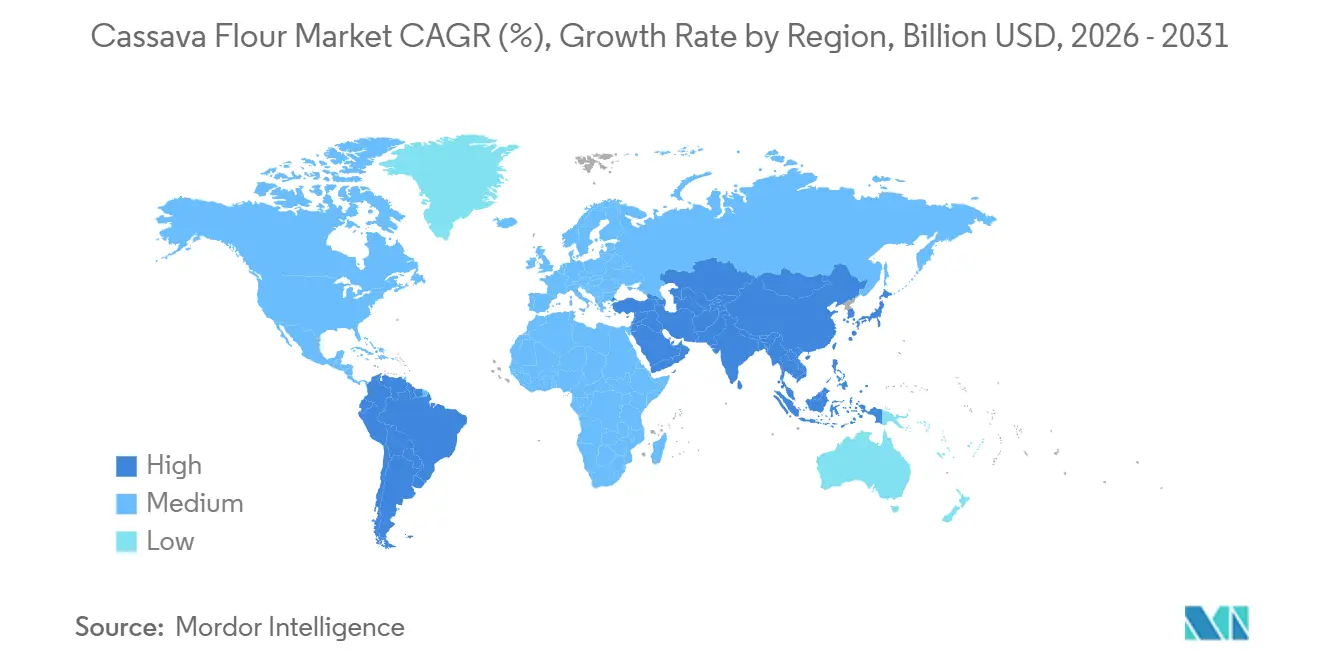
- By geography, Asia-Pacific held 43.90% of the cassava flour market share in 2025, while South America is forecast to expand at a 7.82% CAGR through 2031.
Note: Market size and forecast figures in this report are generated using Mordor Intelligence’s proprietary estimation framework, updated with the latest available data and insights as of January 2026.
Market Trends and Insights
Drivers Impact Analysis of Cassava Flour Market*
| Driver | (~) % Impact on CAGR Forecast | Geographic Relevance | Impact Timeline |
|---|---|---|---|
| Gluten-free and allergen-free food adoption | +1.5% | Global, with concentration in North America, Europe, and Australia | Short term (≤ 2 years) |
| Bakery, snacks, and convenience food formulation growth | +1.2% | Global, led by North America, Europe, and urbanizing Asia-Pacific markets | Short term (≤ 2 years) |
| Wheat-import substitution and food-security programs | +1.0% | Africa (Nigeria, Cameroon, Tanzania), South America (Brazil, Colombia, Bolivia) | Medium term (2-4 years) |
| E-commerce and premium health-food distribution expansion | +0.5% | North America, Europe, urban Asia-Pacific | Short term (≤ 2 years) |
| Farm-gate and mobile processing reducing root perishability | +0.6% | Sub-Saharan Africa, Nigeria, Ghana, Mozambique | Medium term (2-4 years) |
| Energy-efficient drying and residue valorization | +0.4% | Nigeria, Ghana, Indonesia; with technology transfer to Latin America | Long term (≥ 4 years) |
| Source: Mordor Intelligence | |||
Gluten-free and allergen-free food adoption
The scale of the gluten-free addressable market is systematically underestimated when analysts focus only on celiac disease. A 2025 meta-analysis in Gut covering 49,476 participants across 16 countries found a pooled prevalence of 10.3% for self-reported non-coeliac gluten or wheat sensitivity, with women 2.3 times more likely to report sensitivity than men, a demographic skew that concentrates purchasing decisions precisely among health-conscious household grocery buyers. Cassava flour's competitive advantage in this space is functional: as noted in a 2025 IntechOpen review of cassava flour processing and food applications, its high amylopectin content, low gelatinization temperature, and desirable pasting profiles allow substitution for wheat flour in dough-based applications without structural failure, a performance attribute that rice or almond flour cannot consistently replicate. This baking functionality creates a defensible premium in retail and foodservice channels that sustains price points 20-35% above conventional flours, supporting margin expansion even as volumes scale. The Lancet published a 2025 piece confirming that non-coeliac gluten sensitivity affects roughly 10% of adults globally, underscoring that medical validation, rather than consumer fashion, now anchors a meaningful portion of demand.
Bakery, snacks, and convenience-food formulation growth
Food manufacturers are expanding cassava flour's role beyond niche gluten-free shelving into mainstream reformulation, particularly in composite flour systems where cassava can replace 15-30% of wheat without altering product texture or nutrition. A 2026 peer-reviewed study in the Journal of the Saudi Society of Agricultural Sciences demonstrated that enzymatic modification of cassava polysaccharides significantly improves chip crispness, a finding relevant to the snack segment where texture is the primary commercial hurdle[1]. Institutional food companies have acted on these developments: reporting from the Nigeria Cassava Investment Accelerator indicates that Nestlé and Danone have incorporated cassava-derived carbohydrates into infant formula and clinical nutrition lines, citing the hypoallergenic profile as a formulation advantage over wheat or barley starch. The snack and convenience-food categories are particularly receptive because extrusion-based processing, used for crisps, coated nuts, and extruded puffs, benefits from cassava flour's stable viscosity and oil absorption characteristics, as documented in a 2025 evaluation published in the African Journal of Agricultural Science and Food Research. For large food manufacturers facing SKU-level reformulation pressure from retailers demanding free-from certifications, cassava flour now provides both a technical solution and a regulatory label claim simultaneously.
Wheat-import substitution and food-security programs
Government-mandated wheat-flour substitution is converting geopolitical food-security urgency into recurring institutional demand for cassava flour at scale. Nigeria's Federal Government formally revived the 20% HQCF mandatory inclusion policy in September 2025, following a Senate bill initiated in November 2024; the International Institute of Tropical Agriculture (IITA), through its Food and Nutrition Science Laboratory, simultaneously expanded training programs for HQCF production and wheat-composite bread across East and West Africa. Cameroon moved from policy intent to fiscal action: effective January 1, 2025, the government exempted locally produced cassava flour from VAT and permitted up to 15% cassava-blend in bread, citing annual wheat import costs that exceeded CFA 178 billion in 2023, per Business in Cameroon. Tanzania's government, working with IITA under the National Cassava Development Strategy 2020-2030, targets 24% export growth and estimates that replacing just 10% of annual wheat imports (valued at USD 231 million in 2020) with cassava flour would save TZS 57 billion (approximately USD 22.8 million) annually. The non-obvious implication is that mandatory inclusion legislation, when sustained across multiple African markets simultaneously, functions as a structural demand guarantee rather than a discretionary procurement preference, thereby substantially reducing volume risk for industrial-scale processors that commit to high-quality cassava flour capacity.
Farm-gate and mobile processing reducing root perishability
Fresh cassava roots begin deteriorating within 24-72 hours of harvest, a biological constraint that has historically limited processing radii to areas within a few kilometers of plants and forced large seasonal under-utilization of installed milling capacity. Mobile processing units, truck-mounted mini-factories that convert fresh roots into semi-processed cake or flour directly at the farm gate, are dismantling this constraint in Nigeria's Oyo and Benue states, where DADTCO-linked pilots have reduced spoilage losses and extended shelf-life, improving farmer income per the Nigeria Cassava Investment Accelerator. A Springer Nature 2025 study analyzing processing technology adoption among 570 Nigerian cassava processors found that automated systems increased starch output by 35% and net returns by 28% compared to manual methods, though only 18% of processors had adopted automation, indicating that diffusion is still in its early phases and adoption gains will remain a consistent growth support through the forecast period. CIRAD's energy-efficient flash dryer prototype for small-scale cassava processing, operational at the Federal Institute of Industrial Research in Lagos, achieves a drying capacity of 50-150 kg/hour and reduces moisture from 47% to under 10%, enabling farmgate-scale processors to meet HQCF moisture standards[2]. South Africa's Roff Industries launched its Cassava Hammer Mill System in October 2025 with 500-750 kg/hour processing capacity in a compact 9m × 4m footprint, targeting smallholder cooperatives across sub-Saharan Africa.
Restraints Impact Analysis of Cassava Flour Market*
| Restraint | (~) % Impact on CAGR Forecast | Geographic Relevance | Impact Timeline |
|---|---|---|---|
| Climate, disease, and root-quality variability | -0.8% | Sub-Saharan Africa, Brazil, Southeast Asia | Medium term (2-4 years) |
| Inadequate storage and processing infrastructure | -0.6% | Sub-Saharan Africa, rural South Asia, and smaller South American producers | Long term (≥ 4 years) |
| Cyanogenic-compound control and food-safety compliance | -0.7% | Global export markets; most critical in Europe, Australia, and North America compliance zones | Short term (≤ 2 years) |
| Low dryer utilization and contract-dependent demand | -0.4% | Nigeria, Ghana, Mozambique; secondary impact in Indonesia and Vietnam | Medium term (2-4 years) |
| Source: Mordor Intelligence | |||
Climate, disease, and root-quality variability
Cassava's reputation as a climate-resilient crop obscures growing vulnerabilities that are already visible in major supply regions. Brazil's CEPEA research center reported that the 2026 national cassava output is expected to contract approximately 2.5% to around 20 million metric tons, after a 9.4% production surge in 2025, due to anticipated lower area-harvest ratios and productivity softening linked to rainfall pattern shifts, including El Niño projections that threaten the Center-South growing regions. Cassava brown streak disease continues to erode yield reliability in East Africa: IITA's mitigation efforts through certified seed distribution and varietal improvement remain under-resourced relative to the scale of the threat, leaving smallholder processors' off-take agreements chronically exposed to supply shortfalls. In Brazil's industrial processing belt, CEPEA noted that cassava root prices rose for 8 consecutive weeks through March 2026 as supply tightened, illustrating how even short-term agronomic disruptions translate directly into processor margin compression and market price volatility. Inconsistent root quality, driven by soil variation, harvest timing, and varietal mixing, also complicates flour standardization, creating batch-level quality variance that industrial buyers treat as a commercial risk and price into procurement contracts accordingly.
Cyanogenic-compound control and food-safety compliance
Cyanogenic glycoside management is the most consequential technical barrier to cassava flour's expansion into premium export markets, yet it is consistently underweighted in commercial market assessments. A 2025 systematic review in Frontiers in Sustainable Food Systems found that average HCN concentrations in cassava flour samples reached 71.1 mg/kg, more than 7 times the FAO/WHO Codex Alimentarius maximum of 10 mg/kg, while even effective processing combinations (controlled fermentation combined with mechanical dewatering and flash drying) can leave residual HCN near the threshold under non-ideal field conditions[3]. China issued NY/T 4861-2025 in 2025, a national technical code of practice specifically covering cyanogenic glycoside control in cassava foods, naming peeling, milling, dewatering, and drying as critical control points; this standard tightens the regulatory floor for the world's largest cassava starch processing economy. The EU's Regulation 2023/915, updated effective January 2025, enforces a 10 mg/kg ceiling on HCN in cassava flour and tapioca flour entering European markets, while Australia's Department of Agriculture and Water Resources issued a 2025 notification after detecting excessive HCN levels in cassava chips imported from Sri Lanka. The combined effect is that certification and traceability infrastructure, rather than raw processing capacity, will determine which producers can capture premium export markets as compliance checks intensify.
*Our forecasts treat driver/restraint impacts as directional, not additive. The impact forecasts reflect baseline growth, mix effects, and variable interactions.
Cassava Flour Market Segment Analysis
By Product Type:
Certified Organic Products Lead GrowthOrganic cassava flour is forecast to grow at a 7.46% CAGR through 2031, making it the fastest-growing product category in the cassava flour market. This growth reflects demand from food manufacturers and consumers in North America and Europe that seek certified organic and gluten-free ingredients for premium retail, bakery, and foodservice products. European organic requirements require third-country facilities to maintain detailed audit documentation, establish traceable ingredient flows, and pass periodic inspections. These obligations favor cooperatives and processors that already have mature quality records, trained staff, and established export systems. The cassava flour market size for organic products is therefore closely tied to certification capacity, buyer confidence, and retail demand.
Conventional cassava flour remained the largest product type with 59.71% market share because it serves high-volume food and beverage, animal feed, and pharmaceutical applications. Its broad use reflects a lower certification burden, competitive economics, and the continuing need for cost-efficient ingredients in staple food systems across Sub-Saharan Africa and Southeast Asia. Modified cassava flour occupies a smaller but more specialized position in the cassava flour industry because processing improves viscosity, gelatinization stability, and binding performance for extrusion, sauces, dairy alternatives, and products requiring uniform texture. Buyers in these cassava flour market applications tend to value consistent functional performance, dependable specifications, and predictable processing behavior over the lowest raw-material cost. Direct-to-consumer channels, specialist health-food stores, and subscription services have broadened the route to market for certified products, helped smaller brands reach defined consumer groups, and reduced reliance on mainstream retail listings.

By End Use:
Industrial Applications Retain the Largest PositionIndustrial applications accounted for 45.62% of the cassava flour market share in 2025. Food and beverage manufacturing is the largest industrial demand center, with use in bakery products, confectionery, noodles, sauces, and ready-to-eat foods. This part of the cassava flour market uses the ingredient as a gluten-free base, a starch extender, and a way to diversify raw-material sourcing. Animal feed producers also use cassava flour for digestible energy and low-allergen formulations, especially in specialized aquaculture and companion animal feed. Pharmaceutical and personal care buyers represent a further source of demand through cassava-based sorbitol, glucose syrup, and starch-derived excipients, which can replace wheat-derived alternatives in selected formulations.
Foodservice is projected to grow at an 8.11% CAGR through 2031, the fastest rate among end-use segments. A 2025 study found that cassava, chickpea, and corn composite flour could produce gluten-free bread with specific volume, crumb hardness, and springiness comparable to wheat bread. This evidence supports menu reformulation by quick-service restaurants, casual dining operators, and institutional caterers that need repeatable product quality. Retail and household demand is also supported by diaspora grocery channels and consumers who follow paleo, grain-free, or allergen-elimination diets. Foodservice operators can use gluten-free menus as a product differentiator rather than only as an accommodation, creating a more balanced demand base for cassava processors.
Geography Analysis
APAC Cassava Flour Market
Asia-Pacific held 43.90% of the cassava flour market size in 2025. Thailand, Vietnam, and Indonesia provide much of the region’s processing base, while China is an important user of cassava ingredients in food processing, bioplastics, and pharmaceutical excipients. Indonesia’s Lampung province exported 3,330 tons of tapioca flour to China through May 2026, based on the source material, demonstrating the link between regional processing, port access, and cross-border demand. Indonesia also restricted imports of cassava and tapioca flour in 2025 to promote domestic processing, modified cassava flour, and other value-added derivatives. These measures can strengthen local demand in the cassava flour market, encourage processors to move beyond primary products, and support investment in more specialized domestic capacity.
South America Cassava Flour Market
South America is forecast to grow at a 7.82% CAGR through 2031, making it the fastest-growing regional part of the cassava flour market. Brazil produced 20.8 million metric tons of cassava in 2025, providing a large raw-material base for starch and flour processing, although supply conditions are expected to tighten in 2026. Colombia opened a pilot cassava flour processing plant in San Juan Nepomuceno through its Bioeconomy Program, using technology developed by Clayuca. Bolivia also completed a cassava industrialization plant in 2025 to support domestic wheat substitution and value-added exports. These investments connect food-security goals to processing capacity, local procurement, and higher-value agricultural output.
North America and EMEA Cassava Flour Market
North America and Europe are mature demand centers where certification, premium positioning, and online distribution shape purchasing decisions. U.S. demand is linked to paleo, grain-free, clean-label, and gluten-free eating patterns, while European buyers face strict hydrocyanic acid and organic certification requirements. Those requirements concentrate supply among processors that can document compliant production, manage traceability, maintain reliable shipment quality, and respond quickly to buyer audits or product testing. The Middle East and Africa combine export-oriented processing in Nigeria, Ghana, Tanzania, and Cameroon with local food-security requirements, while Gulf Cooperation Council countries add smaller import demand for certified gluten-free products. Across these regions, the cassava flour market share available to exporters will depend on food safety, consistent quality, the ability to meet customer specifications, and access to farmer networks that can provide regular root volumes.
Competitive Landscape
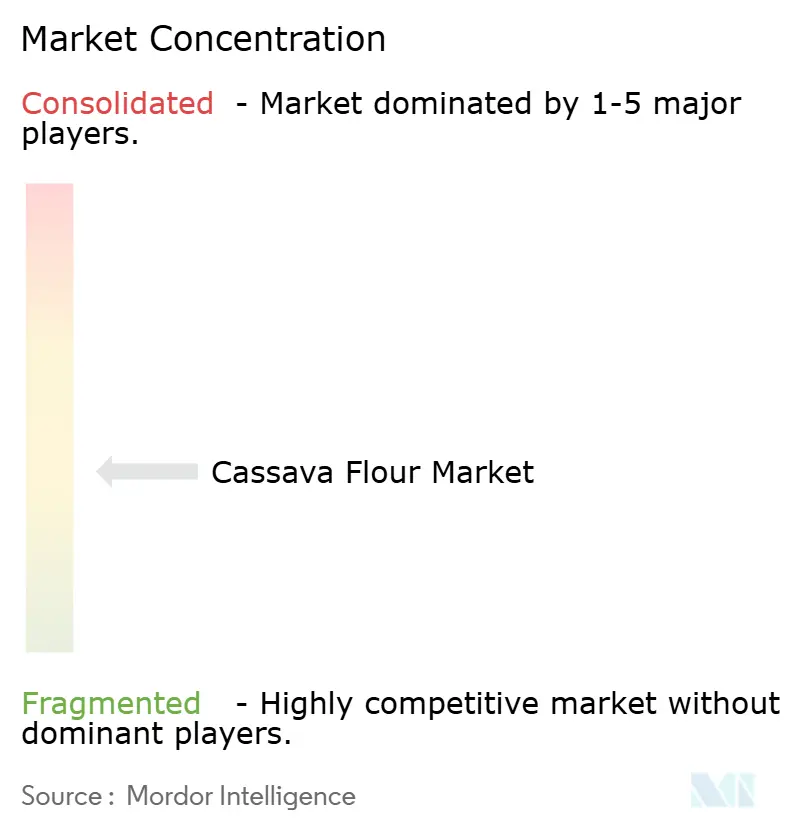
The cassava flour market is moderately fragmented, with no single supplier holding a decisive position across all regions and applications. Competition centers on access to roots, processing technology, product consistency, certification, and the ability to deliver a stable ingredient specification rather than on consumer branding alone. Cargill, Ingredion, and Archer Daniels Midland serve industrial customers through broad ingredient portfolios and established customer relationships across multiple food and ingredient categories. Their scale supports multi-origin sourcing, global distribution, and supply to manufacturers that need consistent inputs across several formulations and production sites. Regional suppliers can compete in the cassava flour market when they offer reliable local procurement, specialized grades, lower logistics costs, closer support for customer requirements, and a clearer connection to local farmer supply.
Thai Wah Public Company Limited has focused on cassava-derived ingredients and specialty starch applications in the Asia-Pacific. Its joint venture with Fuji Nihon, finalized in March 2025, was designed to support manufacturing, distribution, and innovation in tapioca starch and cassava-derived ingredients for regional and export customers. Psaltry International has built a vertically integrated model that combines smallholder sourcing with high-quality cassava flour, starch, and sorbitol production. DADTCO has pursued mobile processing systems that can link dispersed farmers to commercial processing and export channels where fixed infrastructure is less practical. These approaches show that vertical supply integration, farm-level processing, and wider product portfolios can be important alternatives to fixed, centralized operations.
The clearest opening is for certified organic and high-quality cassava flour that can consistently comply with European and Codex hydrocyanic acid requirements. Processors can address this through controlled fermentation, dewatering, drying, low-cyanogenic varieties, routine testing, and documented corrective action when results fall outside specifications. FSSC 22000, ISO 22000, and Codex-aligned systems can help suppliers meet institutional and pharmaceutical-grade requirements and reassure buyers that quality controls are consistently applied. Companies that build these capabilities can participate in higher-value customer relationships, while producers without them may remain concentrated in local commodity channels. The cassava flour industry will continue to reward suppliers that combine verified food safety, dependable farmer supply, functional product performance, and export-ready documentation.
Cassava Flour Industry Leaders
-
Psaltry International Company
-
Matna Foods Ltd.
-
Dufil Prima Foods Ltd.
-
MHOGO Foods
-
YARP Foods
- *Disclaimer: Major Players sorted in no particular order
Cassava Flour Market Companies Covered in this Report
- DADTCO Rivers Cassava Processing Company Limited
- Psaltry International Company
- Matna Foods Ltd.
- Pure Cassava, Dufil Prima Foods Ltd.
- IFGREEN Industries and Investment Ltd.
- MHOGO Foods
- YARP Foods
- Green Hills Natural Foods
- Prospera Foods
- PT Agromoda Solution Indonesia
- Mocaf Factory
- Cassava Naturals
- King Cassava, Amerta Pacific
- Thai Wah Public Company Limited
- Tapioca Vietnam
- Cassava S/A
- Cargill, Incorporated
- Archer Daniels Midland Company
- Ingredion Incorporated
- Tereos S.A.
Recent Industry Developments in Cassava Flour Market
- July 2026: Thai Wah Public Company Limited (TWPC) officially opened its new manufacturing facility in China as part of its China 2.0 strategy, targeting high-value-added (HVA) cassava ingredient demand; the plant was intended to strengthen TWPC's competitiveness in the world's largest cassava-consuming economy and reduce logistics costs for Asian clients.
- October 2025: Roff Industries (South Africa) launched its Cassava Hammer Mill System, a turnkey milling solution that processed 500-750 kg of flour per hour in a compact 9m × 4m footprint, targeting smallholder cooperatives and entrepreneurs across Africa that sought cost-effective cassava flour production capability.
- March 2025: Thai Wah Public Company Limited and Japan's Fuji Nihon Corporation finalized their strategic joint venture, Thai Wah Fuji Nihon Company Limited, with TWPC holding 51% and Fuji Nihon holding 49%, focused on the manufacturing, distribution, and innovation of tapioca starch and cassava-derived ingredients targeting Asia-Pacific and global export markets.
Global Cassava Flour Market Report Scope
Cassava flour is a fine, powdery, white flour made from the whole starchy underground root of the cassava plant (also called yuca or manioc). The cassava flour market report is segmented by product type, end use, and geography. By Product type, the market is segmented into conventional cassava flour, organic cassava flour, and modified cassava flour. By end use, the market is segmented into retail/household, foodservice, and industrial. The industrial segment is sub-segmented into food and beverage, animal feed, pharmaceuticals, personal care and cosmetics, and other industrial applications. By geography, the market is segmented into North America, Europe, Asia-Pacific, South America, and Middle East and Africa. The market forecasts are provided in terms of value (USD).
| Conventional Cassava Flour |
| Organic Cassava Flour |
| Modified Cassava Flour |
| Retail/Household | |
| Foodservice | |
| Industrial | Food and Beverage |
| Animal Feed | |
| Pharmaceuticals | |
| Personal Care and Cosmetics | |
| Other Industrial Applications |
| North America | United States |
| Canada | |
| Mexico | |
| Rest of North America | |
| Europe | United Kingdom |
| Germany | |
| France | |
| Italy | |
| Spain | |
| Sweden | |
| Belgium | |
| Poland | |
| Netherlands | |
| Rest of Europe | |
| Asia-Pacific | China |
| Japan | |
| India | |
| Thailand | |
| Singapore | |
| Indonesia | |
| South Korea | |
| Australia | |
| Rest of Asia-Pacific | |
| South America | Brazil |
| Argentina | |
| Colombia | |
| Peru | |
| Chile | |
| Rest of South America | |
| Middle East and Africa | United Arab Emirates |
| South Africa | |
| Saudi Arabia | |
| Nigeria | |
| Egypt | |
| Morocco | |
| Turkey | |
| Rest of Middle East and Africa |
| Product Type | Conventional Cassava Flour | |
| Organic Cassava Flour | ||
| Modified Cassava Flour | ||
| End Use | Retail/Household | |
| Foodservice | ||
| Industrial | Food and Beverage | |
| Animal Feed | ||
| Pharmaceuticals | ||
| Personal Care and Cosmetics | ||
| Other Industrial Applications | ||
| Geography | North America | United States |
| Canada | ||
| Mexico | ||
| Rest of North America | ||
| Europe | United Kingdom | |
| Germany | ||
| France | ||
| Italy | ||
| Spain | ||
| Sweden | ||
| Belgium | ||
| Poland | ||
| Netherlands | ||
| Rest of Europe | ||
| Asia-Pacific | China | |
| Japan | ||
| India | ||
| Thailand | ||
| Singapore | ||
| Indonesia | ||
| South Korea | ||
| Australia | ||
| Rest of Asia-Pacific | ||
| South America | Brazil | |
| Argentina | ||
| Colombia | ||
| Peru | ||
| Chile | ||
| Rest of South America | ||
| Middle East and Africa | United Arab Emirates | |
| South Africa | ||
| Saudi Arabia | ||
| Nigeria | ||
| Egypt | ||
| Morocco | ||
| Turkey | ||
| Rest of Middle East and Africa | ||
Key Questions Answered in the Report
What is the projected value of the cassava flour market by 2031?
The cassava flour market is forecast to reach USD 7.35 billion by 2031, rising from USD 5.13 billion in 2025 at a 6.4% CAGR from 2026 to 2031.
Which cassava flour product type is growing fastest?
Organic cassava flour is projected to be the fastest-growing product type at a 7.46% CAGR through 2031. Growth is tied to food manufacturers and consumers seeking certified organic and gluten-free ingredients, while processors must maintain traceability, inspection records, organic controls, and clear labeling for export customers.
Which end use held the largest share in 2025?
Industrial applications held 45.62% share in 2025. Food processing was the largest source of industrial demand because cassava flour can be used in bakery goods, confectionery, noodles, sauces, and ready-to-eat products, while animal feed, pharmaceutical excipients, personal care ingredients, sorbitol, and glucose syrup broaden the application base.
Why is food safety important for cassava flour exporters?
Exporters must control hydrocyanic acid because European rules set a maximum level of 10 mg/kg for cassava flour.