
Cardiovascular Ultrasound System Market Size and Share
Market Overview
| Study Period | 2020 - 2031 |
|---|---|
| Market Size (2026) | USD 1.95 Billion |
| Market Size (2031) | USD 2.29 Billion |
| Growth Rate (2026 - 2031) | 3.29 % |
| Fastest Growing Market | Asia Pacific |
| Largest Market | North America |
| Market Concentration | Medium |
Major Players *Disclaimer: Major Players sorted in no particular order Image © Mordor Intelligence. Reuse requires attribution under CC BY 4.0. | |
Cardiovascular Ultrasound System Market Analysis by Mordor Intelligence
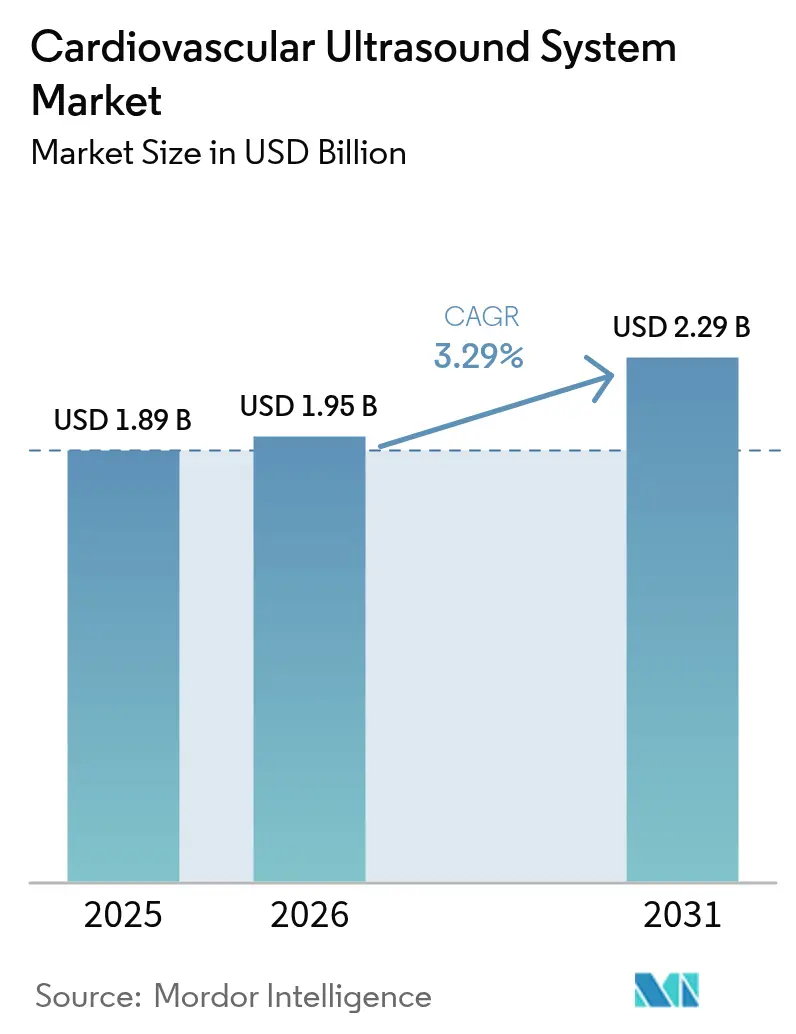
The Cardiovascular Ultrasound System Market size was valued at USD 1.89 billion in 2025 and estimated to grow from USD 1.95 billion in 2026 to reach USD 2.29 billion by 2031, at a CAGR of 3.29% during the forecast period (2026-2031).
Advances in artificial intelligence, broader adoption of handheld scanners and increasing use in emergency care are reshaping clinical workflows within the cardiovascular ultrasound system market. Regulatory support is solidifying, as shown by the FDA clearance given to UltraSight’s AI-guided cardiac ultrasound software in 2023, signaling a permissive stance toward innovation. Growing cardiovascular disease prevalence, the need for cost-effective non-invasive diagnostics and expanding point-of-care deployment are enabling mid-single-digit growth despite ongoing reimbursement pressure. Competitive activity is intense; large vendors are adding AI assets through acquisitions while start-ups pursue disruptive, cloud-centric models to serve the cardiovascular ultrasound system market.
Key Report Takeaways
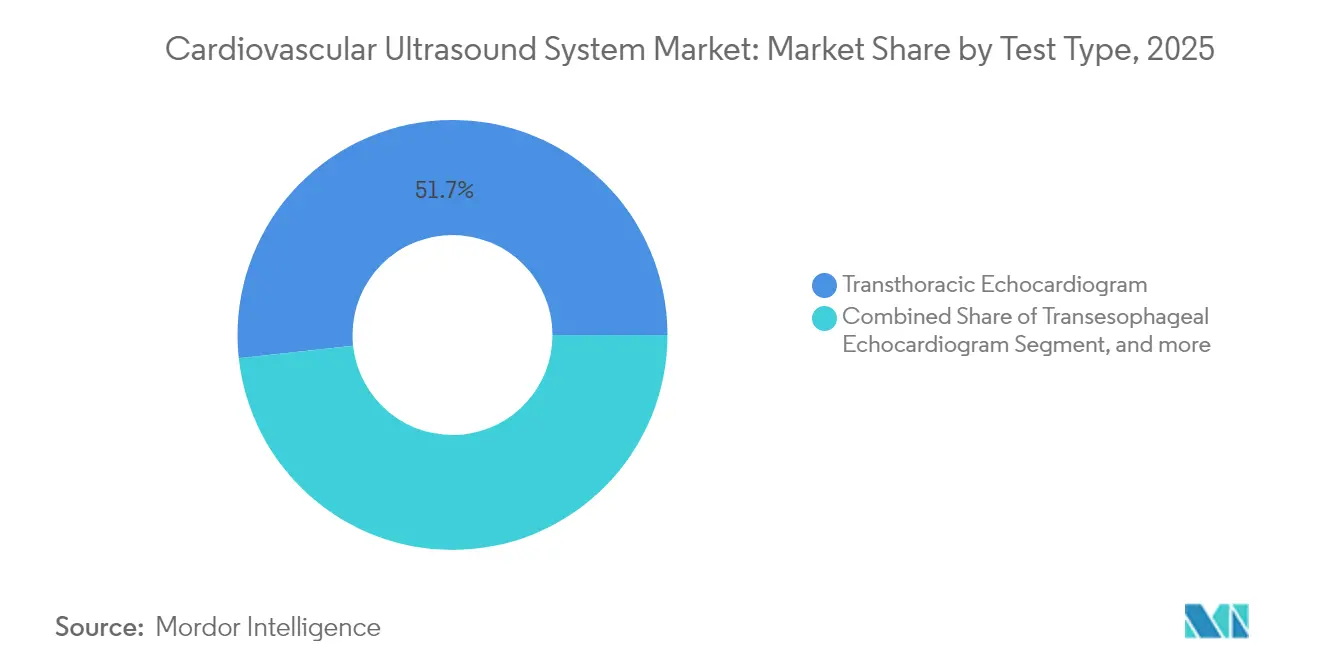
- By test type, transthoracic echocardiography commanded 51.73% of cardiovascular ultrasound system market share in 2025, while stress echocardiography is projected to expand at an 8.31% CAGR to 2031.
- By technology, 2-D platforms led with 42.74% of the cardiovascular ultrasound system market size in 2025, whereas 3-D & 4-D imaging is forecast to grow at a 9.02% CAGR through 2031.
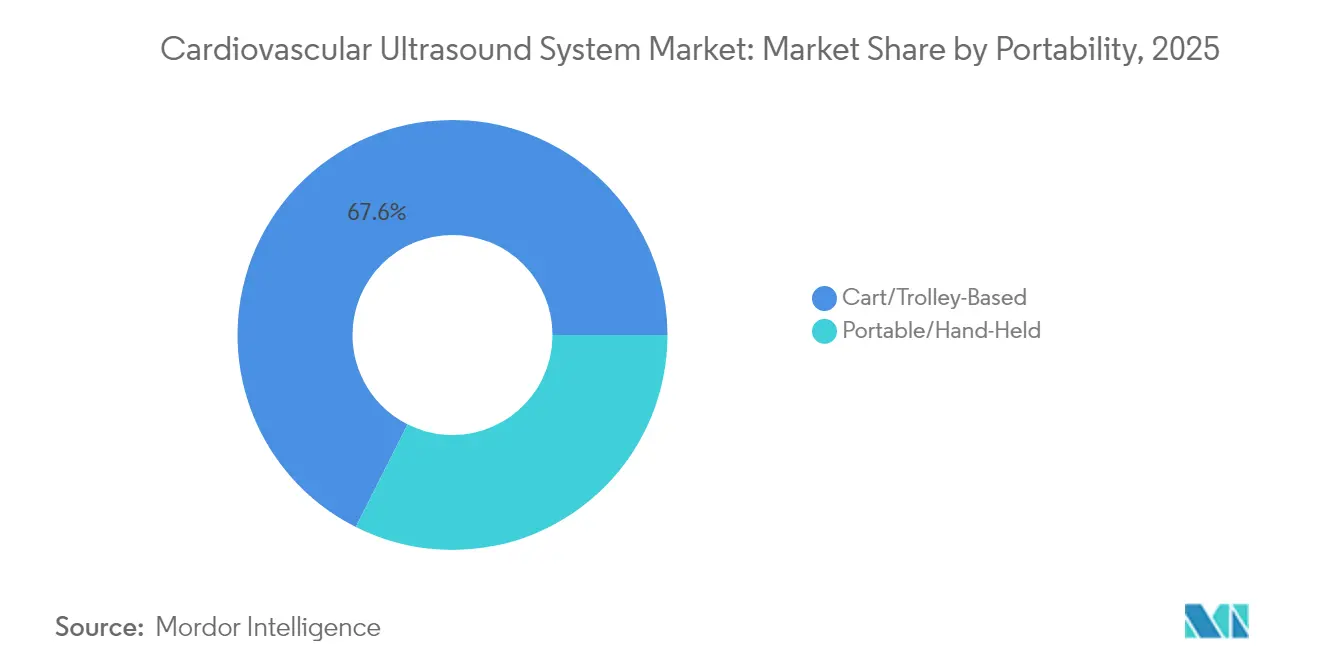
- By portability, cart-based systems held 67.58% of the cardiovascular ultrasound system market size in 2025 and handheld devices are advancing at a 12.47% CAGR over 2026-2031.
- By display type, color systems captured 83.68% share in 2025 as premium color units are set to rise at a 7.03% CAGR to 2031.
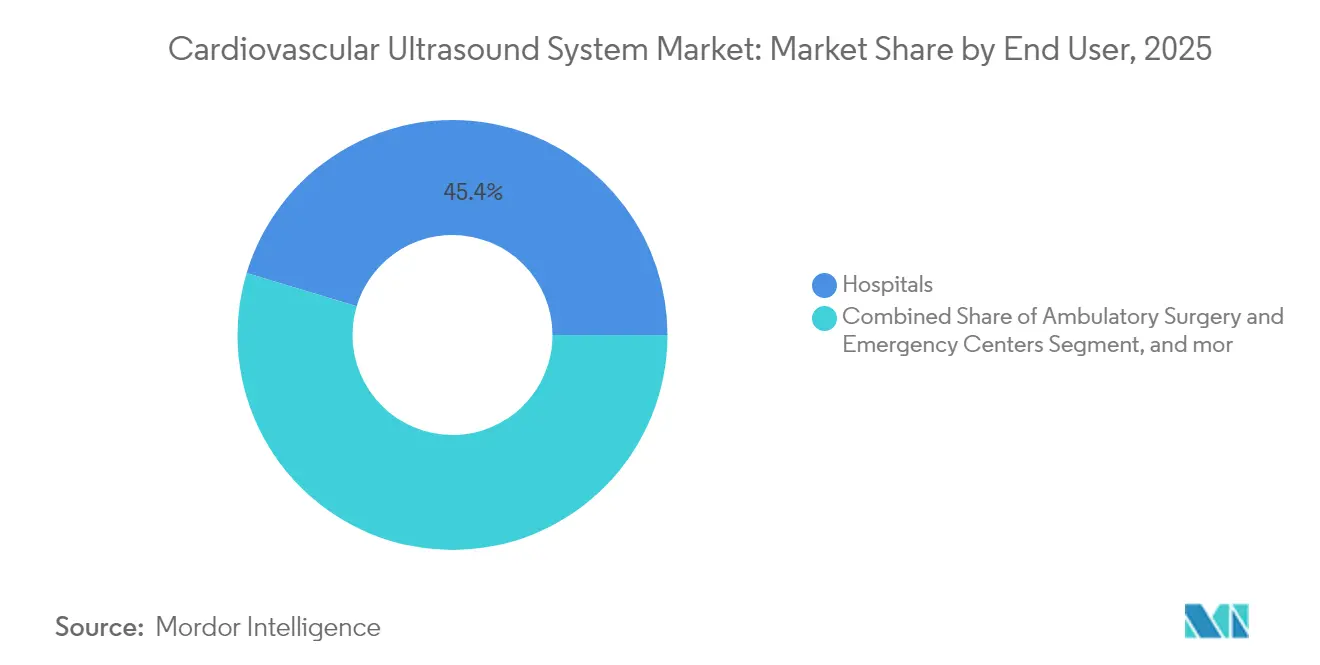
- By end user, hospitals accounted for 45.35% of cardiovascular ultrasound system market share in 2025, while ambulatory surgery and emergency centers are on track for a 10.05% CAGR in the same period.
- By geography, North America dominated with 32.12% share in 2025 and Asia-Pacific is poised to expand at an 8.62% CAGR through 2031.
Note: Market size and forecast figures in this report are generated using Mordor Intelligence’s proprietary estimation framework, updated with the latest available data and insights as of 2026.
Market Trends and Insights
Drivers Impact Analysis of Cardiovascular Ultrasound System Market*
| Market Driver | (~) % Impact on CAGR Forecast | Geographic Relevance | Impact Timeline |
|---|---|---|---|
| Escalating cardiovascular disease burden and aging demographics | +1.2% | Global, stronger in North America and Europe | Long term (≥ 4 years) |
| AI-driven quantification, 3-D/4-D imaging and miniaturisation | +1.5% | Global, earliest uptake in North America and Europe | Medium term (2–4 years) |
| Expansion of point-of-care and emergency-department ultrasound | +0.8% | Global, pronounced in emerging markets | Medium term (2–4 years) |
| Shift from invasive diagnostics toward non-invasive ultrasound | +0.7% | Global, higher in developed markets | Medium term (2–4 years) |
| Growing emphasis on early diagnosis and preventive cardiology | +0.5% | Global | Long term (≥ 4 years) |
| Integration of AI and cloud-based imaging platforms | +0.4% | Global | Medium term (2–4 years) |
| Source: Mordor Intelligence | |||
Escalating Global Prevalence of Cardiovascular Diseases and Aging Demographics
Cardiovascular diseases remained the leading cause of hospital admissions in England, recording 1.5 million inpatient episodes in 2022-23.[1]Similar upward trends are evident across Asia and North America, propelled by sedentary lifestyles, dietary changes and population aging. Point-of-care echocardiography has become integral to early detection strategies, supporting routine screening in ambulatory settings. Research published in 2025 demonstrated that trained clinicians can use cardiac POCUS to identify hypertrophic cardiomyopathy, diastolic dysfunction and tamponade with high accuracy.[2] As older adults require more frequent cardiac monitoring, demand for repeatable radiation-free imaging rises, anchoring long-run growth in the cardiovascular ultrasound system market.
Technological Advancements: AI-Driven Quantification, 3-D/4-D Imaging and Miniaturisation
Deep-learning algorithms now automate chamber delineation, wall-motion scoring and valvular quantification, bringing interpretation times down by up to 40% compared with manual review. FDA-cleared 3-D quantification of mitral regurgitation allows volumetric assessment that was unattainable with 2-D imaging. Miniaturised probes fit in a pocket yet deliver diagnostic image quality, permitting exams at the bedside, in ambulances and even at home. These capabilities democratise access, widen the referral base and reinforce technology refresh cycles throughout the cardiovascular ultrasound system market.
Expansion of Point-of-Care & Emergency-Department Ultrasound Applications
Bedside echocardiography accelerates triage for tamponade, shock and heart failure, reducing time-to-treatment in emergency departments. AI guidance tools embedded in handheld devices now coach novice users on probe positioning, image capture and common measurements. This lowers operator dependency and enables broader practitioner adoption, opening new revenue streams in primary care and remote clinics. The flexibility of point-of-care exams aligns with value-based reimbursement models that reward care delivered in low-cost settings.
Shift from Invasive Cardiac Diagnostics toward Non-Invasive Ultrasound Modalities
Stress echo and contrast-enhanced studies supply functional insight without catheterisation risks or radiation exposure. A comparative review showed non-invasive ultrasound achieves diagnostic yields comparable to invasive angiography for selected coronary assessments. Hospitals therefore redirect budgets to non-invasive suites, fostering steady replacement demand for premium cardiovascular ultrasound systems.
Restraints Impact Analysis of Cardiovascular Ultrasound System Market*
| Market Restraint | (~) % Impact on CAGR Forecast | Geographic Relevance | Impact Timeline |
|---|---|---|---|
| High capital cost of premium cardiovascular ultrasound platforms | −0.9% | Emerging markets, notably Asia-Pacific and Africa | Short term (≤ 2 years) |
| Reimbursement pressure and budget constraints in developed markets | −0.8% | North America and Europe | Medium term (2–4 years) |
| Shortage of skilled sonographers and advanced echo interpreters | −0.6% | Global, acute in rural zones | Long term (≥ 4 years) |
| Limited access in low-income and rural settings | −0.5% | Sub-Saharan Africa and parts of South Asia | Long term (≥ 4 years) |
| Source: Mordor Intelligence | |||
High Capital Cost of Premium Cardiovascular Ultrasound Platforms
Top-tier scanners with 3-D capabilities can exceed USD 250,000, pricing out smaller providers and prolonging replacement cycles. Total cost of ownership further rises with service contracts and software upgrades. Tiered product lines and refurbished systems offer partial relief, but the cost gap between entry and premium remains large, restraining penetration in budget-constrained markets.
Reimbursement Pressure and Budget Constraints in Developed Markets
Medicare pays USD 198.58 for a complete transthoracic study with Doppler in 2025, a 12% real decline from 2021 levels. Hospitals must justify capital outlay with demonstrable outcome improvements rather than procedure volume. This financial squeeze moderates unit demand, especially for high-specification devices, within the cardiovascular ultrasound system market.
*Our forecasts treat driver/restraint impacts as directional, not additive. The impact forecasts reflect baseline growth, mix effects, and variable interactions.
Cardiovascular Ultrasound System Market Segment Analysis
By Test Type:
TTE Holds Leadership while Stress Echo Gains SpeedTransthoracic echocardiography delivered 51.73% of 2025 revenues, underpinning its role as a routine, non-invasive cornerstone across all care settings. Its broad clinical utility secures replacement demand and ensures the cardiovascular ultrasound system market size tied to TTE remains substantial. Stress echocardiography is expanding fastest at an 8.31% CAGR to 2031 because it reveals inducible ischemia without radiation and fits preventive cardiology protocols. Rapid case throughput and reimbursements aligned with functional assessments further spur adoption.
TEE retains importance for valve evaluation and structural heart interventions. With 4-D probes now offering real-time volumetric guidance during transcatheter procedures, the segment sustains steady growth. Niche applications such as fetal and pediatric echocardiography drive technology tailoring, creating opportunities for compact, high-frequency transducers.

By Technology:
2-D Dominates yet 3-D & 4-D AccelerateTwo-dimensional imaging continues to generate 42.74% of cardiovascular ultrasound system market size due to mature workflows, familiarity and cost advantages. Diagnostic confidence from 2-D plus color Doppler remains sufficient for most routine exams. However, 3-D & 4-D imaging is on a 9.02% CAGR trajectory as interventional cardiologists demand volumetric guidance for valve repair and congenital corrections. Automated 3-D quantification of regurgitation severity adds reproducibility and shortens reporting time.
Enhanced Doppler modes such as vector flow mapping and micro-vascular imaging extend functional insights, anchoring 2-D-centric systems in everyday practice. Vendors leverage shared hardware to offer modular upgrades, smoothing the transition toward advanced modalities without full platform replacement, sustaining the cardiovascular ultrasound system market.
By Portability:
Handheld Devices Redefine AccessCart platforms still account for 67.58% of revenue thanks to premium performance, transducer versatility and integrated measurement suites. They remain indispensable in echo labs and tertiary care centers for comprehensive studies. Yet handheld units clock a 12.47% CAGR, proving that portability coupled with AI assistance can satisfy many frontline needs. The ability to disinfect, transport and deploy in seconds gained prominence during the COVID-19 surge and continues to influence procurement criteria.
Vendor strategies now blend handheld probes with cloud dashboards, enabling enterprise-wide fleet management and remote over-read. Hospitals pairing carts with handhelds achieve workflow flexibility, highlighting complementary rather than cannibalistic dynamics inside the cardiovascular ultrasound system market.
By Display Type:
Color Imaging PrevailsColor systems captured 83.68% share in 2025 because flow visualisation is indispensable for valvular pathology, shunts and hemodynamic assessment. Premium color units are rising at 7.03% CAGR as OLED and high-dynamic-range panels deliver finer detail and reduced eye fatigue. Innovation in pseudo-color overlay on B-mode images helps identify subtle tissue changes and supports AI-driven tissue classification.
Black-and-white displays survive in ultra-portable probes aimed at rapid structural checks where flow data is secondary. Battery savings and lower price points keep these devices attractive in austere settings yet color-capable options are rapidly narrowing the cost gap, reinforcing the color-dominant future of the cardiovascular ultrasound system market.
By End User:
Hospitals Anchor Demand while Ambulatory Centers SurgeHospitals generated 45.35% of 2025 revenue because complex cases, interventional support and critical care continue to cluster in institutional environments. Integrated cardiology departments leverage full-feature carts and dedicated sonography teams, ensuring high study volumes. Ambulatory surgery and emergency centers will grow at 10.05% CAGR as outpatient pathways shift diagnostics closer to the patient.
Reimbursement adjustments that favor same-day discharge and the embrace of AI-guided handheld probes broaden use among non-cardiology clinicians. Diagnostic imaging centers complement hospital networks by handling follow-up exams and overflow, sustaining balanced demand across sites in the cardiovascular ultrasound system market.
Geography Analysis
North America Cardiovascular Ultrasound System Market
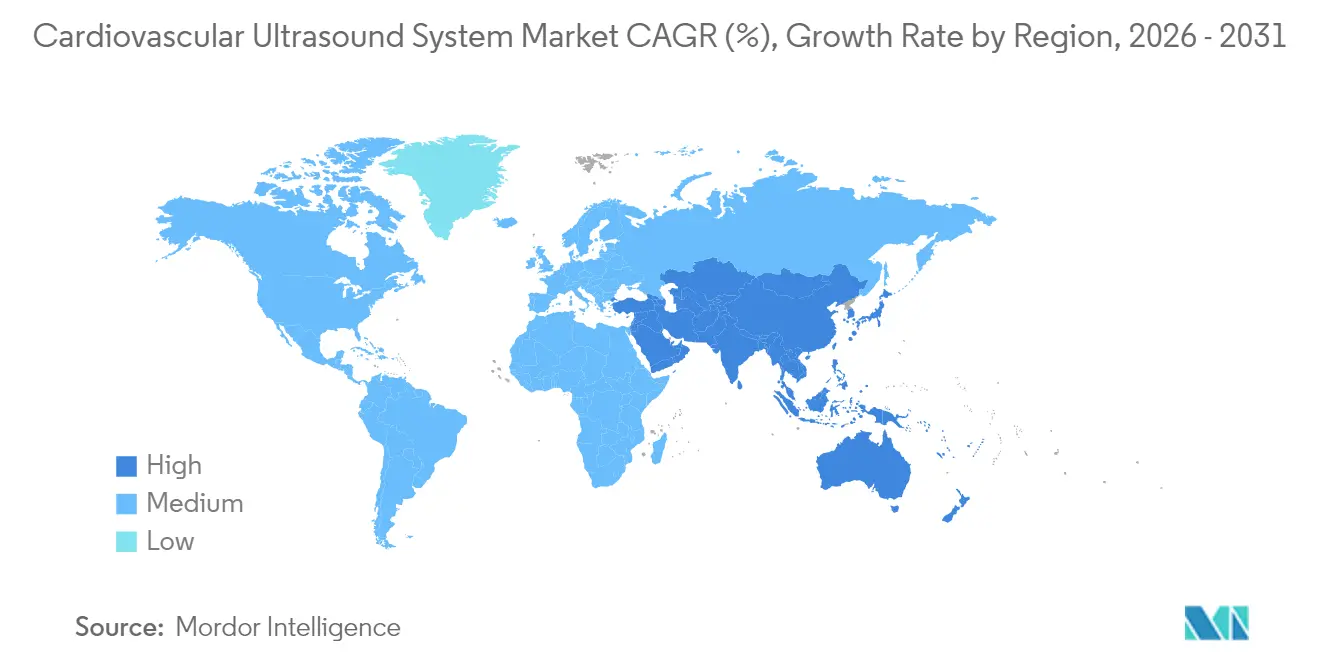
North America contributed 32.12% of global revenue in 2025, backed by advanced infrastructure and quick uptake of AI-enabled upgrades. Workforce shortages persist; 46.3% of U.S. counties have no resident cardiologist, affecting 22 million people. Vendors market workflow automation and remote reading to mitigate staffing gaps.
APAC Cardiovascular Ultrasound System Market
Asia-Pacific is the fastest-growing territory at an 8.62% CAGR through 2031. China’s volume-based procurement and local manufacturing incentives foster competitive domestic suppliers, while India’s tier-2 cities add echo capacity through private hospital chains. Portable, battery-powered systems resonate in rural clinics, driving breadth of adoption across socioeconomic tiers.
EMEA and South America Cardiovascular Ultrasound System Market
Europe maintains a balanced profile with strong reimbursement for non-invasive imaging and a large aging population. Middle East & Africa and South America are smaller yet expanding as governments prioritise cardiovascular disease management. Brazil leads regional uptake through private insurance penetration and growing elective procedure volumes. Collectively, geographic trends underscore the need for scalable solutions that range from premium carts to ultra-portable probes within the cardiovascular ultrasound system market.
Regulatory Landscape
Cardiovascular ultrasound systems are generally regulated as moderate-risk devices in major markets, with US pathways commonly proceeding through FDA Class II 510(k) routes for diagnostic ultrasound imaging and Doppler systems. Recent product clearances continue to signal regulatory acceptance of iterative hardware and software upgrades. In March 2026, GE HealthCare received FDA 510(k) clearance for its LOGIQ Vita and LOGIQ S20 diagnostic ultrasound series (K260673), reinforcing the cadence of platform refreshes and feature additions under existing device classifications.
In Europe, ultrasound manufacturers must align with EU MDR 2017/745 requirements for quality management systems, technical documentation, and post-market surveillance to maintain CE marking. In May 2026, the European Commission adopted Implementing Regulation (EU) 2026/977 to set more uniform procedural requirements and maximum timelines for Notified Bodies under the MDR, targeting predictability in conformity assessment. In China, NMPA activity in 2025-2026 highlights tightening and modernization, with an October 2025 initiative to optimize whole life-cycle regulation for high-end devices and, in April 2026, CMDE publishing a dedicated review framework and final guidance for intravascular ultrasound diagnostic equipment, raising the bar for evidence generation, testing, and ongoing vigilance for advanced cardiovascular ultrasound modalities.
Competitive Landscape
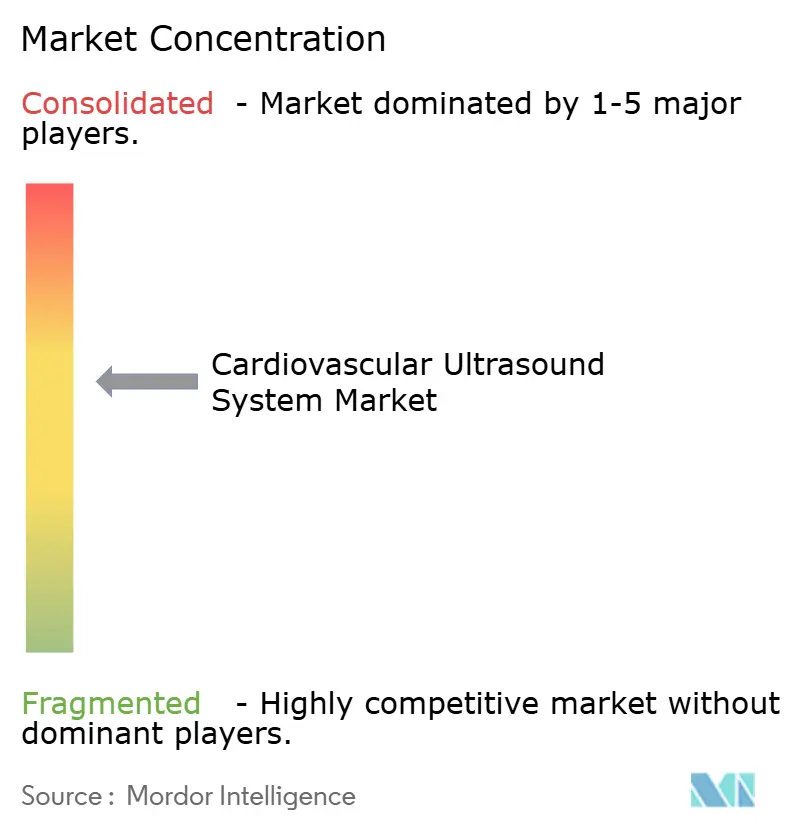
Market concentration is moderate; GE HealthCare, Philips and Siemens Healthineers continue to dominate premium tiers through broad portfolios and service ecosystems. GE HealthCare’s USD 51 million purchase of Intelligent Ultrasound in 2024 bolstered real-time AI analytics capabilities. Philips focuses on integrated workflow suites that combine echo, CT and MR data in structural heart programs, while Siemens Healthineers leverages AcuNav 4-D ICE to strengthen its interventional presence.
Disruptors such as Butterfly Network and Clarius Mobile Health accelerate portability at sub-USD 3,000 price points, targeting primary care and low-resource environments. Cloud-first newcomers offer software-as-a-service packages with algorithm updates, challenging traditional capital-equipment economics. Chinese vendors advance in price-sensitive regions, expanding global footprints as domestic policies encourage export.
Strategic partnerships with pharma companies emerge to support disease-specific AI tools, as seen in Ultromics and Pfizer’s collaboration on EchoGo for amyloidosis detection. Vendors that align AI, workflow efficiency and outcome-focused metrics are positioned to gain advantage as health systems migrate toward value-based purchasing, shaping future competition within the cardiovascular ultrasound system market.
Cardiovascular Ultrasound System Industry Leaders
-
Canon Medical Systems Corporation
-
Esaote SpA
-
GE Healthcare
-
Siemens Healthcare GmbH
-
Koninklijke Philips N.V.
- *Disclaimer: Major Players sorted in no particular order
Cardiovascular Ultrasound System Market Companies Covered in this Report
- Canon
- GE Healthcare
- Siemens Healthineers
- Koninklijke Philips
- FUJIFILM / Hitachi Healthcare
- Samsung Group
- Mindray
- Esaote
- Butterfly Network Inc.
- Chison Medical Imaging
- Clarius Mobile Health
- Terason (Teratech Corp.)
- Supersonic Imagine (Hologic)
- Shenzhen Wisonic Medical
- Medisono
- United Imaging Healthcare
- Shenzhen Landwind Medical
- ContextVision AB
- Whale Imaging
Market Opportunities and Future Outlook
A key whitespace sits at the intersection of workforce constraints and point-of-care decentralization: AI-guided acquisition and automated quantification can reduce operator dependency and support broader use of echocardiography outside traditional echo labs. This fits clinical adoption patterns where AI-enhanced POCUS is being used by non-cardiologists in emergency and intensive care settings to identify reduced ventricular function and valvular abnormalities, expanding utilization beyond specialist-led workflows.
Vendors are translating this into product and platform strategies, pairing handheld or portable hardware with cloud-based dashboards for fleet management and remote over-read to address coverage gaps such as counties lacking resident cardiologists while maintaining enterprise governance. Regulatory and quality-system changes are also shaping near-term investment priorities in design controls, software lifecycle processes, and post-market readiness, particularly as AI functionality becomes more deeply embedded in cardiovascular ultrasound workflows. In the United States, the FDA Quality Management System Regulation (QMSR) became effective in February 2026, increasing the operational emphasis on harmonized quality practices for manufacturers and suppliers. On the technology front, 2026 research directions toward deep generative models for image enhancement and data augmentation, alongside progress in wearable ultrasound concepts moving toward higher-dimensional imaging for continuous monitoring, support a development pipeline for new form factors and use cases. Near-term commercial opportunity concentrates where these advances can be validated and packaged into compliant, repeatable clinical protocols, supported by ongoing FDA clearances such as GE HealthCare's March 2026 510(k) for the LOGIQ Vita and S20 series and continued evaluation against IEC 60601-2-37 Edition 3.0 (2024) safety and performance expectations.
Recent Industry Developments in Cardiovascular Ultrasound System Market
- May 2026: Canon Medical Systems and Olympus announced the US launch of the Aplio i800 EUS premium ultrasound system, manufactured by Canon and distributed exclusively by Olympus. The alliance improves channel access and bundled workflow offerings around premium ultrasound platforms, supporting broader deployment in hospital systems that procure through established endoscopy and imaging relationships.
- May 2024: Samsung Medison announced the acquisition of Sonio, a French startup specializing in AI for ultrasound, for USD 92 million. The deal accelerates AI feature integration across ultrasound portfolios and raises competitive pressure on incumbents to expand automated guidance and interpretation capabilities.
- April 2024: Us2.ai received FDA clearance for its Us2.v2 software, which automates analysis of echocardiographic DICOM images with 45 automated echo parameters including strain analysis. FDA-cleared automation reinforces the shift toward software-led productivity gains, enabling providers to standardize reporting and reduce interpretation time constraints in high-volume echo workflows.
Cardiovascular Ultrasound System Market Report Scope and Research Methodology
Market Definition and Coverage
For this report, the cardiovascular ultrasound system market covers the value of ultrasound systems used to assess cardiac structure and function in clinical settings, including the equipment and configurations typically used for echocardiography workflows.
Scope exclusions: This sizing excludes non-cardiac ultrasound applications and does not count invasive intravascular imaging catheters or procedure-specific disposables that are not part of the system sale.
Segments Covered in This Report
- By Test Type
- Transthoracic Echocardiogram (TTE)
- Transesophageal Echocardiogram (TEE)
- Stress Echocardiogram
- Other Test Types
- By Technology
- 2-D
- 3-D & 4-D
- Doppler Imaging
- By Portability
- Cart/Trolley-Based
- Portable/Hand-Held
- By Device Display
- Color Display
- Black & White (B/W) Display
- By End User
- Hospitals
- Ambulatory Surgery & Emergency Centers
- Diagnostic Imaging Centers & Others
- By Geography
- North America
- United States
- Canada
- Mexico
- Europe
- Germany
- United Kingdom
- France
- Italy
- Spain
- Rest of Europe
- Asia-Pacific
- China
- Japan
- India
- Australia
- South Korea
- Rest of Asia-Pacific
- Middle East & Africa
- GCC
- South Africa
- Rest of Middle East & Africa
- South America
- Brazil
- Argentina
- Rest of South America
- North America
Data Sources, Market Sizing, and Validation
Desk Research
To build the starting dataset, we pulled public and official information that helps explain the demand pool for echocardiography and the overall medical imaging spend. Sources used include, for example, the World Health Organization for cardiovascular burden signals, the US CDC for heart disease statistics, the OECD for health expenditure baselines, and the US FDA device databases for product clearances and approvals.
We also reviewed manufacturer annual reports, investor presentations, and reputable medical-society and hospital-network publications that discuss echo utilization patterns and technology adoption. Where available, we used paid subscriptions focused on company financials and news, and we checked patent databases to understand activity around imaging features and probes. The desk sources listed here are illustrative, and many other public sources were also referenced to collect, cross-check, and clarify data points.
Primary Interviews and Surveys
Primary work was used to pressure-test the demand indicators and pricing assumptions behind the model, including feedback from hospital imaging leads, cardiology clinicians, procurement teams, and service partners. We also spoke with regional experts across APAC, EMEA, and the Americas so replacement cycles, purchasing routes, and mix shifts (cart-based vs portable setups) could be adjusted in a realistic way.
Distribution of primary research fieldwork respondents
| Company type | Respondent position | Region |
|---|---|---|
| Top tier: 38% | CXOs: 13% | APAC: 48% |
| Mid tier: 45% | Functional/Unit leaders: 38% | EMEA: 32% |
| Smaller Players: 17% | Managers: 49% | Americas: 20% |
Market-Sizing & Forecasting
Sizing starts with a top-down build where country-level cardiac disease load, diagnostic imaging infrastructure, and expected echocardiography utilization are converted into an addressable annual equipment demand pool. We then translate those demand totals into value using typical system ASP ranges and mix assumptions across technology and display types, and roll the results up into regional and global totals.
To keep the outcome grounded, we use selective bottom-up checks to validate the totals, including supplier revenue alignment at an aggregate level, hospital purchase cycle patterns, and channel feedback on unit shipment direction. In locations where public data is thin, we use proxy indicators such as installed base age, replacement rate by care setting, and import or shipment directionality from relevant trade statistics before finalizing the country totals.
For forecasting, we use scenario-based forecasting supported by light multivariate regression where the data series is stable. Inputs include cardiovascular procedure volumes, hospital capex trend, aging population share, and expected technology migration toward higher-end imaging. Assumptions are finalized only after checking them with primary inputs on pricing pressure, budget timing, and the pace of new product adoption.
Data Validation & Update Cycle
Before sign-off, model outputs are checked against independent signals such as imaging equipment spending trends, health system investment cycles, and the direction of product approvals and launches. We review outliers at the country level, and if a variance cannot be explained by a visible demand or pricing driver, we re-check inputs and may re-contact relevant interviewees to confirm the assumption.
Each report is refreshed annually, and interim updates are made when material events occur, such as major regulatory changes or clear shifts in purchasing behavior. Right before delivery, we run a final review pass so the numbers reflect the most recent public disclosures and market signals.
Mordor Intelligence's Cardiovascular Ultrasound System Market Size Measured Against Other Published Estimates
It is normal to see different market values published for cardiovascular ultrasound systems, even when the topic name looks the same. In most cases, the gap comes from what each publisher counts as part of the system market, the base year chosen, and how pricing and replacement cycles are carried into the forecast.
Some estimates group broader cardiovascular ultrasound activity together, including adjacent imaging categories or loosely defined add-ons that are not consistently tracked across countries. In Mordor Intelligence, the total is kept to cardiovascular ultrasound systems used for echocardiography workflows, and the 2026 starting value is tied back to test-type and technology splits that can be validated through interviews and cross-checks.
Benchmark comparison
| Source | Market Size | Gaps in Research Methodology |
|---|---|---|
| Mordor Intelligence | USD 1.95 B (2026) | |
| Industry Publisher A | USD 1.93 B (2024) | Uses an earlier base year and may reflect a wider end-user and setting interpretation (including home and research purchases) without clearly separating true system sales from broader ultrasound use in cardiac pathways, which can lift totals and CAGR. |
| Industry Publisher B | USD 1.50 B (2024) | Anchors to a smaller 2024 base and applies higher growth assumptions over a longer horizon, but the public summary does not show how ASP progression, replacement cycles, and country-level demand checks were validated, which can push the starting value down. |
Overall, the spread mainly reflects scope tightness and the way base-year value is constructed. When the count is limited to system sales connected to echocardiography use, and the price and replacement assumptions are checked with real-world buyers and clinical users, the final number becomes easier to trace and repeat year to year.
Key Questions Answered in the Report
What is the current size of the cardiovascular ultrasound system market?
The cardiovascular ultrasound system market size stands at USD 1.95 billion in 2026.
How fast is the market expected to grow?
The market is forecast to post a 3.29% CAGR, reaching USD 2.29 billion by 2031.
Which technology segment is expanding most rapidly?
3-D & 4-D imaging is the fastest-growing technology, projected at a 9.02% CAGR over 2026-2031.
Why are handheld ultrasound devices gaining traction?
Handheld units support point-of-care exams, reduce infection risk and integrate AI guidance, leading to a 12.47% CAGR.
What is the biggest restraint on market growth?
High capital cost of premium platforms remains the strongest brake, subtracting an estimated 0.9 percentage points from the forecast CAGR.
Which region will record the fastest growth?
Asia-Pacific is expected to grow at an 8.62% CAGR owing to rising healthcare investment and cardiovascular disease prevalence.