
Carboprost Tromethamine Market Size and Share
Market Overview
| Study Period | 2020 - 2031 |
|---|---|
| Market Size (2026) | USD 2.11 Billion |
| Market Size (2031) | USD 2.79 Billion |
| Growth Rate (2026 - 2031) | 5.78 % |
| Fastest Growing Market | Asia-Pacific |
| Largest Market | North America |
| Market Concentration | Medium |
Major Players *Disclaimer: Major Players sorted in no particular order Image © Mordor Intelligence. Reuse requires attribution under CC BY 4.0. | |
Carboprost Tromethamine Market Analysis by Mordor Intelligence
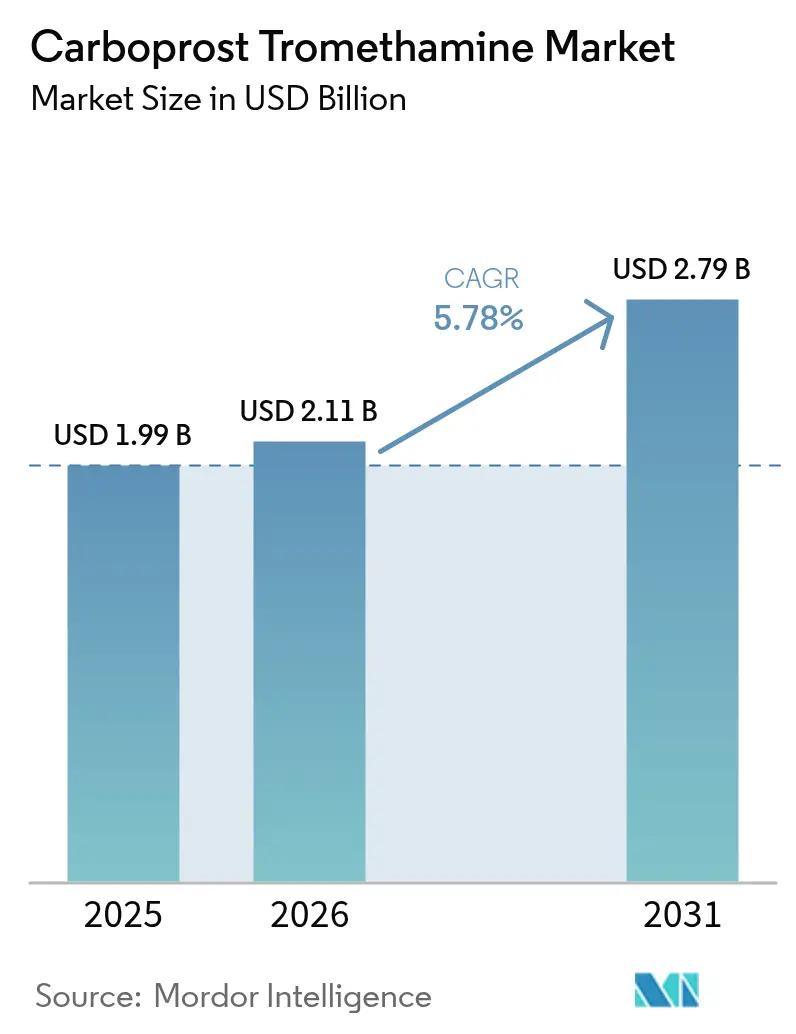
The carboprost tromethamine market size was valued at USD 1.99 billion in 2025 and estimated to grow from USD 2.11 billion in 2026 to reach USD 2.79 billion by 2031, at a CAGR of 5.78% during the forecast period (2026-2031). Escalating concern over postpartum hemorrhage (PPH)—which still causes one maternal death every five minutes—keeps demand for this prostaglandin F2-alpha analogue elevated.[1] Wider training in obstetric emergencies, broader surgical gynecology use cases and brisk generic launches are all reinforcing uptake. At the same time, digital health platforms and AI-enabled early-warning systems shorten the window between bleeding onset and drug administration, raising utilization rates. Cold-chain hurdles in low-resource settings and a gradual shift toward tranexamic acid as a first-line agent temper, but do not derail, momentum.
Key Report Takeaways
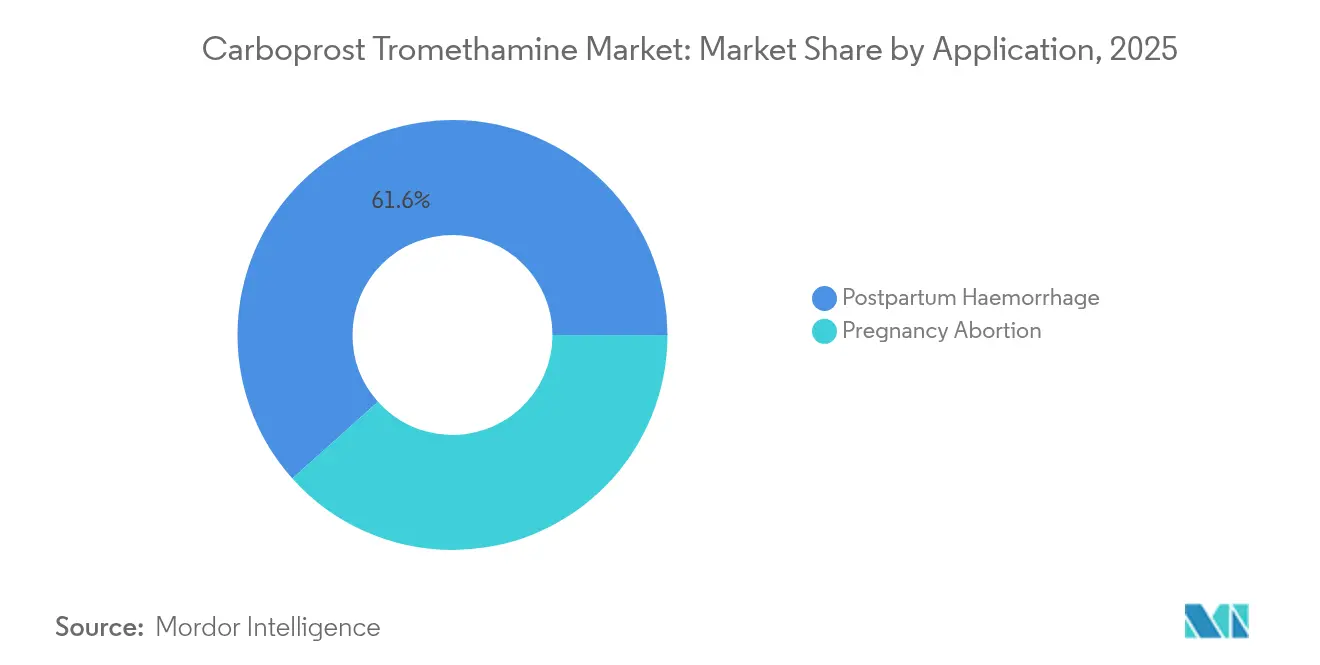
- By application, postpartum hemorrhage treatment held 61.62% of the carboprost tromethamine market share in 2025, while pregnancy abortion is projected to expand at a 9.21% CAGR through 2031.
- By distribution channel, hospital pharmacies led with 67.60% revenue share in 2025; online pharmacies are advancing at a 10.05% CAGR to 2031.
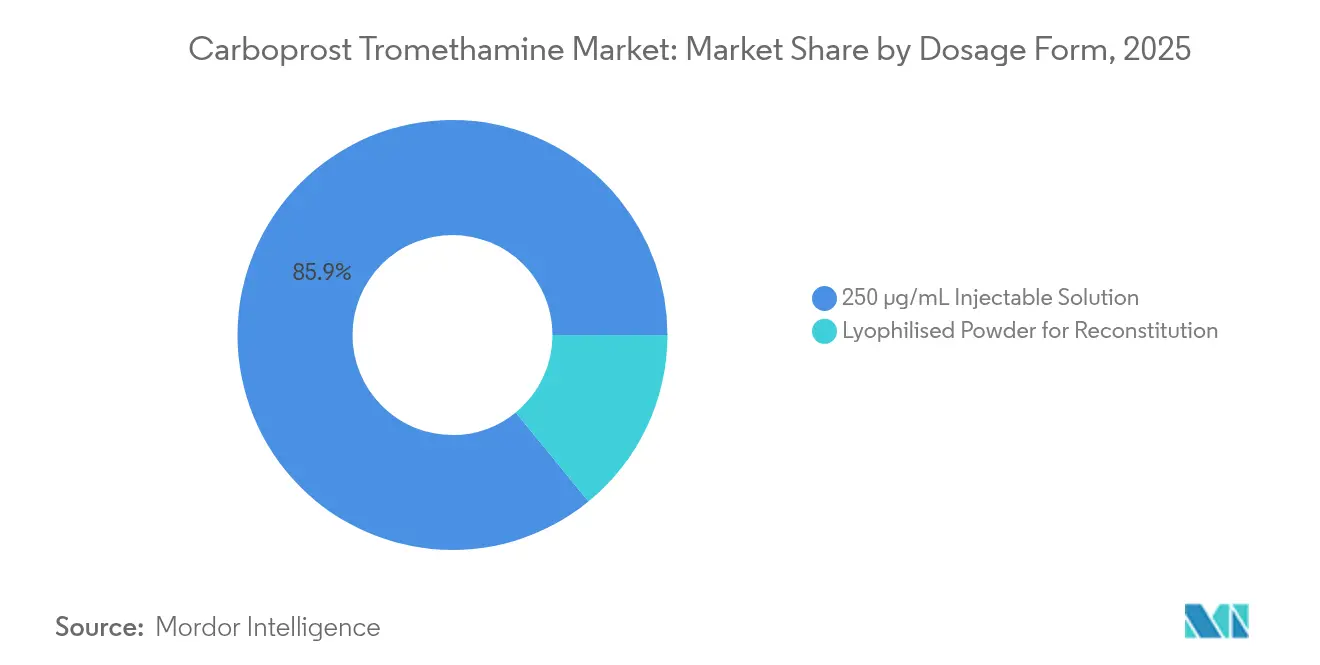
- By dosage form, the 250 µg/mL injectable solution accounted for 85.90% of the carboprost tromethamine market size in 2025; lyophilized powder is growing at 8.44% CAGR.
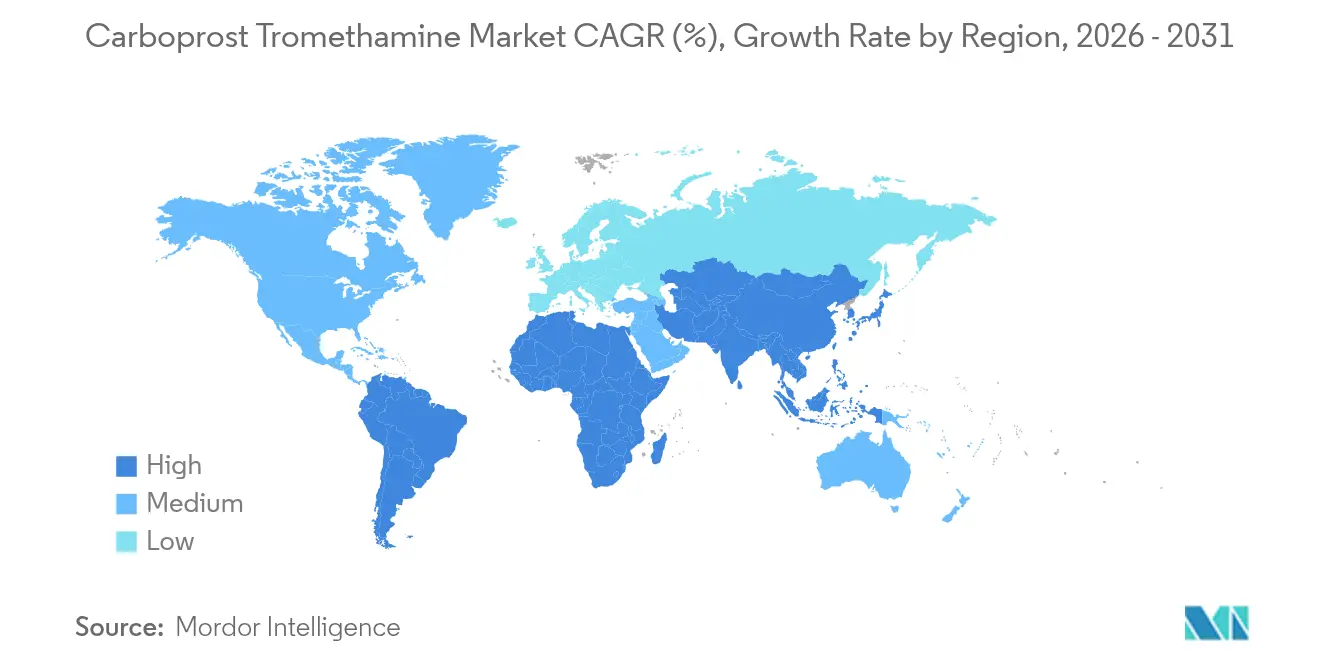
- By geography, North America commanded 40.75% share in 2025, while Asia-Pacific is forecast to post the fastest 7.62% CAGR to 2031.
Note: Market size and forecast figures in this report are generated using Mordor Intelligence’s proprietary estimation framework, updated with the latest available data and insights as of 2026.
Market Trends and Insights
Drivers Impact Analysis of Carboprost Tromethamine Market*
| Driver | (~) % Impact on CAGR Forecast | Geographic Relevance | Impact Timeline |
|---|---|---|---|
| Rising Prevalence Of Postpartum Haemorrhage (PPH) | +1.2% | Global, with highest impact in Sub-Saharan Africa and South Asia | Long term (≥ 4 years) |
| Expanding Use Of Uterotonics In Surgical Gynaecology | +0.8% | North America & EU, expanding to APAC | Medium term (2-4 years) |
| Generic Launches Driving Price Accessibility | +1.1% | Global, particularly emerging markets | Short term (≤ 2 years) |
| Increasing Obstetric Emergency Training In Low-Resource Settings | +0.7% | APAC, MEA, Latin America | Long term (≥ 4 years) |
| AI-Guided Early-Warning Systems For Maternal Bleeding | +0.4% | North America, EU, select APAC markets | Medium term (2-4 years) |
| Integration Of Carboprost In Obstetric Tele-Health Bundles | +0.3% | Global, with early adoption in developed markets | Medium term (2-4 years) |
| Source: Mordor Intelligence | |||
Rising Prevalence Of Postpartum Hemorrhage (PPH)
PPH remains the leading cause of maternal mortality worldwide, prompting hospitals to keep carboprost on every delivery ward crash-cart. Clinical data show the drug controls bleeding in 90% of refractory uterine atony cases after one or two doses. WHO’s 2024 global call for PPH data is driving protocol harmonization in which carboprost is firmly embedded who.int. Large trials such as the UK-based COPE study may even move it into first-line positioning, further lifting the carboprost tromethamine market.[2]
Expanding Use Of Uterotonics In Surgical Gynecology
Surgeons are increasingly administering carboprost during laparoscopic myomectomy and cesarean deliveries to cut blood loss and operative time, extending revenue streams beyond obstetrics. U.S. guideline updates that stress evidence-based labor management reinforce this uptake. Simulation-based training programs, now spreading from Arizona to Tanzania, ensure competence with carboprost in diverse surgical scenarios.[3]
Generic Launches Driving Price Accessibility
FDA approvals of abbreviated new drug applications, coupled with bulk-drug park incentives in India, are widening generic supply and driving down unit costs. Programs such as India’s Janaushadhi outlets further encourage generic uptake, enlarging the carboprost tromethamine market in price-sensitive geographies.
Increasing Obstetric Emergency Training In Low-Resource Settings
WHO estimates that universal midwifery coverage could avert 60% of maternal deaths, a goal that hinges on reliable uterotonic access. Studies from Rwanda show hospitals with modern inventory tools are 33.25 times more likely to keep adequate carboprost stocks, implying higher demand as training spreads.
Restraints Impact Analysis of Carboprost Tromethamine Market*
| Restraint | (~) % Impact on CAGR Forecast | Geographic Relevance | Impact Timeline |
|---|---|---|---|
| Gastro-Intestinal & Cardio-Pulmonary Side-Effect Profile | -0.9% | Global, particularly in markets with strict safety protocols | Long term (≥ 4 years) |
| Stringent Cold-Chain Requirements In LMICs | -0.7% | APAC, MEA, Latin America | Medium term (2-4 years) |
| Growing Preference For Tranexamic Acid As First-Line Therapy | -1.1% | Global, with early adoption in developed markets | Short term (≤ 2 years) |
| Legal Restrictions On Medical Abortion In Key Regions | -0.5% | North America, select EU markets, parts of APAC | Long term (≥ 4 years) |
| Source: Mordor Intelligence | |||
Gastro-Intestinal & Cardio-Pulmonary Side-Effect Profile
Carboprost frequently causes vomiting, diarrhea and transient fever, while bronchospasm can occur in asthmatic patients, prompting some clinicians to favor milder agents. Case reports of inadvertent IV administration underscore safety concerns and the need for vigilant training.[4]
Stringent Cold-Chain Requirements In LMICs
The injectable must be stored at 2-8 °C, a hurdle in regions where just 15-20% of clinics have reliable refrigeration, according to supply-chain audits. Conflict-hit countries such as Sudan demonstrate how fragile distribution networks can wipe out stock entirely.
*Our forecasts treat driver/restraint impacts as directional, not additive. The impact forecasts reflect baseline growth, mix effects, and variable interactions.
Carboprost Tromethamine Market Segment Analysis
By Application:
PPH Dominance, Abortion UpsidePostpartum hemorrhage maintained 61.62% carboprost tromethamine market share in 2025, reflecting its entrenched role when oxytocin or misoprostol fail. Pregnancy abortion, although smaller, is forecast to rise at 9.21% CAGR on improving reproductive-health access. Clinical trials could expand first-line status, adding fresh volume to the carboprost tromethamine market size for obstetric emergencies.
Robust international guidelines and rolling obstetric-team training keep consumption steady. Conversely, abortion use grows chiefly in emerging economies liberalizing reproductive services, though political headwinds in parts of North America and Europe keep expansion uneven.

By Distribution Channel:
Digital SurgeHospital pharmacies contributed 67.60% of 2025 sales thanks to immediate in-facility use. Yet online outlets are advancing 10.05% annually, mirroring India’s USD 128 billion digital pharmacy boom. Cold-chain fulfillment and prescription-only status limit e-commerce share today, but omnichannel players are investing in insulated packaging and affiliate clinician networks to unlock the carboprost tromethamine market online.
Retail pharmacies remain a transitional layer, especially in middle-income countries where obstetric drug protocols permit outpatient fills under specialist prescription. Stringent storage mandates still favor hospital custody, but policy moves toward home births in select regions could alter this split post-2031.
By Dosage Form:
Injectable SupremacyThe 250 µg/mL ready-to-use injection captured 85.90% of 2025 revenue, anchoring emergency protocols that call for an initial 250 µg intramuscular dose repeatable every 15–30 minutes up to 2 mg. Lyophilized powder, clocking an 8.44% CAGR, appeals to facilities with unreliable refrigeration, extending shelf life and easing procurement cycles—advantages vital for the carboprost tromethamine market size in remote regions.
Formulation innovation now targets single-dose autoinjectors and resin-stabilized vials to broaden ambient-temperature resilience. If commercialized, these could migrate large hospital volumes into decentralized community settings.
Geography Analysis
North America Carboprost Tromethamine Market
North America, with 40.75% 2025 share, benefits from codified guidelines, wide insurance cover and seamless cold-chain logistics. FDA oversight ensures consistent quality, while recent ANDA withdrawals are consolidating production around fewer, well-capitalized players.
EMEA, APAC and South America Carboprost Tromethamine Market
Asia-Pacific posts the fastest 7.62% CAGR as public health programs such as Kenya’s Linda Mama scale up free maternity coverage and India’s PLI scheme boosts local API output. Rapid digital-health uptake widens distribution reach, but rural cold-chain gaps still cap penetration. Europe shows steady progress on the back of universal healthcare funding and standardized obstetric protocols, though diverse abortion laws and a tilt toward tranexamic acid introduce regional variability. The Middle East & Africa and South America record lower but improving uptake as supply-chain modernization projects roll out.
Regulatory Landscape
Carboprost tromethamine is regulated as a prescription (Rx) uterotonic in major markets, with quality and labeling requirements tied to compendial and regulator expectations for sterile injectables. In the United States, the United States Pharmacopeia (USP) sets the documentary standard for Carboprost Tromethamine Injection (including assay limits of 90.0% to 110.0% of labeled amount using USP reference standards), while FDA oversight governs labeling (SPL) and facility compliance for sterile manufacturing and distribution.
Cross-border supply compliance is a key factor for global sourcing because U.S. importation requires FDA establishment registration (21 CFR Part 207) and related import controls. In April 2026, the United States issued a Presidential Proclamation on adjusting imports of pharmaceuticals and pharmaceutical ingredients, creating a new tariff framework tied to onshoring plans or MFN pricing agreements, a development that can affect landed cost and supplier selection for carboprost and its inputs.
Value Chain Analysis
The value chain begins with specialized chemical synthesis of prostaglandin precursors and API production, with API sourcing activity concentrated in established hubs such as India. This is followed by high-barrier sterile fill-finish for 250 ug/mL injectable presentations, along with associated quality testing against pharmacopeial requirements. Because the drug is used in acute obstetric settings, downstream demand is driven mainly by institutional procurement, where hospital formularies, tendering, and emergency stock policies shape purchase timing.
Cold-chain distribution (2-8 C storage) and sterile injectable packaging requirements, including container-closure integrity and extractables/leachables testing, raise cost and time through the midstream and logistics layers, especially in low-resource regions with limited reliable refrigeration. Market participation has broadened through additional generic commercialization, including Hospira marketing a generic carboprost tromethamine injection from April 2024 and ANI Pharmaceuticals commencing marketing in December 2024, reinforcing the need for compliant sterile capacity and temperature-controlled distribution partnerships.
Competitive Landscape
The carboprost tromethamine market is moderately fragmented. Pfizer’s Hemabate remains the reference brand, yet generic firms such as Amneal are ramping injectables portfolios to capture hospital tenders. Strategic acquisitions—Hikma buying Xellia’s sterile assets and Lilly taking over Nexus’s plant—signal capacity expansion in high-barrier parenterals. Indian CDMOs are capitalizing on the U.S. Biosecure Act, positioning as alternative suppliers to Chinese factories.
Technology differentiation centers on AI-driven demand forecasting and temperature-controlled logistics. Partnerships for autoinjector development and high-viscosity delivery systems could open premium niches once cold-chain constraints ease.
Carboprost Tromethamine Industry Leaders
-
Pfizer
-
Dr. Reddy’s Laboratories
-
Fresenius Kabi
-
Teva Pharmaceutical Industries
-
Amneal Pharmaceuticals
- *Disclaimer: Major Players sorted in no particular order

Carboprost Tromethamine Market Companies Covered in this Report
- Pfizer
- Dr. Reddy’s Laboratories Ltd
- Fresenius
- Teva Pharmaceutical Industries
- Amneal Pharmaceuticals
- Caplin Steriles Limited
- ANGUS Chemical Company
- Aurobindo Pharma
- Evacure Biotech
- Intas Pharmaceuticals
- Zydus Lifesciences
- Sun Pharmaceuticals Industries
- Lupin
- Cipla
- Hikma Pharmaceuticals
- Gland Pharma
- Jiangsu Hengrui Pharma
- Ferring Pharmaceuticals
- Steriscience Specialities
Market Opportunities and Future Outlook
Opportunities are concentrated on reducing cold-chain friction and strengthening readiness in care settings where postpartum hemorrhage protocols depend on rapid access to second-line uterotonics. The current dosage-form mix remains anchored in ready-to-use injectables, but the broader context points to growing interest in formulations and packaging that improve resilience where refrigeration is unreliable, consistent with efforts to build obstetric emergency response capability in low-resource settings.
On the supply side, the presence of multiple generic manufacturers in FDA labeling ecosystems, along with additional marketed generics (for example, Hospira in April 2024 and ANI Pharmaceuticals in December 2024), highlights room for dependable, compliant sterile capacity and temperature-controlled distribution to win hospital tenders. At the system level, the context also points to AI-enabled early-warning systems and tele-health bundles that shorten time-to-treatment, which creates implementation space for manufacturers and distributors to support protocol standardization, training, and validated cold-chain fulfillment across hospital and emerging omnichannel routes.
Recent Industry Developments in Carboprost Tromethamine Market
- June 2026: The US FDA published Orange Book Cumulative Supplement 6, updating regulatory listings and therapeutic equivalence information across generic drug products. These updates influence substitution behavior and contracting dynamics for hospital formularies that rely on Orange Book status when managing multiple carboprost tromethamine equivalents.
- March 2025: Mallinckrodt and Endo announced a merger to form a diversified pharmaceuticals company focused on injectables and specialty drugs. Consolidation of sterile-injectable portfolios can affect capacity allocation and competitive intensity for hospital-supplied obstetric injectables, including uterotonics.
- May 2024: Pfizer introduced Carboprost Tromethamine Injection, USP 250 mcg/mL single-dose vial within its hospital portfolio. The change reinforced availability of the reference branded option alongside expanding generics in hospital purchasing channels where immediate access and cold-chain compliance are critical.
Carboprost Tromethamine Market Report Scope and Research Methodology
Market Definition and Coverage
This market is measured as the value of carboprost tromethamine products used in clinical care, counted based on sales to healthcare channels across major regions, and expressed in current USD.
Scope exclusions: We exclude broader uterotonic drug classes and related obstetric products unless the active molecule is carboprost tromethamine.
Segments Covered in This Report
- By Application
- Postpartum Haemorrhage Treatment
- Pregnancy Abortion (2nd Trimester)
- By Distribution Channel
- Hospital Pharmacies
- Retail Pharmacies
- Online Pharmacies
- By Dosage Form
- 250 µg/mL Injectable Solution
- Lyophilised Powder for Reconstitution
- By Geography
- North America
- United States
- Canada
- Mexico
- Europe
- Germany
- United Kingdom
- France
- Italy
- Spain
- Rest of Europe
- Asia-Pacific
- China
- Japan
- India
- Australia
- South Korea
- Rest of Asia-Pacific
- Middle East and Africa
- GCC
- South Africa
- Rest of Middle East and Africa
- South America
- Brazil
- Argentina
- Rest of South America
- North America
Data Sources, Market Sizing, and Validation
Desk Research
Desk work started with aligning the demand backdrop for postpartum hemorrhage management and obstetric care, because these set the real use pool for this drug. We used public health and utilization signals from sources such as the World Health Organization (WHO), the US Centers for Disease Control and Prevention (CDC), and national health ministries, and then checked medical guidance and safety context from sources such as the FDA label information and peer reviewed clinical literature.
We also reviewed trade and supply signals that help avoid unrealistic volume jumps, using sources such as UN Comtrade for import export directionality and selected customs publications where available, followed by company filings, investor presentations, and reputable press to understand launches and channel presence. Patent databases were referenced to sanity check product activity and formulation work. These desk sources are illustrative, and many other public references were also used during data collection, validation, and clarification.
Primary Interviews and Surveys
Primary inputs were taken from structured expert interviews and short surveys across manufacturers, distributors, hospital procurement, and practicing clinicians, because each group sees a different part of demand and pricing. We used these discussions to confirm typical pack strengths, channel mix, tender behavior where relevant, and how stock availability changes ordering patterns by region.
Distribution of primary research fieldwork respondents
| Company type | Respondent position | Region |
|---|---|---|
| Top tier: 34% | CXOs: 12% | APAC: 41% |
| Mid tier: 44% | Functional/Unit leaders: 38% | EMEA: 34% |
| Smaller Players: 22% | Managers: 50% | Americas: 25% |
Market-Sizing & Forecasting
Sizing began with a top-down build that reconstructs the treated demand pool from obstetric case volumes and postpartum hemorrhage management pathways, which are then translated into drug demand using typical dosing and channel access. We then corroborated the totals with selective bottom-up checks like sampled average selling price by pack and approximate volume roll ups from supplier and distributor discussions, and the model was adjusted when the two views did not line up.
Key inputs that shaped the model included postpartum hemorrhage incidence signals, institutional delivery share, protocol level adoption of prostaglandin options, average dose per treatment episode, channel mix across hospital versus retail, and price dispersion by geography and procurement type. When data gaps showed up for smaller countries, we used proxy ratios from similar health system peers and validated the direction with local expert feedback.
For forecasting, scenario analysis was used so adoption and pricing could be flexed around realistic clinical practice changes, supply continuity, and policy level shifts. Assumptions were kept simple and were cross checked with what interviewees expect in ordering patterns over the next few years.
Data Validation & Update Cycle
Outputs were checked through triangulation across independent signals, and then followed by variance checks at region level so extreme swings could be questioned early. If an outlier appeared, we revisited the input driver that caused it, and respondents were re contacted when a practical explanation was not available from desk sources.
Before sign off, the model and narrative are reviewed in multiple steps so assumptions, math, and scope alignment stay consistent. Reports are refreshed annually, and interim updates are made when material events occur, such as label changes, supply disruptions, or meaningful channel shifts. Right before delivery, a final pass is done so clients receive the latest updated view.
Mordor Intelligence's Carboprost Tromethamine Market Size Compared Against Other Published Estimates
Published numbers for this market can look far apart, even when they seem to talk about the same drug, because the boundaries and input choices are not identical. Differences usually come from the year selected as the anchor, which channels are counted, and how pricing is converted and projected.
By tracking dose based demand signals and refreshing channel level price ranges, Mordor Intelligence keeps the carboprost tromethamine total tied to treated obstetric use rather than broader uterotonic spending, which is where spreads often start. Another common gap driver is how growth is modeled, since some estimates apply a single CAGR without re checking supply availability, procurement patterns, and regional adoption speed.
Benchmark comparison
| Source | Market Size | Gaps in Research Methodology |
|---|---|---|
| Mordor Intelligence | USD 2.11 B (2026) | |
| Global Consultancy A | USD 1.52 B (2023) | Uses an earlier anchor year and a longer forecast window, and the scope can undercount hospital-led purchasing and pack-price variation by country, which pulls the starting value down. |
| Industry Publisher B | USD 2.00 B (2023) | Reports a round-number base value and applies a smoother growth path, with limited transparency on how dosing intensity, institutional delivery share, and channel mix are converted into revenue. |
The table shows that timing, channel coverage, and price logic explain most of the gap, not just different growth rates. When the demand pool is built from treated cases and then checked against practical selling prices by channel, the resulting market value stays easier to trace and repeat across regions.
Key Questions Answered in the Report
What is the current size of the carboprost tromethamine market?
The carboprost tromethamine market is worth USD 2.11 billion in 2026 and is projected to reach USD 2.79 billion by 2031.
Which application dominates market demand?
Postpartum hemorrhage treatment accounts for 61.62% of 2025 revenue, reflecting its role as the primary second-line uterotonic.
Which region is growing fastest?
Asia-Pacific is expanding at a 7.62% CAGR through 2031 as healthcare access widens and manufacturing capacity rises.
How are online pharmacies influencing distribution?
Online channels are growing at a 10.05% CAGR, particularly in India, though cold-chain needs still favor hospital pharmacies for now.
What are the main restraints limiting market growth?
Key barriers include carboprost’s side-effect profile, strict refrigeration requirements in low-resource settings, increasing use of tranexamic acid and varied abortion regulations.