
Global Canes And Crutches Market Size and Share
Market Overview
| Study Period | 2020 - 2031 |
|---|---|
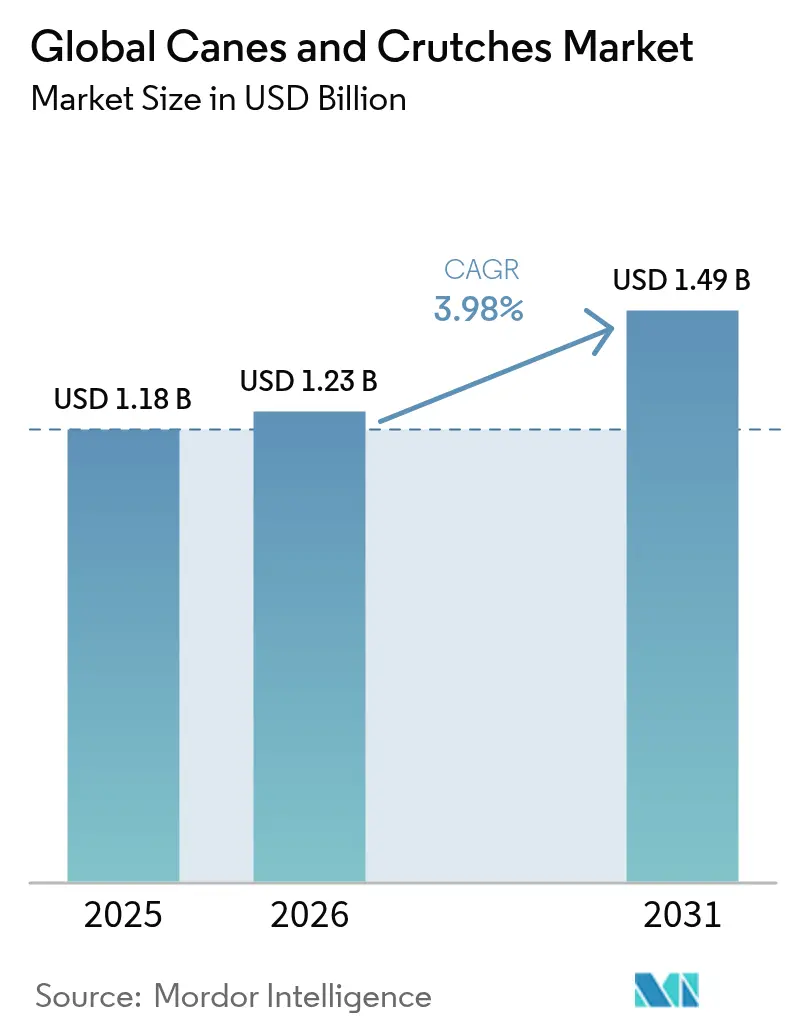
| Market Size (2026) | USD 1.23 Billion |
| Market Size (2031) | USD 1.49 Billion |
| Growth Rate (2026 - 2031) | 3.98 % |
| Fastest Growing Market | Asia Pacific |
| Largest Market | North America |
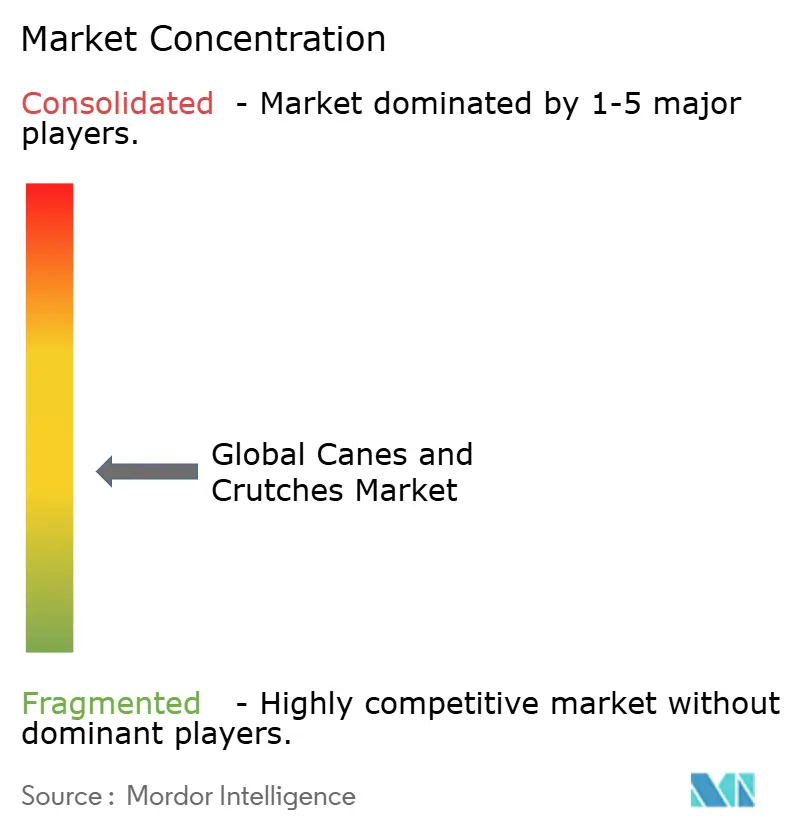
| Market Concentration | Medium |
Major Players *Disclaimer: Major Players sorted in no particular order Image © Mordor Intelligence. Reuse requires attribution under CC BY 4.0. | |
Global Canes And Crutches Market Analysis by Mordor Intelligence
The canes and crutches market size was valued at USD 1.18 billion in 2025 and estimated to grow from USD 1.23 billion in 2026 to reach USD 1.49 billion by 2031, at a CAGR of 3.98% during the forecast period (2026-2031). Demand moves steadily from basic walking aids to connected, lightweight devices that fit coordinated care programs and consumer expectations for independent living. Population ageing supplies the deepest demand pool, with the World Health Organization estimating 2.5 billion people in need of assistive products by 2050[1]. Technology-ready healthcare systems, new reimbursement codes and rising musculoskeletal disease prevalence further widen the customer base. Materials science has become a strategic factor as carbon-fiber composites cut device weight and enable sensor integration. At the same time, policy makers tighten documentation rules for “low-tech” equipment, forcing suppliers to justify clinical value and accelerate product refresh cycles.
Key Report Takeaways
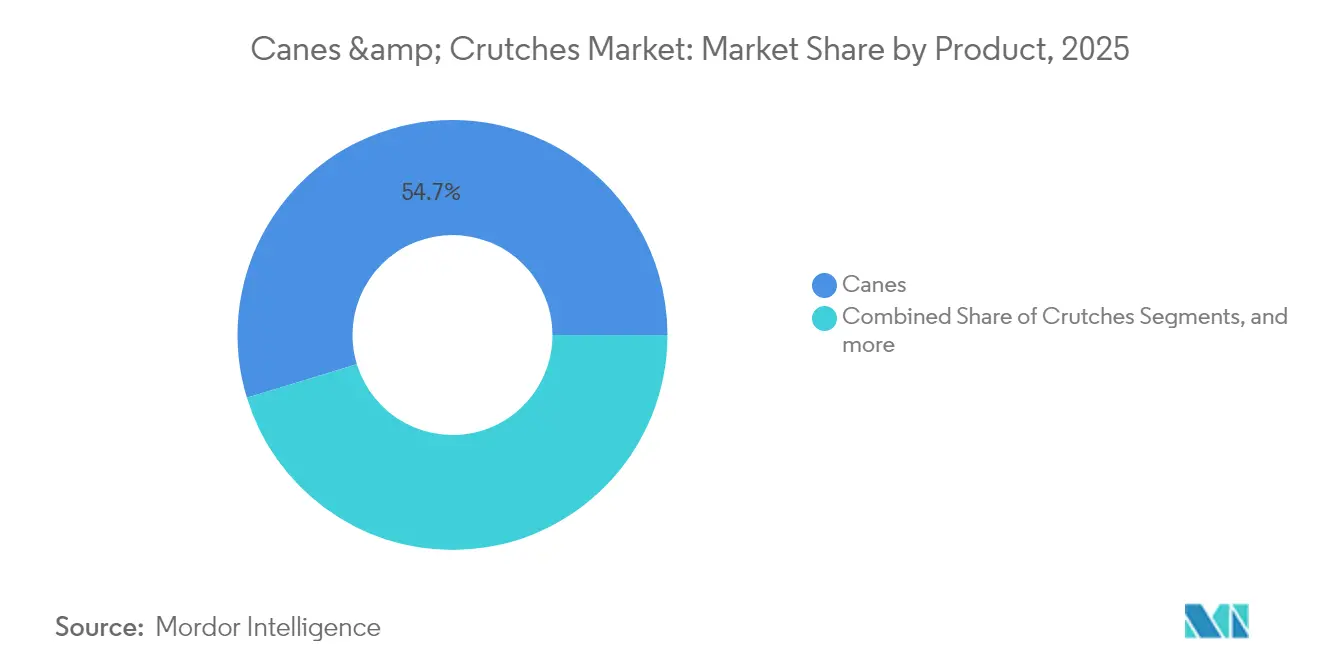
- By product type, canes led with 54.72% of the canes and crutches market share in 2025, whereas crutches are projected to post the fastest 4.25% CAGR to 2031.
- By material composition, aluminum accounted for 37.05% of revenue in 2025, while carbon-fiber composites are forecast to expand at a 4.33% CAGR through 2031.
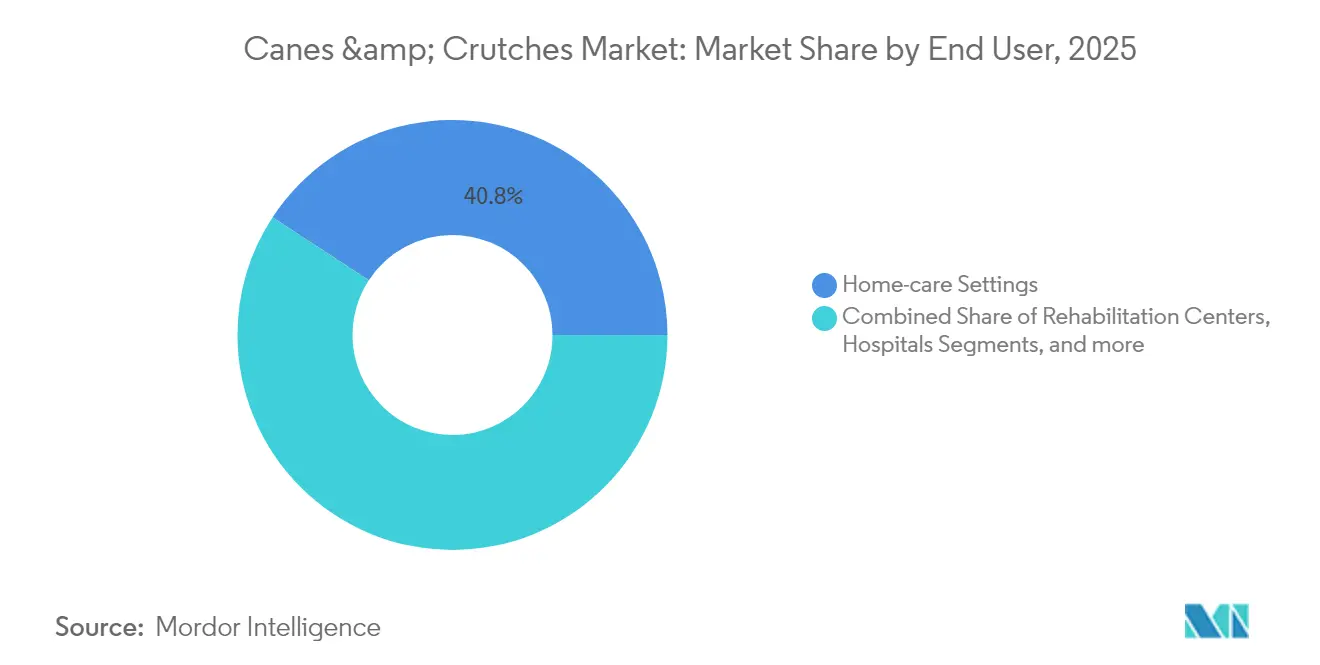
- By end user, home-care settings captured 40.78% of the canes and crutches market size in 2025; rehabilitation centers represent the quickest growing end-user segment at a 4.08% CAGR.
- By distribution channel, retail pharmacies held 44.92% revenue share in 2025, but online portals are advancing at a 4.16% CAGR to 2031.
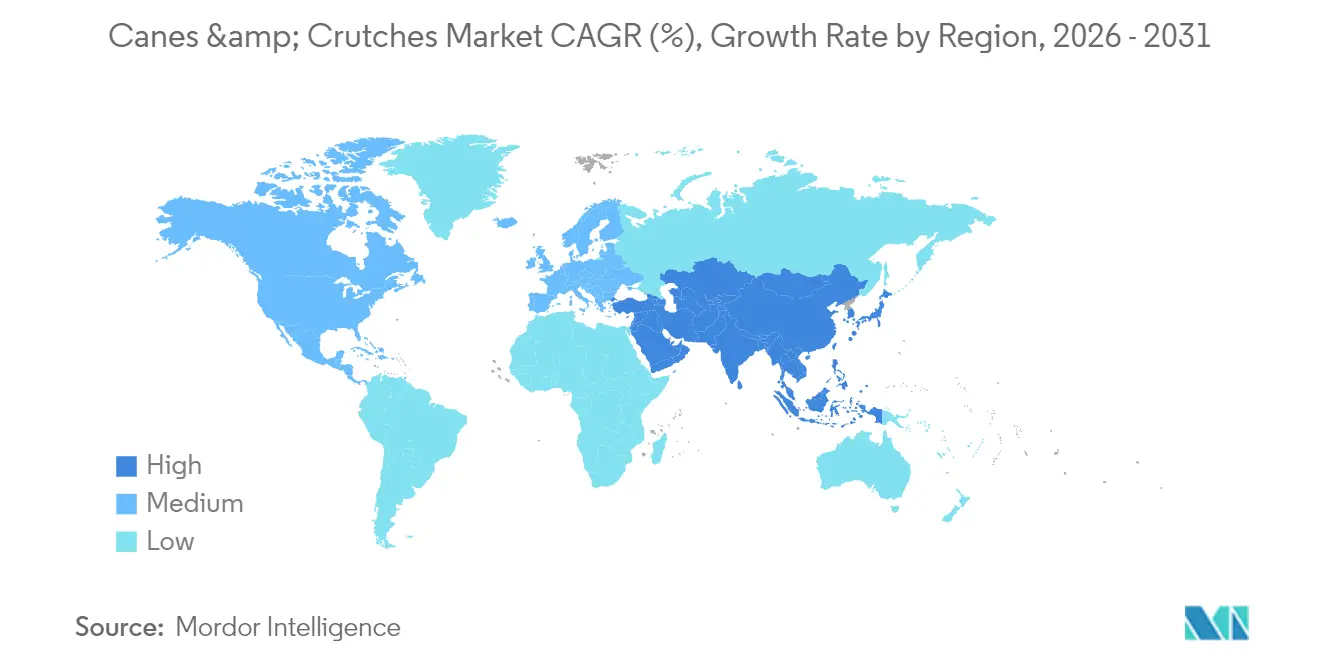
- By geography, North America commanded 40.10% revenue share in 2025; Asia-Pacific is the fastest growing region at a 4.34% CAGR through 2031.
Note: Market size and forecast figures in this report are generated using Mordor Intelligence’s proprietary estimation framework, updated with the latest available data and insights as of 2026.
Market Trends and Insights
Drivers Impact Analysis of Global Canes And Crutches Market*
| Driver | % Impact on CAGR Forecast | Geographic Relevance | Impact Timeline |
|---|---|---|---|
| Rise in global geriatric population | +1.2% | Global, concentrated in APAC and North America | Long term (≥ 4 years) |
| Growing incidence of osteoarthritis & rheumatoid arthritis | +0.8% | Global, higher impact in developed markets | Medium term (2-4 years) |
| Rise in rehabilitation & home-health adoption | +0.7% | North America & EU, expanding to APAC | Medium term (2-4 years) |
| Smart, sensor-enabled canes & crutches adoption surge | +0.5% | North America & EU early adoption, APAC following | Short term (≤ 2 years) |
| Sustainability-driven demand for carbon-fiber aids | +0.3% | Global, led by environmentally conscious markets | Long term (≥ 4 years) |
| Hands-free knee-crutch innovations boosting accessory sales | +0.2% | North America & EU, niche market expansion | Short term (≤ 2 years) |
| Source: Mordor Intelligence | |||
Rise in Global Geriatric Population
United Nations data show the share of people aged 65 and above rising sharply in the least-developed economies, confirming a prolonged upswing for the canes and crutches market[2]. Larger elderly cohorts directly translate into higher demand for balance-support aids as well as replacements driven by progressive mobility decline. Asian countries such as Japan face support-ratio drops to 2.4 workers per senior by 2025, tightening caregiver capacity and encouraging uptake of self-help devices. Governments respond with healthy-ageing policies and reimbursement improvements, which together sustain long-range purchasing momentum.
Growing Incidence of Osteoarthritis & Rheumatoid Arthritis
Musculoskeletal disorders push a constant flow of chronic users into the canes and crutches market. These conditions advance gradually, extending device lifecycles and replacement frequency. Non-invasive aids appeal to payers seeking cost avoidance versus surgery, making crutches and canes central to conservative treatment strategies. As younger cohorts experience joint damage owing to sedentary lifestyles and sports stress, addressable demand widens beyond traditional senior demographics.
Rise in Rehabilitation & Home-Health Adoption
Outpatient rehabilitation centers are expanding at a 4.21% CAGR, encouraged by payer moves toward cost-efficient care pathways. Discharged patients take portable walking aids home, boosting follow-on sales of accessories and smart monitoring features. Growth in home-health services aligns with Medicare support for aging-in-place, thereby positioning connected mobility devices as integral components of virtual care plans. Real-time usage data allow therapists to update exercise protocols without clinic visits, improving outcomes and device stickiness.
Smart, Sensor-Enabled Canes & Crutches Adoption Surge
The FDA-cleared EvoWalk 1.0 illustrates how artificial-intelligence and electrical stimulation create therapeutic value that satisfies tighter reimbursement rules evolutiondevices.com. Embedded sensors capture gait symmetry, load distribution and cadence, turning a mechanical aid into a data source for clinicians. Patent applications in self-care technologies filed under the World Intellectual Property Organization confirm commercial confidence in this transformation[3].
Restraints Impact Analysis of Global Canes And Crutches Market*
| Restraint | % Impact on CAGR Forecast | Geographic Relevance | Impact Timeline |
|---|---|---|---|
| Availability of alternative mobility devices | -0.6% | Global, higher impact in developed markets | Medium term (2-4 years) |
| Shrinking third-party reimbursement for "low-tech" aids | -0.4% | North America & EU primarily | Short term (≤ 2 years) |
| Ergonomic injuries from prolonged axillary-crutch use | -0.2% | Global, clinical awareness driving change | Long term (≥ 4 years) |
| Growing preference for robotic exoskeletons | -0.3% | North America & EU early adoption | Long term (≥ 4 years) |
| Source: Mordor Intelligence | |||
Availability of Alternative Mobility Devices
Wheelchairs, scooters and walkers present functional substitutes, especially for users whose strength or balance is severely impaired. Medicare’s detailed rules for power mobility equipment make these options financially feasible for specific clinical profiles. Advancing power-assist technology narrows the effort gap further, prompting some consumers to bypass crutches entirely.
Shrinking Third-Party Reimbursement for “Low-Tech” Aids
Centers for Medicare & Medicaid Services introduced new documentation layers and HCPCS codes in 2024, raising administrative hurdles for basic walking aids. Insurers increasingly demand evidence of measurable clinical benefit, a requirement easier to meet for sensor-enhanced products than for conventional wooden canes. Heightened paperwork may delay device issuance and suppress volume growth among price-sensitive groups.
*Our forecasts treat driver/restraint impacts as directional, not additive. The impact forecasts reflect baseline growth, mix effects, and variable interactions.
Global Canes And Crutches Market Segment Analysis
By Product Type
The segment held a 54.72% share of the canes and crutches market in 2025, confirming the versatility of single-point, quad and offset designs for users with light to moderate balance issues. Crutches, though smaller in base, are projected to expand at a 4.25% CAGR through 2031 as rehabilitation protocols emphasize early ambulation and as smart crutch prototypes attract technology-savvy clinics. Axillary models risk user fatigue and nerve compression, steering demand toward ergonomic forearm formats. Smart crutches equipped with load sensors and Bluetooth modules transform post-injury care into an evidence-based process, appealing to therapists intent on tracking compliance.
Rising material substitution underpins the product split. Lightweight carbon-fiber shafts improve swing clearance and reduce upper-body strain, boosting adoption among long-term users. Accessory sales such as ice tips, pivoting ferrules and shock-absorbing grips form a recurring-revenue layer that helps manufacturers differentiate beyond commodity frames. Because crutch prescriptions often accompany outpatient surgeries, hospital discharge planners have become a critical gatekeeper for brand choice in the canes and crutches market.

By Material Composition:
Aluminum Dominates, Carbon-Fiber GainsAluminum delivered 37.05% revenue in 2025 thanks to its friendly price-performance ratio and established tooling lines. Carbon-fiber, however, represents the fastest growing slice at a 4.33% CAGR. Composite shafts withstand high cyclic loading while weighing less than half of steel counterparts, a benefit that resonates with frail seniors and active rehabilitation patients alike. In addition, carbon-fiber accommodates embedded wiring for sensor arrays without compromising structural integrity, a prerequisite for the next generation of connected aids.
Wood keeps a niche foothold serving users who favor traditional aesthetics, yet its declining share reflects weight, moisture and maintenance drawbacks. Thermoplastic elastomers find roles in tips and ergonomic handles, where slip resistance and vibration dampening gain renewed attention from occupational therapists. As healthcare procurement policies embrace lower life-cycle carbon footprints, recyclable composite resins add a sustainability lever that further propels the canes and crutches market.
By End User:
Home-Care Leads, Rehabilitation Centers OutpaceHome-care settings accounted for 40.78% of global revenue in 2025, underscoring consumer preference for aging at home as well as payer initiatives that steer patients away from costlier institutional beds. Here, bundled service models pair a cane or crutch with telehealth check-ins, ensuring adherence and safety. Rehabilitation centers, though smaller today, are expected to grow the quickest at 4.08% CAGR because outpatient therapy volumes surge when hospitals discharge patients sooner.
Hospitals and clinics sustain steady baseline demand, primarily through acute injury and post-operative pathways. Sports medicine facilities add incremental growth by prescribing forearm crutches and smart gait-training sticks to athletes focused on rapid return-to-play protocols. Meanwhile, the canes and crutches industry sees occupational health programs introduce stand-assist sticks on factory floors to reduce slip-and-fall incidents among aging workers.
By Distribution Channel:
Retail Remains Central, Online AcceleratesRetail pharmacies preserved a 44.92% share in 2025 thanks to proximity, inventory breadth and pharmacist guidance. Yet online storefronts post a 4.16% CAGR through 2031 as mobility-restricted consumers value home delivery and peer reviews. E-commerce platforms facilitate subscription offerings for replacement tips and batteries, transforming one-off sales into annuity streams. Hospital pharmacies focus on high-turn crutches tied to surgical departments, while durable medical equipment showrooms increasingly stock carbon-fiber and smart variants to capture upscale demand.
New reimbursements permit electronic document submission, cutting processing time for remote purchases and legitimizing the digital channel. As a result, omni-channel strategies emerge: manufacturers list flagship lines on major marketplaces but steer professional-grade models through clinical portals that bundle training videos and tele-rehab support.
Geography Analysis
North America Canes and Crutches Market
North America anchored 40.10% of global revenue in 2025, supported by Medicare and Medicaid policies that subsidize device acquisition and by robust distribution infrastructures. The canes and crutches market size in the region benefits from updated HCPCS codes that standardize billing and facilitate quicker claims processing cms.gov. High technology adoption encourages early uptake of sensor-enabled models, giving suppliers pricing power. Demographic patterns remain a core driver, as the proportion of residents aged 65+ grows each year.
APAC Canes and Crutches Market
Asia-Pacific is forecast to post the fastest 4.34% CAGR through 2031. Japan’s projected healthcare outlay of ¥89 trillion in 2040 underscores the financial imperative to deploy cost-effective mobility aids for a rapidly greying population. China’s anticipated health spend reaching USD 33.4 trillion by 2060 further expands the prospective customer base. Regional governments invest in community health programs that reimburse basic walking aids, stimulating volume expansion. Local manufacturing clusters in China and India compress lead times and lower landed costs, accelerating penetration of the canes and crutches market.
EMEA and South America Canes and Crutches Market
Europe delivers solid yet slower growth. Harmonized CE-mark processes streamline market entry, while national payers maintain strict evidence requirements that push suppliers toward data-rich smart devices. Sustainability directives favor recyclable materials, accelerating carbon-fiber adoption. In contrast, Middle East & Africa and South America move from nascent to developing stages. Rising disposable incomes and insurance coverage improvements permit gradual uptake, though constrained distribution networks and lower clinician density temper short-term advances.
Regulatory Landscape
Regulation for canes and crutches is generally lighter than for powered mobility, but compliance still centers on device classification, labeling, and performance standards. In the United States, canes and crutches are classified as Class I medical devices under 21 CFR 890.3075 and 21 CFR 890.3150, which typically reduces premarket submission burden while keeping expectations in areas such as record-keeping, complaint handling, and post-market vigilance.
In Europe, Regulation (EU) 2017/745 (MDR) drives conformity through General Safety and Performance Requirements (GSPR) and risk-based classification, which increases documentation discipline for manufacturers selling through clinical channels. Across regions, ISO 11334 test methods (covering items such as elbow crutches and multi-legged walking sticks) function as an engineering and procurement anchor, shaping durability, fatigue testing, and user-safety claims that payers and institutional buyers use when standardizing purchasing.
Value Chain Analysis
The value chain starts with raw inputs (aluminum tubing, composite fibers/resins, plastics, and elastomers for tips and grips), then moves into component fabrication (shafts, cuffs, height-adjust mechanisms, ferrules), followed by final assembly, finishing, and packaging. As product mix shifts toward lightweight and connected variants, suppliers of carbon-fiber structures and embedded electronics (sensors, Bluetooth modules, batteries for add-on devices) gain influence, and compliance with recognized safety and test standards increasingly shapes design validation and quality documentation.
Go-to-market relies on healthcare distribution and retail access, with hospitals and discharge planners influencing crutch selection for post-operative pathways, while pharmacy chains and DME retailers drive scale for standard canes. Online channels support direct-to-consumer replenishment of accessories (tips, cuffs, grips) and can bundle education and tele-rehab content, but fulfillment reliability and returns handling remain critical due to fit and safety considerations. Large distributors and broad-line manufacturers such as Cardinal Health, Medline Industries, and Drive DeVilbiss Healthcare support reach through catalog breadth, private-label programs, and inventory positioning that aligns with home-care growth.
Competitive Landscape
The canes and crutches market displays moderate fragmentation. The top five brands hold under 40% of global sales, leaving room for regional specialists and niche innovators. Scale advantages reside chiefly in procurement contracts with pharmacy chains and hospital groups. Drive DeVilbiss leverages broad catalogues that cross-sell bathroom safety and wheelchairs, reinforcing channel loyalty. Cardinal Health exploits distribution muscle to secure formulary positions, whereas Medline Industries capitalizes on private-label programs for large health-system accounts.
Strategic movement concentrates on three themes. First, mergers and carve-outs reshape portfolios, as illustrated by Bioventus divesting its Advanced Rehabilitation unit for USD 45 million in October 2024, reallocating capital toward core biologics. Second, digital augmentation rises: Evolution Devices obtained FDA 510(k) clearance for an AI-enabled stimulatory system that attaches to a standard crutch, signalling convergence between mobility aids and therapeutic wearables. Third, supply-chain localisation mitigates tariff risks; several Asian makers set up assembly in Mexico to serve the United States duty-free under USMCA.
Patent filings cluster around sensor arrays, haptic feedback and foldable carbon-fiber frames, hinting at higher intellectual-property intensity. Start-ups pursue direct-to-consumer subscriptions that package maintenance parts and tele-rehab dashboards, chipping at incumbents reliant on dealer networks. Overall, rivalry pivots from commodity pricing to proof of clinical benefit and digital ecosystem integration.
Global Canes And Crutches Industry Leaders
-
Cardinal Health, Inc.
-
Medline Industries, Inc.
-
Drive DeVilbiss Healthcare
-
Invacare Corporation
-
Sunrise Medical
- *Disclaimer: Major Players sorted in no particular order
Global Canes And Crutches Market Companies Covered in this Report
- Drive DeVilbiss Healthcare
- Cardinal Health
- Medline Industries
- GF Health Products
- NOVA Medical Products
- Invacare
- Ergoactives
- Sunrise Medical
- Ossenberg
- BESCO Medical
- Carex (Compass Health)
- Ottobock
- Pride Mobility Products
- iWALKFree
- Flexmotiv
- TFI HealthCare
- AMG Medical
- Home Medical Products
- Benmor Medical
- Stander
Market Opportunities and Future Outlook
A key opportunity lies in moving commodity walking aids toward documented-care tools that align with tighter reimbursement and clinical evidence expectations. The market already shows a pathway through FDA-cleared augmentation, such as Evolution Devices EvoWalk 1.0 (510(k) cleared), alongside payer-side documentation emphasis signaled by CMS HCPCS updates in 2024. This combination creates room for add-on sensor modules, gait-cueing attachments, and service wrappers that help therapists monitor adherence in home-care and outpatient rehabilitation workflows.
At the same time, substitution pressure from advanced mobility platforms is becoming more apparent and is reshaping product positioning. In July 2026, WHILL launched the Modo Breeze, a carbon-fiber ultralight electric wheelchair priced at USD 1,999 at consumer retail, illustrating how lightweight materials and mass-market pricing are moving beyond manual aids. For cane and crutch suppliers, this strengthens the case for differentiated ergonomic and carbon-fiber products, alongside connected features and accessory ecosystems that improve comfort, reduce overuse injuries, and support independent living when a full power-mobility upgrade is not pursued.
Recent Industry Developments in Global Canes And Crutches Market
- March 2026: Drive Medical launched WalkWise by Drive, a smart attachment for walkers and rollators that provides activity insights for caregivers. While not a cane or crutch itself, it signals Drive Medicals push to layer monitoring and data services onto everyday mobility aids, reinforcing the markets shift toward connected, care-coordinated solutions. The launch also supports cross-selling into home-care channels where adherence and fall-risk visibility are purchasing priorities.
- June 2025: Drive Medical acquired the product line of De Oro Devices, including the NexStride gait-cueing device that attaches to canes and walkers. The move expands Drive Medicals portfolio toward neurologic and mobility-assist use cases where cueing can improve gait patterns and user confidence. It also strengthens differentiation beyond commodity frames by adding an attachable technology element that can be bundled through retail and DME channels.
- July 2024: Drive Medical acquired the full product portfolio of Mobility Designed, Inc., including the M+D Comfort Crutch. Bringing a recognized comfort-focused crutch design into a larger platform supports broader distribution and procurement access, especially in clinical discharge and rehab settings. The acquisition highlights ongoing consolidation aimed at combining specialized design IP with large-scale manufacturing and channel reach.
Global Canes And Crutches Market Report Scope and Research Methodology
Market Definition and Coverage
This market covers the value of commercially sold canes and crutches that support walking by improving balance or shifting weight away from an injured or weak lower limb, measured as product revenues in USD.
Scope exclusions: Excludes walkers, rollators, wheelchairs, mobility scooters, and rehabilitation gait trainers.
Segments Covered in This Report
- By Product Type
- Canes
- Single-point Canes
- Quad / Multiple-leg Canes
- Crutches
- Axillary Crutches
- Forearm Crutches
- Hands-free / Smart Crutches
- Accessories
- Canes
- By Material Composition
- Wood
- Aluminum
- Carbon-fiber / Composite
- Thermoplastic & Others
- By End User
- Hospitals & Clinics
- Home-care Settings
- Rehabilitation Centers
- Sports Injury Centers
- By Distribution Channel
- Retail Pharmacies
- Hospital Pharmacies
- Online
- By Geography
- North America
- United States
- Canada
- Mexico
- Europe
- Germany
- United Kingdom
- France
- Italy
- Spain
- Rest of Europe
- Asia-Pacific
- China
- Japan
- India
- Australia
- South Korea
- Rest of Asia-Pacific
- Middle East and Africa
- GCC
- South Africa
- Rest of Middle East and Africa
- South America
- Brazil
- Argentina
- Rest of South America
- North America
Data Sources, Market Sizing, and Validation
Desk Research
To build the base market picture, we start with public sources that describe the size of the demand pool and the healthcare context. Common references include the World Health Organization for aging and disability indicators, the US CDC for injury and falls data, and the OECD for health system and demographic series.
We also review sources such as UN Comtrade for trade flows tied to walking aids, procurement and reimbursement notes published by health agencies, and peer reviewed orthopedic and rehabilitation journals for usage patterns and replacement behavior. Company annual reports, investor presentations, and credible press releases help validate product mix trends and channel shifts. In a few places, paid subscriptions for company financials and patent databases are used to reduce blind spots around smaller brands and product changes, although the core model remains anchored on observable demand signals. The sources listed here are illustrative, and we reviewed other public references for cross checks and clarification.
Primary Interviews and Surveys
Primary discussions are used to pressure test what we see in desk research, especially around price bands, channel shares, and the replacement cadence for canes and crutches. We speak with a mix of manufacturers, distributors, and large buyers such as hospitals, pharmacies, and mobility retailers across APAC, EMEA, and the Americas, then reconcile differences before finalizing assumptions.
Distribution of primary research fieldwork respondents
| Company type | Respondent position | Region |
|---|---|---|
| Top tier: 31% | CXOs: 19% | APAC: 49% |
| Mid tier: 50% | Functional/Unit leaders: 22% | EMEA: 30% |
| Smaller Players: 19% | Managers: 59% | Americas: 21% |
Market-Sizing & Forecasting
Sizing is built using a top-down approach where population aging, mobility limitation prevalence, and injury incidence are translated into an addressable user pool, then converted into annual unit demand using typical utilization and replacement cycles for canes and crutches. Because channel behavior affects buy-through, penetration by care setting and distribution route is applied before values are computed.
Those unit estimates are converted to revenue using average selling price ranges by product type and material, adjusted for mix shifts toward ergonomic handles, adjustable designs, and higher durability tips. We corroborate totals using selective bottom-up checks such as sampled manufacturer and distributor revenue signals, retailer review of fast moving SKUs, and sanity checks on import and export trends. When a country level unit proxy is weak, we apply regional averages anchored to demographic similarity, followed by an expert review to avoid overfitting.
For forecasting, scenario analysis is used so key drivers can be flexed in a transparent way, such as changes in fall related hospital visits, post surgery rehabilitation volumes, reimbursement coverage, and inflation in aluminum and polymer input costs that can influence pricing. The final forecast path is selected after aligning with what interviewees expect for demand stability and ASP movement over the next few years.
Data Validation & Update Cycle
Before sign off, outputs are checked against independent signals, including trade trends, demographic changes, and the implied units per patient that fall out of the model. Any sharp year to year jumps are traced back to a specific driver, and the input is either corrected or explained with a clear event link.
A second analyst reviews the model logic, then a final pass confirms math, currency timing, and that assumptions are consistent across regions. Reports are refreshed annually, with interim updates when there is a material change such as a major reimbursement update or a large price shock. If a new data point materially shifts totals, interviews are re opened for a short reconfirmation before release.
Mordor Intelligence's Canes and Crutches Market Estimate Compared With Other Published Estimates
Published numbers for canes and crutches do not always match, even when they appear to cover the same products, because the boundaries and base years are often not aligned. Differences usually come from what is counted within the category, how channels are treated, and whether the price and volume picture is refreshed regularly.
Import and export movements for walking aids, combined with interview checks on replacement cadence and channel mix, are used to keep Mordor Intelligence aligned to the real demand pool for canes, crutches, and commonly purchased accessories. This tends to widen the gap versus studies that frame the market as a narrower hospital only revenue line or keep pricing flat across years.
Benchmark comparison
| Source | Market Size | Gaps in Research Methodology |
|---|---|---|
| Mordor Intelligence | USD 1.23 B (2026) | |
| Global Consultancy A | USD 1.12 B (2024) | Uses an earlier base year and typically centers the estimate on hospital and pharmacy sales, which can undercount retail and online purchases along with add-on items like tips and cuffs. |
| Industry Publisher B | USD 1.11 B (2024) | Keeps a 2024 base with a broad global split, but the value build often relies on a simpler CAGR application with limited explanation of ASP progression and replacement cycle assumptions by product type. |
Across the three figures, the spread is mainly explained by scope edges (accessories and channel coverage) and the choice of base year, which changes how inflation and mix are reflected. By keeping the model tied to observable demand indicators and cross checking the revenue math with supplier and channel feedback, the estimate stays traceable to inputs a reader can follow and repeat.
Key Questions Answered in the Report
What is the current value of the canes and crutches market?
The canes and crutches market size reached USD 1.23 billion in 2026 and is forecast to attain USD 1.49 billion by 2031.
Which product segment leads global sales today?
Canes dominate, holding 54.72% of worldwide revenue in 2025.
Which region is expanding the fastest?
Asia-Pacific is projected to grow at a 4.34% CAGR through 2031, driven by rapid population ageing and healthcare modernization.
How are smart technologies influencing future growth?
Sensor-enabled and AI-assisted devices enhance clinical monitoring, satisfy stricter reimbursement rules and are projected to add 0.5 percentage points to the overall CAGR.
What material trend is shaping product innovation?
Carbon-fiber composites, expanding at 4.33% CAGR, reducing weight and permit embedded electronics, boosting user comfort and data-capture capabilities.
Why are reimbursement policies considered a restraint?
New HCPCS documentation requirements raise administrative load and may delay payment for conventional “low-tech” aids, limiting near-term uptake among cost-sensitive users.