
Market Overview
| Study Period | 2020 - 2031 |
|---|---|
| Forecast Data Period | 2026 - 2031 |
| Historical Data Period | 2020 - 2024 |
| Growth Rate | 6.67 % |
| Market Concentration | Medium |
Major Players *Disclaimer: Major Players sorted in no particular order Image © Mordor Intelligence. Reuse requires attribution under CC BY 4.0. | |
Canada Neonatal And Prenatal Devices Market Analysis by Mordor Intelligence
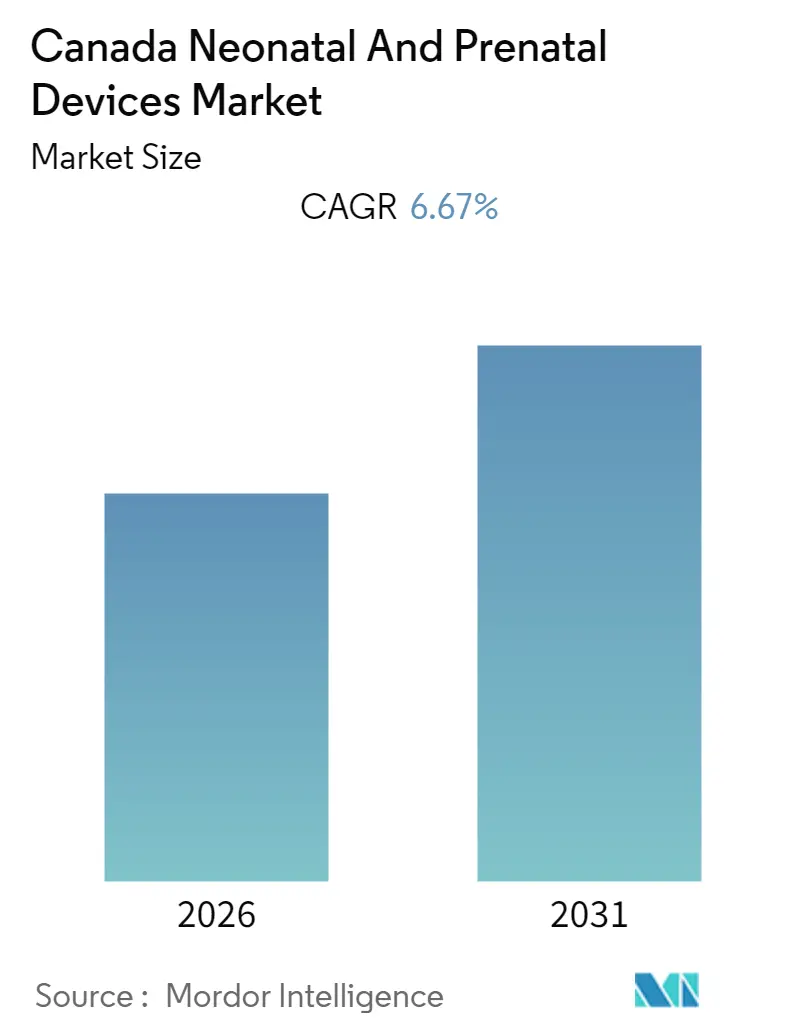
Canada Neonatal And Prenatal Devices market size in 2026 is estimated at USD 360.18 million, growing from 2025 value of USD 337.67 million with 2031 projections showing USD 497.6 million, growing at 6.67% CAGR over 2026-2031.
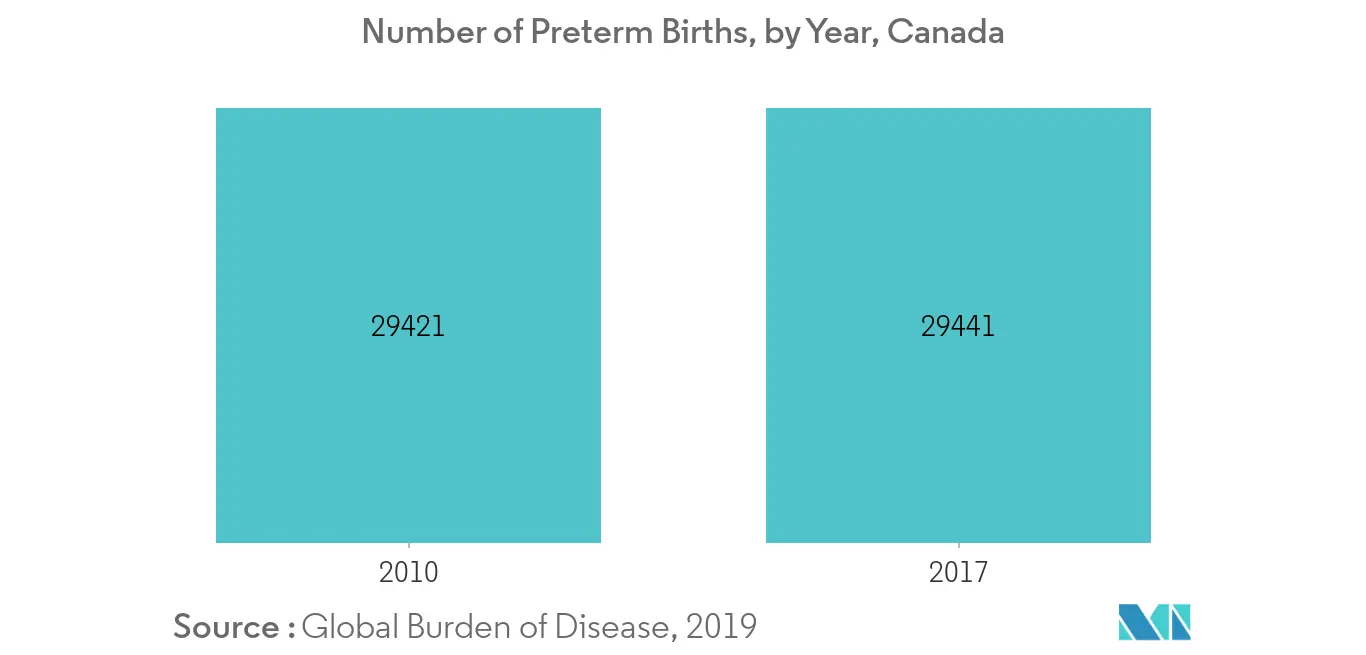
Owing to the rapid evolution of the market in the use of new technology, medical device companies that are able to launch new innovative equipment will be rewarded with huge benefits. The increasing awareness for neonatal & prenatal care, rising incidence of preterm births, and increased demand for prenatal therapeutics, diagnostics, and monitoring devices are the major factors driving the growth of this market.
However, the rising cost of neonatal care, due to advancements in medical devices, is one of the major factors hindering the market
Note: Market size and forecast figures in this report are generated using Mordor Intelligence’s proprietary estimation framework, updated with the latest available data and insights as of 2026.
Canada Neonatal And Prenatal Devices Market Trends and Insights
Neonatal Care Equipment is Expected to Hold a Significant Market Share
Neonatal monitoring instruments and equipment are used in the neonatal intensive care unit (NICU), emergency room, and operating theatre at all levels of hospitals for continuous monitoring of the neonates and infants. The demand for this equipment has increased to increase in preterm births, even in developed. Preterm born babies are more prone to infections and diseases and require more care. According to an article published in 2018 by Prakesh S. Shah, 8% of pregnancies in Canada result in preterm birth. The Canadian Preterm Birth Network (CPTBN) is funded by the Canadian Institutes of Health Research and aims to expand existing neonatal platforms to develop a pan-Canadian network. Such initiatives help boost segment growth.
Competitive Landscape
Companies, like Becton, Dickinson and Company, GE Healthcare, Koninklijke Philips NV, Masimo, Medtronic PLC, hold substantial shares in the fetal and neonatal care equipment market. Some of the strategies implemented include agreements, collaborative models, business expansion, and product developments
Canada Neonatal And Prenatal Devices Industry Leaders
-
GE Healthcare
-
Siemens Healthineers AG
-
Koninklijke Philips N.V.
-
Becton, Dickinson and Company
-
Medtronic PLC
- *Disclaimer: Major Players sorted in no particular order

Market Opportunities and Future Outlook
In Canada, opportunities are closely tied to expansion and modernization of care settings, which increases installed-base demand for fetal monitoring, diagnostic ultrasound, incubators, neonatal monitoring, and respiratory support equipment. In 2026, multiple facility and service expansions point to procurement whitespace. British Columbia opened a new health-care pavilion at Burnaby Hospital that includes maternity and neonatal intensive care units, while Saskatchewan's Prince Albert Victoria Hospital acute care tower reached a 50% construction milestone with a relocated Malhotra Neonatal Intensive Care Unit and an increase in bassinets (from 11 to 13). In parallel, Indigenous Services Canada supported community-based maternal care capacity through the April 2026 opening of the Shirley Bighead Nihtawiki and Ohpikihawasowin Birthing and Childrearing Lodge at Sturgeon Lake First Nation, supported by federal construction and operating funding. This creates additional demand for reliable prenatal monitoring, point-of-care diagnostics, and referral-connected digital workflows.
A second opportunity area is workflow digitization and standardization across perinatal and neonatal pathways, supported by Health Canada's 2026 regulatory and guidance activity on licensing and establishment oversight. Health Canada implemented updated guidance in February 2026 to streamline Class II, III, and IV medical device licence application management, and published amendments to the Medical Devices Regulations in June 2026 to modernize the establishment licensing framework (with Phase II changes scheduled to come into force in December 2026). This setting supports vendors that can pair compliant device portfolios with interoperable software, service, and cybersecurity-ready deployment models for hospitals and regional networks, particularly where NICU monitoring and prenatal diagnostic imaging require integration, traceability, and uptime.
Recent Industry Developments
- June 2026: Health Canada published amendments to the Medical Devices Regulations in Canada Gazette, Part II, modernizing the medical device establishment licensing framework. The update strengthens oversight mechanisms and aligns operational requirements for entities that import and distribute devices used in high-acuity settings, including neonatal and prenatal care.
- February 2025: GE HealthCare received a 60-month Canadian government contract (effective 2025-02-05 to 2030-02-04) to supply general purpose and obstetrical ultrasound units. Multi-year public procurement of obstetrical ultrasound supports ongoing replacement cycles and standardization of prenatal imaging capability across eligible facilities.
- September 2024: GE HealthCare launched CareIntellect for Perinatal, a cloud-first software platform designed to support perinatal surveillance and workflow across care teams. The platform reinforces the market shift toward integrated perinatal information management and connectivity that complements fetal monitoring and ultrasound device adoption.
Research Methodology Framework and Report Scope
Market Definition and Coverage
For this methodology, the Canada neonatal and prenatal devices market covers revenues earned from medical devices used to monitor, support, and treat the fetus and newborns, mainly across obstetrics settings and neonatal intensive care units.
Scope exclusions (for clarity): We do not count pharmaceuticals, general hospital consumables, or broader maternity services that are not device-led.
Segmentation Overview
- By Product Type
- Fetal Care Equipment
- Fetal Dopplers
- Fetal Magnetic Resonance Imaging (MRI) Devices
- Ultrasound Devices
- Fetal Pulse Oximeters
- Other Fetal Care Equipment
- Neonatal Care Equipment
- Incubators
- Neonatal Monitoring Devices
- Phototherapy Equipment
- Respiratory Assistance and Monitoring Devices
- Other Neonatal Care Equipment
- Fetal Care Equipment
Data Sources, Market Sizing, and Validation
Desk Research
Desk research was used first to map the care pathway in Canada and the device purchasing setup across provinces, since those choices shape what gets bought and how often systems are replaced. Public sources were also used to map the core demand pool, including births, preterm birth share, and NICU capacity signals.
Examples of sources used include Statistics Canada birth and health tables, Health Canada medical device licensing and safety communications, the Canadian Institute for Health Information for hospital activity indicators, and provincial health ministry budget and planning documents that discuss hospital equipment funding. We also reviewed procurement portals and hospital network notices to capture tender language, plus peer-reviewed clinical journals for adoption trends in neonatal ventilation and monitoring. Manufacturer annual reports, investor decks, and credible press were used to track product launches, recalls, and pricing direction. For selected checks, paid subscriptions were used for company financials and news, plus patent databases to confirm technology direction. These are illustrative sources only, and many other public documents were also consulted to collect data, validate assumptions, and clarify gaps.
Primary Interviews and Surveys
Primary work was run through expert interviews and structured surveys with clinicians, biomedical teams, distributors, and procurement stakeholders who influence fetal monitoring and NICU equipment decisions. Since Canada is treated as the full geography here, views were balanced across major provinces and care settings, so secondary assumptions on utilization, replacement timing, and price movements could be adjusted in a practical way.
Distribution of primary research fieldwork respondents
| Company type | Respondent position |
|---|---|
| Top tier: 29% | CXOs: 15% |
| Mid tier: 54% | Functional/Unit leaders: 31% |
| Smaller Players: 17% | Managers: 54% |
Market-Sizing & Forecasting
The sizing model starts from a top-down build that reconstructs the addressable device demand using Canada birth volumes, preterm share, NICU bed presence, and typical monitoring and therapy coverage per unit of care. That demand pool is then converted into annual spending by applying realistic replacement cycles and an average selling price range for key device groups, and it is checked for consistency against observed procurement behavior.
Selective bottom-up approximations were used to keep totals grounded, including channel feedback on unit placements, sampled price quotes from tenders, and a sanity check using supplier revenue exposure to Canada when it could be reasonably isolated. Inputs that mattered most included newborn admissions intensity (approximated through hospital activity indicators), shift from wired to wireless monitoring, respiratory support adoption in NICUs, phototherapy utilization patterns, and currency timing for imported equipment pricing. For forecasting, scenario analysis was used so the base case reflects expected policy stability and upgrade cadence, and then conservative and faster-refresh cases were reviewed with interviewees. When gaps appeared in the bottom-up checks, the model was adjusted using range-based ASP assumptions rather than forcing a precise unit count that cannot be verified.
Data Validation & Update Cycle
Outputs were validated through multiple checks, including cross-comparing implied spend per birth against historical trends and checking whether growth rates matched hospital equipment renewal discussions captured in interviews. Outliers were flagged, and assumptions were revisited when a single variable, such as replacement cycle or ASP drift, created an unrealistic jump.
Before sign-off, the model and narrative were reviewed in steps by another analyst so calculation logic, units, and year labels stay consistent. Reports are refreshed annually, and interim updates are made when material events occur, such as policy changes, large recalls, or major product approvals that shift demand. Right before delivery, a final review pass is completed so clients receive the most current view available at that time.
Mordor Intelligence's Canada Neonatal and Prenatal Devices Market Size Compared Against Other Published Estimates
Published market sizes for this category often vary widely, even when they describe the same country, because the device list and the chosen anchor year are not aligned. Differences also come from how prices are treated for imported equipment and whether NICU-only devices are mixed with broader maternal care tools.
Some published figures appear to bundle adjacent areas like broader maternity equipment and non-device support services, which can inflate the device-only value. A tighter list is then paired with tender-led price checks and replacement-cycle reality, which keeps the total closer to what hospitals budget for. Mordor Intelligence counts fetal care equipment and neonatal care equipment sold into Canada, and postpartum products and service revenues sit outside the market.
Benchmark comparison
| Source | Market Size | Gaps in Research Methodology |
|---|---|---|
| Mordor Intelligence | USD 360.18 M (2026) | |
| Global Consultancy A | USD 1200.00 M (2023) | Appears to use a broader scope that can include maternity equipment beyond fetal and neonatal device categories, and it is anchored to an earlier year that is not aligned to the 2026 base. |
| Trade Publisher B | USD 337.67 M (2025) | Uses a different anchor year and may not fully normalize currency timing and replacement cycle effects, which can shift the reported level even if the product list is similar. |
Taken together, the comparison suggests that the largest swings come from mixing non-target items into scope and from year and price normalization choices. When scope is kept to fetal and neonatal device revenues and assumptions are rechecked with procurement and clinician inputs, the resulting number is easier to trace back to clear demand and pricing drivers.
Key Questions Answered in the Report
What is the current Canada Fetal and Neonatal Care Equipment Market size?
The Canada Fetal and Neonatal Care Equipment Market is projected to register a CAGR of 6.67% during the forecast period (2026-2031)
Who are the key players in Canada Fetal and Neonatal Care Equipment Market?
GE Healthcare, Siemens Healthineers AG, Koninklijke Philips N.V., Becton, Dickinson and Company and Medtronic PLC are the major companies operating in the Canada Fetal and Neonatal Care Equipment Market.
What years does this Canada Fetal and Neonatal Care Equipment Market cover?
The report covers the Canada Fetal and Neonatal Care Equipment Market historical market size for years: 2019, 2020, 2021, 2022, 2023 and 2024. The report also forecasts the Canada Fetal and Neonatal Care Equipment Market size for years: 2026, 2027, 2028, 2029, 2030 and 2031.