
Market Overview
| Study Period | 2020 - 2031 |
|---|---|
| Forecast Data Period | 2026 - 2031 |
| Base Year Market Size (2025) | USD 2.39 Billion |
| Market Size (2026) | USD 3.27 Billion |
| Market Size (2031) | USD 15.77 Billion |
| Growth Rate (2026 - 2031) | 36.95 % |
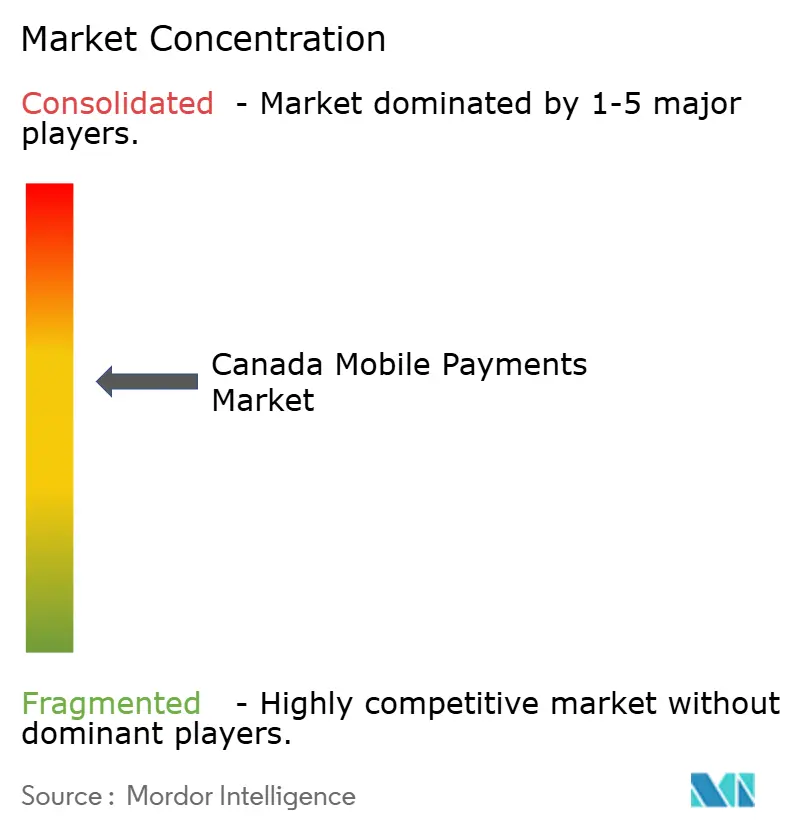
| Market Concentration | Medium |
Major Players *Disclaimer: Major Players sorted in no particular order Image © Mordor Intelligence. Reuse requires attribution under CC BY 4.0. | |
Canada Mobile Payments Market Analysis by Mordor Intelligence
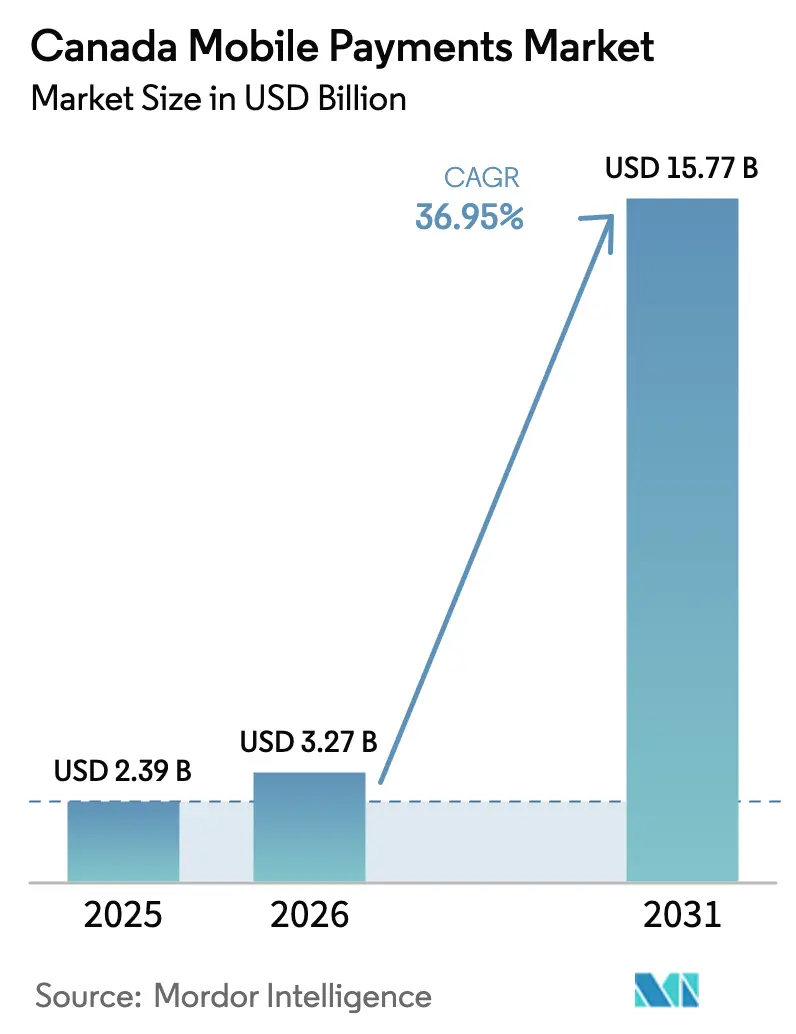
The Canada mobile payments market size is expected to grow from USD 2.39 billion in 2025 to USD 3.27 billion in 2026 and is forecast to reach USD 15.77 billion by 2031 at 36.95% CAGR over 2026-2031. The surge reflects rapid digitization of financial services, aggressive modernization of payment infrastructure, widespread consumer acceptance of contactless technology, and the displacement of cash at the point of sale. Digital payments already account for 86% of national payment volume, with contactless transactions representing 53% of all payments in 2024, highlighting a broad behavioral shift among Canadians.[1]Government programs such as Real-Time Rail (RTR) and the Consumer-Driven Banking Framework are unlocking new avenues for product innovation while addressing latency and data-sharing barriers that historically limited market expansion. Retailers are bolstering uptake by embedding payments into loyalty programs, while wearable and smartphone-enabled fare collection is transforming urban mobility and accelerating transaction volumes. Together, these forces place the Canada mobile payments market among the fastest-growing ecosystems worldwide.
Key Report Takeaways
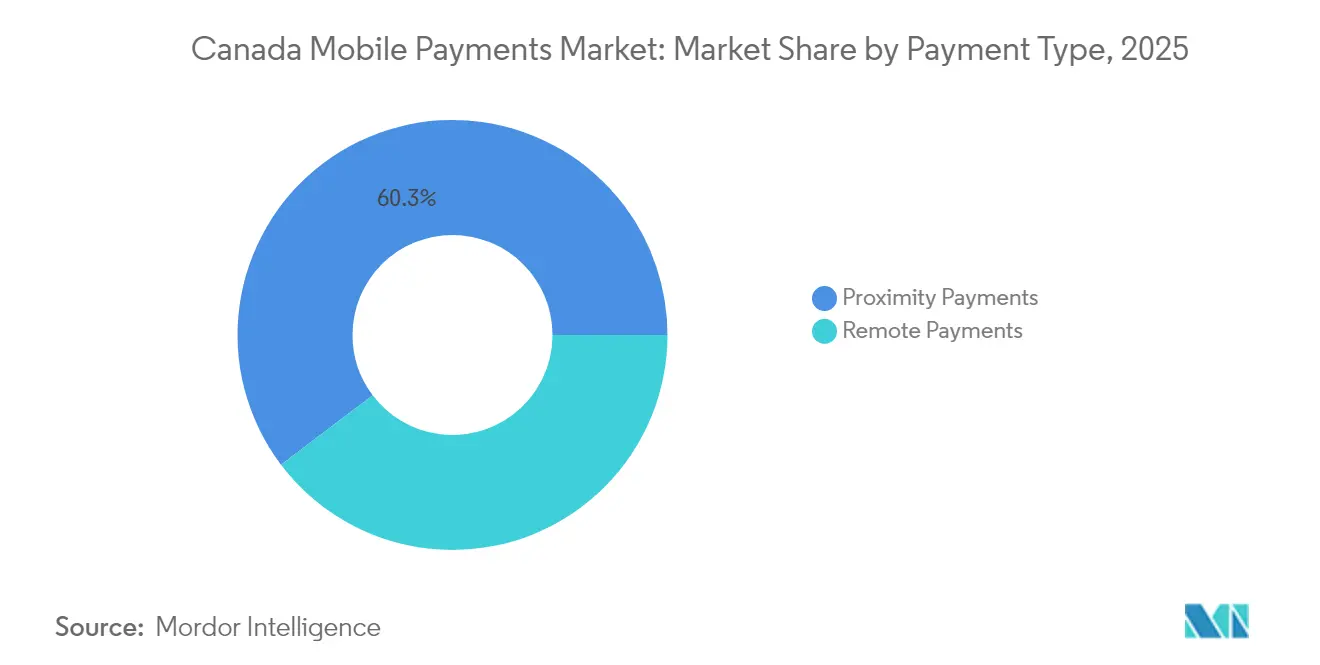
- By payment type, proximity transactions led with a 60.30% revenue share in 2025, while remote payments are set to post the highest CAGR at 38.05% through 2031.
- By transaction type, point of sale held 53.40% of the Canada mobile payments market share in 2025, whereas transit and ticketing transactions are projected to advance at a 39.95% CAGR to 2031.
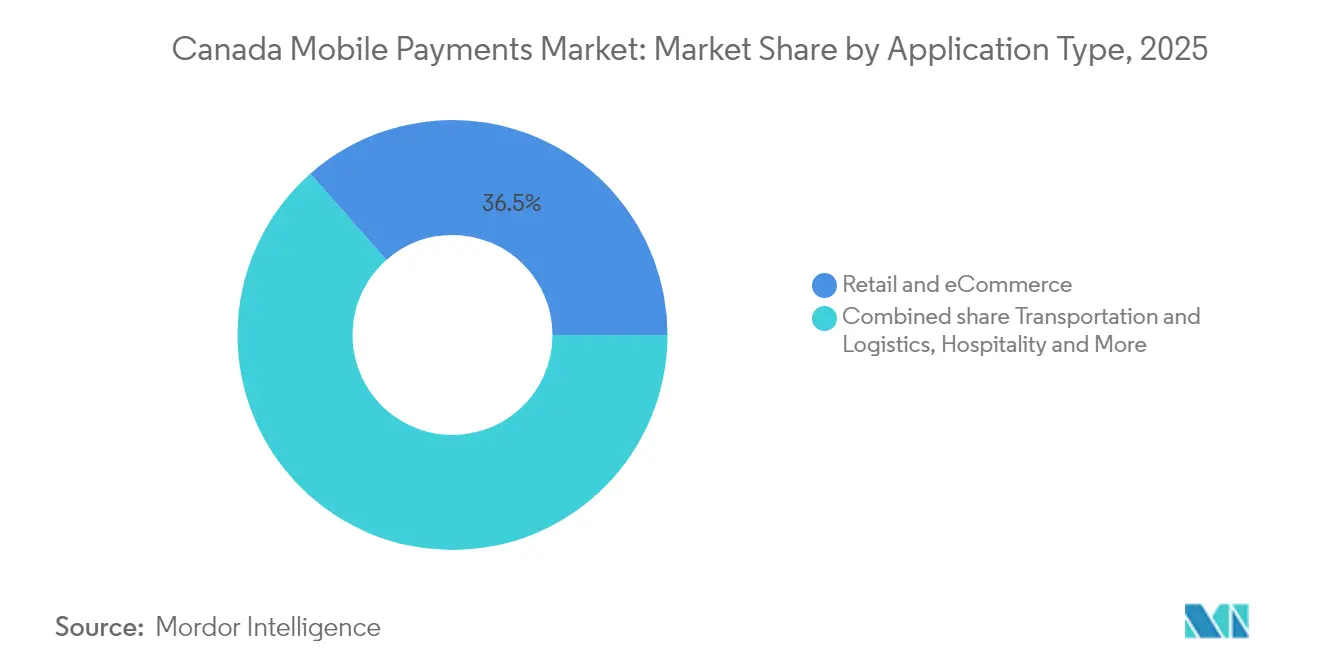
- By application, retail and wholesale captured 36.50% of the Canada mobile payments market size in 2025; transportation and logistics is poised for the fastest growth at 40.40% CAGR.
- By end-user, personal users commanded 56.40% of the market in 2025, but business adoption is forecast to accelerate at a 38.70% CAGR.
Note: Market size and forecast figures in this report are generated using Mordor Intelligence’s proprietary estimation framework, updated with the latest available data and insights as of 2026.
Canada Mobile Payments Market Trends and Insights
Drivers Impact Analysis*
| Driver | (~) % Impact on CAGR Forecast | Geographic Relevance | Impact Timeline |
|---|---|---|---|
| Increasing Internet Penetration Boosting Mobile Commerce Adoption | +8.2% | National, with stronger gains in Ontario, Quebec, British Columbia | Medium term (2-4 years) |
| Rising Adoption of Interac Debit Rails for Contactless In-store Payments | +9.1% | National, concentrated in urban centers | Short term (≤ 2 years) |
| Expansion of Loyalty-Integrated Closed-Loop Mobile Wallets by Canadian Retailers | +6.7% | National, early adoption in Toronto, Vancouver, Montreal | Medium term (2-4 years) |
| Government Push for Real-Time Rail & Open Banking Framework | +11.3% | National implementation with phased rollout | Long term (≥ 4 years) |
| Growing Acceptance of Wearable Payments at Mass Transit Systems | +3.5% | Urban centers: Toronto, Vancouver, Montreal, Ottawa | Short term (≤ 2 years) |
| Source: Mordor Intelligence | |||
Increasing Internet Penetration Boosting Mobile Commerce Adoption across Canadian Provinces
Enhanced broadband availability is accelerating e-commerce activity, with mobile commerce transactions expanding 42% year over year in 2024. The CAD 6 billion (USD 4.37 billion) connectivity strategy aims to deliver 50 Mbps speeds nationwide by 2030, reducing rural-urban disparities and enlarging the total addressable base for payment providers. British Columbia’s regional plan alone delivered CAD 2.5 billion (USD 1.82 billion) in economic benefits by 2024, a result that demonstrates the economic multiplier of reliable connectivity. More than 73,000 rural households are set to benefit from 132 projects in flight, directly translating to incremental transaction volume for digital wallets. Mobile app payment usage rose from 37% of adults in 2022 to 45% in 2024, signaling sustained appetite for smartphone-based settlement mechanisms.
Rising Adoption of Interac Debit Rails for Contactless In-store Payments
Interac processes more than 16 million daily transactions, while sustaining fraud at below CAD 0.01 per CAD 100. Its tiered interchange policy, introduced in October 2024, reduced fees for small merchants, sparking greater acceptance of tap-to-pay debit.[2] Interac e-Transfer penetration grew seven percentage points to 58% in 2024, and contactless debit accounted for 70% of all debit purchase volume. Integration with Apple Pay, Google Pay, and Samsung Pay widens consumer choice and strengthens Interac’s position against global card schemes. Independent merchants already report 27% savings on processing costs, enhancing cash-flow resilience for small businesses.[3]
Expansion of Loyalty-Integrated Closed-Loop Mobile Wallets by Canadian Retailers
Retailers capitalize on closed-loop architecture to aggregate consumer data, drive repeat visits, and deploy personalized promotions. Tim Hortons’ Scan & Pay model issues 10 points per dollar spent, blending payment and rewards in a single user journey. Loblaw Companies’ PC Optimum program boasts 17 million members and generated CAD 3.9 billion (USD 2.84 billion) in e-commerce revenue in 2024, underscoring the power of data-driven personalization. The success of these models is influencing quick-service restaurants, grocery chains, and drugstores to accelerate wallet development. Market projections show Canadian digital wallets scaling from USD 1.39 billion in 2024 to USD 20.48 billion by 2030, with loyalty embedded as a core differentiator.
Government Push for Real-Time Rail & Open Banking Framework Accelerating Mobile Payment Innovation
RTR will provide 24 × 7 real-time settlement by 2026 using ISO 20022 data standards, enabling richer messaging and advanced fraud controls. Parallel implementation of the Consumer-Driven Banking Framework in 2025 creates a secure API layer that lets consumers share financial data with accredited fintechs. Combined, these initiatives shrink settlement windows, reduce reconciliation costs, and trigger product innovation across B2C and B2B use cases. Payments Canada’s collaboration with IBM and CGI has already completed the exchange component, pointing to an on-schedule launch. Once live, RTR will align Canada with global leaders such as Brazil’s Pix, catalyzing a new generation of instant, data-rich payment experiences.
Restraints Impact Analysis*
| Restraint | (~) % Impact on CAGR Forecast | Geographic Relevance | Impact Timeline |
|---|---|---|---|
| Fragmented Provincial Privacy Regulations Restricting Data-Sharing Across Ecosystems | -4.8% | National, with varying intensity by province | Medium term (2-4 years) |
| Higher Merchant Discount Fees for Mobile Wallets vs. Interac Debit Discouraging SMB Adoption | -3.2% | National, particularly affecting small merchants | Short term (≤ 2 years) |
| Latency Issues in Rural Broadband Limiting Seamless Proximity Transactions | -2.1% | Rural and remote areas, Northern territories | Medium term (2-4 years) |
| Consumer Security Concerns over Tokenization Failures in NFC Devices | -1.9% | National, with higher impact among older demographics | Short term (≤ 2 years) |
| Source: Mordor Intelligence | |||
Fragmented Provincial Privacy Regulations Restricting Data-Sharing Across Ecosystems
Canada operates under a dual privacy regime: the federal PIPEDA statute and multiple provincial acts. Divergent compliance obligations inflate development expenses for wallet providers that must tailor data-handling protocols by jurisdiction. While Ottawa’s 2024 proposal to modernize PIPEDA aspires to harmonize standards with the EU’s GDPR, implementation timelines and final provisions remain uncertain. The fragmentation undermines network effects that rely on seamless data exchange, limiting the scale of loyalty programs and targeted offers. Open banking participants face additional hurdles because API frameworks must satisfy overlapping federal and provincial mandates before launch.
Higher Merchant Discount Fees for Mobile Wallets vs. Interac Debit Discouraging SMB Adoption
Mobile wallets often impose blended fees of 1–4% per sale, noticeably above the sub-1% effective rate of Interac debit, leading to merchant reluctance, especially in rural and low-margin sectors. Ottawa negotiated a reduction in average credit card fees to 1.4% in 2024, yet some processors did not pass the savings to merchants, dulling the policy’s intended effect. Fixed costs to enable contactless terminals and tokenization further weigh on small retailers with limited volume. The cost gap entrenches Interac’s advantage and slows the diffusion of international wallet brands beyond metropolitan cores.
*Our forecasts treat driver/restraint impacts as directional, not additive. The impact forecasts reflect baseline growth, mix effects, and variable interactions.
Segment Analysis
By Payment Type: Proximity Dominance Faces Remote Surge
Proximity transactions commanded 60.30% of the Canada mobile payments market in 2025, driven by near-field communication ubiquity at more than 500,000 merchant locations nationwide. Over 70% of debit purchases cleared via tap-to-pay as consumers embraced quick checkout. The segment benefits from habit formation during the pandemic and trusted domestic rails such as Interac Flash. Yet the remote cohort is expanding at a 38.05% CAGR to 2031 as e-commerce volumes, QR code scans, and biometrically authenticated in-app payments grow. Mobile wallet providers exploiting single-click checkout and tokenized credentials are eroding the historical gap between online and in-store experiences. Payment orchestration platforms now enable merchants to route transactions dynamically, optimizing authorization rates and reducing fraud. Apple’s decision to open Secure Element access to developers further blurs proximity and remote boundaries by allowing in-app NFC experiences outside the browser.
Remote payments also gain from the softPOS revolution, which converts Android or iOS devices into full-service terminals at minimal cost, expanding acceptance among micro-merchants at pop-up markets and service professionals on the move. As RTR delivers instant funds availability, settlement anxiety for remote sellers diminishes, widening adoption. The Canada mobile payments market size for remote channels is expected to surpass USD 6.48 billion by 2031, roughly 41.10% of overall flows, signaling a more balanced channel mix. Canada mobile payments industry observers note that fraud mitigation through dynamic CVV and biometric pairing is shortening the trust gap between proximity and remote payment types.

By Transaction Type: POS Leadership Challenged by Transit Innovation
Point-of-sale interactions accounted for 53.40% of the Canada mobile payments market size in 2025, supported by mature acceptance infrastructure, predictable purchase patterns, and solid consumer trust. Merchants continue to upgrade POS firmware to accept wallet tokenization, dynamic QR, and in-app loyalty redemption. Interac Flash and dual-tap flows accelerate throughput for high-volume sectors such as grocery, convenience, and quick-service restaurants. However, transit and ticketing transactions, bundled under “other” today, are scaling at a 39.95% CAGR. Urban operators in Toronto, Vancouver, Montréal, and Ottawa have embraced open-loop acceptance, allowing riders to tap wearables or phones directly at fare gates without PIN verification.
The appeal of touch-less entry and time savings is catalyzing ridership recovery post-pandemic. Transit agencies are also capturing richer ridership analytics that feed capacity planning and dynamic pricing. Beyond subways and buses, smart-ticketing solutions are penetrating sports arenas, museums, and parking garages, transforming event ticketing into an all-in-one experience. Payments for micro-mobility choices such as bike and scooter rentals are also processed through embedded wallet rails, adding incremental value. These developments imply that POS growth will moderate while transit, mobility-as-a-service, and venue ticketing carve out a larger share of transaction mix inside the Canada mobile payments market.
By Application: Retail Supremacy Meets Transportation Disruption
Retail and ecommerce held 36.50% of Canada mobile payments market share in 2025. Supermarket chains, pharmacy outlets, and quick-service food brands continue to layer loyalty, personalized offers, and buy-online-pick-up-in-store (BOPIS) flows into wallet experiences. Tim Hortons’ loyalty-linked Scan & Pay and Loblaw’s PC Optimum are notable exemplars of successful customer engagement strategies anchored in mobile payment enrollment. Retailers rely on consumer data reservoirs to refine assortment, optimize promotions, and reduce queue times. The Canada mobile payments market size for retail is projected to reach USD 5.66 billion in 2031, supported by omnichannel commerce and expanded same-day delivery options.
Transportation and logistics is the fastest-growing vertical, advancing at a 40.40% CAGR. Fleets utilize mobile wallets to automate driver fuel payments and tolls, while parcel carriers disburse instant payroll via RTR, improving workforce liquidity. Ports and rail operators experiment with IoT-linked smart contracts that trigger payment upon verified delivery events. Wearable fare collection in mass transit is driving incremental wallet activation among commuters, compounding network effects. As RTR provides immediate settlement, logistics firms reduce working-capital buffers and accelerate asset rotation, improving sector economics.
By End-user: Personal Adoption Leads Business Acceleration
Personal users represented 56.40% of market volume in 2025, underpinned by smartphone penetration of 84% among Canadians aged 15+. Generation Z is the vanguard, with 69% using wallets weekly. Consumer security perception has improved with tokenization and biometric two-factor authentication, yet Bank of Canada data indicates mobile payment usage remains only 16% among adults, signaling vast headroom. Loyalty benefits, account aggregation, and instant P2P transfers are expanding the value proposition for late adopters.
Businesses are increasingly migrating to mobile point-of-sale solutions for inventory management, staff scheduling, and analytics, driving a 38.70% CAGR in enterprise transaction value. Real-Time Rail promises real-time payroll, supplier settlement, and treasury optimization, features that resonate with corporate finance chiefs. Mid-market firms are deploying API-driven mobile disbursements to contractors and gig workers. The Canada mobile payments industry is also witnessing banks embed card-based spend controls and receipt capture into mobile corporate cards, simplifying audit trails.
Geography Analysis
Ontario and Quebec dominate adoption due to dense urban populations, head offices of major banks, and early deployment of advanced transit wallets. Toronto’s integration of Presto cards inside Apple Wallet illustrates how provincial agencies cooperate with global platforms to streamline fare collection, boosting daily transaction counts. Quebec’s distinct linguistic context necessitates French-language wallet interfaces, offering differentiation opportunities for localized providers. Ontario accounts for roughly 38.60% of the Canada mobile payments market, partly because technology clusters in the Greater Toronto Area accelerate fintech experimentation.
British Columbia and Alberta exhibit robust growth as technology workforces and foreign investment rise. British Columbia’s CAD 584 million rural connectivity plan improved internet service to 73,000 households, adding USD 467 million in economic impact and lifting transaction demand in previously underserved communities. Calgary and Edmonton benefit from energy-sector digitalization projects that route fuel and expense payments through mobile‐first platforms, cutting back-office paperwork. Government commitments to universal 5G coverage are expected to ease latency issues that hamper wallet performance in resource extraction zones.
Atlantic provinces and northern territories lag on penetration but represent a material upside as low-Earth-orbit satellite coverage and government subsidies extend broadband reach. CRTC’s mandate for 100% mobile coverage by 2026 will reduce the disconnect between urban and rural consumer experiences. Once connectivity is stable, service providers can leverage geotargeted marketing to onboard remote populations. Northern mining sites already deploy mobile wallets for safety wearables and shift payments, establishing proof points for broader retail usage. Taken together, regional disparities are narrowing, and policy initiatives suggest a more nationally uniform growth curve for the Canada mobile payments market.
Regulatory Landscape
Canada mobile payments operate under a maturing federal oversight regime anchored by the Retail Payment Activities Act (RPAA) and the Retail Payment Activities Regulations, with the Bank of Canada designated as the lead supervisor for payment service providers (PSPs). RPAA registration requirements became mandatory on November 1, 2024, and the operational risk management and end-user funds safeguarding requirements came into full force on September 8, 2025, formalizing expectations around governance, incident handling, and protection of customer funds across wallet operators, processors, and other PSPs.
Adjacent rules also shape day-to-day acceptance economics and conduct. The Financial Consumer Agency of Canada (FCAC) administers the Code of Conduct for the Payment Card Industry in Canada, which sets network-operator and acquirer obligations that influence merchant terms and transparency in card-based mobile wallet acceptance. For identity and wallet security practices, the Digital ID and Authentication Council of Canada (DIACC) supports voluntary conformance guidance through the Pan-Canadian Trust Framework (PCTF), which ecosystem participants use to align on security and trust requirements for digital wallet implementations.
Value Chain Analysis
The Canada mobile payments value chain starts with device platforms and wallet interfaces (for example, Apple Pay, Google Pay, and Samsung Pay) and moves into merchant acceptance and orchestration layers (POS terminal vendors, softPOS providers, payment gateways, and value-added platforms). Transactions are processed via acquirers and processors (such as Moneris and other facilitators), routed over card networks and domestic debit rails (notably Interac) or direct bank links, and settled through Canadian clearing infrastructure. Banks and credit unions remain central issuers and account-holders, while fintechs and payment facilitators add capabilities such as cross-border transfers, SMB enablement, embedded checkout, and risk tooling.
Infrastructure and governance nodes are becoming more interoperable as national rails and supervision expand. Payments Canada is advancing Real-Time Rail (RTR) with testing and a sequenced onboarding approach toward launch. Amendments to the Canadian Payments Act that came into force on September 1, 2025 expanded eligibility for Payments Canada membership to include regulated PSPs and other entities, reducing dependence on incumbent intermediaries over time. In parallel, the Bank of Canada supervision regime under the RPAA, with key requirements effective September 8, 2025, adds standardized compliance expectations across non-bank PSPs, affecting onboarding, reporting, safeguarding design, and vendor management throughout the ecosystem.
Competitive Landscape
Competition is moderate and characterized by a mix of domestic incumbents, global technology platforms, and agile fintech entrants. Interac’s domestic network processed 16 million daily debit and P2P transactions in 2024 with nominal fraud, reinforcing its incumbency advantage. Major banks pursue digital leadership through acquisitions and in-house innovation; RBC’s integration of HSBC Canada expands scale and cross-border reach, while TD’s fourth consecutive “Best Consumer Digital Bank” award underscores user-experience investment. These institutions leverage trusted brands and deposit bases to bundle value-added wallet functions such as instant credit top-ups and dynamic spend insights.
Technology majors aim to reshape customer interfaces. Apple’s enablement of in-app NFC using the Secure Element opens merchant creativity well beyond card tokenization, positioning the firm to monetize transaction routing and ecosystem royalties. Google and Samsung compete via open-source partnerships and deeper Android OS hooks. PayPal and Wise expand cross-border capabilities, catering to expatriate and SMB remittance needs. Lightspeed Commerce and Moneris differentiate by combining payments with inventory and loyalty modules for small merchants.
Market entrants focus on vertical niches and under-served geographies. Wage-advance provider DailyPay entered Canada in April 2025, leveraging RTR’s upcoming instant rails to deliver earned-wage access. Processing specialists experiment with cannabis retail and tele-health subverticals where compliance complexity offers defensible moats. The impending open-banking regime will lower switching costs, enabling fintech players to intermediate data-driven value propositions such as micro-saving, pay-by-bank, and BNPL alternatives that bypass card schemes. Strategic alliances with telecom operators and government agencies will be critical to unlocking rural customer acquisition as connectivity gaps close.
Canada Mobile Payments Industry Leaders
-
Canadian Imperial Bank of Commerce
-
Apple Inc.
-
PayPal Holdings Inc.
-
Google LLC
-
Samsung Electronics Co., Ltd.
- *Disclaimer: Major Players sorted in no particular order
Market Opportunities and Future Outlook
Compliance-driven platform upgrades are a near-term catalyst for product and vendor churn across the ecosystem, especially around operational risk management, incident response, and customer funds safeguarding. The Bank of Canada began supervising PSPs under the RPAA, and registered PSPs face recurring reporting obligations, including an annual report due by March 31 each year (with the first such cycle highlighted by the Bank of Canada in early 2026). This creates room for regulated tooling and services bundled into payment stacks, such as automated controls evidence, safeguarding account structures, reconciliation, and incident-reporting workflows, along with merchant-facing propositions that translate compliance into trust.
Interoperability and new access paths are also expanding at the rail and data layers, enabling mobile payment use cases beyond traditional card-tokenization. Payments Canada is progressing RTR, with an established by-law and rules framework slated to come into force in 2026, and the 2025 expansion of Payments Canada membership eligibility to supervised PSPs opens a route for additional non-bank participants to connect to national clearing. On the data side, the consumer-driven banking framework advanced through 2025 legislation and subsequent federal activity, with proposed regulations published in 2026 that designate the Bank of Canada as the oversight authority, supporting use cases such as pay-by-bank and account-linked wallet experiences where data portability and standardized API access become operationalized. Separately, the federal government has been advancing a stablecoin policy framework through 2026, which adds another compliance-and-product track for digital money instruments that can intersect with wallet distribution and merchant acceptance once rules are finalized.
Recent Industry Developments
- June 2026: The Canada Gazette published proposed consumer-driven banking regulations that designate the Bank of Canada as the oversight authority for the framework. The move advances the regulatory pathway for accredited data sharing, a prerequisite for account-linked wallet features such as pay-by-bank checkout, financial data aggregation, and streamlined onboarding across providers.
- November 2025: PayPal introduced its Pay in 4 buy-now-pay-later offering in Canada, enabling consumers to split eligible purchases into four interest-free installments within the PayPal checkout experience. The launch strengthens conversion-oriented remote mobile payments for merchants by adding an alternative funding and repayment flow inside a mainstream digital wallet and checkout stack.
- March 2024: PayPal launched PayPal Complete Payments for small and mid-sized enterprises in Canada, with support for wallet tender types including Apple Pay and Google Pay alongside card acceptance. This bundled approach lowers integration effort for SMBs and standardizes wallet acceptance within a single provider relationship, supporting broader mobile wallet penetration at online and in-app checkouts.
Research Methodology Framework and Report Scope
Market Definition and Coverage
We size the Canada mobile payments market as the dollar value of payment transactions that are initiated on a smartphone or tablet and successfully completed to a merchant or another person, across in-store and remote use.
Scope exclusions: We exclude handset hardware sales and card-not-present online checkouts that begin on a desktop or laptop.
Segmentation Overview
- By Payment Type
- Proximity Payments
- Remote Payments
- By Transaction Type
- Peer-to-Peer (P2P)
- In-store Point-of-Sale (POS)
- Person-to-Merchant (P2M/Checkout)
- Other Transaction Types
- By Application
- Retail and eCommerce
- Transportation and Logistics
- Hospitality and Food-Service
- Government and Public Sector
- Other Applications (Education, Healthcare)
- By End-user
- Personal
- Business
Data Sources, Market Sizing, and Validation
Desk Research
Desk work starts with public payment-system statistics and clear definitions, since those help us anchor the total addressable payments pool before narrowing it to mobile-initiated value. We rely on sources such as Payments Canada publications on transaction value and volume, Bank of Canada payments oversight materials, Statistics Canada series that signal retail and e-commerce activity, and consumer payment research from official or academic channels.
We also review public documents like company annual reports and investor presentations to understand wallet acceptance, merchant reach, and product focus, followed by reputed press and association websites to track regulatory and infrastructure changes (for example, new requirements for payment service providers). When the model needs extra checks on firm-level scale or event timing, we selectively use paid subscriptions for company financials and news intelligence, and for patent and shipment-level trade signals when relevant. These sources listed are illustrative only, and many other public and proprietary references were used for data collection, validation, and clarification.
Primary Interviews and Surveys
Primary work is used to pressure-test the mobile-initiated transaction scope, typical take rates, and how quickly behaviors shift between in-store tap-to-pay and in-app remote payments. We spoke with a mix of payment ecosystem participants, such as issuers, acquirers, merchant-facing teams, and platform and risk professionals, and then mapped feedback across Canada so assumptions reflect real operating conditions and not just national averages.
Distribution of primary research fieldwork respondents
| Company type | Respondent position |
|---|---|
| Top tier: 25% | CXOs: 13% |
| Mid tier: 60% | Functional/Unit leaders: 32% |
| Smaller Players: 15% | Managers: 55% |
Market-Sizing & Forecasting
Our sizing begins with a top-down build that reconstructs Canada payment value into a mobile-initiated demand pool, and then filters it by channel behavior and wallet-enabled acceptance. In practice, the model uses publicly visible indicators such as total retail payment value and volume, contactless usage trends, e-commerce sales signals, smartphone adoption proxies, and merchant acceptance readiness to decide what share can reasonably be attributed to mobile initiation.
Once that anchor is set, we corroborate results with selective bottom-up approximations, such as sampled transaction value per active user and adoption rates by merchant category, followed by channel checks from ecosystem interviews. When gaps show up, such as unclear splits between in-app and browser-based journeys, we apply conservative allocation rules that are consistent year to year and are re-checked with interview feedback.
For forecasting, scenario analysis is used because policy changes, risk controls, and consumer habits can shift adoption faster than a straight-line trend. Growth drivers and constraints are translated into assumptions for wallet penetration, average transaction value progression, and the mix of proximity versus remote mobile payments, and then those assumptions are reviewed with primary inputs before finalizing the forecast path.
Data Validation & Update Cycle
Validation is done through multiple checks so the final totals stay consistent with independent signals. We compare the modeled mobile payment value against broader payment-system totals and mix trends, and then test for anomalies such as sudden jumps that are not supported by contactless penetration, e-commerce movement, or reported regulatory milestones.
Before sign-off, the workbook is reviewed by another analyst, followed by a final pass that re-checks calculations, currency consistency, and year labeling. Reports are refreshed annually, and interim updates are made when material events occur, such as major rule changes for payment service providers or large shifts in consumer payment behavior. Right before delivery, we do a quick recut of the key assumptions so clients receive the latest updated view.
Mordor Intelligence's Canada Mobile Payments Market Size Compared Against Other Published Estimates
It is normal to see different published market sizes for Canada mobile payments, since the same phrase can be used to describe very different transaction sets and measurement rules. Differences usually come from what counts as mobile, whether totals represent transaction value or provider revenues, and how quickly assumptions are refreshed when payment habits change.
Some published figures expand scope to include broader digital payments, or they blend in desktop-originated e-commerce and even adjacent processing services, which makes the addressable total look much larger. In Mordor Intelligence, only transactions initiated on a smartphone or tablet are counted, and totals are further checked against payment-system value signals and contactless and online transfer trend lines so desktop-led flows do not inflate the result.
Benchmark comparison
| Source | Market Size | Gaps in Research Methodology |
|---|---|---|
| Mordor Intelligence | USD 3.27 B (2026) | |
| Industry Association A | USD 12.20 T (2024) | Uses total retail payment transaction value for Canada across all methods, which is not limited to mobile initiation and includes many non-mobile instruments and rails. |
| Trade Journal B | USD 913.00 B (2024) | Focuses on card payments value for the country rather than mobile-initiated payments, so it captures plastic-led spend and other card usage that does not require a smartphone. |
The spread in the table mainly comes from mixing different layers of the payments stack, since total payments and total card spend are much broader pools than mobile-initiated transactions. By keeping the definition tied to mobile initiation and then validating the output against independent payment-system totals and adoption signals, the estimate stays traceable to clear inputs and repeatable steps.
Key Questions Answered in the Report
What is the size of the Canada mobile payments market in 2026?
The market is valued at USD 3.27 billion in 2026 and is projected to expand at a 36.95% CAGR to USD 15.77 billion by 2031.
Which segment holds the largest share of the Canada mobile payments market?
Proximity transactions lead with a 60.30% share, reflecting strong consumer preference for tap-to-pay at retail locations.
How will Real-Time Rail affect businesses?
RTR will enable real-time payroll, supplier settlement, and improved cash-flow visibility, reducing the working-capital cycle for enterprises.
Why do small merchants hesitate to accept mobile wallets?
Higher merchant discount fees of 1–4% per transaction compared with lower Interac debit costs discourage adoption among cost-sensitive retailers.
Which regions are experiencing the fastest growth?
Western provinces such as British Columbia and Alberta are registering rapid uptake thanks to technology sector expansion and targeted connectivity investments.
What role do loyalty programs play in the market?
Loyalty-integrated wallets from retailers like Tim Hortons and Loblaw drive repeat purchases and deepen consumer engagement, materially influencing transaction volumes.