
Market Overview
| Study Period | 2020 - 2031 |
|---|---|
| Forecast Data Period | 2026 - 2031 |
| Base Year Market Size (2025) | USD 8.51 Billion |
| Market Size (2026) | USD 9.67 Billion |
| Market Size (2031) | USD 18.26 Billion |
| Growth Rate (2026 - 2031) | 13.56 % |
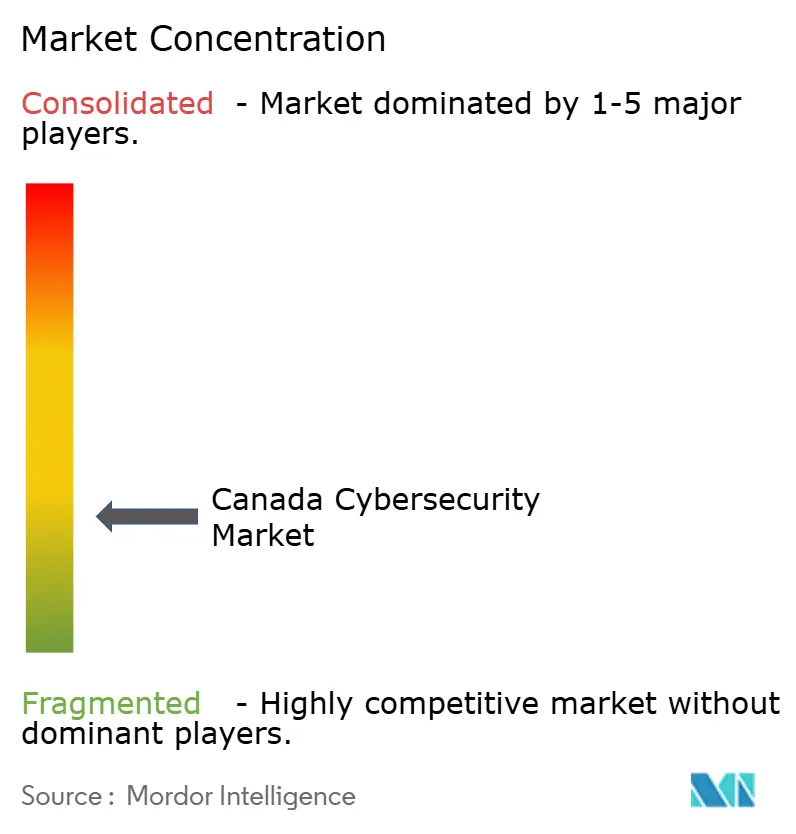
| Market Concentration | Low |
Major Players *Disclaimer: Major Players sorted in no particular order Image © Mordor Intelligence. Reuse requires attribution under CC BY 4.0. | |
Canada Cybersecurity Market Analysis by Mordor Intelligence
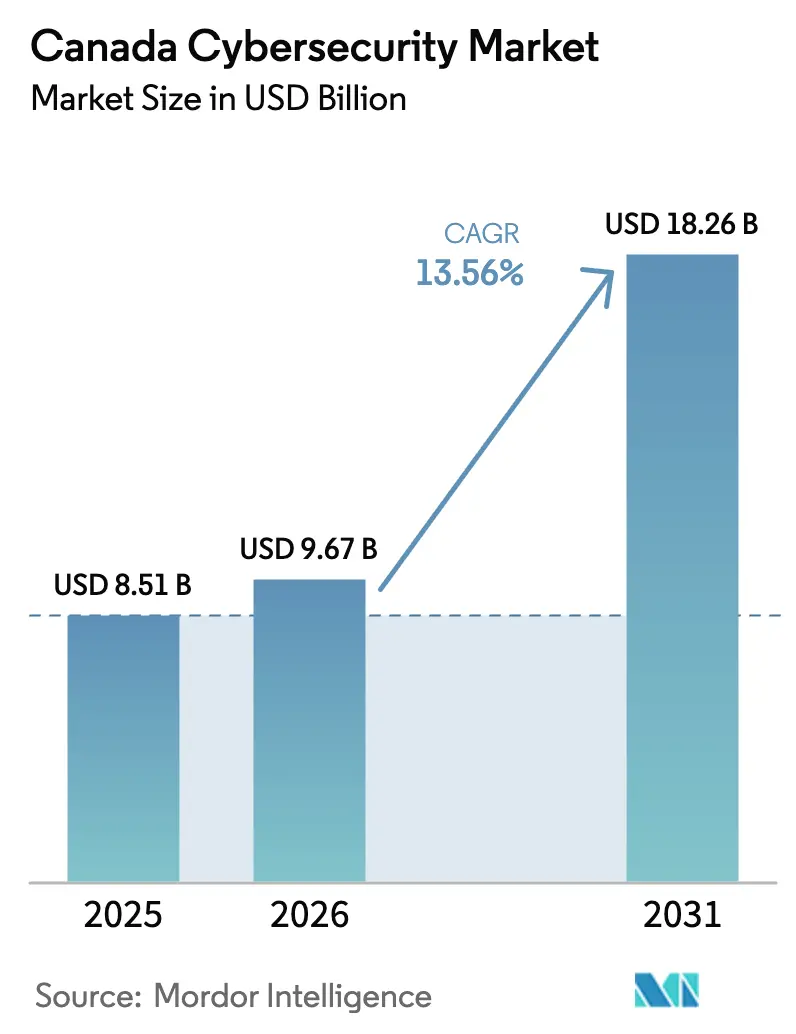
The Canada Cybersecurity Market size was valued at USD 8.51 billion in 2025 and is estimated to grow from USD 9.67 billion in 2026 to reach USD 18.26 billion by 2031, at a CAGR of 13.56% during the forecast period (2026-2031). Growing ransomware sophistication, stricter federal breach-notification rules, and accelerated cloud adoption among small and medium enterprises are converging to push security from a one-time purchase to a continuous operational discipline. Vendors able to bundle threat intelligence, detection, and response into integrated platforms are gaining ground as boards seek unified visibility over expanding attack surfaces. Fragmented provincial mandates create additional demand for compliance-automation tools, while sovereign-data requirements give Canadian-born providers a competitive wedge against multinational rivals. Intensifying competition, rising incident costs, and sizable public-sector investments position the Canada cybersecurity market for sustained double-digit growth through the forecast horizon.
Key Report Takeaways
- By offering, solutions led with a 62.73% revenue share of the Canada cybersecurity market in 2025, while services are forecast to expand at a 15.22% CAGR through 2031.
- By deployment mode, cloud architectures captured 63.84% of the Canada cybersecurity market share in 2025 and will accelerate at a 15.32% CAGR to 2031.
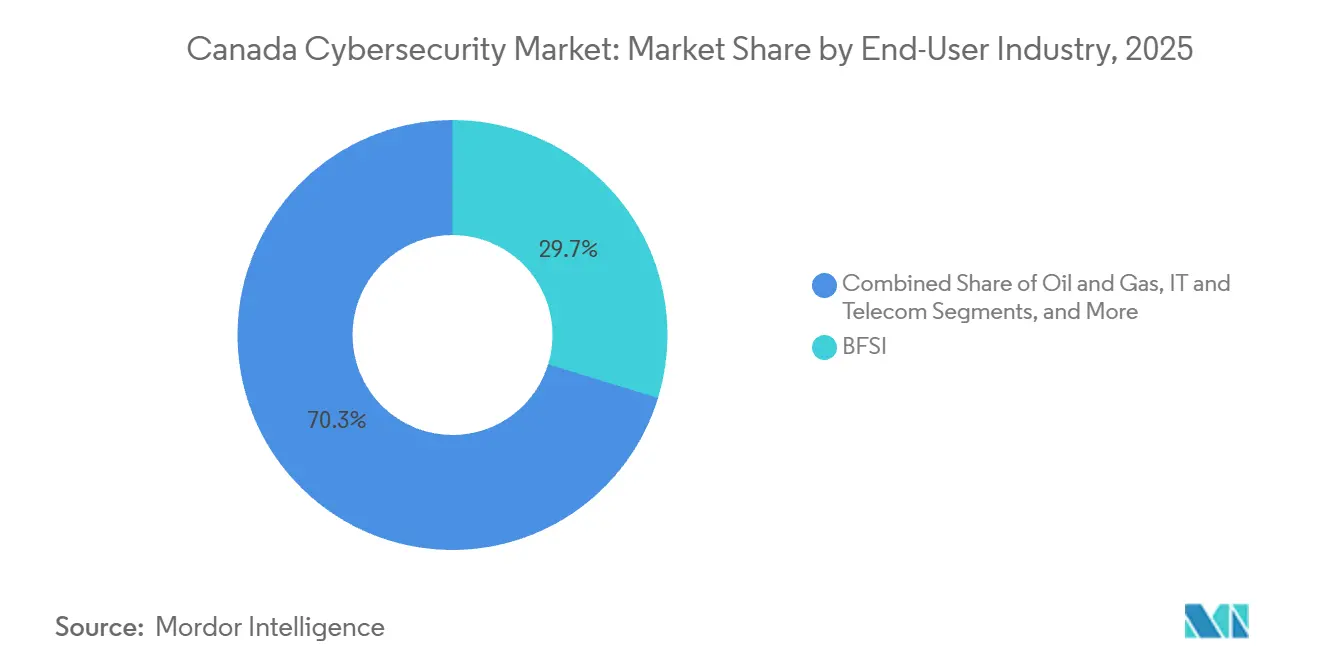
- By end-user industry, banking, financial services, and insurance held a 29.73% revenue share of the Canada cybersecurity market in 2025; healthcare is projected to post the fastest 14.66% CAGR through 2031.
- By enterprise size, large organizations accounted for 61.74% of 2025 spending of the Canada cybersecurity market, whereas small and medium enterprises will rise at a 15.42% CAGR through 2031.
Note: Market size and forecast figures in this report are generated using Mordor Intelligence’s proprietary estimation framework, updated with the latest available data and insights as of January 2026.
Canada Cybersecurity Market Trends and Insights
Drivers Impact Analysis*
| Driver | (~) % Impact on CAGR Forecast | Geographic Relevance | Impact Timeline |
|---|---|---|---|
| Rising frequency and cost of ransomware incidents | +2.8% | National, pronounced in healthcare and municipal services | Short term (≤ 2 years) |
| Tightening federal regulation (Bill C-26 and CCSPA) | +3.2% | National, sector-specific enforcement in BFSI, telecom, energy, transportation | Medium term (2-4 years) |
| Accelerated cloud migration by Canadian SMEs | +2.4% | National, higher adoption in Ontario, Quebec, British Columbia | Medium term (2-4 years) |
| Public-sector digital-service expansion and Zero-Trust mandates | +2.1% | Federal agencies and provincial digital-service teams | Medium term (2-4 years) |
| Province-specific critical-infrastructure mandates | +1.5% | Ontario, Quebec, Alberta, British Columbia | Long term (≥ 4 years) |
| “Buy Canadian Cyber” federal procurement platform | +1.2% | Federal procurement and downstream public contracts | Long term (≥ 4 years) |
| Source: Mordor Intelligence | |||
Rising Frequency and Cost of Ransomware Incidents
High-profile attacks demonstrate that total recovery costs far exceed ransom payments, encompassing system rebuilds, legal counsel, and reputational remediation. The CAD 5.7 million (USD 4.2 million) paid by the City of Hamilton in February 2024 highlights how multi-stage extortion cripples essential services and triggers public scrutiny. Healthcare suffered a major blow when 326,800 patient records were exposed during the TransForm incident, which spurred a CAD 480 million (USD 355 million) class-action lawsuit. Retail vulnerability was illustrated by London Drugs, which closed 79 stores for a week and faced employee-notification expenses. Statistics Canada noted that 16% of businesses endured a cyber event in 2023, with combined recovery and prevention outlays surpassing USD 9 billion. The National Cyber Threat Assessment 2025-2026 singles out ransomware-as-a-service ecosystems as the leading threat vector, pushing boards to classify cyber risk as an enterprise-continuity issue.[1]
Tightening Federal Regulation (Bill C-26 and CCSPA)
Parliament has compressed incident-reporting windows and elevated cybersecurity oversight to the board level. Bill C-26 obliges critical-infrastructure operators to implement formal security programs, submit to audits, and face penalties for non-compliance. The Canadian Consumer Privacy Act imposes a 72-hour notification rule and grants the Privacy Commissioner order-making power, prompting enterprises to adopt automated detection and response workflows. Guideline B-13 from the banking regulator requires board-level cyber-risk governance and annual penetration testing, embedding cybersecurity in prudential oversight. The 2025 National Cyber Security Strategy earmarks USD 28 million for threat-intelligence collaboration, while Budget 2024 allocates USD 678.5 million over five years to Zero-Trust pilots across federal agencies. Collectively, these measures heighten compliance pressure and accelerate platform consolidation.
Accelerated Cloud Migration by Canadian SMEs
Small and medium enterprises are moving workloads to hyperscale platforms that provide built-in encryption, identity management, and threat analytics. Cloud deployment held 63.84% share in 2025 and is projected to outpace on-premise growth at a 15.32% CAGR. Federal cloud-first guidance has set a procurement benchmark replicated by provinces and municipalities. Managed detection and response subscriptions bundle endpoint, SIEM, and analyst triage into one monthly fee, giving resource-constrained firms 24/7 coverage without capital expenditure. CyberSecure Canada certification supplies vetted provider lists, lowering search costs and reinforcing cloud uptake among the long-tail of businesses.
Public-Sector Digital-Service Expansion and Zero-Trust Mandates
Government digitization programs are replacing perimeter-based defenses with identity-centric controls. Treasury Board funding supports Zero-Trust pilots that authenticate every user and device before granting access. Bill C-72 forces healthcare networks to enable cross-provincial data exchange, necessitating robust encryption and breach-detection capabilities. Ontario requires privacy-impact assessments within 24 hours of an incident, while British Columbia offers subsidized assessments to small and medium enterprises. Public-sector standards thus cascade into private-sector procurement criteria, spurring demand for identity and access management and micro-segmentation tools.
Restraints Impact Analysis*
| Restraint | (~) % Impact on CAGR Forecast | Geographic Relevance | Impact Timeline |
|---|---|---|---|
| Acute mid-level cyber-talent shortage | -2.1% | National hot spots in Toronto, Montreal, Vancouver | Medium term (2-4 years) |
| High TCO of advanced XDR/Zero-Trust architectures | -1.8% | National, heaviest on SMEs and mid-market firms | Short term (≤ 2 years) |
| Compliance overlap drives audit costs | -1.2% | BFSI and healthcare face multi-agency oversight | Medium term (2-4 years) |
| SME budget fatigue and MDR subscription churn | -1.0% | Retail, hospitality, professional services | Short term (≤ 2 years) |
| Source: Mordor Intelligence | |||
Acute Mid-Level Cyber-Talent Shortage
Canada requires thousands of additional analysts who can triage alerts, conduct forensics, and refine detection rules. Universities are not producing enough graduates with three to seven years of experience, causing salary inflation that erodes security-operations budgets. The gap is widest for small and medium enterprises, which must rely on managed services because they cannot match the compensation packages offered by financial institutions and technology firms. Government workforce-development programs aim to expand talent pipelines, yet the shortage will persist through the medium term and temper adoption of complex security architectures.[2]
High TCO of Advanced XDR/Zero-Trust Architectures
Licensing alone understates the full expense of extended detection and response and Zero-Trust frameworks. Organizations must inventory assets, rewrite access policies, and retrain staff, consuming as much as 30% of annual security budgets before measurable risk reduction appears. Small and medium enterprises struggle with subscription fatigue as endpoint, email, identity, and SIEM services add recurring fees. This cost pressure slows migration to integrated platforms and sustains demand for bundled managed services that shift integration burdens to providers.[3]
*Our forecasts treat driver/restraint impacts as directional, not additive. The impact forecasts reflect baseline growth, mix effects, and variable interactions.
Segment Analysis
By Offering: Services Outpace Solutions as Security Turns Operational
Solutions represented 62.73% of 2025 revenue, yet services are poised to expand faster than solutions sales, advancing at a 15.22% CAGR through 2031 as organizations view protection as a continuous discipline rather than a capital purchase. Managed detection and response dominates services growth, particularly among firms lacking dedicated security staff. Professional services consulting, integration, and training rise when enterprises deploy Zero-Trust or extended detection and response platforms that demand policy overhauls.
The installed base of firewalls, endpoint agents, and identity platforms ensures solutions retain a sizeable footprint, but growth clusters around cloud security and identity and access management as workloads migrate and authentication replaces perimeter defenses. Application-layer protection gains momentum amid heightened software-supply-chain attacks, while integrated risk-management dashboards help boards monitor compliance. This operational tilt underscores that the Canada cybersecurity market is shifting from isolated tools to outcome-based services that merge technology and talent.

By Deployment Mode: Cloud Architectures Cement Leadership
Cloud deployments held 63.84% Canada cybersecurity market share in 2025 and are projected to rise at a 15.32% CAGR, propelled by hyperscalers’ embedded threat analytics and economies of scale. Federal and provincial cloud-first mandates create clear procurement pathways, and Microsoft’s USD 5.5 billion data-center expansion underscores provider confidence in sovereign-cloud demand. Small and medium enterprises benefit from pay-as-you-go models that compress implementation timelines and outsource maintenance.
On-premise installations persist in sectors governed by strict data-sovereignty or operational-technology constraints, notably banking, energy, and critical infrastructure. Hybrid strategies that pair local data stores with cloud-based analytics balance control and scalability. Telecommunications carriers such as Bell Canada are capitalizing on the trend by reselling managed cloud security, cementing their role as intermediaries between hyperscalers and risk-averse customers. Over the forecast horizon, pure on-premise rollouts will decline, but hybrid architectures will keep local data centers relevant within the broader Canada cybersecurity market.
By End-User Industry: Healthcare Surges While BFSI Retains Scale
Banking, financial services, and insurance held 29.73% of 2025 outlays, buoyed by regulator-mandated board oversight, annual penetration testing, and ISO-aligned response plans. Guideline B-13 compels institutions to treat cyber risk on par with credit exposure, keeping budgets robust. Healthcare, conversely, is expected to record a 14.66% CAGR as Bill C-72 mandates interoperable electronic records, heightening liability for breaches and fueling demand for encryption and identity tools.
Government entities accelerate spending by modernizing citizen services and imposing 24-hour reporting windows, while energy and utilities protect sprawling operational-technology estates that adversaries view as high-value targets. Retail and consumer sectors invest in business-continuity tools after headline-grabbing outages. Across segments, managed detection and response bridges talent gaps, underscoring why services will outrun solutions within the Canada cybersecurity market size forecast.

By Enterprise Size: SMEs Embrace Managed Detection and Response
Large enterprises accounted for 61.74% of 2025 revenue through sizable security operations centers and multilayered platforms. However, small and medium enterprises are forecast to grow at 15.42% annually through 2031, propelled by subscription-based offerings that bundle endpoint protection, SIEM, and expert triage. Rising cyber-insurance premiums and stricter underwriting standards now require evidence of continuous monitoring, nudging SMEs toward certified providers listed under the CyberSecure Canada program.
Sovereign-data residency plays to domestic vendors’ strengths. Firms such as eSentire, Arctic Wolf, and Field Effect compete successfully against multinational platforms by combining rapid incident response with Canadian storage and aligning with customer compliance needs. As board-level scrutiny spreads from large corporations to mid-market firms, SMEs will allocate a larger share of their IT budgets to security, propelling the services-led growth engine of the Canada cybersecurity market.
Geography Analysis
Ontario, Quebec, British Columbia, and Alberta account for the bulk of the Canada cybersecurity market, yet each province enforces distinct mandates that shape local demand. Ontario’s Bill 194 requires privacy-impact assessments for all public-sector digital services and imposes a 24-hour incident-reporting window, spurring rapid procurement of automation tools. Quebec’s Bill 82 established the Ministry of Cybersecurity and Digital Affairs and introduced mandatory notification for private-sector breaches, while launching a cross-provincial digital-identity framework. Alberta’s 2024 strategy emphasizes quantum readiness and public-private information sharing, positioning the province as a hub for post-quantum cryptography research. British Columbia’s CyberBC program subsidizes assessments for small and medium enterprises, broadening the addressable market for managed service providers.
Provincial fragmentation complicates compliance for national enterprises but creates opportunities for vendors offering multi-jurisdictional reporting dashboards. Federal initiatives mitigate disjointed rules, the National Cyber Security Strategy funds threat-intelligence exchange, and Budget 2024 backs Zero-Trust pilots across agencies. Treasury Board allocations accelerate identity-centric controls that will ripple through provincial procurement templates. Together, these programs elevate baseline expectations for incident detection and reporting across Canada cybersecurity market stakeholders.
Toronto, Montreal, and Vancouver anchor the vendor ecosystem, hosting headquarters for eSentire, CGI, and 1Password and benefiting from proximity to financial hubs and research universities. Calgary leverages its energy sector to drive operational-technology security contracts. Even smaller provinces feel the impact of rising threat activity. Saskatchewan faced a healthcare breach that compromised thousands of patient files, underscoring that geographic scale offers no immunity. Overall, spending correlates with economic weight, but targeted provincial incentives ensure that growth opportunities proliferate nationwide, reinforcing the diversified geography of the Canada cybersecurity market size.
Regulatory Landscape
Canada is tightening cybersecurity governance for critical systems through federal legislation and regulator-led guidance. Bill C-8 received Royal Assent on June 16, 2026, establishing the Critical Cyber Systems Protection Act (CCSPA) and amending the Telecommunications Act. CCSPA requirements focus on cybersecurity programs, incident reporting, and oversight for designated operators in sectors such as finance, telecommunications, energy, and transportation.
The Communications Security Establishment (CSE) and its Canadian Centre for Cyber Security (Cyber Centre) remain key technical authorities, publishing alerts and advisories that shape baseline controls and patching urgency across public and private sectors. Compliance pressure is reinforced by national strategy and procurement-linked requirements that turn security controls into contractual obligations. The National Cyber Security Strategy 2025 provides a federal framework for collaboration and resilience, while Public Services and Procurement Canada introduced the Canadian Program for Cyber Security Certification (CPCSC) Level 1 in April 2026, with requirements applying to select defense contracts starting in summer 2026. Alongside province-level requirements referenced in the report (including Ontario and Quebec mandates), the combined framework raises demand for audit-ready security programs, reporting workflows, and documentation that can be produced consistently across jurisdictions.
Value Chain Analysis
The Canada cybersecurity value chain connects global platform vendors and domestic specialists, with demand flowing from regulated end users (BFSI, telecom, government, energy, transportation, and healthcare) into procurement vehicles, integrators, and managed service providers. Upstream, multinational vendors supply core security technologies, including endpoint, network, cloud, identity, and SIEM/XDR. Canadian firms tend to differentiate via local incident response, data residency alignment, and sector-specific expertise.
Federal procurement mechanisms influence downstream channel dynamics through qualified supplier ecosystems such as the Cyber Security Procurement Vehicle (CSPV) pool of approved vendors, which provides a structured route to public-sector awards. Delivery and operations are services-heavy, with systems integrators, telecom carriers, and MDR providers packaging tools with 24/7 monitoring, response, and compliance support to address talent constraints. Regional clusters also shape the ecosystem, including Toronto-Waterloo for talent and venture formation, Montreal for AI research, and Ottawa for defense and national-security adjacency. Hardware still matters for finished networking and security appliances, but software and services capture a larger share as buyers standardize on integrated platforms and continuous operations.
Competitive Landscape
The Canada cybersecurity market is fragmented, with no single player exceeding a 10% share. Multinational platforms Microsoft, Cisco, Palo Alto Networks compete alongside Canadian specialists such as eSentire, Arctic Wolf, Field Effect, and BlackBerry Cybersecurity, whose local data residency and rapid incident response resonate with compliance-minded buyers. Arctic Wolf’s USD 160 million purchase of BlackBerry’s Cylance endpoint business integrates artificial-intelligence prevention with managed detection and response, illustrating the rush toward unified visibility.
Systems integrators are also active. CGI’s December 2025 acquisition of OBS augments its managed services and positions the firm to bundle security with digital-transformation engagements. Telecommunications carriers are expanding into security through partnerships and acquisitions, capitalizing on existing network footprints. White-space opportunities persist in operational-technology defense, compliance automation, and software supply-chain assurance, niches that firms such as Cybeats and Magnet Forensics are addressing through specialized tooling.
Investment momentum supports continued innovation. Microsoft’s USD 5.5 billion sovereign-cloud build-out, IBM’s USD 155 million semiconductor research infusion, and 1Password’s USD 75 million funding round all underscore confidence in domestic growth potential. Against this backdrop, managed detection and response vendors are best positioned to capture share as clients shift from point solutions to outcome-based subscriptions. Competitive intensity is expected to rise, yet the diverse mix of global and local players ensures vibrant choice for buyers across the Canada cybersecurity market.
Canada Cybersecurity Industry Leaders
-
IBM Canada Ltd.
-
Cisco Systems Canada Co.
-
Microsoft Canada Inc.
-
Check Point Software Technologies Ltd.
-
Palo Alto Networks (Canada) Ltd.
- *Disclaimer: Major Players sorted in no particular order
Market Opportunities and Future Outlook
Federal programs are creating identifiable whitespace for compliance-ready offerings that bundle governance artifacts, monitoring, and incident reporting into repeatable packages for regulated operators. With CCSPA established through Bill C-8 (Royal Assent on June 16, 2026), designated operators in finance, telecommunications, energy, and transportation have clearer obligations around formal cybersecurity programs and oversight. This tightens demand for compliance automation, continuous control monitoring, and evidence management that can support audits. The Cyber Centre also launched the Critical Infrastructure Resilience and Escalated Threat Navigation (CIREN) initiative in April 2026, adding a practical guidance stream that vendors and service providers can translate into runbooks, tabletop exercises, and incident-preparedness services for critical infrastructure.
Procurement-linked certification and R&D funding provide additional entry points, especially for Canadian providers looking to scale through government channels. Public Services and Procurement Canada launched CPCSC Level 1 in April 2026, and requirements apply to select defense contracts starting in summer 2026, which supports consultative readiness services and certified tooling among defense suppliers and their IT partners. On the innovation side, the National Cybersecurity Consortium (NCC) maintains a project funding pipeline exceeding CAD 133.1 million for collaborative R&D, supporting productization in areas such as threat intelligence sharing, resilience, and advanced cryptography. This funding channel also gives startups and academic-industry partnerships a pathway to move pilots into deployable solutions in the Canadian market.
Recent Industry Developments
- July 2026: Microsoft Canada disclosed critical vulnerabilities in SharePoint Server and announced end of life for SharePoint Enterprise Server 2016/2019 on July 14, 2026. The vulnerabilities affect Canadian enterprises using SharePoint, highlighting ongoing exposure in on premises environments. The end of life pushes customers toward cloud and SaaS based deployments, accelerating modernization in the Canadian market.
- June 2026: IBM Canada Ltd. published security advisories AV26-597 and associated critical updates for multiple products. The actions reinforce the need for robust patch management across Canadian IT environments. The updates strengthen incident response capabilities and reduce risk from widespread vulnerabilities in enterprise deployments.
- May 2026: Cisco Systems Canada Co. released advisory AV26-430 addressing Crosswork Network Controller, IoT Field Network Director, Network Services Orchestrator, and SD-WAN CVE-2026-20182 in Cloud release 20.15.506. The advisory targets vulnerabilities affecting network management and SD-WAN capabilities for Canadian customers. Prompt patching supports resilience of enterprise networks amid rising threat activity in the market.
Research Methodology Framework and Report Scope
Market Definition and Coverage
For this study, the Canada cybersecurity market covers spending on products and services that prevent, detect, respond to, and recover from cyber threats across Canadian public and private organizations, including on-premise and cloud delivered models.
Scope exclusions: This sizing excludes in-house internal labor costs that are not paid to external cybersecurity vendors or service providers.
Segmentation Overview
- By Offering
- Solutions
- Application Security
- Cloud Security
- Data Security
- Network Security
- Endpoint Security
- Infrastructure Protection
- Integrated Risk Management
- Identity and Access Management (IAM)
- Services
- Professional Services
- Managed Services
- Solutions
- By Deployment Mode
- Cloud
- On-Premise
- By End-user Industry
- BFSI
- Government and Public Sector
- Oil and Gas
- IT and Telecom
- Retail, E-commerce and Consumers
- Manufacturing and Industrial
- Energy and Utilities
- Healthcare
- Other End-user Industries
- By End-user Enterprise Size
- Large Enterprises
- Small and Medium Enterprises (SMEs)
Data Sources, Market Sizing, and Validation
Desk Research
Desk research was used to set the guardrails for the model, mainly by understanding demand drivers, policy triggers, and where cybersecurity budgets typically sit within overall IT spending. We referenced public sources such as Statistics Canada digital economy and business ICT tables, Government of Canada cyber and privacy guidance, the Canadian Centre for Cyber Security advisories, and federal publications on the cybersecurity industry footprint (output, revenue, and jobs). We also reviewed broader signals like breach reporting obligations, public sector procurement patterns, and cloud adoption narratives that show up across industries.
To convert those signals into workable model inputs, we used a mix of company annual reports and investor materials for revenue cues, and reputable press coverage for incident trends. We also reviewed patents and standards literature to sanity check technology themes and mapping. In selective cases, paid subscriptions for company financials and news intelligence, patent databases, and public tenders helped speed up cross checks, especially when disclosures were not cleanly split for Canada. The desk sources mentioned above are illustrative, and many other public documents and datasets were also used for data collection, cross verification, and research clarification.
Primary Interviews and Surveys
Primary work focused on validating what is actually purchased in Canada, how buyers split spend between tools and services, and how deployment choices are shifting as cloud programs mature. We engaged with a mix of suppliers, channel and service partners, and buyer side security leaders across major end user groups in Canada to confirm assumptions, fill gaps left by public data, and then align the final model outputs to real procurement behavior.
Distribution of primary research fieldwork respondents
| Company type | Respondent position |
|---|---|
| Top tier: 35% | CXOs: 13% |
| Mid tier: 48% | Functional/Unit leaders: 28% |
| Smaller Players: 17% | Managers: 59% |
Market-Sizing & Forecasting
Sizing started from a top-down build where national IT and digital spend signals were reconstructed into a cybersecurity demand pool, and then split by common buying patterns across Canadian enterprises and public agencies. The totals were corroborated with selective bottom-up checks, such as sampled vendor and partner revenue cues, channel intensity, and approximate ASP times volume for high frequency tools, which were then used to adjust outliers.
Key model inputs included the pace of cloud workload migration, the share of organizations adopting managed security services due to skills gaps, breach and ransomware incident pressure, federal and provincial compliance needs, and sector exposure differences across BFSI, government, telecom, and energy. Where public series were not available at the right granularity, we used primary feedback to set reasonable ranges and then stress tested the outputs so the implied spend per organization stayed realistic.
For the forecast, scenario analysis was used because spending can swing with regulation updates and incident cycles. Growth paths were anchored on expected security tooling refresh cycles, service attach rates, and cloud security penetration, and then checked against what respondents report during budget approvals across the forecast window.
Data Validation & Update Cycle
Validation was done through multiple checks so the final value does not rely on a single data stream. We compared the modeled totals against independent signals like public sector security program intensity, reported cyber incident trends, and the implied share of cybersecurity within broader IT spend, and then reviewed any jumps that did not match a real market driver.
Before sign off, the work is reviewed in steps, including internal analyst review of assumptions, variance checks across cut points, and re-contacts when interview feedback conflicts with desk indicators. The report is refreshed annually, and interim updates are made when material events occur, such as regulatory shifts, large cyber incidents that affect spend allocation, or meaningful changes in cloud adoption. Right before delivery, an analyst performs a fresh data pass so clients receive the latest updated view.
Mordor Intelligence's Canada Cybersecurity Market Estimate Compared With Other Published Estimates
Published market sizes for Canada cybersecurity often differ because researchers do not always count the same spend categories, and they may anchor the base year on a different timing of currency conversion and budget cycles. Differences also come from how services are treated, especially when managed security, incident response retainers, and cloud security operations are bundled into broader IT contracts.
The benchmark table shows a spread that is largely explained by what gets counted as cybersecurity spending, and in Mordor Intelligence's model, the market includes both solutions and services purchased by Canadian end users across cloud and on-premise deployments, instead of limiting the total to a narrower product only view or a supplier footprint snapshot.
Benchmark comparison
| Source | Market Size | Gaps in Research Methodology |
|---|---|---|
| Mordor Intelligence | USD 8.51 B (2025) | |
| Industry Research Publisher A | USD 7.30 B (2024) | Uses an earlier base year and may apply a tighter service capture, which can undercount recurring managed security and incident response spending that rises with cloud operations and compliance work. |
| Government Industry Snapshot B | USD 3.70 B (2020) | Supplier side measure of cybersecurity firm revenues in one year, which can exclude imported solutions and buyer side spend paid to broader IT service providers that deliver security as part of wider contracts. |
Overall, the differences are consistent with scope and measurement choices, rather than a disagreement on growth direction. By tying the model to clear demand signals, practical service attach assumptions, and repeatable cross checks, the final value stays traceable for planning and budgeting discussions.
Key Questions Answered in the Report
What is the projected value of the Canada cybersecurity market by 2031?
The market is forecast to reach USD 18.26 billion by 2031, growing at a 13.56% CAGR.
Which deployment model is expanding the fastest in Canada?
Cloud-based security leads growth, projected to rise at a 15.32% CAGR through 2031.
Why is healthcare spending on cybersecurity accelerating?
Bill C-72’s interoperability rules and recent ransomware attacks are driving a 14.66% CAGR in healthcare security budgets.
How are small and medium enterprises addressing talent shortages?
SMEs are increasingly adopting managed detection and response subscriptions that bundle technology and analyst expertise into predictable monthly fees.
Which provinces have introduced notable cybersecurity legislation recently?
Ontario enacted Bill 194, Quebec passed Bill 82, Alberta updated its Cybersecurity Strategy, and British Columbia expanded the CyberBC program.