
Market Overview
| Study Period | 2020 - 2031 |
|---|---|
| Forecast Data Period | 2026 - 2031 |
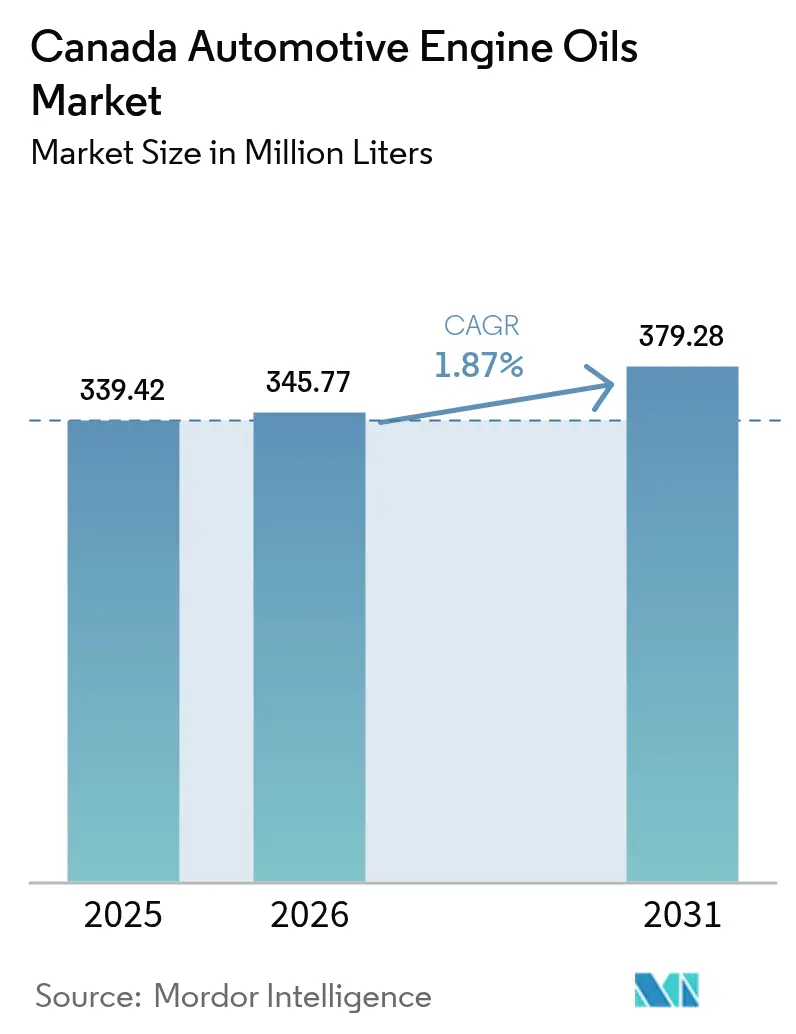
| Base Year Market Size (2025) | 339.42 Million Liters |
| Market Volume (2026) | 345.77 Million Liters |
| Market Volume (2031) | 379.28 Million Liters |
| Growth Rate (2026 - 2031) | 1.87 % |
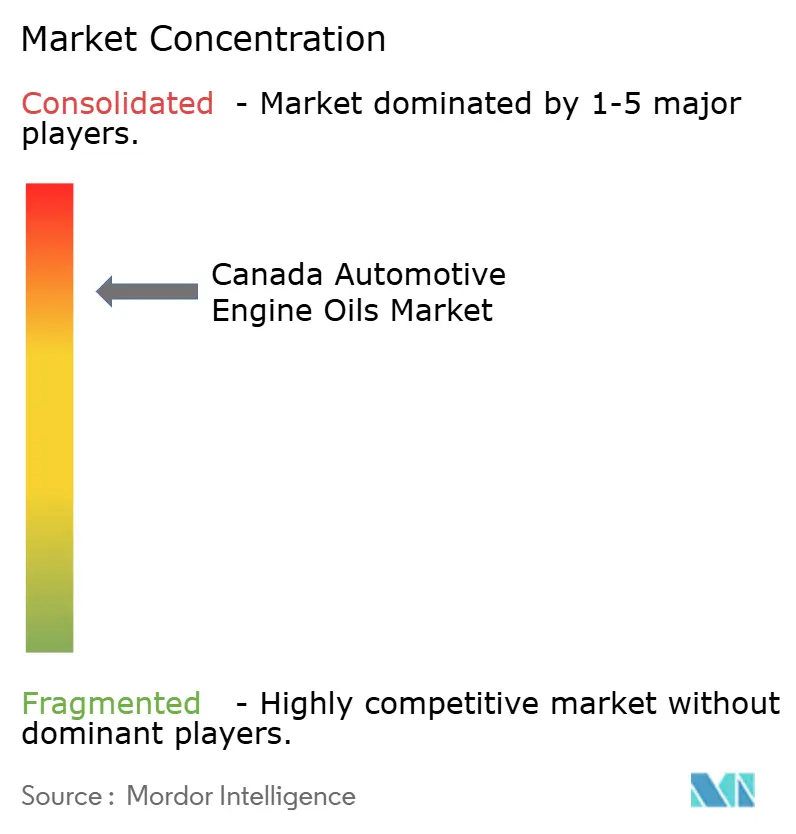
| Market Concentration | High |
Major Players *Disclaimer: Major Players sorted in no particular order Image © Mordor Intelligence. Reuse requires attribution under CC BY 4.0. | |
Canada Automotive Engine Oils Market Analysis by Mordor Intelligence
The Canada Automotive Engine Oils Market size is expected to grow from 339.42 million liters in 2025 to 345.77 million liters in 2026 and is forecast to reach 379.28 million liters by 2031 at 1.87% CAGR over 2026-2031. Growing demand for low-viscosity synthetic grades, the resilience of heavy-duty vehicle activity, and climate-driven viscosity requirements underpin the measured expansion of the Canada automotive engine oils market. While electrification is beginning to erode lubricant consumption in the United States and Mexico, Canada’s colder climate, longer average vehicle age, and extensive resource-extraction corridors slow the substitution effect. Multinational suppliers are scaling synthetic production capacity to meet Clean Fuel Regulations that favor 0W-20 and 5W-20 formulations. At the same time, e-commerce growth pushes light commercial fleets to operate in start-stop urban cycles that elevate oil stress levels and accelerate fill frequency, partially offsetting volume lost to passenger EV adoption. Competitive dynamics remain shaped by vertically integrated majors that leverage upstream access to Alberta crude, refinery presence in Ontario and Quebec, and nationwide retail footprints, sustaining high brand visibility and scale efficiencies.
Key Report Takeaways
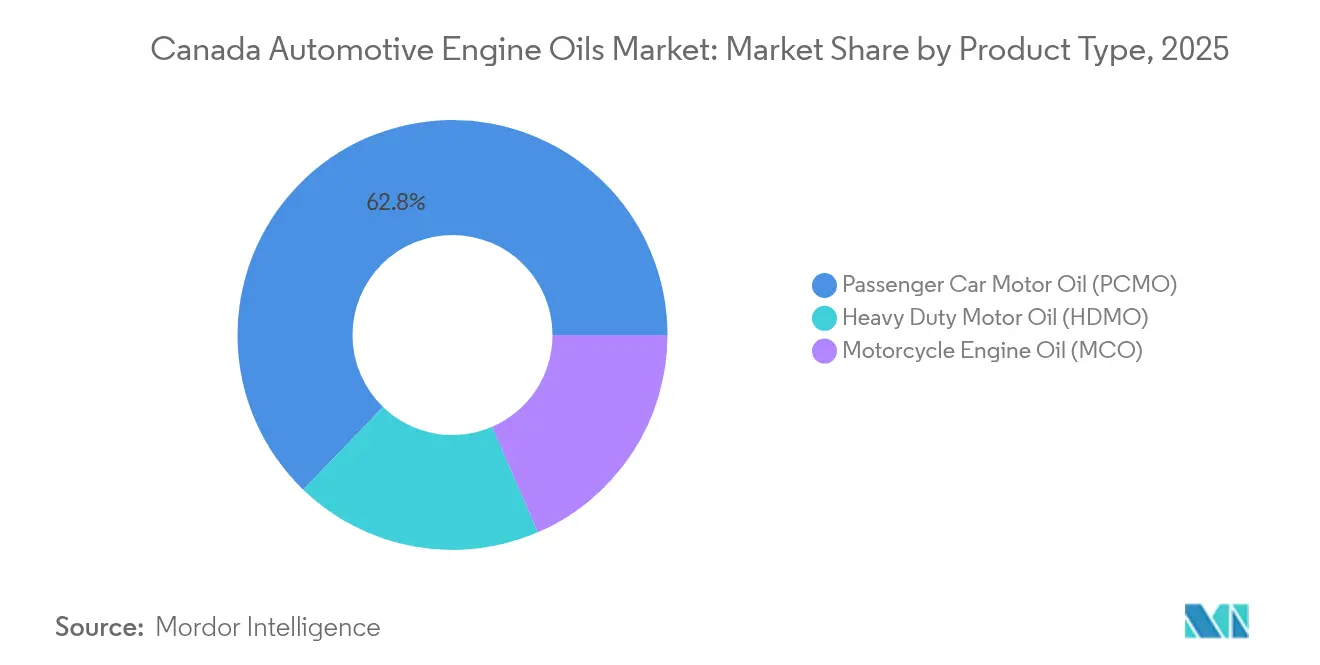
- By product type, passenger car motor oil accounted for a 62.78% share of the Canada automotive engine oils market size in 2025, whereas heavy duty motor oil is forecast to advance at a 2.02% CAGR through 2031.
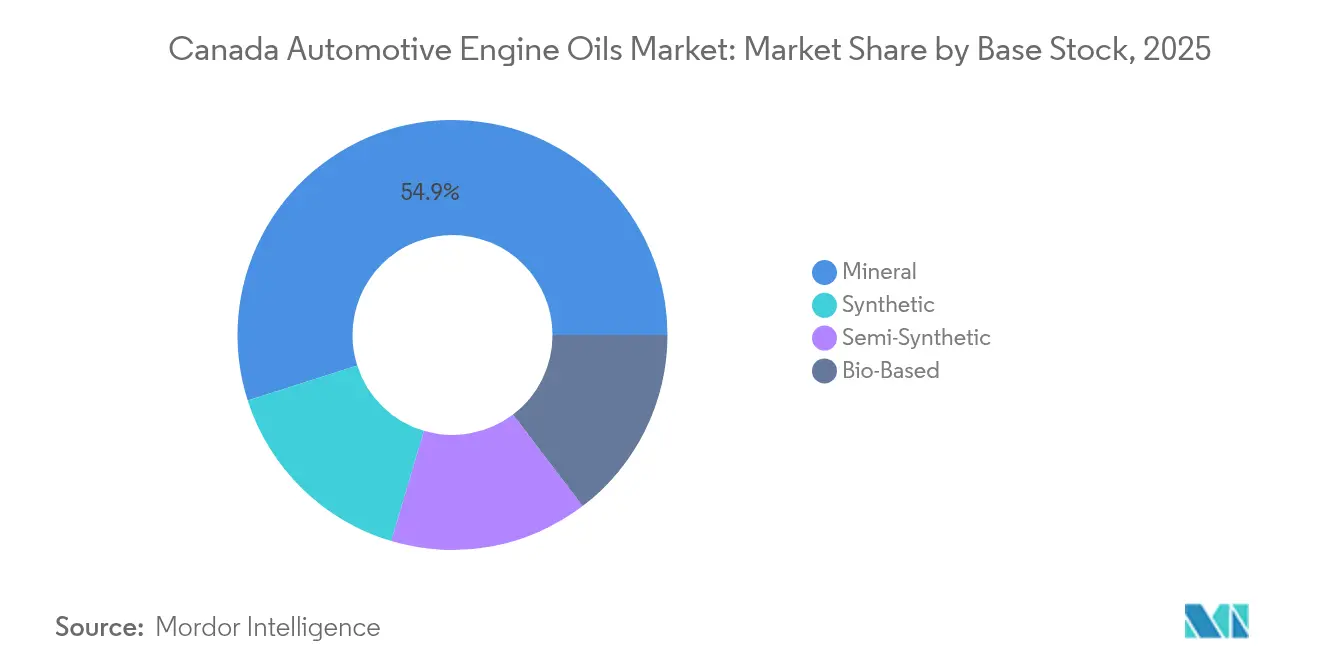
- By base stock, mineral oils held 54.92% of the Canada automotive engine oils market share in 2025, while synthetic grades are projected to expand at a 2.14% CAGR between 2026 and 2031.
Note: Market size and forecast figures in this report are generated using Mordor Intelligence’s proprietary estimation framework, updated with the latest available data and insights as of 2026.
Canada Automotive Engine Oils Market Trends and Insights
Drivers Impact Analysis*
| Driver | (~) % Impact on CAGR Forecast | Geographic Relevance | Impact Timeline |
|---|---|---|---|
| Rapid growth of last-mile delivery fleets | +0.40% | National, concentrated in Toronto, Vancouver, Montreal metropolitan areas | Medium term (2-4 years) |
| Surge in ride-hailing platform vehicles and bulk-service tie-ups | +0.30% | Urban centers, expanding to mid-tier cities | Short term (≤ 2 years) |
| Tightening CO₂ / Euro 6-equivalent emission norms driving premium synthetics | +0.20% | National, with early adoption in British Columbia, Ontario | Long term (≥ 4 years) |
| OEM-mandated extended-drain intervals raising per-fill value | +0.10% | National, led by premium vehicle segments | Medium term (2-4 years) |
| Motorcycle enthusiast culture boosting high-performance oils | +0.10% | Regional, strongest in Alberta, British Columbia | Short term (≤ 2 years) |
| Source: Mordor Intelligence | |||
Rapid Growth of Last-Mile Delivery Fleets
Commercial vehicle registrations rose 8.3% in 2024, and a large share of that gain came from light vans servicing e-commerce fulfillment[1]Statistics Canada, “Motor Vehicle Registrations,” statcan.gc.ca . Every vehicle in this cohort experiences frequent cold starts, prolonged idling, and dense stop-and-go operation that degrade conventional oils quickly. Fleet managers now specify semi-synthetic or full-synthetic formulations to maintain viscosity at elevated sump temperatures and to secure warranty compliance across mixed-make fleets. Concentrated activity in Toronto, Vancouver, and Montreal produces localized spikes in lubricant demand that wholesalers must meet with flexible inventory programs. The Canada automotive engine oils market benefits because these fleets favor 10,000 km or shorter drains despite OEM guidance, opting for preventive maintenance to cut downtime. Suppliers that bundle telematics-based oil monitoring with bulk delivery contracts are strengthening long-term customer stickiness in this fast-growing niche.
Surge in Ride-Hailing Platform Vehicles and Bulk-Service Tie-ups
Uber and other mobility platforms formalized fleet-maintenance agreements in 2024 that allow operators to buy premium synthetics at negotiated rates. Typical ride-hailing vehicles accumulate over 200,000 km annually, driving synthetic oil penetration as platforms enforce strict vehicle uptime metrics. These B2B channels now capture a sizeable portion of urban PCMO volume that previously moved through quick-lube outlets. Concentration of demand in large metropolitan areas lets suppliers schedule milk-run deliveries and reduce last-mile logistics costs. The Canada automotive engine oils market, therefore, records higher average selling prices even as overall passenger-car kilometres plateau. New entrants that lack B2B relationships face a steeper climb because brand switching costs have fallen for fleet owners who buy on total cost of ownership rather than ticket price alone.
Tightening CO₂ / Euro 6-Equivalent Emission Norms Driving Premium Synthetics
Clean Fuel Regulations mandate stepwise carbon-intensity reductions that push automakers toward engines calibrated for thinner oils. OEM service manuals increasingly prescribe 0W-20 and 5W-20 synthetics with high VI base oils that minimize hydrodynamic drag. Mineral oils often fail cold-crank simulations at -30 °C, common in prairie provinces, forcing a migration to Group III or Group IV stocks. Provinces that attach provincial carbon levies to tailpipe emissions have accelerated adoption, with British Columbia leading due to its aggressive ZEV credits. As engine downsizing and turbocharging proliferate, formulation specialists incorporate shear-stable viscosity modifiers and low-SAPs additive packs to protect after-treatment devices. The regulation led shift toward synthetics sustains volume even as drain intervals elongate, maintaining revenue resilience for the Canada automotive engine oils market.
OEM-Mandated Extended-Drain Intervals Raising Per-Fill Value
Ford’s 2024 bulletin moved scheduled drains for select models from 8,000 km to 16,000 km, contingent on certified synthetic usage. This tactic transfers routine maintenance cost to consumers, yet it also lifts per-fill value, because full synthetics command 40-60% price premiums over mineral alternatives. Fleets gain productivity through fewer service stops, but lubricant marketers offset shrinking litres with richer margins. Additive houses invest in boron and molybdenum chemistries that deliver TBN retention over longer cycles. The Canada automotive engine oils market therefore tilts toward high-value SKUs, cushioning suppliers from electrification-driven volume attrition. Extended drains are also spurring digital fleet dashboards that predict optimal oil-change timing, creating data-centric revenue opportunities for service providers.
Restraints Impact Analysis*
| Restraint | (~) % Impact on CAGR Forecast | Geographic Relevance | Impact Timeline |
|---|---|---|---|
| Shared-mobility consolidation reducing private-car kilometres | -0.20% | Urban centers, particularly Toronto, Vancouver, Montreal | Medium term (2-4 years) |
| Grey-import lubricants eroding branded volumes | -0.10% | Border regions, online retail channels | Short term (≤ 2 years) |
| Rising drain-intervals lowering service frequency | -0.10% | National, accelerated by OEM mandates | Long term (≥ 4 years) |
| Source: Mordor Intelligence | |||
Shared-Mobility Consolidation Reducing Private-Car Kilometres
Household vehicle ownership plateaued at 1.4 vehicles in 2024 as urban households opted for car-sharing subscriptions[2]OECD, “Household Transport Choices and Climate Policy,” oecd.org. Each shared unit records higher annual mileage, but the aggregate national VKT shrinks as redundant private vehicles leave the road. The Canada automotive engine oils market loses conventional retail transactions because professional fleet depots service these shared cars and often adopt extended-drain synthetics. Municipal investments in multimodal transport and zero-emission zones will deepen this trend by 2027. Suppliers respond by shifting promotional budgets from consumer channels to fleet account management, yet brand recognition among individual motorists declines, making future retention harder if ownership rebounds.
Grey-Import Lubricants Eroding Branded Volumes
Parallel imports through e-commerce sites surged during 2024, as currency swings widened the price gaps between U.S. and Canadian retail shelves. Unofficial channels offer branded packs at 20-30% discounts, undercutting authorized distributors. Warranty clauses rarely block these oils because they meet API and ILSAC labels, so price-sensitive do-it-yourself consumers embrace them. The Canada automotive engine oils market thus faces downward price pressure even within premium categories. Regulators are reviewing label-compliance enforcement, yet policing thousands of small parcels is challenging. Authorized suppliers counter with QR code authentication and loyalty programs, but the competitive moat continues to narrow in regions close to the U.S. border.
*Our forecasts treat driver/restraint impacts as directional, not additive. The impact forecasts reflect baseline growth, mix effects, and variable interactions.
Segment Analysis
By Product Type: Commercial Fleets Push HDMO Momentum
Heavy Duty Motor Oil accounted for a smaller base but is forecast to grow at a 2.02% CAGR to 2031 within the Canada automotive engine oils market. Resource extraction in Alberta, Saskatchewan, and British Columbia exposes engines to abrasive particulates and 40 °C temperature swings, compelling operators to specify high-TBN synthetics. OEMs endorse 10W-30 CK-4 formulations that promise 3% fuel-economy gains, an advantage that resonates when diesel costs spike. Fleet trials show 20,000 km drains are feasible under oil-analysis programs, reducing service pit stops in remote mining sites. Among on-road freight haulers, border congestion and long idling times raise soot levels, making premium detergency essential. Suppliers offering field-lab sample kits improve value perception and secure contract renewals.
Passenger Car Motor Oil retained a commanding 62.78% share of the Canada automotive engine oils market size in 2025. However, growth moderates as electric cars chip away at internal-combustion share in urban centers. Remaining ICE vehicles age, with a median of 10.6 years, which sustains demand for high-mileage 5W-30 formulations that swell seals and counter blow-by. Yet OEM push for 0W-20 synthetics in new models is shifting mix, lifting revenue per litre. Quick-lube chains adapt by promoting synthetic upgrades bundled with cabin filters and tire rotations to hold ticket values steady. Recreational off-roaders and performance enthusiasts preserve demand for 5W-50 and 10W-60 niche grades that carry premium margins.
Motorcycle Engine Oil remains a niche yet high-value pocket within the Canada automotive engine oils market. Seasonal riders in Alberta and British Columbia favor ester-rich synthetics that resist shear in shared-sump transmissions, and demand spikes between April and July. Powersports dealerships stock small-pack SKUs with attractive dollar-per-litre yields, although total litres are modest. LIQUI MOLY’s Parts Canada tie-up expands shelf presence at 1,200 locations and exemplifies the opportunity for specialty blenders to carve profitable micro-segments.


By Base Stock: Synthetic Leadership Strengthens
Synthetic formulations are projected to post a 2.14% CAGR through 2031, outpacing all other base-stock categories in the Canada automotive engine oils market. Group III and Group IV stocks deliver pour points below -40 °C, a critical attribute for reliable starts in prairie winters. Price premiums narrow as multinationals add capacity—Shell’s CAD 15 million expansion in Sarnia being a prime example—compressing unit economics for conventional mineral blends. Fleet TCO calculations favor synthetics once drain intervals exceed 12,000 km, tipping procurement policies even among cost-conscious small operators.
Mineral oils still held 54.92% of the Canada automotive engine oils market share in 2025, reflecting entrenched habits among owners of legacy vehicles built before 2015. DIY consumers buying 4-litre jug specials at big-box retailers remain loyal to SN-grade 5W-30 conventional oil that meets minimum warranty coverage at the lowest upfront cost. However, tightened volatility and cold-crank benchmarks under ILSAC GF-6 make it harder for mineral formulations to remain compliant without costly additive boosts. Semi-synthetic blends emerge as a compromise solution, capturing drivers moving up the quality curve while trimming sticker shock.
Bio-based lubricants stay nascent, limited to pilot deployments in municipal fleets that chase Scope 3 emission reductions. Earth Alive’s acquisition of Interlube positions it to scale biodegradable hydraulic fluids, yet automotive crankcase volumes will remain small until ASTM oxidation stability hurdles are cleared. Nonetheless, Clean Fuel Regulations assign carbon value to life-cycle emissions, so early adopters could gain subsidy support and secure future upside if policy incentives strengthen.
Geography Analysis
Ontario and Quebec together represent over half of the national lubricant demand by volume, aided by 18.2 million registered vehicles and dense dealership networks that ensure product availability. Ontario’s auto-assembly corridor drives OEM factory-fill requirements for export-bound vehicles, supporting steady offtake for 0W-20 synthetics. Quebec’s winter climate pushes retailers to stock higher VI grades that flow at -35 °C, driving an above-average synthetic mix. Urban electrification strategies in Toronto and Montreal will curb growth, yet last-mile van fleets clustered around suburban distribution hubs maintain baseline consumption.
Western Canada delivers the fastest incremental litres to the Canada automotive engine oils market. Alberta’s oil-sands haul trucks use 5-W 40 HDMO with advanced dispersant packages that maintain viscosity under severe soot load. British Columbia’s forestry and mining sectors rely on hydraulic fracturing and logging equipment that demand extreme-pressure additives. Recreational vehicle culture supports robust sales of motorcycle and ATV oils, especially during spring thaw when off-road trail access opens. Suppliers face logistical hurdles moving stock into remote northern towns, so bulk rail shipments to Edmonton and Calgary terminals are followed by road tanker redistribution.
Atlantic Canada records modest but stable demand. Its older vehicle parc leans toward mineral oils, and harsh salt-spray winters shorten vehicle life, keeping average engine technology dated. Distribution costs across dispersed coastal communities lift shelf prices, nudging some consumers toward online cross-border purchases that feed the grey-import channel. Nonetheless, commercial fishing fleets increasingly trial biodegradable gear oils under federal grant schemes, pointing to a potential early adopter role for bio-based crankcase liquids should technical barriers fall.
Regulatory Landscape
Regulation affecting automotive engine oils in Canada is anchored in the Canadian Environmental Protection Act, 1999 (CEPA), which governs chemical substance assessment and risk management for ingredients used in lubricants and additive packages. Environment and Climate Change Canada (ECCC) also administers the Clean Fuel Regulations (SOR/2022-140), linking lifecycle carbon-intensity compliance to formulation and additive documentation practices that shape demand for lower-viscosity, efficiency-oriented engine oils aligned with OEM requirements.
Compliance obligations also extend to fuels and additive reporting through the Fuels Information Regulations, No. 1, which require reporting by companies producing or importing more than 400 cubic meters of liquid fuel containing additives. In standards oversight, the Canadian General Standards Board (CGSB) published CAN/CGSB-3.517-2025 for diesel fuel in February 2025, and CGSB stopped offering standards development and conformity assessment services as of April 1, 2026, while keeping access to its standards catalogue, changing how market participants reference and procure standards documentation.
Value Chain Analysis
The value chain starts with crude supply and refining, supported by Canada's integrated petroleum footprint across provinces including Alberta (feedstock) and refining centers in Ontario and Quebec. Base oils then move to domestic lubricant manufacturing and blending, where large-scale producers such as Petro-Canada Lubricants in Mississauga, Ontario operate a major facility producing about 15,600 barrels per day of base oils and specialty lubricant products; formulation work combines base stocks with additive packages designed to meet OEM viscosity and performance requirements for cold-weather operation.
Downstream, packaging and distribution rely on a national network of terminals, wholesale routes, and retail and service channels. Industry infrastructure is represented by the Canadian Fuels Association, whose membership footprint includes 16 refineries, 76 fuel distribution terminals, and about 12,000 retail sites, supporting availability for both do-it-yourself retail packs and bulk supply to fleets, dealerships, and quick-lube operators. CEPA and fuel-related rules add compliance and documentation steps that influence sourcing (additive selection, traceability) and inventory strategy, while domestic blending assets such as Shell's Brockville lubricants plant in Ontario support continuity of supply across passenger car and heavy-duty formulations.
Competitive Landscape
The Canada automotive engine oils market exhibits consolidated concentration. Scale advantages secure stable feedstock, letting majors amortize additive R&D over larger volumes and sustain aggressive price promotions. Private-label store brands source base oils on the spot market and outsource blending, limiting their ability to match OEM-specific formulations or to secure factory-fill agreements.
Digital transformation is reshaping channel power. Quick-lube chains deploy subscription apps that recommend service windows based on telematics data, locking customers into brand ecosystems. B2B platforms negotiate multi-year supply contracts with ride-hailing or parcel-delivery fleets, bundling lubricant, filter, and diagnostic services. Majors that can guarantee just-in-time delivery to urban depots at competitive rates win share, while smaller regional blenders pivot toward niche products such as vintage-car zinc-rich formulas or biodegradable hydraulic oils.
Innovation focus centers on lower-viscosity synthetics capable of meeting GF-7 and API SP+ standards that will roll out before 2030. Companies invest in molybdenum-based anti-wear and calcium-rich detergents to protect turbocharged gasoline particulate filters. Petro-Canada’s digital handbook platform simplifies viscosity selection for fleet managers suffering winter gelling issues, boosting customer retention. Castrol, Valvoline, and Mobil leverage retail partnerships to push 0W-20 packs into big-box stores, reinforcing brand equity even as overall passenger-car litres edge downward.
Canada Automotive Engine Oils Industry Leaders
BP p.l.c.
HF Sinclair Corporation (Petro-Canada lubricants)
Imperial Oil Limited
Shell Plc
Saudi Arabian Oil Co.
- *Disclaimer: Major Players sorted in no particular order

Market Opportunities and Future Outlook
Whitespace is forming around premium, low-viscosity synthetics that fit OEM recommendations (notably 0W-20 and 5W-20) and pair with carbon-intensity compliance programs that reward efficiency improvements. The Clean Fuel Regulations under ECCC provide a policy anchor through 2030, and in July 2026 the federal government registered Regulations Amending the Sulphur in Gasoline Regulations, re-enacting a temporary compliance unit trading system for 2026-2030 that preserves operational flexibility for fuel and additives supply chains. This keeps attention on additive performance, documentation, and compatibility, which in turn feeds into engine-oil formulation and positioning.
Distribution and service-model expansion remains a practical lever, with consolidation and build-out of regional distribution platforms improving access to fleets and independent workshops. A specific example is Harnois Energies and Michaud Petroleum's May 2024 agreement to create a new entity focused on distribution of fuel, lubricants, and specialty products across Canada, which reinforces the influence of midstream distributors in broadening availability beyond core metro corridors. Opportunity also sits in circularity and risk management, because supply-chain volatility and regulatory scrutiny of chemical ingredients push diversification of base oil and additive sourcing and expanded collection and recycling pathways for used oils. That supports service-led offerings such as oil analysis programs and bulk logistics tailored to heavy-duty and resource-corridor operations.
Recent Industry Developments
- July 2026: Environment and Climate Change Canada registered Regulations Amending the Sulphur in Gasoline Regulations, re-enacting a temporary compliance unit trading system for 2026-2030. The amendment provides operational flexibility for refiners and importers managing fuel and additives compliance, influencing planning for additive supply and documentation across the broader lubricants and fuels ecosystem.
- April 2025: Petro-Canada Lubricants launched a revamped SUPREME passenger car motor oil product line aligned with emerging ILSAC GF-7 and API SQ performance benchmarks. The reformulation and packaging update supports portfolio premiumization and gives distributors and service channels a refreshed SKU set to trade customers up into higher-value synthetic and synthetic-blend offerings.
- May 2024: Harnois Energies and Michaud Petroleum's May 2024 agreement to create a new corporate entity focused on the distribution of fuel, lubricants, and specialty products across Canada. The combination strengthens regional distribution reach and can improve product availability and service coverage for engine oil suppliers targeting fleets and independent workshops.


Research Methodology Framework and Report Scope
Market Definition and Coverage
For this study, the market covers automotive engine oils consumed in Canada for on-road vehicles, counted as the volume of oil sold for engine lubrication across passenger cars, commercial vehicles, and motorcycles, across retail and workshop channels.
Scope exclusions: We exclude industrial lubricants, hydraulic and gear oils, coolants, grease, and factory-fill volumes that are not recorded as engine oil consumption in Canada.
Segmentation Overview
- By Product Type
- Passenger Car Motor Oil (PCMO)
- 0W-XX
- 5W-XX
- 10W-XX
- 15W-XX
- Monogrades
- Other Grades
- Heavy Duty Motor Oil (HDMO)
- 0W-XX
- 5W-XX
- 10W-XX
- 15W-XX
- Monogrades
- Other Grades
- Motorcycle Engine Oil (MCO)
- 0W-XX
- 5W-XX
- 10W-XX
- 15W-XX
- Monogrades
- Other Grades
- Passenger Car Motor Oil (PCMO)
- By Base Stock
- Mineral
- Synthetic
- Semi-Synthetic
- Bio-Based
Data Sources, Market Sizing, and Validation
Desk Research
Desk research was used to anchor the demand pool and to keep our assumptions tied to public signals that can be checked. We referenced vehicle parc and registration trends, kilometers driven context, and repair and maintenance behavior from sources such as Statistics Canada, Natural Resources Canada, and Transport Canada, which help explain how often oil is likely to be changed and the volumes implied by those service patterns.
We also reviewed technical and regulatory signals that affect viscosity and base-stock mix, since these change liters per drain and product selection. Illustrative sources included SAE and API documentation on viscosity grades and service categories, Canadian climate normals from Environment and Climate Change Canada, and OEM and service-bay guidance shared through public bulletins and association pages. General secondary inputs, such as public company filings and investor presentations, were used to understand channel emphasis and product mix, while a lubricants-focused paid subscription and an import-export shipment-level database were used selectively to cross-check supply and trade direction. The desk sources listed are indicative only, and many other public references were used for data collection, validation, and clarification.
Primary Interviews and Surveys
Primary work was used to test what desk sources cannot confirm cleanly, especially drain intervals, synthetic penetration, and how demand shifts between do-it-yourself retail and installer-led channels. We spoke with blenders, distributors, service networks, fleet maintenance teams, and independent workshops across Canada so assumptions on liters per service and the engine-oil product mix could be adjusted before finalizing totals.
Distribution of primary research fieldwork respondents
| Company type | Respondent position |
|---|---|
| Top tier: 25% | CXOs: 14% |
| Mid tier: 56% | Functional/Unit leaders: 33% |
| Smaller Players: 19% | Managers: 53% |
Market-Sizing & Forecasting
Sizing starts from a top-down demand reconstruction where the in-use vehicle parc in Canada is paired with service behavior to estimate annual engine oil consumption. The core build uses market fingerprints such as gasoline versus diesel parc split, average oil sump sizes by vehicle type, observed drain intervals (and how they vary for severe winter use), the share of synthetic and semi-synthetic oils, and the mix shift toward lower-viscosity grades that can reduce liters per change.
Once the demand pool is shaped, we corroborate it with selective bottom-up checks so the totals remain practical. These checks include channel-level sampling of typical pack sizes and turnover, supplier and distributor roll-ups for a limited set of representative routes to market, and sanity checks against trade flows where imports are a meaningful part of supply. When a data gap appears (for example, mixed channel reporting or partial coverage of motorcycle volumes), the model uses conservative ranges that are then narrowed through primary feedback.
For forecasting, scenario analysis is used because the drivers are not moving in a straight line, and small changes in the parc and drain interval assumptions can shift liters meaningfully. The forecast is tied to expected vehicle parc evolution, electrification pace for light vehicles, heavy-duty activity outlook, and the expected progression in synthetic share, with final ranges aligned to what industry respondents consider realistic for the next five years.
Data Validation & Update Cycle
Outputs are checked through several passes so unusual jumps do not slip into the final market series. We compare implied liters per vehicle against independent signals, review variance by vehicle type and channel, and then re-check any outliers back to the original assumption that created them.
Before sign-off, a second analyst reviews the calculation chain and tests the sensitivity of key inputs, such as drain interval and synthetic penetration, to confirm the direction makes sense. Reports are refreshed annually, and interim updates are made when material events occur, such as major regulation changes, supply disruptions, or clear shifts in the vehicle parc. Right before delivery, a final freshness check is completed so the published view reflects the latest available inputs.
Mordor Intelligence's Canada Automotive Engine Oils Market Size Compared Against Other Published Estimates
Market totals for automotive engine oils in Canada can vary across publications, even when they appear to cover the same topic. In practice, differences usually come from how the market is bounded (engine oil only versus broader automotive lubricants), whether results are shown in liters or converted into revenue, and how drain intervals and synthetic mix are treated over time.
By tracking drain interval shifts, winter-driven viscosity mix, and synthetic penetration updates, Mordor Intelligence keeps the 2025 estimate tied to liters consumed in Canada rather than blending in non-engine lubricant categories or price-led inflation assumptions. The spread is also influenced by whether a study applies aggressive assumptions about premiumization, or uses older parc inputs that do not reflect the current trajectory of the in-use fleet.
Benchmark comparison
| Source | Market Size | Gaps in Research Methodology |
|---|---|---|
| Mordor Intelligence | USD 339.42 M (2025) | |
| Trade Journal A | USD 3.40 B (2026) | This estimate appears to cover broader automotive lubricants revenue rather than engine oils volume, which expands scope and introduces pricing assumptions that are not comparable to liters consumed. |
| Industry Publisher B | USD 9.02 B (2023) | This total aligns to the full lubricants market (industrial plus automotive), and the year differs, so the number is inflated by adjacent product categories and a different base-period currency conversion. |
Taken together, the comparison indicates that the biggest gaps come from scope and unit choice, followed by base-year differences. When the boundary is kept to engine oils and the main drivers are stated in plain terms (parc, drains, mix, and climate), the resulting market size is easier to audit and repeat in future updates.


Key Questions Answered in the Report
How large is the Canada automotive engine oils market in 2026?
The Canada automotive engine oils market size reached 345.77 million liters in 2026.
What CAGR is expected for engine oils in Canada through 2031?
Demand is forecast to grow at a 1.87% CAGR, taking volume to 379.28 million liters by 2031.
Which segment is growing fastest in Canadian engine oils?
Heavy Duty Motor Oil leads growth with a 2.02% CAGR, fueled by resource and freight activity.
Why are synthetic oils gaining share in Canada?
Clean Fuel Regulations, cold weather performance, and OEM extended-drain mandates are pushing adoption of low-viscosity synthetics.
Which provinces consume the most engine oils?
Ontario and Quebec together account for more than half of national demand due to their large vehicle fleets and industrial bases.
How are ride-hailing fleets affecting lubricant sales?
Bulk-purchase agreements with mobility platforms shift volume to B2B channels and raise synthetic mix, increasing per-litre value despite fewer retail transactions.
Page last updated on:


 Your data is secure and never sold or shared.


