
Market Overview
| Study Period | 2021 - 2031 |
|---|---|
| Forecast Data Period | 2026 - 2031 |
| Base Year Market Size (2025) | USD 6.50 Billion |
| Market Size (2026) | USD 6.83 Billion |
| Market Size (2031) | USD 8.78 Billion |
| Growth Rate (2026 - 2031) | 5.15 % |
| Market Concentration | Medium |
Major Players *Disclaimer: Major Players sorted in no particular order Image © Mordor Intelligence. Reuse requires attribution under CC BY 4.0. | |
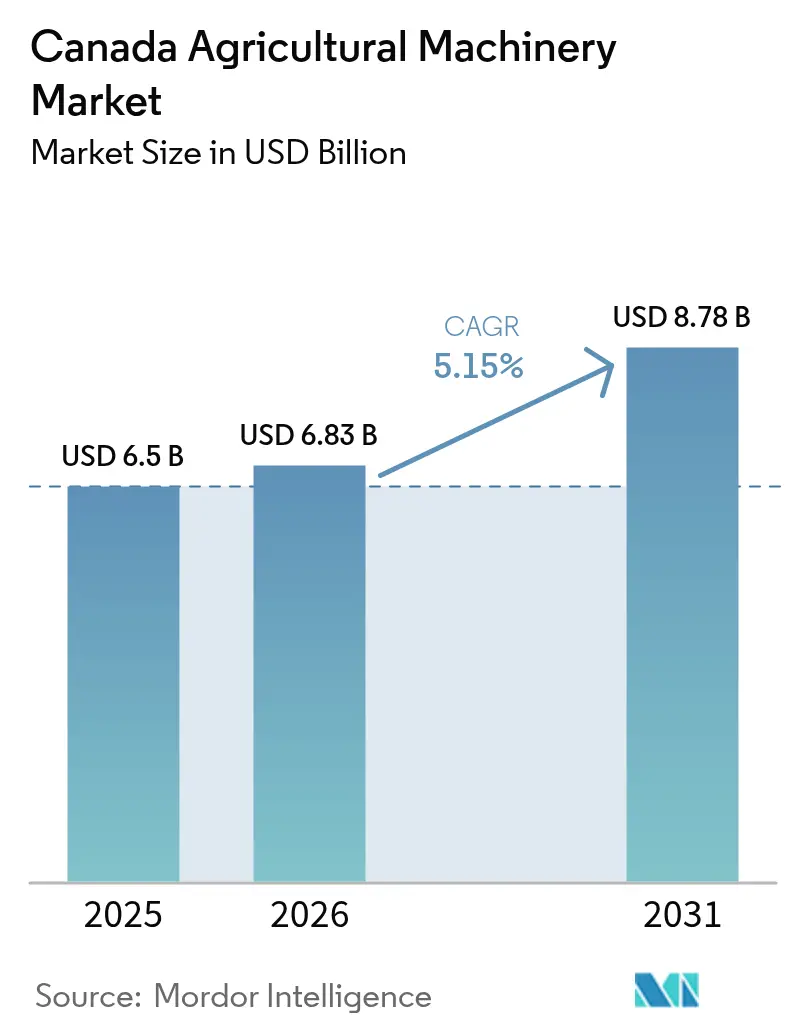
Canada Agricultural Machinery Market Analysis by Mordor Intelligence
The Canada agricultural machinery market size is expected to grow from USD 6.50 billion in 2025 to USD 6.83 billion in 2026 and is forecast to reach USD 8.78 billion by 2031 at 5.15% CAGR over 2026-2031. Structural labor shortages, the USD 3.5 billion Sustainable Canadian Agricultural Partnership, and accelerating uptake of precision technologies have created a resilient demand foundation despite financing headwinds. Farmers are replacing human labor with autonomous and semi-autonomous machines while simultaneously modernizing fleets to capitalize on carbon-credit incentives and water-efficient irrigation systems. Competitive intensity has risen as digital-first newcomers pressure incumbent Original Equipment Manufacturers (OEMs), leading to faster product cycles, retrofit solutions, and integrated hardware-software offerings. These dynamics underpin a steady expansion path for the Canada agricultural machinery market, particularly in Western provinces where large-scale grain operations and supportive policy frameworks converge.
Key Report Takeaways
- By product type, tractors accounted for 44.55% of the Canada agricultural machinery market share in 2025, while irrigation machinery is advancing at a 5.68% CAGR to 2031.
Note: Market size and forecast figures in this report are generated using Mordor Intelligence’s proprietary estimation framework, updated with the latest available data and insights as of 2026.
Canada Agricultural Machinery Market Trends and Insights
Drivers Impact Analysis*
| Driver | (~)% Impact on CAGR Forecast | Geographic Relevance | Impact Timeline |
|---|---|---|---|
| Shortage of agricultural labor | +1.2% | National, with highest impact in Alberta and Saskatchewan | Medium term (2-4 years) |
| Government subsidies and tax incentives for mechanization | +0.9% | National, with enhanced support in Ontario and Quebec | Short term (≤ 2 years) |
| Technological advancements in precision and autonomous machinery | +1.1% | National, with early adoption in Prairie provinces | Long term (≥ 4 years) |
| Aging tractor fleet replacement cycle | +0.8% | National, with concentration in established farming regions | Medium term (2-4 years) |
| Diversification toward multi-crop systems increasing demand for versatile implements | +0.7% | Prairie provinces and Ontario | Medium term (2-4 years) |
| Carbon-credit monetization propelling low-emission equipment adoption | +0.5% | National, with emphasis on livestock-intensive regions | Long term (≥ 4 years) |
| Source: Mordor Intelligence | |||
Shortage of Agricultural Labor
Canada’s farm labor gap is forecast to hit 113,800 positions by 2025 and 123,000 by 2030, forcing producers to invest in autonomous tractors, robotic harvesters, and remote-operation platforms. Temporary foreign workers already cover roughly 75% of seasonal needs, yet elevated turnover and rising wage expectations persist[1]. OEMs (Original Equipment Manufacturers) such as Deere & Company and AGCO Corporation are fast-tracking autonomous retrofit kits and full-electric self-driving tractors aimed at commercial launch by 2026. Larger machines that cover more acres per hour now command premium pricing as operators seek to maximize output per remaining worker. As a result, mid-range horsepower segments are stagnating while high-horsepower and specialty robotics segments capture incremental Canada agricultural machinery market demand.
Government Subsidies and Tax Incentives for Mechanization
Federal and provincial grants cover up to 50% of eligible equipment costs under the Agricultural Clean Technology Program, with awards ranging from USD 25,000 to USD 2 million[2]. British Columbia tops provincial support with a 65% cost-share on technology purchases up to USD 100,000, accelerating small-farm modernization. The Sustainable Canadian Agricultural Partnership injects USD 3.5 billion into competitiveness initiatives over five years, directly subsidizing precision sprayers, low-emission tractors, and smart irrigation pivot retrofits. Interest-free advances up to USD 250,000 under the Advance Payments Program further soften financing costs, particularly for grain growers facing volatile commodity cycles. Subsidy stacking creates a multiplier effect on private capital, prompting a near-term spike in Canada agricultural machinery market orders ahead of funding windows.
Technological Advancements in Precision and Autonomous Machinery
More than 50.4% of Canadian farms already deploy at least one precision feature, such as GPS guidance or variable-rate application, and adoption is rising fastest among Prairie grain operations. Olds College runs Canada’s first on-farm autonomous equipment test bed, proving commercial viability for driverless platforms in harsh climates. OEMs address connectivity gaps by integrating satellite-based IoT modules that minimize data latency and enable over-the-air software updates. These enablers translate into expanding Canada agricultural machinery market revenue streams rooted in subscription analytics, remote diagnostics, and autonomy-as-a-service models.
Aging Tractor Fleet Replacement Cycle
The average workhorse tractor in Canada now exceeds 12 years of service, with replacement intervals lengthening amid high capital costs. Deferred purchases have inflated the used-equipment pool’s average listing age to a decade, while OEM order backlogs for new high-horsepower units stretch 12 to 15 months. Manufacturers respond with factory-approved retrofit kits that retrofit auto-steer, telematics, and partial autonomy onto legacy units, extending economic life spans at a fraction of the cost of new equipment. Economic depreciation studies show high-horsepower tractors deliver optimal ROI when replaced every 8 years, creating pent-up demand that could unlock a strong replacement wave once interest rates ease. This dynamic supports the service and parts side of the Canada agricultural machinery market even during new-unit downturns.
Restraints Impact Analysis*
| Restraint | (~)% Impact on CAGR Forecast | Geographic Relevance | Impact Timeline |
|---|---|---|---|
| High upfront procurement and maintenance cost | -0.8% | National, with greater impact on smaller operations | Short term (≤ 2 years) |
| Security and data-privacy risks in connected machinery | -0.4% | National, with concentration in precision agriculture adopters | Medium term (2-4 years) |
| Rising interest rates constraining equipment financing | -0.9% | National, with particular impact on debt-financed purchases | Short term (≤ 2 years) |
| Tariff volatility on U.S.-sourced components | -0.6% | National, with emphasis on import-dependent manufacturers | Medium term (2-4 years) |
| Source: Mordor Intelligence | |||
High Upfront Procurement and Maintenance Cost
Large self-propelled machines now list between USD 400,000 and USD 1.2 million, while annual maintenance can consume up to 20% of operating budgets[3]. Farmers increasingly scour auction sites for late-model equipment, but competition from U.S. buyers inflates bids, narrowing domestic supply. Software subscriptions for precision platforms add recurring expenses, pressing smaller growers to consider cooperative ownership or equipment-as-a-service agreements. Despite OEM extended-warranty offerings, cash-strapped operators continue delaying purchases, tempering near-term Canada agricultural machinery market growth.
Security and Data-Privacy Risks in Connected Machinery
Connected tractors transmit agronomic data via cloud platforms, exposing farms to potential cyber intrusions that could manipulate application rates or compromise proprietary yield maps. OEMs deploy encrypted networks and token-based access, yet liability remains ambiguous under Canadian privacy statutes, deterring certain growers from adopting telematics. Integration with third-party analytics multiplies attack surfaces, prompting insurers to demand robust cyber-hygiene practices or levy higher premiums. Until federal standards clarify data ownership and breach responsibility, precision machinery adoption may lag among risk-averse operators within the Canada agricultural machinery market.
*Our forecasts treat driver/restraint impacts as directional, not additive. The impact forecasts reflect baseline growth, mix effects, and variable interactions.
Segment Analysis
By Product Type: Tractors Retain Core Position as Irrigation Accelerates
Tractors generated 44.55% of the Canada agricultural machinery market share in 2025, reflecting their indispensable role across row-crop, forage, and specialty operations. High-horsepower categories (≥ 100 HP) experienced a 4.3% annual demand uptick, driven by farm consolidation, autonomous retrofits, and labor substitution needs. In contrast, mid-range 40-99 HP sales dipped 6% as cash constraints led operators to extend service life rather than upgrade mid-class units.
Irrigation machinery represents the fastest-growing segment with a 5.68% CAGR. Drip systems gain traction in specialty crops across British Columbia and Ontario, while variable-rate pivots spread through Prairie grain farms seeking precise soil-moisture management. Water-use regulations and climate risk adaptation drive demand for soil-sensor networks that integrate with pivot controllers, creating cross-sell opportunities with agronomic software vendors. OEMs differentiate through energy-efficient pumps, remote fault detection, and modular add-ons that retrofit existing pivots. These advances attract government rebates aimed at water conservation, further catalyzing irrigation sales inside the Canada agricultural machinery market.


Geography Analysis
Alberta anchors the Canada agricultural machinery market with significant operating revenue of the national total. Large grain and oilseed enterprises dominate procurement, prioritizing high-horsepower tractors, combines, and precision sprayers that optimize broad-acre productivity. Auto-steer adoption exceeds 80% among Alberta operations, and drone-based scouting is becoming mainstream. This innovation mindset positions the province at the forefront of autonomy pilots and electric-drive retrofits, sustaining demand for advanced machinery despite cyclical commodity swings.
Saskatchewan and Manitoba form the second demand tier, collectively generating nearly half of the national wheat and canola output. Their extensive cropland underpins steady replacement cycles for tractors and air seeders. Conservation tillage covers more than 75% of Prairie acreage, encouraging investment in no-till drills equipped with sectional control and seed-population sensors. Dealers in these provinces emphasize robust service networks to support long-distance customers and maintain uptime during compressed planting windows, driving healthy parts revenue even in downturns.
Ontario showcases a highly diversified agricultural structure spanning cash crops, dairy, poultry, and intensive horticulture. Smaller field sizes and higher land values tilt purchasing toward versatile mid-horsepower tractors, self-propelled forage harvesters, and specialized implements. The province leads renewable-energy adoption on farms, installing rooftop solar panels that power electric irrigation pumps and barn automation systems.
Regulatory Landscape
Canada agricultural machinery regulations combine federal requirements on engine emissions with provincial rules on equipment safety and use. Environment and Climate Change Canada administers off-road compression-ignition (diesel) engine emission requirements under the Canadian Environmental Protection Act framework, shaping OEM engine technology choices and aftertreatment configurations offered into Canada. At the provincial level, Ontario administers oversight for farm implements through the Farm Implements Act and related regulations, affecting how equipment is represented and used in-market.
Standards alignment is a key compliance pathway for manufacturers and importers, with common reference to CSA safety requirements and harmonization with ISO and ASABE practices for areas such as roll-over protective structures (ROPS) and general machinery safety. Trade policy and rules of origin under CUSMA remain an important operating constraint and advantage for North America-sourced machinery, with industry bodies such as the Association of Equipment Manufacturers highlighting CUSMA compliance as a practical stabilizer amid tariff volatility and component sourcing uncertainty.
Competitive Landscape
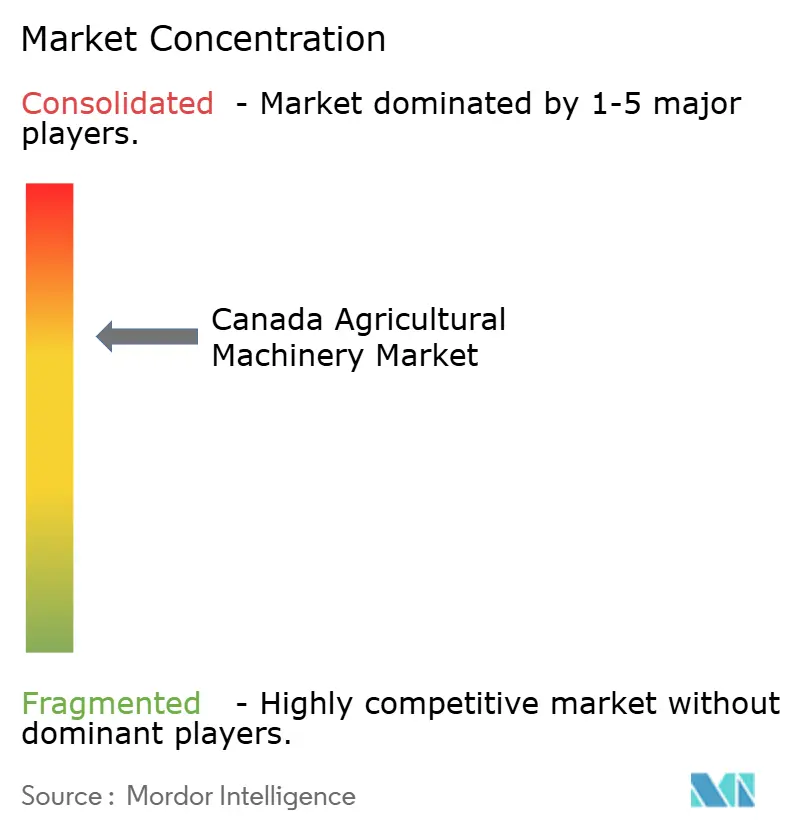
The Canada agricultural machinery market features moderate concentration. Global majors Deere & Company, CNH Industrial N.V., and AGCO Corporation dominate high-horsepower segments, leveraging extensive dealer networks and integrated telematics ecosystems. Mid-tier firms such as Kubota Corporation and Claas KGaA mbH carve out shares in specialty and compact tractor classes, whereas domestic implement manufacturers compete on niche functionality and localized agronomic knowledge.
Competitive dynamics have intensified as technology companies enter with cloud-based analytics and autonomy solutions. Brilliant Harvest’s AI-powered efficiency platform integrates seamlessly with multiple equipment brands, prompting OEMs to enhance open-API capabilities. Strategic acquisitions highlight a pivot toward vertical integration; Linamar’s purchase of Bourgault adds seeding expertise, while AGCO Corporation’s OutRun retrofit kit expands its aftermarket footprint.
Dealer consolidation continues, with multi-store groups improving service coverage and financing options, raising entry barriers for smaller OEMs. Growing customer expectation for bundled solutions equipment, software, agronomic advice, and financing pushes manufacturers to build end-to-end platforms. As autonomy matures, hardware margins may compress, shifting profit pools toward data services and predictive maintenance. The Canada agricultural machinery market is therefore evolving into an ecosystem play, rewarding players that couple reliable iron with seamless digital experiences.
Canada Agricultural Machinery Industry Leaders
-
Deere & Company
-
CLAAS KGaA mbH
-
AGCO Corporation
-
Kubota Corporation
-
CNH Industrial N.V.
- *Disclaimer: Major Players sorted in no particular order
Market Opportunities and Future Outlook
Cost-shared public programs are creating near-term whitespace for suppliers that can package eligible hardware, installation, and digital enablement into grant-ready offerings. The Sustainable Canadian Agricultural Partnership (2023-2028) provides a funding backbone across provinces, while the Agricultural Clean Technology Program (Adoption Stream) has supported purchases of low-emission and energy-efficient equipment; program deadlines in March 2026 reinforced demand for equipment that can be deployed quickly and documented for claims. In British Columbia, a new intake opened in February 2026 for its On-Farm Technology Adoption Program to accelerate labour-saving technologies, reinforcing demand for autonomous-assist retrofits, smart sprayer upgrades, and irrigation modernization tied to water efficiency goals.
Interoperability and software access constraints in Western Canada have also emerged as practical barriers, creating room for open-platform precision tools, compatible aftermarket kits, and dealer-led integration services that support mixed fleets. Financing and total cost of ownership remain competitive levers as high upfront prices and interest rates pressure buying decisions; changes in captive and partner financing structures (including AGCOs restructuring of its Canadian finance joint venture) underline the importance of flexible credit offers for large-ticket tractors, combines, and precision implements. Trade conditions remain a planning variable, with the CUSMA review process scheduled to begin in July 2026, keeping attention on rules-of-origin compliance and component sourcing strategies for OEMs and Canadian implement manufacturers.
Recent Industry Developments
- May 2026: AGCO executed purchase agreements dated April 30, 2026, with Rabobank subsidiaries to sell 49% equity interests in AGCO Finance LLC and AGCO Finance Canada, Ltd., for approximately USD 190 million and put new financing framework agreements in place. The move changes how AGCO supports retail and dealer financing across North America, which can affect purchase affordability and inventory turn for major equipment categories in Canada.
- January 2026: Kubota highlighted new autonomous and specialty-product direction at CES 2026, including the M5 Narrow Diesel Specialty Tractor and a concept Versatile Platform Transformer robot. The announcements reinforce the push toward labor-saving capabilities and specialized equipment formats that fit Canadian horticulture and other high-value crop applications.
- November 2024: Deere expanded forestry equipment production at its John Deere Specialty Products facility in Langley, British Columbia, adding output for machines such as tracked harvesters and bunchers. The expansion supports regional manufacturing and parts-service availability in Western Canada, helping customers that operate at the agriculture-forestry interface and rely on high-uptime off-highway equipment.
Research Methodology Framework and Report Scope
Market Definition and Coverage
This market covers the value of agricultural machinery sold for farming use in Canada. It includes equipment used for soil preparation, planting, crop care, irrigation, harvesting, and forage work across farm operations.
Scope exclusions: We exclude machinery meant mainly for industrial or construction work, and we exclude multi-purpose equipment when it is counted for mixed non-agricultural use.
Segmentation Overview
- By Product Type
- Tractors
- Less than 40 HP
- 40-99 HP
- More than 100 HP
- Plowing and Cultivating Machinery
- Plows
- Harrows
- Rotovators and Cultivators
- Other Equipment
- Planting Machinery
- Seed Drills
- Planters
- Spreaders
- Other Planting Machinery
- Sprayers
- Irrigation Machinery
- Drip Irrigation Systems
- Sprinkler Irrigation Systems
- Other Irrigation Machinery
- Harvesting Machinery
- Combine Harvesters
- Other Harvesting Machinery
- Haying and Forage Machinery
- Mowers and Conditioners
- Balers
- Other Haying and Forage Machinery
- Other Types
- Tractors
Data Sources, Market Sizing, and Validation
Desk Research
Desk research was used to build the base demand picture and to ground assumptions that can be checked year over year. We reviewed public data series such as Statistics Canada farm and economic tables, Agriculture and Agri-Food Canada program updates, and relevant customs trade data, which help indicate machinery buying capacity and replacement timing.
To avoid overfitting, inputs were only taken from sources that can be replicated, such as association and standards websites (for equipment and farm safety guidance), peer-reviewed agronomy and mechanization studies, and reputable press coverage on crop economics and equipment finance. Company filings and investor presentations were used to understand product mix, pricing direction, and Canada exposure. We then used a paid subscription for company financials and patent databases to cross-check revenue ranges and innovation activity. The examples above are illustrative only, and many other public and paid sources were also referred to for data collection, validation, and research clarification.
Primary Interviews and Surveys
Primary interviews and surveys focused on dealers and distributors, large farm operators, equipment-focused service partners, and industry experts who monitor field demand and replacement cycles. These conversations were used to confirm what drives orders in Canada, how financing and seasonality affect deliveries, and where price changes were actually realized versus only announced.
Coverage was balanced across the main farming regions in Canada, and responses were compared across customer sizes so assumptions did not lean too heavily on one crop type or one buying pattern.
Distribution of primary research fieldwork respondents
| Company type | Respondent position |
|---|---|
| Top tier: 35% | CXOs: 13% |
| Mid tier: 51% | Functional/Unit leaders: 30% |
| Smaller Players: 14% | Managers: 57% |
Market-Sizing & Forecasting
Sizing started with a top-down build that reconstructs the demand pool from Canada farm activity and equipment adoption signals, then converts that pool into value using price bands by machinery type. After the logic was set, we added selective bottom-up checks, such as rolling up a sampled set of supplier and dealer-reported sales ranges and testing implied unit volumes against typical shipment timing and replacement behavior.
Key model inputs included planted acreage trends for major crops, farm income and input-cost pressure, machinery replacement cycles by age and utilization, interest rate and finance availability signals, and observed price progression (list price movement adjusted for discounting and mix shift). Where data gaps existed, we used conservative interpolation based on adjacent-year patterns and then tested the outcome against interview feedback to avoid sharp step changes.
For forecasting, scenario analysis was used around farm profitability and financing conditions, and the final path was anchored to the scenario most primary respondents described as realistic. This keeps the forecast explainable, since each step is linked to a small set of drivers that can be revisited as the season and policy conditions change.
Data Validation & Update Cycle
Outputs were checked against independent signals, including import and shipment direction, dealer inventory commentary, and farm income trend lines, and then large variances were reviewed one by one before sign-off. When an assumption moved the total more than expected, we went back to the source data, rechecked unit and price logic, and then revisited the topic with a small set of respondents to confirm the direction.
Each report is refreshed annually, and interim adjustments are made when major events materially change demand, such as policy shifts, sharp rate changes, or a clear equipment cycle break. Before delivery, a final analyst pass is done so the numbers reflect the most recent public updates and the latest market conversations.
Mordor Intelligence's Canada Agricultural Machinery Market Estimate Compared With Other Published Estimates
Published market sizes for Canada agricultural machinery can vary even when the topic label looks the same, because the counted products and the timing assumptions often differ. Differences usually come from whether only farm-use equipment is counted, how multi-purpose machinery is treated, and whether the year reflects deliveries, registrations, or bookings.
By tracking annual farm-use equipment boundaries and refreshing pricing and replacement-cycle assumptions with dealer checks, Mordor Intelligence keeps the estimate aligned to machinery that is actually used in agricultural operations rather than blended with adjacent industrial equipment.
Benchmark comparison
| Source | Market Size | Gaps in Research Methodology |
|---|---|---|
| Mordor Intelligence | USD 6.50 B (2025) | |
| Global Publisher A | USD 8.37 B (2024) | This estimate appears to use a different base year and may include broader equipment definitions or additional value components, which can lift the total even before growth is applied. |
| Industry Brief B | USD 8.38 B (2030) | The figure is reported as a 2030 endpoint, and the uplift can reflect a more aggressive price escalation path or a wider inclusion of technology add-ons and multi-purpose machinery across the forecast window. |
The spread across sources is mostly explained by base-year choice, what is included as agricultural-use machinery, and how price and replacement cycles are carried through the forecast. When the scope and timing are made explicit and the value build is tied to repeatable indicators, the resulting market size becomes easier to reconcile and to update as new signals emerge.
Key Questions Answered in the Report
How large is the Canadian agricultural equipment market in 2026?
The Canadian agricultural equipment market size is USD 6.83 billion in 2026.
What is the forecast CAGR for Canadian agricultural equipment through 2031?
Market value is projected to grow at a 5.15% CAGR from 2026 to 2031.
Which segment leads current sales?
Tractors command 44.55% of 2025 Canadian agricultural equipment market share.
Which product category is growing fastest?
Irrigation machinery is advancing at a 5.68% CAGR through 2031.
How does labor scarcity affect equipment demand?
Acute worker shortages push producers toward autonomous and semi-autonomous machinery, accelerating modernization plans.