
Market Overview
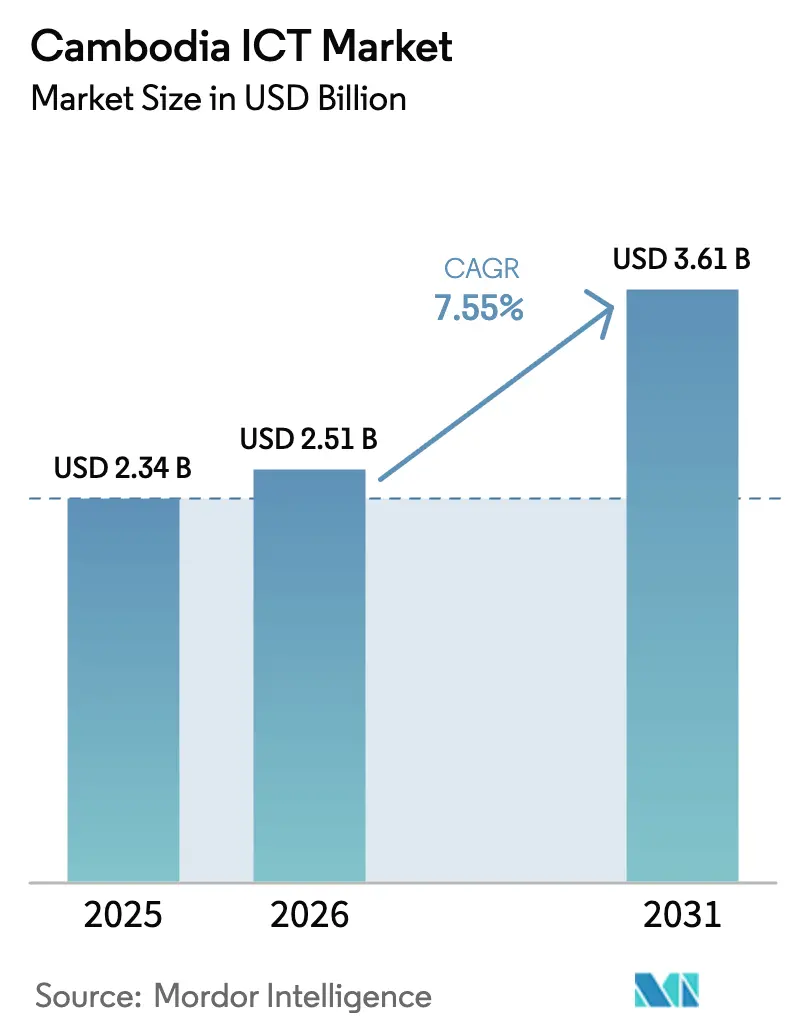
| Study Period | 2020 - 2031 |
|---|---|
| Forecast Data Period | 2026 - 2031 |
| Base Year Market Size (2025) | USD 2.34 Billion |
| Market Size (2026) | USD 2.51 Billion |
| Market Size (2031) | USD 3.61 Billion |
| Growth Rate (2026 - 2031) | 7.55 % |
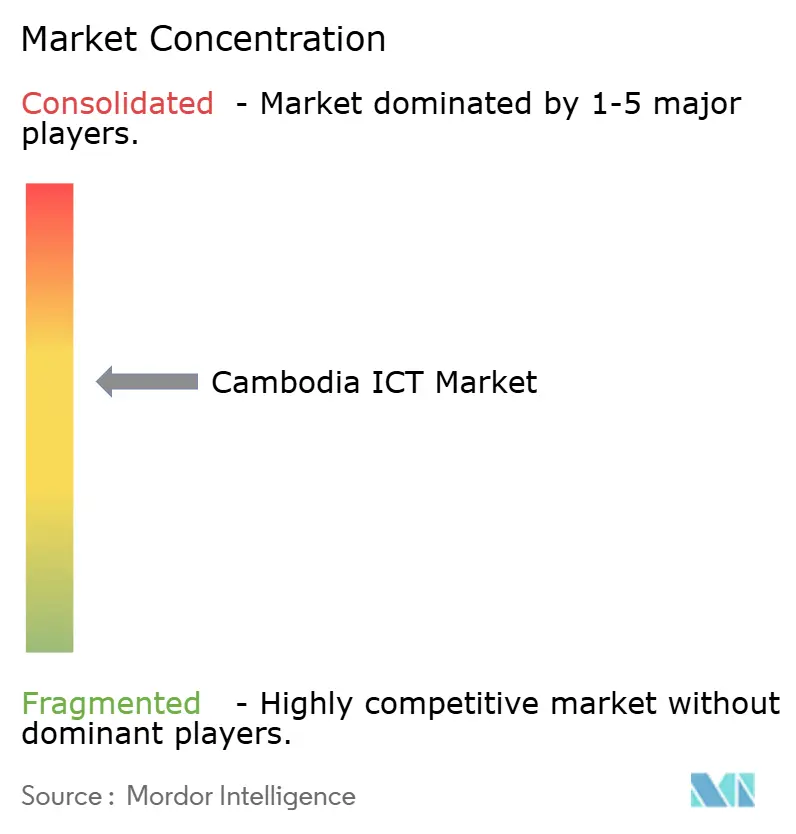
| Market Concentration | Medium |
Major Players *Disclaimer: Major Players sorted in no particular order Image © Mordor Intelligence. Reuse requires attribution under CC BY 4.0. | |
Cambodia ICT Market Analysis by Mordor Intelligence
The Cambodia ICT market size is expected to increase from USD 2.34 billion in 2025 to USD 2.51 billion in 2026 and reach USD 3.61 billion by 2031, growing at a CAGR of 7.55% over 2026-2031. Policy-driven digitization, nationwide commercial 5G service launched on 1 January 2026, and surging demand for cloud-native and mobile-first enterprise solutions are expanding the addressable base of both consumers and businesses. Telecom operators are upgrading radio access networks, while hyperscale and local data-center investors are adding capacity, narrowing latency gaps that once limited enterprise workloads. Small and medium enterprises (SMEs) are embracing software-as-a-service and QR-code payments, reshaping distribution channels and compressing cash cycles. Meanwhile, draft data-protection rules and rural power constraints remain headwinds, tempering the otherwise robust growth trajectory of the Cambodia ICT market.
Key Report Takeaways
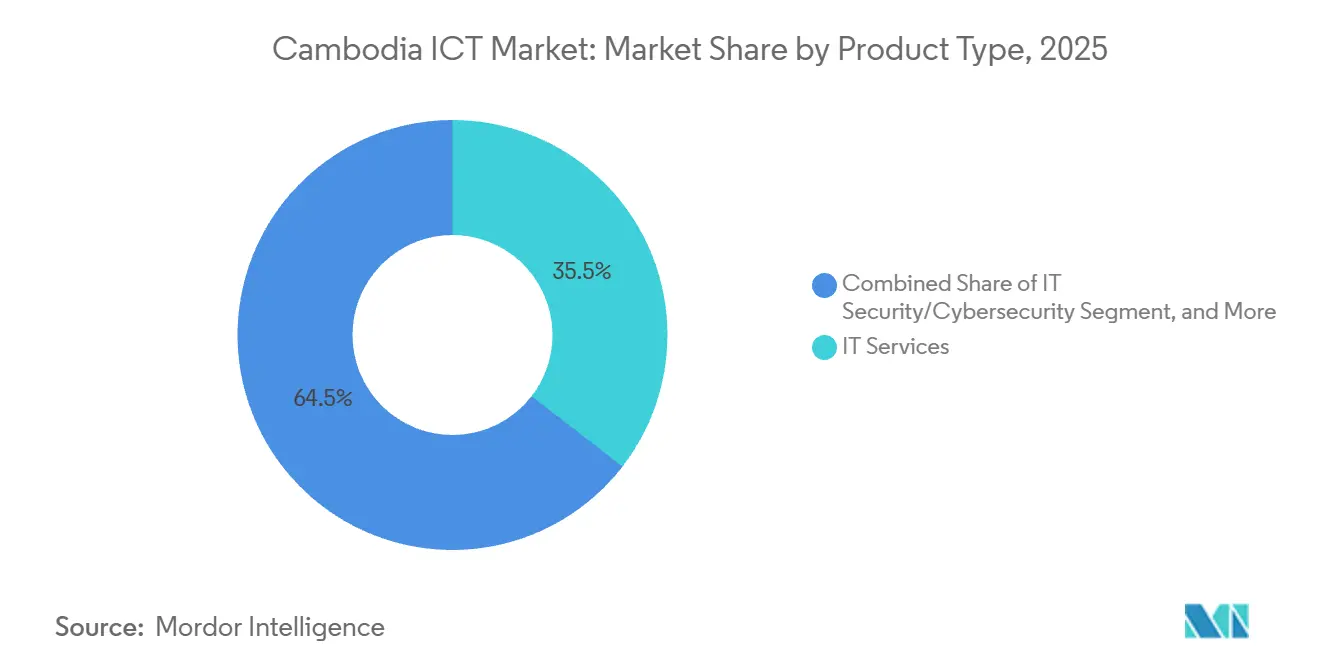
- By product category, IT services led with 35.48% revenue share in 2025, while cyber-security is forecast to advance at an 8.24% CAGR to 2031.
- By enterprise size, large enterprises accounted for 52.21% of the Cambodia ICT market share in 2025, whereas SMEs are projected to expand at an 8.72% CAGR through 2031.
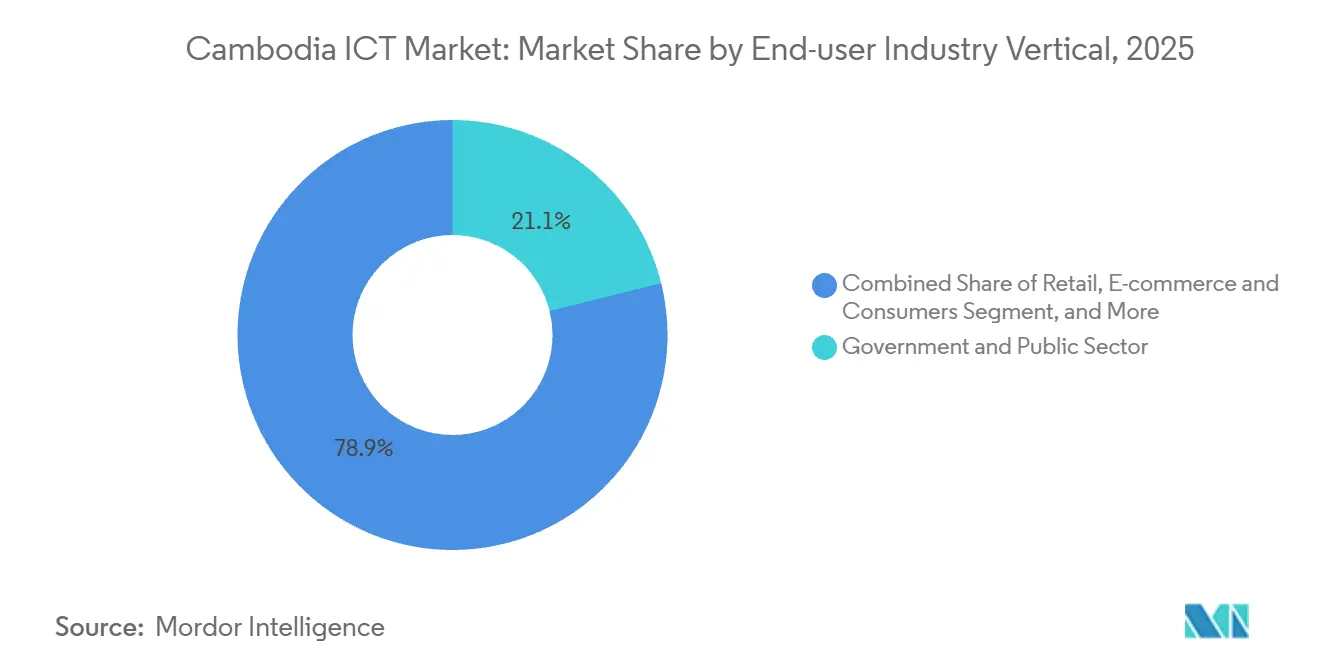
- By end-user vertical, government and public sector held 21.14% of spending in 2025, but retail and e-commerce is the fastest-growing vertical at an 8.91% CAGR to 2031.
Note: Market size and forecast figures in this report are generated using Mordor Intelligence’s proprietary estimation framework, updated with the latest available data and insights as of January 2026.
Cambodia ICT Market Trends and Insights
Drivers Impact Analysis*
| Driver | (~) % Impact on CAGR Forecast | Geographic Relevance | Impact Timeline |
|---|---|---|---|
| Government Digital Economy and Society Policy 2021-2035 | +1.8% | National, strongest in Phnom Penh and provincial capitals | Long term (≥ 4 years) |
| Rapid Expansion of Mobile Internet Subscriptions | +1.5% | National, urban-led with rural catch-up | Medium term (2-4 years) |
| Accelerating Cloud and Data Center Investments | +1.2% | Phnom Penh and Siem Reap hubs | Medium term (2-4 years) |
| CamDX Adoption Catalyzing Seamless B2B e-KYC APIs | +0.9% | National, banking and fintech sectors | Short term (≤ 2 years) |
| Rising Smartphone Penetration and Affordable Data Prices | +0.8% | Nationwide | Short term (≤ 2 years) |
| Regional 5G Infrastructure-Sharing Mandates Lowering Capex | +0.7% | Operator networks countrywide | Medium term (2-4 years) |
| Source: Mordor Intelligence | |||
Government Digital Economy and Society Policy 2021-2035
The policy framework mandates end-to-end digitization of public services, standardizes interoperability for ministries, and funds a Tier IV National Data Center that will provide sovereign cloud for sensitive workloads. Rollouts such as the DG SuperApp, SARIKA text-to-speech, and verify.gov.kh have cut document-processing times for citizens and enterprises. Cross-border validation was demonstrated when the Philippines integrated the Khmer digital-identity stack, underscoring export potential. Public procurement under the policy is catalyzing demand for enterprise software, cybersecurity, and platform-as-a-service offerings. Standardized APIs embedded in the framework lower integration costs for start-ups and incumbents alike, encouraging fintech, e-commerce, and health-tech scale-ups.
Rapid Expansion of Mobile Internet Subscriptions
Mobile subscriptions hit about 19.6 million in 2025, equivalent to 117.38 subscriptions per 100 people, creating a mobile-first customer base. The nationwide 5G launch supports peak speeds of up to 20 Gbps, enabling latency-sensitive applications such as autonomous logistics and real-time quality control. Operators added hundreds of base stations and secured fresh bank financing ahead of the launch, driving wider coverage and better service quality. Ubiquitous connectivity underpins subscription video, cloud gaming, and mobile payments, opening new revenue streams for telecoms and content providers. SaaS vendors also benefit as reliable bandwidth reaches rural districts.
Accelerating Cloud and Data Center Investments
Huawei Cloud opened the first in-country cloud region in late 2024, ensuring data-residency compliance for regulated industries and lowering latency for domestic users. Four local colocation operators plus new greenfield projects are boosting rack supply in Phnom Penh, while hyperscalers serve overflow demand from regional hubs. Public-sector and development-finance programs subsidize cloud-migration roadmaps for SMEs, especially in tourism and retail. Converging local and regional capacity is prompting banks, retailers, and logistics firms to adopt hybrid-cloud architectures that were once considered risky because of latency and power constraints. As electricity reliability improves in urban centers, the cost-benefit equation tilts further in favor of cloud deployments.
CamDX Adoption Catalyzing Seamless B2B e-KYC APIs
CamDX processed more than 21.7 million e-KYC transactions by end-2024, linking 60 financial institutions through OAuth 2.0 and mobile deep-link authentication. The CamDigiKey app combines AI-based facial recognition, optical character recognition, and liveness checks to validate identity in minutes. Banks integrating the platform have slashed onboarding times and expanded reach to unbanked rural users. The system’s tie-in with the Interior Ministry’s ID database provides authoritative data feeds, reducing fraud. This infrastructure lowers compliance costs for fintech entrants and creates network effects that accelerate the usage of digital payments and micro-lending products. [1]
Restraints Impact Analysis*
| Restraint | (~) % Impact on CAGR Forecast | Geographic Relevance | Impact Timeline |
|---|---|---|---|
| Rural Connectivity and Digital Literacy Gaps | -0.6% | Northeastern and mountainous provinces | Long term (≥ 4 years) |
| Pending Personal Data Protection Law Creating Compliance Uncertainty | -0.4% | Nationwide | Short term (≤ 2 years) |
| Low Fixed-Broadband Affordability | -0.3% | Rural and low-income urban households | Medium term (2-4 years) |
| Electricity Reliability Constraints for Edge Data Centers | -0.2% | Rural and peri-urban districts | Medium term (2-4 years) |
| Source: Mordor Intelligence | |||
Rural Connectivity and Digital Literacy Gaps
Urban internet penetration surpassed 90%, yet fixed-broadband access remains scarce in rural areas, where penetration is 3.5% and speeds lag regional peers. Operators hesitate to invest in sparsely populated zones with low average revenue per user despite subsidies from the Universal Service Obligation Fund. NGOs and the Ministry of Education promote digital-skills programs, but research shows persistent competency gaps among teachers and graduates. Limited bandwidth and skills curb the adoption of cloud ERP, telemedicine, and e-learning outside major cities, constraining inclusive growth. This divide slows nationwide adoption of advanced ICT applications in the Cambodian market. [2]
Pending Personal Data Protection Law Creating Compliance Uncertainty
Draft data-protection and cybersecurity bills are still under review, leaving enterprises without clear rules on cross-border transfer, breach notification, or localization. Multinationals hesitate to commit long-term capital to in-country infrastructure, while local fintech firms must plan for potential retroactive compliance costs. Development lenders are funding capacity-building, yet enforcement frameworks remain nascent, as reflected in Cambodia’s Tier 4 ranking on the Global Cybersecurity Index. Financial institutions and healthcare providers handling sensitive data, therefore, delay certain cloud migrations, dampening short-term momentum in the Cambodia ICT market. [3]
*Our forecasts treat driver/restraint impacts as directional, not additive. The impact forecasts reflect baseline growth, mix effects, and variable interactions.
Segment Analysis
By Product Type - Managed Services Anchor IT Services Dominance
IT services held 35.48% of 2025 revenue, giving the segment the largest Cambodia ICT market share among product lines. Managed security and cloud migration projects top the order books as government APIs and bank modernization accelerate. The Cambodia ICT market size associated with cyber-security solutions is set to climb at an 8.24% CAGR after Japan’s USD 5 million equipment grant and the July 2025 cyber-crime crackdown. Application, cloud, and identity security tools therefore post the fastest spend growth. Hardware demand remains steady, driven by Smart Axiata’s 475 additional BTS sites in 2024 and continued radio densification. In software, ERP, CRM, and core-banking overhauls dominate, with ABA Bank’s SUSE-based stack providing 99.999% uptime and 15% cost savings. The Cambodia ICT market benefits further from infrastructure outlays for the Tier IV National Data Centre and Telcotech’s campus. Finally, telecom operators are shifting toward value-added services, using e-money wallets and digital identity to diversify beyond pure connectivity.
The Cambodia ICT market is therefore evolving from asset-intensive build-outs to service-centric monetization, positioning managed service providers as pivotal orchestrators. Growth potential hinges on tight integration between sovereign data centers, operator edge nodes, and public-cloud APIs, a configuration that de-risks latency-sensitive workloads without violating anticipated data-localization clauses. Vendors able to pair compliance expertise with scalable automation will capture outsized share as ministries mandatorily expose micro-services through CamDX.

By Enterprise Size - SME Cloud Adoption Outpaces Large-Enterprise Spending
Large enterprises generated 52.21% of 2025 spend, but SMEs are pacing the Cambodia ICT market at an 8.72% CAGR to 2031. Grants under the Cambodia Jobs and Enterprise Transformation program helped subsidize cloud inventory and CRM platforms, lowering total cost of ownership for firms with fewer than 100 employees. Online Business Registration and CamDigiKey have streamlined licensing and banking, cutting onboarding time and encouraging micro-enterprises to formalize. Consequently, the Cambodia ICT market size attributed to SMEs is forecast to swell materially over the outlook period.
The large-enterprise segment remains vital, funding sophisticated 5G, AI, and API-monetization projects. Metfone’s pivot to a techco model, bundling eMoney, CamID, and school-information systems, exemplifies revenue-diversification plays. Smart Axiata’s USD 50 million debt facility and Huawei EasyAAU roll-out underscore the capital requirements for maintaining network leadership. Even so, the democratization of SaaS levels digital capabilities, enabling SMEs to deliver near-par service quality without matching the absolute spend of incumbents. This widening user base underpins secular expansion in the Cambodia ICT market.
By End-User Vertical - Retail and E-Commerce Lead Digital Acceleration
Retail and e-commerce recorded the highest 8.91% CAGR outlook on the back of social-commerce uptake among 21.61 million Facebook and TikTok users. Bakong processed USD 54.8 billion in the first half of 2024, and QR codes already power nearly half of digital payments, aligning payment rail maturity with merchant onboarding needs. Cloud POS, inventory analytics, and logistics tech therefore dominate procurement pipelines across large retailers and MSMEs alike. The Cambodia ICT market size allocated to retail tech will rise proportionately as cross-border KHQR acceptance spreads to Vietnam and Laos.
Government and public sector kept 21.14% share in 2025, driven by DG SuperApp contracts and the National Data Centre. BFSI continues modernizing core systems to reach the unbanked, with ABA Bank’s platform upgrade improving deployment times by 50%. Healthcare, manufacturing, and telecom also deepen IoT and analytics adoption, but their growth trails retail due to regulatory and infrastructure frictions. As verticals converge on API-based ecosystems, the Cambodia ICT market will see horizontal demand for managed security and analytics regardless of industry silos.
Geography Analysis
Phnom Penh anchors Cambodia ICT market demand thanks to dense fiber networks, multiple tier-III colocation sites, and the bulk of the nation’s ICT talent. Siem Reap, Battambang, and Sihanoukville follow, benefiting from tourism-driven service clusters and special-economic-zone incentives. Mobile broadband coverage exceeds 93% of the population, yet average speeds and reliability decline outside urban cores, limiting cloud and video-conferencing quality for rural enterprises. The Universal Service Obligation Fund subsidizes tower builds in remote provinces, but challenging terrain and low average revenue per user impede rapid rollout.
Cross-border cooperation shapes the geography of investment. China-Cambodia free-trade provisions streamline ICT equipment imports, while Australia’s Partnerships for Infrastructure injects telecommunications funding with governance conditionalities. ASEAN digital-economy talks aim to harmonize data-flow rules, giving Cambodian start-ups wider regional market access once technical standards align. Phnom Penh’s concentration of data centers yields agglomeration benefits, prompting hyperscalers to consider edge nodes in nearby provinces to manage overflow and support disaster recovery.
Rural provinces lag in fixed-broadband affordability, compelling reliance on cellular data for business applications. Power reliability issues constrain edge-computing deployments outside core grids, though solarized base stations show promise as micro-edge hosts. Government policy targets inclusive growth by mandating digital-literacy programs and smart-village pilots, but capacity gaps persist. Over the forecast horizon, gradual 5G expansion and targeted infrastructure grants will chip away at geographic disparities, pulling new user cohorts into the mainstream Cambodia ICT market.
Regulatory Landscape
Cambodia’s ICT regulatory framework is anchored by the Law on Telecommunications (2015), with the Ministry of Post and Telecommunications (MPTC) and the Telecommunication Regulator of Cambodia (TRC) overseeing sector administration, licensing, dispute resolution, and competition oversight. Sub-Decree No. 110 on the ICT licensing regime reinforces that ICT operations require authorization, licenses, or certificates under the competent authority, shaping entry requirements and compliance planning for telecom operators, IT service providers, and digital platforms.
Policy-led digitization also influences compliance needs for ICT vendors serving government and regulated industries. In April 2026, MPTC leadership reviewed draft laws covering personal data protection, ICT, and digital government, indicating an active rulemaking cycle that increases attention on governance, localization, and security requirements for cloud, data center, and identity-driven services. Separately, domain governance requirements such as the mandatory use of the .kh domain under Sub-Decree No. 287 (2021) add operational obligations for businesses operating online in Cambodia.
Competitive Landscape
The market is moderately concentrated. Smart Axiata, Metfone, and Cellcard serve virtually all mobile subscribers and leverage scale advantages to invest in 5G, fiber backhaul, and fintech platforms. To offset pricing pressure, operators bundle content streaming, cloud back-up, and micro-insurance, moving beyond traditional airtime revenue. In contrast, IT Services, software, and colocation remain fragmented, with local integrators, Vietnamese data-center operators, and regional hyperscalers vying for enterprise contracts.
Strategic alliances reshape competition. Smart Axiata’s pact with TrueMoney merges telecom distribution and fintech rails, unlocking cross-sell efficiencies and boosting rural customer reach. Metfone’s partnership with Cisco elevates its enterprise portfolio, letting it offer certified lifecycle support across the provinces. All three operators joined the GSMA Open Gateway initiative, exposing network APIs for fraud prevention and identity verification, a move that levels the playing field for over-the-top service innovators.
White-space innovation emerges in AI localization for the Khmer language, edge-computing nodes powered by solar arrays, and cybersecurity solutions tailored to the country’s evolving regulatory landscape. Start-ups leverage CamDX’s standardized APIs to embed finance in ride-hailing and e-commerce apps, while blockchain pilots in land registry attract developer ecosystems aligned with the National Blockchain Roadmap. Competitive intensity will therefore remain moderate to high as incumbents guard scale advantages and disruptors exploit policy-driven digital public infrastructure openings.
Cambodia ICT Industry Leaders
-
Amazon Inc
-
IBM Corporation
-
Huawei Technologies Co., Ltd.
-
Google LLC
-
Microsoft Corporation
- *Disclaimer: Major Players sorted in no particular order
Market Opportunities and Future Outlook
Digital public infrastructure and the formalization of digital government services create addressable opportunities for systems integrators, managed service providers, and security vendors that can implement interoperable platforms across ministries and regulated sectors. Cambodia’s Digital Economy and Society Policy Framework 2021-2035 and the Digital Government Policy 2022-2035 emphasize standardized interoperability and government-wide digitization, expanding demand for identity, API integration, cybersecurity, and sovereign or hybrid cloud architectures as compliance expectations evolve.
AI enablement is a further whitespace as Cambodia develops a national AI strategy with flagship activities noted for 2025 and 2026, focused on supply-side infrastructure and developer support. It also connects to enterprise adoption needs where low-latency computing, data governance, and security controls are prerequisites, particularly as MPTC advanced draft legislation on personal data protection, ICT, and digital government in April 2026. At the regional level, cloud and AI infrastructure spending by multinational technology firms in Southeast Asia, including Amazon’s announced long-horizon investment program, points to growing nearby capacity and partner ecosystems that Cambodian enterprises and service providers can tap, while in-country regulatory clarity and data-residency priorities continue to shape deployment choices.
Recent Industry Developments
- May 2026: Amazon announced planned investments in Southeast Asia AI and cloud infrastructure totaling over US$33 billion through 2039, encompassing ongoing development across regional sites. The expansion signals elevated hyperscaler presence and regional capacity that can influence Cambodia's cloud, data-center, and AI ecosystem investment and pricing dynamics.
- April 2026: DEAM Computer International deployed an IBM enterprise server solution in Cambodia to support high-performance business infrastructure. The upgrade supports demand for enterprise IT services, cybersecurity, and data-management capabilities within the Cambodia market segment.
- March 2026: Smart Axiata signed a Memorandum of Understanding with Amazon's Prime Video to deliver digital entertainment content via 5G connectivity. The collaboration demonstrates operator ability to bundle OTT content with 5G and mobility services, shaping consumer demand and service bundles in Cambodia.
Research Methodology Framework and Report Scope
Market Definition and Coverage
For this study, we treat the Cambodia ICT market as the total spending in Cambodia on information and communication technologies, covering communication services and the core IT stack used by consumers, businesses, and public sector users.
Scope exclusions: We exclude consumer electronics that are not primarily ICT-enabling, and we also exclude non-ICT professional services that sit outside technology delivery.
Segmentation Overview
- By Product Type
- IT Hardware
- Computer Hardware
- Networking Equipment
- Peripherals
- IT Software
- IT Services
- IT Consulting and Implementation
- IT Outsourcing (ITO)
- Business Process Outsourcing (BPO)
- Managed Security Services
- Cloud and Platform Services
- IT Infrastructure
- IT Security/Cybersecurity
- Application Security
- Cloud Security
- Data Security
- Network Security
- Endpoint Security
- Infrastructure Protection
- Integrated Risk Management
- Identity and Access Management (IAM)
- Communication Services
- IT Hardware
- By Enterprise Size
- Small and Medium-sized Enterprises
- Large Enterprises
- By End-user Industry Vertical
- BFSI
- Government and Public Sector
- Oil and Gas
- IT and Telecom
- Retail, E-commerce and consumers
- Manufacturing and Industrial
- Energy and Utilities
- Healthcare
- Other End-user Industry Verticals (Includes Transportation, Logistics, Education, Hospitality etc.)
Data Sources, Market Sizing, and Validation
Desk Research
Desk work starts with public signals that show how big the addressable demand pool is and how fast it is changing. We referenced official sources such as Cambodia's Ministry of Posts and Telecommunications, the National Institute of Statistics, World Bank indicators, and ITU connectivity series, then supplemented that view with trade and adoption context from sources such as the U.S. International Trade Administration and ASEAN digital economy briefs.
To translate those signals into a value model, we also reviewed company filings and investor presentations from relevant operators and technology providers, alongside trusted press and policy releases that flag major network, cloud, and digital government rollouts. Where needed, paid subscriptions covering company financials, news and financials, patent databases, and shipment-level import or export flows were used to cross-check pricing direction and timing of spend. These examples are illustrative rather than exhaustive, and we used additional public and paid references to collect data, validate assumptions, and clarify open questions.
Primary Interviews and Surveys
We conduct expert interviews and surveys with CXOs, functional or unit leaders, and managers from large, mid-sized, and smaller ICT participants in Cambodia. Responses test adoption, pricing, channel mix, telecom demand, cloud use, and missing SME activity, after which we reconcile the findings with desk evidence. Re-contact is considered when a response materially conflicts with published indicators or another respondent group.
Distribution of primary research fieldwork respondents
| Company type | Respondent position |
|---|---|
| Top tier: 25% | CXOs: 15% |
| Mid tier: 55% | Functional/Unit leaders: 33% |
| Smaller Players: 20% | Managers: 52% |
Market-Sizing & Forecasting
Sizing starts with a top-down build where national ICT spend is reconstructed from observable demand pools, then mapped back to Cambodia-specific adoption and price markers. In practice, we use indicators such as mobile and fixed broadband subscriptions, data traffic growth, enterprise digitization activity, government ICT program rollouts, and import patterns for ICT equipment, which together guide the direction of volumes and spend.
Those totals are then corroborated with selective bottom-up approximations, including sampled ASP x volume checks for key service lines, channel feedback on hardware and software mix, and supplier revenue hints where disclosures exist. When a bottom-up view is incomplete, gaps are handled by using conservatively ranged penetration and replacement cycles that were confirmed through interviews, and then normalized so the final value remains consistent with macro demand signals.
For forecasting, we primarily use scenario analysis supported by exponential smoothing on the most stable inputs. The forward drivers are adjusted through expert consensus. Variables that matter most include tariff and pricing direction in communication services, cloud and cybersecurity subscription growth, network investment cycles, FX movement versus the USD, and the pace at which SMEs shift from one-time purchases to recurring software and managed services spending.
Data Validation & Update Cycle
Outputs are checked in a few layers so the numbers do not rely on one data stream. We compare results against independent signals such as connectivity statistics, operator revenue direction, major contract announcements, and import trends, then investigate any sharp jumps that do not match the real-world timeline.
Before sign-off, the model and assumptions go through analyst reviews, and experts are re-contacted when pricing, FX, or policy changes can materially move the near-term view. Reports are refreshed annually, and interim updates are made when there are material events. After that, a final pre-delivery pass is completed so clients receive the latest updated perspective.
Mordor Intelligence's Cambodia Ict Market Size Compared With Other Published Estimates
Different published market sizes for Cambodia ICT often do not match because the boundary of what is counted changes, and timing choices can amplify the gap. In this space, even small differences in whether values are reported in current USD, constant USD, or converted using a different FX window can move the headline figure.
The biggest gap drivers we see are refresh cadence and price logic, since telecom pricing, device mix, and subscription adoption can shift within a year, and older assumptions can lag reality. The checks that keep the model anchored include cross-verifying operator and service revenue direction, validating plausible ASP bands with channel feedback, and reconciling any mismatch with external connectivity signals, with assumptions refreshed close to the base-year cut in Mordor Intelligence.
Benchmark comparison
| Source | Market Size | Gaps in Research Methodology |
|---|---|---|
| Mordor Intelligence | USD 2.34 B (2025) | |
| Trade-led Blog Source A | USD 2.01 B (2025) | Uses an older estimate track with limited clarity on FX timing and price updates, which can understate the shift toward higher value services like cloud, security, and managed offerings. |
| Industry Commentary Source B | USD 1.83 B (2024) | Reports an earlier-year value without a clear roll-forward for service ASP progression and subscription mix, which can keep totals tied to legacy connectivity spending patterns. |
Overall, the spread is mainly explained by what is included, how prices are rolled forward, and when currency conversion is applied. By keeping the steps traceable to demand indicators and by re-checking sensitive assumptions like telecom pricing and services mix near the base year, we produce a market value that is easier to reproduce and stress-test for planning.
Key Questions Answered in the Report
How large is the Cambodia ICT market in 2026?
The Cambodia ICT market size reached USD 2.51 billion in 2026 and is forecast to expand to USD 3.61 billion by 2031.
What is driving the fastest growth within Cambodia’s ICT spend?
Cyber-security services are expanding at an 8.24% CAGR through 2031 thanks to government mandates and Japan's USD 5 million equipment grant.
Which customer segment is accelerating ICT adoption most quickly?
SMEs are pacing spend at an 8.72% CAGR as cloud ERP and digital-payment subsidies lower adoption barriers.
Which vertical offers the strongest growth opportunity?
Retail and e-commerce show the fastest 8.91% CAGR on the back of social commerce and Bakong QR-code payment uptake.
Why are hyperscalers not yet present in Cambodia?
Pending data-protection rules and limited in-country demand have kept AWS, Google Cloud, and Microsoft Azure from building local regions, creating room for domestic data-center operators.
What challenges could slow ICT growth over the next five years?
Rural broadband gaps, delayed data-protection legislation, and provincial power reliability issues may curb adoption outside major cities.