
Cambodia Fruits And Vegetables Market Analysis by Mordor Intelligence
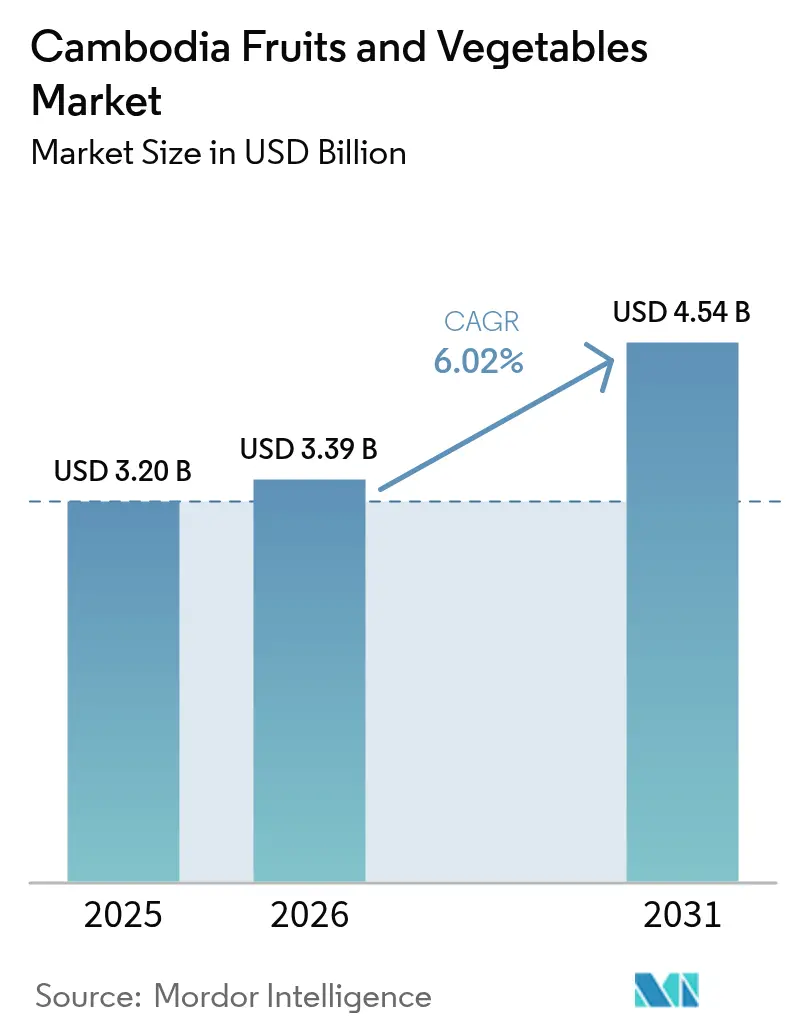
The Cambodia fruits and vegetables market size is expected to grow from USD 3.20 billion in 2025 to USD 3.39 billion in 2026 and is forecast to reach USD 4.54 billion by 2031 at 6.02% CAGR over 2026-2031. Solid government support for irrigation, preferential trade terms under the China-Cambodia Free Trade Agreement, and urban consumers’ stronger preference for balanced diets underpin this expansion. Cold-chain investments along the Phnom Penh-Sihanoukville expressway and the July 2025 opening of Techo International Airport’s cargo hub are lowering spoilage rates and widening export windows, especially for high-value mangoes and leafy greens. Growing e-commerce platforms, backed by UNDP’s digital onboarding of 1,200 smallholder farms, shorten distribution chains and improve farmgate returns. At the same time, pesticide-residue compliance pressures and rural labor shortages temper growth but have spurred adoption of GAP (Good Agricultural Practices) protocols and mechanization pilots in key provinces.
Key Report Takeaways
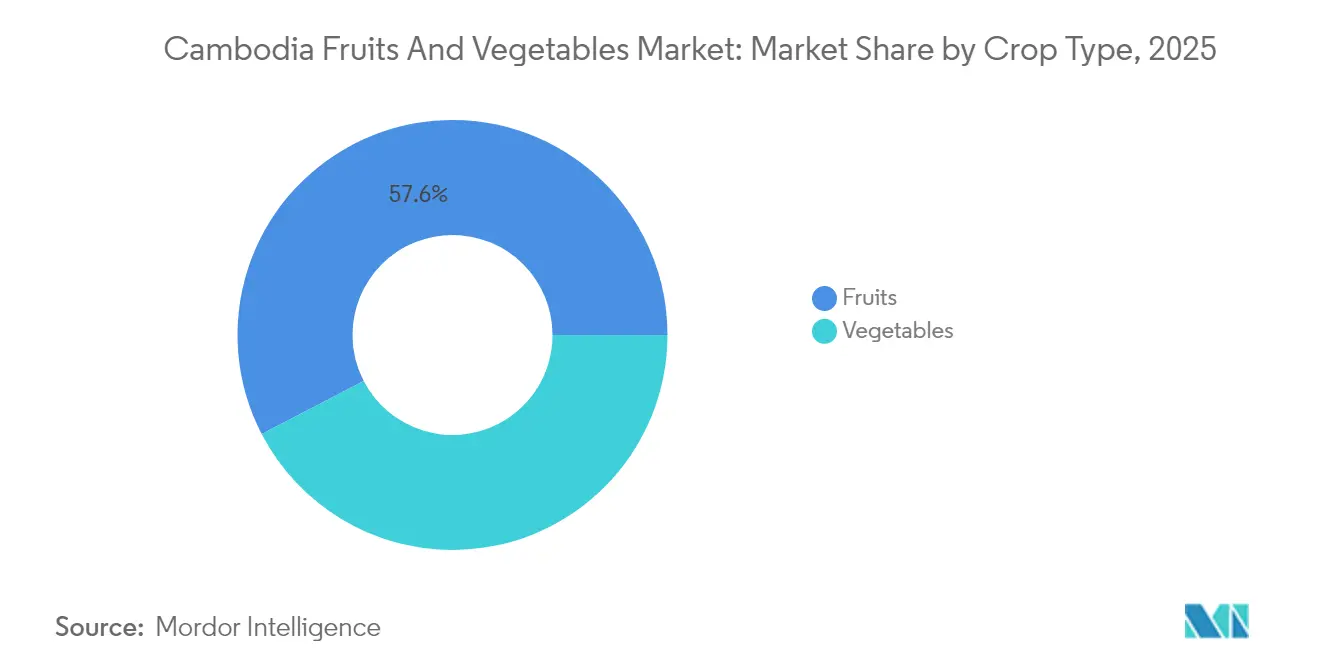
- By crop type, fruits held 57.62% of the Cambodia fruits and vegetables market share in 2025, while vegetables posted the fastest 9.44% CAGR through 2031.
Note: Market size and forecast figures in this report are generated using Mordor Intelligence’s proprietary estimation framework, updated with the latest available data and insights as of 2026.
Cambodia Fruits And Vegetables Market Trends and Insights
Drivers Impact Analysis*
| Driver | (~) % Impact on CAGR Forecast | Geographic Relevance | Impact Timeline |
|---|---|---|---|
| Rising domestic demand for healthy diets | +1.2% | National, concentrated in Phnom Penh and urban centers | Medium term (2-4 years) |
| Government subsidies for irrigation expansion | +0.9% | Rural provinces, notably Battambang and Kampong Cham | Long term (≥ 4 years) |
| Preferential export tariffs under China–Cambodia FTA | +1.1% | National, strongest in mango-growing regions | Short term (≤ 2 years) |
| Cold-chain corridors along Phnom Penh–Sihanoukville Expressway | +0.7% | Central and southern provinces | Medium term (2-4 years) |
| Agritech e-marketplaces connecting farmers to urban retailers | +0.6% | National, early adoption in Siem Reap and Phnom Penh | Short term (≤ 2 years) |
| GAP certification programs unlocking premium Asian outlets | +0.4% | Export-oriented provinces, especially Battambang | Long term (≥ 4 years) |
| Source: Mordor Intelligence | |||
Rising Domestic Demand for Healthy Diets
Urban income gains and health campaigns are shifting Cambodians toward higher fresh-produce intake. The 2021-22 Demographic and Health Survey found that overweight prevalence among women rose from 18% in 2014 to 33% in 2021-22, triggering a consumer pivot to fruits and vegetables. Urban households nowadays devote 23% of food budgets to produce versus 16% for rural households. Retailers in Phnom Penh report double-digit growth in refrigerated produce sections, incentivizing import displacement with local supply. This trend supports steady off-season demand, smoothing revenue for farmers adopting protected cultivation.
Government Subsidies for Irrigation Expansion
The Ministry of Water Resources and Meteorology backed 2,300 new irrigation systems in 2024 with USD 45 million in grants, expanding cultivated land for fruits and vegetables by 15%[1]Source: Ministry of Water Resources and Meteorology, “Irrigation Infrastructure Development Report 2024,” mowram.gov.kh. The scheme stabilizes water availability, enabling year-round planting that cuts seasonal volatility and raises yields by 18% on demo plots. Asian Development Bank’s USD 120 million Phase II funding, approved in April 2025, extends canals and drip systems targeting vegetable clusters[2]Source: Asian Development Bank, “Cambodia Agricultural Value Chain Competitiveness Project,” adb.org. Steadier output boosts contract-farming attractiveness for processors and exporters, anchoring raw-material supply to meet FTA-driven demand. Enhanced water security also facilitates crop diversification, allowing farmers to shift from subsistence rice production to higher-value horticultural crops that command premium prices in domestic and export markets.
Preferential Export Tariffs Under China–Cambodia FTA
China’s zero-tariff import window for mangoes, bananas, and durians propelled Cambodia's fresh-mango exports up 78% in 2024 compared with 2023 [3]Source: China-Cambodia FTA Secretariat, “Mango Export Review 2024,” ccfta.gov.kh. Chinese buyers bypass intermediaries, lifting farmgate prices 25% and driving GAP certification enrollment to 15,000 hectares. Simplified phytosanitary inspections shorten transit by two days, cutting loss rates. Three new Chinese-funded plants, announced in 2024, add 28,000 metric tons of pulp and dried-fruit capacity, anchoring higher-value processing at origin.
Cold-Chain Corridors Along Phnom Penh–Sihanoukville Expressway
Strategic cold-chain infrastructure development along the Phnom Penh-Sihanoukville expressway transforms post-harvest logistics capabilities, reducing spoilage rates from 35% to 18% for temperature-sensitive produce. The corridor features twelve new refrigerated warehouses with 45,000-metric tons capacity, enabling farmers in interior provinces to access export markets efficiently. Private fleet operators expanded refrigerated trucks by 40% in 2024 to service both export consolidation points and urban retailers. Alignment with Techo International Airport’s cargo hub, operational since July 2025, opens premium Asian outlets reachable within 24 hours. Growers of berries, lettuce, and herbs nowadays capture prices 30% above domestic wet-market levels owing to extended shelf life.
Restraints Impact Analysis*
| Restraint | (~) % Impact on CAGR Forecast | Geographic Relevance | Impact Timeline |
|---|---|---|---|
| Seasonal production peaks causing price volatility | -1.4% | Nationwide, most severe in northern provinces | Short term (≤ 2 years) |
| Limited mechanization and smallholder plot size | -0.8% | Rural areas, notably Battambang and Kampong Cham | Long term (≥ 4 years) |
| Pesticide-residue rejections in key export markets | -0.6% | Export-focused provinces | Medium term (2-4 years) |
| Youth labor migration leading to farm-labor shortages | -0.5% | Remote rural provinces | Medium term (2-4 years) |
| Source: Mordor Intelligence | |||
Seasonal Production Peaks cause Price Volatility
Cambodia's tropical monsoon climate creates pronounced seasonal production cycles that generate extreme price volatility, with some vegetables experiencing price swings exceeding 150% between harvest peaks and scarcity periods. The 2024 harvest season saw tomato prices fluctuate from USD 0.45 per kilogram during peak supply in November to USD 1.15 per kilogram in March, creating income uncertainty for farmers and supply chain disruptions for processors. Limited storage infrastructure exacerbates the problem, forcing farmers to sell immediately at harvest regardless of market conditions. This volatility particularly affects smallholder farmers who lack financial buffers to withstand price troughs, often forcing distress sales that perpetuate the cycle of market instability.
Limited Mechanization and Smallholder Plot Size
Cambodia agricultural sector remains characterized by small-scale farming operations with average plot sizes of 0.87 hectares, constraining mechanization adoption and limiting productivity gains compared to regional competitors. The Cambodia Agriculture Survey 2021 revealed that only 12% of vegetable farmers utilize mechanical equipment beyond basic hand tools, significantly below Vietnam's 45% mechanization rate. Fragmented holdings complicate shared-equipment models, leaving labor-intensive operations with costs up to 40% higher than Vietnam’s mechanized counterparts. Credit access remains thin, with average loan tickets under USD 1,500, well below the USD 6,000 needed for a two-wheel tractor. These structural constraints slow productivity gains needed to meet rising domestic and export demand
*Our forecasts treat driver/restraint impacts as directional, not additive. The impact forecasts reflect baseline growth, mix effects, and variable interactions.
Segment Analysis
By Crop Type: Fruits Sustain Market Leadership
The Cambodia fruits and vegetables market size is being shaped by shifting demand patterns and infrastructure improvements. Fruits account for 57.62% of the Cambodia fruits and vegetables market share in 2025, supported by strong domestic consumption and trade preferences with China. The fruit segment benefits from cross-crop diversification, while advances in cold-chain infrastructure enable the cultivation of berries and salad greens. Processors are increasingly developing mixed-juice blends to balance raw material requirements, while exporters optimize container loads with assorted fruit shipments. Additionally, crop cooperatives are collaborating to improve bargaining power for inputs and logistics.
The vegetables segment is expanding at a 9.44% CAGR, generating higher volumes but lower revenue per metric ton due to shorter shelf life and spoilage risks. Highland potato cultivation is on the rise to supply urban fast-food chains and snack processors, offering new income streams for mountain farmers. Moreover, the vegetable segment, particularly exotic leafy varieties, holds the potential to surpass overall market growth with continued improvements in cold-chain infrastructure.


Geography Analysis
Battambang’s 28.15% share in 2025 underscores its status as Cambodia's agricultural engine. Productivity exceeds national averages by 40% due to contiguous flat lands suited for mechanization and matched with reliable canal irrigation. Cold-store capacity increases in 2024 trimmed post-harvest loss from 28% to 15%, allowing farmers to target off-peak windows with higher margins. Export-oriented clusters benefit from collective packing houses that meet Chinese and Asian protocols. Labor scarcity, however, is intensifying, forcing wages upward and nudging farmers toward small-scale mechanization loans.
Siem Reap holds an 18.82% market share in 2025, leveraging tourism industry demand and international development support to establish premium positioning strategies. The province's focus on sustainable agriculture attracts significant donor funding, with Heifer International's vegetable value chain project supporting 800 smallholder farmers through cooperative formation and market linkage development. The province also pilots agritourism tours, linking cultural heritage with farm experiences to elevate awareness of sustainable practices.
The Phnom Penh-Kandal urban axis contributes 16.36% of value in 2025 despite minimal acreage, due to intensive greenhouse and vertical farm projects geared toward high-value herbs and salad greens. Proximity to retailers ensures 24-hour harvest-to-shelf cycles, and year-round microclimate control supports premium positioning.
Kampong Cham’s 14.03% share in 2025 stems from mixed orchard-vegetable systems and proximity to national highways that lower transport costs. Border provinces collectively hold 22.64% in 2025, carving niches in dragon fruit and passion fruit supplied to Vietnam and Thailand. Enhanced expressway links and customs facilitation promise to unlock further trade for these regions, gradually balancing national supply.
Regulatory Landscape
Cambodia's fruits and vegetables sector is regulated primarily by the Ministry of Agriculture, Forestry and Fisheries (MAFF), with the General Directorate of Agriculture (GDA) overseeing plant protection, quarantine, and import licensing. The 2022 Law on Plant Protection and Quarantine provides the core SPS framework for risk-based controls, inspection, and plant health certification. For most fresh produce imports, exporters typically provide a phytosanitary certificate, alongside MAFF-issued import licensing documentation.
For on-farm quality and market access, Cambodia uses CAM-GAP (aligned with ASEAN GAP) as the main standard for fresh produce, supported by pesticide Maximum Residue Limits (MRLs) under Prakas 002 (Annex 1B), aligned with ASEAN references. In November 2025, Prakas No. 962 introduced tax incentives for agricultural production that include specified fruit commodities, such as Pailin longan, mango, and banana. A sub-decree on contract-based agricultural production is also intended to formalize production and purchase agreements to improve quality compliance and export competitiveness.
Value Chain Analysis
The value chain for fruits and vegetables in Cambodia runs from input supply (seeds, fertilizers, crop protection products) and smallholder-dominated production through aggregation, packing, wholesale distribution, retail, and export channels. Compliance and coordination have gained weight after the June 2022 Law on Food Safety created an across-the-chain framework, with the Ministry of Commerce coordinating implementation. MAFF and its technical departments manage SPS-related controls that influence both domestic distribution and exports.
Supporting functions are increasingly shaped by multi-year programs focused on value chain upgrading and climate resilience. Examples include the ASPIRE-AT platform (supported by partners such as IFAD and EIB), which targets horticulture-related value chains and market linkages, and the CREA project (GEF grant administered through IFAD), which promotes climate-resilient technologies. Bottlenecks remain concentrated in fragmented production, uneven post-harvest handling, and limited domestic value addition. As a result, many commodities still move through informal and export-heavy channels to neighboring countries for processing, which limits the share of processing margins captured in Cambodia.
Market Opportunities and Future Outlook
The near-term opportunity centers on export readiness driven by compliance requirements, alongside downstream value addition as Cambodia tightens parts of the enabling environment. Team Europe announced funding in March 2026 to establish a national ISO-accredited agricultural testing laboratory, aimed at addressing residue and quality verification needs from premium export markets. The same announcement included support for Kirirom Food Production to expand mango processing capacity to 80,000 tonnes per year, which points to additional demand for grading, packing, drying, and pulp capacity close to production zones.
Cold chain and trade logistics also remain a concrete investment lane, supported by public priorities and private buildout. Khmer Cold Chain opened a centralized cross-docking and cold storage facility in Kien Svay (Kandal) in January 2024 with about 6,000 cubic meters of capacity, while national planning highlights a much larger cold storage requirement by 2030, indicating room for multi-temperature warehousing, reefer transport, and packhouse integration along key corridors. MAFFs March 2026 sector objectives, including the designation of 2026 as the Year of Harvest, further emphasize commercial agricultural communities and R&D capacity building, supporting demand for GAP services, extension, and contract-farming models to stabilize quality and volumes for modern retail and export programs.
Recent Industry Developments
- July 2026: Cambodia secured Chinese market access for fresh jackfruit exports through MAFF-led engagement, adding a new channel for a high-volume tropical fruit category. The development raises the importance of orchard registration, packhouse controls, and SPS-compliant logistics for exporters targeting China.
- June 2026: Royal Group Phnom Penh SEZ Plc signed a joint venture agreement with the Kampong Thom Provincial Administration to develop a Farm-to-Factory Agro-Processing Special Economic Zone. This accelerates investment in local processing and industrial services that can reduce post-harvest losses and increase value-added handling of fruits and vegetables.
- January 2026: Daun Penh Agrico (a THACO AGRI subsidiary) listed a USD 50 million corporate bond on the Cambodia Securities Exchange to fund 7,376 hectares of fruit plantations in Ratanakiri for export. The transaction broadened the use of domestic capital markets for scaling plantation supply and supporting export-oriented infrastructure needs.


Research Methodology Framework and Report Scope
Market Definition and Coverage
This market is defined as the value of fresh fruits and fresh vegetables supplied and consumed within Cambodia, including locally produced volumes and net trade flows, measured in USD for the stated year.
Scope exclusions: Processed, preserved, frozen, canned, and juice-based fruit and vegetable products are excluded from this sizing.
Segmentation Overview
- By Crop Type (Production Analysis (Volume), Consumption Analysis (Volume and Value), Import Analysis (Volume and Value), Export Analysis (Volume and Value), and Price Trend Analysis)
- Fruits
- Vegetables
Data Sources, Market Sizing, and Validation
Desk Research
Desk research was used to establish the factual base for production, area, yield, and trade, and then to align definitions for fresh produce in Cambodia. We reviewed public datasets such as FAOSTAT, UN Comtrade, ITC Trade Map, and World Bank indicators, and then cross-checked them with official releases from Cambodia ministries and national statistics where available.
To keep pricing and trade signals realistic, we compared reported unit values and domestic price references against agriculture bulletins, customs summaries, and reputable press coverage of farmgate and wholesale movements. Company filings, investor presentations, and project notes on cold chain and logistics were also reviewed to understand how losses and distribution reach can affect marketed volumes. Paid subscriptions were used selectively for company financials and intelligence, patent databases, and shipment-level import and export checks. These desk sources are not exhaustive, and many other public references were reviewed for data collection, validation, and clarification.
Primary Interviews and Surveys
We conduct expert interviews and surveys in Cambodia with growers, traders, distributors, retailers, and public-sector specialists. Their feedback helps assess production, post-harvest loss, pricing, channel structure, and demand assumptions, while also clarifying gaps in secondary data and the relationship between local supply, imports, and exports. Unusual responses are rechecked before the model is finalized.
Distribution of primary research fieldwork respondents
| Company type | Respondent position |
|---|---|
| Top tier: 29% | CXOs: 20% |
| Mid tier: 46% | Functional/Unit leaders: 32% |
| Smaller Players: 25% | Managers: 48% |
Market-Sizing & Forecasting
Market sizing used a top-down approach where national production and trade statistics are reconstructed into a fresh produce supply pool, and then converted into value using observed price ranges. To keep totals grounded, we corroborated with selective bottom-up approximations, such as sampled price times volume checks for key wholesale nodes and channel-level splits shared by interviewees, and then adjusted when the two views did not align.
Key inputs in the model included harvested area and yield trends for major crop groups, seasonal price patterns, import and export volumes by broad commodity codes, and shifts in domestic demand tied to income and urbanization. Post-harvest loss assumptions and the share of produce routed through wet markets versus modern retail were also included, since they affect how much volume is effectively marketed. Forecasting relied on scenario analysis supported by short-cycle time series smoothing, where production growth, trade intensity, and price progression were stressed under plausible weather and logistics conditions (and then anchored back to expert feedback). When bottom-up checks lacked coverage for a crop or channel, gaps were handled by using proxy crops with similar seasonality and applying conservative ranges confirmed during interviews.
Data Validation & Update Cycle
Validation was done through multiple checks so that one data series did not dominate the outcome. We compared model output against independent signals such as trade unit values versus domestic price ranges, production growth versus harvested area changes, and implied per capita availability versus consumption expectations shared by market participants.
When large variances appeared, assumptions were revisited, respondents were re-contacted for clarification, and the data mapping was corrected before sign-off. Each report is refreshed annually, and interim updates are triggered if a material change is observed, such as sharp trade restrictions, major weather shocks, or meaningful policy changes. Before delivery, an analyst performs a fresh pass so clients receive the latest updated view.
Mordor Intelligence's Cambodia Fruits and Vegetables Market Size Measured Against Other Published Estimates
Published market sizes for Cambodia fruits and vegetables do not always match, even when the titles sound similar, because the included product forms and the way value is calculated can differ. Differences also come from the time window used, the price basis applied, and whether trade is treated as a separate add-on or integrated into the consumption pool.
The biggest gap drivers in this market usually come from mixing fresh produce with processed categories, applying a single average price without seasonal checks, or extending long-term growth rates without re-testing yields, losses, and export-grade shares. By tracking fresh-only production and net trade flows and refreshing price and loss assumptions through primary checks, Mordor Intelligence keeps the estimate tied to the marketed fresh volume instead of counting value added from processing or broad horticulture categories.
Benchmark comparison
| Source | Market Size | Gaps in Research Methodology |
|---|---|---|
| Mordor Intelligence | USD 3.20 B (2025) | |
| Regional Consultancy A | USD 3.56 B (2026) | A wider scope is implied because the write-up includes processing and minimally processed forms, which can lift value beyond fresh produce, and the base year and forecast window are set differently. |
| Industry Portal B | USD 4.54 B (2031) | This is a later-year forecast value rather than a current-year estimate, so it reflects assumed growth in output and pricing, and it should not be compared as a like-for-like same-year market size. |
The comparison mainly shows that scope and year alignment matter more than small modeling choices in this market. When the boundary stays on fresh fruits and vegetables and the pricing logic is checked against trade and domestic signals, the final number remains easier to trace and repeat across updates.


Key Questions Answered in the Report
What is the current value of the Cambodia fruits and vegetables market?
The market is valued at USD 3.39 billion in 2026 and is projected to reach USD 4.54 billion by 2031.
Which crop segment is growing fastest?
Vegetables are expanding at a 9.44% CAGR through 2031, the fastest among all crops.
Why is Battambang province important for produce supply?
Battambang provides 28.15% of national output, supported by extensive irrigation and cold-storage facilities that boost yields and reduce spoilage.
What role does the China-Cambodia FTA play in exports?
The FTA eliminates tariffs on key fruits, notably mangoes, boosting export volumes and improving farmgate prices by 25%.
Page last updated on:


 Your data is secure and never sold or shared.


